• About

Sacred Cow Chips

Sacred Cow Chips

Tag Archives: Class Struggle

Joy-Politik Weird Trick: Anti-Business, Anti-Labor

01 Tuesday Oct 2024

Posted by Nuetzel in corporate taxes, Tax Incidence

≈ Leave a comment

Tags

Capital Flight, Capital-Labor Ratio, Class Struggle, Corporate Imcome Tax, Elasticity, Greedflation, Kamala Harris, Tax Incidence, Unrealized Capital Gains
Workers nationwide are assured that great joy will prevail if Kamala Harris retains her grip on the reins of power next year. Finally, greedy employers and rich people generally will have to “pay their fair share”. While slower job growth and stagnating real wages might dampen the enthusiasm, Harris offers vague assurances that “metrics” will demonstrate how her policies pay for themselves, achieving positive returns on investment (ROI). That creates an attractive buzz and it takes a lot of chutzpah, but she probably wouldn’t know an ROI if it bit her in the ass.

Tax “Big Greed”

This installment of my “Joy-Politik” series covers another federal tax proposal put forward by Harris. In my last post, I discussed her plan to tax unrealized capital gains, which is inimical to investment incentives, a healthy capital base, and economic growth. Here I discuss her proposal: to increase the corporate income tax rate from 21 percent to 28 percent (and increase the alternative minimum tax rate for corporations from 15% to 21%).

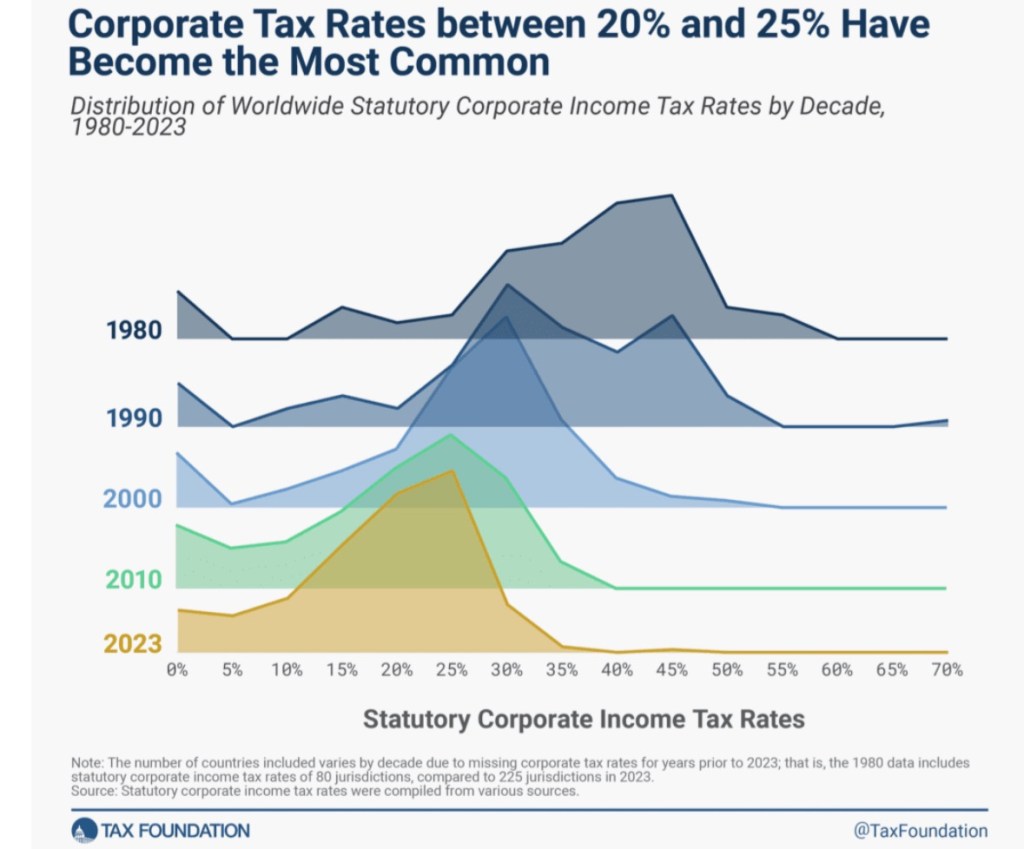
The chart at the top of this post shows that corporate statutory tax rates have trended down quite a bit over the past 40+ years. That’s a strong indicator of competition for corporate investment capital. It’s intense because governments know capital investment produces jobs, higher wages, and economic growth. U.S. corporate taxes today are competitive within the distribution, and they are below the international average. A hike to 28% would push the U.S. to a much less competitive level.

But here’s Harris’ rhetorical move: insist that the income of corporations must be taxed heavily, even punitively, for the benefit of the masses! While you’re at it, deride these greedy companies for causing inflation. The thinking is that a corporation’s shareholders will have to pay the tax. That’s who they’re after, and they can’t resist the left-populist optics!

Tax Incidence

Let’s put aside the “class struggle” premise and the political joy of bashing the rich; let’s also put aside the mistaken attribution of inflation to corporate greed. Beyond all that, Harris (and many others) makes a fundamental error in thinking that shareholders will bear the full burden of the tax. Anyone with a passing familiarity with tax incidence knows that the burden of the tax will be shared by the firm’s workers, customers, and shareholders. That’s because firms attempt to pass the tax along to consumers in higher prices and employees in lower wages.

Corporations cannot avoid tax incidence entirely. All parties (the firms, their consumers, workers, and shareholders) respond with some degree of elasticity. Ultimately, the interplay between their responses will yield a behavioral compromise whereby each of the three groups shoulders a portion of the burden.

Workers have limited mobility, but the supply of capital to a country is fairly elastic. Capital will deploy to locales where the returns net of taxes are most favorable. So capital tends to flee from jurisdictions in which it is more heavily penalized. This reduces the amount of capital available to each worker (tools, machinery, information/computing resources), ultimately leading to reduced productivity and wages.

As of 2021, even the federal government’s tax studies assumed that workers bore 20% – 25% of the burden of a corporate tax increase. However, the true labor share is likely to be higher. An abundance of research (for example, see here, here, and here) supports this conclusion. The full range of estimates runs from 15% – 100%. A number of studies suggest a range of 50% – 100%, with 70% seen as a reasonable midpoint. That means wages can be expected to decline in the wake of a corporate tax hike, and labor ultimately bears more than two-thirds of the increased corporate rate hike. With this in mind, no one should mistake Harris’ anti-corporate policy stance as labor-friendly. Quite the contrary!

Broad Economic Effects

The macroeconomic effects of the corporate tax hike are unfavorable, according to a Tax Foundation report:

“Raising the corporate income tax rate to 28 percent is the largest driver of the negative effects, reducing long-run GDP by 0.6 percent, the capital stock by 1.1 percent, wages by 0.5 percent, and full-time equivalent jobs by 125,000.“

The report’s estimates of losses for the entire Harris tax package through 2034 exclude a few provisions such as the new minimum tax on unrealized gains of high income earners. Therefore, the negative impacts are likely larger. But even without that, the losses in the report are a 2% decline in GDP, a 1.2% loss of wages, a 3% decline in the capital stock, and 786,000 fewer jobs.

Conclusion

Kamala Harris makes a great show of her desire to stick it to the rich for their “fair share.” In this case, the motives of corporations are demonized and presented as a natural vehicle through which the rich can be targeted. That effort would be worse than futile. The bulk of the incidence of the change in the corporate income tax rate would fall on workers. Even worse, the impact on jobs, the capital stock, and GDP are all likely to be negative. Rewarding workers by punishing their employers is a negative sum proposition, not a joyous thing.
Riding the DEI Weimar Curve: What’s Next on the Pogrom?

24 Friday Nov 2023

Posted by Nuetzel in anti-Semitism, DEI, fascism, Liberty

≈ Leave a comment

Tags

Adolf Hitler, anti-Semitism, Banality of Evil, Bari Weiss, C.S. Lewis, Class Struggle, Critical Theory, David Foster, DEI, Diversity, Equity, Federalist Society, Gaza, Great Depression, Hamas, Inclusion, Inner Ring, Institutionalized Racism, Jamie Kirchick, Marxism, Naziism, Oppressors, Philip Carl Salzman, Protected Groups, Reverse Discrimination, Ricochet, Social Justice, Tablet, Weimar Republic, Zero-Sum Game

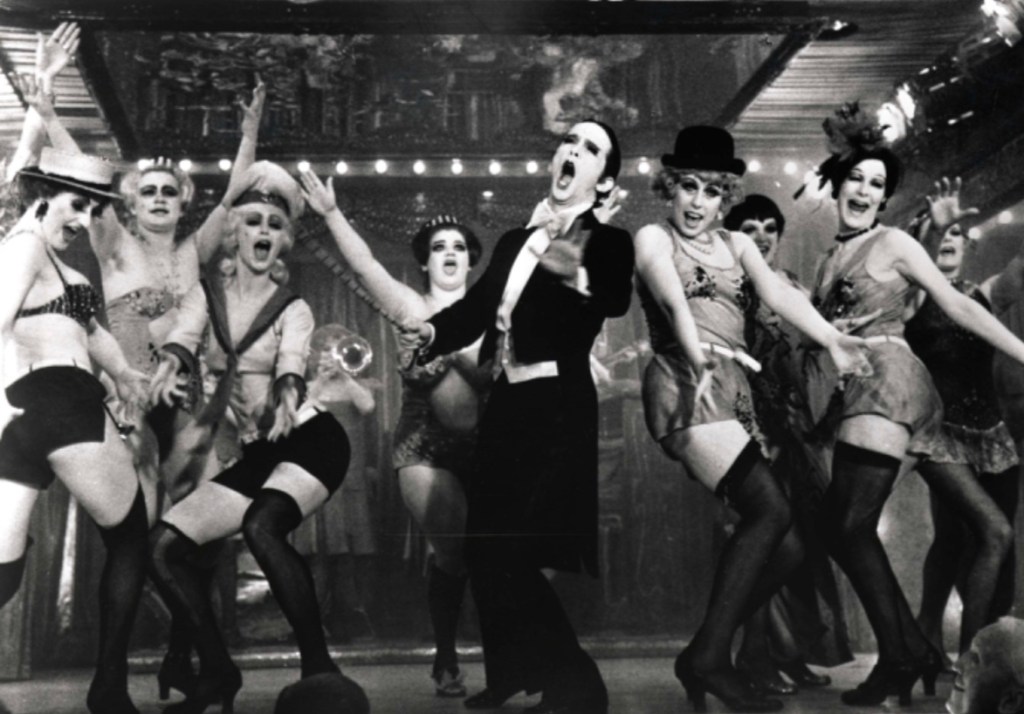
Germany’s inter-war descent into genocidal barbarism is perhaps the most horrifying episode of modern times. Seemingly normal, “nice people” in Germany were persuaded to go along with the murderous pogroms of the anti-Semitic National Socialists, giving truth to the “banality of evil”, as the famous expression goes. Of course, there were plenty of true believers, and multitudes bowed to the Nazis under fierce coercion, but many others went along just to “fit in”.

What could life have felt like in Weimar Germany in the late 1920s and early 1930s as the fascists accumulated power? Were normal people afraid? Well before Adolf Hitler’s rise to power he was known for his hatred of Jews, but German political leaders who enabled his ascent did not take his extreme prejudice as seriously as they should have, or they thought they could at least keep him and his followers in check. Surely there were people who foresaw the approaching cataclysm for what it would be.

Current expressions of anti-Semitism might give us a sense of what life was like during the decline and fall of the Weimar Republic. Just ask Jewish students at NYU and Cornell if they’ve sensed a whiff of it in the wake of Hamas’ slaughter of civilians in southern Israel on October 7th. The harassment these students have endured was motivated in part by claims that Israeli retaliation is morally inferior to the barbarities committed by Hamas, which is preposterous.

Of course, unlike late Weimar Germany, when Jews were blamed for economic (and other) problems, the Jew hatred we’re witnessing in the U.S. today has little to do with the immediate state of the economy. Conditions now are nothing like what prevailed in Germany as the Great Depression took hold, despite current inflationary stresses on real household incomes.

And yet some hold Jews in contempt for their relative economic success, a fact that is bound up with the frequency with which Jews are placed at the center of economic conspiracy theories. One would think Jews to be the ultimate “white oppressors”. But it seems that much of the current wave of anti-Semitism comes from fairly elite quarters, ensconced within major institutions where its sympathizers are insulated from day-to-day economic pressures.

And that brings us to a frightening aspect of the current malaise: how heavily institutionalized the hatred for certain groups or “classes” has already become. This owes to the blame directed toward whites, men, Jews, and Asians presumed to have been endowed with an inside track on success at the expense of others. Success of any kind, in the narrative of “critical” social justice, is “oppressive”, as if success is a zero-sum game.

Here is Philip Carl Salzman on this point:

“The ‘social justice’ political analysis is founded on the Marxist conviction that society is divided into two classes: oppressors and victims. The corresponding ‘social justice’ ethic is that victims must be raised up and celebrated and that oppressors must be suppressed and eliminated.”

This thinking has been integrated into the policies, practices and rhetoric taught in schools at all levels, corporations and nonprofits, social and traditional media, and government (including intelligence agencies and the military). This level of integration gives diversity, equity, and inclusivity (DEI) policies coercive force on behalf of so-called “protected groups”, in the parlance of anti-discrimination law. When those practices are enforced by government in various ways, the private gains extracted from “unprotected” groups amount to fascism.

Bari Weiss wrote an article in Tablet last week entitled “End DEI” in which she describes her bemused reaction as a student in the early 2000s to nascent DEI rhetoric. (Also see her recent speech to the Federalist Society here.) It’s more obvious today, but even then she recognized the hate inherent in DEI doctrine. She crystallizes the dangers she saw in DEI ideology:

“What I saw was a worldview that replaced basic ideas of good and evil with a new rubric: the powerless (good) and the powerful (bad). It replaced lots of things. Colorblindness with race-obsession. Ideas with identity. Debate with denunciation. Persuasion with public shaming. The rule of law with the fury of the mob.

“People were to be given authority in this new order not in recognition of their gifts, hard work, accomplishments, or contributions to society, but in inverse proportion to the disadvantages their group had suffered, as defined by radical ideologues. According to them, as Jamie Kirchick concisely put it in these pages: ‘Muslim > gay, Black > female, and everybody > the Jews.’”

Weiss says Jewish leaders told her, at that time, not to be hysterical, that these perverse ideas would ultimately pass like any fad. That sounds so eerily familiar. Instead, we’ve witnessed a widespread ideological takeover.

“If underrepresentation is the inevitable outcome of systemic bias, then overrepresentation—and Jews are 2% of the American population—suggests not talent or hard work, but unearned privilege. This conspiratorial conclusion is not that far removed from the hateful portrait of a small group of Jews divvying up the ill-gotten spoils of an exploited world.

“It isn’t only Jews who suffer from the suggestion that merit and excellence are dirty words. It is strivers of every race, ethnicity, and class. That is why Asian American success, for example, is suspicious. The percentages are off. The scores are too high. From whom did you steal all that success?”

The whole DEI enterprise is corrupt and unethical. It denies the meritorious in favor of those having certain superficial characteristics like the “right” skin color. That is evil and economically demented besides. It also breeds hatred that often flows both ways between classes of people, creating an incendiary environment. That we’re talking about systemic, legalized discrimination against any group is disturbing enough, but when small minorities are “othered” in this way, the potential for violent action against them is magnified. But this is just where the DEI mindset leads its proponents and beneficiaries.

Our slide into this monstrous “social justice” regime mirrors the insanity and anger that was fomented against certain “out groups” when the Nazi’s accumulated power in the latter years of the Weimar Republic. Too many today have succumbed to this zero-sum psychology, young and old alike. Fortunately, they are beginning to face some fierce resistance, but those who extol the supposed righteousness of the class struggle via DEI won’t easily give up. Our institutions are infested with their kind.

As long as influential people preach the virtues of DEI and social justice, the danger of a headlong plunge into genocidal madness is possible. And the sad truth is that normal human beings are subject to social manipulation of the most evil kind. David Foster at Ricochet: quotes an address given by C.S. Lewis in which he emphasizes this point. His words are haunting:

“Of all the passions, the passion for the Inner Ring is most skillful in making a man who is not yet a very bad man do very bad things.”

Elsewhere in Lewis’ address, he says:

“And the prophecy I make is this. To nine out of ten of you the choice which could lead to scoundrelism will come, when it does come, in no very dramatic colours. Obviously bad men, obviously threatening or bribing, will almost certainly not appear. Over a drink, or a cup of coffee, disguised as triviality and sandwiched between two jokes, from the lips of a man, or woman, whom you have recently been getting to know rather better and whom you hope to know better still—just at the moment when you are most anxious not to appear crude, or naïf or a prig—the hint will come. It will be the hint of something which the public, the ignorant, romantic public, would never understand: something which even the outsiders in your own profession are apt to make a fuss about: but something, says your new friend, which ‘we’ — and at the word ‘we’ you try not to blush for mere pleasure—something ‘we’ always do.

“And you will be drawn in, if you are drawn in, not by desire for gain or ease, but simply because at that moment, when the cup was so near your lips, you cannot bear to be thrust back again into the cold outer world. It would be so terrible to see the other man’s face—that genial, confidential, delightfully sophisticated face—turn suddenly cold and contemptuous, to know that you had been tried for the Inner Ring and rejected. And then, if you are drawn in, next week it will be something a little further from the rules, and next year something further still, but all in the jolliest, friendliest spirit. It may end in a crash, a scandal, and penal servitude; it may end in millions, a peerage and giving the prizes at your old school. But you will be a scoundrel.”

The Dubious 1917 Redemption of Karl Marx

27 Sunday Nov 2022

Posted by Nuetzel in Marxism

≈ Leave a comment

Tags

Bolsheviks, Class Struggle, Das Kapital, Das Karl Marx Problem, Fidel Castro, Google Ngram, John Maynard Keynes, Josef Stalin, Karl Marx, Labor Theory of Value, Lenin, Marxism, Michael Makovi, Phil Magness, Philip Hobsbawm, Pol Pot, Workers’ Paradise

Karl Marx has long been celebrated by the Left as a great intellectual, but the truth is that his legacy was destined to be of little significance until his writings were lauded, decades later, by the Bolsheviks during their savage October 1917 revolution in Russia. Vladimir Lenin and his murderous cadre promoted Marx and brought his ideas into prominence as political theory. That’s the conclusion of a fascinating article by Phil Magness and Michael Makovi (M&M) appearing in the Journal of Political Economy. The title: “The Mainstreaming of Marx: Measuring the Effect of the Russian Revolution on Karl Marx’s Influence“.

The idea that the early Soviet state and other brutal regimes in its mold were the main progenitors of Marxism is horrifying to its adherents today. That’s the embarrassing historical reality, however. It’s not really clear that Marx himself would have endorsed those regimes, though I hesitate to cut him too much slack.

A lengthy summary of the M&M paper is given by the authors in “Das Karl Marx Problem”. The “problem”, as M&M describe it, is in reconciling 1) the nearly complete and well-justified rejection of Marx’s economic theories during his life and in the 34 years after his death, with 2) the esteem in which he’s held today by so many so-called intellectuals. A key piece of the puzzle, noted by the authors, is that praise for Marx comes mainly from outside the economics profession. The vast majority of economists today recognize that Marx’s labor theory of value is incoherent as an explanation of the value created in production and exchange.

The theoretical rigors might be lost on many outside the profession, but a moments reflection should be adequate for almost anyone to realize that value is contributed by both labor and non-labor inputs to production. Of course, it might have dawned on communists over the years that mass graves can be dug more “efficiently” by combining labor with physical capital. On the other hand, you can bet they never paid market prices for any of the inputs to that grisly enterprise.

Marx never thought in terms of decisions made at the margin, the hallmark of the rational economic actor. That shortcoming in his framework led to mistaken conclusions. Second, and again, this should be obvious, prices of goods must incorporate (and reward) the value contributed by all inputs to production. That value ultimately depends on the judgement of buyers, but Marx’s theory left him unable to square the circle on all this. And not for lack of trying! It was a failed exercise, and M&M provide several pieces of testimony to that effect. Here’s one example:

“By the time Lenin came along in 1917, Marx’s economic theories were already considered outdated and impractical. No less a source than John Maynard Keynes would deem Marx’s Capital ‘an obsolete economic textbook . . . without interest or application for the modern world’ in a 1925 essay.”

Marxism, with its notion of a “workers’ paradise”, gets credit from intellectuals as a highly utopian form of socialism. In reality, it’s implementation usually takes the form of communism. The claim that Marxism is “scientific” socialism (despite the faulty science underlying Marx’s theories) is even more dangerous, because it offers a further rationale for authoritarian rule. A realistic transition to any sort of Marxist state necessarily involves massive expropriations of property and liberty. Violent resistance should be expected, but watch the carnage when the revolutionaries gain the upper hand.

What M&M demonstrate empirically is how lightly Marx was cited or mentioned in printed material up until 1917, both in English and German. Using Google’s Ngram tool, they follow a group of thinkers whose Ngram patterns were similar to Marx’s up to 1917. They use those records to construct an expected trajectory for Marx for 1917 forward and find an aberrant jump for Marx at that time, again both in English and in German material. But Ngram excludes newspaper mentions, so they also construct a database from Newspapers.com and their findings are the same: newspaper references to Marx spiked after 1917. There was nothing much different when the sample was confined to socialist writers, though M&M acknowledge that there were a couple of times prior to 1917 during which short-lived jumps in Marx citations occurred among socialists.

To be clear, however, Marx wasn’t unknown to economists during the 3+ decades following his death. His name was mentioned here and there in the writings of prominent economists of the day — just not in especially glowing terms.

“… absent the events of 1917, Marx would have continued to be an object of niche scholarly inquiry and radical labor activism. He likely would have continued to compete for attention in those same radical circles as the main thinker of one of its many factions. After the Soviet boost to Marx, he effectively crowded the other claimants out of [the] socialist-world.”

Magness has acknowledged that he and Makovi aren’t the first to have noticed the boost given to Marx by the Bolsheviks. Here, Magness quotes Eric Hobsbawm’s take on the subject:

“This situation changed after the October Revolution – at all events, in the Communist Parties. … Following Lenin, all leaders were now supposed to be important theorists, since all political decisions were justified on grounds of Marxist analysis – or, more probably, by reference to textual authority of the ‘classics’: Marx, Engels, Lenin, and, in due course, Stalin. The publication and popular distribution of Marx’s and Engels’s texts therefore become far more central to the movement than they had been in the days of the Second International [1889 – 1914].”

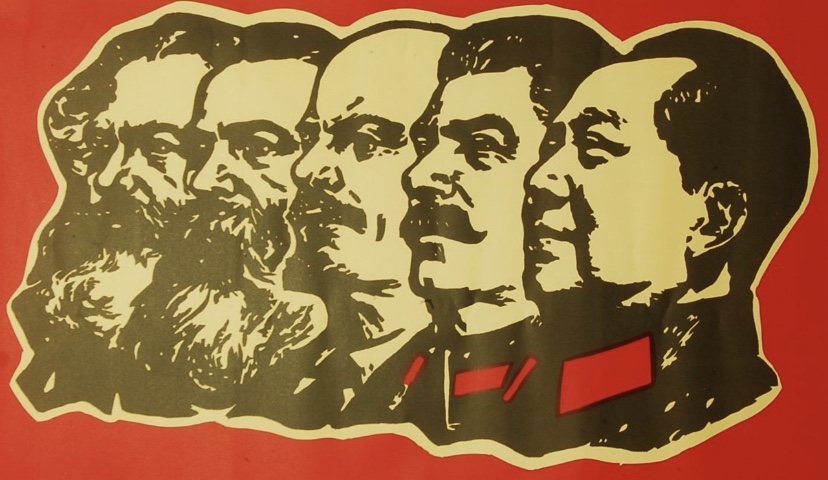
Much to the chagrin of our latter day Marxists and socialists, it was the advent of the monstrous Soviet regime that led to Marx’s “mainstream” ascendency. Other brutal regimes arising later reinforced Marx’s stature. The tyrants listed by M&M include Joseph Stalin, Mao Zedong, Fidel Castro, and Pol Pot, and they might have added several short-lived authoritarian regimes in Africa as well. Today’s Marxists continue to assure us that those cases are not representative of a Marxist state.

Perhaps it’s fair to say that Marx’s name was co-opted by thugs, but I posit something a little more consistent with the facts: it’s difficult to expropriate the “means of production” without a fight. Success requires massive takings of liberty and property. This is facilitated by means of a “class struggle” between social or economic strata, or it might reflect divisions based on other differences. Either way, groups are pitted against one another. As a consequence, we witness an “othering” of opponents on one basis or another. Marxists, no matter how “pure of heart”, find it impossible to take power without demanding ideological purity. Invariably, this requires “reeducation”, cleansing, and ultimately extermination of opponents.

Karl Marx had unsound ideas about how economic value manifests and where it should flow, and he used those ideas to describe what he thought was a more just form of social organization. The shortcomings of his theory were recognized within the economics profession of the day, and his writings might have lived on in relative obscurity were it not for the Bolshevik’s intellectual pretensions. Surely obscurity would have been better than a legacy shaped by butchers.

Socialist Supremacy’s Dark History of Culling the Race

26 Wednesday Feb 2020

Posted by Nuetzel in racism, Socialism

≈ Leave a comment

Tags

Adolph Hitler, Che Guevara, Class Struggle, Disparate impact, FEE, Fidel Castro, Foundation for Economic Education, Friedrich Engels, Joseph Stalin, Karl Marx, Liberalism Unrelinquished, Marion Tupy, National Socialism, racism, Sidney and Beatrice Webb, Socialism

Can you think of a social philosophy steeped in many years of blame-making and hatred for “others”, including massive persecution, more than a passing flirtation with racism, and genocide. Why, that would be socialism! Marion Tupy’s 2017 article on racism and socialism at the Foundation for Economic Education (FEE) blog is a good reminder, just in case you know anyone having a romantic fascination with collectivist ideology. I know too many! And if they subscribe to the notion that socialism eschews racism, they are sadly mistaken. In fact, to put it kindly, socialists ultimately eschew anyone standing in their way. Here are a few excerpts from Tupy’s article:

“… Sidney and Beatrice Webb, who were both socialists and eugenicists, bemoaned the falling birthrates among so-called higher races in the New Statesman in 1913. They warned that ‘a new social order [would be] developed by one or other of the colored races, the Negro, the Kaffir or the Chinese’.

Che Guevara, the Argentine revolutionary and friend of the Cuban dictator Fidel Castro, offered his views on race in his 1952 memoir The Motorcycle Diaries, writing, ‘The Negro is indolent and lazy and spends his money on frivolities, whereas the European is forward-looking, organized and intelligent.’ …

In the New York Tribune in 1853, Karl Marx came close to advocating genocide, writing, “The classes and the races, too weak to master the new conditions of life, must give way.” His friend and collaborator, Engels, was more explicit.

In 1849, Engels published an article in Marx’s newspaper, Neue Rheinische Zeitung. In it, Engels condemned the rural populations of the Austrian Empire for failing enthusiastically to partake in the revolution of 1848. …

‘The Austrian Germans and Magyars will be set free and wreak a bloody revenge on the Slav barbarians,’ he continued. ‘The next world war will result in the disappearance from the face of the earth not only of reactionary classes and dynasties, but also of entire reactionary peoples. And that, too, is a step forward.’

Here Engels clearly foreshadows the genocides of the 20th-century totalitarianism in general and the Soviet regime in particular. In fact, Joseph Stalin loved Engels’ article and commended it to his followers in The Foundations of Leninism in 1924. He then proceeded to suppress Soviet ethnic minorities, including the Jews, Crimean Tatars, and Ukrainians.”

As Tupy notes, socialists are given to dressing-up their repressions as “class struggles”, as opposed to racism when it suits them, ideological eliminationism, and genocidal paroxysm. And these fits have often had pronounced “disparate impacts” on ethnic, racial and national minorities. In this sense, Hitler, the national socialist was no exception. Again, from Tupy:

“Hitler’s hatred of the Jews, for example, was partly rooted in his belief that capitalism and international Jewry were two sides of the same coin. As he once famously asked, ‘How, as a socialist, can you not be an anti-Semite?'”

Socialism is not an ideology of “kindness”. As a practical matter, it is an ideology of coercion, control, and extreme inequality of outcomes. It is antithetical to the ideal of personal liberty, not “liberal” in any real sense of the word. It should come as no surprise that the practitioners of socialism have indulged in virulent intolerance and racism. And it’s not simply a matter of “my way or the highway”. It’s often my way or death for those who don’t fall in line, and a highway to hell on earth for those who do.

Follow Sacred Cow Chips on WordPress.com

Recent Posts

  • Immigration and Merit As Fiscal Propositions
  • Tariff “Dividend” From An Indigent State
  • Almost Looks Like the Fed Has a 3% Inflation Target
  • Government Malpractice Breeds Health Care Havoc
  • A Tax On Imports Takes a Toll on Exports

Archives

  • December 2025
  • November 2025
  • October 2025
  • September 2025
  • August 2025
  • July 2025
  • June 2025
  • May 2025
  • April 2025
  • March 2025
  • February 2025
  • January 2025
  • December 2024
  • November 2024
  • October 2024
  • September 2024
  • August 2024
  • July 2024
  • June 2024
  • May 2024
  • April 2024
  • March 2024
  • February 2024
  • January 2024
  • December 2023
  • November 2023
  • August 2023
  • July 2023
  • June 2023
  • May 2023
  • April 2023
  • March 2023
  • February 2023
  • January 2023
  • December 2022
  • November 2022
  • October 2022
  • September 2022
  • August 2022
  • July 2022
  • June 2022
  • May 2022
  • April 2022
  • March 2022
  • February 2022
  • January 2022
  • December 2021
  • November 2021
  • October 2021
  • September 2021
  • August 2021
  • July 2021
  • June 2021
  • May 2021
  • April 2021
  • March 2021
  • February 2021
  • January 2021
  • December 2020
  • November 2020
  • October 2020
  • September 2020
  • August 2020
  • July 2020
  • June 2020
  • May 2020
  • April 2020
  • March 2020
  • February 2020
  • January 2020
  • December 2019
  • November 2019
  • October 2019
  • September 2019
  • August 2019
  • July 2019
  • June 2019
  • May 2019
  • April 2019
  • March 2019
  • February 2019
  • January 2019
  • December 2018
  • November 2018
  • October 2018
  • September 2018
  • August 2018
  • July 2018
  • June 2018
  • May 2018
  • April 2018
  • March 2018
  • February 2018
  • January 2018
  • December 2017
  • November 2017
  • October 2017
  • September 2017
  • August 2017
  • July 2017
  • June 2017
  • May 2017
  • April 2017
  • March 2017
  • February 2017
  • January 2017
  • December 2016
  • November 2016
  • October 2016
  • September 2016
  • August 2016
  • July 2016
  • June 2016
  • May 2016
  • April 2016
  • March 2016
  • February 2016
  • January 2016
  • December 2015
  • November 2015
  • October 2015
  • September 2015
  • August 2015
  • July 2015
  • June 2015
  • May 2015
  • April 2015
  • March 2015
  • February 2015
  • January 2015
  • December 2014
  • November 2014
  • October 2014
  • September 2014
  • August 2014
  • July 2014
  • June 2014
  • May 2014
  • April 2014
  • March 2014

Blogs I Follow

  • Passive Income Kickstart
  • OnlyFinance.net
  • TLC Cholesterol
  • Nintil
  • kendunning.net
  • DCWhispers.com
  • Hoong-Wai in the UK
  • Marginal REVOLUTION
  • Stlouis
  • Watts Up With That?
  • Aussie Nationalist Blog
  • American Elephants
  • The View from Alexandria
  • The Gymnasium
  • A Force for Good
  • Notes On Liberty
  • troymo
  • SUNDAY BLOG Stephanie Sievers
  • Miss Lou Acquiring Lore
  • Your Well Wisher Program
  • Objectivism In Depth
  • RobotEnomics
  • Orderstatistic
  • Paradigm Library
  • Scattered Showers and Quicksand

Blog at WordPress.com.

Passive Income Kickstart

OnlyFinance.net

TLC Cholesterol

Nintil

To estimate, compare, distinguish, discuss, and trace to its principal sources everything

kendunning.net

The Future is Ours to Create

DCWhispers.com

Hoong-Wai in the UK

A Commonwealth immigrant's perspective on the UK's public arena.

Marginal REVOLUTION

Small Steps Toward A Much Better World

Stlouis

Watts Up With That?

The world's most viewed site on global warming and climate change

Aussie Nationalist Blog

Commentary from a Paleoconservative and Nationalist perspective

American Elephants

Defending Life, Liberty and the Pursuit of Happiness

The View from Alexandria

In advanced civilizations the period loosely called Alexandrian is usually associated with flexible morals, perfunctory religion, populist standards and cosmopolitan tastes, feminism, exotic cults, and the rapid turnover of high and low fads---in short, a falling away (which is all that decadence means) from the strictness of traditional rules, embodied in character and inforced from within. -- Jacques Barzun

The Gymnasium

A place for reason, politics, economics, and faith steeped in the classical liberal tradition

A Force for Good

How economics, morality, and markets combine

Notes On Liberty

Spontaneous thoughts on a humble creed

troymo

SUNDAY BLOG Stephanie Sievers

Escaping the everyday life with photographs from my travels

Miss Lou Acquiring Lore

Gallery of Life...

Your Well Wisher Program

Attempt to solve commonly known problems…

Objectivism In Depth

Exploring Ayn Rand's revolutionary philosophy.

RobotEnomics

(A)n (I)ntelligent Future

Orderstatistic

Economics, chess and anything else on my mind.

Paradigm Library

OODA Looping

Scattered Showers and Quicksand

Musings on science, investing, finance, economics, politics, and probably fly fishing.

  • Subscribe Subscribed
    • Sacred Cow Chips
    • Join 128 other subscribers
    • Already have a WordPress.com account? Log in now.
    • Sacred Cow Chips
    • Subscribe Subscribed
    • Sign up
    • Log in
    • Report this content
    • View site in Reader
    • Manage subscriptions
    • Collapse this bar
 

Loading Comments...