• About

Sacred Cow Chips

Sacred Cow Chips

Tag Archives: Free Markets

Green Hubris: The Flub of Rome

21 Sunday Jun 2015

Posted by Nuetzel in Global Warming

≈ 1 Comment

Tags

Brendan O'Neil, Club of Rome, Fr. Robert Sirico, Free Markets, Green Theology, IPCC, John Hinderaker, Limits to Growth, Matt Ridley, Papal encyclical, Patrick J. Michaels, Politics of Science, Prometheus, Thomas Malthus, Tim Ball

paleo hubris

The Papal Encyclical published last week has generated controversy for venturing into areas about which Pope Francis, and for that matter the Catholic Church, has absolutely no authority or expertise. Pope Francis has noble aims. His compassion for the poor is admirable and even poignant. Nevertheless, the Pope errs in his assessment of scientific, technological and economic issues, and he fails to reference or consider mountains of evidence that contradict the views that dominate this encyclical. It should come as no surprise that he has been swept along by the Leftist orthodoxy, of which he has long been a part.

On one hand, Pope Francis expresses a viewpoint that is almost universally shared: that we are stewards of the natural world and have a moral obligation to treat it well for the benefit of others now and in the future. However, he also believes in the unproven proposition of anthropomorphic global warming (AGW), that human activities are causing global temperatures to rise inexorably. He takes the questionable view that ongoing technological advances will benefit only the rich, leaving the poor behind in increasingly desperate circumstances. And he recklessly questions the morality of free markets and capitalism, asserting that they benefit only the rich and work against the interests of the broader masses.

One of the most interesting pieces of commentary on the Encyclical appeared in The Wall Street Journal, entitled “The Pope’s Green Theology“, written by Fr. Robert Sirico, a Catholic priest. (If the link doesn’t work, Google “wsj Sirico Green Theology”.)

“… capitalism has spurred the greatest reduction in global poverty in world history: The number of people living on $1.25 a day fell to 375 million in 2013 from 811 million in 1991, according to the International Labor Office. This is only one statistic among reams of evidence that vindicate capitalism. An honest debate among experts will lay this canard to rest.

The encyclical unwisely concedes too much to the secular environmental agenda, for example, by denigrating fossil fuels. But it also voices moral statements dismissing popular, ill-conceived positions. The repeated lie that overpopulation is harming the planet—expressed by even some of the advisers for the Vatican—is soundly rejected.“

Much of the evidence on global temperatures contradicts the Pope’s position, yet he sides with the groupthink of the environmental Left based on model predictions that have been consistently wrong over several decades. The models have drastically over-predicted global temperature trends, even before the “pause” in warming that began in the late 1990s.

It is rather early in the game for the Catholic Church to take such an unequivocal position on an issue as far afield from matters of religious faith as climate science. As Dr. Tim Ball notes, the Catholic Church has not always bet well on science, going back to its denunciation of Galileo almost 400 years ago. Apparently, any lessons learned from that episode about the process of scientific inquiry have been forgotten. Matt Ridley has a great (if lengthy) essay on the politics of science and the damage that politicized climate science has done to the cause of real understanding:

“Expertise, authority and leadership should count for nothing in science. The great Thomas Henry Huxley put it this way: ‘The improver of natural knowledge absolutely refuses to acknowledge authority, as such. For him, scepticism is the highest of duties; blind faith the one unpardonable sin.’ Richard Feynman was even pithier: ‘Science is the belief in the ignorance of experts.’”

Climate science is really in its infancy. Recorded history of the climate is in its infancy as well. The scant evidence of global warming during the 20th century is well within the range of natural variation estimated for the past 8,000 years, according to a study by a former lead author for the Intergovernmental Panel On Climate Change (IPCC). For the Pope, or anyone else, to make strong claims about “the science”, or to prescribe draconian limits on individual liberty in an effort to plan “the climate”, is hubris of the first order. That’s ironic given the Pope’s condemnation of what he characterizes as mankind’s Promethean hubris, as if making the world more livable was sinful. The Encyclical condemns technological progress, going so far as to denigrate the use of air conditioning. That attitude is driven by objections to energy use; nevertheless, the Pope reveals a deep mistrust of technology and betrays the soul of a Luddite.

Patrick J. Michaels of CATO’s Center for the Study of Science wrote about the Pope’s climate views and the morality of “dense energy” in April:

“Abundant and dependable energy frees mankind from a menial existence, allowing us to use our given talents for the greater good. The mental capital of the poor in the underdeveloped world is untapped without dense energy. The burning of dung for cooking is a major cause of early death from pulmonary disease. The massive deforestation that must occur without dense energy amplifies floods from ubiquitous tropical downpours.“

Here is a link to some very sarcastic commentary from Brendan O’Neil at Reason on the Pope’s “Dotty Green Theology“. O’Neil mentions the tyrannical fantasies dancing in the minds of some on the environmental Left:

“Christianity’s end-of-worldism is getting a new airing in the apocalypse obsession of greens, who warn of an eco-unfriendly End of Days. Its promise of Godly judgement for our wicked ways has been replaced by greens’ promise that we’ll one day be judged for our planetary destructiveness. A leading British green has fantasised about ‘international criminal tribunals’ for climate-change deniers, who will be ‘partially but directly responsible for millions of deaths.'”

Let’s hope the Pope isn’t on board with that, though he did propose that a worldwide governing body take charge of environmental issues. Please, no favors! John Hinderaker, in the context of the Encyclical, discusses the regressive impact of policies that raise energy prices. That’s consistent with the Pope’s green objectives. Hinderaker cites figures showing that those earning less than $30,000 per year in the U.S. spend 23% of their after-tax income on energy, compared to just 7% for those earning $50,000 or more.

It is extremely late in the game for the Pope to inveigh against capitalism, with all evidence pointing to the long-term success of free markets in lifting the poor from the depths of privation. In fact, the Encyclical is strongly reminiscent of the Malthusian “Limits to Growth” published by the Club of Rome. That “study” contained what has proven to be among the worst collections of prognostications of all time, and the Club persists in purveying doom and gloom to this day.

I have written before on Sacred Cow Chips about Pope Francis’ statist, anti-market inclinations. From that post:

“… it is not just the secular Left that fails to recognize the inherent conflict between big government and religious liberty. Pope Francis himself seems oblivious to the dangerous implications of big government for religious freedom. His apostolic exhortation for greater reliance on the state to care for the poor simultaneously embraces socialism and condemns capitalism. I take no issue in principle with the provision of a social safety net, but the Pope should be more results-oriented in assessing different forms of social organization and their impacts on poverty. Big government typically fails to achieve the kinds of humane objectives usually espoused by the Left. The sad ‘road to serfdom’ has played out too many times in the past.“

Progressives Identify Twin Evils: Progress and People

20 Monday Apr 2015

Posted by Nuetzel in Human Welfare

≈ Leave a comment

Tags

Big Coffee Table Book of Doom, Depopulation, Dismal Science, Don Beaudreaux, Fixed Supply, Free Markets, Infinite Resource, Kevin Williamson, Overdevelopment, Overpopulation, Overshoot, Ramez Naam, Reason, Ron Bailey, Scarcity, Thomas Malthus

doom and gloom

“The Big Coffee Table Book of Doom” is an entertaining review of an actual coffee table book entitled “Overdevelopment Overpopulation Overshoot“, which appeals to the progressive Left’s neo-Malthusian mindset. I am almost tempted to buy this book for my coffee table as fodder for my own amusement, sort of like the board game “Class Struggle” I bought for laughs when I was in grad school. The review, written by Ron Bailey in Reason, pokes fun at the selection of photos in the book, which are chosen to reinforce such fables as over-population, climate change and the supposed evils of capitalism. Of course, this sort of nonsense will never die, primarily because people love a good scare story and because it aligns with the privileged Left’s sense of righteousness and noblesse oblige. Bailey highlights several actual trends that contradict the doomsday narrative:

“Agricultural productivity per acre is improving faster than the demand for food; as a result, fewer acres are needed to grow crops. These trends suggest that as much as 400 million hectares could be restored to nature by 2060, an area nearly double the size of the United States east of the Mississippi River.“

“… the total global fertility rate has fallen from over 5 children per woman in 1970 to 2.45 today, rapidly approaching the 2.1 rate that is the threshold of population stability.“

And on the “perils” of urbanization:

“Urban dwellers have greater access to education, market opportunities, and medicine, and they have fewer kids.“

As Kevin Williamson has pointed out, an egregious distortion of the neo-Malthusian perspective is an attitude that human beings are liabilities rather than assets. This is underscored by the recent comments of a UN official calling for depopulation as a serious objective. One wonders how she might propose to attain that objective. Can the eliminationists be far behind? In rebuttal to such thinking, Bailey quotes Ramez Naam, author of “Infinite Resource“:

“‘Would your life be better off if only half as many people had lived before you?’ In this thought experiment, you don’t get to pick which people are never born. Perhaps there would have been no Newton, Edison, or Pasteur, no Socrates, Shakespeare, or Jefferson. ‘Each additional idea is a gift to the future,’ Naam writes. ‘Each additional idea producer is a source of wealth for future generations.’ Fewer people means fewer new ideas about how to improve humanity’s lot and to further decouple our endeavors from the natural world. ‘If we fix our economic system and invest in the human capital of the poor,’ Naam writes, ‘then we should welcome every new person born as a source of betterment for our world and all of us on it.'”

Population growth has traditionally been a source of economic growth and enhanced welfare, and that is likely to remain the case. I do not claim that population growth will always be an imperative. Rather, fertility decisions are properly the business of families and individuals, not central authorities or public policy, which should take a neutral stance with respect to these decisions.

Malthusian doom is related to the economic law of scarcity, but it is not a direct implication of that law: scarcity means that resource availability is limited relative to potentially limitless demand. The law of scarcity does not assert that there are absolute limits to raw materials or production in the long run, only that human wants, if unrestrained, will always exceed available supplies. There are many ways in which supplies of resources increase over time. Exploration reveals new supplies and technology makes new supplies accessible at lower cost. More fundamentally, growth in the productivity of utilized resources causes effective economic supplies to grow. This is illustrated in Don Beaudreaux’s recent essay on the productivity of land (and see a follow-ups on the topic here):

“The economic supply of land, like that of any other resources you can name, is not a physical phenomenon. As long as people are free and inspired to innovate – and as long as input and output prices are free to adjust to changes in supply and demand – the economic supplies of even the most ‘fixed’ and ‘nonrenewable’ resources will expand.“

Prognostications of doom for humanity appeal to the ignorance of those with no perspective on the mechanisms by which well-being has improved in the developed world over the past few centuries. This has occurred largely by virtue of human ingenuity and free markets. The growth has also enabled greatly improved environmental conditions. The developing world will share in the prosperity only when those governments embrace real market liberalization.

Human Achievement, Comfort and Joy

28 Saturday Mar 2015

Posted by Nuetzel in Human Welfare

≈ 1 Comment

Tags

Alex Epstein, Competitive Enterprise Institute, Earth Hour, Fossil fuels, Free Markets, Human Achievement Hour, International Dateline, Matt Ridley, Ronald Bailey, The Rational Optimist, Tonga

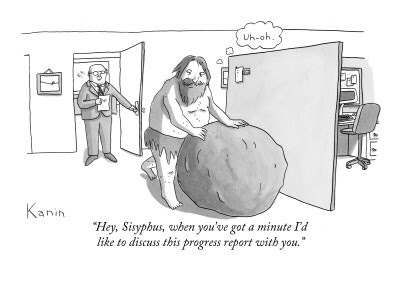
sisyphus-when-you-ve-got-a-minute

2015’s Human Achievement Hour (HAH) starts at 8:30 p.m. on Saturday, March 28. That’s tomorrow night! It starts at 8:30  p.m. in every time zone, so it’s a rolling celebration. But you can celebrate human achievement for a full 24 hours, starting Saturday at about 2:30 a.m. Central Daylight Time, when it will be 8:30 p.m. Saturday in Tonga, just over the international date line. It’s coming up soon! This will be my third year of celebrating HAH. To mark the occasion I just might start celebrating with the Tongans. Here is the Facebook event page for HAH. The Competitive Enterprise Institute is the sponsor of HAH. Here is the first part of their description, followed by their suggestion for how to celebrate.

“Observing Human Achievement Hour is about paying tribute to the human innovations that have allowed people around the globe to live better, fuller lives, while also defending the basic human right to use energy to improve the quality of life of all people.” “In order to celebrate with CEI and friends worldwide, we invite you to enjoy the benefits of energy, capitalism, and human innovation by utilizing your favorite innovation or human advancement…“

Once again this year, I will illuminate every lightbulb in my home to pay homage to the wonder of widely distributed electricity and the tremendous benefits derived from our ability to harness the power of fossil fuels. In a review of Alex Epstein’s The Moral Case for Fossil Fuels, Ronald Bailey of Reason says:

“As humanity burned more fossil fuels and increased carbon dioxide in the atmosphere, human lives dramatically improved. ‘Weather, climate, and climate change matter—but not nearly as much as they used to, thanks to technology,’ Epstein writes. For example, the death rate from extreme weather events has dropped 98 percent since 1920. Indeed, the chief benefit of burning fossil fuels has been longer and healthier human lives. The central idea of Epstein’s book is that ‘more energy means more ability to improve our lives; less energy mean less ability—more helplessness, more suffering, and more death.’“

Matt Ridley adds his thoughts on the benefits of fossil fuels at The Rational Optimist blog. Both Ridley and Bailey are confident that humans will one day achieve such efficiencies in the production of energy from renewable sources as to be competitive with fossil fuels. That will be worth celebrating. We are not there yet, however, and we do ourselves no favor in attempting to restrict fossil fuel consumption in the meantime. In fact, the risks of anthropomorphic global warming are far less severe than climate activists insist. Moreover, a warmer climate would not be unambiguously bad for people.

It is no accident that HAH is scheduled to coincide with Earth Hour, a “celebration” that stands in stark contrast to HAH in its antipathy for free market institutions and its condemnation of humankind’s relatively recent success in adapting to our planet’s environment. But there is no doubt that our progress in reducing poverty has hinged on the complementary nature of human ingenuity and the free market, the latter being a fairly recent (on historical scales) and most powerful innovation for promoting voluntary human cooperation and enrichment. Here is a recent Ridley post in which he elaborates on reasons for continued optimism. A quote:

“For 200 years, pessimists have had all the headlines-even though optimists have far more often been right. There is immense vested interest in pessimism. No charity ever raised money by saying things are getting better. No journalist ever got the front page writing a story about how disaster was now less likely. Pressure groups and their customers in the media search even the most cheerful statistics for glimmers of doom. Don’t be browbeaten-dare to be an optimist!“

Let’s celebrate for the right reasons. The flourishing of human welfare in the face of a harsh natural environment is real achievement.

Newer posts →
Follow Sacred Cow Chips on WordPress.com

Recent Posts

  • A Warsh Policy Scenario At the Federal Reserve
  • The Coexistence of Labor and AI-Augmented Capital
  • The Case Against Interest On Reserves
  • Immigration and Merit As Fiscal Propositions
  • Tariff “Dividend” From An Indigent State

Archives

  • February 2026
  • January 2026
  • December 2025
  • November 2025
  • October 2025
  • September 2025
  • August 2025
  • July 2025
  • June 2025
  • May 2025
  • April 2025
  • March 2025
  • February 2025
  • January 2025
  • December 2024
  • November 2024
  • October 2024
  • September 2024
  • August 2024
  • July 2024
  • June 2024
  • May 2024
  • April 2024
  • March 2024
  • February 2024
  • January 2024
  • December 2023
  • November 2023
  • August 2023
  • July 2023
  • June 2023
  • May 2023
  • April 2023
  • March 2023
  • February 2023
  • January 2023
  • December 2022
  • November 2022
  • October 2022
  • September 2022
  • August 2022
  • July 2022
  • June 2022
  • May 2022
  • April 2022
  • March 2022
  • February 2022
  • January 2022
  • December 2021
  • November 2021
  • October 2021
  • September 2021
  • August 2021
  • July 2021
  • June 2021
  • May 2021
  • April 2021
  • March 2021
  • February 2021
  • January 2021
  • December 2020
  • November 2020
  • October 2020
  • September 2020
  • August 2020
  • July 2020
  • June 2020
  • May 2020
  • April 2020
  • March 2020
  • February 2020
  • January 2020
  • December 2019
  • November 2019
  • October 2019
  • September 2019
  • August 2019
  • July 2019
  • June 2019
  • May 2019
  • April 2019
  • March 2019
  • February 2019
  • January 2019
  • December 2018
  • November 2018
  • October 2018
  • September 2018
  • August 2018
  • July 2018
  • June 2018
  • May 2018
  • April 2018
  • March 2018
  • February 2018
  • January 2018
  • December 2017
  • November 2017
  • October 2017
  • September 2017
  • August 2017
  • July 2017
  • June 2017
  • May 2017
  • April 2017
  • March 2017
  • February 2017
  • January 2017
  • December 2016
  • November 2016
  • October 2016
  • September 2016
  • August 2016
  • July 2016
  • June 2016
  • May 2016
  • April 2016
  • March 2016
  • February 2016
  • January 2016
  • December 2015
  • November 2015
  • October 2015
  • September 2015
  • August 2015
  • July 2015
  • June 2015
  • May 2015
  • April 2015
  • March 2015
  • February 2015
  • January 2015
  • December 2014
  • November 2014
  • October 2014
  • September 2014
  • August 2014
  • July 2014
  • June 2014
  • May 2014
  • April 2014
  • March 2014

Blogs I Follow

  • Passive Income Kickstart
  • OnlyFinance.net
  • TLC Cholesterol
  • Nintil
  • kendunning.net
  • DCWhispers.com
  • Hoong-Wai in the UK
  • Marginal REVOLUTION
  • Stlouis
  • Watts Up With That?
  • Aussie Nationalist Blog
  • American Elephants
  • The View from Alexandria
  • The Gymnasium
  • A Force for Good
  • Notes On Liberty
  • troymo
  • SUNDAY BLOG Stephanie Sievers
  • Miss Lou Acquiring Lore
  • Your Well Wisher Program
  • Objectivism In Depth
  • RobotEnomics
  • Orderstatistic
  • Paradigm Library
  • Scattered Showers and Quicksand

Blog at WordPress.com.

Passive Income Kickstart

OnlyFinance.net

TLC Cholesterol

Nintil

To estimate, compare, distinguish, discuss, and trace to its principal sources everything

kendunning.net

The Future is Ours to Create

DCWhispers.com

Hoong-Wai in the UK

A Commonwealth immigrant's perspective on the UK's public arena.

Marginal REVOLUTION

Small Steps Toward A Much Better World

Stlouis

Watts Up With That?

The world's most viewed site on global warming and climate change

Aussie Nationalist Blog

Commentary from a Paleoconservative and Nationalist perspective

American Elephants

Defending Life, Liberty and the Pursuit of Happiness

The View from Alexandria

In advanced civilizations the period loosely called Alexandrian is usually associated with flexible morals, perfunctory religion, populist standards and cosmopolitan tastes, feminism, exotic cults, and the rapid turnover of high and low fads---in short, a falling away (which is all that decadence means) from the strictness of traditional rules, embodied in character and inforced from within. -- Jacques Barzun

The Gymnasium

A place for reason, politics, economics, and faith steeped in the classical liberal tradition

A Force for Good

How economics, morality, and markets combine

Notes On Liberty

Spontaneous thoughts on a humble creed

troymo

SUNDAY BLOG Stephanie Sievers

Escaping the everyday life with photographs from my travels

Miss Lou Acquiring Lore

Gallery of Life...

Your Well Wisher Program

Attempt to solve commonly known problems…

Objectivism In Depth

Exploring Ayn Rand's revolutionary philosophy.

RobotEnomics

(A)n (I)ntelligent Future

Orderstatistic

Economics, chess and anything else on my mind.

Paradigm Library

OODA Looping

Scattered Showers and Quicksand

Musings on science, investing, finance, economics, politics, and probably fly fishing.

  • Subscribe Subscribed
    • Sacred Cow Chips
    • Join 128 other subscribers
    • Already have a WordPress.com account? Log in now.
    • Sacred Cow Chips
    • Subscribe Subscribed
    • Sign up
    • Log in
    • Report this content
    • View site in Reader
    • Manage subscriptions
    • Collapse this bar
 

Loading Comments...