• About

Sacred Cow Chips

Sacred Cow Chips

Tag Archives: Jeffrey Singer

Statists Might Like To Vaccinate Against Many Things

25 Monday Nov 2019

Posted by Nuetzel in Vaccinations

≈ Leave a comment

Tags

Anti-Vaxxers, Community Protection Threshold, Contagion, Contra-Indications, Externality, Federaalism, Herd Immunity, Immunization, Jeffrey Singer, Lancet, Measles, Mercury, Michigan Vaccine Law, Post Hoc Ergo Propter Hoc, Precautionary Principle, Price Discrimination, Private Governance, Vaccine Hesitancy, Vaccine Preservatives, Vaccine Resistors, Whooping Cough
The vaccine debate illustrates a widespread misunderstanding about the meaning of an “advanced society”. It does not mean that difficult social problems must be dealt with always and everywhere in a uniform way, as supporters of vaccine mandates seem to assume. Instead, it often means that society can respect differences in the preferences of individuals by allowing varied approaches to problem-solving across jurisdictions, as well as across public and private institutions. This latter notion of advancement respects individual freedom and facilitates experiential social learning. But is that varied approach wise in a world of communicable diseases?

One standard of “community” protection assumes that vaccines work with a high degree of certainty within groups of individuals, especially with a second booster. The share of the population vaccinated against most common childhood diseases is fairly high. In fact, these shares mostly exceed their respective “community protection thresholds” — the percentage required to prevent a particular disease from spreading. That means achieving so-called “herd immunity”. Of course, that will not be true across many local subgroups. Nevertheless, if one accepts this standard, a runaway contagion in the U.S. is an extremely remote possibility, affording some flexibility for respecting preferences for and against vaccination.

My Friend, the Vaccine Resistor

One of my best friends is a passionate vaccine resistor (VR). I won’t say he’s “vaccine hesitant” because that doesn’t come close to his position. I won’t call him an “anti-vaxxer” because he doesn’t mind if others avail themselves of vaccines (and besides, the term has taken on such derogatory connotation. He’s a fine fellow, very smart, lots of fun to be with, and we have plenty of mutual interests. We’ve argued about vaccinations before, and a few other medical and nutritional issues, but we mostly stay out of each others’ ways on these topics.

But I recently witnessed my pal get into a “debate” on social media with a mutual acquaintance and some of her connections. She happens to be a nurse. She’d posted a photo of an attractive young woman in a t-shirt imprinted, “Vaccines Cause Adults”. My buddy spoke up and said “Not for everyone!’, and he posted a link to an article that he felt supported his position. Of course, a number of barbed responses came his way. Okay, some of those were fair debate points, though barbed, but others were quite derisive, ad hominem attacks on him. He responded by posting links to more articles and research, which might not have been productive. It’s usually a waste of time to argue with people on social media. But to his great credit he maintained his equanimity. The episode made me feel a bit sad. People can be such assholes on social media. I was put off by the nurse’s refusal to moderate . That’s a typical pattern: posters allow their other friends to hurl terrible insults at anyone who disagrees, even when it’s an old friend. Mind you, I stayed on the sidelines in this case, except that I originally “liked” the nurse’s meme.

Later, I had a private exchange with my friend. I’m on board with vaccinations. I believe that widespread immunization contributes to public health, but I told him there are certain points on which I can sympathize with VRs. Without knowing the details, he encouraged me to write a blog post on the subject. I’m not sure he’ll like the results. However, as noted above, I’m willing to make a few concessions to my buddy’s side of the argument, and I wish we could identify a path that would settle the debate.

My Standpoint

This is one part my pal won’t like. Are VRs anti-science? First, VR’s come in several varieties. Some might resist only some vaccines and not others. But VRs do not disavow empiricism, as they claim their own set of empirical findings to support their position, however one might regard the research quality. 

I believe many VRs are misled by a serious post hoc ergo propter hoc fallacy: after this, therefore because of this. For example, for many observers, the purported link between autism and the measles, mumps and rubella vaccine was put to rest when the British medical journal Lancet retracted the original article supporting that claim as faulty. That doesn’t wash with more radical VRs, many of whom seem to have someone on the autism spectrum in their own families. They are understandably sensitive, but please forgive me: that suggests a need to find some external explanation, a source of blame not related to genetics.

Radical VRs are selective proponents of the precautionary principle: any risk of harm from a vaccine delivered in any amount is too great a risk. They seem reluctant to acknowledge the reality of a dose-response relationship, which bears on the risks of exposure to certain compounds often present in vaccine formulations. VRs will not acknowledge that vaccines present a manageable risk. And then there are the misleading references to disease incidence counts, as opposed to disease incidence rates, that are all too common (though my friend is almost certainly innocent on this count).

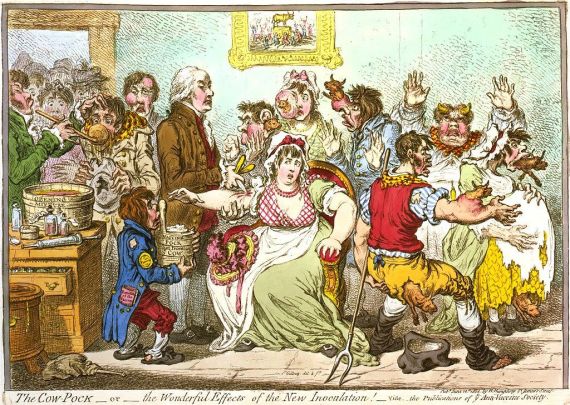
Vaccine resistance is not a new phenomenon, as the cartoon above from 1802 illustrates. Certain people will always find the idea of injecting germs into their systems deeply unsettling. Of course, that’s a very natural basis of resistance. A person’s body is their own property, after all. My default position is that an individual’s control over their own body is inviolable, and parents should always be the first authority over decisions about their children. The real issue, however, is the question of whether unvaccinated children inflict external costs on others.

Points of Contention

The major objections of VRs fall into several categories: 1) preservatives; 2) multiple viruses; 3) vulnerable infants; 4) contra-indications; 5) inefficacy; and 6) free choice. There may be others, but I’ll go with those.

Preservatives: Some vaccines still use a form of mercury, but a much more innocuous variant than the one VRs found so objectionable a few decades ago. Still, they object. And they object to many other compounds used in minute quantities as preservatives, such as formaldehyde, which occurs naturally in our bodies. I think the following test is helpful: if it were proposed that VRs take new versions of the vaccines that had zero preservatives, many would still refuse, especially if they were asked to pay the additional cost of providing them in that form. Thus, preservatives are revealed to be something of a side show.

Multiple Viruses: VRs object to the administration of vaccines that inoculate against several viruses in one dose or within a short window of time. This objection has some plausibility, since an injection of several different “bugs’ at once might place excessive stress on the body, even if the risk is still small. But again, would VRs volunteer to take single strain vaccines in a schedule over a lengthier period of time? Probably not.

Vulnerable Infants: VRs say it’s too risky to vaccinate infants in their first few months of life. This too is a plausible objection, and it would seem like a relatively easy concession to make in the interests of compromise … except, it won’t ever be good enough. Radical VRs will not agree to having their children vaccinated at any age.

Contra-Indications: There are undoubtedly genetic factors that pre-dispose certain individuals to an adverse reaction to certain vaccines. These might be rare, so an effort to compromise by requiring a thorough genetic profile before vaccination would be costly. I believe profiling is a reasonable demand for individuals to make, however, provided they pay the cost themselves.

Inefficacy: My friend posted an intriguing article about the drastic declines that occurred in the incidence of various diseases before the introduction of vaccines to prevent those diseases. This might not be the same link, but it makes the same argument. That doesn’t mean vaccines don’t work, of course. There is a vast literature that shows that they do. Bing it! And in cases such as smallpox, the use of “folk applications” of puss to a small scratch in the skin were in use long before the vaccine was available. Nevertheless, the VRs contend that the historical rates of disease incidence provide evidence against vaccinating. They also contend that diseases like measles are not serious enough to warrant precautions like vaccines. Measles can be deadly, though not as deadly as the flu.

Free Choice: This is the point on which I’m most sympathetic to VRs. Again, we own our own bodies and should have authority over our own minor children, yet communicable diseases seem to be a classic case of externality. Susceptible individuals may inflict a cost on others by refusing vaccination or segregation. Other people own their bodies too, and they have a right to avoid exposure. They too can isolate themselves or take precautions as they deem necessary. If both parties wish to participate in society, then both hold rights they allege to be threatened by the other. That complicates the task of reconciling these interests in private, voluntary ways, and yet they often are reconciled privately.

Solutions?

The debate today often revolves around mandatory vaccination, which would be an extreme measure relying on the coercive power of the state. The rationale is that even a vaccinated majority would be subject to an unnecessarily high risk of infection when in frequent contact with an unvaccinated minority. It’s difficult to endorse such broad intrusiveness when we’re dealing with a negative externality of such minute probability. And such a policy is not at all defensible without exceptions for individuals for whom a vaccine is contra-indicated.

Tolerating differences in vaccination rules across cities, school districts, or even states, may be a reasonable approach to settling the debate in the long run. These variations allow empirical evidence to accumulate on the efficacy of different vaccine regimes. It also allows individuals and families to “vote with their feet”, migrating to jurisdictions that best suit their preferences. These are the basic foundations of federalism, a principle of great usefulness in preserving freedoms while addressing regional differences of opinion on contentious issues.

Michigan has a policy allowing unvaccinated children to attend schools, but a waiver must be obtained requiring the child’s parents to attend a vaccine education program. The policy is credited with increasing vaccination rates. The problem is that VRs tend to view this requirement as an infringement on their rights. Advocates of the policy might argue that the situation should be viewed as an arms-length, voluntary exchange between two parties, in this case a family and a public entity. The vaccine education program is just the price one must pay in lieu of vaccination. The exchange is not arms length, however, as it would be if the school were a private entity. The VR parents who refuse the waiver are not rebated for taxes paid for local schools. In fact, like all taxes, the payment is coerced.

It’s not always necessary to appeal to some form of government action, even at local levels. For example, private schools may require vaccination among enrollees, and private businesses, especially health care providers, may require staff to be vaccinated. Life and health insurers may wish to price risk differently for the unvaccinated. VRs might object that they are subject to discrimination by institutions requiring immunization, or who price discriminate in favor of the immunized, but VRs are free to form competitive institutions, even on small scales or as mutual companies. To the extent that such private rules are unjustified, the institutions who discriminate are likely to learn or lose eventually. That’s the beauty of market solutions. In these ways, non-coercive private governance is far preferable to action by the state.

Dr. Jeffrey Singer is an advocate of immunization who opposes mandatory vaccine laws, as he explained a few years ago in “Vaccination and Free Will“. He suggested elsewhere, in “Seeking Balance In Vaccination Laws“, that schools, instead of requiring immunization, could mitigate the risk of a contagion by insisting that unvaccinated children be held out of school when a particular threat arises and remain out until it passed. That’s a reasonable idea, but I suspect many pro-vax parents would fear that it doesn’t go far enough in protecting against the introduction of a disease by an unvaccinated child.

Conclusion

Recent increases in the incidence of diseases such as measles, mumps and whooping cough are extremely troubling. Whether these outbreaks bear any relationship to patterns of vaccination in the population is certainly a valid question. To the extent that more families and individuals wish to be immunized, and that private institutions wish to take action to increase vaccination rates within their sphere of influence, I’m all for it. Vaccination laws are a different matter.

Political action at the local level might mean that school districts and other public entities will require vaccinations or vaccine education programs. Alternatives exist for those refusing to vaccinate, but broad mandatory vaccination is too coercive. Such measures carry significant costs, not least of which is a loss of liberty and normalization of losses of liberty. It’s not clear that a vaccination mandate at the national level, or even a state vaccination mandate, can offer benefits sufficient to justify those costs. Nudges are irritating and may be costly, but forcible intrusions are way out-of-bounds. Unfortunately, there are parties that simply can’t resist the temptations of behavioral control, and that’s worthy of resistance. Let’s continue to muddle through with an essentially federalist approach to vaccination policy. I regard that as a hallmark of an advanced society.


Prohibition Disaster: Opioid Edition

18 Thursday Jan 2018

Posted by Nuetzel in Prohibition

≈ 2 Comments

Tags

Center for Disease Control, DEA Schedule II, Dilaudid, Drug Enforcement Administration, Fentanyl, Heroin, Jeffrey Miron, Jeffrey Singer, Medically-Assisted Treatment, Narcan, Needle Exchange Programs, Notre Dame, Opioid Overdose Deaths, OxyContin, Pill Mills, Prohibition, Safe Injection Rooms, William Halsted

Opioid deaths in the U.S. keep climbing inexorably. However, at the same time, prescriptions for all opioids have decreased for four straight years (2013-2016), according to the Center for Disease Control, and prescriptions for high-dose opioids have decreased for seven straight years (2010-2016). Further decreases are expected when prescriptions are reported for 2017. How does the declining supply square with the increasing death rate? Contrary to popular belief, opioid prescriptions are not now and never were the cause of opioid overdose deaths. The causes are  complex, but they have everything to do with ill-fated efforts to regulate prescriptions and prohibit some opioids.

Fatal Fun

In this informative interview, Dr. Jeffrey Singer explains that 75% of opioid deaths occur among “recreational” users who have never obtained a legitimate prescription. The recent increases in overdose deaths have been dominated by “other synthetic opioids” like fentanyl and heroin, both of which are illegal (except for fentanyl in patches or anesthesia). Oddly, heroin is not legal for medical use in the U.S., despite the fact that it is less than half as powerful as Dilaudid, which Singer says is used fairly routinely to relieve severe pain.

Singer debunks a widespread notion about the dynamic underlying opioid deaths:

“…first of all the narrative that everyone has bought into, and this is very frustrating to us practitioners, is that the opioid overdose death problem is a direct result of doctors prescribing pain medicine for patients. So, the popular notion is that I’d write a prescription for an opioid for my patient for pain, my patient becomes a drug addict, and then starts resorting to all sorts of illegal behavior in search of the drug. He becomes a dope fiend, and then he eventually overdoses and dies. … That is not what’s going on.“

From the very beginning, the problem of opioid use was driven by an appetite for recreational drugs. Certainly there are people with legitimate medical needs who develop a dependence or addiction and ultimately turn to the black market for continuing supplies. Dr. Singer does not deny that. But there are also individuals who manage to use these drugs recreationally without ever compromising their lives or livelihoods (see Singer’s anecdote about the “Father of American Surgery”, William Halsted). Unfortunately, however, there are recreational users who become dependent or addicted, just as some do with alcohol.

Where do the opioid supplies come from? Of course, heroin and fentanyl make their way onto the market from overseas, and supplies of prescription opioids also make their way onto the black market. For a real buzz, a lot of oxycodone can be extracted from a OxyContin capsule to bypass its slow release. In fact, illegally-obtained OxyContin became a major source of recreational opioid use following its introduction in the 1990s. At the time, physicians were encouraged to be more aggressive in addressing pain management. But the increase in legitimate use for pain brought a concomitant increase in leakage of pills onto the black market. Rx pads are stolen, a few patients might sell legitimate prescriptions, and pills are stolen from medicine cabinets at parties or over at Grampa’s place, for example.

We’re Watching You, Herr Doktor

Efforts to reduce the availability of opioids have been underway for a number of years now. The DEA has mandated reductions in the quantity of opioids manufactured (25% in 2016 and 20% in 2017). The crackdown on so-called “pill-mills” might have helped stem the flow of opioids to the illegal market, especially in Florida, but the measures included strict supply quotas that have harmed those with legitimate needs for the medications. The DEA reclassified hydrocondone as a Schedule II drug, imposing maximum dosages that are too low to relieve the pain experienced by some patients. All 50 states now have prescription drug monitoring programs (PDMPs), which follow prescribing doctors and patients. Singer says PDMPs have a chilling effect on doctors even when their patients’ needs are legitimate. Finally, the FDA has supported pharmaceutical companies in developing “abuse-deterrent formulations” that can’t be crushed or liquified. And those companies have a strong incentive to do so as they can obtain new patents in the process! Some states have required insurers to cover the new formulations, ending the sale of cheaper generics. That is a nice crony deal for big pharma!

While Endangering Lives

The restrictive policies have led to substitution of heroin for opioid pills, as this Notre Dame study shows. The policies endanger: 1) patients with legitimate needs for pain management; 2) occasional users who are otherwise productive members of society; and 3) heavy recreational users. With greater reliance on black market heroin, there is no way for users to tell exactly what they’re getting: it’s probably impure and it’s often amped with fentanyl, or fentanyl sold as heroin. Fentanyl is 50 times as powerful as morphine and 7 – 8 times as powerful as heroin! Singer describes the severe information problem facing users of black market intoxicants:

“… when I go into the supermarket or liquor store to buy a bottle of liquor and I see on the label it says, let’s say, ’80 proof,’ or ‘15% alcohol,’ the thought never crosses my mind that it may not be that, that it could be adulterated with all sorts of impurities or laced with something that could kill me. I believe what it says on the label, because it’s legal, and in the legal market. 

Number one, they have competitors and number two, I have recourse if I’ve been defrauded and injured. But, when were dealing with the illegal market, you go to somebody in a subterranean way who says, ‘Yeah, I have what you want.’ And you don’t know if it’s the dose, you don’t know if it’s pure, that’s what’s happening. In fact, what we’ve learned, because of the narrative that it’s a doctor’s prescribing, since about 2010, 2011, all of the policies of both the federal government and the state governments have been aimed at curtailing the amounts of opioids prescribed.“

Prohibition always creates more danger for users. Adulteration of is one side of it. In “Legalizing Opioids Would Dramatically Reduce Overdose Deaths“, Harvard economist Jeffrey Miron adds that prohibition leads to mixing with other legal or illegal substances:

“In 2013, 77 percent of deaths involving prescription opioids involved mixing with either alcohol or another drug. If opioids are easily accessible, people tend to use the substance they desire; when access is limited, however, some consumers obtain an insufficient quantity and therefore improvise with alcohol, benzodiazepines, and other drugs. Taking these drugs together increases the risk of overdose, especially when dealing with depressants like opioids ….“

Miron and Singer both discuss the risks created by prohibition for users who have developed tolerance to the drugs. Miron says:

“[Tolerance] makes usage less dangerous as the body develops resistance to opioids’ respiratory-depressing effects. … [but] under prohibition users who have developed tolerance get cut off, whether by legal or medical restrictions or by being forced into non-[Medically-Assisted Treatment] treatment. Tolerance then declines, according to medical experts in drug rehabilitation, so users who resume use are more prone to suffer an overdose.

One study proposes that environmental factors also influence tolerance, and that ‘a failure of tolerance should occur if the drug is administered in an environment that has not, in the past, been associated with that drug.’ Therefore, prohibition may increase the chance of overdose by driving users out of their routine into unfamiliar settings in which their tolerance against the respiratory effect of opioids is diminished. “

Finally, by encouraging the development of a black market, prohibition drives up prices, prompting some users to engage in crime to finance their highs. Prohibition itself cedes the market to underworld elements, whose competition culminates in gangsterism and violence.

Medically-Assisted Treatment

Singer believes resources should be redeployed: less drug regulation and interdiction efforts and more harm reduction programs and medically-assisted treatment (MAT):

“… when you take [Methadone] orally, it gets absorbed from the gut. It levels that bind with your opioid receptors enough so you won’t experience withdrawal symptoms. … And the idea behind methadone maintenance is that you get used to not, it’s sort of, behavior modification. You’re blunting withdrawal symptoms, but you’re getting used to not feeling the high. And then it’s hoped that over time, you can be tapered off the methadone. And now you don’t crave the high anymore, and you’re over your addiction problem. That’s the idea behind medical-assisted treatment, whether it’s methadone or Suboxone or others.“

While doctors, within limits, can prescribe drugs to treat pain, they aren’t authorized to prescribe Methadone or Suboxone to treat addiction. But MAT can actually prevent people from dying! In addition, Singer mentions needle exchange programs to prevent the spread of hepatitis and HIV, and safe injection rooms:

“…you go into the room, you inject there, and then you leave. The needle is then discarded by the people who run the place. And not only that, but you have the bonus of somebody being around there with Narcan so if you overdose, because again, you’re using an illegally obtained substance, so you don’t know really what’s in it. … in Switzerland, they reported that teen heroin use has come down, because when the kids see these people going in and out of the clinic to get their injection, it doesn’t look cool.“

Conclusion

There are solutions to the deadly nature of the opioid epidemic, but prohibition is not one of them and never will be. If anything, prohibition in varying degrees has aggravated the dangers of opioids. To truly solve the problem, we should eliminate restrictions on the production and distribution of legal opioids for pain management, legalize heroin, and stop interfering in markets. That would be merciful for patients in real pain, make recreational use of opioids dramatically safer, and put an end to the gangland violence associated with underground competition. Second, redirect those resources into MATs and other harm reduction programs. Miron notes that legalization has worked in other countries, like Portugal and France, to reduce overdoses and opioid deaths. As a political matter, however, these steps might not be feasible unless we get over the cultural bias stigmatizing recreational opioid use as “evil”, and the idea that laws and enforcement can actually prevent people from trying to get high.

Follow Sacred Cow Chips on WordPress.com

Recent Posts

  • Immigration and Merit As Fiscal Propositions
  • Tariff “Dividend” From An Indigent State
  • Almost Looks Like the Fed Has a 3% Inflation Target
  • Government Malpractice Breeds Health Care Havoc
  • A Tax On Imports Takes a Toll on Exports

Archives

  • December 2025
  • November 2025
  • October 2025
  • September 2025
  • August 2025
  • July 2025
  • June 2025
  • May 2025
  • April 2025
  • March 2025
  • February 2025
  • January 2025
  • December 2024
  • November 2024
  • October 2024
  • September 2024
  • August 2024
  • July 2024
  • June 2024
  • May 2024
  • April 2024
  • March 2024
  • February 2024
  • January 2024
  • December 2023
  • November 2023
  • August 2023
  • July 2023
  • June 2023
  • May 2023
  • April 2023
  • March 2023
  • February 2023
  • January 2023
  • December 2022
  • November 2022
  • October 2022
  • September 2022
  • August 2022
  • July 2022
  • June 2022
  • May 2022
  • April 2022
  • March 2022
  • February 2022
  • January 2022
  • December 2021
  • November 2021
  • October 2021
  • September 2021
  • August 2021
  • July 2021
  • June 2021
  • May 2021
  • April 2021
  • March 2021
  • February 2021
  • January 2021
  • December 2020
  • November 2020
  • October 2020
  • September 2020
  • August 2020
  • July 2020
  • June 2020
  • May 2020
  • April 2020
  • March 2020
  • February 2020
  • January 2020
  • December 2019
  • November 2019
  • October 2019
  • September 2019
  • August 2019
  • July 2019
  • June 2019
  • May 2019
  • April 2019
  • March 2019
  • February 2019
  • January 2019
  • December 2018
  • November 2018
  • October 2018
  • September 2018
  • August 2018
  • July 2018
  • June 2018
  • May 2018
  • April 2018
  • March 2018
  • February 2018
  • January 2018
  • December 2017
  • November 2017
  • October 2017
  • September 2017
  • August 2017
  • July 2017
  • June 2017
  • May 2017
  • April 2017
  • March 2017
  • February 2017
  • January 2017
  • December 2016
  • November 2016
  • October 2016
  • September 2016
  • August 2016
  • July 2016
  • June 2016
  • May 2016
  • April 2016
  • March 2016
  • February 2016
  • January 2016
  • December 2015
  • November 2015
  • October 2015
  • September 2015
  • August 2015
  • July 2015
  • June 2015
  • May 2015
  • April 2015
  • March 2015
  • February 2015
  • January 2015
  • December 2014
  • November 2014
  • October 2014
  • September 2014
  • August 2014
  • July 2014
  • June 2014
  • May 2014
  • April 2014
  • March 2014

Blogs I Follow

  • Passive Income Kickstart
  • OnlyFinance.net
  • TLC Cholesterol
  • Nintil
  • kendunning.net
  • DCWhispers.com
  • Hoong-Wai in the UK
  • Marginal REVOLUTION
  • Stlouis
  • Watts Up With That?
  • Aussie Nationalist Blog
  • American Elephants
  • The View from Alexandria
  • The Gymnasium
  • A Force for Good
  • Notes On Liberty
  • troymo
  • SUNDAY BLOG Stephanie Sievers
  • Miss Lou Acquiring Lore
  • Your Well Wisher Program
  • Objectivism In Depth
  • RobotEnomics
  • Orderstatistic
  • Paradigm Library
  • Scattered Showers and Quicksand

Blog at WordPress.com.

Passive Income Kickstart

OnlyFinance.net

TLC Cholesterol

Nintil

To estimate, compare, distinguish, discuss, and trace to its principal sources everything

kendunning.net

The Future is Ours to Create

DCWhispers.com

Hoong-Wai in the UK

A Commonwealth immigrant's perspective on the UK's public arena.

Marginal REVOLUTION

Small Steps Toward A Much Better World

Stlouis

Watts Up With That?

The world's most viewed site on global warming and climate change

Aussie Nationalist Blog

Commentary from a Paleoconservative and Nationalist perspective

American Elephants

Defending Life, Liberty and the Pursuit of Happiness

The View from Alexandria

In advanced civilizations the period loosely called Alexandrian is usually associated with flexible morals, perfunctory religion, populist standards and cosmopolitan tastes, feminism, exotic cults, and the rapid turnover of high and low fads---in short, a falling away (which is all that decadence means) from the strictness of traditional rules, embodied in character and inforced from within. -- Jacques Barzun

The Gymnasium

A place for reason, politics, economics, and faith steeped in the classical liberal tradition

A Force for Good

How economics, morality, and markets combine

Notes On Liberty

Spontaneous thoughts on a humble creed

troymo

SUNDAY BLOG Stephanie Sievers

Escaping the everyday life with photographs from my travels

Miss Lou Acquiring Lore

Gallery of Life...

Your Well Wisher Program

Attempt to solve commonly known problems…

Objectivism In Depth

Exploring Ayn Rand's revolutionary philosophy.

RobotEnomics

(A)n (I)ntelligent Future

Orderstatistic

Economics, chess and anything else on my mind.

Paradigm Library

OODA Looping

Scattered Showers and Quicksand

Musings on science, investing, finance, economics, politics, and probably fly fishing.

  • Subscribe Subscribed
    • Sacred Cow Chips
    • Join 128 other subscribers
    • Already have a WordPress.com account? Log in now.
    • Sacred Cow Chips
    • Subscribe Subscribed
    • Sign up
    • Log in
    • Report this content
    • View site in Reader
    • Manage subscriptions
    • Collapse this bar
 

Loading Comments...