
Tags
Adolph Loos, Asymmetry, Blobitecture, Brianna Rennix, Capitalism, Classical Style, Contemporary Design, Current Affairs, Evelyn Waugh, Form Follows Function, International Style, Louis Sullivan, Modern Architecture, Nathan J. Robinson, Ornamentation, Peter Eisenman, The Decline and Fall
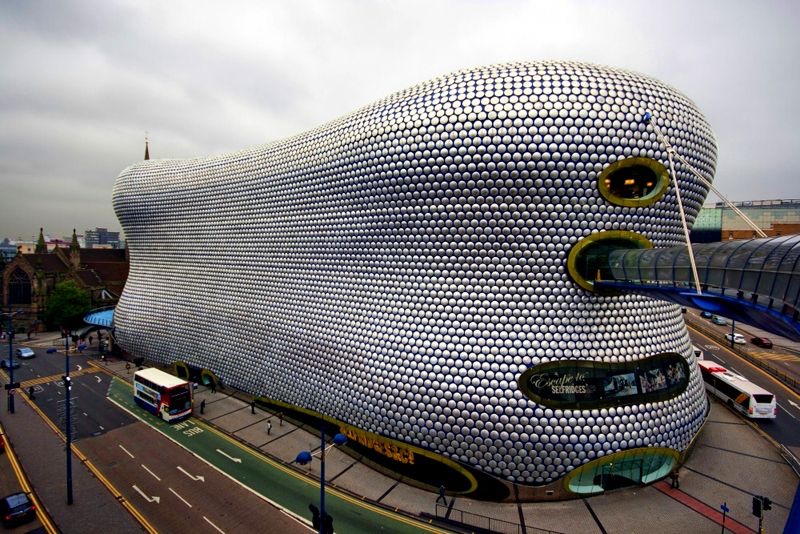
I like interesting “shapes” as much as the next guy, but I have to agree with this piece in Current Affairs: much about modern architecture has gone badly wrong. Brianna Rennix and Nathan J. Robinson’s (R&R) entertaining piece decries what they call “blobitecture”, among other errant aesthetic trends in the design of modern buildings. The article includes a number of great photos depicting very good and very bad architecture, along with a few amusing captions like the following:
“If It doesn’t make you feel desperately, crushingly alone, it’s probably not a piece of prize-winning contemporary architecture.”
“Oh my fucking God, just look at it. Look at it! Does this make you happy? Does it nourish your spirit? What’s with all the little random protrusions? Aaaaagghh.”
Calling of the Moderns
By “modern”, R&R really mean a philosophy of design having roots in the early twentieth century. “Form follows function” was the dictum set down by the famed architect Louis Sullivan. R&R quickly aver that Sullivan did not intend to condemn all ornamentation, but his statement was often interpreted as such. The misunderstanding was reinforced by Adolph Loos, who likened more austere designs to demonstrations of “spiritual strength”. So, modern design was not only superior from a practical perspective, but it was “honest”, imbued with a kind of valor and perhaps devine aspiration.
Form, and To Hell With Function
A delicious irony in R&R’s discussion is the fact that modern architecture has subverted its objectives in at least one fundamental respect. The utilitarian emphasis, with few or starkly simplified adornments, morphed into a celebration of asymmetry, then shape-shifted into a brave new world of three-dimensional manifolds. But buildings with unusual shapes can present difficulties in using the space effectively. So much for “form follows function”! As an illustration, R&R offer this vignette about Peter Eisenman:
“… one Eisenman-designed house so departed from the normal concept of a house that its owners actually wrote an entire book about the difficulties they experienced trying to live in it. For example, Eisenman split the master bedroom in two so the couple could not sleep together, installed a precarious staircase without a handrail, and initially refused to include bathrooms. In his violent opposition to the very idea that a real human being might actually attempt to live (and crap, and have sex) in one of his houses, Eisenman recalls the self-important German architect from Evelyn Waugh’s novel Decline and Fall, who becomes exasperated [by] the need to include a staircase between floors: ‘Why can’t the creatures stay in one place? The problem of architecture is the problem of all art: the elimination of the human element from the consideration of form. The only perfect building must be the factory, because that is built to house machines, not men.’”
But Sometimes It’s Okay
My tastes must be more eclectic than R&R’s, because when it comes to modern buildings, my opinion is “it all depends….” I’ve never liked the boxy international style that still dominates most skylines, but some modern buildings really are interesting. Sometimes I like asymmetry and sometimes I don’t. The shapes of buildings, whatever they are, might contribute to a city-scape in appealing ways. But it probably depends on the presence of certain things like surrounding greenery, which R&R value highly, or even a stylized nod to classical aesthetics. A building — the whole of a structure— can have an ornamental quality of its own, even if it lacks the kind of minutia R&R yearn for. Some skyscrapers, which R&R find so damnable, do indeed soar gracefully.
Cost, From Both Sides of the Mouth
One of the more interesting points made by R&R has to do with cost. They contend that architects are reluctant to propose ornamentation and aesthetic minutia because of the presumed addition to cost of the final design. And likewise, clients are presumed to view those elements as lacking a return on investment. But as R&R note, this logic does not always stand up to scrutiny: unusual structural elements can be extremely expensive to engineer. In the end, a more traditional structure with decorative elements might be far less costly.
Is Capitalism To Blame?
Finally, I take issue with a point R&R make more strongly toward the end of their essay: that capitalism is a primary driver of the ugliness of modern design. They seem to equate capitalism with the sort of corporatist fascism that relies so heavily on government for its viability. This is the meaning of capitalism only in the imagination of the Left, even as the Left increasingly embraces the state-dominated mechanics of corporatism.
The large private entities that thrive under such a regime might well be inclined to build the sort of stark monoliths assailed by R&R. An ancient, didactic finance professor once cautioned me against investing in companies that build glitzy offices, essentially monuments to themselves. He said it’s a sure sign of trouble ahead, of managerial waste. Fair enough, but today, in a world of “too big to fail”, it might be more symbolic of prospective bailouts from ravaged taxpayers. The problem is these corporate managers don’t pay enough attention to ROI precisely because they are protected from downside risks by public policy makers. So they bring on the monoliths!
In contrast, capitalism means truly private enterprise with no guarantee against failure. It relies on the sovereignty of individual actors in pursuit of their self-interest. Yes, costs matter, but they must be balanced against benefits in order to reach rational, efficient outcomes. In this sense, tastes guide decisions, including decisions about design. The abominations of modern architecture are not purely cost-driven, capitalist phenomena, independent of tastes. Whether it is an office, a storefront, or a home, tastes matter, not just costs. People and businesses are usually willing to pay more for things they find attractive. But again, there’s no accounting for tastes.
Of course, commercial developers can and sometimes do make bad design choices, but that’s hardly uniform. At the same time, to label better design choices “pastiche” or “Disneyfied” sounds like a bit of a cop-out when we’re entertaining thoughts of ornamentation and adornment. Perhaps it’s a thin line. But I find a great deal of variety in the design of residential and commercial construction today, and I quite like some of it.
Tyranny of the Critics
R&R give frequent nods to “democratic” ideals, as if some sort of majoritarian principle should guide design. The ideal is more closely approximated by the free market in which people can express their preferences through purchase decisions, whether those be residential or commercial structures, or even simple decisions about which stores to frequent. Sure, most people might hate contemporary architecture, but alternatives are available. I very much enjoyed R&R’s article and agree with many of their sentiments, but what they really crave is the hand of a central planner who thinks just like them.
 Sacred Cow Chips