
• About

Sacred Cow Chips

Sacred Cow Chips

Tag Archives: Native Americans

The Wealth of Space Colonies

17 Friday Jan 2020

Posted by Nuetzel in Space Travel

≈ Leave a comment

Tags

Mayflower, Native Americans, Plymouth Company, Rand Simberg, Terry L. Anderson

Pilgrim colonies in outer space will fare better under the liberal order of capitalism than socialism. Both forms of social organization require some form of governance: various rules regulating or prohibiting behavior and a system for adjudicating violations. Socialist pilgrims would be subject to central decision-making in all or most social affairs, as well as common property ownership and equally-shared rewards from effort of any kind. These are the classic conditions under which a tragedy of the commons can be expected, which would jeopardize the very survival of the colonists. In contrast, capitalist pilgrims would be subject to rules defining property rights; individuals would be free to make various production decisions and contract freely with one another, and perhaps only a portion of the rewards for effort would be shared equally via taxation. In other words, a great deal of the governance that takes place under capitalism would be of a private nature, just as it is on Earth in the advanced economies.

The authoritarian impulses of mission sponsors and planners might hold sway for a time, but they will ultimately clash with the long-term survival imperative. That might give way to a “discovery process” whereby authorities elect to conduct experiments to test various forms of social organization and degrees of individual autonomy. Rand Simberg has a pretty good idea about what those experiments would turn up. In “Socialists in Space“, he covers the history of the U.S. space program as a “command” model. A shift toward more private space activity is still underway, of course, but the power of competition and private enterprise to reduce costs is already evident. The subtitle to Simberg’s article extends that point: “Opening a frontier is hard. Its even harder when you’re a socialist“. He cites the cogent example of the pilgrim colony established by the passengers on the Mayflower:

“When the Plymouth Company adopted the settlement’s initial economic rules, it stated that “all profits & benefits that are got by trade, traffic, trucking, working, fishing, or any other means” were to be placed in the common stock of the colony, and that ‘all such persons as are of this colony, are to have their meat, drink, apparel, and all provisions out of the common stock.’ In other words, to use a phrase from a subsequent century: From each according to his ability, to each according to his needs.

About half the settlement died of starvation in the first winter. It was only after the colony changed its rules to allow people to keep the product of their own efforts, for their consumption or for sale, that they finally had the first bountiful harvest. This wasn’t a unique event; many of the early English settlements, including Jamestown a few years earlier, had to learn the lesson the hard way.”

Lest you object that many Native American civilizations lived for centuries under harsh conditions despite their collectivist forms of governance, it is something of a myth that those tribes always treated property as common. In fact, as Terry L. Anderson wrote in 1997:

“... while there were exceptions that led to the tragedy of the commons, generally American Indians understood the importance of incentives. Property rights, supplemented by customs and traditions where appropriate, often produced the incentives that were needed to husband resources in what was frequently a hostile environment.”

Simberg goes on to discuss the kinds of necessities, or actually opportunities, that are likely to arise in space. Entrepreneur-capitalists will exploit these more successfully than socialist workers ever could. That includes uses of extraterrestrial materials, agriculture, manufacturing, and terraforming solutions. There will be successes and failures, but the efforts will be diversified and the probability of success, and survival in an environment of extreme scarcity, will be improved by the superior structure of incentives for agents having ownership. There will be some dependency on the mission’s sponsoring organization for a considerable period of time, which might dictate certain “terms of trade”. Nonetheless, a liberal order is ultimately the surest way to make a colony prosper on any body or man-made structure in the universe.

We have seen repeatedly that the most effective means of achieving common objectives like ending privation, or indeed, survival, is individual liberty. Freedom and voluntary trade unlock growth in prosperity, thus providing the means for achieving broader social objectives (like the colony’s survival) and the provision of public goods.

For the foreseeable future, it is likely that missions into space, from launch to arrival and initial encampment, will be central planned, but the planning need not be the responsibility of any national government. Again, private space missions are a reality and are growing as a share of launches and payload. After all, the Mayflower itself was a private merchant vessel. The transit itself involves a singular overriding goal: to reach the destination safely, which is subject to high risks of catastrophe and thinly-tested technologies. Thus, it’s reasonable to expect a command structure to be more effective in transit than a crew of autonomous decision makers. Like the Mayflower, passengers will have limited freedoms while on board and during the initial stages of their settlement.

That may differ for more extended the missions. Just as there are likely to be greater benefits from personal autonomy in permanent settlements on moons and planets, the same would be true on multi-generational journeys to other star systems.

International treaties regarding activities and claims on resources in outer space are an area of controversy, according to Simberg. Some hope to use treaties to collectivize space, demanding “collective property rights” and equity in the use of extraterrestrial resources. I wrote about related topics last year in “Space, Property Rights, and Scarcity“, quoting a few uninformed comments by purported experts on space law about scarcity, capitalism, and the “global commons” theory of rights in outer space. Fortunately, there is considerable resistance to their socialist designs. Harvesting resources from outer space will be greatly encouraged by private incentives, much to the benefit of all mankind. And successful colonization of other worlds demands liberalized social arrangements that rely on private incentives. Fortunately, as Simberg says, the “current administration has repeatedly stated that space is not in fact a commons“.


Who Brought the Melting Pot To the Pow Wow?

11 Wednesday May 2016

Posted by Nuetzel in Censorship, Free Speech

≈ 1 Comment

Tags

Bollywood, Censorship, Chinese New Year, Cinco de Mayo, Cultural Appropriation, Cultural Exchange, Delta Blues, Eugene Volokh, Exclusivity, Fighting Words, Flower Drum Song, Hate Speech, Huckleberry Finn, Intellectual Property, Jewish Community Center, Mardi Gras Indians, Moon Festival, Native Americans, Neverland, Peter Pan, Pow Wow, Rivalrous goods, Separate But Equal, The Grateful Dead, The King and I, Ugg-a-Wugg, Washington Redskins

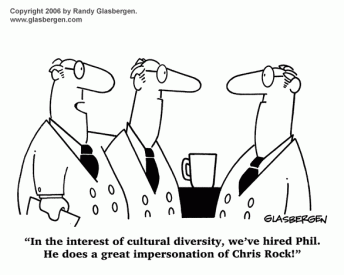
Chris Rock

I ran into a Chinese colleague in a break room at work and mentioned that I’d seen her engaged in a “pow wow” with a senior staffer, and she asked, “Pow wow?” I tried to explain the Native American origins of the term for a gathering or meeting, and I think she liked that, but I joked that my use of the term might represent “cultural appropriation” (CA). A second colleague who’d entered the kitchen glanced at me with a raised eyebrow. Knowing them well, I’m not sure either of them knew what I meant. As it happens, describing the pow wow as a celebration is more accurate, so my use of the term to describe a meeting was too narrow. In fact, in modern usage by Native Americans, it is a celebration of culture, but meetings take place at these events as well.

CA occurs when aspects of one culture are used in some way by others. It is criticized for trivializing the traditions or symbols of the source culture or because it robs it’s members of intellectual property (IP) rights. I can think of examples of cultural trivialization, such as the “Ugg-a-Wugg” song from the musical Peter Pan. Such complaints strike me as hyper-sensitive, but perhaps the umbrage taken by Native Americans to this song is understandable. Nevertheless, I stand more strongly behind the right of free expression. This song, which is rarely performed today out of respect for Native Americans, was part of a larger Neverland fantasy that has great appeal. And after all, the Indians were good guys in the story!

Works such as Peter Pan and Huckleberry Finn are historical and reflect the times in which they were created. As such, some argue that they should be left in their original form. And I agree, in general. However, in the case of a musical that is performed publicly again and again by various professional and amateur groups, I am sympathetic to the notion that potentially offensive elements can be excised if the changes do not do great damage to the story. If it is not in the public domain, the owners of the story’s rights have the final say.

The IP argument is flawed to the extent that IP arguments are always flawed: ideas are non-rivalrous and non-exclusive. Moreover, even IP rights recognized under U.S. law are limited to individual “property”; they do not extend to the traditions and symbols of various cultures that coexist in society.

Another area emphasized by critics of CA has to do with historical grievances against a dominant culture, often without regard to current circumstances. Apparently, such grievances place the minority culture off-limits. Under this view, cultural exchange is fundamentally bad, which is fundamentally absurd. It has the faint ring of “separate but equal” — paradoxical given the avowed desire among critics of CA for an end to racial and social division.

While European colonialists certainly exploited the native inhabitants in many lands, today’s liberal order in the West is attractive to members of different cultures around the globe.They adopt similar institutions and practices at home, and some of them bring their cultures to us. We all gain in the exchange.

Strong condemnation of CA has been all the rage on college campuses over the past few years (see several of the links here). It reflects a hyper-sensitivity about the normal mixing of cultures. Cultural exchange tends to elevate appealing aspects of all cultures into the larger society. Should we really condemn any of the following harmless activities?

  • Yoga classes at the Jewish Community Center?
  • Cinco de Mayo celebrations by non-Mexicans?
  • Caucasians celebrating the Chinese New Year or Moon Festival?
  • St. Patrick’s Day celebrations by non-Irish, non-Catholics?
  • Flower Drum Song or The King and I?
  • Caucasians playing Delta Blues?
  • African American Mardi Gras Indians?
  • Caucasians watching Bollywood movies?
  • The Grateful Dead at the Pyramids?
  • Caucasians cooking “ethnic” foods?

I grant that respect dictates avoiding use of another group’s sacred symbols. Beyond that, it is difficult to conceive of any objections to activities like those above. They are all forms of cultural cross-pollination, even if they seem to trivialize in some cases. This sometimes  involves cultural interpretation by “others” that might not be accurate, but that is always the case when cultures mix. People incorporate or adapt features of other cultures that they enjoy, which is hardly a sin.

Curious about pow wow, I found the following qualification in the Wikipedia entry for pow-wow:

“…the term has also been used by non-Natives to describe any gathering of Native Americans, or to refer to any type of meeting among non-Natives (such as military personnel). However, such use may be viewed as cultural appropriation, and disrespectful to Native peoples.“

Well, well, well! Pow wow is used in conversational english to lend an air of informality or lightness to certain proceedings. It may simultaneously convey a serious diplomatic purpose and an opportunity to resove differences. Sometimes, non-Natives might even use the term to sound clever, like using the French term soirée rather than “party”. Or perhaps they are amused by the image of corporate managers seated akimbo around a camp fire, passing a peace pipe. Or any pipe. Trivial? Maybe, but if that possibility outrages Native Americans, it strikes me as an over-reaction. After all, the joke is partly on “the suits”, and there isn’t much the Indians can do about it under the law.

I have always been fascinated by American Indian history and culture. I do not use the term pow-wow in disrespect. I use it because it’s colorful and I like it. The cross-pollination of language and culture is borne out of the utility of a particular word or practice. It can hardly be bad that a few shards of Native American language and culture are incorporated into broader American society.

My sister has a beautiful scarf bearing the profile of an American Indian in full head dress. She has always had an interest in the art and culture of the American southwest, which has benefitted from the heavy influence of Indians who are native to that region. So it was unsurprising to me that she would be drawn to the beauty of the scarf. It is a work of art and she does not wear it out of disrespect for American Indians.

Certain acts of CA are thought to intersect with racism, however. How about the Washington Redskins football team name? The team logo and merchandise use Native American symbols. The same goes for the Atlanta Braves and other teams. However, the term Redskin almost certainly has overtly racist origins as a description of an enemy thought to be savage, much as “Nips” was a derogative used by Allied soldiers in World War II as a term for the Japanese.  Defenders of the team claim that “Redskin” is not meant to trivialize or denigrate Native Americans, but instead to recognize their honor and ferocity in battle. The team owner and many fans insist that the tradition of the team name should continue in tribute to American Indians. Nevertheless, the name is understandably objectionable to Native Americans today as a crude description of their genealogy. My friend John Crawford tells me of a proposal to change the team logo to a red-skinned potato, but apparently the idea was rejected by the U.S. Patent Office.

In all of these matters, free speech outweighs all other considerations. While cultural appropriation is sometimes regarded with hostility, that does not give the aggrieved special rights to prevent it. The same is true of racism, however regrettable it is. Even so-called hate speech is protected under the U.S. Constitution, short of “fighting words”. Critics of cultural appropriation can seek to educate, influence, boycott and to shame those believed to have run afoul of their standards. In most cases, however, I think the best advice is to chill out.


Follow Sacred Cow Chips on WordPress.com

Recent Posts

  • Immigration and Merit As Fiscal Propositions
  • Tariff “Dividend” From An Indigent State
  • Almost Looks Like the Fed Has a 3% Inflation Target
  • Government Malpractice Breeds Health Care Havoc
  • A Tax On Imports Takes a Toll on Exports

Archives

  • December 2025
  • November 2025
  • October 2025
  • September 2025
  • August 2025
  • July 2025
  • June 2025
  • May 2025
  • April 2025
  • March 2025
  • February 2025
  • January 2025
  • December 2024
  • November 2024
  • October 2024
  • September 2024
  • August 2024
  • July 2024
  • June 2024
  • May 2024
  • April 2024
  • March 2024
  • February 2024
  • January 2024
  • December 2023
  • November 2023
  • August 2023
  • July 2023
  • June 2023
  • May 2023
  • April 2023
  • March 2023
  • February 2023
  • January 2023
  • December 2022
  • November 2022
  • October 2022
  • September 2022
  • August 2022
  • July 2022
  • June 2022
  • May 2022
  • April 2022
  • March 2022
  • February 2022
  • January 2022
  • December 2021
  • November 2021
  • October 2021
  • September 2021
  • August 2021
  • July 2021
  • June 2021
  • May 2021
  • April 2021
  • March 2021
  • February 2021
  • January 2021
  • December 2020
  • November 2020
  • October 2020
  • September 2020
  • August 2020
  • July 2020
  • June 2020
  • May 2020
  • April 2020
  • March 2020
  • February 2020
  • January 2020
  • December 2019
  • November 2019
  • October 2019
  • September 2019
  • August 2019
  • July 2019
  • June 2019
  • May 2019
  • April 2019
  • March 2019
  • February 2019
  • January 2019
  • December 2018
  • November 2018
  • October 2018
  • September 2018
  • August 2018
  • July 2018
  • June 2018
  • May 2018
  • April 2018
  • March 2018
  • February 2018
  • January 2018
  • December 2017
  • November 2017
  • October 2017
  • September 2017
  • August 2017
  • July 2017
  • June 2017
  • May 2017
  • April 2017
  • March 2017
  • February 2017
  • January 2017
  • December 2016
  • November 2016
  • October 2016
  • September 2016
  • August 2016
  • July 2016
  • June 2016
  • May 2016
  • April 2016
  • March 2016
  • February 2016
  • January 2016
  • December 2015
  • November 2015
  • October 2015
  • September 2015
  • August 2015
  • July 2015
  • June 2015
  • May 2015
  • April 2015
  • March 2015
  • February 2015
  • January 2015
  • December 2014
  • November 2014
  • October 2014
  • September 2014
  • August 2014
  • July 2014
  • June 2014
  • May 2014
  • April 2014
  • March 2014

Blogs I Follow

  • Passive Income Kickstart
  • OnlyFinance.net
  • TLC Cholesterol
  • Nintil
  • kendunning.net
  • DCWhispers.com
  • Hoong-Wai in the UK
  • Marginal REVOLUTION
  • Stlouis
  • Watts Up With That?
  • Aussie Nationalist Blog
  • American Elephants
  • The View from Alexandria
  • The Gymnasium
  • A Force for Good
  • Notes On Liberty
  • troymo
  • SUNDAY BLOG Stephanie Sievers
  • Miss Lou Acquiring Lore
  • Your Well Wisher Program
  • Objectivism In Depth
  • RobotEnomics
  • Orderstatistic
  • Paradigm Library
  • Scattered Showers and Quicksand

Blog at WordPress.com.

Passive Income Kickstart

OnlyFinance.net

TLC Cholesterol

Nintil

To estimate, compare, distinguish, discuss, and trace to its principal sources everything

kendunning.net

The Future is Ours to Create

DCWhispers.com

Hoong-Wai in the UK

A Commonwealth immigrant's perspective on the UK's public arena.

Marginal REVOLUTION

Small Steps Toward A Much Better World

Stlouis

Watts Up With That?

The world's most viewed site on global warming and climate change

Aussie Nationalist Blog

Commentary from a Paleoconservative and Nationalist perspective

American Elephants

Defending Life, Liberty and the Pursuit of Happiness

The View from Alexandria

In advanced civilizations the period loosely called Alexandrian is usually associated with flexible morals, perfunctory religion, populist standards and cosmopolitan tastes, feminism, exotic cults, and the rapid turnover of high and low fads---in short, a falling away (which is all that decadence means) from the strictness of traditional rules, embodied in character and inforced from within. -- Jacques Barzun

The Gymnasium

A place for reason, politics, economics, and faith steeped in the classical liberal tradition

A Force for Good

How economics, morality, and markets combine

Notes On Liberty

Spontaneous thoughts on a humble creed

troymo

SUNDAY BLOG Stephanie Sievers

Escaping the everyday life with photographs from my travels

Miss Lou Acquiring Lore

Gallery of Life...

Your Well Wisher Program

Attempt to solve commonly known problems…

Objectivism In Depth

Exploring Ayn Rand's revolutionary philosophy.

RobotEnomics

(A)n (I)ntelligent Future

Orderstatistic

Economics, chess and anything else on my mind.

Paradigm Library

OODA Looping

Scattered Showers and Quicksand

Musings on science, investing, finance, economics, politics, and probably fly fishing.

  • Subscribe Subscribed
    • Sacred Cow Chips
    • Join 128 other subscribers
    • Already have a WordPress.com account? Log in now.
    • Sacred Cow Chips
    • Subscribe Subscribed
    • Sign up
    • Log in
    • Report this content
    • View site in Reader
    • Manage subscriptions
    • Collapse this bar
 

Loading Comments...