
Tags
Accreditation Agencies, Ariel Deschapell, Bernie Sanders, College Admission Standards, Community Colleges, Diversity Goals, Dropout Rates, Federal Accreditation, Federal Reserve Bank of New York, Free Tuition, Graduation Rates, National Bureau of Economic Research, NBER, Socialized Costs, Student Debt, Subsidized Loans, Tuition Bubble
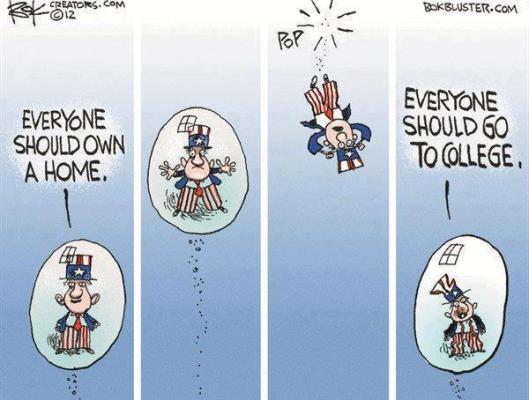
Free college tuition would undermine the quality of higher education and increase its real cost to society. In fact, it may well cost many subsidized students more than its worth in lost work experience, wages and self-esteem. Those foregone opportunities are very real costs despite their consignment as “unseen” counterfactuals. They are mostly incremental to costs that are more obvious to the minds of statists promoting free post-secondary education.
Basic supply and demand analysis is the only requirement for understanding the tuition bubble in U.S. higher education, and the absurdity of heavy subsidies as a solution. Ariel Deschapell calls subsidies “worse than nothing“, comparing the approach to “throwing gasoline on a fire“. He’s quite right.
There is no question that increased subsidies lead to higher tuition and ultimately greater student debt. A recent paper published by the National Bureau of Economic Research (NBER) found that loan subsidies “fully account” for the increase in college tuition costs from 1987 – 2010. Another 2015 study published by the Federal Reserve Bank of New York reached broadly similar conclusions:
“We find that institutions more exposed to changes in the subsidized federal loan program increased their tuition disproportionately around these policy changes, with a sizable pass-through effect on tuition of about 65 percent. We also find that Pell Grant aid and the unsubsidized federal loan program have pass-through effects on tuition, although these are economically and statistically not as strong. The subsidized loan effect on tuition is most pronounced for expensive, private institutions that are somewhat, but not among the most, selective.“
As Deschapell points out, most schools turn away a significant share of their applicants. How can that sort of demand exist, given the sky-high tuition charged by many colleges and universities? Subsidies. Subsidized tuition. Subsidized loans. When the cost to the end user of educational services is reduced at a given price, demand for those services increases. The papers linked above demonstrate the strength of the response.
Unfortunately, the supply of higher education is subject to relatively hard limits. Traditionally, the supply of educators, facilities and other learning resources has not been especially elastic. Technology has arguably made education more scalable, but only in terms of enrollment, and not at a zero incremental cost. Outcomes are more dependent than ever on a student’s intelligence, preparation and ability to remain engaged.
The supply of education is limited by still other factors. The long-term impact of inflation on costs is often more severe for service industries such as education, as they generally do not share in the productivity growth enjoyed by goods-producing sectors. Moreover, the increasing complexity of administrative functions, including education finance and regulatory compliance in an astonishing number of areas such as health, environmental and diversity goals (and certainly some self-inflicted administrative bloat), imposes cost escalation at many schools. Worst of all, the supply of education and acceptance of federally-subsidized student loans by certain institutions is restricted by federally-appointed accreditation agencies. This puts a lid on competitive pressures in higher education and inflates costs.
Higher demand and limited supply mean that some form of rationing is necessary. What mechanisms for rationing educational opportunities are available? Higher admission standards are sometimes a possibility, but public institutions may have little flexibility to raise standards, especially for resident students. Interestingly, diversity goals can lead to a de facto tightening of admission standards for some applicants even as standards for others are overridden or compromised. Declining quality of education is a “relief valve” to be avoided, but it is a very real possibility.
Higher tuition to the payer is an almost unavoidable consequence. That is why Deschapell likens free, givernment-paid tuition to an accelerant. Supporters of free tuition fail to recognize this relatively simple, causal chain.
When student debt is subsidized, it tends to mount faster than educational achievement and job prospects allow, leading to high rates of default. It also distorts the choices of would-be individual payers by inflating tuition costs. Passing the cost of education along to taxpayers, or “socializing the cost” as Deschapell says, completely severs the responsibility for marginal costs from the marginal benefit of education, an obvious prescription for a misallocation of resources. The decision to pursue more education, and the responsibility, should be in the hands of the same individuals: those in the best position to know whether it is viable: prospective students and their families. They know better than anyone the real opportunities foregone in terms of lost wages and the skills and experience that can be gained by staying out of school. Eliminating tuition from the decision would divert many more individuals into pursuits for which they are ill-suited.
College graduation or completion rates are disappointingly low, and correspondingly, dropout rates are very high, especially at community colleges. Moreover, profiles of the dropout population show that colleges have no business admitting a significant share of those individuals. This is damning evidence that we are already over-allocating resources to this activity. Additional subsidies won’t fix the problem.
There is no doubt that cross-sectionally, advanced education is associated with better employment prospects and higher incomes. And higher education can provide “social benefits” in excess of its direct value to students. Those facts do not imply, however, that generous inducements to questionable prospects will create positive outcomes. Quite the contrary. And in fact, the quality of education is vulnerable to dilution with increases in the number of poorly-qualified students.
A better way to improve the lifetime prospects of more people is to encourage production and employment opportunities with flexible wage policies, light taxes and less intrusive regulation. Competition at all levels of education should also be promoted; those steps would do more to improve outcomes than subsidies ever can. Throwing public money at education is generally unproductive, inflates tuition and drains the productive sector of resources. After all, the strength of that very sector must be relied upon to keep public education afloat. Individuals cannot be absolved of facing the real trade-offs inherent in their choices. Ultimately, by distorting decisions, free tuition cannot truly empower individuals and improve well being.
 Sacred Cow Chips