
Tags
Condom Dispensers, Cost-Benefit, Female to Male Transition, Free Tampons, FTM, Gender Transition, Gender-Affirming Care, Hysterectomy, Intersex, Market Test, Menstruation, MTF, Non-Binary Population, Overactive Bladders, Pay Toilets, Private Goods, Public Budgets, Public Restrooms, Tampon Dispenser, Tampons in Men’s Rooms, Tax Burdens, Trans Population, Trans-Men
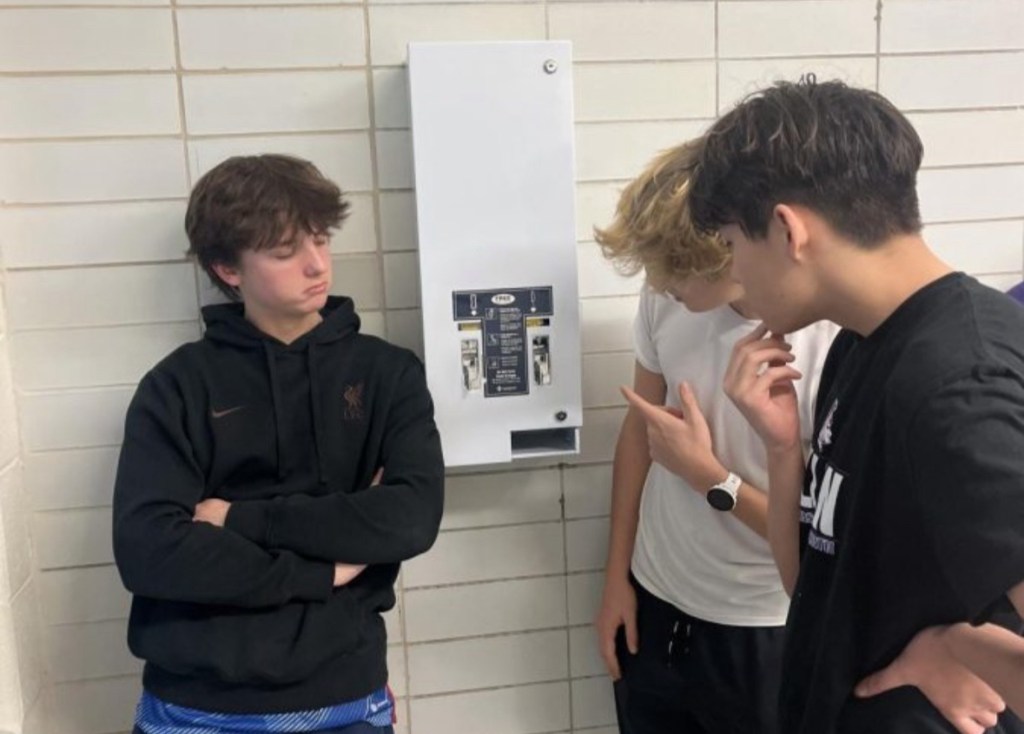
I had to laugh when I saw this tweet on X the other day:
I actually think she was fishing for sympathetic comments from … anyone. Or it was intended as a rhetorical question, as the poster seems to regard many cis-men as the meanies in this affair. But let’s give her the benefit of the doubt. Maybe she really wanted to engage with men who object to tampon dispensers in men’s public restrooms.
Before getting started, I want to be clear that I’m using the term “public restroom” to mean a restroom available to the general public and furnished by the public sector. I distinguish these from restrooms in commercial establishments intended for use by customers only.
Tampon Dispensing Is Not Cost-Free
So I have a question: who will be asked to pay for the dispensers in men’s public restrooms, their installation, servicing, and the tampons themselves? Will the tampons be dispensed at no charge, as some advocates would like? That’s the case in some public schools, so there might be a tendency to think tampons should be free in other men’s public restrooms. Of course, another possibility is to install pay vending machines for tampons, and I will address that in later sections. Here I note that I’d have no objection if they paid for themselves.
Free tampons in men’s public restrooms, or even priced tampons that don’t cover their costs, would represent a use of public resources. Taxpayers would be on the hook. Alternatively, some other public expenditure might be reduced to make room in government budgets for the new amenity. Public budgets are notoriously strapped, and foregoing other budget needs would carry an opportunity cost. Public resources should be put to the most urgent public needs, which might run the gamut from critical services like law enforcement, sanitation, and street repair to the staffing of mental health facilities.
If this strikes you as economic small-ball, remember that demands for public funds are seemingly without end. Whether taxes are increased or the budget is reallocated, “my life” is affected to a degree by every new demand that is met. To pay for tampon dispensers in men’s public restrooms, resources must be diverted from some other valued use.
Beneficiaries
Surely Ms. Fachner believes that tampons in men’s restrooms confer social benefits. Might those benefits exceed the opportunity cost of the necessary resources?
Well, biological males don’t have ovaries, they can’t get pregnant, and they don’t have periods, so we can scratch them off the list of potential beneficiaries. This is about trans- or intersex men who menstruate or perhaps suffer bleeding from hysterectomies. As I’ll discuss below, this is a small minority of users of men’s public restrooms.
But wait, here’s one advocate:
“Our culture does not really acknowledge the diversity of menstruating individuals.“
Statements like that lend absolutely no clarity. In fact, it’s a gross obfuscation made in an effort to redefine reality and exaggerate the prevalence of menstruating males.
Estimates of the Trans-Male Population
The transgender population was estimated at about 0.5% – 0.6% of the total U.S. population in 2022, based on two studies. That’s about one in every 200 individuals. However, male-to-female (MTF) transitions are 2 – 4 times more common than female to male (FTM) transitions. Combining these estimates yields one FTM in every 400 – 800 men. Of course, not all FTMs menstruate (and they don’t menstruate over the entirety of a given month). So men who might need a tampon in a public restroom are a small minority.
Nonbinaries?
Some would insist that any such estimate should account for the nonbinary population of individuals who menstruate. Part of this group is the intersex (hermaphrodite) population who identify as males. A number of these individuals have had gender-affirming care and would already have been counted as FTMs in the studies linked above (and I will continue to use “FTM” as inclusive of this group). However, I’m skeptical of the non-binary classification on surveys because some otherwise “straight” individuals use it to signal their participation in the avant guarde of gender identification, perceiving it as something fashionable or even virtuous.
Nevertheless, one 2022 poll found that the trans plus nonbinary population was about 1.6% of all adults. Combining this with the MTF/FTM estimates above, an implied upper bound on the male tampon “market” would be about 3 out of every 400 distinct visitors to a men’s restroom, or less than one out of every hundred. If the nonbinary classification is taken at face value, it’s still a small minority and probably far less than 1/100.
Woe Is We
A great many of us suffer inconveniences in life, some of them terrible, but it would be extremely costly and irrational for the state to attempt to neutralize every one of them. For example, people with overactive bladders are far more common than the trans population. Should the state accommodate them by doubling the number of public restrooms? At some point it’s worth recognizing that claims on public resources can become preposterous.
The economic argument against outfitting all men’s public restrooms with tampon dispensers falls into a broader category of common-sense resistance to eliminating (or compensating) for every tiny cross borne by anyone: every minor strife, inconvenience, or “micro-aggression” individuals might experience. The cumulative effect of this cavalcade of demands on society and on each other, which cannot all be met, is to breed discontent while stifling social and economic progress. We live in the real world where scarcity matters. We must therefore be sensible about where and how we expend our energy and resources.
Costs
I haven’t yet explored the specific costs associated with adding tampon dispensers to men’s public restrooms. Not surprisingly, it’s difficult to pin them down completely, but a few notes are helpful.
The cost of a free-tampon dispenser ranges from about $90 to $140. A pay tampon vending machine ranges from about $300 – $500. Then the dispensers have to be installed, stocked, and serviced, and there is a potentially greater cost of sanitation within each restroom. This article includes cost data from 2017-2019 for a public school district in Massachusetts. It’s ambiguous as to whether installations of free dispensers occurred in women’s restrooms only or all restrooms, but much of the article is written as if it applies to women and girls. To be clear, I don’t take issue with providing free tampon dispensers in school restrooms for females.
The dispensers and receptacles for the school district totaled $33,000, which presumably included the labor cost of installation. The annual cost of keeping the dispensers stocked was just $2.48 per student annually, but it’s not clear whether that average includes labor, or whether the divisor is the female student population or all students. Certainly all of these costs would be greater today.
Don’t Putsch It
The FTM minority is likely to grow, especially in parts of the country where advocates for the gender dysphoric have won legislative battles over gender-affirming care for youths. This is a huge mistake. It’s highly unethical to encourage unalterable, life-changing medical interventions for what often amount to youthful anxieties that usually pass with age. But these initiatives go hand-in-hand with bills requiring free menstrual products in all school restrooms and in all public restrooms. It would be more reasonable to suggest to any biological female considering a gender transition, who must weigh many considerations, that they’ll sometimes be inconvenienced by the need to pack a precautionary tampon.
Crazy Counter-Arguments
There were some interesting comments on Ms. Fachner’s tweet. One contended that men should have tampons available in the event that a female companion happens to need one. Well, it’s so nice to know that chivalry still has a place among the woke! But if a woman needs a tampon while she’s out, and if she has any sense, she’ll try the womens’ restroom herself before asking a male companion to check the men’s room.
Another commenter felt that the availability of tampons in men’s restrooms is the equivalent of condom dispensers in womens’ restrooms. Not quite! A woman out with a male companion might wish to have protection available if she expects to have intercourse. I’m not sure how many public women’s restrooms have condom dispensers, but you might find paid dispensers at truck stops, dance clubs, or other private venues where the sexes meet and greet. In any event, interest in condoms in women’s restrooms might well be a more common phenomenon than FTMs unprepared for the onset of a period.
Market Test
The mere existence of vending machines for condoms and other products in the restrooms of private establishments proves that these offerings satisfy a sort of market test. The charges for those products, including tampons, pads, and condoms in women’s restrooms, might or might not cover all of the associated costs. However, even if they don’t, the machines are provided as a courtesy to customers and/or because competitors provide them. Either way, as a market proposition, the establishments find the machines to be advantageous.
Would private establishments find it profitable to offer tampons and pads in vending machines in men’s restrooms? It’s possible, and businesses catering to non-traditional lifestyles are more likely to offer menstrual products in men’s restrooms, if only as a courtesy to FTM customers. However, it’s uncommon at best among mainstream businesses. Again, the economic logic is dependent on the volume of menstrual products likely to be dispensed. If they add value, the market is likely to provide them. This might be more plausible for machines that vend multiple products.
Successful pricing of tampons in men’s public restrooms would be easier if the probable volume was greater, but it will be quite low relative to women’s restrooms. Thus, the up-front fixed costs are difficult to justify. In any case, vending machines of any type are less common in public restrooms. Perhaps that’s because the items sold would not cover all of the associated costs. Or perhaps it’s because public administrators lack the incentives that motivate actions in the private sector. Enter the activists!
Market Failure?
One might argue that passing the market test is irrelevant because public facilities are intended to offer a range of services which the market can’t be relied upon to provide. That’s not clear cut in the case of restrooms themselves, and I’ve advocated for more pay toilets in the past. However, tampons are very much a private good. A trans-male with an unmet need for a tampon is in a bad spot, and he might generate external costs. However, I maintain that the situation is fairly uncommon, and those hypothetical external costs are fairly easy to internalize. This is not a true market failure nor a public priority.
Finally, I note again that Ms. Fachner addresses her question only to cis-men. I have news for her: like any other form of common sense, the rudimentary economic logic of costs and benefits is inclusive and available to all, regardless of sexual preference and gender identification.



 Sacred Cow Chips