• About

Sacred Cow Chips

Sacred Cow Chips

Category Archives: Renewable Energy

The Wind, The Sun, and a Load of Subsidies

17 Thursday Mar 2016

Posted by Nuetzel in Environment, Renewable Energy, Subsidies

≈ Leave a comment

Tags

Abandoned Wind Turbines, Baseline Capacity, Cronyism, Decarbonization, Energiewende, Federal Energy Regulatory Commission, Intermittency, Investor Intel, John Peterson, Peaking Capacity, Power Storage, Renewable energy, Rooftop Solar, Seeker Blog, Solar Reimbursement Rates
image


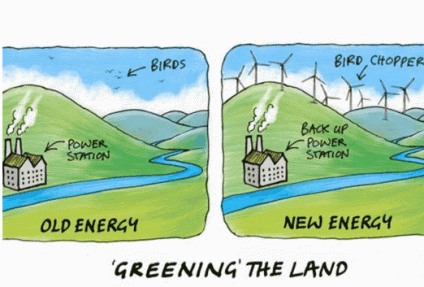
Renewable energy sources are not economically viable without subsidies, and they can impose some ugly external costs. Taxpayer subsidies for renewables like solar and wind projects are rationalized on the grounds that adoption will reduce carbon emissions and bring declining costs, ultimately saving resources by virtue of “free inputs”: the sun and the wind. But the cost of carbon emissions is highly uncertain, even speculative, and subsidies usually manage to get wasteful projects off the ground that are all too often run by political cronies. Despite the free variable inputs, these projects entail substantial resource costs that are conveniently overlooked by supporters. No wonder so many renewable outputs cannot be sustained without a continuing flow of aid.

What happens when the subsidies reach their sunset? There are thousands of abandoned wind turbines littering the U.S. (and a number of abandoned solar farms, too). There are several thousand turbines at one abandoned wind farm north of Los Angeles and another east of the Bay Area. There are many more in Hawaii, Iowa, Maine, Texas and other states. Attorneys often warn landowners that lease agreements with wind developers are risky. There are a number of ways that crony wind developers impose “external costs” on landowners. Eventual disposal is a risk, as the developers might just be inclined to take the subsidies and run.

Again, wind’s big advantages, aside from the subsidies, are that wind itself is free and produces no carbon, but other resources needed to make use of wind energy are not renewable, and producing those inputs produces CO2. To build and install the windmills requires materials (including steel and scarce rare-earth materials used in the electronic components), machinery, and of course labor and land costs. There is also a substantial investment in connecting windmills to the power grid. Ultimate disposal is a certainty, and it is not cheap. Then there is a controversial cost in terms of slaughtered avian life. Increasingly, wind turbines are thought to create health issues for people living nearby.

Solar power has the same advantages as wind in terms of a free input and no direct carbon output. In addition, the cost of solar panels has declined precipitously. Rooftop solar installations have allowed consumers to sell power back to electric utilities at certain times. In fact, without those “reimbursements” on top of the subsidies, installed on-site solar power would not be economically viable for many households and businesses. Reimbursement rates are therefore a huge controversy. Solar advocates have insisted that consumers should be reimbursed at the retail price of electricity. That is difficult to square with the fact that utilities could produce that power themselves for much less. It is especially difficult to square with the fact that the excess solar generation is often mismatched with the timing of power demand.

This brings us to the achilles heel of wind and solar power: wind and sunshine are intermittent, and not just on a daily basis, but over weeks, whole seasons and even years. This risk can be diversified geographically, but only to an extent, and effective power storage options do not presently exist and will not exist for some time, even with massive subsidies. Intermittent energy production requires the availability of other reliable power sources that are costly to turn on and off as needs dictate. It requires other “peaking” capacity to fill the “valleys” in wind and solar output, and baseline capacity is needed to provide for the less variable components of demand. Baseline capacity relies on nuclear power (which many solar advocates abhor) and carbon-emitting fossil fuels. Peaking capacity is typically provided by oil and natural gas generators. Hydro-electric power can be used as baseline or dialed back as needed, but hydro capacity is generally limited.

Renewable energy activists speak of replacing traditional power sources with wind and solar power. It is difficult enough, however, for wind and solar to replace peaking capacity, let alone baseline capacity. Peak wind and solar power production is not well-aligned with peak power demand in many areas (see the second chart at this link). The extra resources required to provide redundant facilities are significant, with ratepayers picking up the tab.

Given the current state of technology, pushing renewable energy goals even further, to the replacement of baseline capacity, is misguided at best. Yet it has been tried, with unintended but easily foreseeable consequences. Germany’s Energiewende program seeks to “decarbonize” power production without nuclear power. The costs have been very high:

“The report gives enough detail that you can see why Germany’s nuclear ban leads to a shocking cost of avoidance of $300 [/mt CO2]. … J.P. Morgan modeled a balanced deep decarbonization strategy, which using 35% nuclear, costs only $84/mt CO2. Note that the $300 is a bare-bones estimate – none of the cost of the additional transmission infrastructure required by high-renewables is included in the analysis. Even so the baseline Energiewende plan will double already second-highest in Europe current costs from $108 to $203/MWhr.“

California officials apparently want to go in the same direction. John Peterson reinforces the difficulties of integrating renewable energy capacity into the power grid in a recent post at InvestorIntel:

“The disadvantages [of intermittent power sources] include:

  • Intermittent power sources must have conventional backup for frequent periods when the wind and sun aren’t feeling particularly cooperative;
  • Cannibalization of peaking plant revenue streams results in higher electric costs for all because interest, depreciation, overhead and other fixed operating expenses must be recovered from fewer units of production;
  • When utilities pay premium prices for renewables, that indirectly increases electricity prices for all; and
  • When Federal, State and local treasuries subsidize the construction and operation of intermittent power sources, they indirectly increase everyone’s tax burden.“

The U.S. Federal Energy Regulatory Commission (FERC) is currently investigating the risk of intermittent energy sources to the reliability of the power grid.

“Power demand is relatively predictable and conventional power plants, like nuclear plants and natural gas, can adjust output accordingly. Solar and wind power, however, cannot easily adjust output. Peak power demand also occurs in the evenings, when solar power is going offline. Adding green power which only provide power at intermittent and unpredictable times [and stopping or even retiring other capacity], makes the power grid more fragile.“

Given decreasing costs, solar energy is likely to play an increasing role in power production in the future; wind production to a lesser extent. Both will depend on advances in the technology of power storage. However, there are still tremendous diseconomies that make current, widespread adoption of both wind and solar power a “Renewable Irony“. Like other attempts to centrally plan economic activity, the intentions are well and good, but execution requires mandated behavior and artificial inducements that impose heavy costs on society. Renewables should not be forced on us prematurely. They will happen voluntarily and naturally if we let them, guided by market signals as technology matures and resource scarcities evolve.


Subsidized Waste: The Renewable Irony

12 Tuesday May 2015

Posted by Nuetzel in Renewable Energy

≈ Leave a comment

Tags

Charles Frank, Christopher Helman, Elon Musk, Energy Matters, Energy storage, Energy subsidies, Lobos Motl, Renewable energy, Tesla Powerwall battery, The Brookings Institution, The Economist, Viv Forbes, Wind and solar

wind damage

The new Tesla “Powerwall” home battery is probably most noteworthy for the breathless hype it has generated. The $3,500 cost for the 10 kWh version is not cheap, and the installed price is probably closer to $7,000. The battery has a limited number of charge cycles, though Tesla has not fully disclosed all of the specifications. People of considerable expertise in this area (not me!) do not believe that Tesla’s new battery is the least bit innovative as an energy storage technology. See this post by Lobos Motl, or this one by Christopher Helman. This is not to say that Tesla has not made contributions to battery technology, only that this variation is not new, except for the marketing.

How can it pay for itself? The promise is not so much for back-up power during outages. Instead, it is an arbitrage play allowing consumers to store power during off-peak hours and avoid usage during peak-price hours. But the application (and hope) that has excited the media and well-meaning greens is efficient storage of power generated by intermittent, renewable sources. Tesla’s marketing effort certainly fostered such hopes; those with home solar panels may have Tesla sugar plums dancing in their heads.

Advocates of renewable energy can rightly claim that the costs of energy storage (and some forms of renewable power generation) have been declining. But there is still a mismatch between expectations and reality: the Tesla battery is not new technology, and it is not really cheap in terms cost per unit of energy stored and later delivered. The economic viability of intermittent sources of power obviously depends on the combined cost of storage, transmission and the power generated by a renewable source relative to other fuels, including the initial capital outlays. This is reviewed at the Energy Matters blog in “The High Cost of Renewables“, which is largely based on this paper from The Brookings Institution by Charles Frank.

It’s relevant to compare renewables such as wind and solar to nuclear energy and natural gas as replacements for “base-load” coal plants. Nuclear and gas power are often touted as viable, reduced or no-carbon solutions to providing for the energy needs. Two issues make renewables more costly than nuclear and gas in terms of installed cost per kilowatt, despite the huge up-front installation costs of nuclear. The first is the intermittency of wind and solar power generation. According to Frank’s calculations at the link above, this factor alone causes solar to be nearly four times as costly as nuclear energy, and wind to be more than 25% more costly. The second issue is that wind and solar installations have short useful lives relative to nuclear. This adds to the wind and solar cost disadvantages, but the practice of dividing costs by the number of years of useful life probably distorts the comparisons. The shorter-lived installations can be expected to involve lower costs at replacement, which should be averaged into a comparison with a longer-lived asset. Still, there is no question that renewables are more costly than gas and nuclear power.

Critics took Frank to task over certain assumptions following the publication of his paper. He offered rebuttals here, here and here in which he revised his calculations in ways that tested his critics’ assertions. Frank’s conclusions are the same:

“Taking all changes into account, my main conclusions are strengthened. Wind continues to rank number four and, by a large margin, solar number five. Gas combined cycle continues to rank number one by a large margin, although nuclear drops from two to three [behind hydroelectric power].”

This article in The Economist also emphasizes the problem of intermittency:

“… countries which have a lot of renewable generation must still pay to maintain traditional kinds of power stations ready to fire up when demand peaks. And energy from these stations also becomes more expensive because they may not run at full-blast.“

“Firing-up” a power station repeatedly consumes fuel at a greater than proportionate rate. If fossil fuels are involved, this process eats into the presumed benefits of using renewables. Of course, there are other factors that make large-scale renewable energy  “farming” undesirable, such as massive land requirements and danger to birds and even marine life. Here is another piece offering a reality check on the true costs of wind power.

Certain forms of renewable energy and energy storage technologies will continue to advance and their costs will decline over time. However, solar and wind power are currently more costly than other alternatives. The benefits of these technologies to society are highly speculative, since models of carbon-forced climate change do a poor job of explaining the actual climate. In any case, climate change, should it occur, is not unambiguously costly. In the absence of more convincing evidence, the costs of renewable energy supplies should be fully internalized by rational actors (who may have personal preferences for renewables) in private, arms-length transactions. Unfortunately, to date, the growth in the share of renewable energy production in most countries has been abetted by government subsidies, so even the aforementioned private actors are collecting rents at the expense of the rest of society. The extra costs imposed on society represent a waste of resources.

In the absence of compelling evidence of pure public benefits, new technologies should be subject to true market tests, not forced upon the public by mandates or encouraged via artificial self-interest created by subsidies. In “Green Energy Policy: ‘Nothing That Works’“, Viv Forbes discusses the real goals of the extreme green lobby, quoting several environmental radicals. Here is the “money” quote:

“… Amory Lovins of the Rocky Mountains Institute, said: ‘It would be little short of disastrous for us to discover a source of clean, cheap, abundant energy, because of what we might do with it.’“

There are a few countries that have attempted to adopt aggressive policies of renewable energy mandates. Here is a discussion of the German “Green Energy Debacle”. Australia has had its share of problems as well. And here is a warning about the implications of green policy and the imposition of “energy poverty on poor countries“.

Newer posts →
Follow Sacred Cow Chips on WordPress.com

Recent Posts

  • A Warsh Policy Scenario At the Federal Reserve
  • The Coexistence of Labor and AI-Augmented Capital
  • The Case Against Interest On Reserves
  • Immigration and Merit As Fiscal Propositions
  • Tariff “Dividend” From An Indigent State

Archives

  • February 2026
  • January 2026
  • December 2025
  • November 2025
  • October 2025
  • September 2025
  • August 2025
  • July 2025
  • June 2025
  • May 2025
  • April 2025
  • March 2025
  • February 2025
  • January 2025
  • December 2024
  • November 2024
  • October 2024
  • September 2024
  • August 2024
  • July 2024
  • June 2024
  • May 2024
  • April 2024
  • March 2024
  • February 2024
  • January 2024
  • December 2023
  • November 2023
  • August 2023
  • July 2023
  • June 2023
  • May 2023
  • April 2023
  • March 2023
  • February 2023
  • January 2023
  • December 2022
  • November 2022
  • October 2022
  • September 2022
  • August 2022
  • July 2022
  • June 2022
  • May 2022
  • April 2022
  • March 2022
  • February 2022
  • January 2022
  • December 2021
  • November 2021
  • October 2021
  • September 2021
  • August 2021
  • July 2021
  • June 2021
  • May 2021
  • April 2021
  • March 2021
  • February 2021
  • January 2021
  • December 2020
  • November 2020
  • October 2020
  • September 2020
  • August 2020
  • July 2020
  • June 2020
  • May 2020
  • April 2020
  • March 2020
  • February 2020
  • January 2020
  • December 2019
  • November 2019
  • October 2019
  • September 2019
  • August 2019
  • July 2019
  • June 2019
  • May 2019
  • April 2019
  • March 2019
  • February 2019
  • January 2019
  • December 2018
  • November 2018
  • October 2018
  • September 2018
  • August 2018
  • July 2018
  • June 2018
  • May 2018
  • April 2018
  • March 2018
  • February 2018
  • January 2018
  • December 2017
  • November 2017
  • October 2017
  • September 2017
  • August 2017
  • July 2017
  • June 2017
  • May 2017
  • April 2017
  • March 2017
  • February 2017
  • January 2017
  • December 2016
  • November 2016
  • October 2016
  • September 2016
  • August 2016
  • July 2016
  • June 2016
  • May 2016
  • April 2016
  • March 2016
  • February 2016
  • January 2016
  • December 2015
  • November 2015
  • October 2015
  • September 2015
  • August 2015
  • July 2015
  • June 2015
  • May 2015
  • April 2015
  • March 2015
  • February 2015
  • January 2015
  • December 2014
  • November 2014
  • October 2014
  • September 2014
  • August 2014
  • July 2014
  • June 2014
  • May 2014
  • April 2014
  • March 2014

Blogs I Follow

  • Passive Income Kickstart
  • OnlyFinance.net
  • TLC Cholesterol
  • Nintil
  • kendunning.net
  • DCWhispers.com
  • Hoong-Wai in the UK
  • Marginal REVOLUTION
  • Stlouis
  • Watts Up With That?
  • Aussie Nationalist Blog
  • American Elephants
  • The View from Alexandria
  • The Gymnasium
  • A Force for Good
  • Notes On Liberty
  • troymo
  • SUNDAY BLOG Stephanie Sievers
  • Miss Lou Acquiring Lore
  • Your Well Wisher Program
  • Objectivism In Depth
  • RobotEnomics
  • Orderstatistic
  • Paradigm Library
  • Scattered Showers and Quicksand

Blog at WordPress.com.

Passive Income Kickstart

OnlyFinance.net

TLC Cholesterol

Nintil

To estimate, compare, distinguish, discuss, and trace to its principal sources everything

kendunning.net

The Future is Ours to Create

DCWhispers.com

Hoong-Wai in the UK

A Commonwealth immigrant's perspective on the UK's public arena.

Marginal REVOLUTION

Small Steps Toward A Much Better World

Stlouis

Watts Up With That?

The world's most viewed site on global warming and climate change

Aussie Nationalist Blog

Commentary from a Paleoconservative and Nationalist perspective

American Elephants

Defending Life, Liberty and the Pursuit of Happiness

The View from Alexandria

In advanced civilizations the period loosely called Alexandrian is usually associated with flexible morals, perfunctory religion, populist standards and cosmopolitan tastes, feminism, exotic cults, and the rapid turnover of high and low fads---in short, a falling away (which is all that decadence means) from the strictness of traditional rules, embodied in character and inforced from within. -- Jacques Barzun

The Gymnasium

A place for reason, politics, economics, and faith steeped in the classical liberal tradition

A Force for Good

How economics, morality, and markets combine

Notes On Liberty

Spontaneous thoughts on a humble creed

troymo

SUNDAY BLOG Stephanie Sievers

Escaping the everyday life with photographs from my travels

Miss Lou Acquiring Lore

Gallery of Life...

Your Well Wisher Program

Attempt to solve commonly known problems…

Objectivism In Depth

Exploring Ayn Rand's revolutionary philosophy.

RobotEnomics

(A)n (I)ntelligent Future

Orderstatistic

Economics, chess and anything else on my mind.

Paradigm Library

OODA Looping

Scattered Showers and Quicksand

Musings on science, investing, finance, economics, politics, and probably fly fishing.

  • Subscribe Subscribed
    • Sacred Cow Chips
    • Join 128 other subscribers
    • Already have a WordPress.com account? Log in now.
    • Sacred Cow Chips
    • Subscribe Subscribed
    • Sign up
    • Log in
    • Report this content
    • View site in Reader
    • Manage subscriptions
    • Collapse this bar
 

Loading Comments...