• About

Sacred Cow Chips

Sacred Cow Chips

Category Archives: Slavery

Juneteenth Marred By An Economic Fallacy

28 Saturday Jun 2025

Posted by Nuetzel in Economic Development, Slavery

≈ Leave a comment

Tags

1619 Project, Abolition, Antebellum South, Capital Deepening, Civil War, Coercion, Emancipation, Juneteenth, Nathan Nunn, Phil Magness, Redistribution, Reparatiins, Rod D. Martin, Slavery, Welfare Loss
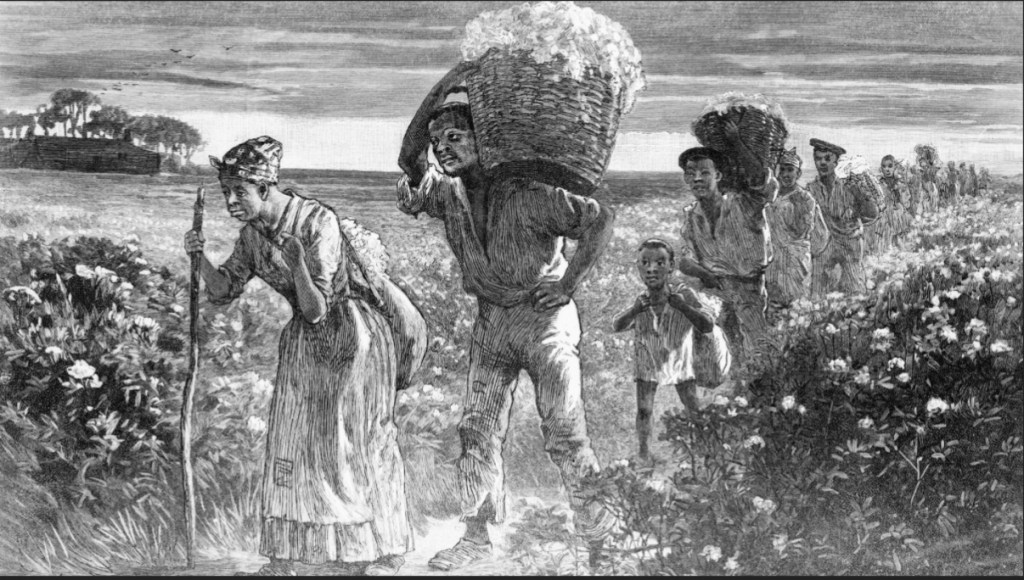
The Juneteenth holiday (June 19th) marks the anniversary of the abolition of slavery in the U.S. It should be viewed as a celebration of basic human rights. However, in purely economic terms, slavery was (and still is in many parts of the world) a complete revocation of property rights (self-ownership). But not only was slave-holding the worst sort of theft, it represented a total suspension of the labor market mechanism and had dire consequences for long-term economic development, especially in the south.

Government sanction of slaveholding in the southern U.S. and an extremely low effective wage for slaves promoted an excessive and inefficient dependence on, and utilization of, the low-cost input: slave labor. As a result, slavery created an obstacle to economic development, innovation, and capital deepening. The overall impact on the U.S. was to reduce economic welfare and development, and the dysfunction was obviously concentrated in the south.

That hasn’t stopped some activists from making the claim that slavery enabled the success of American capitalism. For example, this book contends that:

“… the expansion of slavery in the first eight decades after American independence drove the evolution and modernization of the United States.“

The so-called 1619 Project has promoted this narrative as well. Interestingly, this is similar to claims made prior to emancipation by defenders of slavery.

Of course, one can’t overemphasize the injustices suffered by American slaves, like those of other enslaved peoples throughout history. But it is foolhardy to attribute the long-term economic success of the American economy to slavery. Even today, 160 years after emancipation, it’s a safe bet that most Americans would be better off without its legacy.

To be clear I’ll outline several assertions I’m making here. First, if slaves had been free workers, they would have enjoyed freedoms and captured the value of their labors from the start. (Though it is not clear how many Africans would have come to America voluntarily as free workers, had they been given the opportunity. Some, however, were already enslaved.)

Under this counterfactual, more efficient pricing of labor would have led to deeper capital. At the same time, while many black non-slaves would still have worked in agriculture, blacks would have been more dispersed occupationally, working at tasks that best suited individual skills. The resulting efficiency gains would have been magnified by virtue of working in combination with more capital assets, enhancing productivity. And these workers would have been free to build their own human capital through education and work experience. Meanwhile, government would not have wasted resources enforcing slave ownership, and plantation owners (and other slave holders) would have made more rational resource allocation decisions. All these factors would have produced a net gain in welfare and improved economic development from at least the time of the nation’s founding.

There is no question that enslavement and the welfare losses suffered by slaves (and many of their descendants) far outweighed the gains captured by those who employed slave labor, as well as those who consumed or otherwise made use of the product of slave labor. A proper economic accounting of these losses acknowledges that slaves were denied their worker surplus and their ability to earn an opportunity cost, and they were often punished or tortured as a means of coercing greater effort. This serves to emphasize the implausibility of the argument that the America reaped net economic benefits from slavery.

Slavery was so powerful an institution that it permeated southern culture and perceptions of status. Wealth was tied-up in slave-chattel, and the free labor made for a handsome return on investment. Thus, both economic and cultural factors acted to lock producers into an unending series of short-run input decisions.

Furthermore, as Phil Magness explains in a letter to the Editor in the Wall Street Journal:

“… slavery’s economics … largely depended on government support. Fugitive slave patrols, military expenditures to fend off the threat of slave revolts and censorship of abolitionist materials by the post office were necessary to secure the institution’s economic position. These policies transferred the burden of enforcing the slave system from the plantation masters on to the taxpaying public.“

Meanwhile, the distortions to the cost of labor slowed the adoption of a variety of production techniques, including horse-drawn cultivators and harrows, steel plows, and steam-powered machinery. In other words, planters had little incentive to modernize production. Other technologies commonly used in the north during that era could have been applied in the south, but only to its much smaller share of acreage dedicated to grain crops.

Southern agricultural practices were “frozen in place”, as Rod D. Martin puts it. Ultimately, had southern planters adopted labor-saving technologies, and had southern governments shifted resources away from protecting slavery as an institution toward more diversified economic development, the antebellum economy would have experienced more rapid growth.

Growth in demand for cotton exports was certainly a boon to the south during the years preceding the Civil War, but the reliance on cotton was such that the southern economy was heavily exposed to risks of draught and other shocks. Furthermore, the lack of industrialization meant that southern states captured little of the final value of the textiles produced with cotton. The inadequacy of transportation infrastructure in the south was another serious detriment to long-term growth.

The work of Nathan Nunn, which is cited by Martin, generally supports the hypothesis that slavery retards economic growth. Nunn found a strong negative correlation between slave use and later economic development across different “New World” economies, as well as U.S. states and counties.

Martin goes so far as to say that the Union’s victory over the Confederacy was due in large part to economic under-development attributable to slavery in the south. That narrative has been challenged by a few scholars who claimed that the south was actually wealthier than the north. The owners of large southern plantations were quite well off, of course, but estimates of their wealth are unreliable, and in any case slaves themselves were highly illiquid “assets”. That meant planters would have been hard pressed to raise the capital needed for investment in labor-saving technologies, even if they’d had proper incentives to do so.

On the whole, there is no question the north was far more industrialized, diversified, and prosperous than the south. It was also much larger in terms of population and total output. Thus, Martin’s assertion that slavery explains why the south lost the Civil War is probably a bit too sweeping.

Nevertheless, the slavery “ecosystem” helps explain the south’s historic under-development. It was characterized by artificially cheap labor, illiquidity, a lack of diversification, a rigid social hierarchy based on the aberrant ownership of human chattel, and state subsidization of slave owners. These conditions restricted the supply of investment capital in the south. This was a drag on economic development before the Civil War. Those characteristics, along with the direct costs of the war itself, go a long way toward explaining the south’s lengthy period of depressed conditions after the Civil War as well.

It’s certainly not a knock on the slave population prior to emancipation to say that they were not responsible for the success of American capitalism. It’s a knock on the institution of slavery itself. Our wealth and the bounties produced by today’s economy are not supercharged by the efforts of slave labor in the distant past. If anything, our prosperity would be far greater had slavery never been practiced on U.S. soil.

I oppose reparations as a form of redistribution partly because most prospective payers today have absolutely no connection to slave-holding in antebellum America. It’s ironic that certain activists now argue for reparations based on imagined economic benefits once used to defend slavery itself.

Hamilton, Jefferson & Miranda’s Propaganda

12 Sunday Jun 2016

Posted by Nuetzel in Constitution, Slavery

≈ 2 Comments

Tags

13th Amendment, Abraham Lincoln, Alexander Hamilton, Bank of the United States, Ben Affleck, Central Bank, Charles Kessler, Commerce Clause, Corwin Amendment, Declaration of Independence, Hamilton on Broadway, James Madison, James Monroe, King George, Lin-Manuel Miranda, Manumission, Maria Reynolds, Michelle DuRoss, Necessary and Proper Clause, Raymond Burr, Ron Chernow, Spencer Kornhaber, State's Rights, The Atlantic, The Federalist Papers, Thomas Jefferson, Three-Fifths Compromise, Warren Meyer, Yeoman Farmer

image

I know too well to take any history I get from the theatre with a grain of salt! Nevertheless, I’d really like to see Hamilton on Broadway. It’s a hugely successful musical by Lin-Manuel Miranda about the life of Alexander Hamilton, one of our nation’s founding fathers, inspired by the book Alexander Hamilton by Ron Chernow. I’ve heard much of the show’s music, infused with R&B and rap/hip-hop; it’s more appealing to me than I’d ever have expected of rap. The show has been nominated for a record 16 Tony Awards (the ceremony is tonight), and of course it’s a very hot ticket. The last time I checked, the cheapest seats available were about $650 each for the last row in the house, and that was about 45 days out! With a party of four, that’s a cool $2,600 for an evening of theatre. I think we’ll wait for the touring production to roll through the midwest next year.

In Hamilton, all of the founding fathers are cast as people of color, a controversial decision that led to a recent uproar over a casting notice encouraging non-white performers to audition for leads. The casting of the founding fathers is an interesting artistic decision. One writer, Spencer Kornhaber in The Atlantic,  says that the “colorblind” casting:

“… is part of the play’s message that Alexander Hamilton’s journey from destitute immigrant to influential statesman is universal and replicable….“

That’s admirable, as far as it goes. I believe Kornhaber comes closer to Miranda’s  true motivation for the casting decision a paragraph later:

“… movements like Black Lives Matter, and renewed calls for the consideration of reparations, are built on the idea that ‘all’ remains an unfulfilled promise—and that fulfillment can only come by focusing on helping the specific populations that suffer greatest from America’s many inequalities rooted in oppression. … While Hamilton does not explicitly take a side, the simple fact of its casting suggests which way it probably leans.“

In broad strokes, the following is true about the drafting of the U.S. Constitution and arguments over its adoption: Alexander Hamilton favored provisions that tipped power in favor of the central government at the expense of the states, while Thomas Jefferson favored more stringent limits on central powers and strong states’ rights, or federalism as it is commonly known. It’s also true that over the years, Hamilton’s constitutional legacy tended to receive little emphasis in historical narratives relative to Jefferson’s. In the musical, Hamilton is portrayed as a hero to those who would benefit from a powerful and benevolent central government, particularly slaves, while Jefferson is portrayed in less flattering terms. Miranda’s casting implies that the relative emphasis on federal power versus states rights would surely have been reversed had the founding fathers been people of color.

A friend of mine saw the show before it became quite so hot. His kids are “theatre kids”, as mine were up to a certain age. I have great respect for my friend’s intellect and I am sympathetic to his political orientation, which I’d describe as libertarian with strong Randian influences. Here is his brief review of Hamilton:

“I loved Hamilton — it was a great night of theater. I even like the music — which is rap/hip-hop style that I haven’t found enjoyable, at least until now. My biggest concern about the play is its portrayal of Jefferson and Madison, who don’t come off well. Jefferson is a party boy more interested in partying in Paris than in seriously running a new nation. Both are portrayed as instigators in digging up dirt on Hamilton to use against him politically. Yes, they would have benefited from Hamilton’s womanizing scandals, but did they actively seek out that kind of trash? The play says yes…

And of course the play takes the position, I’d argue, that nothing Jefferson writes or says can be taken seriously because he is a slaveholder….the Bank of the U.S. is regarded by the play as a wonderful creation, thanks to Hamilton.“

I’ve read a number of accounts confirming Miranda’s treatment of Jefferson in the show, and the influence it apparently has on viewers without much background in political thought, American history, and the U.S. Constitution. I’ve lost the link, but one writer quoted his teenage daughter as saying “That Jefferson, he’s the WORST!”

There are a number of historical inaccuracies in Miranda’s book of Hamilton. An important fact contradicting the show’s vilification of Jefferson is that he, Madison and Aaron Burr:

“…did not approach Hamilton about his affair [as represented in the show], it was actually James Monroe and Frederick Muhlenberg in 1792. Monroe was a close friend of Jefferson’s and shared the information of Hamilton’s affair with him. In 1796, journalist James Callendar broke the story of Hamilton’s infidelity. Hamilton blamed Monroe, and the altercation nearly ended in a duel. “

In no way did Chernow implicate Jefferson as a participant in blackmail against Hamilton over the affair with an “emotionally unstable” Maria Reynolds. That is entirely Miranda’s invention. His fictionalized Jefferson is a conniving devil, a disgraceful misrepresentation.

Let’s get one other thing out of the way: it is not reasonable to condemn individuals or their actions of 220 years ago outside the context of general attitudes and practices of that period. That’s not to condone those attitudes and practices, however. Last year, I quoted Warren Meyer on this point:

“Meyer mentions the recent incident involving Ben Affleck, who asked the host of a PBS documentary to omit any mention of a slave-owning Affleck ancestor:

‘So an ancestor held opinions about slavery we all would find horrifying today. But given the times, I can bet that pretty much every relative of Affleck’s of that era, slaveholder or no, held opinions (say about women) that we would likely find offensive today.’“

By all accounts, Chernow’s book about Hamilton is an excellent biography, but not without its faults. Charles Kessler states that Chernow relies on other biographies rather than original source material, and that Chernow misrepresents the attitudes of Jefferson and James Madison on commerce; like Hamilton, they viewed it as a “civilizing influence of the highest order“. I’m the first to vouch for the importance of well-functioning capital markets, but apparently Chernow is under the mistaken impression that capitalism itself is intricately tied to powerful banks, particularly central banks like the Federal Reserve! And Chernow exaggerates the difference in the views of Jefferson and Hamilton on the Constitution itself. Here is Kessler:

“A huge gulf remains between Hamilton’s loyalty to what he called a ‘limited Constitution’ and today’s ‘living Constitution,’ which seems capable of justifying virtually any activity that the federal government sees fit to undertake.“

Both Jefferson and Hamilton recognized that abolition would have represented a huge obstacle to forming a new nation. And there was the related problem, recognized by both men, of whether and how to compensate slave owners in the event of abolition. It should go without saying that a failure to reach an agreement between the colonies at the Constitutional Convention would not have led to abolition of slavery by other means. The contrary is implicit in any argument that the constitutional compromise was wholly unjust. It might have been hoped that forming a union would establish a framework within which dialogue on the issue could continue, though ultimately, a fractured union and a war was necessary to finally  emancipate the slaves.

Yes, Jefferson held slaves and had a strong economic interest in keeping them. In his circle of wealthy landowners, slavery was considered a normal part of life. However, Jefferson also publicly advocated various plans to free slaves, one as early as 1779. Here is a clause from Jefferson’s rough draft of the Declaration of Independence, before it was revised by other members of the Committee of Five and by Congress, in reference to “his present majesty”, King George:

“he has waged cruel war against human nature itself, violating it’s most sacred rights of life & liberty in the persons of a distant people who never offended him, captivating & carrying them into slavery in another hemisphere, or to incur miserable death in their transportation thither. this piratical warfare, the opprobrium of infidel powers, is the warfare of [the] Christian king of Great Britain, determined to keep open a market where MEN should be bought & sold, he has prostituted his negative for suppressing every legislative attempt to prohibit or to restrain this execrable commerce ….“

While the clause was explicitly critical of trade in slaves, as distinct from ownership, it reveals the thinking of a man who was very progressive for his time. As for outright abolition, it is easy today to be critical of Jefferson’s proposals, which called for gradualism and, later, even deportation of freed slaves to Santo Domingo. Those proposals were based in part on fear shared by many authorities of an economic crisis and civil disorder if slaves were freed en masse. Jefferson certainly did not view slaves as equals to white men, but that was not unusual in those times; he did call for training them in certain skills as a condition of granting them freedom.

Hamilton’s record on slavery is not quite as heroic as Miranda’s musical would have you believe. He was highly ambitious and something of a social climber, so he was reluctant to air his views publicly regarding abolition. He married into a prominent New York slaveholding family, and there are records of his role in returning slaves captured by the British to their previous owners. From historian Michelle DuRoss (linked above):

“… when the issue of slavery came into conflict with his personal ambitions, his belief in property rights, or his belief of what would promote America’s interests, Hamilton chose those goals over opposing slavery. In the instances where Hamilton supported granting freedom to blacks, his primary motive was based more on practical concerns rather than an ideological view of slavery as immoral.“

Hamilton’s is known to have advocated manumission: freeing slaves who agreed to serve in the fight against the British. That position was a practical matter, as it would help in the war effort, and it might have played on the patriotic instincts of slaveowners who would otherwise insist on compensation. His mentor, George Washington, himself a reluctant slave owner, undoubtedly saw the practical value of manumission.

Hamilton’s real constitutional legacy came in two parts: first was his strong support for the Constitution during the ratification process and his (anonymous) contributions to The Federalist Papers. Later came his relatively broad interpretation of provisions granting certain powers to the federal government: the power to issue currency, the commerce clause and the “necessary and proper clause”. He also proposed a few ideas that were never adopted, such as lifetime terms in office for the president and members of the Senate. He did not propose any constitutional provision for the abolition of slavery or for granting full constitutional rights to slaves.

Hamilton was a major proponent of establishing a so-called national bank, known as the Bank of the United States when it was chartered in 1793. This allowed the new country to issue currency and was used as a way to eliminate war debts that were, by then, greatly diminished in value. Hamilton’s central bank meant great rewards to any investor who held the debt, especially those who had purchased the debt at a steep discount. Unfortunately, this was tantamount to monetizing government debt, or paying off debt by imposing an inflation tax (which reached 72% in the bank’s first five years of operation). The establishment of the bank also removed a major restraint on the growth of the federal government. Moreover, Hamilton was a protectionist, advocating tariffs on foreign goods and subsidies to domestic producers. It is little wonder that some have called him the “father of crony capitalism”.

Jefferson was quite possibly a bon vibrant in the best sense of the term, as opposed to the “party boy” depicted by Miranda. He was a man of great intellect, capable and actively conversant in philosophy, science and the practical arts. He wrote the Declaration of Independence, itself a forceful testimonial to natural rights. His constitutional legacy was powerful if indirect: he was a mentor to James Madison, who wrote the first draft of the Constitution. Jefferson was an advocate of majoritarian rule but also sought to protect individual rights against a tyranny of the majority. To that end, he advocated government limited in function to the protection of rights. In short, he was a classical liberal.

There were certainly contradictions between Jefferson’s philosophy and actions. Slaveholding was one, as already noted, but that was not unusual among southern aristocrats of the time, and Jefferson at least recognized the ethical dilemma and publicly offered policy solutions. But as a slaveholder, he made an odd spokesperson for the interests of the “yeoman farmer”, an agrarian individualist in the popular mind and a myth that persists to this day. Jefferson also advocated protectionist policies, such as an embargo on U.S. exports starting in 1807.

Yes, there were abolitionists at the time of our nation’s founding. Both Hamilton and Jefferson were quite sympathetic to the principle of abolition, but both recognized the practical difficulty of pushing it forward without endangering the founding of the nation, and both had personal and probably selfish reasons to avoid fighting that battle. The musical Hamilton glosses over this reality in the case of Hamilton himself, and at the same time condemns Jefferson. Miranda might just as well condemn Abraham Lincoln for his initial support of the original 13th (Corwin) Amendment in the early 1860s, which was never ratified. Ultimately, in 1865, a different 13th Amendment was ratified, accomplishing what would have been evident from the original text of the Constitution but for the so-called “three-fifths compromise”. That provision essentially counted a slave as 3/5s of a “free person” for purposes of apportioning representation and taxes, an idea originally proposed by Madison and revived by Alexander Hamilton himself!

I will still see the musical Hamilton when I get an opportunity. Lin-Manuel Miranda is a man of great talent, but he has misrepresented crucial facts about the Founders of the nation. Those interested in the truth, including those who teach our children, should not take it seriously as an account of history.

Follow Sacred Cow Chips on WordPress.com

Recent Posts

  • Immigration and Merit As Fiscal Propositions
  • Tariff “Dividend” From An Indigent State
  • Almost Looks Like the Fed Has a 3% Inflation Target
  • Government Malpractice Breeds Health Care Havoc
  • A Tax On Imports Takes a Toll on Exports

Archives

  • December 2025
  • November 2025
  • October 2025
  • September 2025
  • August 2025
  • July 2025
  • June 2025
  • May 2025
  • April 2025
  • March 2025
  • February 2025
  • January 2025
  • December 2024
  • November 2024
  • October 2024
  • September 2024
  • August 2024
  • July 2024
  • June 2024
  • May 2024
  • April 2024
  • March 2024
  • February 2024
  • January 2024
  • December 2023
  • November 2023
  • August 2023
  • July 2023
  • June 2023
  • May 2023
  • April 2023
  • March 2023
  • February 2023
  • January 2023
  • December 2022
  • November 2022
  • October 2022
  • September 2022
  • August 2022
  • July 2022
  • June 2022
  • May 2022
  • April 2022
  • March 2022
  • February 2022
  • January 2022
  • December 2021
  • November 2021
  • October 2021
  • September 2021
  • August 2021
  • July 2021
  • June 2021
  • May 2021
  • April 2021
  • March 2021
  • February 2021
  • January 2021
  • December 2020
  • November 2020
  • October 2020
  • September 2020
  • August 2020
  • July 2020
  • June 2020
  • May 2020
  • April 2020
  • March 2020
  • February 2020
  • January 2020
  • December 2019
  • November 2019
  • October 2019
  • September 2019
  • August 2019
  • July 2019
  • June 2019
  • May 2019
  • April 2019
  • March 2019
  • February 2019
  • January 2019
  • December 2018
  • November 2018
  • October 2018
  • September 2018
  • August 2018
  • July 2018
  • June 2018
  • May 2018
  • April 2018
  • March 2018
  • February 2018
  • January 2018
  • December 2017
  • November 2017
  • October 2017
  • September 2017
  • August 2017
  • July 2017
  • June 2017
  • May 2017
  • April 2017
  • March 2017
  • February 2017
  • January 2017
  • December 2016
  • November 2016
  • October 2016
  • September 2016
  • August 2016
  • July 2016
  • June 2016
  • May 2016
  • April 2016
  • March 2016
  • February 2016
  • January 2016
  • December 2015
  • November 2015
  • October 2015
  • September 2015
  • August 2015
  • July 2015
  • June 2015
  • May 2015
  • April 2015
  • March 2015
  • February 2015
  • January 2015
  • December 2014
  • November 2014
  • October 2014
  • September 2014
  • August 2014
  • July 2014
  • June 2014
  • May 2014
  • April 2014
  • March 2014

Blogs I Follow

  • Passive Income Kickstart
  • OnlyFinance.net
  • TLC Cholesterol
  • Nintil
  • kendunning.net
  • DCWhispers.com
  • Hoong-Wai in the UK
  • Marginal REVOLUTION
  • Stlouis
  • Watts Up With That?
  • Aussie Nationalist Blog
  • American Elephants
  • The View from Alexandria
  • The Gymnasium
  • A Force for Good
  • Notes On Liberty
  • troymo
  • SUNDAY BLOG Stephanie Sievers
  • Miss Lou Acquiring Lore
  • Your Well Wisher Program
  • Objectivism In Depth
  • RobotEnomics
  • Orderstatistic
  • Paradigm Library
  • Scattered Showers and Quicksand

Blog at WordPress.com.

Passive Income Kickstart

OnlyFinance.net

TLC Cholesterol

Nintil

To estimate, compare, distinguish, discuss, and trace to its principal sources everything

kendunning.net

The Future is Ours to Create

DCWhispers.com

Hoong-Wai in the UK

A Commonwealth immigrant's perspective on the UK's public arena.

Marginal REVOLUTION

Small Steps Toward A Much Better World

Stlouis

Watts Up With That?

The world's most viewed site on global warming and climate change

Aussie Nationalist Blog

Commentary from a Paleoconservative and Nationalist perspective

American Elephants

Defending Life, Liberty and the Pursuit of Happiness

The View from Alexandria

In advanced civilizations the period loosely called Alexandrian is usually associated with flexible morals, perfunctory religion, populist standards and cosmopolitan tastes, feminism, exotic cults, and the rapid turnover of high and low fads---in short, a falling away (which is all that decadence means) from the strictness of traditional rules, embodied in character and inforced from within. -- Jacques Barzun

The Gymnasium

A place for reason, politics, economics, and faith steeped in the classical liberal tradition

A Force for Good

How economics, morality, and markets combine

Notes On Liberty

Spontaneous thoughts on a humble creed

troymo

SUNDAY BLOG Stephanie Sievers

Escaping the everyday life with photographs from my travels

Miss Lou Acquiring Lore

Gallery of Life...

Your Well Wisher Program

Attempt to solve commonly known problems…

Objectivism In Depth

Exploring Ayn Rand's revolutionary philosophy.

RobotEnomics

(A)n (I)ntelligent Future

Orderstatistic

Economics, chess and anything else on my mind.

Paradigm Library

OODA Looping

Scattered Showers and Quicksand

Musings on science, investing, finance, economics, politics, and probably fly fishing.

  • Subscribe Subscribed
    • Sacred Cow Chips
    • Join 128 other subscribers
    • Already have a WordPress.com account? Log in now.
    • Sacred Cow Chips
    • Subscribe Subscribed
    • Sign up
    • Log in
    • Report this content
    • View site in Reader
    • Manage subscriptions
    • Collapse this bar
 

Loading Comments...