• About

Sacred Cow Chips

Sacred Cow Chips

Tag Archives: Capital Deepening

Some Dimensions Of the AI/Data Center Freakout

25 Thursday Jun 2026

Posted by Nuetzel in Artificial Intelligence, Government Failure

≈ Leave a comment

Tags

AI, AI Alignment, AI Land Use, AI Power Consumption, AI Regulation, Andy Masley, Anthropic, Bernie Sanders, Brian Albrecht, Capital Deepening, Chinese Communist Party, Comparative advantage, Dario Amodei, Data Centers, Dean Ball, Donald Trump, Elon Musk, Fable, Friedrich Hayek, Google, Luddites, Mythos, National Security, NIMBY, OpenAI, Rebecca Lowe, Sam Altman, Sam Altman (OpenAI), Sovereign Wealth Fund, Sundar Pichai, Superabundance, The Fatal Conceit, Timnit Gebru, Water Cooling, xAI
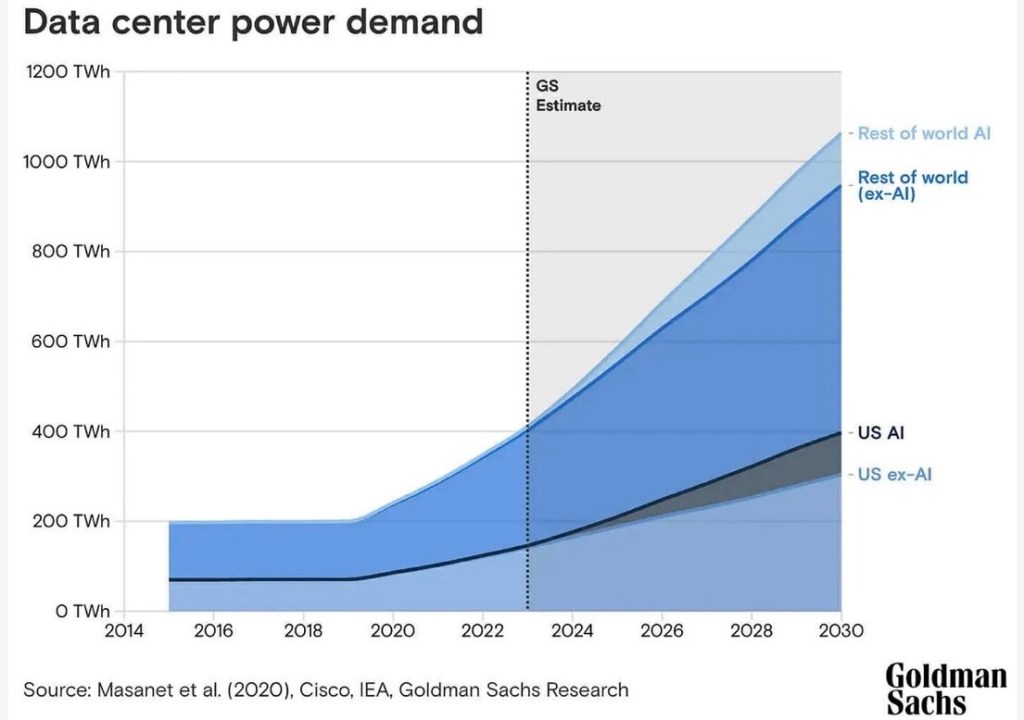
Bad policy ideas are circulating that have been conceived amid hysteria over AI. These are interventionist approaches to the development and deployment of AI models, ranging from direct confiscation of AI capital, taxes on the flow of compute, various forms of regulation, and state and local efforts to forbid the construction of data centers. All of these actions would unnecessarily inhibit achievement of AI’s enormous potential benefits and present unnecessary national security challenges as well.

Land Use and Displacement

Emotionally I’m probably just as NIMBY as the next guy when it comes to developments in my vicinity that might offend my personal aesthetics or intrude on my privacy. But at a more rational level, I object to developments that will inflict external costs on me. I happen to live in a private community that provides some buffer against incursions of those kinds, but I deeply sympathize with anyone who finds their property will soon be next door to a large or obnoxious industrial, commercial or government facility, and I despise the use of eminent domain for almost any purpose.

But let’s step back and consider the case in which an owner of private property receives what they feel is just compensation on the sale of their land to a data center developer. This property might be in your close proximity, but you can’t prevent your neighbor from selling unless it’s by way of a larger political process to revoke his property rights. Of course, you can help organize or join a resistance group in an attempt to stop the development. That’s perfectly reasonable if you fear the prospect of having your property stranded in the middle of a new industrial or commercial development.

Ultimately, such efforts are likely to influence negotiations between communities and developers. In fact, developers of data centers can often be persuaded to work with communities in addressing public concerns, and some developers are eager to do so.

Water and Power Consumption

Aside from land use, potential displacement, and aesthetic issues (including plain-old NIMBYism), other underlying concerns exciting local opposition to data centers have to do with predicted strains on water and power supplies. These are no doubt critical issues in certain localities. However, on the whole these concerns are vastly overblown, as elucidated by Andy Masley at this link. In particular, water use by data centers is on the same order of magnitude as other industrial uses. Contrary to some claims, any water pollution by data centers is usually confined to the construction phase, if at all, and in that respect is very much like any other construction project. And as Masley points out, a data center can generate tax revenue for use in reducing water scarcity.

It should also be noted that data centers house the computational power of the entire internet. As the chart (from Masley) at the top of this post shows, AI represents an incremental need that is still relatively small relative to total data center power use. Incidentally, water cooling rather than air cooling reduces a data center’s power consumption.

Nevertheless, the power consumption of data centers is indeed a matter of critical importance and controversy. Referring again to the chart at the top, it’s evident that data center power usage is growing rapidly. However, developers are increasingly planning to produce their own power off-grid, often colocating with their power sources to minimize transmission costs. This includes locating alongside natural gas basins, installing wind and solar collection facilities nearby, and coming soon, incorporating modular nuclear reactors. The latter would provide base-load, dispatchable, zero-carbon power for data centers. Of course, modular reactors will be costly and might eat into returns from developing data centers, but other power sources are costly as well, and it is the one sure dispatchable, zero-carbon, off-grid solution.

Water and energy supplies for data centers are key to enabling broad contributions of AI to consumer welfare, productivity growth, and national security. Local interests should weigh other benefits that construction of data centers will bring to a community. Construction jobs and permanent data center jobs are obviously important considerations, as well as the aforementioned increases in local tax revenue.

State Regulation and Litigation

Of course, AI controversies are playing out at the national and state levels as well. First, there is the issue of AI regulation. AI legislation in all 50 states attempts to regulate various “threatening” aspects of AI. These bills address topics such as fraud prevention (e.g., deep fakes), chatbot safety, and restrictions on automated AI decisioning (e.g., hiring, insurance coverage and claims adjudication).

There is litigation and potential litigation at the state level related to alleged abuses by Open AI’s ChatGPT. These concern the use of customer data and alleged encouragement of self-harm, among other matters. And the New York legislature has passed a bill calling for a one-year moratorium on AI data center development.

These regulatory and legal efforts at the state and local level raise the prospect of fragmented treatment of AI in different jurisdictions that would be disruptive and costly for both AI companies and users. Federalist principles aside, economic efficiency argues for a more uniform approach to many concerns about AI. But whether it’s at the federal, state, or local level, tight regulatory control of AI risks compromising the healthy competitive development of AI technology and the industry. That’s because politicians and bureaucrats cannot possess the knowledge of evolving competition, scarcity, and market incentives only revealed by free market processes.

Rooting for Regulation

Unfortunately, modern-day Luddites at the national level are calling for a moratorium on AI development. In fact, in 2023, fears of AI misalignment with human interests brought even Elon Musk to call for a six-month “pause” on development. Today, a number of industry insiders call for a “slowdown”, if only other countries go along with it (fat chance!).

Yes, AI is improving… fast, but the most consequential threats have to do with security protocols. Anthropic, in particular, almost begged for government control over its Mythos product, which recently gripped the AI and cybersecurity communities with its advanced ability to identify software vulnerabilities. The Fable version is said to incorporate “guardrails”, but reportedly Fable is vulnerable to “jailbreaks”. In what should not have surprised Anthropic after its own warnings, the federal government imposed export controls, restricting access by foreign nationals. And now, Anthropic has withdrawn availability of the models worldwide..

Be Careful What You Ask For

Perhaps Anthropic got what it deserved, but sadly, the Trump Administration seems to have crossed a threshold from a “light touch” approach to regulating AI to something more severe. Let’s hope the Mythos/Fable affair doesn’t presage a permanent transition from private governance to state control. That would inhibit development and present risks likely to rattle some of AI’s most important customers, .

The last link cites Timnit Gebru’s critique that AI labs have made a huge miscalculation:

“She argues that AI labs have consistently used ‘dangerous AI’ narratives for marketing, investor appeal, and competitive advantage, only for the narrative to backfire when actual state power intervenes. (on X)”

It’s possible that Anthropic and a few of its competitors have fallen for the same mistaken notion that central planning by government bureaucrats can improve upon market processes. Statists on the right and the left have been eager to join the chorus for regulatory control.

Fatal Conceit

Dean Ball channels Friedrich Hayek in the following tweet on the mistaken impression that government must impose a “strategy” and “plan” AI.

“I think part of it, at least vis a vis US/China competition, is that US and western chattering classes find it hard to believe that the market-driven outcome of frontier AI could possibly be right. They basically believe, in their hearts, that the Chinese system, with its ‘industrial strategy,’ has eclipsed capitalism. So they harbor the same inferiority complex toward the Chinese system that many Americans once harbored toward the EU’s system. Their heuristic is that the industrial strategists of China have grasped the whole picture of the technological competition in a way that US industrialists, with their ‘profit maximizing incentives,’ could not possibly have matched. And so any outcome in the economy that is not the result of ‘strategy’ is therefore prima facie worse than what the ‘strategists’ have concocted. They also believe the Chinese strategists possess awesome powers of foresight and the ability to evade all tendencies of financial and economic gravity, due of course to ‘strategy,’ really it’s almost a kind of orientalism.”

National security is an important consideration, of course, but AI development should not be hamstrung for fear of the ever-present need for improved encryption or by the prospect of threats from autonomous weapons systems. Indeed, AI can and should be put to use defending against all such threats to national security without compromising its promise as a revolutionary technology with a wide range of applications. Again, Trump’s purported intent to encourage U.S. AI development is undercut by his fixations on controlling trade and “taking stakes”. And do foreign customers want to deal with this confusing state of affairs? Or simply go to China?

AI and Capital Redistribution

Another nest of controversies has to do with the widespread presumption that AI will be negative for labor markets. Prescriptions from the populist left and right include various kinds of AI taxation, redistribution, and even nationalization.

Bernie Sanders and Donald Trump both want a sovereign wealth fund, and Sanders wants to fund it with a one-time 50% tax on AI stock. Sanders, the High Prince of Economic Parasites, is sponsoring a bill he claims would allow the American public to take a role in determining the future of AI, whatever that means. What he hopes to create is a mechanism for wealth redistribution, since the fashionable view is that AI will be a catastrophe for labor. While the AI industry is far from profitable at the moment, many AI stocks have soared in value. And Sanders’ target “AI industry” might fairly broad, including chip manufacturers and other producers of AI infrastructure.

If the public wants to kill AI investment in the U.S., tank equity markets, and give politicians an excuse for more profligate spending, then Sander’s bill is a grand idea. It would be an outright expropriation of wealth. The impacts on economic growth, productivity, American competitiveness, and national security would be unambiguously negative. And lest you think such a redistribution is necessary to compensate for job losses caused by AI, that issue is far from settled. In fact, it’s highly likely that the job realignment certain to take place will result in growth from a variety of occupations previously unimagined, just as technological advances have in the past.

The Compute Tax

Others (including Sanders) have also broached the idea of a “compute tax”, or as Brian Albrecht explains:

“… a levy on computational resources. Think GPU hours, processing power, data center electricity, or some similar proxy for AI work.”

Albrecht believes the real intent is to tax the stock of physical AI capital, as opposed to a flow of input services rendered for AI. But consider the number of goods and services whose values are likely to be enhanced by the use of AI as an input. And also consider the innovation and discovery that will be made possible by AI. Albrecht wisely questions the logic of adding to the cost and discouraging this value added via taxation. In the context of killing the golden goose, he cites two rules of optimal taxation: don’t tax intermediate goods and don’t tax capital. When the supply of capital is elastic, he notes, taxing it is more likely to harm workers than to help them. And one can reasonably argue that the external benefits expected to flow from AI would justify a compute subsidy rather than a tax. Finally, Albrecht cautions that a compute tax, unless it is very broad and at a very high rate, won’t raise much revenue.

Trump’s Confusion

Bernie Sanders deserves plenty of condemnation for his infantile, class-warfare rhetoric and interventionist approach to economic policy, including state ownership of the means of production. But in practice Donald Trump isn’t much better. He’s been busy partially nationalizing several different industries, including steel, semiconductors, nuclear energy, rocket motors, quantum computing, and critical mineral supplies, often with direct reins on business decisions (e.g., the “Golden Share” in U.S. Steel). Now, he’s angling to acquire equity stakes in AI companies. The Senate Armed Services Committee is ready to help him out with a bill that would establish a Department of Defense Equity Investment Account at the Treasury.

These are all part of the sovereign wealth fund Trump has decided is in the fiscal and national security interests of the U.S. Again, government ownership stakes in private companies invite cronyism, political interference, and regulatory capture. In the case of AI, it is an invitation to censorship and government surveillance. Moreover, spare government funds would be better spent paying down our burgeoning public debt, reducing government obligations and interest expense at zero risk. In contrast, the value of private equity stakes and their returns are fully at risk, while leaving government debt, interest expenses, and interest rate rollover risks in place.

Trump is now inveigling the likes of Sam Altman (OpenAI), Dario Amodei (Anthropic), Sundar Pichai (Google), and even Elon Musk (xAI) to accept his vision of public ownership of AI stock. It’s effectively a trap and a prescription for competitive failure, but Trump doesn’t get it.

Superabundance?

Many AI industry leaders have indeed bought into some version of an AI wealth transfer, primarily because they accept the notion of superabundance along with heavy losses of remunerative work for humans. But in fact they don’t understand the economics of capital deepening and the contradictions implied by their position.

First, savings and funds available for capex are scarce, and any given project for AI buildout must compete with many other valued uses. The working world will not be monopolized by AI robots any time soon, even given dramatic cost reductions. AI may well increase the productivity of human workers (along with their wages) in greater proportion than other forms of physical capital. But some forms of labor are likely to be in surplus, and that will cause the wages in those occupations to become more competitive relative to the cost of potential AI-augmented substitutes. In fact, occupations in which humans are more competitive than machines will persist. Here is Albrecht on this point:

“And comparative advantage always pops up fighting against [human job losses]. When automation makes some things cheap, the things that remain expensive tend to be the things that are hard to automate. And the things that are hard to automate are, almost by definition, the things where humans still have comparative advantage. The saved dollar drifts toward where humans are still worth paying. That’s not optimism. That’s what comparative advantage means.“

A second contradiction of the superabundance job-loss narrative is, as I’ve said, that there will be many inventive new occupations available for humans. At worst, job losses will be a transitional phenomenon. Third, superabundance itself implies drastically lower prices, which would ultimately benefit wage earners and consumers, obviating the need for government intervention on their behalf.

I had to laugh when I read this quote of Rebecca Lowe, who has an amusing and sensible reaction to the “AI will take all the jobs” narrative:

“I think a large part of this is you don’t really get experts in their particular domains writing about AI. Instead, you get ‘the AI expert’, and they want to reinvent the wheel. You see this when they write about economics, or when they write about philosophy. You talk to an AI person and suddenly they’re like, ‘I’ve just discovered this thing!’ And it turns out they’re talking about, like, supply and demand. And you’re like, oh my God.”

CCP Interference

I’ll briefly touch on one other controversy: whether the anti-AI/data center furor is being instigated by the Chinese in an attempt to undermine U.S. leadership in AI. The House Energy and Commerce Committee claims to have evidence that strongly suggests the CCPs involvement in attempts to hamstring substantial U.S. leadership in AI. Apparently no details on that evidence have been made public, however. It would not be surprising or uncharacteristic of the CCP, and if true would constitute another tension in the attempt to safeguard national security while avoiding government obstruction in AI development.

Summary

Artificial intelligence is animating economic controversies at the local, state and federal levels. Like other forms of industrial development, opponents are roused by claims of strains on local resources as well as displacement of property owners. Some of these claims are exaggerated or can be resolved via negotiation or technological solutions.

There are also fears that AI can be used in a variety of nefarious ways. There may be legitimate dangers, and AI companies themselves are actively working to address so called “alignment” issues. Nevertheless, there are increasing calls for state and/or federal regulation of AI. These proposals must be approached cautiously or they could easily derail U.S. progress on perhaps the most promising technologies to ever come down the line. That would indeed represent an economic and national security failure.

Finally, fear that AI will lead to large-scale job losses and widening inequality has prompted calls for taxes on AI capital, or even partial nationalization, with redistribution of future profits to the public. This would be a colossal mistake. Nothing could stanch AI development more effectively than such a policy. Unfortunately, even Donald Trump has called for the government to take equity stakes in AI companies pursuant to “national priorities” and supposedly for the benefit of American taxpayers. In fact, this partial nationalization has already begun. This is a prescription for destructive regulation, planning failures, and corruption.

The key lesson in all this is that we’ll all be better off if government stays out of the way of AI development.

Juneteenth Marred By An Economic Fallacy

28 Saturday Jun 2025

Posted by Nuetzel in Economic Development, Slavery

≈ Leave a comment

Tags

1619 Project, Abolition, Antebellum South, Capital Deepening, Civil War, Coercion, Emancipation, Juneteenth, Nathan Nunn, Phil Magness, Redistribution, Reparatiins, Rod D. Martin, Slavery, Welfare Loss

The Juneteenth holiday (June 19th) marks the anniversary of the abolition of slavery in the U.S. It should be viewed as a celebration of basic human rights. However, in purely economic terms, slavery was (and still is in many parts of the world) a complete revocation of property rights (self-ownership). But not only was slave-holding the worst sort of theft, it represented a total suspension of the labor market mechanism and had dire consequences for long-term economic development, especially in the south.

Government sanction of slaveholding in the southern U.S. and an extremely low effective wage for slaves promoted an excessive and inefficient dependence on, and utilization of, the low-cost input: slave labor. As a result, slavery created an obstacle to economic development, innovation, and capital deepening. The overall impact on the U.S. was to reduce economic welfare and development, and the dysfunction was obviously concentrated in the south.

That hasn’t stopped some activists from making the claim that slavery enabled the success of American capitalism. For example, this book contends that:

“… the expansion of slavery in the first eight decades after American independence drove the evolution and modernization of the United States.“

The so-called 1619 Project has promoted this narrative as well. Interestingly, this is similar to claims made prior to emancipation by defenders of slavery.

Of course, one can’t overemphasize the injustices suffered by American slaves, like those of other enslaved peoples throughout history. But it is foolhardy to attribute the long-term economic success of the American economy to slavery. Even today, 160 years after emancipation, it’s a safe bet that most Americans would be better off without its legacy.

To be clear I’ll outline several assertions I’m making here. First, if slaves had been free workers, they would have enjoyed freedoms and captured the value of their labors from the start. (Though it is not clear how many Africans would have come to America voluntarily as free workers, had they been given the opportunity. Some, however, were already enslaved.)

Under this counterfactual, more efficient pricing of labor would have led to deeper capital. At the same time, while many black non-slaves would still have worked in agriculture, blacks would have been more dispersed occupationally, working at tasks that best suited individual skills. The resulting efficiency gains would have been magnified by virtue of working in combination with more capital assets, enhancing productivity. And these workers would have been free to build their own human capital through education and work experience. Meanwhile, government would not have wasted resources enforcing slave ownership, and plantation owners (and other slave holders) would have made more rational resource allocation decisions. All these factors would have produced a net gain in welfare and improved economic development from at least the time of the nation’s founding.

There is no question that enslavement and the welfare losses suffered by slaves (and many of their descendants) far outweighed the gains captured by those who employed slave labor, as well as those who consumed or otherwise made use of the product of slave labor. A proper economic accounting of these losses acknowledges that slaves were denied their worker surplus and their ability to earn an opportunity cost, and they were often punished or tortured as a means of coercing greater effort. This serves to emphasize the implausibility of the argument that the America reaped net economic benefits from slavery.

Slavery was so powerful an institution that it permeated southern culture and perceptions of status. Wealth was tied-up in slave-chattel, and the free labor made for a handsome return on investment. Thus, both economic and cultural factors acted to lock producers into an unending series of short-run input decisions.

Furthermore, as Phil Magness explains in a letter to the Editor in the Wall Street Journal:

“… slavery’s economics … largely depended on government support. Fugitive slave patrols, military expenditures to fend off the threat of slave revolts and censorship of abolitionist materials by the post office were necessary to secure the institution’s economic position. These policies transferred the burden of enforcing the slave system from the plantation masters on to the taxpaying public.“

Meanwhile, the distortions to the cost of labor slowed the adoption of a variety of production techniques, including horse-drawn cultivators and harrows, steel plows, and steam-powered machinery. In other words, planters had little incentive to modernize production. Other technologies commonly used in the north during that era could have been applied in the south, but only to its much smaller share of acreage dedicated to grain crops.

Southern agricultural practices were “frozen in place”, as Rod D. Martin puts it. Ultimately, had southern planters adopted labor-saving technologies, and had southern governments shifted resources away from protecting slavery as an institution toward more diversified economic development, the antebellum economy would have experienced more rapid growth.

Growth in demand for cotton exports was certainly a boon to the south during the years preceding the Civil War, but the reliance on cotton was such that the southern economy was heavily exposed to risks of draught and other shocks. Furthermore, the lack of industrialization meant that southern states captured little of the final value of the textiles produced with cotton. The inadequacy of transportation infrastructure in the south was another serious detriment to long-term growth.

The work of Nathan Nunn, which is cited by Martin, generally supports the hypothesis that slavery retards economic growth. Nunn found a strong negative correlation between slave use and later economic development across different “New World” economies, as well as U.S. states and counties.

Martin goes so far as to say that the Union’s victory over the Confederacy was due in large part to economic under-development attributable to slavery in the south. That narrative has been challenged by a few scholars who claimed that the south was actually wealthier than the north. The owners of large southern plantations were quite well off, of course, but estimates of their wealth are unreliable, and in any case slaves themselves were highly illiquid “assets”. That meant planters would have been hard pressed to raise the capital needed for investment in labor-saving technologies, even if they’d had proper incentives to do so.

On the whole, there is no question the north was far more industrialized, diversified, and prosperous than the south. It was also much larger in terms of population and total output. Thus, Martin’s assertion that slavery explains why the south lost the Civil War is probably a bit too sweeping.

Nevertheless, the slavery “ecosystem” helps explain the south’s historic under-development. It was characterized by artificially cheap labor, illiquidity, a lack of diversification, a rigid social hierarchy based on the aberrant ownership of human chattel, and state subsidization of slave owners. These conditions restricted the supply of investment capital in the south. This was a drag on economic development before the Civil War. Those characteristics, along with the direct costs of the war itself, go a long way toward explaining the south’s lengthy period of depressed conditions after the Civil War as well.

It’s certainly not a knock on the slave population prior to emancipation to say that they were not responsible for the success of American capitalism. It’s a knock on the institution of slavery itself. Our wealth and the bounties produced by today’s economy are not supercharged by the efforts of slave labor in the distant past. If anything, our prosperity would be far greater had slavery never been practiced on U.S. soil.

I oppose reparations as a form of redistribution partly because most prospective payers today have absolutely no connection to slave-holding in antebellum America. It’s ironic that certain activists now argue for reparations based on imagined economic benefits once used to defend slavery itself.

Trade Charades and a Capital Crusade

15 Tuesday Apr 2025

Posted by Nuetzel in Balance of Payments, Federal Budget, Protectionism

≈ 4 Comments

Tags

Balance of Payments, Capital Account, Capital Deepening, Capital Surplus, central planning, Cronyism, Current Account, Donald Trump, Federal Budget Deficit, John Cochrane, Reciprocal Tariffs, Scott Lincicome, Trade Barriers, Trade Deficit

I’m nowhere near eating crow over the skepticism I’ve directed at Donald Trump’s trade offensive. The uncertainty created by his erratic policy changes is very likely to drag the U.S. into recession. However, there were signs last week of movement in a more promising direction, as he placed a 90-day pause on the targeted “reciprocal” tariffs announced in early April. However, a “baseline” universal tariff of 10% still applies to all imported goods. So do tariffs targeted at China, which have ratcheted up through a few rounds of retaliation. Now, he’s announced exemptions for some key electronics products, many of which come from China, and there are signs that he’s ready to exempt imports of auto parts. Needless to say, the tariffs and their exemptions represent an ill-advised escapade in central planning, replete with ample opportunities for politically-motivated favoritism and prejudice.

Why the Pause?

The pause in reciprocal tariffs was ostensibly intended to allow time to negotiate lower trade barriers with “more than 75 countries” that came forward to engage with Trump rather than retaliate. Now, there are said to be as many as 90 countries that wish to negotiate. This more or less aligns with an evolution of the strategy I described in my last post: game theory suggests that a dominant trading partner may be able to threaten or impose higher tariffs and ultimately achieve agreement on a regime with lower trade barriers on both sides. In Trump’s case, that would involve reaching many different bilateral agreements within a very short time, an imposing challenge given the history of trade negotiations. So far we have no deals, though Trump claims some are close. If only we didn’t have to reach formal agreements not to interfere with mutually beneficial trade!

A debate ensued almost immediately over whether Trump’s pause showed that he “caved” to the negative market reaction to his tariffs, but perhaps he acted primarily because a number of nations approached with hats in hand. Trump knew he had the leverage to force other nations to make concessions on trade barriers. They obviously responded.

The timing of the pause was surely a combination of those overtures, market reaction, advisor opinion, and Trump’s own instincts. This view is buttressed by the unaltered universal 10% tariffs, the remaining special tariffs on specific nations and product categories, and the punative tariffs on China. Furthermore, Trump knows he can reimpose a targeted tariff on any country that refuses a deal satisfactory to him. Let’s hope he’s reasonable and doesn’t allow his love affair with tariffs to color his position in these talks.

My hope is that the Trump Administration can negotiate a large number of new agreements with trading partners to reduce or eliminate tariffs and other barriers to trade. Obviously the pause is no guarantee of success, and severe challenges remain with more belligerent trading partners, especially China.

Disclaimer!

None of the foregoing is intended as a dispensation for the many apparent misconceptions Trump has about trade. In the MAGA cult clamor to defend all-things Trump, there have been a number of absurd claims about tariffs and trade, such as: tariffs are not a tax; tariffs don’t raise the price of imports; trade deficits are a deduction from GDP; tariffs can replace the income tax; trade deficits will bankrupt the country; high tariffs produced rapid growth in the late 19th century; “reciprocal” tariffs will eliminate our bilateral trade deficits; U.S. manufacturing is in crisis; value added taxes are trade barriers; it’s better to export goods than services; and trade deficits reduce investment. Every one a laugher, but I’ll leave most of them aside for now.

In the remainder of this post, I’ll focus on Trump’s aims for coaxing firms, via tariff avoidance, to make capital investment in the U.S., and the implications of that effort for the trade balance. An influx of capital might be construed as a strength of Trump’s policy agenda, though his effort to “cut deals” in this manner is a form of economic meddling as well as a vehicle for cronyism. Moreover, he doesn’t understand the nexus between foreign investment, the federal deficit, and the balance of payments. He’ll be disappointed to learn that his notion that trade deficits are ruinous conflicts with his vision of encouraging foreign accumulations of productive U.S. assets.

Oh No! A Capital Surplus!

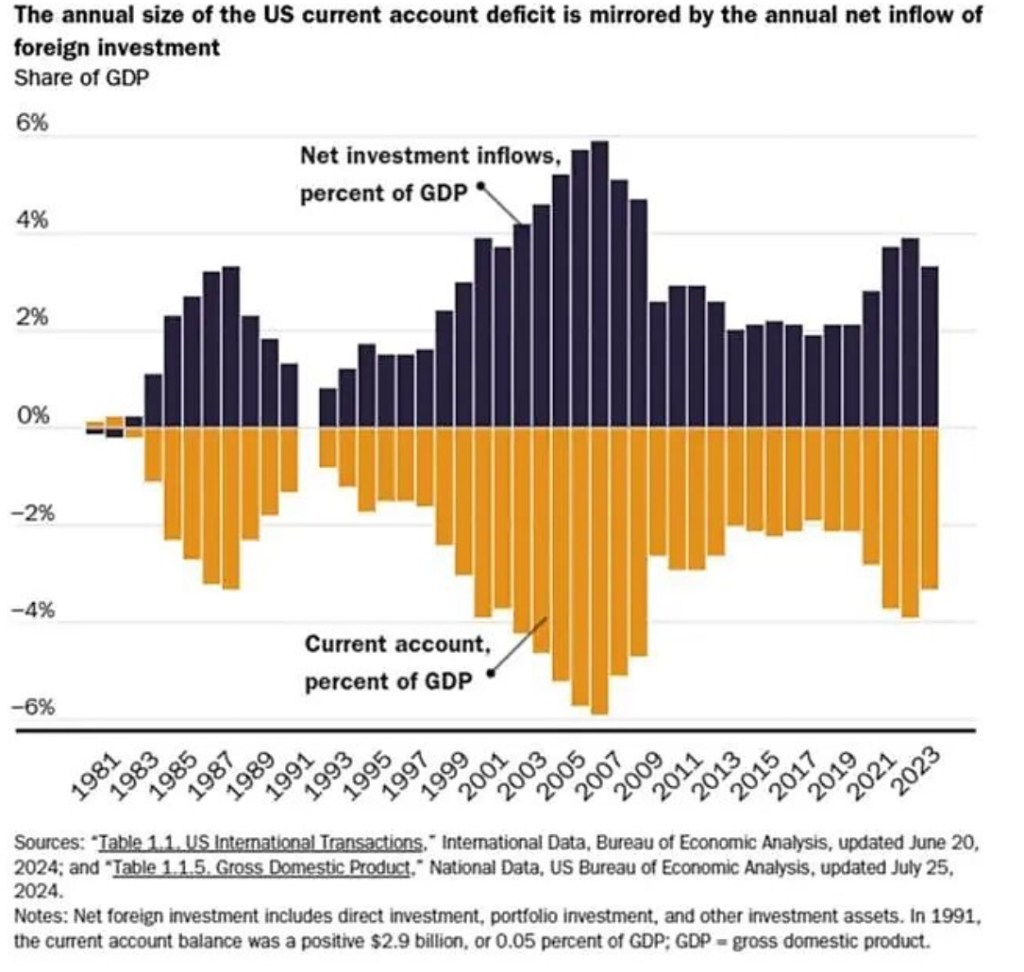
It isn’t a widely understood equivalence, but each year we have a surplus in foreign purchases of U.S. assets (the capital account surplus) that is roughly matched by a deficit in trade for foreign goods and services (the current account deficit). This is why the balance of payments (BoP) balances! Here is the near mirror image of these two sides of the BoP, from Scott Lincicome’s “Things Everyone Should Know about Trade Deficits”:

The two sides of the BoP are very much codetermined. One does not exclusively drive the other.

It’s wonderful to be in a position to avail ourselves of foreign savings to invest in our economy. Unfortunately, a large portion of this foreign investment finances our huge government budget deficit, and that is a real problem. Otherwise, the investment would make a greater contribution to U.S. growth.

Funding the Federal Deficit

As John Cochrane explains, transfer payments account for a large share of government spending and borrowing. In turn, these transfers are spent by recipients on consumer goods, some of which come from overseas. Cochrane emphasizes that we are borrowing from abroad, as shown by our capital surplus, to finance this consumption, rather than investing foreign capital in productive assets. While one might conclude that our capital surplus and our trade deficit are creating a long-term vulnerability, the root of the problem is the federal government’s largess.

There is a sense in which different prongs of Trump’s policy agenda could act to address this problem. These are his efforts to reduce government waste, deregulate, and encourage direct investment in new plant and equipment. Reducing the federal budget deficit is paramount, but huge doubts remain over his determination to control spending or undertake real entitlement reforms. Tariffs will generate some revenue, but part of that will be required to offset other tax breaks Trump is contemplating.

Deepening the Capital Base

Trump harps on the need for firms, both foreign and domestic, to produce goods here in the U.S. Currently he’s taking credit for $5 trillion of new investment in the U.S., though we really don’t know whether all of these are “new deals” or had already been planned. Deregulation can improve incentives to invest in physical capital and increase the speed with which it comes online. To the extent that investment in productive capital replaces government borrowing, the debt we accumulate (held by foreign and domestic lenders) will be more sustainable.

However, Trump seems oblivious to a fact made inescapable by the balance of payments relationship. This new investment, should it come to fruition, will bring with it future excesses of imports over exports. Foreign demand for U.S. capital assets lifts domestic income and leads to a stronger dollar, both of which boost imports and the trade deficit. The trade deficit will persist even if foreign investment in new factories fully replaces the bloated federal deficit as a use of foreign capital.

Of course, the intent of Trump’s reshoring campaign is for new domestic output to substitute for imports and increase exports. That would bring positive returns for domestic and foreign capital, but rising income and a stronger dollar will stimulate demand for other imports, while exports would flag with the strength of the dollar. In any case, the new investments and a larger capital surplus will increase the trade deficit.

Follow Sacred Cow Chips on WordPress.com

Recent Posts

  • Some Dimensions Of the AI/Data Center Freakout
  • Warsh and Fed Confront a Crossroads On Policies
  • Isotopes Point To Natural CO2 Origins
  • Is “Global Temperature” a Fiction?
  • ESG Contortions: Virtue, Returns, and Politics

Archives

  • June 2026
  • May 2026
  • April 2026
  • March 2026
  • February 2026
  • January 2026
  • December 2025
  • November 2025
  • October 2025
  • September 2025
  • August 2025
  • July 2025
  • June 2025
  • May 2025
  • April 2025
  • March 2025
  • February 2025
  • January 2025
  • December 2024
  • November 2024
  • October 2024
  • September 2024
  • August 2024
  • July 2024
  • June 2024
  • May 2024
  • April 2024
  • March 2024
  • February 2024
  • January 2024
  • December 2023
  • November 2023
  • August 2023
  • July 2023
  • June 2023
  • May 2023
  • April 2023
  • March 2023
  • February 2023
  • January 2023
  • December 2022
  • November 2022
  • October 2022
  • September 2022
  • August 2022
  • July 2022
  • June 2022
  • May 2022
  • April 2022
  • March 2022
  • February 2022
  • January 2022
  • December 2021
  • November 2021
  • October 2021
  • September 2021
  • August 2021
  • July 2021
  • June 2021
  • May 2021
  • April 2021
  • March 2021
  • February 2021
  • January 2021
  • December 2020
  • November 2020
  • October 2020
  • September 2020
  • August 2020
  • July 2020
  • June 2020
  • May 2020
  • April 2020
  • March 2020
  • February 2020
  • January 2020
  • December 2019
  • November 2019
  • October 2019
  • September 2019
  • August 2019
  • July 2019
  • June 2019
  • May 2019
  • April 2019
  • March 2019
  • February 2019
  • January 2019
  • December 2018
  • November 2018
  • October 2018
  • September 2018
  • August 2018
  • July 2018
  • June 2018
  • May 2018
  • April 2018
  • March 2018
  • February 2018
  • January 2018
  • December 2017
  • November 2017
  • October 2017
  • September 2017
  • August 2017
  • July 2017
  • June 2017
  • May 2017
  • April 2017
  • March 2017
  • February 2017
  • January 2017
  • December 2016
  • November 2016
  • October 2016
  • September 2016
  • August 2016
  • July 2016
  • June 2016
  • May 2016
  • April 2016
  • March 2016
  • February 2016
  • January 2016
  • December 2015
  • November 2015
  • October 2015
  • September 2015
  • August 2015
  • July 2015
  • June 2015
  • May 2015
  • April 2015
  • March 2015
  • February 2015
  • January 2015
  • December 2014
  • November 2014
  • October 2014
  • September 2014
  • August 2014
  • July 2014
  • June 2014
  • May 2014
  • April 2014
  • March 2014

Blogs I Follow

  • Passive Income Kickstart
  • OnlyFinance.net
  • TLC Cholesterol
  • Nintil
  • kendunning.net
  • DCWhispers.com
  • Hoong-Wai in the UK
  • Marginal REVOLUTION
  • Stlouis
  • Watts Up With That?
  • American Elephants
  • The View from Alexandria
  • The Gymnasium
  • A Force for Good
  • Notes On Liberty
  • troymo
  • SUNDAY BLOG Stephanie Sievers
  • Miss Lou Acquiring Lore
  • Your Well Wisher Program
  • Objectivism In Depth
  • RobotEnomics
  • Orderstatistic
  • Paradigm Library
  • Scattered Showers and Quicksand
  • Jam Review

Blog at WordPress.com.

Passive Income Kickstart

OnlyFinance.net

TLC Cholesterol

Nintil

To estimate, compare, distinguish, discuss, and trace to its principal sources everything

kendunning.net

The Future is Ours to Create

DCWhispers.com

Hoong-Wai in the UK

A Commonwealth immigrant's perspective on the UK's public arena.

Marginal REVOLUTION

Small Steps Toward A Much Better World

Stlouis

Watts Up With That?

The world's most viewed site on global warming and climate change

American Elephants

Defending Life, Liberty and the Pursuit of Happiness

The View from Alexandria

In advanced civilizations the period loosely called Alexandrian is usually associated with flexible morals, perfunctory religion, populist standards and cosmopolitan tastes, feminism, exotic cults, and the rapid turnover of high and low fads---in short, a falling away (which is all that decadence means) from the strictness of traditional rules, embodied in character and inforced from within. -- Jacques Barzun

The Gymnasium

A place for reason, politics, economics, and faith steeped in the classical liberal tradition

A Force for Good

How economics, morality, and markets combine

Notes On Liberty

Spontaneous thoughts on a humble creed

troymo

SUNDAY BLOG Stephanie Sievers

Escaping the everyday life with photographs from my travels

Miss Lou Acquiring Lore

Gallery of Life...

Your Well Wisher Program

Attempt to solve commonly known problems…

Objectivism In Depth

Exploring Ayn Rand's revolutionary philosophy.

RobotEnomics

(A)n (I)ntelligent Future

Orderstatistic

Economics, chess and anything else on my mind.

Paradigm Library

OODA Looping

Scattered Showers and Quicksand

Musings on science, investing, finance, economics, politics, and probably fly fishing.

Jam Review

"If you get confused, listen to the music play."

  • Subscribe Subscribed
    • Sacred Cow Chips
    • Join 128 other subscribers
    • Already have a WordPress.com account? Log in now.
    • Sacred Cow Chips
    • Subscribe Subscribed
    • Sign up
    • Log in
    • Report this content
    • View site in Reader
    • Manage subscriptions
    • Collapse this bar

Loading Comments...