• About

Sacred Cow Chips

Sacred Cow Chips

Tag Archives: Facebook

Mr. Musk Often Goes To Washington

31 Monday Jul 2017

Posted by Nuetzel in Automation, Labor Markets, Technology

≈ 1 Comment

Tags

Absolute Advantage, Comparative advantage, DeepMind, Elon Musk, Eric Schmidt, Facebook, Gigafactory, Google, Mark Zuckerberg, OpenAI, rent seeking, Ronald Bailey, SpaceX, Tesla
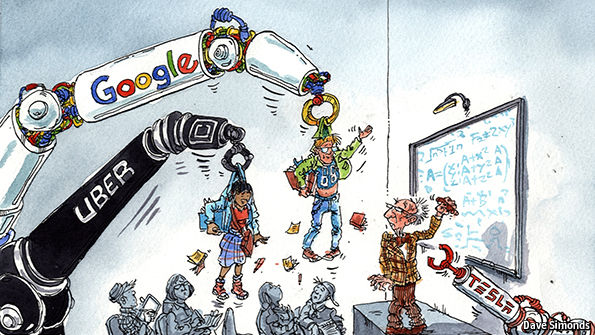
Elon Musk says we should be very scared of artificial intelligence (AI). He believes it poses an “existential risk” to humanity and  calls for “proactive regulation” of AI to limit its destructive potential. His argument encompasses “killer robots”: “A.I. & The Art of Machine War” is a good read and is consistent with Musk’s message. Military applications already involve autonomous machine decisions to terminate human life, but the Pentagon is weighing whether decisions to kill should be made only by humans. Musk also focuses on more subtle threats from machine intelligence: It could be used to disrupt power and communication systems, to manipulate human opinion in dangerous ways, and even to sow panic via cascades of “fake robot news”, leading to a breakdown in civil order. Musk has also expressed a fear that AI could have disastrous consequences in commercial applications with runaway competition for resources. He sounds like a businessmen who really dislikes competition! After all, market competition is self-regulating and self-limiting. The most “destructive” effects occur only when competitors come crying to the state for relief!

Several prominent tech leaders and AI experts have disputed Musk’s pessimistic view of AI, including Mark Zuckerberg of Facebook and Eric Schmidt, chairman of Google’s parent company, Alphabet, Inc. Schmidt says:

“My question to you is: don’t you think the humans would notice this, and start turning off the computers? We’d have a race between humans turning off computers, and the AI relocating itself to other computers, in this mad race to the last computer, and we can’t turn it off, and that’s a movie. It’s a movie. The state of the earth currently does not support any of these scenarios.“

Along those lines, Google’s AI lab known as “DeepMind” has developed an AI off-switch, otherwise known as the “big red button“. Obviously, this is based on human supervision of AI processes and on ensuring the interruptibility of AI processes.

Another obvious point is that AI, ideally, would operate under an explicit objective function(s). This is the machine’s “reward system”, as it were. Could that reward system always be linked to human intent? To a highly likely non-negative human assessment of outcomes? Improved well-being? That’s not straightforward in a world of uncertainty, but it is at least clear that a relatively high probability of harm to humans should impose a large negative effect on any intelligent machine’s objective function.

Those kinds of steps can be regarded as regulatory recommendations, which is what Musk has advocated. Musk has outlined a role for regulators as gatekeepers who would review and ensure the safety of any new AI application. Ronald Bailey reveals the big problem with this approach:

“This may sound reasonable. But Musk is, perhaps unknowingly, recommending that AI researchers be saddled with the precautionary principle. According to one definition, that’s ‘the precept that an action should not be taken if the consequences are uncertain and potentially dangerous.’ Or as I have summarized it: ‘Never do anything for the first time.’“

Regulation is the enemy of innovation, and there are many ways in which current and future AI applications can improve human welfare. Musk knows this. He is the consummate innovator and big thinker, but he is also skilled at leveraging the power of government to bring his ideas to fruition. All of his major initiatives, from Tesla to SpaceX, to Hyperloop, battery technology and solar roofing material, have gained viability via subsidies.

But another hallmark of crony capitalists is a willingness to use regulation to their advantage. Could proposed regulation be part of a hidden agenda for Musk? For example, what does Musk mean when he says, “There’s only one AI company that worries me” in the context of dangerous AI? His own company(ies)? Or another? One he does not own?

Musk’s startup OpenAI is a non-profit engaged in developing open-source AI technology. Musk and his partners in this venture argue that widespread, free availability of AI code and applications would prevent malicious use of AI. Musk knows that his companies can use AI to good effect as well as anyone. And he also knows that open-source AI can neutralize potential advantages for competitors like Google and Facebook. Perhaps he hopes that his first-mover advantage in many new industries will lead to entrenched market positions just in time for the AI regulatory agenda to stifle competitive innovation within his business space, providing him with ongoing rents. Well played, cronyman!

Any threat that AI will have catastrophic consequences for humanity is way down the road, if ever. In the meantime, there are multiple efforts underway within the machine learning community (which is not large) to prevent or at least mitigate potential dangers from AI. This is taking place independent of any government action, and so it should remain. That will help to maximize the potential for beneficial innovation.

Musk also asserts that robots will someday be able to do “everything better than us”, thus threatening the ability of the private sector to provide income to individuals across a broad range of society. This is not at all realistic. There are many detailed and nuanced tasks to which robots will not be able to attend without human collaboration. Creativity and the “human touch” will always have value and will always compete in input markets. Even if robots can do everything better than humans someday, an absolute advantage is not determinative. Those who use robot-intensive production process will still find it advantageous to use labor, or to trade with those utilizing more labor-intensive production processes. Such are the proven outcomes of the law of comparative advantage.


Fake News and Fake Virtue

28 Monday Nov 2016

Posted by Nuetzel in Free Speech, Propaganda

≈ 2 Comments

Tags

A. Barton Hinkle, Censorship, Donald Trump, Dumb News, Edward Morrissey, Facebook, Fake News, Fidel Castro, Free Speech, Hamilton, Hate Speech, Mark Zuckerberg, Melissa Zimdars, Mike Pence, Noah Rothman, Propaganda, Roger Simon, Scott Shackford

hillary-clinton-tells-the-truth

Suddenly, since the election, “fake news” has become all the rage. Not that it’s a new phenomenon. All of us have come across it on social media. Most of us think we know it when we see it, and the recent election probably sensitized a great many of us to its cheap seduction. Some of it is satire, some is sincerely-held conspiracy theory, some is cooked-up, milli-penny click bait, and some of it is intended to drive an agenda.

Those forms of “fake news” are only the most obvious. I believe, for example, that the dangers of positively fake news are no greater than those posed by omission or demotion of news. It was rather obvious during the recent election campaign that news networks often ignored important stories that did not favor their own points of view. And since the death of the tyrant Fidel Castro, we’ve heard pronouncements that he was a “great leader” from a variety of sources who should know better; we’ve heard very little from them about his oppressive and murderous regime.

News as reported, and not reported, is often manipulated or mischaracterized to suit particular agendas. Reporters have their sources, and sources usually have agendas and stratagems in mind, which include rewarding reporters to get the coverage they desire. The manipulation even extends to news about science: grant-hungry and media-savvy members of the scientific community, and the pop-science community, know how to leverage it to their advantage.

Given the universal human capacity for bias, Roger Simon asks, only half in jest, whether all news is fake news. You can rely on so-called fact-checkers in an attempt to verify stories you find suspicious, but choose your fact checkers wisely because they are no better than the biases they bring to their duties. Let’s face it: facts are not always as clear-cut as we’d like. Simon makes his advisory on bias in reporting in the context of Mark Zuckerberg’s new-found passion to identify “fake news” and purveyors of “fake news”, and potentially to ban them from Facebook. No doubt his concern stems from accusations from angry Hillary Clinton supporters that Facebook failed to control the flow of “fake news” during the presidential campaign. He wants users to “flag” fake stories, but he knows that won’t always yield definitive conclusions. Simon quotes the Wall Street Journal:

“Facebook is turning to outside groups for help in fact-checking… It is also exploring a product that would label stories as false if they have been flagged as such by third-parties or users, and then show warnings to users who read or share the articles.

‘The problems here are complex, both technically and philosophically,’ [Zuckerberg] wrote. ‘We believe in giving people a voice, which means erring on the side of letting people share what they want whenever possible.’“

Well, that’s a relief! But what kind of chilling effect might be inflicted when the fact priests assign their marks? And what kind of fact-check/flagging escalation might be engendered among users? In the end, users and third-party “authorities” have biases. You can’t take any proscriptive action that will please them all. Better for hosts to keep their fingers off the scale, avoid censorship, and let users please themselves!

Zuckerberg should know better than to think that “facts” are always easily discerned, that “fake” news is solely the province of crank blogs and flakey “new media” organizations, or that “fake news” has any political affiliation. Consider the following examples offered by A. Barton Hinkle at Reason.com:

“The [New York] Times’ record for disseminating agitprop dates back at least to the early 1930s, when Walter Duranty won a Pulitzer for his reporting that denied the existence of famines in Soviet Russia—during a period when millions were dying of starvation.

More recently, The Times has given the nation the Jayson Blair fabrications—which it followed up with the infamous 2004 story, ‘Memos on Bush Are Fake But Accurate, Typist Says.’ It followed that up four years later with a story implying that GOP presidential candidate John McCain had had an affair with a lobbyist. (The lobbyist sued, and reached a settlement with the paper.)

Over the years other pillars of the media also have fallen on their faces. NBC News had to confess that it rigged GM trucks with incendiary devices for an explosive Dateline segment. The Washington Post gave up a Pulitzer after learning that Janet Cooke’s reporting about an 8-year-old heroin addict was false. In 1998 the Cincinnati Enquirer renounced its own series alleging dark doings by the Chiquita banana company. That same year, CNN retracted its story alleging ‘that the U.S. military used nerve gas in a mission to kill American defectors in Laos during the Vietnam War.’ The San Jose Mercury News had to denounce its own series alleging that the CIA was to blame for the crack cocaine epidemic. Rolling Stone just got hit with a big libel judgment for its now-retracted story about a rape at U.Va. And so on.“

Retractions are good, of course, but they aren’t always forthcoming, and they often receive little notice after the big splash of an initial report. The damage cannot be fully undone. Yet no one proposes to censor “the paper of record” or, with the exception of Fox News, the major television networks.

Edward Morrissey, writing at The Week, notes that the Trump election represented such a total breakdown in the accepted political wisdom that the identification of scapegoats was inevitable:

“Over the past week, the consensus Unified Theory from the media is this: Blame fake news. This explanation started with BuzzFeed’s analysis of Facebook over the past three months, which claimed that the top 20 best-performing ‘fake news’ articles got more engagement than the top 20 ‘mainstream news’ stories. …

There are also serious problems with the evidence BuzzFeed presents. As Timothy Carney points out at the Washington Examiner, the “real news” that Silverman uses for comparison are, in many cases, opinion pieces from liberal columnists. The top ‘real’ stories — which BuzzFeed presented in a graphic to compare against the top ‘fake’ stories — consist of four anti-Trump opinion pieces and a racy exposé of Melania Trump’s nude modeling from two decades ago.“

In Reason, Scott Shackford considers a proposed list of “fake news” sources compiled by a communications professor. Shackford says:

“… [Professor] Zimdars’ list is awful. It includes not just fake or parody sites; it includes sites with heavily ideological slants like Breitbart, LewRockwell.com, Liberty Unyielding, and Red State. These are not “fake news” sites. They are blogs that—much like Reason—have a mix of opinion and news content designed to advance a particular point of view. Red State has linked to pieces from Reason on multiple occasions, and years ago I wrote a guest commentary for Breitbart attempting to make a conservative case to support gay marriage recognition.“

Warren Meyer rightfully identifies the “fake news” outrage as an exercise in idealogical speech suppression, much like the left’s cavalier use of the term “hate speech”:

“The reason it is such a dangerous term for free speech is that there is no useful definition of hate speech, meaning that in practice it often comes to mean, ‘confrontational speech that I disagree with.’“

Worries about “fake” news are one thing, but perhaps we should be just as concerned about the “scourge of dumb news“, and the way it often supplants emphasis on more serious developments. Did the fracas over the Hamilton cast’s treatment of Mike Pence distract the media, and the public, from stories about Donald Trump’s potential conflicts of interest around the globe, which broke at about the same time? Here are some other examples of “dumb” news offered by Noah Rothman, the author of the last link:

“Colin Kaepernick, the Black Lives Matter movement, college-age adults devolving into their childlike selves, or pretentious celebrities politicizing otherwise apolitical events; for the right, these and other similar stories masquerade as and suffice for intellectual stimulation and political engagement. The left is similarly plagued by mock controversies. The faces printed on American currency notes, minority representation in film adaptations of comic books, and astrophysicists insensitive enough to announce feats of human engineering while wearing shirts with cartoon depictions of scantily clad women on them. This isn’t politics but, for many, it’s close enough.“

Okay, so what? We all choose news sources we prefer or discern to be reliable, interesting, or entertaining, and that’s wonderful. No one should presume to question the degree to which news and entertainment ought to intersect. I do not want protection from “fake news”, “dumb news”, or any news source that I prefer, least of all from the government. After all, if there is any entity that might wish to “control the narrative” it’s the government, or anyone who stands to gain from it’s power to coerce.

The Gains From Traits: GMOs Bring Welfare Gains

08 Friday Jan 2016

Posted by Nuetzel in Biotechnology

≈ 1 Comment

Tags

Biology Fortified, Biotechnology, Conflict of Interest, crony capitalism, EU GMO Research, Facebook, GE Pharmaceuticals, genetic engineering, Genetic Food Progress, GMO Labelling, GMO Safety, GMO Skepti-Forum, GMOs, Industry-Funded Research, Insulin and GMOs, Julie Kelly, Libertarianism and GMOs, Marc Brazeau, Multi-Generational Studies, Robert Wenzel

GMO-Right Genes
For about 30 years I have injected analog human insulin, produced by GMO E. coli bacteria, directly into my tissue. And I feel great, as do many other Type I diabetics who benefit from the advance this offers over earlier insulins made with pork and beef insulin crystals. Quite simply, I have the wrong genes. Those bad genes enabled my immune system to destroy the insulin-producing cells I needed to stay alive. At first, that necessitated the use of a faulty substitute, but later, an organism was created in a lab with the right gene to produce the powerful analog insulin I use now.

There are many other genetically-engineered pharmaceutical products on the market today, and more are coming. Julie Kelly discusses some of these developments in “The March of Genetic Food Progress” (if gated, Google “wsj Julie Kelly Genetic”). One in particular is an egg laid by a GM chicken that treats:

“… a rare and potentially fatal disorder called lysosomal acid lipase deficiency. The chicken… produces eggs with an enzyme that replaces a faulty human enzyme, addressing the underlying cause of the disease.“

She also writes of GM piglets that resist a viral respiratory disease. Her article mentions a few promising new GMOs foods in the pipeline. In a Sacred Cow Chips post in July 2015, “Nice Splice: New & Old GMO Varieties Blossom“, I quoted William Saletan on a large number of new GMOs, which I repeat here:

“… drought-tolerant corn, virus-resistant plums, non-browning apples, potatoes with fewer natural toxins [and fewer carcinogens when fried], and soybeans that produce less saturated fat. … virus-resistant beans, heat-tolerant sugarcane, salt-tolerant wheat, disease-resistant cassava, high-iron rice, and cotton that requires less nitrogen fertilizer. … high-calcium carrots, antioxidant tomatoes, nonallergenic nuts, bacteria-resistant oranges, water-conserving wheat, corn and cassava loaded with extra nutrients, and a flaxlike plant that produces the healthy oil formerly available only in fish.“

GMO foods enhance farm productivity, reduce waste, conserve land, improve the environment and provide better nutrition. They offer solutions to a variety of human problems that are otherwise out-of-reach.

Anti-GMO activists have smeared all of these GMO crops and even GM insulin as unsafe, but they base their claims on shoddy “research” or willful misinterpretation of research. To scare-monger people with diseases like diabetes is repugnant. Decades of experience have proven the safety of modern insulin products. Those negative claims about insulin arose from a paper reviewed here, which had a different research purpose and did not even mention GMO-produced insulin.

GMOs have been in the food supply to some extent for over 25 years. There is no shortage of high-quality, independent, peer-reviewed research proving the safety of GMOs in various contexts, including multi-generational studies for GMO animal feeds. Here is a review of GMO safety and environmental research funded by the EU. Another review of 10 years of safety research found that:

“The scientific research conducted so far has not detected any significant hazards directly connected with the use of genetically engineered crops.”

An excellent post by Marc Brazeau on the Biology Fortified blog, “About Those Industry Funded GMO Studies“, covers a variety of research demonstrating GMO safety for humans, livestock, honey bees, and invertebrates. As the title suggests, Brazeau also probes the question of financial or professional conflict of interest, industry funding and their alleged impact on GMO research. Favorable GMO research is often condemned by activists on this basis. The “industry shill” argument is often invoked by activists to dismiss positive results regardless of the experimental rigor involved. Brazeau reviews some research on these questions, and notes the following:

“… where compositional studies are concerned … the company has already performed in-house studies. They are contracting independent scientists to confirm their findings. This is going to skew the results of the sample towards industry favorable study outcomes. This doesn’t mean the studies were suspect. They were just more likely to result in a favorable outcome to begin with. If the in-house study had an unfavorable outcome in compositional assessment or other tests, then that project would be stopped and it’s back to the drawing board for a new project. There is no need for follow up testing by outside independent researchers. That’s a big reason why so many studies … will produce favorable results.“

I highly recommend the GMO Skepti-Forum on Facebook as a site on which informed (and usually civil) debate takes place on GMOs. Many of the discussants are scientists actively involved in GMO research. It’s a go-to location for me when investigating on-line memes that reference GMO research.

Finally, Robert Wenzel posts some thoughts regarding “Libertarianism and GMOs“. His position on GMOs mirrors my own. He asserts that individuals have a choice about whether to consume GMOs; they are capable of finding alternatives without imposing restrictions the behavior of others who wish to avail themselves of the benefits or are unconcerned about alleged risks. In fact, the benefits often include affordability and safety. Wenzel argues that this position is consistent with the non-aggression principle, the philosophical anchor of Libertarianism.

Some libertarians object to Wenzel’s defense of biotechnology based on the crony capitalism that undoubtedly benefits the biotech industry, as well as his opposition to GMO labelling. There are certainly ties between the large biotech firms and regulators, but that is no reason to condemn the technology. Labelling proponents start from the faulty premise that there is something inherently harmful about consuming GMOs. Their solution is to impose costs on others, while they are already free to purchase their food from purveyors who offer non-GMO assurances. Hence, the argument that forced labelling represents a form of aggression.


Newer posts →
Follow Sacred Cow Chips on WordPress.com

Recent Posts

  • Immigration and Merit As Fiscal Propositions
  • Tariff “Dividend” From An Indigent State
  • Almost Looks Like the Fed Has a 3% Inflation Target
  • Government Malpractice Breeds Health Care Havoc
  • A Tax On Imports Takes a Toll on Exports

Archives

  • December 2025
  • November 2025
  • October 2025
  • September 2025
  • August 2025
  • July 2025
  • June 2025
  • May 2025
  • April 2025
  • March 2025
  • February 2025
  • January 2025
  • December 2024
  • November 2024
  • October 2024
  • September 2024
  • August 2024
  • July 2024
  • June 2024
  • May 2024
  • April 2024
  • March 2024
  • February 2024
  • January 2024
  • December 2023
  • November 2023
  • August 2023
  • July 2023
  • June 2023
  • May 2023
  • April 2023
  • March 2023
  • February 2023
  • January 2023
  • December 2022
  • November 2022
  • October 2022
  • September 2022
  • August 2022
  • July 2022
  • June 2022
  • May 2022
  • April 2022
  • March 2022
  • February 2022
  • January 2022
  • December 2021
  • November 2021
  • October 2021
  • September 2021
  • August 2021
  • July 2021
  • June 2021
  • May 2021
  • April 2021
  • March 2021
  • February 2021
  • January 2021
  • December 2020
  • November 2020
  • October 2020
  • September 2020
  • August 2020
  • July 2020
  • June 2020
  • May 2020
  • April 2020
  • March 2020
  • February 2020
  • January 2020
  • December 2019
  • November 2019
  • October 2019
  • September 2019
  • August 2019
  • July 2019
  • June 2019
  • May 2019
  • April 2019
  • March 2019
  • February 2019
  • January 2019
  • December 2018
  • November 2018
  • October 2018
  • September 2018
  • August 2018
  • July 2018
  • June 2018
  • May 2018
  • April 2018
  • March 2018
  • February 2018
  • January 2018
  • December 2017
  • November 2017
  • October 2017
  • September 2017
  • August 2017
  • July 2017
  • June 2017
  • May 2017
  • April 2017
  • March 2017
  • February 2017
  • January 2017
  • December 2016
  • November 2016
  • October 2016
  • September 2016
  • August 2016
  • July 2016
  • June 2016
  • May 2016
  • April 2016
  • March 2016
  • February 2016
  • January 2016
  • December 2015
  • November 2015
  • October 2015
  • September 2015
  • August 2015
  • July 2015
  • June 2015
  • May 2015
  • April 2015
  • March 2015
  • February 2015
  • January 2015
  • December 2014
  • November 2014
  • October 2014
  • September 2014
  • August 2014
  • July 2014
  • June 2014
  • May 2014
  • April 2014
  • March 2014

Blogs I Follow

  • Passive Income Kickstart
  • OnlyFinance.net
  • TLC Cholesterol
  • Nintil
  • kendunning.net
  • DCWhispers.com
  • Hoong-Wai in the UK
  • Marginal REVOLUTION
  • Stlouis
  • Watts Up With That?
  • Aussie Nationalist Blog
  • American Elephants
  • The View from Alexandria
  • The Gymnasium
  • A Force for Good
  • Notes On Liberty
  • troymo
  • SUNDAY BLOG Stephanie Sievers
  • Miss Lou Acquiring Lore
  • Your Well Wisher Program
  • Objectivism In Depth
  • RobotEnomics
  • Orderstatistic
  • Paradigm Library
  • Scattered Showers and Quicksand

Blog at WordPress.com.

Passive Income Kickstart

OnlyFinance.net

TLC Cholesterol

Nintil

To estimate, compare, distinguish, discuss, and trace to its principal sources everything

kendunning.net

The Future is Ours to Create

DCWhispers.com

Hoong-Wai in the UK

A Commonwealth immigrant's perspective on the UK's public arena.

Marginal REVOLUTION

Small Steps Toward A Much Better World

Stlouis

Watts Up With That?

The world's most viewed site on global warming and climate change

Aussie Nationalist Blog

Commentary from a Paleoconservative and Nationalist perspective

American Elephants

Defending Life, Liberty and the Pursuit of Happiness

The View from Alexandria

In advanced civilizations the period loosely called Alexandrian is usually associated with flexible morals, perfunctory religion, populist standards and cosmopolitan tastes, feminism, exotic cults, and the rapid turnover of high and low fads---in short, a falling away (which is all that decadence means) from the strictness of traditional rules, embodied in character and inforced from within. -- Jacques Barzun

The Gymnasium

A place for reason, politics, economics, and faith steeped in the classical liberal tradition

A Force for Good

How economics, morality, and markets combine

Notes On Liberty

Spontaneous thoughts on a humble creed

troymo

SUNDAY BLOG Stephanie Sievers

Escaping the everyday life with photographs from my travels

Miss Lou Acquiring Lore

Gallery of Life...

Your Well Wisher Program

Attempt to solve commonly known problems…

Objectivism In Depth

Exploring Ayn Rand's revolutionary philosophy.

RobotEnomics

(A)n (I)ntelligent Future

Orderstatistic

Economics, chess and anything else on my mind.

Paradigm Library

OODA Looping

Scattered Showers and Quicksand

Musings on science, investing, finance, economics, politics, and probably fly fishing.

  • Subscribe Subscribed
    • Sacred Cow Chips
    • Join 128 other subscribers
    • Already have a WordPress.com account? Log in now.
    • Sacred Cow Chips
    • Subscribe Subscribed
    • Sign up
    • Log in
    • Report this content
    • View site in Reader
    • Manage subscriptions
    • Collapse this bar
 

Loading Comments...