• About

Sacred Cow Chips

Sacred Cow Chips

Tag Archives: Genocide

To End War and Poverty in the Middle East

09 Friday Aug 2024

Posted by Nuetzel in Middle East, Terrorism

≈ Leave a comment

Tags

Abraham Accords, anti-Semitism, Ashkenazi, David Post, Egypt, Gaza Blockade, Gaza Strip, Genocide, Golan Heights, Hamas, Hezbollah, Houthis, Human Shields, Iran, Israel, Israeli Defence Forces, Jacob Sullum, Jerusalem, Jordan, League of Nations, Levant, Mizrahim, October 7th Massacre, Palestine, Palestinian Authority, Separation Wall, Six-Day War, Syria, Two-State Solution, UN Partition Plan, Volokh Conspiracy, West Bank
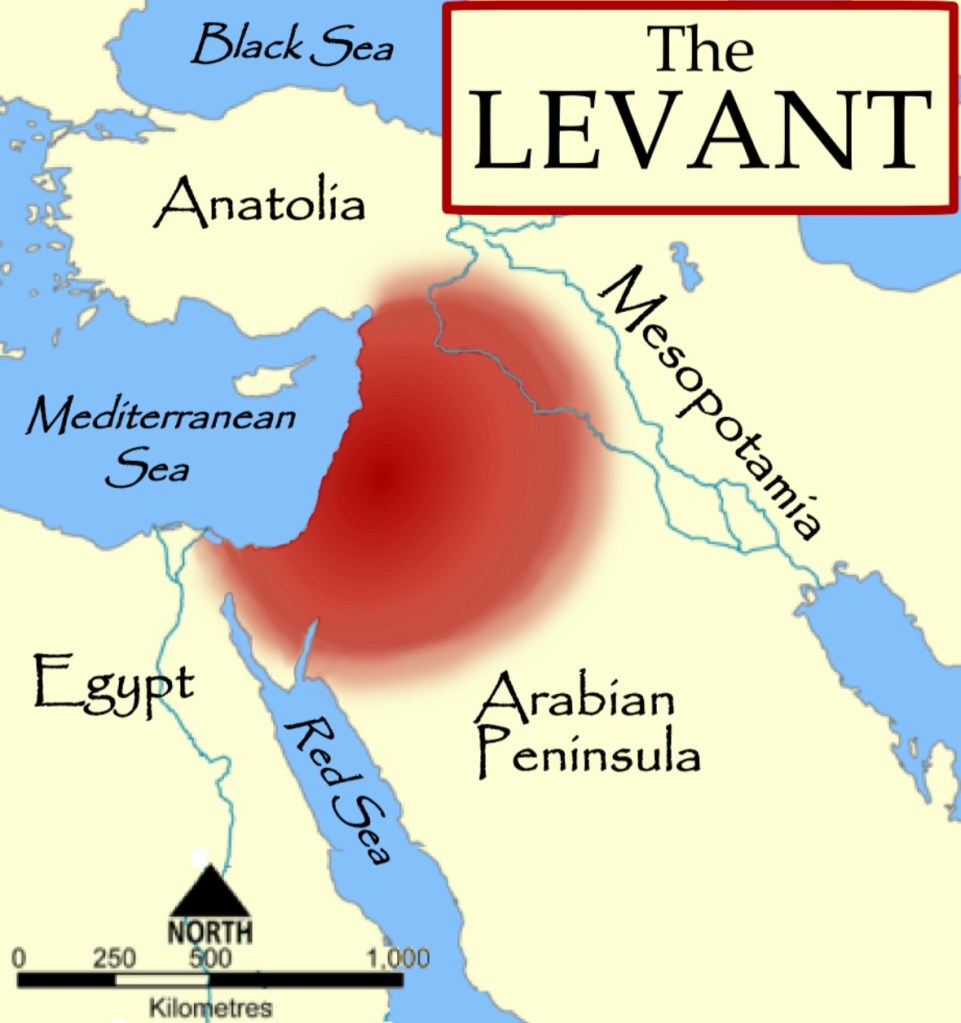
The timing of this post might be awkward given the escalation of threats by Iran and its client militia groups toward Israel. But I’m posting it anyway because this blog is a way for me to get things off my chest. Read on…

In the West there is fairly broad agreement that the Palestinian people should have a sovereign state of their own. There is much less agreement over the geographic boundaries of such a state and the sequence of events that must take place in order for it to be established. Among Palestinians there is some support for a two-state solution, but it is far from a majority.

The UN Partition Plan

The following map might be helpful in what follows. It shows the proposed boundaries of an Israeli state and an Arab state under the Partition Plan adopted by UN Resolution in 1947. The Resolution called for replacing a League of Nations mandate for British administration of the region requiring the establishment of a Jewish homeland. Likewise, the Arab state was intended to accommodate Palestinian nationalists. Together the two states were expected to comprise an economic union.
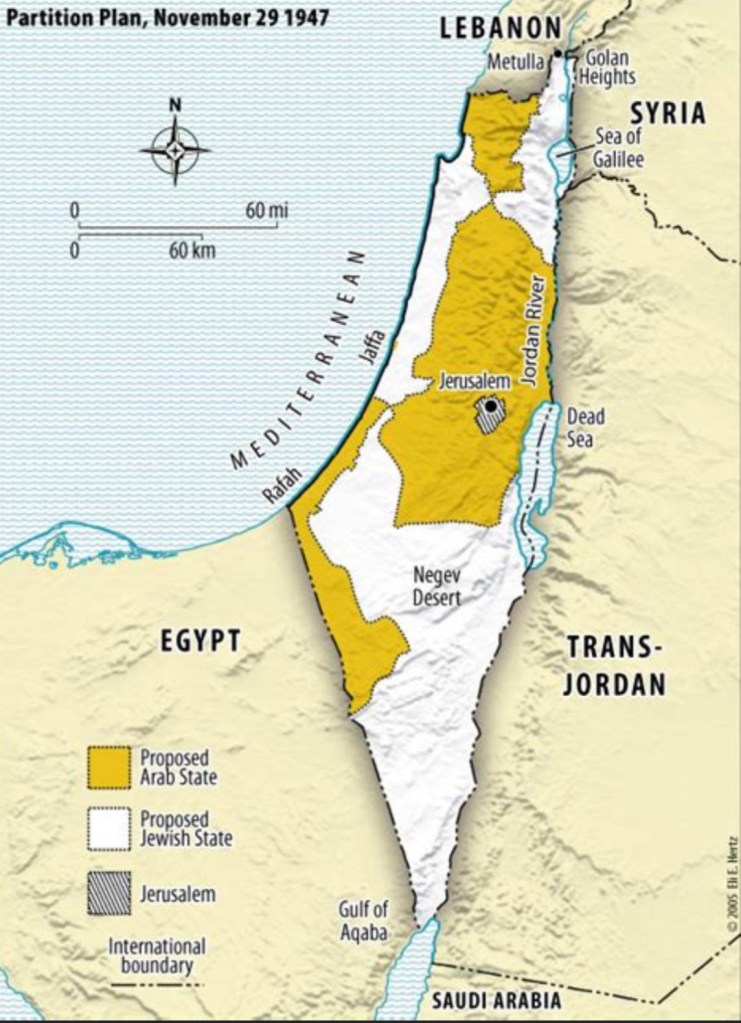
What is striking is the discontinuity of the lands assigned to each state, and this surely contributed to almost immediate border challenges. More on that below.

The Gaza Strip is the region along the shore of the Mediterranean on the lower left, which was designated as Palestinian. The Golan Heights is the Israeli region on the upper right. The West Bank is the Palestinian region in the middle. Jerusalem and its vicinity was designated as an international zone to be administered by the UN.

Border Battles

Today, the geography of a prospective Palestinian state would certainly include the Gaza Strip. There doesn’t seem to be any great dispute there, but the West Bank is another story. In this context, it’s important to remember some key details about the history of this region since 1947. David Post writes at the Volokh Conspiracy that the Palestinian state was obliterated by other Arab states in 1948:

“The State of Palestine was strangled in its infancy, not by the Israelis, who accepted the U.N. partition plan, but by the neighboring Arab States—Egypt, Syria, and Jordan—who did not. The day after the British pulled their forces out, the Arab armies marched in, and the first Arab-Israeli War began.“

The hostilities were formally ended with the signing of three different Armistices in 1949:

“The boundaries fixed in those agreements gave to each of the four countries involved more-or-less the territory that their armies had managed to control as of the date that ceasefires had been declared. The West Bank became part of Jordan; Gaza became part of Egypt; the Golan Heights became part of Syria. Israel got—or kept—the rest. The Palestinians, who had no army of their own, got nothing.“

Here are the boundaries under the 1949 Armistices:
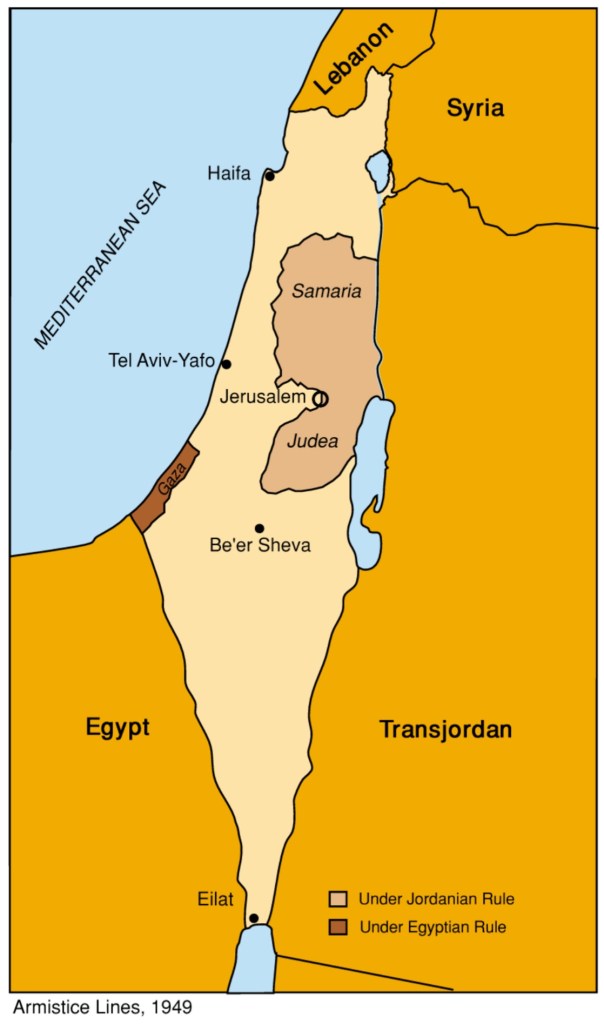
The three Arab states, which refused to recognize Israel’s right to exist, attacked again in 1967. In a matter of six days and on three fronts, the Israelis drove them back and took Gaza, the West Bank, and retook the Golan Heights. Post asks:

“Why is it that only starting then, now that Israel was in control of these areas, did the world rouse itself to Palestinian grievances, and demand that ‘Palestinian lands’ be given back to the Palestinians?“

It’s worth noting that these conflicts led to the displacement of a great many Palestinians, but Israel did not provoke the attacks.

Indigenous Populations

Enemies of Israel, including those in the West, go so far as to say the Israelis are not entitled to a homeland in the Levant. Even worse, they chant “from the river to the sea”, often ignorant that it is a thinly veiled call for genocide. But Jews have as great a claim to a homeland in the Levant as the Palestinians. Jacob Sullum wrote of this truth last October, in the wake of the Hamas butchery on October 7, 2023. Israeli Jews are characterized by enemies as “colonizers”. This, as Sullum says:

“… is a ‘simplistic morality tale’, that pits white European oppressors against ‘indigenous’ people, eliding Israel’s demographic roots and the ancient Jewish connection to the land. “

Sullum goes on to discuss research on the genetic origins of modern Jewish populations. For example, one paper found that the ancestors of Ashkenazi Jews, who account for almost a third of Jews in Israel, likely descended from a “diverse population in the Middle East.” And Sullum points out that Mizrahim Jews of Middle Eastern and North African origin represent almost 45% of Israeli Jews. Furthermore, another study found that Jews and Arabs in the Middle East both share high percentages of Y chromosomes with a single gene pool, which suggests a common origin. Therefore, both Palestinians and Israeli Jews have legitimate claims to a homeland in the Levant.

Israel and Gaza

Contrary to claims by Hamas supporters, there was no occupation of Gaza by Israel at the time of the October 7th massacre. Israel’s prior occupation of Gaza ended almost 20 years ago, in 2005. However, Israel has restricted the movement of goods in and out of the Gaza Strip since the 1990s. Israel and Egypt tightened the blockade on Gaza in 2007 after Hamas took control there, though it was eased in steps from 2010 – 2013. Given the uncompromising belligerence of Hamas and its proclivity for diverting resources to support aggression against Israel, it’s fair to say the blockade is, and has been, a legitimate instrument of defense, as long as Gaza is “governed” by Hamas.

Last year, less than a week after the October 7th massacre and hostage taking, the Israeli Defense Forces (IDF) began ground operations in Gaza in an effort to root out Hamas fighters, destroy their war-making infrastructure, and rescue hostages held by Hamas in Gaza. Of course, that fight goes on.

Hamas has fought against Israel’s retaliatory action in ways that have propaganda value, especially given the naïveté of much of the Western press. Its fighters are often embedded among civilians within residential areas and facilities like schools and hospitals. The use of human shields is a war crime for which Hamas bears full responsibility, and Hamas has made it clear that their aim is to kill Israelis, civilian and military alike. Hamas has made a practice of exaggerating Palestinian death counts, a distortion that has been more obvious to statisticians than journalists.

The Israeli blockade of the Gaza Strip will be tough to end without a complete surrender by Hamas and release of the hastages. Even then, the current IDF occupation is unlikely to end until efforts are well underway to flesh out the details of a new Palestinian government, if not statehood.

The West Bank

Perhaps even more thorny for an eventual two-state solution is that Israel occupies the West Bank and has established settlements that Palestinians strongly oppose. Jordan might also have designs on retaking West Bank territory, which would once again leave Palestinians as the odd people out. Israel took the land in its own defense during the Six-Day War in 1967 and kept it as a security buffer:

“… Israel insisted that it should not, and would not, simply return to the pre-war situation — the dangerous combination of precarious armistice lines and aggressive neighbors that had prevailed for 19 years. …

The idea that Israeli security depended on continued control over parts of the West Bank was held not only by Israeli officials, but also by the American Joint Chiefs of Staff. … Referring to the West Bank, they argued that Israel required a new boundary that would ‘widen the narrow portion of Israel’ and help protect Tel Aviv.“

Israel splits aspects of governance with the Palestinian Authority in parts of the West Bank, but most of the security apparatus is run by Israel.

The continued West Bank occupation is as fraught with controversy as ever. Today there is bitter resentment over new Israeli settlements and the construction of the “Separation Wall” just inside the western border of the West Bank. The situation is made all the more intractable by Hamas’ presence there amid ongoing attacks against Israeli interests.

Withdrawing from the West Bank would create a huge vulnerability for Israel, so one can hardly expect it to cede control of the entire territory. Yet it is hard to imagine an economically viable Palestinian state confined to the Gaza Strip. In fact, some feel that more than the West Bank should be in play for creating a contiguous corridor to Gaza, which would help promote a new Palestinian state’s economic viability.

Iran

Obviously Hamas is not the only threat to Israel’s security. To the north in Lebanon, Hezbollah is a well-armed adversary. And like Hamas, it receives considerable support from Iran. It’s difficult to imagine that Iran could maintain this support, not to mention its nuclear ambitions, without the flow of oil revenue made possible by U.S. acquiescence. Reaching a peaceful resolution to the conflicts between Israel and its neighbors will be very difficult without somehow neutralizing the Iranian threat. Regime change there would be key to this effort.

What Must Happen

The obstacles to establishing a peaceful, two-state solution for Palestinians and Israelis are so steep that the prospect seems almost unimaginable. A complete defeat of both Hamas and Hezbollah would be critical, and the Palestinian Authority or any other successor regime must be counted on to negotiate in good faith and with the legitimate support of the Palestinian people. Likewise, Israel must be willing to negotiate meaningful concessions, at least in terms of its occupied territories in the West Bank.

For a successful resolution, the role of other Arab states can’t be emphasized enough. These states should apply pressure to Israel’s neighbors like Syria and Jordan to rein-in their own territorial ambitions. In a positive sign, there is now growing pressure on Iran from other Arab states to end its belligerence.

A reconstituted Abraham Accords framework could strengthen diplomatic and economic ties across the region, promoting cross-investment, trade, and cultural exchange. The framework should include a mechanism to encourage aid from the Arab states and Israel to help Palestinians build a new, peaceful, and prosperous state.

Finally, a peaceful two-state solution hinges on continued U.S. support for Israel and a new Palestinian homeland. Unfortunately, in recent years we’ve witnessed a drift toward anti-Zionism (and even anti-Semitism) among Democrats. This sort of foolishness on the far Left knows no bounds. If the anti-Zionist position comes to be accepted by the mainstream of the party, it could severely compromise Israel’s leverage in negotiations.

Summary

A resolution that would ultimately bring peace to the Middle East seems remote in the midst of the current hostilities. It would require a dramatic softening of views among nearly all parties to solve the impasse over nation-state homelands for both Jews and Palestinians. In no particular order, the following are all necessary:

  • Israel’s neighboring states must not covet territory originally intended for the Palestinians, or for that matter the state of Israel.
  • Iran must butt out one way or another (in the language of high diplomacy), which would do much to neutralize militant factions like Hamas, Hezbollah, and the Houthis.
  • Other Arab states must come to the table along with the Israelis to negotiate economic and political accords, including aid to the Palestinian people.
  • The U.S. must resist internal calls from the Left to withdraw support for Israel.
  • More immediately, Israel must do its best to root out and defeat Hamas, Hezbollah, and the Houthis.
  • The Palestinian people must decide they want peace and a prosperous civilization.
  • Israel must show a willingness to negotiate concessions to Palestinians in the West Bank, and to aid in the rebuilding of Gaza.

Taken together that’s a very tall order! The U.S. can and should do its part to support Israel and the Palestinian people, penalize Iran, and help to bring all parties to the negotiating table. A refashioning of the Abraham Accords could contribute to peace in the region, including a stable, prosperous, and well-governed Palestinian homeland.

Evil Force Multiplication

15 Tuesday Mar 2016

Posted by Nuetzel in Liberty, Socialism, Tyranny

≈ Leave a comment

Tags

Banality of Evil, Bookworm Room, Force Multiplier, Gary Johnson, Genocide, Johan Norberg, Nordic Nirvana, Social Democracy, Ted Cruz, Welfare State

big-govt compassion

Following up on “Socialism Is Concentrated Power“, check out “Because government is a force multiplier for evil, a vote for the small government candidate is a vote for good” from the Bookworm Room. I’m four days late making my 2nd anniversary post on Sacred Cow Chips, so this is it. I’ll try to keep it brief so I can get it out before bedtime on a school night.

I don’t agree with everything in Bookworm’s analysis, but I certainly agree with the general thrust:

“The problem with government is that, as it grows, no matter the original good intentions behind it, it invariably becomes a force multiplier for evil. Thus, once government power passes a certain point, government becomes the equivalent of a bull in a china shop, with its every motion causing massive damage. Incidentally, the china in that shop is always you — the individual.“

Bookworm discusses two major forms of force multiplication of evil by the state: money and death. Governments are incredible graft machines and resource wastrels. More tragically, the many genocidal acts over the course of history would not have been possible without government as the machine of authority and “legitimization”. Fear of the government’s police power may ultimately spur normal people to participate in “banal” acts of unspeakable evil. And here, Bookworm points out a few ironies about the “nice” people who root for state control:

“A compassionate government will talk itself into euthanizing people who, because they are very old or sick, use up more than their fair share of medical care. This has already happened under England’s National Health Service, which kills off old, sick people, and whose ‘ethicists’ advocate even more killings (out of ‘compassion’ of course).

A compassionate government dedicated to efficiency will convince itself that individuals or organizations that stand in the way of efficiency must be controlled and, if they won’t be controlled, must be destroyed. After all, without mandated efficiency, people will suffer.

A compassionate government dedicated to “fairness” (usually thought of in economic terms), will quickly conclude that it’s entirely unfair that one distinct group or another is wealthier or healthier than the rest. That group must be brought to heel and, failing that, destroyed.

A compassionate government dedicated to national purity will naturally have to kill the impure within its borders and, once that’s done, it would be even more compassionate to extend that purity throughout the world.

Even the most murderous theocracies will argue that compassion guides them. Their tortures, executions, and Holy Wars are meant to bring people closer to God, which is the highest form of human existence. Isn’t that a nice, compassionate thing to do?“

Bookworm offers praise to the genius of the U.S. founding fathers in crafting governing principles designed to limit government power. And Bookworm recognizes Senator Ted Cruz as the only major party candidate to consistently stand for small government and constitutional principles. I’m not all in on this endorsement, as Cruz has taken stands and aligned himself with individuals not supportive of civil liberties such as gay marriage. However, in many important ways, Cruz recognizes the danger of government power. Bookworm might have mentioned Gary Johnson, the likely Libertarian Party nominee, as the most consistent critic of big government among the names likely to appear on presidential ballots in the fall.

Some might object to Bookworm’s discussion of the many failed experiments with government domination of society by noting that he never mentions the alleged success of European social democracies, particularly the Nordic states. Sweden and Denmark are the most cited examples. However, Europe is not an economic success story, with median incomes comparable to states with the lowest incomes in the U.S. Moreover, the “Nordic Nirvana” is something of a myth. In “How Laissez-Faire Made Sweden Rich“, Johan Norberg gives a detailed history of Sweden’s political and economic evolution:

“It was not socialist policies that turned Sweden into one of the world’s richest countries. When Sweden got rich, it had one of the most open and deregulated economies in the world, and taxes were lower than in the United States and most other western countries. The Social Democrats kept most of those policies intact until the 1970s, when they thought that those excellent foundations—unprecedented wealth, a strong work ethic, an educated work force, world-class exports industries, and a relatively honest bureaucracy—were so stable that the government could tax and spend and build a generous cradle-to-grave welfare state on them.

They couldn’t. At least not without costs. Because that welfare state began to erode the conditions that had made the model viable in the first place. And the fourth richest country became the 14th richest within three decades.“

Fortunately, for more than 70 years, Western Europe has avoided the kind of dire, genocidal consequences that often flow from a dominant state, but Europe has stagnated economically. Hazards await them as a growing and increasingly diverse population competes for diminished economic gains; government control is a dead-weight on their prospects. I hope we can avoid that fate in the U.S., though we’re already far down the road. Like the Bookworm says, vote for small government!


The Banality of Evil Is No Defense

31 Friday Jul 2015

Posted by Nuetzel in Tyranny

≈ Leave a comment

Tags

Adolf Eichmann, Banality of Evil, Conspiracy film, Genocide, Holocaust, Ingenuity of Evil, S. Alexander Haslam, Stephen D. Reicher, Tyrannical Evil

Conspiracy-film

Psychology is not my usual bailiwick, but this article “questioning the banality of evil” caught my interest. A long-accepted view in the field is that ordinary people are willing to commit heinous acts under authoritative instructions or when they find themselves in certain kinds of roles. Does that view somehow imply that such a perpetrator is less accountable because they were “just following orders”, or because they were overwhelmed by the pressure imposed by their role?

The authors of the article, S. Alexander Haslam and Stephen D. Reicher, cite recent research challenging the standard view. They argue that even when individuals are tasked with doing evil, they are often fully engaged and even creative in the execution of their assignments. They discuss the case of the Nazi tyranny and especially Adolf Eichmann, who was one of the chief architects of the Holocaust. His trial on war crimes, however, originally reinforced the “banality of evil” narrative:

“… Eichmann worked hard to undermine the charge that he was a dangerous fanatic by presenting himself as an inoffensive pen-pusher. … [but] Eichmann [was] a man who identified strongly with anti-semitism and Nazi ideology; a man who did not simply follow orders but who pioneered creative new policies; a man who was well aware of what he was doing and was proud of his murderous ‘achievements’.“

This reminds me of a great film called “Conspiracy“, in which Stanley Tucci is brilliant in the role of Eichmann. The film depicts a meeting of the top echelon of the Nazi bureaucracy, based on actual meeting notes, at which the “Jewish question” is addressed. Anyone who has ever attended a fairly large corporate meeting will experience an eerie familiarity with the banality of the proceedings, at least until a certain point. These are bureaucrats. Soon enough, however, it becomes clear that the participants are discussing something horrific, despite the opaque jargon and their hesitation to give voice to the plain meaning of the agenda. First, a consensus has to be established. But like so many corporate meetings, the consensus and the outcome are preordained. There are objections, and some of the participants voice them more strongly than others. They are ultimately either cajoled or bullied into submission. But those objectors do not blindly accept the evil they are being asked to do. On the other hand, the monsters putting forward the killing agenda, including Eichmann, know exactly what they are doing and believe in it.

Haslam and Reicher insist that “ingenuity” is more descriptive of evil actions performed by individuals under tyranny than “banality”; that’s a takeaway from “Conspiracy” as well. However, Haslam and Reicher present these competing characterizations of evil-doing as if they are mutually exclusive hypotheses. In fact, it’s likely that these two “kinds” of evil coexist and are almost certainly complementary in their effects. Is there any reason to rule out the possibility that some individuals are simply “good” soldiers who faithfully follow orders? Who, like the timid Mr. Twimble in “How To Succeed…”, always play it “the company way”?  They might not be the most intelligent members of society, but there are certainly those who will do as they are told, and there are others who might need motivation to act. In fact, the authors admit as much in their discussion of leadership as a catalyst for action by others:

“… people are surrounded by would-be leaders who tell them what to make of the world around them. For this reason, the study of leadership must be a central component of any analysis of tyranny and outgroup hostility. Indeed, tyrannical leaders only thrive by convincing us that we are in crisis, that we face threat and that we need their strong decisive action to surmount it.“

This is where the distinctions get muddy. I’m no psychologist, but to my way of thinking, further action and support for tyrannical evil by the members of a motivated in-group may be quite banal. Even a conscious decision to follow abhorrent orders in one’s own self-interest may qualify as an act of banality.

A group may well be convinced by their leaders that their actions are right, and that is frightening. Some will act consciously and viciously. Some will attempt to resist. Under great pressure, not all are capable of marshaling sufficient moral or intellectual resistance to the call to participate in evil acts, but none of that that offers justification. Banal or otherwise, participation in heinous acts against an out-group cannot be forgiven by mankind.

Follow Sacred Cow Chips on WordPress.com

Recent Posts

  • The Case Against Interest On Reserves
  • Immigration and Merit As Fiscal Propositions
  • Tariff “Dividend” From An Indigent State
  • Almost Looks Like the Fed Has a 3% Inflation Target
  • Government Malpractice Breeds Health Care Havoc

Archives

  • January 2026
  • December 2025
  • November 2025
  • October 2025
  • September 2025
  • August 2025
  • July 2025
  • June 2025
  • May 2025
  • April 2025
  • March 2025
  • February 2025
  • January 2025
  • December 2024
  • November 2024
  • October 2024
  • September 2024
  • August 2024
  • July 2024
  • June 2024
  • May 2024
  • April 2024
  • March 2024
  • February 2024
  • January 2024
  • December 2023
  • November 2023
  • August 2023
  • July 2023
  • June 2023
  • May 2023
  • April 2023
  • March 2023
  • February 2023
  • January 2023
  • December 2022
  • November 2022
  • October 2022
  • September 2022
  • August 2022
  • July 2022
  • June 2022
  • May 2022
  • April 2022
  • March 2022
  • February 2022
  • January 2022
  • December 2021
  • November 2021
  • October 2021
  • September 2021
  • August 2021
  • July 2021
  • June 2021
  • May 2021
  • April 2021
  • March 2021
  • February 2021
  • January 2021
  • December 2020
  • November 2020
  • October 2020
  • September 2020
  • August 2020
  • July 2020
  • June 2020
  • May 2020
  • April 2020
  • March 2020
  • February 2020
  • January 2020
  • December 2019
  • November 2019
  • October 2019
  • September 2019
  • August 2019
  • July 2019
  • June 2019
  • May 2019
  • April 2019
  • March 2019
  • February 2019
  • January 2019
  • December 2018
  • November 2018
  • October 2018
  • September 2018
  • August 2018
  • July 2018
  • June 2018
  • May 2018
  • April 2018
  • March 2018
  • February 2018
  • January 2018
  • December 2017
  • November 2017
  • October 2017
  • September 2017
  • August 2017
  • July 2017
  • June 2017
  • May 2017
  • April 2017
  • March 2017
  • February 2017
  • January 2017
  • December 2016
  • November 2016
  • October 2016
  • September 2016
  • August 2016
  • July 2016
  • June 2016
  • May 2016
  • April 2016
  • March 2016
  • February 2016
  • January 2016
  • December 2015
  • November 2015
  • October 2015
  • September 2015
  • August 2015
  • July 2015
  • June 2015
  • May 2015
  • April 2015
  • March 2015
  • February 2015
  • January 2015
  • December 2014
  • November 2014
  • October 2014
  • September 2014
  • August 2014
  • July 2014
  • June 2014
  • May 2014
  • April 2014
  • March 2014

Blogs I Follow

  • Passive Income Kickstart
  • OnlyFinance.net
  • TLC Cholesterol
  • Nintil
  • kendunning.net
  • DCWhispers.com
  • Hoong-Wai in the UK
  • Marginal REVOLUTION
  • Stlouis
  • Watts Up With That?
  • Aussie Nationalist Blog
  • American Elephants
  • The View from Alexandria
  • The Gymnasium
  • A Force for Good
  • Notes On Liberty
  • troymo
  • SUNDAY BLOG Stephanie Sievers
  • Miss Lou Acquiring Lore
  • Your Well Wisher Program
  • Objectivism In Depth
  • RobotEnomics
  • Orderstatistic
  • Paradigm Library
  • Scattered Showers and Quicksand

Blog at WordPress.com.

Passive Income Kickstart

OnlyFinance.net

TLC Cholesterol

Nintil

To estimate, compare, distinguish, discuss, and trace to its principal sources everything

kendunning.net

The Future is Ours to Create

DCWhispers.com

Hoong-Wai in the UK

A Commonwealth immigrant's perspective on the UK's public arena.

Marginal REVOLUTION

Small Steps Toward A Much Better World

Stlouis

Watts Up With That?

The world's most viewed site on global warming and climate change

Aussie Nationalist Blog

Commentary from a Paleoconservative and Nationalist perspective

American Elephants

Defending Life, Liberty and the Pursuit of Happiness

The View from Alexandria

In advanced civilizations the period loosely called Alexandrian is usually associated with flexible morals, perfunctory religion, populist standards and cosmopolitan tastes, feminism, exotic cults, and the rapid turnover of high and low fads---in short, a falling away (which is all that decadence means) from the strictness of traditional rules, embodied in character and inforced from within. -- Jacques Barzun

The Gymnasium

A place for reason, politics, economics, and faith steeped in the classical liberal tradition

A Force for Good

How economics, morality, and markets combine

Notes On Liberty

Spontaneous thoughts on a humble creed

troymo

SUNDAY BLOG Stephanie Sievers

Escaping the everyday life with photographs from my travels

Miss Lou Acquiring Lore

Gallery of Life...

Your Well Wisher Program

Attempt to solve commonly known problems…

Objectivism In Depth

Exploring Ayn Rand's revolutionary philosophy.

RobotEnomics

(A)n (I)ntelligent Future

Orderstatistic

Economics, chess and anything else on my mind.

Paradigm Library

OODA Looping

Scattered Showers and Quicksand

Musings on science, investing, finance, economics, politics, and probably fly fishing.

  • Subscribe Subscribed
    • Sacred Cow Chips
    • Join 128 other subscribers
    • Already have a WordPress.com account? Log in now.
    • Sacred Cow Chips
    • Subscribe Subscribed
    • Sign up
    • Log in
    • Report this content
    • View site in Reader
    • Manage subscriptions
    • Collapse this bar
 

Loading Comments...