
Tags
Alex Tabarrok, Anti-Discrimination Laws, Ban the Box, Disparate impact, European Union, Hiring Discrimination, Protected Groups, Racial Proxies, Segregation, Slavery
Some people have the impression that the U.S. is uniquely bad in terms of racial, ethnic, gender, and other forms of discrimination. This misapprehension is almost as grossly in error as the belief held in some circles that the history of slavery is uniquely American, when in fact the practice has been so common historically, and throughout the world, as to be the rule rather than the exception.
This week, Alex Tabarrok shared some research I’d never seen on one kind of discriminatory behavior. In his post, “The US has Relatively Low Rates of Hiring Discrimination”, he cites the findings of a 2019 meta-study of “… 97 Field Experiments of Racial Discrimination in Hiring”. The research focused on several Western European countries, Canada, and the U.S. The experiments involved the use of “faux applicants” for actual job openings. Some studies used applications only and were randomized across different racial or ethnic cues for otherwise similar applicants. Other studies paired similar individuals of different racial or ethnic background for separate in-person interviews.
The authors found that hiring discrimination is fairly ubiquitous against non-white groups across employers in these countries. The authors were careful to note that the study did not address levels of hiring discrimination in countries outside the area of the study. They also disclaimed any implication about other forms of discrimination within the covered countries, such as bias in lending or housing.
The study’s point estimates indicated “ubiquitous hiring discrimination”, though not all the estimates were statistically significant. My apologies if the chart below is difficult to read. If so, try zooming in, clicking on it, or following the link to the study above.

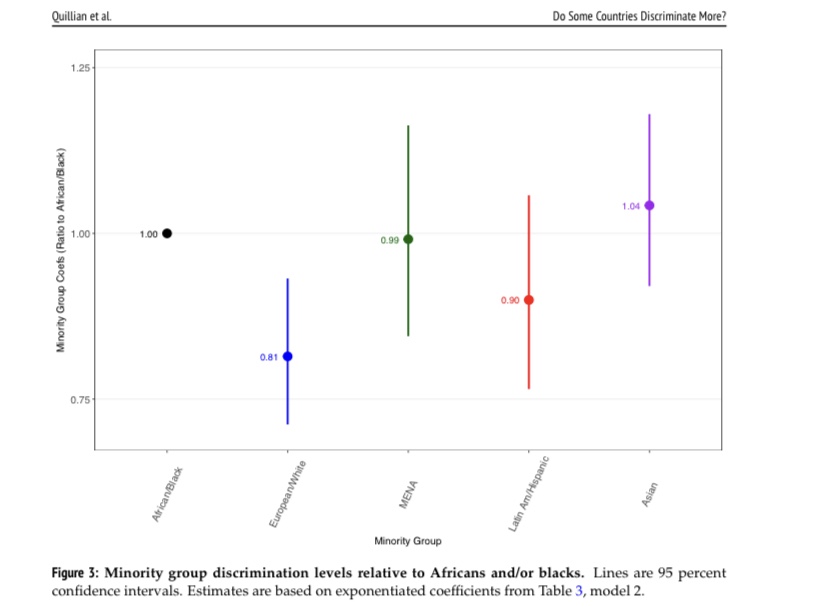
Some of the largest point estimates were highly imprecise due to less coverage by individual studies. The impacted groups and severity varied across countries. Blacks suffered significant discrimination in the U.S., Canada, France, and Great Britain. For Hispanics, the only coverage was in the U. S. and sparsely in Canada. The point estimates showed discrimination in both counties, but it was (barely) significant only in the U.S. For Middle Eastern and North African (MENA) applicants, discrimination was severe in France, the Netherlands, Belgium, and Sweden. Asian applicants faced discrimination in France, Norway, Canada, and Great Britain.
Across all countries, the group suffering the least hiring discrimination was white immigrants, followed by Latin Americans / Hispanics (but only two countries were covered). Asians seemed to suffer the most discrimination, though not significantly more than Blacks (and less in the U.S. than in France, Norway, Canada, and Great Britain). Blacks and MENA applicants suffered a bit less than Asians from hiring discrimination, but again, not significantly less.
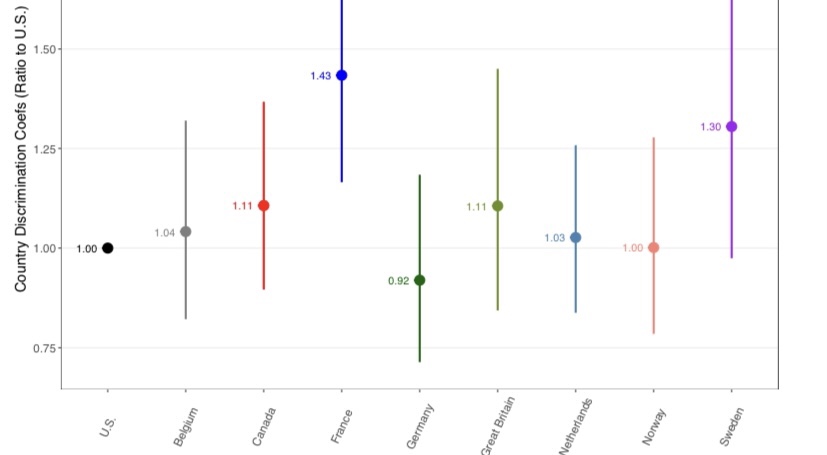
Comparing countries, the authors used U.S. hiring discrimination as a baseline, assigning a value of one. France had the most severe hiring discrimination and at a high level of significance. Sweden was next highest, but it was not significantly higher than in the U.S. Belgium, Canada, the Netherlands and Great Britain had higher point estimates of overall discrimination than the U. S., though none of those differences were significant. Employers in Norway were about as discriminatory as the U.S., and German employers were less discriminatory, though not significantly.
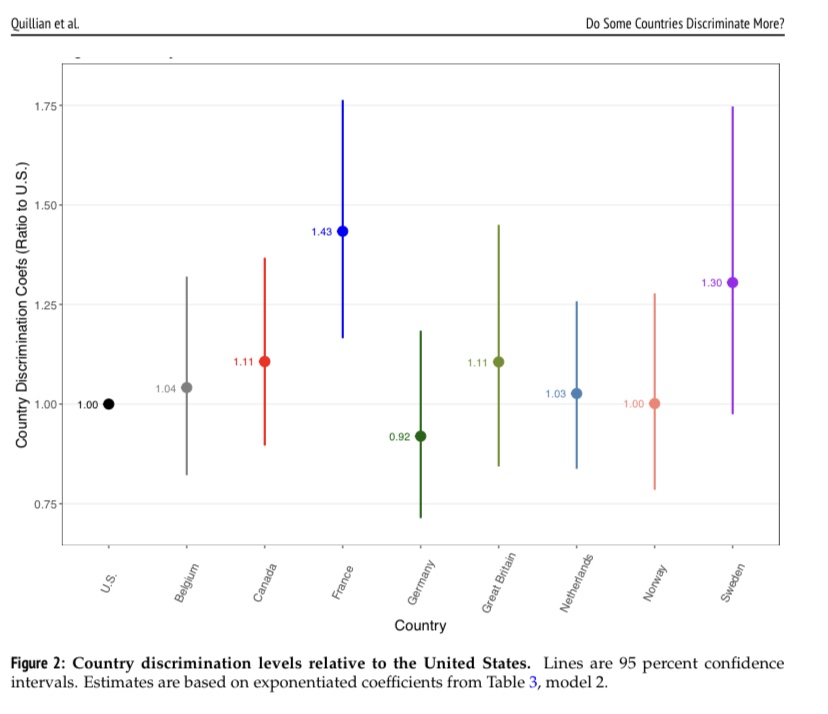
The upshot is that as a group, U.S. employers are generally at the low end of the spectrum in terms of discriminatory hiring. Again, the intent of this research was not to single out the selected countries. Rather, these countries were chosen because relevant studies were available. In fact, Tabarrok makes the following comment, which the authors probably wouldn’t endorse and is admittedly speculative, but I suspect it’s right:
“I would bet that discrimination rates would be much higher in Japan, China and Korea not to mention Indonesia, Iraq, Nigeria or the Congo. Understanding why discrimination is lower in Western capitalist democracies would reorient the literature in a very useful way.”
So the U.S. is not on the high-side of this set of Western countries in terms of discriminatory hiring practices. While discrimination against blacks and Hispanics in the U.S. appears to be a continuing phenomenon, overall hiring discrimination in the U.S. is, at worst, comparable to many European countries.
To anticipate one kind of response to this emphasis, the U.S. is not alone in its institutional efforts to reduce discrimination. In fact, the study’s authors say:
“A fairly similar set of antidiscrimination laws were adopted in North America and many Western European countries from the 1960s to the 1990s. In 2000, the European Union passed a series of race directives that mandated a range of antidiscrimination measures to be adopted by all member states, putting their legislative frameworks on racial discrimination on highly similar footing.”
Despite these similarities, there are a few institutional details that might have some bearing on the results. For example, France bans the recording and “formal discussion” of race and ethnicity during the hiring process. (However, photos are often included in job applications in European countries.) Does this indicate that reporting mandates and prohibiting certain questions reduce hiring discrimination? That might be suggestive, but the evidence is not as clear cut as the authors seem to believe. They cite one piece of conflicting literature on that point. Moreover, it does not explain why Great Britain had a greater (and highly significant) point estimate of discrimination against Asians, or why Canada and Norway were roughly equivalent to France on this basis. Nor does it explain why Sweden and Belgium did not differ from France significantly in terms of discrimination against MENA applicants. Or why Canada was not significantly different from France in terms of hiring discrimination against Blacks. Overall, discrimination in Sweden was not significantly less than in France. Still, at least based on the three applicant groups covered by studies of France, that country had the highest overall level of discrimination. France also had the most significant departure from the U.S., where recording the race and ethnicity of job applicants is institutionalized.
Germany had the lowest overall point estimates of hiring discrimination in the study. According to the authors, employers in German-speaking countries tend to collect a fairly thorough set of background information on job applications. This detail can actually work against discrimination in hiring. Tabarrok notes that so-called “ban the box” policies, or laws that prohibit employers from asking about an applicant’s criminal record, are known to result in greater racial disparities in hiring. The same is true of policies that threaten sanctions against the use of objective job qualifications which might have disparate impacts on “protected” groups. That’s because generalized proxies based on race are often adopted by hiring managers, consciously or subconsciously.
Discrimination in hiring based on race and ethnicity might actually be reasonable when a job entails sensitive interactions requiring high levels of trust with members of a minority community. This statement acknowledges that we do not live in a perfect world in which racial and ethnic differences are irrelevant. Still, aside from exceptions of that kind, overt hiring discrimination based on race or ethnicity is a negative social outcome. The conundrum we face is whether it is more or less negative than efforts to coerce nondiscrimination on those bases across a broad range of behaviors, most of which are nondiscriminatory to begin with, and when interventions often have perverse discriminatory effects. Policymakers and observers in the U.S. should maintain perspective. Discriminatory behavior persists in the U.S., especially against Blacks, but some of this discrimination is likely caused by prohibitions on objective tests of relevant job skills. And as the research discussed above shows, employers here appear to be a bit less discriminatory than those in most other Western democracies.
 Sacred Cow Chips