
Tags
Average Costs, Baseload Power, City Journal, Economic Efficiency, Electric Rate Escalation, Federal Reserve Bank of Dallas, Hyperscalers, Intermittent Power, Nuclear power, Power Cost Pressure, Rate Base Utilization, Renewable Power Mandates, Retail Power Rates, Shawn Regan, Utility Rate Regulation, Wholesale Power Rates
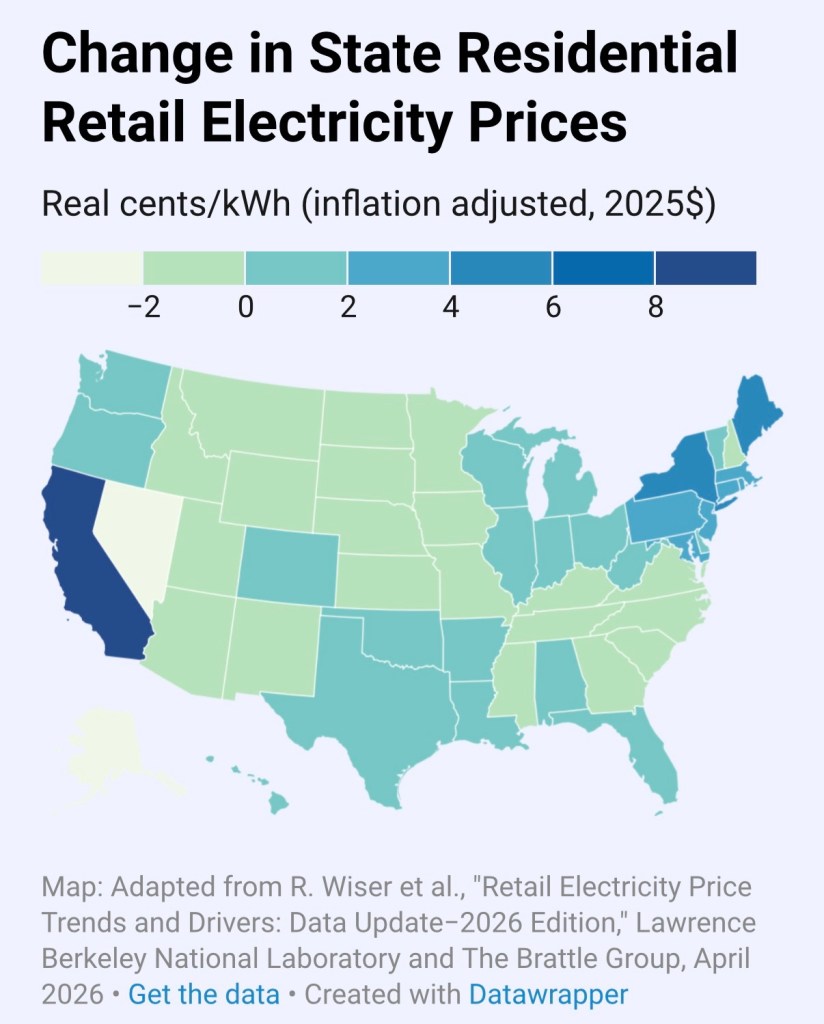
There is tremendous confusion about the impact of the data center boom on retail electricity prices. The public along with much of the media seem convinced that data centers have inflated the rates consumers pay for electric power, and that there is no end in sight. The facts, up till now, are largely contrary to that perception, and the forces underlying the situation are considerably more nuanced than the typical media narrative suggests. (And then of course there’s this.)
The chart above is from an article by Shawn Regan at City Journal, which cites several studies on the issue of data center power demand. The article demonstrates that real electricity prices at the retail level actually declined in 23 states over the period 2019-2025, including some states experiencing strong growth in their power loads. (It’s maddening that the relevant dates are not shown directly in the chart….) Real retail power prices rose less than 2% in 16 other states. However, California, New York, and Maine experienced rapid power price increases, and a few other states in the northeast saw moderate increases.
Of course, in nominal terms, rates increased by much larger percentages. But in real (inflation-adjusted) terms, increases in retail power rates have not been dramatic except in a few states, and it likely had nothing to do with the power requirements of new data centers. Similarly, this study finds no “detectable residential electricity-price externality.“
There are a variety of factors that play into power prices, including wildfire costs in California. However, it just so happens that the same three states and others in the northeast have heavy renewable energy mandates. Not only are these installations costly in their own right, but the intermittent nature of their power production means that redundancy is necessary. In other words, traditional base-load power sources must be maintained to avoid service interruptions, which can be deadly under extreme weather conditions. Of course, if not decommissioned, that existing generating capacity continues as part of the rate base used to calculate power prices. It should be no surprise that consumers in states having heavy renewable mandates have experienced more rapid rate escalation.
This article is typical of the confusion over power prices paid by consumers. It cites a Federal Reserve Bank of Dallas study with a focus on recent trends in wholesale electricity rates (the rates paid by utilities for generated power). Those rates have increased more broadly, and the study predicts a meaningful acceleration as AI hyperscalers continue the data center buildout. However, wholesale rates are not simply passed through into retail rates in the way the study seems to suggest. In fact, large industrial customers often absorb much of those increases, and data centers are no exception.
Another consideration is this: more and more, data centers will rely on their own internal power sources. These are renewables in some cases, and gas-fired in others. Modular nuclear reactors colocated with data centers will be increasingly relied upon as we move forward. These trends will mitigate any upward pressure on wholesale and retail rates in the future.
In addition to these points, the Regan article discussed above shows that over the 2019 – 2025 period, rate pressure had little to do with growth in retail power loads. His second chart, shown below, makes this point rather starkly. And California, Maine, and New York once again stand out in this regard.
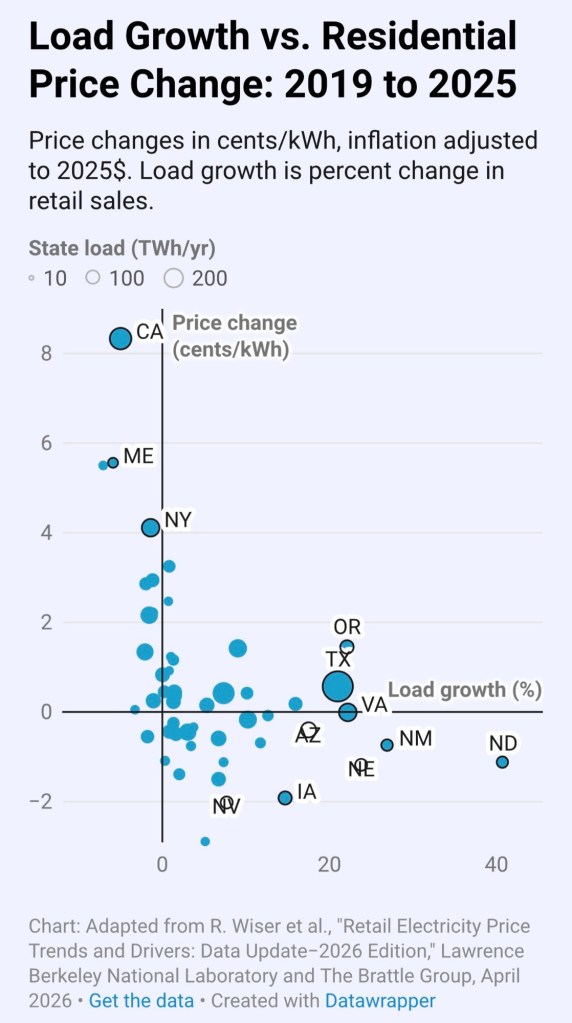
Can rate increases really have so little to do with power demand? There is a good explanation: Regan notes that electric rates are not set by a market process. Rather, state regulators allow utilities to cover their average costs, which are dominated by fixed costs (plant, including transmission infrastructure). New data centers relying on the grid tend to increase plant utilization, even if they require more fuel and necessitate some additional transmission facilities. Greater plant utilization results in a decrease in average cost per kilowatt hour.
There are severe disadvantages to the rate base regulatory framework, however, such as the incentive they create for utilities to “gold-plate” the rate base. This offsets some of the gains consumers might enjoy, which in the end come at the expense of larger ratepayers and a loss of economic efficiency through mispricing on both ends.
Of course, if more and more data centers were to crowd onto the grid, that would require utilities to add generating capacity. In that case, average costs and retail rates would ultimately have to increase. However, as discussed just above, data centers are increasingly relying on their own power sources. Furthermore, large industrial customers are often placed into a higher rate class, and that goes for data centers too. Thus, they absorb cost pressure that consumers never see, sometimes permitting lower rates for small ratepayers.
Finally, it’s possible that the data center boom will run its course, or at least take a pause, before long. Hyperscalers may be run ing short of investment capital, and cash flows might fail to live up to expectations … or hopes. In fact, the buildout might come to a screeching halt if investors lose confidence in the revenue potential of AI.
The AI companies themselves have been talking of a need for a pause in AI development due to the severe risks they claim are embedded in the technology at present. Regulatory pushback might put a brake on the AI buildout as well. There certainly have been voices warning of potential risks to investors. The upshot of all this might mean a halt to the AI boom and the consequent panic over power prices. It would also imply that some of the data center boom has constituted a malinvestment of capital. In fact, the possibility of hulking, vacant, data center complexes is perhaps an underplayed risk to hosting communities.
The data center buildout has had negligible, if any, effects on real residential electric bills. First, there is little evidence of any rate escalation at the retail level. Second, utility rate regulation tends to strongly diffuse the impact of cost pressures on retail rates. Part of that effect comes from the classification of data centers into their own rate class, but a large part has to do with the rate-base regulatory framework, in which increasing utilization of the rate base spreads average costs over more units of generated electric power. In the medium-term, at elevated levels of rate-base utilization, additional increments to load might have a lesser downward influence on retail rates. However, hyperscalers are starting to rely on developing their own, dedicated power sources on-site. This is will become more common going forward, which should mitigate any growth in the burden of electric power costs on consumers.

