• About

Sacred Cow Chips

Sacred Cow Chips

Tag Archives: Economic Efficiency

Data Center Power Price Confusion

15 Tuesday Sep 2026

Posted by Nuetzel in Data Centers, Electric Power

≈ Leave a comment

Tags

Average Costs, Baseload Power, City Journal, Economic Efficiency, Electric Rate Escalation, Federal Reserve Bank of Dallas, Hyperscalers, Intermittent Power, Nuclear power, Power Cost Pressure, Rate Base Utilization, Renewable Power Mandates, Retail Power Rates, Shawn Regan, Utility Rate Regulation, Wholesale Power Rates
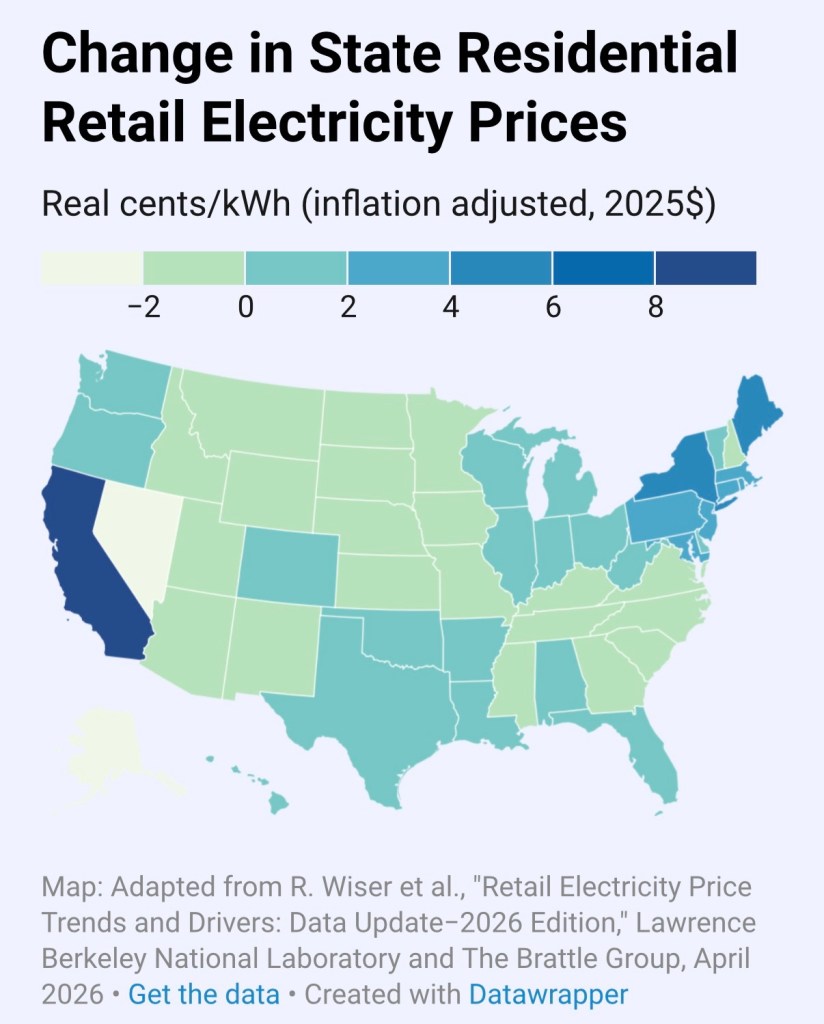
There is tremendous confusion about the impact of the data center boom on retail electricity prices. The public along with much of the media seem convinced that data centers have inflated the rates consumers pay for electric power, and that there is no end in sight. The facts, up till now, are largely contrary to that perception, and the forces underlying the situation are considerably more nuanced than the typical media narrative suggests. (And then of course there’s this.)

The chart above is from an article by Shawn Regan at City Journal, which cites several studies on the issue of data center power demand. The article demonstrates that real electricity prices at the retail level actually declined in 23 states over the period 2019-2025, including some states experiencing strong growth in their power loads. (It’s maddening that the relevant dates are not shown directly in the chart….) Real retail power prices rose less than 2% in 16 other states. However, California, New York, and Maine experienced rapid power price increases, and a few other states in the northeast saw moderate increases.

Of course, in nominal terms, rates increased by much larger percentages. But in real (inflation-adjusted) terms, increases in retail power rates have not been dramatic except in a few states, and it likely had nothing to do with the power requirements of new data centers. Similarly, this study finds no “detectable residential electricity-price externality.“

There are a variety of factors that play into power prices, including wildfire costs in California. However, it just so happens that the same three states and others in the northeast have heavy renewable energy mandates. Not only are these installations costly in their own right, but the intermittent nature of their power production means that redundancy is necessary. In other words, traditional base-load power sources must be maintained to avoid service interruptions, which can be deadly under extreme weather conditions. Of course, if not decommissioned, that existing generating capacity continues as part of the rate base used to calculate power prices. It should be no surprise that consumers in states having heavy renewable mandates have experienced more rapid rate escalation.

This article is typical of the confusion over power prices paid by consumers. It cites a Federal Reserve Bank of Dallas study with a focus on recent trends in wholesale electricity rates (the rates paid by utilities for generated power). Those rates have increased more broadly, and the study predicts a meaningful acceleration as AI hyperscalers continue the data center buildout. However, wholesale rates are not simply passed through into retail rates in the way the study seems to suggest. In fact, large industrial customers often absorb much of those increases, and data centers are no exception.

Another consideration is this: more and more, data centers will rely on their own internal power sources. These are renewables in some cases, and gas-fired in others. Modular nuclear reactors colocated with data centers will be increasingly relied upon as we move forward. These trends will mitigate any upward pressure on wholesale and retail rates in the future.

In addition to these points, the Regan article discussed above shows that over the 2019 – 2025 period, rate pressure had little to do with growth in retail power loads. His second chart, shown below, makes this point rather starkly. And California, Maine, and New York once again stand out in this regard.
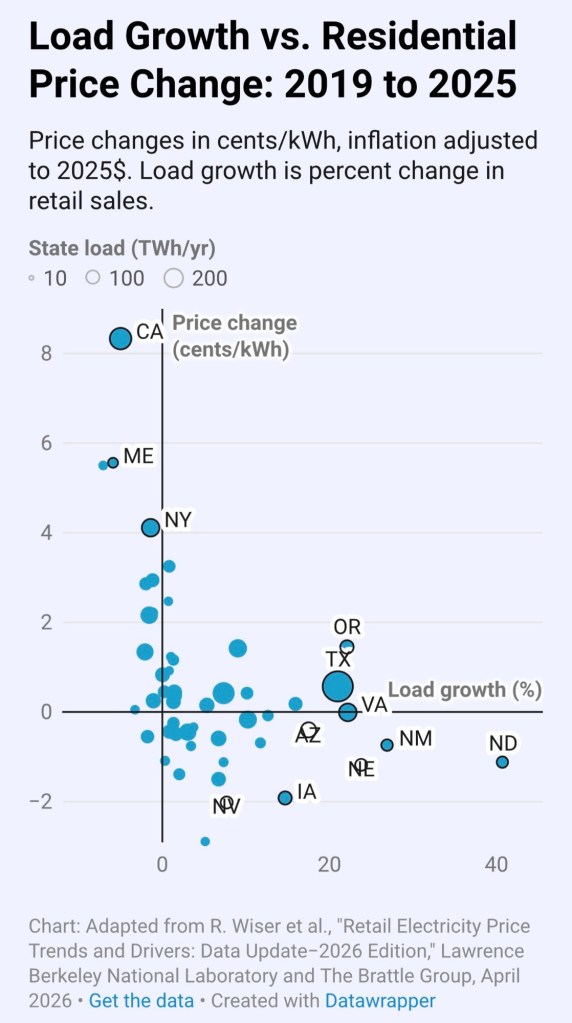
Can rate increases really have so little to do with power demand? There is a good explanation: Regan notes that electric rates are not set by a market process. Rather, state regulators allow utilities to cover their average costs, which are dominated by fixed costs (plant, including transmission infrastructure). New data centers relying on the grid tend to increase plant utilization, even if they require more fuel and necessitate some additional transmission facilities. Greater plant utilization results in a decrease in average cost per kilowatt hour.

There are severe disadvantages to the rate base regulatory framework, however, such as the incentive they create for utilities to “gold-plate” the rate base. This offsets some of the gains consumers might enjoy, which in the end come at the expense of larger ratepayers and a loss of economic efficiency through mispricing on both ends.

Of course, if more and more data centers were to crowd onto the grid, that would require utilities to add generating capacity. In that case, average costs and retail rates would ultimately have to increase. However, as discussed just above, data centers are increasingly relying on their own power sources. Furthermore, large industrial customers are often placed into a higher rate class, and that goes for data centers too. Thus, they absorb cost pressure that consumers never see, sometimes permitting lower rates for small ratepayers.

Finally, it’s possible that the data center boom will run its course, or at least take a pause, before long. Hyperscalers may be run ing short of investment capital, and cash flows might fail to live up to expectations … or hopes. In fact, the buildout might come to a screeching halt if investors lose confidence in the revenue potential of AI.

The AI companies themselves have been talking of a need for a pause in AI development due to the severe risks they claim are embedded in the technology at present. Regulatory pushback might put a brake on the AI buildout as well. There certainly have been voices warning of potential risks to investors. The upshot of all this might mean a halt to the AI boom and the consequent panic over power prices. It would also imply that some of the data center boom has constituted a malinvestment of capital. In fact, the possibility of hulking, vacant, data center complexes is perhaps an underplayed risk to hosting communities.

The data center buildout has had negligible, if any, effects on real residential electric bills. First, there is little evidence of any rate escalation at the retail level. Second, utility rate regulation tends to strongly diffuse the impact of cost pressures on retail rates. Part of that effect comes from the classification of data centers into their own rate class, but a large part has to do with the rate-base regulatory framework, in which increasing utilization of the rate base spreads average costs over more units of generated electric power. In the medium-term, at elevated levels of rate-base utilization, additional increments to load might have a lesser downward influence on retail rates. However, hyperscalers are starting to rely on developing their own, dedicated power sources on-site. This is will become more common going forward, which should mitigate any growth in the burden of electric power costs on consumers.

Feel the Nutzenfreude: Joy In Success of Others

06 Sunday Feb 2022

Posted by Nuetzel in Free markets, Human Welfare

≈ Leave a comment

Tags

David Sedaris, Duke University, Economic Efficiency, Exploitation, Free Markets, Freundschaftsbeziehungen, Gleichschaltung, Mark Twain, Marxism, Michael Munger, Nutzenfreude, Nutzenschmerz, Paretian, Pareto Improvements, Pareto Optimality, Privilege, Property Rights, Schadenfreude, Scottish Enlightenment, Social Justice, Tradenfreude, Tradenschmerz

Michael Munger is a professor of economics at Duke University who has coined a term for the distaste we observe, in some quarters, for the success of others. He calls it Nutzenschmerz, a conjunction of the German words “nutzen” (benefit) and “schmerz” (pain).

According to Munger, nutzenschmertz is an impulse of “indignant outrage over someone getting” … “an undeserved benefit”. Of course, “undeserved” is a key word here. I suspect those inflicted with nutzenschmerz apply definitions as flexible and arbitrary as the envy from which they suffer. Nutzenschmerz is a special kind of envy, however, because it doesn’t necessarily imply a personal want of the benefit. It’s simply a condemnation of another’s good fortune. Munger applies an additional twist to the definition, which I discuss below. As a mnemonic device, it might be helpful to think of nutzenschmerz as a hatred for anyone who “gets their nut”!

People of good spirit believe success in others is something to admire, at least if it doesn’t come at someone else’s expense. Perhaps success is more admirable as the fruit of hard work and talent, as opposed to dumb luck. But good luck is nothing to be ashamed of, and it’s often said we make our own luck. Well, maybe only lucky people say that! “Luck” doesn’t necessarily come at the expense of others, however, and no one “loses” things they have no right to expect.

Furthermore, one’s success, lucky or otherwise, often inures to the benefit of others in the form of better products, new jobs, and higher income. For example, if I were to find a deposit of some rare earth mineral on my property while digging a well, I’d consider myself quite lucky. I would then hire people to mine it. The new supplies of the mineral would be used in industry, bringing more plentiful supplies of certain products to consumers. New jobs! Cheaper products!

Economists have a particular framework for discussing “successes” of this kind. If a change occurs from which everyone benefits and no one loses, economists say the change is a Pareto improvement. If only only a few benefit and no one is made worse off, it is a weak Pareto improvement. When all such opportunities have been exhausted, we have reached a state of Pareto optimality. Free markets generally move society toward that state, externalities aside. This is an aspect of what’s meant when we say markets promote economic efficiency. And when technology, tastes, or resource availability change, as they do constantly, new opportunities arise for Pareto improvements.

The Left is selectively intolerant of success and even Pareto improvements from luck or effort. The attitude is usually couched in terms of undeserved “privilege” or some form of “exploitation”. They exempt their own gains, of course, especially when they find themselves in a position to pick winners (and that enterprise almost always involves picking losers as well). In fact, they are probably inclined to celebrate success that owes to subsidies for politically favored activities, which clearly come at the expense of others and are not Paretian in any sense. Social justice warriors demand a free pass on coveting what belongs to others, and they are often just as contemptible of successful effort as they are of dumb luck. Whatever it is you have, or have achieved, don’t expect them to respect it … or your right to have it.

The word Nutzenschmerz amuses me partly because the original German form of my name begins with the letters “Nütz“. Also, like Munger, I’ve always been charmed by the German linguistic practice of stringing words together, like the more familiar Schadenfreude, which means to take pleasure in the misfortunes of others. Or Freundschaftsbeziehungen (friendship demonstrations). Mark Twain said some German words are so long they have perspective! David Sedalis once commented that he heard lots of long words in Germany, but one of the few that stuck was Lebensabschnittspartner:

“This doesn’t translate to ‘lover’ or ‘life partner’ but, rather, to ‘the person I am with today,’ the implication being that things change, and you are keeping yourself open.”

Then, of course, take Gleichschaltung (the standardization of political, economic, and social institutions in authoritarian states). Er … no, please, not that!

In addition to nutzenschmirz, Munger has coined the term Tradenfreude, meaning “joy … at observing the ‘well-contrived machine’ of commercial society, with everyone trading with everyone else for conveniences and necessities.” By extension, he adds Tradenschmerz, meaning the hatred reserved for free markets by many leftists.

Nutzenschmerz is an emotive force that shapes the Marxist psyche. It could be dismissed as incidental to a shallow grasp of the mutually beneficial nature of voluntary trade. However, it also demonstrates a fundamental disrespect for property rights. It’s a rejection of the very things that motivate human action, and which enable cooperation on a scale unprecedented over nearly all of human history preceding the Scottish Enlightenment.

I propose that we should all practice a philosophy of Nutzenfreude, by which I mean taking pleasure in the Paretian successes of others. It might be vicarious, or it might signal the genesis of new opportunities for the rest of us! The thing is, those successes all represent human progress to one degree or another, from which we all derive incremental benefits. That doesn’t mean we shouldn’t be watchful for harms or externalities, but neither should we regard every success with suspicion, or worse, nutzenschmerz!

Do as Munger says: fight nutzenschmerz! And revel in nutzenfreude!

Follow Sacred Cow Chips on WordPress.com

Recent Posts

  • Data Center Power Price Confusion
  • The Rise of the GOP “Common Good” Socialists
  • Trial Lawyers Reveal Preference For Less Safety
  • Funding Private Social Security Accounts
  • Chinese State, CCP, Cronies Exploit Wage Earners

Archives

  • September 2026
  • August 2026
  • July 2026
  • June 2026
  • May 2026
  • April 2026
  • March 2026
  • February 2026
  • January 2026
  • December 2025
  • November 2025
  • October 2025
  • September 2025
  • August 2025
  • July 2025
  • June 2025
  • May 2025
  • April 2025
  • March 2025
  • February 2025
  • January 2025
  • December 2024
  • November 2024
  • October 2024
  • September 2024
  • August 2024
  • July 2024
  • June 2024
  • May 2024
  • April 2024
  • March 2024
  • February 2024
  • January 2024
  • December 2023
  • November 2023
  • August 2023
  • July 2023
  • June 2023
  • May 2023
  • April 2023
  • March 2023
  • February 2023
  • January 2023
  • December 2022
  • November 2022
  • October 2022
  • September 2022
  • August 2022
  • July 2022
  • June 2022
  • May 2022
  • April 2022
  • March 2022
  • February 2022
  • January 2022
  • December 2021
  • November 2021
  • October 2021
  • September 2021
  • August 2021
  • July 2021
  • June 2021
  • May 2021
  • April 2021
  • March 2021
  • February 2021
  • January 2021
  • December 2020
  • November 2020
  • October 2020
  • September 2020
  • August 2020
  • July 2020
  • June 2020
  • May 2020
  • April 2020
  • March 2020
  • February 2020
  • January 2020
  • December 2019
  • November 2019
  • October 2019
  • September 2019
  • August 2019
  • July 2019
  • June 2019
  • May 2019
  • April 2019
  • March 2019
  • February 2019
  • January 2019
  • December 2018
  • November 2018
  • October 2018
  • September 2018
  • August 2018
  • July 2018
  • June 2018
  • May 2018
  • April 2018
  • March 2018
  • February 2018
  • January 2018
  • December 2017
  • November 2017
  • October 2017
  • September 2017
  • August 2017
  • July 2017
  • June 2017
  • May 2017
  • April 2017
  • March 2017
  • February 2017
  • January 2017
  • December 2016
  • November 2016
  • October 2016
  • September 2016
  • August 2016
  • July 2016
  • June 2016
  • May 2016
  • April 2016
  • March 2016
  • February 2016
  • January 2016
  • December 2015
  • November 2015
  • October 2015
  • September 2015
  • August 2015
  • July 2015
  • June 2015
  • May 2015
  • April 2015
  • March 2015
  • February 2015
  • January 2015
  • December 2014
  • November 2014
  • October 2014
  • September 2014
  • August 2014
  • July 2014
  • June 2014
  • May 2014
  • April 2014
  • March 2014

Blogs I Follow

  • Passive Income Kickstart
  • OnlyFinance.net
  • TLC Cholesterol
  • Nintil
  • kendunning.net
  • DCWhispers.com
  • Hoong-Wai in the UK
  • Marginal REVOLUTION
  • Stlouis
  • Watts Up With That?
  • American Elephants
  • The View from Alexandria
  • The Gymnasium
  • A Force for Good
  • Notes On Liberty
  • troymo
  • SUNDAY BLOG Stephanie Sievers
  • Miss Lou Acquiring Lore
  • Your Well Wisher Program
  • Objectivism In Depth
  • RobotEnomics
  • Orderstatistic
  • Paradigm Library
  • Scattered Showers and Quicksand
  • Jam Review

Blog at WordPress.com.

Passive Income Kickstart

OnlyFinance.net

TLC Cholesterol

Nintil

To estimate, compare, distinguish, discuss, and trace to its principal sources everything

kendunning.net

The Future is Ours to Create

DCWhispers.com

Hoong-Wai in the UK

A Commonwealth immigrant's perspective on the UK's public arena.

Marginal REVOLUTION

Small Steps Toward A Much Better World

Stlouis

Watts Up With That?

The world's most viewed site on global warming and climate change

American Elephants

Defending Life, Liberty and the Pursuit of Happiness

The View from Alexandria

In advanced civilizations the period loosely called Alexandrian is usually associated with flexible morals, perfunctory religion, populist standards and cosmopolitan tastes, feminism, exotic cults, and the rapid turnover of high and low fads---in short, a falling away (which is all that decadence means) from the strictness of traditional rules, embodied in character and inforced from within. -- Jacques Barzun

The Gymnasium

A place for reason, politics, economics, and faith steeped in the classical liberal tradition

A Force for Good

How economics, morality, and markets combine

Notes On Liberty

Spontaneous thoughts on a humble creed

troymo

SUNDAY BLOG Stephanie Sievers

Escaping the everyday life with photographs from my travels

Miss Lou Acquiring Lore

Gallery of Life...

Your Well Wisher Program

Attempt to solve commonly known problems…

Objectivism In Depth

Exploring Ayn Rand's revolutionary philosophy.

RobotEnomics

(A)n (I)ntelligent Future

Orderstatistic

Economics, chess and anything else on my mind.

Paradigm Library

OODA Looping

Scattered Showers and Quicksand

Musings on science, investing, finance, economics, politics, and probably fly fishing.

Jam Review

"If you get confused, listen to the music play."

  • Subscribe Subscribed
    Sacred Cow Chips
    Join 128 other subscribers

    Have a WordPress.com account? Log in now.

  • Sacred Cow Chips
    View site in Reader
    Manage subscriptionsSign upLog in
    Report this content
    Collapse this bar
Loading Comments...