• About

Sacred Cow Chips

Sacred Cow Chips

Category Archives: Free Speech

Does Google Dominance Threaten Choice, Free Speech and Privacy?

29 Tuesday Aug 2017

Posted by Nuetzel in Censorship, Free Speech, monopoly

≈ 1 Comment

Tags

Aaron M. Renn, Alan Reynolds, Alex Tabarrok, Amazon, Anti-Competitive, Antitrust, Bing DuckDuckGo, Censorship, City Journal, Cloudflare, Digital Advertising, Edge Providers, Eric Schmidt, Free Speech, Free State Foundation, Google, ISPs, Julian Assange, Michael Horney, Net Neutrality, Regulatory Capture, rent seeking, Ryan Bourne, Scott Cleland, Scott Shackford, Tyler Cowen, Whole Foods

I’ve long been suspicious of the objectivity of Google search results. If you’re looking for information on a particular issue or candidate for public office, it doesn’t take long to realize that Google searches lean left of center. To some extent, the bias reflects the leftward skew of the news media in general. If you sample material available online from major news organizations on any topic with a political dimension, you’ll get more left than right, and you’ll get very little libertarian. So it’s not just Google. Bing reflects a similar bias. Of course, one learns to craft searches to get the other side of a story,  but I use Bing much more than Google, partly because I bridle instinctively at Google’s dominance as a search engine. I’ve also had DuckDuckGo bookmarked for a long time. Lately, my desire to avoid tracking of personal information and searches has made DuckDuckGo more appealing.

Google is not just a large company offering internet services and an operating system: it has the power to control speech and who gets to speak. It is a provider of information services and a collector of information with the power to exert geopolitical influence, and it does. This is brought into sharp relief by Julian Assange in his account of an interview he granted in 2011 to Google’s chairman Eric Schmidt and two of Schmidt’s advisors, and by Assange’s subsequent observations about the global activities of these individuals and Google. Assange gives the strong impression that Google is an arm of the deep state, or perhaps that it engages in a form of unaccountable statecraft, one meant to transcend traditional boundaries of sovereignty. Frankly, I found Assange’s narrative somewhat disturbing.

Monopolization

These concerns are heightened by Google’s market dominance. There is no doubt that Google has the power to control speech, surveil individuals with increasing sophistication, and accumulate troves of personal data. Much the same can be said of Facebook. Certainly users are drawn to the compelling value propositions offered by these firms. The FCC calls them internet “edge providers”, not the traditional meaning of “edge”, as between interconnected internet service providers (ISPs) with different customers. But Google and Facebook are really content providers and, in significant ways, hosting services.

According to Scott Cleland, Google, Facebook, and Amazon collect the bulk of all advertising revenue on the internet. The business is highly concentrated by traditional measures and becoming more concentrated as it grows. In the second quarter of 2017, Google and Facebook controlled 96% of digital advertising growth. They have ownership interests in many of the largest firms that could conceivably offer competition, and they have acquired outright a large number of potential competitors. Cleland asserts that the Department of Justice (DOJ) and the FTC essentially turned a blind eye to the many acquisitions of nascent competitors by these firms.

The competitive environment has also been influenced by other government actions over the past few years. In particular, the FCC’s net neutrality order in 2015 essentially granted subsidies to “edge providers”, preventing broadband ISPs (so-called “common carriers” under the ruling) from charging differential rates for the high volume of traffic they generate. In addition, the agency ruled that ISPs would be subject to additional privacy restrictions:

“Specifically, broadband Internet providers were prohibited from collecting and using information about a consumer’s browsing history, app usage, or geolocation data without permission—all of which edge providers such as Google or Facebook are free to collect under FTC policies.

As Michael Horney noted in an earlier Free State Foundation Perspectives release, these restrictions create barriers for ISPs to compete in digital advertising markets. With access to consumer information, companies can provide more targeted advertising, ads that are more likely to be relevant to the consumer and therefore more valuable to the advertiser. The opt-in requirement means that ISPs will have access to less information about customers than Google, Facebook, and other edge providers that fall under the FTC’s purview—meaning ISPs cannot serve advertisers as effectively as the edge providers with whom they compete.”

Furthermore, there are allegations that Google played a role in convincing Facebook to drop Bing searches on its platform, and that Google in turn quietly deemphasized its social media presence. There is no definitive evidence that Google and Facebook have colluded, but the record is curious.

Regulation and Antitrust

Should firms like Google, Facebook, and other large internet platforms be regulated or subjected to more stringent review of past and proposed acquisitions? These companies already have great influence on the public sector. The regulatory solution is often comfortable for the regulated firm, which submits to complex rules with which compliance is difficult for smaller competitors. Thus, the regulated firm wins a more secure market position and a less risky flow of profit. The firm also gains more public sector influence through its frequent dealings with regulatory authorities.

Ryan Bourne argues that “There Is No Justification for Regulating Online Giants as If They Were Public Utilities“. He notes that these firms are not natural monopolies, despite their market positions and the existence of strong network externalities. It is true that they generally operate in contested markets, despite the dominance of a just few firms. Furthermore, it would be difficult to argue that these companies over-charge for their services in any way suggestive of monopoly behavior. Most of their online services are free or very cheap to users.

But anti-competitive behavior can be subtle. There are numerous ways it can manifest against consumers, developers, advertisers, and even political philosophies and those who espouse them. In fact, the edge providers do manage to extract something of value: data, intelligence and control. As mentioned earlier, their many acquisitions suggest an attempt to snuff out potential competition. More stringent review of proposed combinations and their competitive impact is a course of action that Cleland and others advocate.  While I generally support a free market in corporate control, many of Google’s acquisitions were firms enjoying growth rates one could hardly attribute to mismanagement or any failure to maximize value. Those combinations expanded Google’s offerings, certainly, but they also took out potential competition. However, there is no bright line to indicate when combinations of this kind are not in the public interest.

Antitrust action is no stranger to Google: In June, the European Union fined the company $2.7 billion for allegedly steering online shoppers toward its own shopping platform. Google faces continuing scrutiny of its search results by the EU, and the EU has other investigations of anticompetitive behavior underway against both Google and Facebook.

It’s also worth noting that antitrust has significant downsides: it is costly and disruptive, not only for the firms involved, but for their customers and taxpayers. Alan Reynolds has a cautionary take on the prospect of antitrust action against Amazon. Antitrust is a big business in and of itself, offering tremendous rent-seeking benefits to a host of attorneys, economists, accountants and variety of other technical specialists. As Reynolds says:

“Politics aside, the question ‘Is Amazon getting too Big?’ should have nothing to do with antitrust, which is supposedly about preventing monopolies from charging high prices. Surely no sane person would dare accuse Amazon of monopoly or high prices.“

Meanwhile, the proposed Amazon-Whole Foods combination was approved by the FTC and the deal closed Monday.

Speech, Again

Ordinarily, my views on “speech control” would be aligned with those of Scott Shackford, who defends the right of private companies to restrict speech that occurs on their platforms. But Alex Tabbarok offers a thoughtful qualification in asking whether Google and Apple should have banned Gab:

“I have no problem with Twitter or Facebook policing their sites for content they find objectionable, such as pornography or hate speech, even though these are permitted under the First Amendment. A free market in news doesn’t mean that every newspaper must cover every story. A free market in news means free entry. But free entry is exactly what is now at stake. Gab was created, in part, to combat what was seen as Facebook’s bias against conservative news and views. If Gab or services like cannot be accessed via the big platforms that is a significant barrier to entry.

When Facebook and Twitter regulate what can be said on their platforms and Google and Apple regulate who can provide a platform, we have a big problem. It’s as if the NYTimes and the Washington Post were the only major newspapers and the government regulated who could own a printing press.

In a pure libertarian world, I’d be inclined to say that Google and Apple can also police whom they allow on their platforms. But we live in a world in which Google and Apple are bound up with and in some ways beholden to the government. I worry when a lot of news travels through a handful of choke points.“

This point is amplified by Aaron M. Renn in City Journal:

“The mobile-Internet business is built on spectrum licenses granted by the federal government. Given the monopoly power that Apple and Google possess in the mobile sphere as corporate gatekeepers, First Amendment freedoms face serious challenges in the current environment. Perhaps it is time that spectrum licenses to mobile-phone companies be conditioned on their recipients providing freedoms for customers to use the apps of their choice.“

That sort of condition requires ongoing monitoring and enforcement, but the intervention is unlikely to stop there. Once the platforms are treated as common property there will be additional pressure to treat their owners as public stewards, answerable to regulators on a variety of issues in exchange for a de facto grant of monopoly.

Tyler Cowen’s reaction to the issue of private, “voluntary censorship” online is a resounding “meh”. While he makes certain qualifications, he does not believe it’s a significant issue. His perspective is worth considering:

“It remains the case that the most significant voluntary censorship issues occur every day in mainstream non-internet society, including what gets on TV, which books are promoted by major publishers, who can rent out the best physical venues, and what gets taught at Harvard or for that matter in high school.“

Cowen recognizes the potential for censorship to become a serious problem, particularly with respect to so-called “chokepoint” services like Cloudflare:

“They can in essence kick you off the entire internet through a single human decision not to offer the right services. …so far all they have done is kick off one Nazi group. Still, I think we should reexamine the overall architecture of the internet with this kind of censorship power in mind as a potential problem. And note this: the main problem with those choke points probably has more to do with national security and the ease of wrecking social coordination, not censorship. Still, this whole issue should receive much more attention and I certainly would consider serious changes to the status quo.“

There are no easy answers.

Conclusions

The so-called edge providers pose certain threats to individuals, both as internet users and as free citizens: the potential for anti-competitive behavior, eventually manifesting in higher prices and restricted choice; tightening reins on speech and free expression; and compromised privacy. All three have been a reality to one extent or another. As a firm like Google attains the status of an arm of the state, or multiple states, it could provide a mechanism whereby those authorities could manipulate behavior and coerce their citizens, making the internet into a tool of tyranny rather than liberty. “Don’t be evil” is not much of a guarantee.

What can be done? The FCC’s has already voted to reverse its net neutrality order, and that is a big step; dismantling the one-sided rules surrounding the ISPs handling of consumer data would also help, freeing some powerful firms that might be able to compete for “edge” business. I am skeptical that regulation of edge providers is an effective or wise solution, as it would not achieve competitive outcomes and it would rely on the competence and motives of government officials to protect users from the aforementioned threats to their personal sovereignty. Antitrust action may be appropriate when anti-competitive actions can be proven, but it is a rent-seeking enterprise of its own, and it is often a questionable remedy to the ills caused by market concentration. We have a more intractable problem if access cannot be obtained for particular content otherwise protected by the First Amendment. Essentially, Cowen’s suggestion is to rethink the internet, which might be the best advice for now.

Ultimately, active consumer sovereignty is the best solution to the dominance of firms like Google and Facebook. There are other search engines and there are other online communities. Users must take steps to protect their privacy online. If they value their privacy, they should seek out and utilize competitive services that protect it. Finally, perhaps consumers should consider a recalibration of their economic and social practices. They may find surprising benefits from reducing their dependence on internet services, instead availing themselves of the variety of shopping and social experiences that still exist in the physical world around us. That’s the ultimate competition to the content offered by edge providers.

What Part of “Free Speech” Did You Not Understand?

27 Thursday Apr 2017

Posted by Nuetzel in Censorship, Free Speech

≈ Leave a comment

Tags

Antifa, Censorship, Eugene Volokh, Fighting Words, First Amendment, Free Speech, Harry A. Blackmun, Hate Speech, Imminent Lawless Action, John Daniel Davidson, New York University, prior restraint doctrine, Reason.com, Robby Soave, The Federalist, Ulrich Baer

The left has adopted an absurdly expansive definition of “hate speech”, and they’d like you to believe that “hate speech” is unconstitutional. Their objective is to establish a platform from which they can ostracize and ultimately censor political opponents on a variety of policy issues, mixed with the pretense of a moral high ground. The constitutional claim is legal nonsense, of course. To be fair, the moral claim may depend on the issue.

John Daniel Davidson writes in The Federalist of the distinction between protected and unprotected speech in constitutional law. The primary exception to protected speech has to do with the use of “fighting words”. Davidson describes one Supreme Court interpretation of fighting words as “a face-to-face insult directed at a specific person for the purpose of provoking a fight.” Obviously threats would fall into the same category, but only to the extent that they imply “imminent lawless action”, according to a major precedent. As such, there is a distinction between fighting words versus speech that is critical, discriminatory, or even hateful, all of which are protected.

Hate speech, on the other hand, has no accepted legal definition. In law, it has not been specifically linked to speech offensive to protected groups under employment, fair housing, hate crime or any other legislation. If we are to accept the parlance of the left, it seems to cover almost anything over which one might take offense. However, unless it qualifies as fighting words, it is protected speech.

The amorphous character of hate speech, as a concept, makes it an ideal vehicle for censoring political opponents, and that makes it extremely dangerous to the workings of a free society. Any issue of public concern has more than one side, and any policy solution will usually create winners and losers. Sometimes the alleged winners and losers are merely ostensible winners and losers, as dynamic policy effects or “unexpected consequences” often change the outcomes. Advocacy for one solution or another seldom qualifies as hate toward those presumed to be losers by one side in a debate, let alone a threat of violence. Yet we often hear that harm is done by the mere expression of opinion. Here is Davidson:

“By hate speech, they mean ideas and opinions that run afoul of progressive pieties. Do you believe abortion is the taking of human life? That’s hate speech. Think transgenderism is a form of mental illness? Hate speech. Concerned about illegal immigration? Believe in the right to bear arms? Support President Donald Trump? All hate speech.“

Do you support the minimum wage? Do you oppose national reparation payments to African Americans? Do you support health care reform? Welfare reform? Rollbacks in certain environmental regulations? Smaller government? You just might be a hater, according to this way of thinking!

The following statement appears in a recent proposal on free speech. The proposal was recommended as policy by an ad hoc committee created by the administration of a state university:

“… Nor does freedom of expression create a privilege to engage in discrimination involving unwelcome verbal, written, or physical conduct directed at a particular individual or group of individuals on the basis of actual or perceived status, or affiliation within a protected status, and so severe or pervasive that it creates an intimidating or hostile environment that interferes with an individual’s employment, education, academic environment, or participation in the University’s programs or activities.“

This is an obvious departure from the constitutional meaning of free expression or any legal precedent.

And here is Ulrich Baer, who is New York University‘s vice provost for faculty, arts, humanities, and diversity (and professor of comparative literature), in an opinion piece this week in the New York Times:

“The recent student demonstrations [against certain visiting speakers] should be understood as an attempt to ensure the conditions of free speech for a greater group of people, rather than censorship. … Universities invite speakers not chiefly to present otherwise unavailable discoveries, but to present to the public views they have presented elsewhere. When those views invalidate the humanity of some people, they restrict speech as a public good.  …

The idea of freedom of speech does not mean a blanket permission to say anything anybody thinks. It means balancing the inherent value of a given view with the obligation to ensure that other members of a given community can participate in discourse as fully recognized members of that community.“

How’s that for logical contortion? Silencing speakers is an effort to protect free speech! As noted by Robby Soave in on Reason.com, “... free speech is not a public good. It is an individual right.” This cannot be compromised by the left’s endlessly flexible conceptualization of “hate speech”, which can mean almost any opinion with which they disagree. Likewise, to “invalidate the humanity of some people” is a dangerously subjective standard. Mr. Baer is incorrect in his assertion that speakers must balance the “inherent” value of their views with an obligation to be “inclusive”. The only obligation is not to threaten or incite “imminent lawless action”. Otherwise, freedom of speech is a natural and constitutionally unfettered right to express oneself. Nothing could be more empowering!

Note that the constitution specifically prohibits the government from interfering with free speech. That includes any public institution such as state universities. Private parties, however, are free to restrict speech on their own property or platform. For example, a private college can legally restrict speech on its property and within its facilities. The owner of a social media platform can legally restrict the speech used there as well.

Howard Dean, a prominent if somewhat hapless member of the democrat establishment, recently tweeted this bit of misinformation: “Hate speech is not protected by the first amendment.” To this, Dean later added some mischaracterizations of Supreme Court decisions, prompting legal scholar Eugene Volokh to explain the facts. Volokh cites a number of decisions upholding a liberal view of free speech rights (and I do not use the word liberal lightly). Volokh also cites the “prior restraint doctrine”:

“The government generally may not exclude speakers — even in government-owned ‘limited public forums’ — because of a concern that the speakers might violate the rules if they spoke.“

If a speaker violates the law by engaging in threats or inciting violence, it is up to law enforcement to step in, ex post, just as they should when antifa protestors show their fascist colors through violent efforts to silence speakers. Volokh quotes from an opinion written by Supreme Court Justice Harry A. Backmun:

“… a free society prefers to punish the few who abuse rights of speech after they break the law than to throttle them and all others beforehand. It is always difficult to know in advance what an individual will say, and the line between legitimate and illegitimate speech is often so finely drawn that the risks of freewheeling censorship are formidable.”

Fake News and Fake Virtue

28 Monday Nov 2016

Posted by Nuetzel in Free Speech, Propaganda

≈ 2 Comments

Tags

A. Barton Hinkle, Censorship, Donald Trump, Dumb News, Edward Morrissey, Facebook, Fake News, Fidel Castro, Free Speech, Hamilton, Hate Speech, Mark Zuckerberg, Melissa Zimdars, Mike Pence, Noah Rothman, Propaganda, Roger Simon, Scott Shackford

hillary-clinton-tells-the-truth

Suddenly, since the election, “fake news” has become all the rage. Not that it’s a new phenomenon. All of us have come across it on social media. Most of us think we know it when we see it, and the recent election probably sensitized a great many of us to its cheap seduction. Some of it is satire, some is sincerely-held conspiracy theory, some is cooked-up, milli-penny click bait, and some of it is intended to drive an agenda.

Those forms of “fake news” are only the most obvious. I believe, for example, that the dangers of positively fake news are no greater than those posed by omission or demotion of news. It was rather obvious during the recent election campaign that news networks often ignored important stories that did not favor their own points of view. And since the death of the tyrant Fidel Castro, we’ve heard pronouncements that he was a “great leader” from a variety of sources who should know better; we’ve heard very little from them about his oppressive and murderous regime.

News as reported, and not reported, is often manipulated or mischaracterized to suit particular agendas. Reporters have their sources, and sources usually have agendas and stratagems in mind, which include rewarding reporters to get the coverage they desire. The manipulation even extends to news about science: grant-hungry and media-savvy members of the scientific community, and the pop-science community, know how to leverage it to their advantage.

Given the universal human capacity for bias, Roger Simon asks, only half in jest, whether all news is fake news. You can rely on so-called fact-checkers in an attempt to verify stories you find suspicious, but choose your fact checkers wisely because they are no better than the biases they bring to their duties. Let’s face it: facts are not always as clear-cut as we’d like. Simon makes his advisory on bias in reporting in the context of Mark Zuckerberg’s new-found passion to identify “fake news” and purveyors of “fake news”, and potentially to ban them from Facebook. No doubt his concern stems from accusations from angry Hillary Clinton supporters that Facebook failed to control the flow of “fake news” during the presidential campaign. He wants users to “flag” fake stories, but he knows that won’t always yield definitive conclusions. Simon quotes the Wall Street Journal:

“Facebook is turning to outside groups for help in fact-checking… It is also exploring a product that would label stories as false if they have been flagged as such by third-parties or users, and then show warnings to users who read or share the articles.

‘The problems here are complex, both technically and philosophically,’ [Zuckerberg] wrote. ‘We believe in giving people a voice, which means erring on the side of letting people share what they want whenever possible.’“

Well, that’s a relief! But what kind of chilling effect might be inflicted when the fact priests assign their marks? And what kind of fact-check/flagging escalation might be engendered among users? In the end, users and third-party “authorities” have biases. You can’t take any proscriptive action that will please them all. Better for hosts to keep their fingers off the scale, avoid censorship, and let users please themselves!

Zuckerberg should know better than to think that “facts” are always easily discerned, that “fake” news is solely the province of crank blogs and flakey “new media” organizations, or that “fake news” has any political affiliation. Consider the following examples offered by A. Barton Hinkle at Reason.com:

“The [New York] Times’ record for disseminating agitprop dates back at least to the early 1930s, when Walter Duranty won a Pulitzer for his reporting that denied the existence of famines in Soviet Russia—during a period when millions were dying of starvation.

More recently, The Times has given the nation the Jayson Blair fabrications—which it followed up with the infamous 2004 story, ‘Memos on Bush Are Fake But Accurate, Typist Says.’ It followed that up four years later with a story implying that GOP presidential candidate John McCain had had an affair with a lobbyist. (The lobbyist sued, and reached a settlement with the paper.)

Over the years other pillars of the media also have fallen on their faces. NBC News had to confess that it rigged GM trucks with incendiary devices for an explosive Dateline segment. The Washington Post gave up a Pulitzer after learning that Janet Cooke’s reporting about an 8-year-old heroin addict was false. In 1998 the Cincinnati Enquirer renounced its own series alleging dark doings by the Chiquita banana company. That same year, CNN retracted its story alleging ‘that the U.S. military used nerve gas in a mission to kill American defectors in Laos during the Vietnam War.’ The San Jose Mercury News had to denounce its own series alleging that the CIA was to blame for the crack cocaine epidemic. Rolling Stone just got hit with a big libel judgment for its now-retracted story about a rape at U.Va. And so on.“

Retractions are good, of course, but they aren’t always forthcoming, and they often receive little notice after the big splash of an initial report. The damage cannot be fully undone. Yet no one proposes to censor “the paper of record” or, with the exception of Fox News, the major television networks.

Edward Morrissey, writing at The Week, notes that the Trump election represented such a total breakdown in the accepted political wisdom that the identification of scapegoats was inevitable:

“Over the past week, the consensus Unified Theory from the media is this: Blame fake news. This explanation started with BuzzFeed’s analysis of Facebook over the past three months, which claimed that the top 20 best-performing ‘fake news’ articles got more engagement than the top 20 ‘mainstream news’ stories. …

There are also serious problems with the evidence BuzzFeed presents. As Timothy Carney points out at the Washington Examiner, the “real news” that Silverman uses for comparison are, in many cases, opinion pieces from liberal columnists. The top ‘real’ stories — which BuzzFeed presented in a graphic to compare against the top ‘fake’ stories — consist of four anti-Trump opinion pieces and a racy exposé of Melania Trump’s nude modeling from two decades ago.“

In Reason, Scott Shackford considers a proposed list of “fake news” sources compiled by a communications professor. Shackford says:

“… [Professor] Zimdars’ list is awful. It includes not just fake or parody sites; it includes sites with heavily ideological slants like Breitbart, LewRockwell.com, Liberty Unyielding, and Red State. These are not “fake news” sites. They are blogs that—much like Reason—have a mix of opinion and news content designed to advance a particular point of view. Red State has linked to pieces from Reason on multiple occasions, and years ago I wrote a guest commentary for Breitbart attempting to make a conservative case to support gay marriage recognition.“

Warren Meyer rightfully identifies the “fake news” outrage as an exercise in idealogical speech suppression, much like the left’s cavalier use of the term “hate speech”:

“The reason it is such a dangerous term for free speech is that there is no useful definition of hate speech, meaning that in practice it often comes to mean, ‘confrontational speech that I disagree with.’“

Worries about “fake” news are one thing, but perhaps we should be just as concerned about the “scourge of dumb news“, and the way it often supplants emphasis on more serious developments. Did the fracas over the Hamilton cast’s treatment of Mike Pence distract the media, and the public, from stories about Donald Trump’s potential conflicts of interest around the globe, which broke at about the same time? Here are some other examples of “dumb” news offered by Noah Rothman, the author of the last link:

“Colin Kaepernick, the Black Lives Matter movement, college-age adults devolving into their childlike selves, or pretentious celebrities politicizing otherwise apolitical events; for the right, these and other similar stories masquerade as and suffice for intellectual stimulation and political engagement. The left is similarly plagued by mock controversies. The faces printed on American currency notes, minority representation in film adaptations of comic books, and astrophysicists insensitive enough to announce feats of human engineering while wearing shirts with cartoon depictions of scantily clad women on them. This isn’t politics but, for many, it’s close enough.“

Okay, so what? We all choose news sources we prefer or discern to be reliable, interesting, or entertaining, and that’s wonderful. No one should presume to question the degree to which news and entertainment ought to intersect. I do not want protection from “fake news”, “dumb news”, or any news source that I prefer, least of all from the government. After all, if there is any entity that might wish to “control the narrative” it’s the government, or anyone who stands to gain from it’s power to coerce.

Post-Election Thoughts: The “Idiocracy”

11 Friday Nov 2016

Posted by Nuetzel in Free Speech, Liberty, Tyranny

≈ Leave a comment

Tags

Barack Obama, Carly Fiorina, Donald Trump, Hillary Clinton, Homophobia, Identity Politics, Misogyny, Peter Thiel, Political Correctness, racism, Robby Soave, Walter Williams

racism

I keep reading about “idiots” in my news feed, directed by angry supporters of Hillary Clinton at anyone who voted for Donald Trump. These crestfallen partisans do not appreciate an irony: their very arrogance and desire to proscribe the freedom of others to speak and act freely actually helped to coalesce Trump’s support. So smug are they in their beliefs and attitudes that they are able to render high-handed judgements as to whether certain beliefs are socially acceptable. That there are many dimensions to social problems is lost on this crowd: it’s all or nothing. You are an idiot, a racist, a misogynist, or a homophobe if you support free speech (because it might offend), private property (you are greedy), free markets (capitalist pig), law enforcement (racist), gun rights (violent), or if you hold attitudes that are “traditional” or religious. In fact, you are probably suspect if you are white, asian, or in any way successful: you are too privileged to understand the negative consequences of your privilege.

Here’s my disclaimer: I don’t particularly like Donald Trump and some of his antics. I strongly disagree with a few of his most prominent policy proposals. Nevertheless, I voted for him because Hillary Clinton is so obviously a devotee of centralized power and she is irredeemably crooked. I was repelled by the identity politics she celebrated, and I found a certain aspect of Donald Trump’s disregard for political correctness to be refreshing.

The fact is that many voters are sick and tired of the name-calling by the left, and of the proscriptive behavior it enables. I’m one of them. Robby Soave at Reason just wrote an excellent article on this point:

“The leftist drive to enforce a progressive social vision was relentless, and it happened too fast. I don’t say this because I’m opposed to that vision—like most members of the under-30 crowd, I have no problem with gender neutral pronouns—I say this because it inspired a backlash that gave us Trump….

There is a cost to depriving people of the freedom (in both the legal and social senses) to speak their mind. The presidency just went to the guy whose main qualification, according to his supporters, is that he isn’t afraid to speak his.“

In the wake of an election that didn’t go their way, the identity politickers are proving themselves to be petulant and vulgar creeps. They decry the Trump election as racist by placing entire demographics and regions into an “idiot” trick bag. They cry racism on counties in which the majority voted for Barack Obama in 2012, but flipped to Donald Trump in 2016.

But no one is shamed. I’d have loved it if Carly Fiorina had been nominated. I’d vote for Walter Williams if he ran for president. I have great respect for Peter Thiel but I don’t know whether I’d vote for him. I might. In the end, it’s usually about policies, and if your policy portfolio has an excessive basis in identity politics and political correctness, and if you are strident about it, don’t be surprised if you stir some resentment. The idiots just might be the ones shooting themselves in the foot.

Note: Yes, I’ve used that cartoon before. I like it!

Who Brought the Melting Pot To the Pow Wow?

11 Wednesday May 2016

Posted by Nuetzel in Censorship, Free Speech

≈ 1 Comment

Tags

Bollywood, Censorship, Chinese New Year, Cinco de Mayo, Cultural Appropriation, Cultural Exchange, Delta Blues, Eugene Volokh, Exclusivity, Fighting Words, Flower Drum Song, Hate Speech, Huckleberry Finn, Intellectual Property, Jewish Community Center, Mardi Gras Indians, Moon Festival, Native Americans, Neverland, Peter Pan, Pow Wow, Rivalrous goods, Separate But Equal, The Grateful Dead, The King and I, Ugg-a-Wugg, Washington Redskins

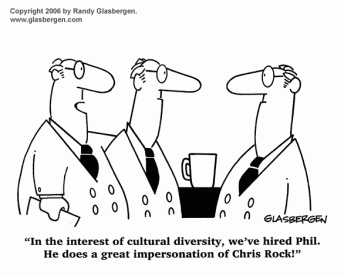
Chris Rock

I ran into a Chinese colleague in a break room at work and mentioned that I’d seen her engaged in a “pow wow” with a senior staffer, and she asked, “Pow wow?” I tried to explain the Native American origins of the term for a gathering or meeting, and I think she liked that, but I joked that my use of the term might represent “cultural appropriation” (CA). A second colleague who’d entered the kitchen glanced at me with a raised eyebrow. Knowing them well, I’m not sure either of them knew what I meant. As it happens, describing the pow wow as a celebration is more accurate, so my use of the term to describe a meeting was too narrow. In fact, in modern usage by Native Americans, it is a celebration of culture, but meetings take place at these events as well.

CA occurs when aspects of one culture are used in some way by others. It is criticized for trivializing the traditions or symbols of the source culture or because it robs it’s members of intellectual property (IP) rights. I can think of examples of cultural trivialization, such as the “Ugg-a-Wugg” song from the musical Peter Pan. Such complaints strike me as hyper-sensitive, but perhaps the umbrage taken by Native Americans to this song is understandable. Nevertheless, I stand more strongly behind the right of free expression. This song, which is rarely performed today out of respect for Native Americans, was part of a larger Neverland fantasy that has great appeal. And after all, the Indians were good guys in the story!

Works such as Peter Pan and Huckleberry Finn are historical and reflect the times in which they were created. As such, some argue that they should be left in their original form. And I agree, in general. However, in the case of a musical that is performed publicly again and again by various professional and amateur groups, I am sympathetic to the notion that potentially offensive elements can be excised if the changes do not do great damage to the story. If it is not in the public domain, the owners of the story’s rights have the final say.

The IP argument is flawed to the extent that IP arguments are always flawed: ideas are non-rivalrous and non-exclusive. Moreover, even IP rights recognized under U.S. law are limited to individual “property”; they do not extend to the traditions and symbols of various cultures that coexist in society.

Another area emphasized by critics of CA has to do with historical grievances against a dominant culture, often without regard to current circumstances. Apparently, such grievances place the minority culture off-limits. Under this view, cultural exchange is fundamentally bad, which is fundamentally absurd. It has the faint ring of “separate but equal” — paradoxical given the avowed desire among critics of CA for an end to racial and social division.

While European colonialists certainly exploited the native inhabitants in many lands, today’s liberal order in the West is attractive to members of different cultures around the globe.They adopt similar institutions and practices at home, and some of them bring their cultures to us. We all gain in the exchange.

Strong condemnation of CA has been all the rage on college campuses over the past few years (see several of the links here). It reflects a hyper-sensitivity about the normal mixing of cultures. Cultural exchange tends to elevate appealing aspects of all cultures into the larger society. Should we really condemn any of the following harmless activities?

  • Yoga classes at the Jewish Community Center?
  • Cinco de Mayo celebrations by non-Mexicans?
  • Caucasians celebrating the Chinese New Year or Moon Festival?
  • St. Patrick’s Day celebrations by non-Irish, non-Catholics?
  • Flower Drum Song or The King and I?
  • Caucasians playing Delta Blues?
  • African American Mardi Gras Indians?
  • Caucasians watching Bollywood movies?
  • The Grateful Dead at the Pyramids?
  • Caucasians cooking “ethnic” foods?

I grant that respect dictates avoiding use of another group’s sacred symbols. Beyond that, it is difficult to conceive of any objections to activities like those above. They are all forms of cultural cross-pollination, even if they seem to trivialize in some cases. This sometimes  involves cultural interpretation by “others” that might not be accurate, but that is always the case when cultures mix. People incorporate or adapt features of other cultures that they enjoy, which is hardly a sin.

Curious about pow wow, I found the following qualification in the Wikipedia entry for pow-wow:

“…the term has also been used by non-Natives to describe any gathering of Native Americans, or to refer to any type of meeting among non-Natives (such as military personnel). However, such use may be viewed as cultural appropriation, and disrespectful to Native peoples.“

Well, well, well! Pow wow is used in conversational english to lend an air of informality or lightness to certain proceedings. It may simultaneously convey a serious diplomatic purpose and an opportunity to resove differences. Sometimes, non-Natives might even use the term to sound clever, like using the French term soirée rather than “party”. Or perhaps they are amused by the image of corporate managers seated akimbo around a camp fire, passing a peace pipe. Or any pipe. Trivial? Maybe, but if that possibility outrages Native Americans, it strikes me as an over-reaction. After all, the joke is partly on “the suits”, and there isn’t much the Indians can do about it under the law.

I have always been fascinated by American Indian history and culture. I do not use the term pow-wow in disrespect. I use it because it’s colorful and I like it. The cross-pollination of language and culture is borne out of the utility of a particular word or practice. It can hardly be bad that a few shards of Native American language and culture are incorporated into broader American society.

My sister has a beautiful scarf bearing the profile of an American Indian in full head dress. She has always had an interest in the art and culture of the American southwest, which has benefitted from the heavy influence of Indians who are native to that region. So it was unsurprising to me that she would be drawn to the beauty of the scarf. It is a work of art and she does not wear it out of disrespect for American Indians.

Certain acts of CA are thought to intersect with racism, however. How about the Washington Redskins football team name? The team logo and merchandise use Native American symbols. The same goes for the Atlanta Braves and other teams. However, the term Redskin almost certainly has overtly racist origins as a description of an enemy thought to be savage, much as “Nips” was a derogative used by Allied soldiers in World War II as a term for the Japanese.  Defenders of the team claim that “Redskin” is not meant to trivialize or denigrate Native Americans, but instead to recognize their honor and ferocity in battle. The team owner and many fans insist that the tradition of the team name should continue in tribute to American Indians. Nevertheless, the name is understandably objectionable to Native Americans today as a crude description of their genealogy. My friend John Crawford tells me of a proposal to change the team logo to a red-skinned potato, but apparently the idea was rejected by the U.S. Patent Office.

In all of these matters, free speech outweighs all other considerations. While cultural appropriation is sometimes regarded with hostility, that does not give the aggrieved special rights to prevent it. The same is true of racism, however regrettable it is. Even so-called hate speech is protected under the U.S. Constitution, short of “fighting words”. Critics of cultural appropriation can seek to educate, influence, boycott and to shame those believed to have run afoul of their standards. In most cases, however, I think the best advice is to chill out.


Newer posts →
Follow Sacred Cow Chips on WordPress.com

Recent Posts

  • Grading Trump II, So Far
  • A Warsh Policy Scenario At the Federal Reserve
  • The Coexistence of Labor and AI-Augmented Capital
  • The Case Against Interest On Reserves
  • Immigration and Merit As Fiscal Propositions

Archives

  • March 2026
  • February 2026
  • January 2026
  • December 2025
  • November 2025
  • October 2025
  • September 2025
  • August 2025
  • July 2025
  • June 2025
  • May 2025
  • April 2025
  • March 2025
  • February 2025
  • January 2025
  • December 2024
  • November 2024
  • October 2024
  • September 2024
  • August 2024
  • July 2024
  • June 2024
  • May 2024
  • April 2024
  • March 2024
  • February 2024
  • January 2024
  • December 2023
  • November 2023
  • August 2023
  • July 2023
  • June 2023
  • May 2023
  • April 2023
  • March 2023
  • February 2023
  • January 2023
  • December 2022
  • November 2022
  • October 2022
  • September 2022
  • August 2022
  • July 2022
  • June 2022
  • May 2022
  • April 2022
  • March 2022
  • February 2022
  • January 2022
  • December 2021
  • November 2021
  • October 2021
  • September 2021
  • August 2021
  • July 2021
  • June 2021
  • May 2021
  • April 2021
  • March 2021
  • February 2021
  • January 2021
  • December 2020
  • November 2020
  • October 2020
  • September 2020
  • August 2020
  • July 2020
  • June 2020
  • May 2020
  • April 2020
  • March 2020
  • February 2020
  • January 2020
  • December 2019
  • November 2019
  • October 2019
  • September 2019
  • August 2019
  • July 2019
  • June 2019
  • May 2019
  • April 2019
  • March 2019
  • February 2019
  • January 2019
  • December 2018
  • November 2018
  • October 2018
  • September 2018
  • August 2018
  • July 2018
  • June 2018
  • May 2018
  • April 2018
  • March 2018
  • February 2018
  • January 2018
  • December 2017
  • November 2017
  • October 2017
  • September 2017
  • August 2017
  • July 2017
  • June 2017
  • May 2017
  • April 2017
  • March 2017
  • February 2017
  • January 2017
  • December 2016
  • November 2016
  • October 2016
  • September 2016
  • August 2016
  • July 2016
  • June 2016
  • May 2016
  • April 2016
  • March 2016
  • February 2016
  • January 2016
  • December 2015
  • November 2015
  • October 2015
  • September 2015
  • August 2015
  • July 2015
  • June 2015
  • May 2015
  • April 2015
  • March 2015
  • February 2015
  • January 2015
  • December 2014
  • November 2014
  • October 2014
  • September 2014
  • August 2014
  • July 2014
  • June 2014
  • May 2014
  • April 2014
  • March 2014

Blogs I Follow

  • Passive Income Kickstart
  • OnlyFinance.net
  • TLC Cholesterol
  • Nintil
  • kendunning.net
  • DCWhispers.com
  • Hoong-Wai in the UK
  • Marginal REVOLUTION
  • Stlouis
  • Watts Up With That?
  • American Elephants
  • The View from Alexandria
  • The Gymnasium
  • A Force for Good
  • Notes On Liberty
  • troymo
  • SUNDAY BLOG Stephanie Sievers
  • Miss Lou Acquiring Lore
  • Your Well Wisher Program
  • Objectivism In Depth
  • RobotEnomics
  • Orderstatistic
  • Paradigm Library
  • Scattered Showers and Quicksand
  • Jam Review

Blog at WordPress.com.

Passive Income Kickstart

OnlyFinance.net

TLC Cholesterol

Nintil

To estimate, compare, distinguish, discuss, and trace to its principal sources everything

kendunning.net

The Future is Ours to Create

DCWhispers.com

Hoong-Wai in the UK

A Commonwealth immigrant's perspective on the UK's public arena.

Marginal REVOLUTION

Small Steps Toward A Much Better World

Stlouis

Watts Up With That?

The world's most viewed site on global warming and climate change

American Elephants

Defending Life, Liberty and the Pursuit of Happiness

The View from Alexandria

In advanced civilizations the period loosely called Alexandrian is usually associated with flexible morals, perfunctory religion, populist standards and cosmopolitan tastes, feminism, exotic cults, and the rapid turnover of high and low fads---in short, a falling away (which is all that decadence means) from the strictness of traditional rules, embodied in character and inforced from within. -- Jacques Barzun

The Gymnasium

A place for reason, politics, economics, and faith steeped in the classical liberal tradition

A Force for Good

How economics, morality, and markets combine

Notes On Liberty

Spontaneous thoughts on a humble creed

troymo

SUNDAY BLOG Stephanie Sievers

Escaping the everyday life with photographs from my travels

Miss Lou Acquiring Lore

Gallery of Life...

Your Well Wisher Program

Attempt to solve commonly known problems…

Objectivism In Depth

Exploring Ayn Rand's revolutionary philosophy.

RobotEnomics

(A)n (I)ntelligent Future

Orderstatistic

Economics, chess and anything else on my mind.

Paradigm Library

OODA Looping

Scattered Showers and Quicksand

Musings on science, investing, finance, economics, politics, and probably fly fishing.

Jam Review

"If you get confused, listen to the music play."

  • Subscribe Subscribed
    • Sacred Cow Chips
    • Join 128 other subscribers
    • Already have a WordPress.com account? Log in now.
    • Sacred Cow Chips
    • Subscribe Subscribed
    • Sign up
    • Log in
    • Report this content
    • View site in Reader
    • Manage subscriptions
    • Collapse this bar
 

Loading Comments...