• About

Sacred Cow Chips

Sacred Cow Chips

Category Archives: Gender Differences

Tampons For Men From a Strapped Public Purse

18 Sunday Aug 2024

Posted by Nuetzel in Gender Differences, Scarcity

≈ Leave a comment

Tags

Condom Dispensers, Cost-Benefit, Female to Male Transition, Free Tampons, FTM, Gender Transition, Gender-Affirming Care, Hysterectomy, Intersex, Market Test, Menstruation, MTF, Non-Binary Population, Overactive Bladders, Pay Toilets, Private Goods, Public Budgets, Public Restrooms, Tampon Dispenser, Tampons in Men’s Rooms, Tax Burdens, Trans Population, Trans-Men
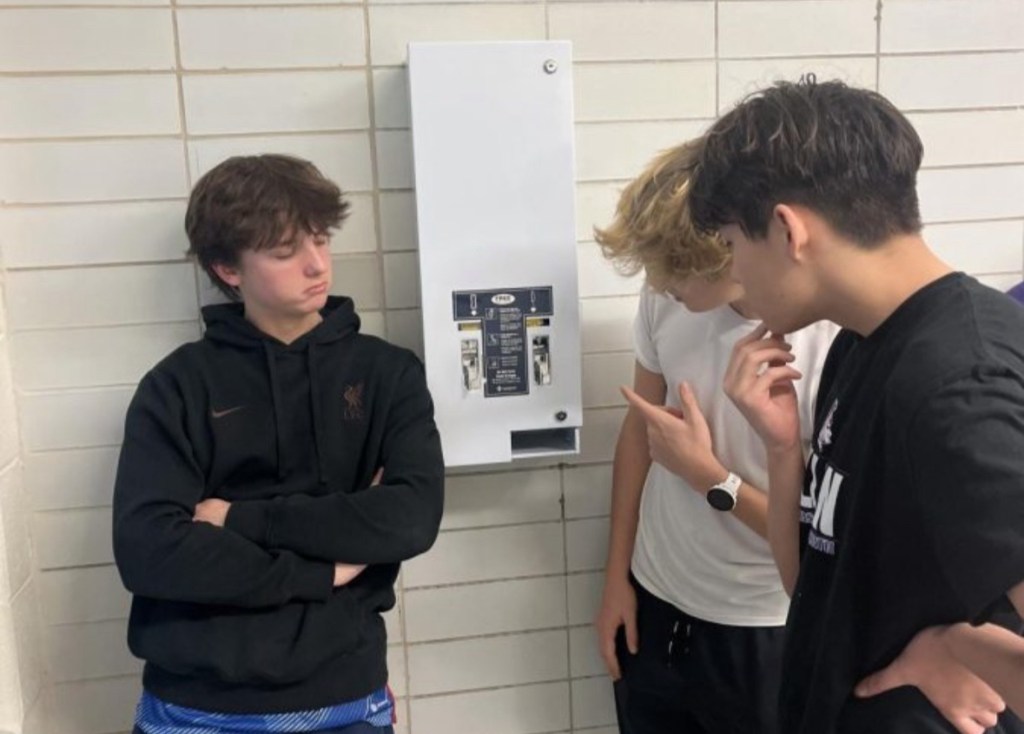
I had to laugh when I saw this tweet on X the other day:

Cis men, if you were to walk into a public restroom and see menstrual products near the soap dispensers, how would it negatively affect your life?

Please provide specific examples.

— Rebecca Fachner (@rebecca_fachner) August 9, 2024

I actually think she was fishing for sympathetic comments from … anyone. Or it was intended as a rhetorical question, as the poster seems to regard many cis-men as the meanies in this affair. But let’s give her the benefit of the doubt. Maybe she really wanted to engage with men who object to tampon dispensers in men’s public restrooms.

Before getting started, I want to be clear that I’m using the term “public restroom” to mean a restroom available to the general public and furnished by the public sector. I distinguish these from restrooms in commercial establishments intended for use by customers only.

Tampon Dispensing Is Not Cost-Free

So I have a question: who will be asked to pay for the dispensers in men’s public restrooms, their installation, servicing, and the tampons themselves? Will the tampons be dispensed at no charge, as some advocates would like? That’s the case in some public schools, so there might be a tendency to think tampons should be free in other men’s public restrooms. Of course, another possibility is to install pay vending machines for tampons, and I will address that in later sections. Here I note that I’d have no objection if they paid for themselves.

Free tampons in men’s public restrooms, or even priced tampons that don’t cover their costs, would represent a use of public resources. Taxpayers would be on the hook. Alternatively, some other public expenditure might be reduced to make room in government budgets for the new amenity. Public budgets are notoriously strapped, and foregoing other budget needs would carry an opportunity cost. Public resources should be put to the most urgent public needs, which might run the gamut from critical services like law enforcement, sanitation, and street repair to the staffing of mental health facilities.

If this strikes you as economic small-ball, remember that demands for public funds are seemingly without end. Whether taxes are increased or the budget is reallocated, “my life” is affected to a degree by every new demand that is met. To pay for tampon dispensers in men’s public restrooms, resources must be diverted from some other valued use.

Beneficiaries

Surely Ms. Fachner believes that tampons in men’s restrooms confer social benefits. Might those benefits exceed the opportunity cost of the necessary resources?

Well, biological males don’t have ovaries, they can’t get pregnant, and they don’t have periods, so we can scratch them off the list of potential beneficiaries. This is about trans- or intersex men who menstruate or perhaps suffer bleeding from hysterectomies. As I’ll discuss below, this is a small minority of users of men’s public restrooms.

But wait, here’s one advocate:

“Our culture does not really acknowledge the diversity of menstruating individuals.“

Statements like that lend absolutely no clarity. In fact, it’s a gross obfuscation made in an effort to redefine reality and exaggerate the prevalence of menstruating males.

Estimates of the Trans-Male Population

The transgender population was estimated at about 0.5% – 0.6% of the total U.S. population in 2022, based on two studies. That’s about one in every 200 individuals. However, male-to-female (MTF) transitions are 2 – 4 times more common than female to male (FTM) transitions. Combining these estimates yields one FTM in every 400 – 800 men. Of course, not all FTMs menstruate (and they don’t menstruate over the entirety of a given month). So men who might need a tampon in a public restroom are a small minority.

Nonbinaries?

Some would insist that any such estimate should account for the nonbinary population of individuals who menstruate. Part of this group is the intersex (hermaphrodite) population who identify as males. A number of these individuals have had gender-affirming care and would already have been counted as FTMs in the studies linked above (and I will continue to use “FTM” as inclusive of this group). However, I’m skeptical of the non-binary classification on surveys because some otherwise “straight” individuals use it to signal their participation in the avant guarde of gender identification, perceiving it as something fashionable or even virtuous.

Nevertheless, one 2022 poll found that the trans plus nonbinary population was about 1.6% of all adults. Combining this with the MTF/FTM estimates above, an implied upper bound on the male tampon “market” would be about 3 out of every 400 distinct visitors to a men’s restroom, or less than one out of every hundred. If the nonbinary classification is taken at face value, it’s still a small minority and probably far less than 1/100.

Woe Is We

A great many of us suffer inconveniences in life, some of them terrible, but it would be extremely costly and irrational for the state to attempt to neutralize every one of them. For example, people with overactive bladders are far more common than the trans population. Should the state accommodate them by doubling the number of public restrooms? At some point it’s worth recognizing that claims on public resources can become preposterous.

The economic argument against outfitting all men’s public restrooms with tampon dispensers falls into a broader category of common-sense resistance to eliminating (or compensating) for every tiny cross borne by anyone: every minor strife, inconvenience, or “micro-aggression” individuals might experience. The cumulative effect of this cavalcade of demands on society and on each other, which cannot all be met, is to breed discontent while stifling social and economic progress. We live in the real world where scarcity matters. We must therefore be sensible about where and how we expend our energy and resources.

Costs

I haven’t yet explored the specific costs associated with adding tampon dispensers to men’s public restrooms. Not surprisingly, it’s difficult to pin them down completely, but a few notes are helpful.

The cost of a free-tampon dispenser ranges from about $90 to $140. A pay tampon vending machine ranges from about $300 – $500. Then the dispensers have to be installed, stocked, and serviced, and there is a potentially greater cost of sanitation within each restroom. This article includes cost data from 2017-2019 for a public school district in Massachusetts. It’s ambiguous as to whether installations of free dispensers occurred in women’s restrooms only or all restrooms, but much of the article is written as if it applies to women and girls. To be clear, I don’t take issue with providing free tampon dispensers in school restrooms for females.

The dispensers and receptacles for the school district totaled $33,000, which presumably included the labor cost of installation. The annual cost of keeping the dispensers stocked was just $2.48 per student annually, but it’s not clear whether that average includes labor, or whether the divisor is the female student population or all students. Certainly all of these costs would be greater today.

Don’t Putsch It

The FTM minority is likely to grow, especially in parts of the country where advocates for the gender dysphoric have won legislative battles over gender-affirming care for youths. This is a huge mistake. It’s highly unethical to encourage unalterable, life-changing medical interventions for what often amount to youthful anxieties that usually pass with age. But these initiatives go hand-in-hand with bills requiring free menstrual products in all school restrooms and in all public restrooms. It would be more reasonable to suggest to any biological female considering a gender transition, who must weigh many considerations, that they’ll sometimes be inconvenienced by the need to pack a precautionary tampon.

Crazy Counter-Arguments

There were some interesting comments on Ms. Fachner’s tweet. One contended that men should have tampons available in the event that a female companion happens to need one. Well, it’s so nice to know that chivalry still has a place among the woke! But if a woman needs a tampon while she’s out, and if she has any sense, she’ll try the womens’ restroom herself before asking a male companion to check the men’s room.

Another commenter felt that the availability of tampons in men’s restrooms is the equivalent of condom dispensers in womens’ restrooms. Not quite! A woman out with a male companion might wish to have protection available if she expects to have intercourse. I’m not sure how many public women’s restrooms have condom dispensers, but you might find paid dispensers at truck stops, dance clubs, or other private venues where the sexes meet and greet. In any event, interest in condoms in women’s restrooms might well be a more common phenomenon than FTMs unprepared for the onset of a period.

Market Test

The mere existence of vending machines for condoms and other products in the restrooms of private establishments proves that these offerings satisfy a sort of market test. The charges for those products, including tampons, pads, and condoms in women’s restrooms, might or might not cover all of the associated costs. However, even if they don’t, the machines are provided as a courtesy to customers and/or because competitors provide them. Either way, as a market proposition, the establishments find the machines to be advantageous.

Would private establishments find it profitable to offer tampons and pads in vending machines in men’s restrooms? It’s possible, and businesses catering to non-traditional lifestyles are more likely to offer menstrual products in men’s restrooms, if only as a courtesy to FTM customers. However, it’s uncommon at best among mainstream businesses. Again, the economic logic is dependent on the volume of menstrual products likely to be dispensed. If they add value, the market is likely to provide them. This might be more plausible for machines that vend multiple products.

Successful pricing of tampons in men’s public restrooms would be easier if the probable volume was greater, but it will be quite low relative to women’s restrooms. Thus, the up-front fixed costs are difficult to justify. In any case, vending machines of any type are less common in public restrooms. Perhaps that’s because the items sold would not cover all of the associated costs. Or perhaps it’s because public administrators lack the incentives that motivate actions in the private sector. Enter the activists!

Market Failure?

One might argue that passing the market test is irrelevant because public facilities are intended to offer a range of services which the market can’t be relied upon to provide. That’s not clear cut in the case of restrooms themselves, and I’ve advocated for more pay toilets in the past. However, tampons are very much a private good. A trans-male with an unmet need for a tampon is in a bad spot, and he might generate external costs. However, I maintain that the situation is fairly uncommon, and those hypothetical external costs are fairly easy to internalize. This is not a true market failure nor a public priority.

Finally, I note again that Ms. Fachner addresses her question only to cis-men. I have news for her: like any other form of common sense, the rudimentary economic logic of costs and benefits is inclusive and available to all, regardless of sexual preference and gender identification.

Every Gentleman Best Heed the Power of Hysterics To Censor

19 Saturday Feb 2022

Posted by Nuetzel in Censorship, Gender Differences, Uncategorized

≈ Leave a comment

Tags

Abortion, Antifa, BLM, Bullying, Center for the Study of Partisanship and Ideology, Civil Rights Law, Critical Race Theory, Dark Triad, Defense Priorities, Disparate impact, Equal Pay, Eric Landers, Family Leave Mandates, Feminization, First Amendment, Gender Conventions, Gender Studies, Georgetown Law School, Grievance Studies, Harrassment, Hate Speech, Human Resources, Ilya Shapiro, Joe Biden, Minimum Wage, Noah Carl, Racial Quotas, racism, Richard Hanania, Sexism, Virtuous Victimhood, Yale Halloween

Here are the gender conventions we’ve adopted in Western society on the rules of debate:

“We accept gender double standards, and tolerate more aggression towards men than we do towards women. We also tolerate more hyper-emotionalism from women than men.”

So says Richard Hanania in an essay called “Women’s Tears Win In the Marketplace of Ideas“. Hanania is the president of the Center for the Study of Partisanship and Ideology, and a research fellow at Defense Priorities. He offers some cogent examples of this disparate treatment, such as the Yale Halloween costume imbroglio and the “cancelling” of Ilya Shapiro at Georgetown Law School. To those we can add Eric Landers’ forced withdrawal as Joe Biden’s chief science advisor, and there are countless others. About this, Hanania says:

“What makes these cases difficult is that male versus male argumentation just has completely different rules, norms, and expectations than male versus female. … A man can’t just yell in another man’s face for 5 or 10 minutes about how he’s hurting his feelings. If a man does behave this way, bystanders are more likely to feel disgusted than join in or play the role of white knight. The man at the receiving end of the abuse is at some point going to have to escalate towards violence, or back down and say something about how this is beneath him. Depending on the situation, observers may assume violence is a distinct possibility, and get between the two sides.

None of these options are available when getting yelled at by a woman. You certainly can’t make an implicit threat of violence. Raising your voice will turn everyone against you, and even walking away can look heartless.”

I’ve witnessed a few pathetic crying jags in the workplace myself, as well as some volleys of verbal belligerence from females on social media that were pointedly anti-social. In my experience, most women can dish out barbs good-naturedly in jest and conduct themselves with dignity in debate. On the other hand, there are too many men who become hostile in debate, which most observers will find much less sympathetic if the counter-party is a woman. And there are a few men, here and there, who have trouble holding back tears in a fraught exchange, but we all know it’s not a good look.

To state the obvious, tears are a natural reaction to grief or real hurt. Anger is well-justified in response to criminal or personal wrongs. Nevertheless, it’s necessary to distinguish between these kinds of reactions and the ignoble tears or venom sometimes brought to controversial debates by neurotic partisans. As Hanania says of our disparate gender conventions, considerable censorship is instigated by an intransigent minority of women who manage to “… indulge their passions in ways that men cannot … .” Most men, anyway… and if they do, they’ve usually lost and know it.

These passionate displays are often tied to claims of individual or group victimhood. The objector could be anyone who feels an under-appreciated beef, but acting-out in order to signal “virtuous victimhood” in this way might indicate a deeper instability.

Again, as Hanania says, females have a definite advantage in the deployment of tears, confrontational rhetoric, and screams. Coincidentally, in a post to which Hanania links, Noah Carl marshals data on the extremely skewed representation of degrees awarded to women in Grievance Studies (e.g. Gender Studies and Critical Race Theory).

Too often, claims of victimhood are invoked in attempts to rebut any number of principled policy positions. For example, your views might be construed as offensive, racist, or sexist if you oppose such things as an increase in the minimum wage, racial quotas, disparate impact actions, equal pay rules, family leave mandates, and abortion. Expressing a strong and reasoned defense of many positions can foment imagined micro-aggressions or even harassment.

The real danger here is that honest debate is suppressed, and with it, very often, the truth. I acknowledge that people must be free to express or defend their views passionately, and with tears, screams, or otherwise, which the First Amendment guarantees. Our gender conventions in this matter should be revisited, however, if men and women are truly to be on equal footing.

Whether baring fangs or shedding tears, there are self-appointed arbiters of acceptable speech represented in almost all of our public and private institutions, ready to shut down debate on account of their feelings. They have more than a few sympathetic allies, male and female, at higher levels of their organizations. In the past, Hanania has discussed the over-representation of females in Human Resource departments. In these contexts, adjudication of disputes often relies on vague notions of what constitutes “hate speech” or “harassment” under Civil Rights Law. If you manage to provoke the tears of a colleague or underling, you’re probably behind the eight ball!

Hanania considers some alternative ground rules or “options” for debate:

  1. Expect everyone who participates in the marketplace of ideas to abide by male standards, meaning you accept some level of abrasiveness and hurt feelings as the price of entry.
  2. Expect everyone to abide by female standards, meaning we care less about truth and prioritize the emotional and mental well-being of participants in debates.”

Either of these options is better than the double standard we have now, and Hanania point to a number of egregious manifestations of our double standard. As he notes, #2 might be what’s meant by the “feminization of intellectual life”, but it fosters the arbitrary prohibition against discussion of any number of ideas that belong on the policy menu.

Option #1 would undoubtedly be condemned as “traditional male dominance” of public debate, but it would bar no one from participation, and obstacles perceived by females, or any sensitive soul, can be viewed as a matter of socialization. Both tearful and ferocious argumentation should be marginalized regardless of the antagonist’s gender.

Imperfect as they are, we have laws and/or social strictures against harassment, bullying, and other aggressive behavior thought to be largely associated with malcontented males. But as Hanania says:

“We haven’t even begun to think carefully about equivalent pathologies stemming from traits of the other sex.”

This problem obviously pales in comparison to the fascist tactics typical of the far Left. That includes the violent behavior of Antifa and BLM, unethical attempts blame conservatives for various, often fabricated deeds, and to threaten and punish them economically, even to the point of state-sponsored thievery and threats of harm to family members. Despite the more benign nature of the disparities discussed here, restoring gender equality to the terms of civil debate, without tears and hysterics, would be a great step forward.

Mean, Humorless Profs By Gender

29 Friday Nov 2019

Posted by Nuetzel in Gender Differences

≈ Leave a comment

Tags

Bias, Chronicle of Higher Education, Gender Discrepancies, Queen Bee Syndrome, RateMyProfessors.com, Social Expectations, STEM Fields, Student Evaluations, Word Frequency

Do college kids disrespect female professors and cut male professors extra slack? Or do female professors act in ways that earn disrespect relative to their male counterparts? The data described here don’t answer those questions, but they do show that consistent asymmetries exist. The results summarize certain features of student evaluations by gender of professor, and while seemingly incredible, they deserve further scrutiny.

The Study

The study in the Chronicle of Higher Education covered 14 million evaluations housed at RateMyProfessor.com. Word frequencies from student evaluations indicate that female professors are perceived less frequently as “brilliant” and “funny” than male professors, and more frequently as “mean” and “rude”. Directionally, the result applied to every area of study without exception. What could be driving such a gap?

First, the scale of measurement needs a closer look. If evaluations average 50 words, let’s say, then 500 single uses of a word per million words would amount to once in every 20 evaluations. That’s a little easier to digest. It’s clear from the charts that “funny” and “rude” are used more frequently than “brilliant” and “mean”, regardless of the professor’s gender. But the bulk of evaluations do not use any of those words. That’s an important qualification, and yet the results are so strikingly consistent that it’s hard to deny that differences exist, at least between extremes within the male and female faculty cohorts.

Explanations

For the moment, suppose the students’ perceptions are accurate in some objective sense. If so, perhaps some women in academia overcompensate in an effort to be taken seriously in a world dominated by males. Males don’t dominate all subject areas, however, and even in areas of study more likely to have high female representation. females are still evaluated more harshly on these criteria. In fact, a perusal of the subject areas might even suggest that some of these particular gender gaps are smaller in STEM fields, which are traditionally dominated by males. Still, the overcompensation hypothesis might have a grain of truth, even if “overcompensation” by female profs is merely a form of ongoing rebellion against traditional gender roles. For the same reason, maybe “severe” female personalities self-select for academic jobs in greater proportion than males, though I’m not sure that holds up.

If the student perceptions are incorrect, what’s driving them? Are expectations for women in academia simply more demanding? Such that many female profs fail to live up across a broad range of dimensions? There is strong support for the proposition that student evaluations are biased against female profs. If students are somehow conditioned to think that a female prof will be inferior, she might have to outperform her male counterparts along various dimensions simply to stay even. That might well explain the regular patterns of words used by some students.

Other Qualifications and Contradictions

The word frequencies described above aren’t definitive by any means, even if you put great stock in student evaluations. In fact, using the interactive tool provided by the authors of the study, the word “nice” appears relatively often and in consistently higher numbers for female than for male profs. And, with consistent but very low frequency, the word “moron” is used to describe more male profs than females. Maybe there’s greater variance across female professors in the “niceness” dimension, and more variance across males in the “smarts” dimension (and some research suggests that the latter is true). I’m not so sure about the “funniness” dimension, but I know some very funny women!

It would be helpful to know the breakdown of word frequencies by student gender. What I often hear from female acquaintances is that women are harder on other women than on men. In relationships involving asymmetric power, this is the so-called “Queen Bee Syndrome“, a phenomenon having some empirical support.

There could be other biases baked into the study, such as a predominance of angry reviewers, but I’m not sure that would explain a bias against female profs. Finally, it’s possible the RateMyProfessors site attracts more male reviewers. A rough (and amusing) feel for the proportion of male and female reviewers might be gleaned by entering the word “hot” into the tool (!). As expected, the mostly male engineers are much more likely to use that expression as a description of female profs, but reviewers in most fields are fairly balanced in their choice of that word.

Conclusion

The word frequencies may well reflect the adoption of harsher standards by some students for female profs relative to male profs, and there may be female profs who “overcompensate”. And maybe more women with relatively “thick-skin” are attracted to the ranks of the professoriate. College students can be a tough crowd, but it’s important to remember that they are mostly young. Teachers can and should refine their approach in ways that might produce greater learning and satisfaction. But more than anything else, the results reinforce the conclusion that institutions should be cautious about the weight they place on student evaluations in assessing faculty performance.


Follow Sacred Cow Chips on WordPress.com

Recent Posts

  • Immigration and Merit As Fiscal Propositions
  • Tariff “Dividend” From An Indigent State
  • Almost Looks Like the Fed Has a 3% Inflation Target
  • Government Malpractice Breeds Health Care Havoc
  • A Tax On Imports Takes a Toll on Exports

Archives

  • December 2025
  • November 2025
  • October 2025
  • September 2025
  • August 2025
  • July 2025
  • June 2025
  • May 2025
  • April 2025
  • March 2025
  • February 2025
  • January 2025
  • December 2024
  • November 2024
  • October 2024
  • September 2024
  • August 2024
  • July 2024
  • June 2024
  • May 2024
  • April 2024
  • March 2024
  • February 2024
  • January 2024
  • December 2023
  • November 2023
  • August 2023
  • July 2023
  • June 2023
  • May 2023
  • April 2023
  • March 2023
  • February 2023
  • January 2023
  • December 2022
  • November 2022
  • October 2022
  • September 2022
  • August 2022
  • July 2022
  • June 2022
  • May 2022
  • April 2022
  • March 2022
  • February 2022
  • January 2022
  • December 2021
  • November 2021
  • October 2021
  • September 2021
  • August 2021
  • July 2021
  • June 2021
  • May 2021
  • April 2021
  • March 2021
  • February 2021
  • January 2021
  • December 2020
  • November 2020
  • October 2020
  • September 2020
  • August 2020
  • July 2020
  • June 2020
  • May 2020
  • April 2020
  • March 2020
  • February 2020
  • January 2020
  • December 2019
  • November 2019
  • October 2019
  • September 2019
  • August 2019
  • July 2019
  • June 2019
  • May 2019
  • April 2019
  • March 2019
  • February 2019
  • January 2019
  • December 2018
  • November 2018
  • October 2018
  • September 2018
  • August 2018
  • July 2018
  • June 2018
  • May 2018
  • April 2018
  • March 2018
  • February 2018
  • January 2018
  • December 2017
  • November 2017
  • October 2017
  • September 2017
  • August 2017
  • July 2017
  • June 2017
  • May 2017
  • April 2017
  • March 2017
  • February 2017
  • January 2017
  • December 2016
  • November 2016
  • October 2016
  • September 2016
  • August 2016
  • July 2016
  • June 2016
  • May 2016
  • April 2016
  • March 2016
  • February 2016
  • January 2016
  • December 2015
  • November 2015
  • October 2015
  • September 2015
  • August 2015
  • July 2015
  • June 2015
  • May 2015
  • April 2015
  • March 2015
  • February 2015
  • January 2015
  • December 2014
  • November 2014
  • October 2014
  • September 2014
  • August 2014
  • July 2014
  • June 2014
  • May 2014
  • April 2014
  • March 2014

Blogs I Follow

  • Passive Income Kickstart
  • OnlyFinance.net
  • TLC Cholesterol
  • Nintil
  • kendunning.net
  • DCWhispers.com
  • Hoong-Wai in the UK
  • Marginal REVOLUTION
  • Stlouis
  • Watts Up With That?
  • Aussie Nationalist Blog
  • American Elephants
  • The View from Alexandria
  • The Gymnasium
  • A Force for Good
  • Notes On Liberty
  • troymo
  • SUNDAY BLOG Stephanie Sievers
  • Miss Lou Acquiring Lore
  • Your Well Wisher Program
  • Objectivism In Depth
  • RobotEnomics
  • Orderstatistic
  • Paradigm Library
  • Scattered Showers and Quicksand

Blog at WordPress.com.

Passive Income Kickstart

OnlyFinance.net

TLC Cholesterol

Nintil

To estimate, compare, distinguish, discuss, and trace to its principal sources everything

kendunning.net

The Future is Ours to Create

DCWhispers.com

Hoong-Wai in the UK

A Commonwealth immigrant's perspective on the UK's public arena.

Marginal REVOLUTION

Small Steps Toward A Much Better World

Stlouis

Watts Up With That?

The world's most viewed site on global warming and climate change

Aussie Nationalist Blog

Commentary from a Paleoconservative and Nationalist perspective

American Elephants

Defending Life, Liberty and the Pursuit of Happiness

The View from Alexandria

In advanced civilizations the period loosely called Alexandrian is usually associated with flexible morals, perfunctory religion, populist standards and cosmopolitan tastes, feminism, exotic cults, and the rapid turnover of high and low fads---in short, a falling away (which is all that decadence means) from the strictness of traditional rules, embodied in character and inforced from within. -- Jacques Barzun

The Gymnasium

A place for reason, politics, economics, and faith steeped in the classical liberal tradition

A Force for Good

How economics, morality, and markets combine

Notes On Liberty

Spontaneous thoughts on a humble creed

troymo

SUNDAY BLOG Stephanie Sievers

Escaping the everyday life with photographs from my travels

Miss Lou Acquiring Lore

Gallery of Life...

Your Well Wisher Program

Attempt to solve commonly known problems…

Objectivism In Depth

Exploring Ayn Rand's revolutionary philosophy.

RobotEnomics

(A)n (I)ntelligent Future

Orderstatistic

Economics, chess and anything else on my mind.

Paradigm Library

OODA Looping

Scattered Showers and Quicksand

Musings on science, investing, finance, economics, politics, and probably fly fishing.

  • Subscribe Subscribed
    • Sacred Cow Chips
    • Join 128 other subscribers
    • Already have a WordPress.com account? Log in now.
    • Sacred Cow Chips
    • Subscribe Subscribed
    • Sign up
    • Log in
    • Report this content
    • View site in Reader
    • Manage subscriptions
    • Collapse this bar
 

Loading Comments...