• About

Sacred Cow Chips

Sacred Cow Chips

Category Archives: Subsidies

Suspending the Economic Problem With Free Stuff

27 Saturday Aug 2016

Posted by Nuetzel in Central Planning, Socialism, Subsidies

≈ Leave a comment

Tags

Bernie Sanders, central planning, Confiscation, Contrived Scarcity, Don Boudreaux, Free Stuff, Hillary Clinton, incentives, Jeffrey Tucker, Nonprice Rationing, Overuse of Resources, Property Rights, Redistribution, Scarcity Deniers, Socialism

denial

When things are scarce, they can’t be free. That’s an iron law of economics. It’s true of everything we ever wish for and almost everything we take for granted. Things are naturally scarce, but when we are told that things can be free, it always comes from likes of whom Jeffrey Tucker calls “scarcity deniers”. Bernie Sanders and Hillary Clinton have told America that a college education should be free, and a large number of people take that seriously. They are scarcity deniers. On one level, the Sanders/Clinton claim is like any other promise that simply cannot be met at the stated cost — a rather garden-variety phenomenon among politicians. These promises are not harmless, as such initiatives usually involve budget overruns, compromised markets, underproduction and wasted resources.

The Sanders/Clinton claim, however, is a form of scarcity-denial that comes almost exclusively from the political left. That is really the point of Tucker’s article:

“This claim seems to confirm everything I’ve ever suspected about socialism. It’s rooted in a very simple error, one so fundamental that it denies a fundamental feature of the world. It denies the existence and the persistence of scarcity itself. That is to say, it denies that producing and allocating is even a problem. If you deny that, it’s hardly surprising that you have no regard for economics as a discipline of the social sciences.“

Our socialist friends (who otherwise claim to be defenders of science) contend that free things can be offered to a broad swath of the population with little consequence. The least cynical among them (perhaps including Sanders) believe that the costs can be shouldered by the wealthy and/or big corporations and banks. Others (including Clinton) know that the cost of “free things” must be met by higher taxes on a broader share of the population. Doesn’t that mean they recognize scarcity? Only superficially, because they fail to grasp the dynamics of resource allocation, the subtle forms in which costs are imposed, and the true magnitude of those costs.

If a thing is scarce, available supplies must be balanced against demand. The reward to suppliers at the margin must match the willingness of buyers to pay. That means there is no surplus and waste, nor any loss attendant to shortage and non-price rationing. The price creates an incentive for consumers to conserve and an incentive for producers to bring additional supplies to market when they are demanded.

A crucial prerequisite for this to work is the establishment of secure property rights. Then, absent coercion, one can’t overuse what isn’t theirs. One can’t simply take a thing from those who create it without a mutually agreeable payment. Creators cannot be forced to respond on demand without compensation. No one can be required to husband resources for others to simply take. No one can be asked to pay for a thing that will be commandeered by others. The establishment of property rights serves these purposes. Incentives become meaningful because they can be internalized by all actors — those consuming and those producing. And the incentives solve the problem of scarcity by balancing the availability of things with needs and desires, and balance them against all other competing uses of resources. Then, the market-clearing price of a thing reflects its degree of scarcity relative to other goods.

The socialist bluster holds that all this is nonsense. Would-be central planners propose that more of a thing be produced because they deem it to be of high value. Furthermore, it must be made available to buyers at a price the planners deem acceptable, or quite possibly for free to their intended constituency! Property rights are violated here in several ways: first, the owner/producer’s authority over their own resources is declared void; second, the owner has no incentive to care for their resources in a responsible and sustainable way; third, a confiscation of resources from others is required to pay at least some of the costs; fourth, the beneficiaries overuse and degrade the resource.

We know a scarce thing cannot be provided for free. Here are some consequences of trying:

  • Overuse of resources. When the buffet is free, the food disappears.
  • The “free thing” will be over-allocated to those who benefit and value it the least. (Example: the education of students for whom there are better alternatives.)
  • Supplies will evaporate unless producers are fully compensated. Otherwise, quality and quantity will deteriorate. This is a form of “contrived scarcity” (HT: Don Boudreaux).
  • If supplies dwindle, new forms of rationing will be necessary. This might involve time-consuming queues, arbitrary allocations, bribes, side payments and favoritism.
  • If suppliers are compensated, someone must pay. That means taxes, public borrowing or money printing.
  • Taxes weaken productive incentives and chase resources away. The consequent deterioration in productive capacity undermines the original goal of providing  something “for free” and inflicts costs on the outcomes of all other markets. This creates more contrived scarcity.
  • So-called progressive taxes tend to hit the most productive classes with the greatest negative force.
  • Government borrowing to fund “free stuff” today inflicts costs on future taxpayers. More fundamentally, it misallocates resources toward the present and away from the future.
  • Printing money to pay for a “free thing” might well cause a general rise in prices. This is a classic, hidden inflation tax, and it may involve the distortion of interest rates, leading to an inter-temporal misallocation of resources.

Scarcity denial is a carrot, but it inevitably becomes a stick. To voters, and to naive shoppers in the marketplace of ideas, the indignant assertion that things can and should be free is powerful rhetoric. Producers, too, might happily accept “free-stuff” policies if they expect to be fully compensated by the government, and they might be pleased to have the opportunity to serve more customers if they think they can do so profitably. However, serving all takers of “free stuff” will escalate costs and is likely to compromise quality. It is also likely to create unpleasant circumstances for customers, such as long waiting times and unfulfilled orders. The stick, on the other hand, will be brandished by the state, blaming and penalizing suppliers for their failure to meet expectations that were unrealistic from the start. The fault for contrived conditions of scarcity lies with the policy itself, not with producers, except to the extent that they allowed themselves to be duped by scarcity deniers. Tucker notes the following:

“Things can be allocated by arbitrary decision backed by force, or they can be allocated through agreement, trading, and gifting. The forceful way is what socialism has always become.“

Politicians and would-be planners with the arrogance to claim that naturally scarce things should be free are dangerous to your welfare. These scarcity deniers cannot provide for human needs more effectively than the free market, and ultimately their efforts will make you subservient and poor.
The Wind, The Sun, and a Load of Subsidies

17 Thursday Mar 2016

Posted by Nuetzel in Environment, Renewable Energy, Subsidies

≈ Leave a comment

Tags

Abandoned Wind Turbines, Baseline Capacity, Cronyism, Decarbonization, Energiewende, Federal Energy Regulatory Commission, Intermittency, Investor Intel, John Peterson, Peaking Capacity, Power Storage, Renewable energy, Rooftop Solar, Seeker Blog, Solar Reimbursement Rates

image


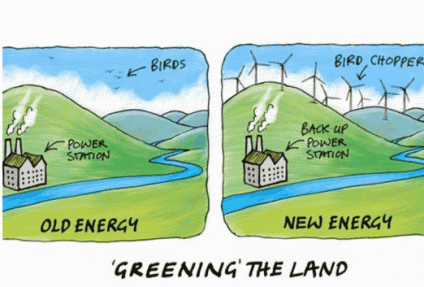
Renewable energy sources are not economically viable without subsidies, and they can impose some ugly external costs. Taxpayer subsidies for renewables like solar and wind projects are rationalized on the grounds that adoption will reduce carbon emissions and bring declining costs, ultimately saving resources by virtue of “free inputs”: the sun and the wind. But the cost of carbon emissions is highly uncertain, even speculative, and subsidies usually manage to get wasteful projects off the ground that are all too often run by political cronies. Despite the free variable inputs, these projects entail substantial resource costs that are conveniently overlooked by supporters. No wonder so many renewable outputs cannot be sustained without a continuing flow of aid.

What happens when the subsidies reach their sunset? There are thousands of abandoned wind turbines littering the U.S. (and a number of abandoned solar farms, too). There are several thousand turbines at one abandoned wind farm north of Los Angeles and another east of the Bay Area. There are many more in Hawaii, Iowa, Maine, Texas and other states. Attorneys often warn landowners that lease agreements with wind developers are risky. There are a number of ways that crony wind developers impose “external costs” on landowners. Eventual disposal is a risk, as the developers might just be inclined to take the subsidies and run.

Again, wind’s big advantages, aside from the subsidies, are that wind itself is free and produces no carbon, but other resources needed to make use of wind energy are not renewable, and producing those inputs produces CO2. To build and install the windmills requires materials (including steel and scarce rare-earth materials used in the electronic components), machinery, and of course labor and land costs. There is also a substantial investment in connecting windmills to the power grid. Ultimate disposal is a certainty, and it is not cheap. Then there is a controversial cost in terms of slaughtered avian life. Increasingly, wind turbines are thought to create health issues for people living nearby.

Solar power has the same advantages as wind in terms of a free input and no direct carbon output. In addition, the cost of solar panels has declined precipitously. Rooftop solar installations have allowed consumers to sell power back to electric utilities at certain times. In fact, without those “reimbursements” on top of the subsidies, installed on-site solar power would not be economically viable for many households and businesses. Reimbursement rates are therefore a huge controversy. Solar advocates have insisted that consumers should be reimbursed at the retail price of electricity. That is difficult to square with the fact that utilities could produce that power themselves for much less. It is especially difficult to square with the fact that the excess solar generation is often mismatched with the timing of power demand.

This brings us to the achilles heel of wind and solar power: wind and sunshine are intermittent, and not just on a daily basis, but over weeks, whole seasons and even years. This risk can be diversified geographically, but only to an extent, and effective power storage options do not presently exist and will not exist for some time, even with massive subsidies. Intermittent energy production requires the availability of other reliable power sources that are costly to turn on and off as needs dictate. It requires other “peaking” capacity to fill the “valleys” in wind and solar output, and baseline capacity is needed to provide for the less variable components of demand. Baseline capacity relies on nuclear power (which many solar advocates abhor) and carbon-emitting fossil fuels. Peaking capacity is typically provided by oil and natural gas generators. Hydro-electric power can be used as baseline or dialed back as needed, but hydro capacity is generally limited.

Renewable energy activists speak of replacing traditional power sources with wind and solar power. It is difficult enough, however, for wind and solar to replace peaking capacity, let alone baseline capacity. Peak wind and solar power production is not well-aligned with peak power demand in many areas (see the second chart at this link). The extra resources required to provide redundant facilities are significant, with ratepayers picking up the tab.

Given the current state of technology, pushing renewable energy goals even further, to the replacement of baseline capacity, is misguided at best. Yet it has been tried, with unintended but easily foreseeable consequences. Germany’s Energiewende program seeks to “decarbonize” power production without nuclear power. The costs have been very high:

“The report gives enough detail that you can see why Germany’s nuclear ban leads to a shocking cost of avoidance of $300 [/mt CO2]. … J.P. Morgan modeled a balanced deep decarbonization strategy, which using 35% nuclear, costs only $84/mt CO2. Note that the $300 is a bare-bones estimate – none of the cost of the additional transmission infrastructure required by high-renewables is included in the analysis. Even so the baseline Energiewende plan will double already second-highest in Europe current costs from $108 to $203/MWhr.“

California officials apparently want to go in the same direction. John Peterson reinforces the difficulties of integrating renewable energy capacity into the power grid in a recent post at InvestorIntel:

“The disadvantages [of intermittent power sources] include:

  • Intermittent power sources must have conventional backup for frequent periods when the wind and sun aren’t feeling particularly cooperative;
  • Cannibalization of peaking plant revenue streams results in higher electric costs for all because interest, depreciation, overhead and other fixed operating expenses must be recovered from fewer units of production;
  • When utilities pay premium prices for renewables, that indirectly increases electricity prices for all; and
  • When Federal, State and local treasuries subsidize the construction and operation of intermittent power sources, they indirectly increase everyone’s tax burden.“

The U.S. Federal Energy Regulatory Commission (FERC) is currently investigating the risk of intermittent energy sources to the reliability of the power grid.

“Power demand is relatively predictable and conventional power plants, like nuclear plants and natural gas, can adjust output accordingly. Solar and wind power, however, cannot easily adjust output. Peak power demand also occurs in the evenings, when solar power is going offline. Adding green power which only provide power at intermittent and unpredictable times [and stopping or even retiring other capacity], makes the power grid more fragile.“

Given decreasing costs, solar energy is likely to play an increasing role in power production in the future; wind production to a lesser extent. Both will depend on advances in the technology of power storage. However, there are still tremendous diseconomies that make current, widespread adoption of both wind and solar power a “Renewable Irony“. Like other attempts to centrally plan economic activity, the intentions are well and good, but execution requires mandated behavior and artificial inducements that impose heavy costs on society. Renewables should not be forced on us prematurely. They will happen voluntarily and naturally if we let them, guided by market signals as technology matures and resource scarcities evolve.


Educational Free Fail

07 Monday Mar 2016

Posted by Nuetzel in Education, Subsidies

≈ 1 Comment

Tags

Accreditation Agencies, Ariel Deschapell, Bernie Sanders, College Admission Standards, Community Colleges, Diversity Goals, Dropout Rates, Federal Accreditation, Federal Reserve Bank of New York, Free Tuition, Graduation Rates, National Bureau of Economic Research, NBER, Socialized Costs, Student Debt, Subsidized Loans, Tuition Bubble

image

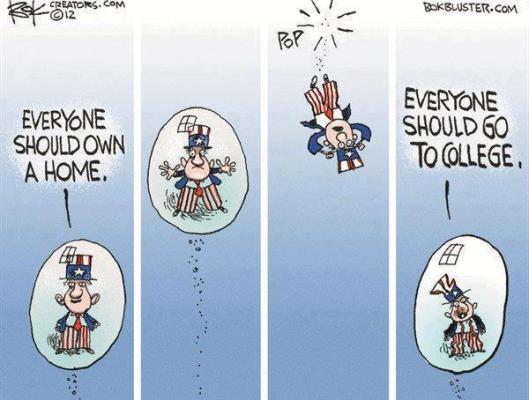
Free college tuition would undermine the quality of higher education and increase its real cost to society. In fact, it may well cost many subsidized students more than its worth in lost work experience, wages and self-esteem. Those foregone opportunities are very real costs despite their consignment as “unseen” counterfactuals. They are mostly incremental to costs that are more obvious to the minds of statists promoting free post-secondary education.

Basic supply and demand analysis is the only requirement for understanding the tuition bubble in U.S. higher education, and the absurdity of heavy subsidies as a solution. Ariel Deschapell calls subsidies “worse than nothing“, comparing the approach to “throwing gasoline on a fire“. He’s quite right.

There is no question that increased subsidies lead to higher tuition and ultimately greater student debt. A recent paper published by the National Bureau of Economic Research (NBER) found that loan subsidies “fully account” for the increase in college tuition costs from 1987 – 2010. Another 2015 study published by the Federal Reserve Bank of New York reached broadly similar conclusions:

“We find that institutions more exposed to changes in the subsidized federal loan program increased their tuition disproportionately around these policy changes, with a sizable pass-through effect on tuition of about 65 percent. We also find that Pell Grant aid and the unsubsidized federal loan program have pass-through effects on tuition, although these are economically and statistically not as strong. The subsidized loan effect on tuition is most pronounced for expensive, private institutions that are somewhat, but not among the most, selective.“

As Deschapell points out, most schools turn away a significant share of their applicants. How can that sort of demand exist, given the sky-high tuition charged by many colleges and universities? Subsidies. Subsidized tuition. Subsidized loans. When the cost to the end user of educational services is reduced at a given price, demand for those services increases. The papers linked above demonstrate the strength of the response.

Unfortunately, the supply of higher education is subject to relatively hard limits. Traditionally, the supply of educators, facilities and other learning resources has not been especially elastic. Technology has arguably made education more scalable, but only in terms of enrollment, and not at a zero incremental cost. Outcomes are more dependent than ever on a student’s intelligence, preparation and ability to remain engaged.

The supply of education is limited by still other factors. The long-term impact of inflation on costs is often more severe for service industries such as education, as they generally do not share in the productivity growth enjoyed by goods-producing sectors. Moreover, the increasing complexity of administrative functions, including education finance and regulatory compliance in an astonishing number of areas such as health, environmental and diversity goals (and certainly some self-inflicted administrative bloat), imposes cost escalation at many schools. Worst of all, the supply of education and acceptance of federally-subsidized student loans by certain institutions is restricted by federally-appointed accreditation agencies. This puts a lid on competitive pressures in higher education and inflates costs.

Higher demand and limited supply mean that some form of rationing is necessary. What mechanisms for rationing educational opportunities are available? Higher admission standards are sometimes a possibility, but public institutions may have little flexibility to raise standards, especially for resident students. Interestingly, diversity goals can lead to a de facto tightening of admission standards for some applicants even as standards for others are overridden or compromised. Declining quality of education is a “relief valve” to be avoided, but it is a very real possibility.

Higher tuition to the payer is an almost unavoidable consequence. That is why Deschapell likens free, givernment-paid tuition to an accelerant. Supporters of free tuition fail to recognize this relatively simple, causal chain.

When student debt is subsidized, it tends to mount faster than educational achievement and job prospects allow, leading to high rates of default. It also distorts the choices of would-be individual payers by inflating tuition costs. Passing the cost of education along to taxpayers, or “socializing the cost” as Deschapell says, completely severs the responsibility for marginal costs from the marginal benefit of education, an obvious prescription for a misallocation of resources. The decision to pursue more education, and the responsibility, should be in the hands of the same individuals: those in the best position to know whether it is viable: prospective students and their families. They know better than anyone the real opportunities foregone in terms of lost wages and the skills and experience that can be gained by staying out of school. Eliminating tuition from the decision would divert many more individuals into pursuits for which they are ill-suited.

College graduation or completion rates are disappointingly low, and correspondingly, dropout rates are very high, especially at community colleges. Moreover, profiles of the dropout population show that colleges have no business admitting a significant share of those individuals. This is damning evidence that we are already over-allocating resources to this activity. Additional subsidies won’t fix the problem.

There is no doubt that cross-sectionally, advanced education is associated with better employment prospects and higher incomes. And higher education can provide “social benefits” in excess of its direct value to students. Those facts do not imply, however, that generous inducements to questionable prospects will create positive outcomes. Quite the contrary. And in fact, the quality of education is vulnerable to dilution with increases in the number of poorly-qualified students.

A better way to improve the lifetime prospects of more people is to encourage production and employment opportunities with flexible wage policies, light taxes and less intrusive regulation. Competition at all levels of education should also be promoted; those steps would do more to improve outcomes than subsidies ever can. Throwing public money at education is generally unproductive, inflates tuition and drains the productive sector of resources. After all, the strength of that very sector must be relied upon to keep public education afloat. Individuals cannot be absolved of facing the real trade-offs inherent in their choices. Ultimately, by distorting decisions, free tuition cannot truly empower individuals and improve well being.


Newer posts →
Follow Sacred Cow Chips on WordPress.com

Recent Posts

  • The Case Against Interest On Reserves
  • Immigration and Merit As Fiscal Propositions
  • Tariff “Dividend” From An Indigent State
  • Almost Looks Like the Fed Has a 3% Inflation Target
  • Government Malpractice Breeds Health Care Havoc

Archives

  • January 2026
  • December 2025
  • November 2025
  • October 2025
  • September 2025
  • August 2025
  • July 2025
  • June 2025
  • May 2025
  • April 2025
  • March 2025
  • February 2025
  • January 2025
  • December 2024
  • November 2024
  • October 2024
  • September 2024
  • August 2024
  • July 2024
  • June 2024
  • May 2024
  • April 2024
  • March 2024
  • February 2024
  • January 2024
  • December 2023
  • November 2023
  • August 2023
  • July 2023
  • June 2023
  • May 2023
  • April 2023
  • March 2023
  • February 2023
  • January 2023
  • December 2022
  • November 2022
  • October 2022
  • September 2022
  • August 2022
  • July 2022
  • June 2022
  • May 2022
  • April 2022
  • March 2022
  • February 2022
  • January 2022
  • December 2021
  • November 2021
  • October 2021
  • September 2021
  • August 2021
  • July 2021
  • June 2021
  • May 2021
  • April 2021
  • March 2021
  • February 2021
  • January 2021
  • December 2020
  • November 2020
  • October 2020
  • September 2020
  • August 2020
  • July 2020
  • June 2020
  • May 2020
  • April 2020
  • March 2020
  • February 2020
  • January 2020
  • December 2019
  • November 2019
  • October 2019
  • September 2019
  • August 2019
  • July 2019
  • June 2019
  • May 2019
  • April 2019
  • March 2019
  • February 2019
  • January 2019
  • December 2018
  • November 2018
  • October 2018
  • September 2018
  • August 2018
  • July 2018
  • June 2018
  • May 2018
  • April 2018
  • March 2018
  • February 2018
  • January 2018
  • December 2017
  • November 2017
  • October 2017
  • September 2017
  • August 2017
  • July 2017
  • June 2017
  • May 2017
  • April 2017
  • March 2017
  • February 2017
  • January 2017
  • December 2016
  • November 2016
  • October 2016
  • September 2016
  • August 2016
  • July 2016
  • June 2016
  • May 2016
  • April 2016
  • March 2016
  • February 2016
  • January 2016
  • December 2015
  • November 2015
  • October 2015
  • September 2015
  • August 2015
  • July 2015
  • June 2015
  • May 2015
  • April 2015
  • March 2015
  • February 2015
  • January 2015
  • December 2014
  • November 2014
  • October 2014
  • September 2014
  • August 2014
  • July 2014
  • June 2014
  • May 2014
  • April 2014
  • March 2014

Blogs I Follow

  • Passive Income Kickstart
  • OnlyFinance.net
  • TLC Cholesterol
  • Nintil
  • kendunning.net
  • DCWhispers.com
  • Hoong-Wai in the UK
  • Marginal REVOLUTION
  • Stlouis
  • Watts Up With That?
  • Aussie Nationalist Blog
  • American Elephants
  • The View from Alexandria
  • The Gymnasium
  • A Force for Good
  • Notes On Liberty
  • troymo
  • SUNDAY BLOG Stephanie Sievers
  • Miss Lou Acquiring Lore
  • Your Well Wisher Program
  • Objectivism In Depth
  • RobotEnomics
  • Orderstatistic
  • Paradigm Library
  • Scattered Showers and Quicksand

Blog at WordPress.com.

Passive Income Kickstart

OnlyFinance.net

TLC Cholesterol

Nintil

To estimate, compare, distinguish, discuss, and trace to its principal sources everything

kendunning.net

The Future is Ours to Create

DCWhispers.com

Hoong-Wai in the UK

A Commonwealth immigrant's perspective on the UK's public arena.

Marginal REVOLUTION

Small Steps Toward A Much Better World

Stlouis

Watts Up With That?

The world's most viewed site on global warming and climate change

Aussie Nationalist Blog

Commentary from a Paleoconservative and Nationalist perspective

American Elephants

Defending Life, Liberty and the Pursuit of Happiness

The View from Alexandria

In advanced civilizations the period loosely called Alexandrian is usually associated with flexible morals, perfunctory religion, populist standards and cosmopolitan tastes, feminism, exotic cults, and the rapid turnover of high and low fads---in short, a falling away (which is all that decadence means) from the strictness of traditional rules, embodied in character and inforced from within. -- Jacques Barzun

The Gymnasium

A place for reason, politics, economics, and faith steeped in the classical liberal tradition

A Force for Good

How economics, morality, and markets combine

Notes On Liberty

Spontaneous thoughts on a humble creed

troymo

SUNDAY BLOG Stephanie Sievers

Escaping the everyday life with photographs from my travels

Miss Lou Acquiring Lore

Gallery of Life...

Your Well Wisher Program

Attempt to solve commonly known problems…

Objectivism In Depth

Exploring Ayn Rand's revolutionary philosophy.

RobotEnomics

(A)n (I)ntelligent Future

Orderstatistic

Economics, chess and anything else on my mind.

Paradigm Library

OODA Looping

Scattered Showers and Quicksand

Musings on science, investing, finance, economics, politics, and probably fly fishing.

  • Subscribe Subscribed
    • Sacred Cow Chips
    • Join 128 other subscribers
    • Already have a WordPress.com account? Log in now.
    • Sacred Cow Chips
    • Subscribe Subscribed
    • Sign up
    • Log in
    • Report this content
    • View site in Reader
    • Manage subscriptions
    • Collapse this bar
 

Loading Comments...