• About

Sacred Cow Chips

Sacred Cow Chips

Category Archives: Tariffs

Trump Bumbles On Trade With Tariffs

02 Friday Mar 2018

Posted by Nuetzel in Free Trade, Protectionism, Tariffs

≈ 1 Comment

Tags

Carve-Outs, central planning, Fair Trade, Import Quotas, monopoly power, Protectionism, Tariffs, Trade Barriers, Trade War, Trading Partners, Trump Tariffs
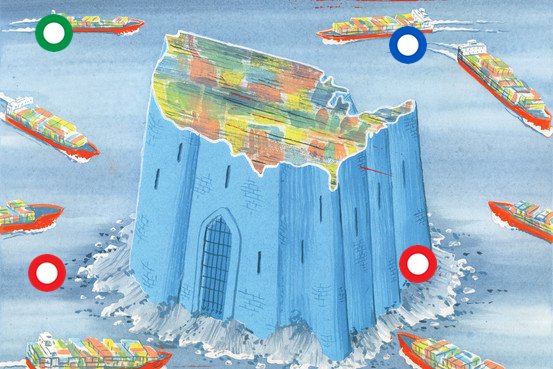
You can get away with lousy policy by calling it a “negotiating tactic” for only so long. But that dubious ploy is one of the rationales offered last week by the Trump Administration for imposing a 25% tariff on imported steel and a 10% tariff on imported aluminum. Sure, the tariffs are like gifts rendered onto American steel and aluminum producers, their shareholders, and their unionized workers. The tariffs allow them to compete more effectively, without any effort, with foreign steel and aluminum in the domestic market, and the tariffs may also give them leeway to raise prices. The tariffs are also forgiving of degraded performance by domestic producers, since reduced competition relieves pressure for efficiency, a primary social cost of monopoly power.

So who pays for these gifts to the domestic steel and aluminum industries? A tariff, of course, is a tax, and a significant portion of it will be passed along into higher prices of both imported and domestically-produced steel and aluminum. Therefore, the burden of that tax will be borne to a large extent by domestics users, including every domestic industry that uses steel or aluminum as an input, and by consumers who purchase those products. That erodes the job security of many domestic workers outside of the steel and aluminum industries. In fact, the tariffs are unlikely to create more jobs even in the steel and aluminum industries given the negative impact of higher prices on the quantities of those metals demanded.

The desperate story line in support of tariffs also includes the assertion that the U.S. steel and aluminum industries are in such dire straits that they are in danger of vanishing. Statistics on U.S. production hardly suggest that is the case, however. Steel output in the U.S. has been reasonably steady since recovering from the last recession, though it has not achieved its pre-recession level. While aluminum output has been declining, it is hardly in a free fall. The stock prices of major steel and aluminum producers, which are forward-looking, have not demonstrated a particular need for government aid (as if that could ever justify a too-big or too-important-to-fail mentality).

Defenders of the tariffs claim that one effect will include additional direct investment in the U.S. by foreign producers of steel and aluminum, because they can avoid the tariffs by setting up production within our borders. Perhaps a few will, but capital is mobile in other sectors as well. Producers in other industries requiring intensive use of steel or aluminum inputs will now have an incentive to shift production overseas, where the tariffs won’t apply. Attempting to prevent such shifts via import tariffs on final products would quickly become a nightmare of central planning.

Apologists for the tariffs go even further, noting that our new regulatory and tax environment will bring foreign producers to the U.S., essentially making the tariffs irrelevant. If that’s the case, why bother imposing the tariffs at all? And why penalize consumers and industries requiring intensive use of steel or aluminum?

The argument that tariffs provide a stronger position from which to negotiate with foreign “trading partners” (or rather, their governments) is tenuous at best. More likely, the tariffs will prompt retaliation by foreign governments against a range of American products. The very notion that “trade wars are good”, tweeted by President Trump on Friday morning, is as nonsensical as a suggestion that voluntary exchange is destructive. Already, the EU has announced plans to retaliate by imposing tariffs  on bourbon and motorcycles produced in the U.S.

Negotiations are unlikely to be successful. Perhaps some foreign governments who subsidize their steel and aluminum producers could be persuaded to enter talks. Our own domestic producers are penalized by various tariffs and quotas in place abroad, and those might be used by foreign interests as a lever in negotiations. However, the most fundamental foreign trade advantages, when they exist, have to do with low wages, less regulation, more efficient production facilities, and sometimes a more favorable tax environment. Wage levels reflect labor productivity, but those wage levels are valued more highly in their home countries than in the U.S, and penalizing these countries with trade sanctions merely penalizes their workers. Not all dimensions of a cost advantage can be negotiated, and in any case, healthy competition in any industry is always in the interests of a nation’s consumers.

National security is another standard argument in favor of protectionist measures. We’re told, for example, that we cannot allow China to produce all of the steel, but China provides only a small fraction of U.S. steel imports. Canada, Brazil and Mexico provide far more. In fact, China was in 11th place on that list in 2017. So our sources of steel are fairly well diversified. A domestic shortage of steel or aluminum caused by a breakdown in relations with one or more steel-exporting countries would lead to higher prices, but it would bring forth greater supplies from other countries and even from high-cost domestic sources. That is not a national emergency.

It’s possible that the Trump Administration will create “carve-outs”, exempting goods from certain countries from the tariffs. Presumably, those would be based on an assessment of each country’s trade policies and whether they are consistent with “fair” trade, in the judgement of U.S. trade authorities. However, all nations play the protectionist game in one form or another, including the U.S. Any carve outs would be better than none at all, but the remaining tariffs imposed by the administration will be a net burden to the U.S. economy.

Up till now, I have been pleasantly surprised by the Trump Administration’s efforts to de-tax and deregulate the U.S. economy. However, the threat that Donald Trump would adopt protectionist trade policies was one of my major trepidations about his candidacy. And here it is, as he promised. The dilemma often expressed by protectionists is that foreign producers can put elements of the domestic economy out of business by selling below cost. That drain on a country’s resources cannot span all industries — the U.S. has a comparative advantage in many areas. Such an effort cannot last forever or else these nations would cannibalize their own industrial base. Foreign governments quite simply cannot afford it economically and politically. On our end, the best advice is to accept the gift of low-cost goods. With access to ultra-cheap goods, whether steel, sorghum, or some finished product, American consumers and producers who use those imports gain unambiguously, and the purchasing power released can be spent on other goods and services.

Protectionist Ugly: Trump Makes Bad on Tariffs

29 Monday Jan 2018

Posted by Nuetzel in Free Trade, Tariffs

≈ Leave a comment

I’ve reacted favorably to much of the Trump Administration’s economic agenda, but foreign trade has been a huge area of concern. Trump’s rhetoric on trade was bellicose on the campaign trail. Thus far in office he has succeeded in upending or threatening trade agreements: he pulled the U.S. out of the Trans-Pacific Partnership (TPP) negotiations, a multilateral trade agreement involving 11 of our Asian trading partners; he has also promised that NAFTA will be renegotiated. This week, he imposed tariffs on solar panels produced in China and washing machines built in South Korea. You will now be forced to pay a penalty tax on any purchase of those products.

Renegotiating existing trade agreements is one thing (though my ideal is unilateral elimination of trade barriers), as is a general preference for bilateral agreements, particularly if they remain focused on trade and not extraneous social issues. But I sincerely hope that the latest move is not the start of a long rollout of tariffs and other protectionist measures. Unfortunately, more such moves are expected.

What possible logic can explain these actions? To hear Donald Trump tell it, the U.S. must enforce trade laws and establish a “level playing field”. So, perhaps this is a form of negotiation. If so, are the cards we hold so strong that we can afford to risk retaliation in the form of tariffs levied on our own exports? Do our trading partners value our business so much that they will not retaliate? Would those countries offer to remove any subsidies they grant their own export industries? Would they tell those industries they must be price followers regardless of cost structure and taxes, charging no less than their American competitors? Can we dictate the terms of trade with these parties? Trump apparently thinks so, but we shall see. I believe the answer is almost certainly no.

Retaliation is likely; this is how trade wars begin, and they have a way of precipitating economic contraction. But that risk represents only one part of the cost of Trump’s tariff action. The real problem is the likely impact of the Trump tariffs on American consumers, American production, and on America’s long-run competitiveness.

  1. Prices: Tariffs are essentially a tax on imports. A significant share of the burden of that tax will be borne by consumers. The price they pay for the import will rise to reflect a portion of the tariff. If, instead, they opt to purchase the American product after the imposition of the tariff, that is a coerced and suboptimal decision based on their existing preferences. They are likely to pay more to the American producer than in the absence of the tariff on the import because American producers will face less competitive pressure. Thus, American consumers will be penalized by the tariff whether they continue to purchase the import or not.
  2. Output: Quantities purchased fall when prices rise. That is the law of demand. American consumers will buy less of the import and less overall, so consumers lose on both price and quantity. But it’s worse than that, because domestic producers gain a degree of market power under the tariff. They have greater leeway to price above marginal cost, which implies output restraint. It is therefore quite possible that domestic output will decrease as well.
  3. Competitiveness: Handicapping foreign competitors eases the pressure on domestic producers to perform by reducing costs, pleasing customers, creating value, and innovating. This is not likely to be a sudden change. Rather, it would manifest in a gradual deterioration of competitiveness. Perhaps no one abroad will want our exports, but domestic consumers will have little recourse except to pay the tariff for the foreign good they preferred to begin with. Meanwhile, if other domestic industries are reliant on tariffed imports as inputs to production, they too will suffer a loss of competitiveness.

I tend to be skeptical of any claim that a foreign government facilitates (or engages in) predatory pricing on American markets. Of course they might. And I know… the U.S. itself has thrown subsidies at solar panels in the past. (Well how unfair!) However, the facts are that in a variety of industries, foreign producers actually have cost advantages over U.S. producers. The very idea of trade is to take advantage of such differences for mutual gain. We buy things from others precisely because we can’t do it all ourselves, at least not without great sacrifice (high cost).

It is all too easy for domestic producers to cry “protect us”, and to claim that national security demands protection. These claims are often accepted with little if any analysis. The pleas for protection are characteristic of rent-seeking crony capitalism. And it isn’t as if Americans have nothing to gain in the exchange: cheap consumer goods and cheap inputs for domestic producers. The income released via low foreign pricing is available for other uses, including saving, larger quantities, or spending on other goods.

American consumers pay the price of trade restrictions and tariffs in several ways. The restrictions not only cost them directly in terms of higher prices, but they also represent a violation of consumer sovereignty and tend to restrain output. That a central authority would deign to prohibit or penalize certain consumer decisions is abominable. One can assert that the actions protect workers, but that is a fiction and holds only in the short-run at best. Remember that workers are consumers in the first instance. Ultimately, the trade restrictions degrade the ability of those workers to compete on world markets. In short, they are destructive. At the link above, George Will quotes Henry George to that effect:

“What protection teaches us, is to do to ourselves in time of peace what enemies seek to do to us in time of war.“

Newer posts →
Follow Sacred Cow Chips on WordPress.com

Recent Posts

  • Immigration and Merit As Fiscal Propositions
  • Tariff “Dividend” From An Indigent State
  • Almost Looks Like the Fed Has a 3% Inflation Target
  • Government Malpractice Breeds Health Care Havoc
  • A Tax On Imports Takes a Toll on Exports

Archives

  • December 2025
  • November 2025
  • October 2025
  • September 2025
  • August 2025
  • July 2025
  • June 2025
  • May 2025
  • April 2025
  • March 2025
  • February 2025
  • January 2025
  • December 2024
  • November 2024
  • October 2024
  • September 2024
  • August 2024
  • July 2024
  • June 2024
  • May 2024
  • April 2024
  • March 2024
  • February 2024
  • January 2024
  • December 2023
  • November 2023
  • August 2023
  • July 2023
  • June 2023
  • May 2023
  • April 2023
  • March 2023
  • February 2023
  • January 2023
  • December 2022
  • November 2022
  • October 2022
  • September 2022
  • August 2022
  • July 2022
  • June 2022
  • May 2022
  • April 2022
  • March 2022
  • February 2022
  • January 2022
  • December 2021
  • November 2021
  • October 2021
  • September 2021
  • August 2021
  • July 2021
  • June 2021
  • May 2021
  • April 2021
  • March 2021
  • February 2021
  • January 2021
  • December 2020
  • November 2020
  • October 2020
  • September 2020
  • August 2020
  • July 2020
  • June 2020
  • May 2020
  • April 2020
  • March 2020
  • February 2020
  • January 2020
  • December 2019
  • November 2019
  • October 2019
  • September 2019
  • August 2019
  • July 2019
  • June 2019
  • May 2019
  • April 2019
  • March 2019
  • February 2019
  • January 2019
  • December 2018
  • November 2018
  • October 2018
  • September 2018
  • August 2018
  • July 2018
  • June 2018
  • May 2018
  • April 2018
  • March 2018
  • February 2018
  • January 2018
  • December 2017
  • November 2017
  • October 2017
  • September 2017
  • August 2017
  • July 2017
  • June 2017
  • May 2017
  • April 2017
  • March 2017
  • February 2017
  • January 2017
  • December 2016
  • November 2016
  • October 2016
  • September 2016
  • August 2016
  • July 2016
  • June 2016
  • May 2016
  • April 2016
  • March 2016
  • February 2016
  • January 2016
  • December 2015
  • November 2015
  • October 2015
  • September 2015
  • August 2015
  • July 2015
  • June 2015
  • May 2015
  • April 2015
  • March 2015
  • February 2015
  • January 2015
  • December 2014
  • November 2014
  • October 2014
  • September 2014
  • August 2014
  • July 2014
  • June 2014
  • May 2014
  • April 2014
  • March 2014

Blogs I Follow

  • Passive Income Kickstart
  • OnlyFinance.net
  • TLC Cholesterol
  • Nintil
  • kendunning.net
  • DCWhispers.com
  • Hoong-Wai in the UK
  • Marginal REVOLUTION
  • Stlouis
  • Watts Up With That?
  • Aussie Nationalist Blog
  • American Elephants
  • The View from Alexandria
  • The Gymnasium
  • A Force for Good
  • Notes On Liberty
  • troymo
  • SUNDAY BLOG Stephanie Sievers
  • Miss Lou Acquiring Lore
  • Your Well Wisher Program
  • Objectivism In Depth
  • RobotEnomics
  • Orderstatistic
  • Paradigm Library
  • Scattered Showers and Quicksand

Blog at WordPress.com.

Passive Income Kickstart

OnlyFinance.net

TLC Cholesterol

Nintil

To estimate, compare, distinguish, discuss, and trace to its principal sources everything

kendunning.net

The Future is Ours to Create

DCWhispers.com

Hoong-Wai in the UK

A Commonwealth immigrant's perspective on the UK's public arena.

Marginal REVOLUTION

Small Steps Toward A Much Better World

Stlouis

Watts Up With That?

The world's most viewed site on global warming and climate change

Aussie Nationalist Blog

Commentary from a Paleoconservative and Nationalist perspective

American Elephants

Defending Life, Liberty and the Pursuit of Happiness

The View from Alexandria

In advanced civilizations the period loosely called Alexandrian is usually associated with flexible morals, perfunctory religion, populist standards and cosmopolitan tastes, feminism, exotic cults, and the rapid turnover of high and low fads---in short, a falling away (which is all that decadence means) from the strictness of traditional rules, embodied in character and inforced from within. -- Jacques Barzun

The Gymnasium

A place for reason, politics, economics, and faith steeped in the classical liberal tradition

A Force for Good

How economics, morality, and markets combine

Notes On Liberty

Spontaneous thoughts on a humble creed

troymo

SUNDAY BLOG Stephanie Sievers

Escaping the everyday life with photographs from my travels

Miss Lou Acquiring Lore

Gallery of Life...

Your Well Wisher Program

Attempt to solve commonly known problems…

Objectivism In Depth

Exploring Ayn Rand's revolutionary philosophy.

RobotEnomics

(A)n (I)ntelligent Future

Orderstatistic

Economics, chess and anything else on my mind.

Paradigm Library

OODA Looping

Scattered Showers and Quicksand

Musings on science, investing, finance, economics, politics, and probably fly fishing.

  • Subscribe Subscribed
    • Sacred Cow Chips
    • Join 128 other subscribers
    • Already have a WordPress.com account? Log in now.
    • Sacred Cow Chips
    • Subscribe Subscribed
    • Sign up
    • Log in
    • Report this content
    • View site in Reader
    • Manage subscriptions
    • Collapse this bar
 

Loading Comments...