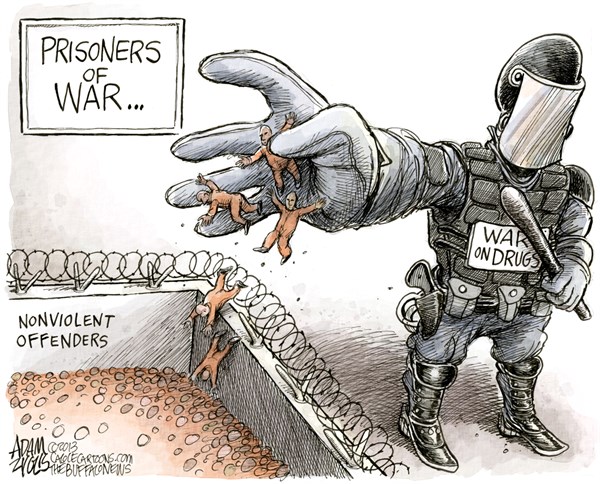
• About

Sacred Cow Chips

Sacred Cow Chips

Category Archives: War On Drugs

Opioids and The War On Pain Treatment

08 Friday Mar 2019

Posted by Nuetzel in Prohibition, War On Drugs

≈ 1 Comment

Tags

Annals of Internal Medicine, CATO Institute, Chronic Pain, Dr. Ted Noel, FDA, Fentanyl, Geraldo Rivera, Heroin, Imported Opioids, Jacob Sullum, Jeffrey Miron, Opioid Addiction, Opioid Deaths, Opioid Prescription, Opioid Production Quotas, OxyContin, PDMPs, Portugal Decriminalization, Prescription Drug Monitoring Programs, Prohibition, Purdue Pharma, Scientific American

I repeatedly hear the bogus claim that prescription pain killers are a primary cause of opioid addiction. Twice this week I heard Geraldo Rivera prattling about it, blaming the drug companies for the opioid epidemic, expressing his view of the righteousness of the many lawsuits faced by Purdue Pharma and other firms. But these cases are hardly sure wins for the plaintiffs, and for good reason. The idea that pharmaceutical companies misleadingly promoted the effectiveness of drugs like Oxycontin for pain relief, and minimized their addictive potential, might appear credible, but there are a number of factors that argue strongly against these claims. Of course, opioids are legal prescription drugs, approved for pain relief by the FDA, and are generally marketed by drug companies under guidelines established by the FDA at the time of approval. And sadly, the narrative promoted by Rivera and many others is at tension with the needs of patients suffering from chronic pain.

In fact, opioids are effective for temporary and chronic pain relief, and they have been used for those purposes for many decades. In “The Other Opioid Problem“, anesthesiologist Dr. Ted Noel asserts that few chronic pain patients have overdosed or been killed by ODs. According to Scientific American:

“A Cochrane review of opioid prescribing for chronic pain found that less than one percent of those who were well-screened for drug problems developed new addictions during pain care; a less rigorous, but more recent review put the rate of addiction among people taking opioids for chronic pain at 8-12 percent [but less than 1% abuse].”

Those prescribed opioids for temporary relief after an injury or surgical procedure are even less likely to develop an addiction. The large majority of addicts are self-selected out of a population of individuals who want to get high. And most of them feed their addictions on opioids obtained illegally, often from imported heroin and fentanyl. Yes, opioids are stolen from legitimate patients, pharmacies, or elsewhere, and sometimes they are prescribed illegally by unscrupulous physicians. That might be the way many addicts get started, but most of the illegal opioid supply in the U.S. is imported heroin and fentanyl.

A causal linkage between opioid prescriptions, addiction and opioid deaths would imply a strong, positive correlation between prescription and death rates. However, Jacob Sullum reports that there is no correlation across states between prescription rates and death rates from opioids. As Sullum notes, this result offers “more reason to doubt that pain pill restrictions will save lives”.

In fact, in a separate article, Sullum writes of other evidence strongly suggesting that those restrictions may have counterproductive effects on opioid deaths, in addition to denying some patients access to the pain pills they legitimately need for treatment. According to Sullum, all 50 states have Prescription Drug Monitoring Programs (PDMPs) that monitor controlled substances and keep tabs on prescribers and pharmacies. These have succeeded in discouraging opioid prescriptions, but research appearing in the Annals of Internal Medicine suggests that the programs might be doing more harm than good:

“Fink et al found six studies that included heroin overdoses, half of which reported a statistically significant association between adoption of PDMPs and increases in such incidents. … To the extent that PDMPs succeed in making pain pills harder to obtain, they encourage nonmedical users to seek black-market substitutes. ‘Changes to either the supply or cost of prescription opioids after a PDMP is instituted,’ Fink et al. observe, ‘might reasonably drive opioid-dependent persons to substitute their preferred prescription opioid with heroin or nonpharmaceutical fentanyl.’

The FDA has enforced quotas on the production of legal opioids. According to the CATO Institute:

“The tight quotas on opioid production contributed to the acute shortage of injectable opioids being felt in hospitals across the nation. It is not only making patients suffer needlessly but places them at increased risk for adverse drug reactions or overdose.”

The FDA’s restrictions were eased somewhat after complaints from the medical community, but the harm continues. At the time of CATO’s report, opioid prescriptions had declined by 41% since 2010, while the overdose rate continued to escalate.

This pattern is all too familiar to those who have been arguing against drug prohibition for years. The flood of fentanyl into the country, and into what is sold as street heroin, is a direct consequence of prohibitions on supplies of legal heroin and other narcotics. But breaking through the puritanical and bumptious mentality of drug warriors is almost impossible. The worse the situation gets, the tighter they turn the screws, doubling down on the policies that have repeatedly failed in the past. Here I repeat the concluding paragraph of a Sacred Cow Chips post from January 2018 on the opioid epidemic:

“There are solutions to the deadly nature of the opioid epidemic, but prohibition is not one of them and never will be. If anything, prohibition in varying degrees has aggravated the dangers of opioids. To truly solve the problem, we should eliminate restrictions on the production and distribution of legal opioids for pain management, legalize heroin, and stop interfering in markets. That would be merciful for patients in real pain, make recreational use of opioids dramatically safer, and put an end to the gangland violence associated with underground competition. Second, redirect those resources into … harm reduction programs. [Jeffrey] Miron notes that legalization has worked in other countries, like Portugal and France, to reduce overdoses and opioid deaths. As a political matter, however, these steps might not be feasible unless we get over the cultural bias stigmatizing recreational opioid use as ‘evil’, and the idea that laws and enforcement can actually prevent people from trying to get high.
Portugal’s Successful Détente With Drug Users

14 Thursday Jun 2018

Posted by Nuetzel in Liberty, Prohibition, War On Drugs

≈ 1 Comment

Tags

Addiction, Drug Legalization, Drug Policy, Drug Prohibition, Drug Treatment Programs, European Monitoring Centre for Drugs and Addiction, Needle Exchanges, Portugal, Portugal Decriminalization, Recreational Drugs, Rehabilition, War on Drugs

The U.S. wastes vast quantities of resources on the War on Drugs with nothing to show for it but counterproductive results. Drug use today is as commonplace as ever, despite the cumulative expenditure of many billions of dollars on law enforcement and judicial costs. We have ceded drug markets to organized crime, tolerated corruption of public officials, incurred the human and economic costs of millions of life-years wasted behind bars, and subjected users to impure and dangerous forms of contraband. And in the process, we have encouraged addiction, disease and death while dedicating relatively few resources to programs that might have helped these troubled souls.

Contrast that with Portugal’s approach to drug policy. The country’s decriminalization of drug use as well as harm reduction and treatment programs both deserve consideration in this context. Decriminalization took place in 2001: drugs are still illegal, but the penalties are very light. Treatment programs include a system of needle exchanges beginning in the early 1990s as well as various forms of outreach instituted in 2003-2005. Before the advent of these policies, Portugal had an extremely high rate of drug abuse; many feared that decriminalization would lead to further degeneracy, but no increase in drug use transpired, and the liberalized policies are credited with a drastic reduction in drug deaths and other tragic fallout. Consider the following:

  • a dramatic decline in the number of people who died from using an illicit drug to a rate of drug-induced death well below the EU average;
  • newly-diagnosed HIV cases among intravenous drug users fell by more than 95%;
  • drug-offenses declined by about 2/3;
  • the proportion of offenders imprisoned for offenses under the influence of drugs fell in half;
  • With the exception of cannabis, estimates of drug use among 15-34 year-olds have decreased, with lifetime and recent use rates below EU averages;

These facts are taken from this discussion of the effects of Portugal’s drug policies, this Wikipedia entry, and the 2018 Portugal Country Drug Report from the European Monitoring Centre for Drugs and Drug Addiction.

As a fiscal matter, some of the strongest objections to Portuguese drug policy have to do with the granting of public aid to drug addicts, who usually have themselves to blame for their predicament. And in fact, decriminalization was accompanied by a decision to transfer funds associated with enforcing drug laws and punishing offenders into treatment and rehabilitation of addicts. This includes subsidized housing and jobs as well as loans for certain productive efforts. These strike me as better uses of public funds than a drug war, and by all accounts the programs have been successful. And to the extent that recovered addicts are able to lead productive lives, they add to the strength of Portugal’s economy. In an ideal, classically-liberal order, privately-funded lifetime insurability would avoid the need for public funding of these programs, but that is a reform for another day.

Like any prohibition of activity in which a plurality engages, laws against drug use are generally ineffective and counterproductive (also see here). Portugal’s enlightened approach to drug policy is praiseworthy, sets a great example for other countries, and might be more politically feasible than full legalization. However, as long as there are any penalties for drug possession, there will be a wedge through which rents can be extracted by the underworld. Full legalization would do the most to attenuate crime and other risks associated with drug use, and it would also maximize the resources available to address problems faced by addicts and drug-dependents.

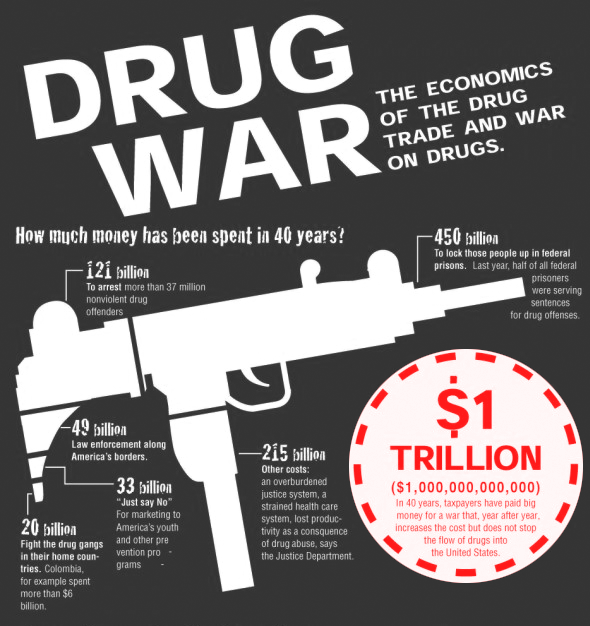
Note: the poster above is from 2014… the numbers are larger now!

Our Homicidal Drug War

17 Tuesday Oct 2017

Posted by Nuetzel in Prohibition, War On Drugs

≈ 4 Comments

Tags

Britigne Shaffer, CATO Institute, Controlled Substances Act, Dan Kahan, DEA, Donald Trump, Drug War, Jeff Sessions, Jeffrey Miron, Mandatory Minimum Sentences, Michael Owen, Milton Friedman, On the Banks, Prohibition, Scott Sumner

Drug prohibition and the war on drugs are destructive policies and most burdensome to communities that can least afford it: impoverished and often minority neighborhoods. Drug laws and their enforcement likely account for the bulk of homicides that occur there, directly or indirectly. A post on SacredCowChips last week discussed the violence that frequently beleaguers communities that are home to unassimilated minorities. Drug prohibition compounds the tragedy in several ways: deadly rivalry among supplier organizations; violent confrontations with law enforcement; user criminality; drug-related incarceration; degraded user productivity; and tainted supplies that exacerbate health risks for users.

Ultimately, bad laws are distinguished by their failure to achieve broad compliance. The thing is, people who want to do drugs will do so regardless of their legality. Most recreational users are sufficiently imbued with a survival instinct and the self-control to govern their use effectively, without ostensible harm. Nearly all recreational users believe they are engaging in a harmless activity, and most of them are right. That is, quite simply, why the drug war just doesn’t work, and it won’t ever work. It doesn’t work for pot, LSD, cocaine, or anything else, including opioids and heroin. (Also see this.)

Prohibition, however, delivers the drug trade into the hands of gangs and mobsters. The supply side of the business attracts individuals having few legitimate market opportunities, who happen to be concentrated in economically depressed neighborhoods. The drug trade’s illegality transforms it into a risky and violent enterprise, and efforts to enforce prohibition magnify those dangers and expose law enforcement to great risk as well. Then, there are the effects of mass incarceration on individuals and their home communities. The situation is self-reinforcing, adding to the instability of these struggling areas.

There is ample evidence that drug prohibition is a driver of crime and responsible for a large number of homicides in the U.S. A Chicago prosecutor was quoted by HuffPo in 2013 as saying that 80% of homicides in the city were gang-related, and therefore primarily drug-related. Economist Jeffrey Miron has linked drug prohibition to international differences in violent crime rates. Scott Sumner has this take on the drug war and crime rates, including a brief analysis of the drop in homicides (40%) after alcohol prohibition was repealed. In 1991, Milton Friedman stated that the repeal of drug laws would eliminate about 10,000 U.S. homicides every year, which at the time would have been about a 40% reduction. And here is Yale’s Dan Kahan on the subject of drug laws and homicide:

“The weight of the evidence pretty convincingly shows that drug-related homicides generated as a consequence of drug prohibition are tremendously high and account for much of the difference in the homicide rates in the U.S. and those in comparable liberal market societies.“

In my last post on the U.S. homicide rate, I drew on Britigne Shaffer’s On the Banks blog post entitled “Michael Owen Nails the Gun Debate“. As log as we have prohibition and a drug war, the U.S. homicide rate is likely to exceed most other industrialized countries:

“We have a system in place where the government subsidizes poverty in urban areas, imposes economic blight in those same areas through heavy taxes and regulations, renders the residents permanently unemployable via the ‘criminal justice’ (sic) system, and creates a lucrative black market in drugs by restricting supply (not to mention increasing demand as people are desperate to escape their circumstances by getting high), meaning the only game in town is often entering the drug trade. The drug trade is violent because those in it have no access to courts to settle disputes. Powerful industries lobby to keep the drug war going; the top spenders are law enforcement unions, the prison industry, big alcohol, tobacco, and pharma.“

The CATO Institute‘s Handbook for Policymakers, Issue #23, advocates the following: repeal of the Controlled Substances Act; allowing states to pursue their own initiatives without federal interference; complete repeal of mandatory minimum sentences; and termination of the Drug Enforcement Administration (DEA). These actions would allow the federal government to focus its resources on real threats, rather than fighting an unending war with an underworld empowered by those very laws, and with Americans who wish to exercise freedom over their use of drugs for medicinal or recreational use. From the CATO Handbook:

“Repeal of prohibition would take the astronomical profits out of the drug business and destroy the drug kingpins who terrorize parts of our cities. It would reduce crime even more dramatically than did the repeal of alcohol prohibition. Not only would there be less crime: reform would also free federal agents to concentrate on terrorism and espionage and would free local police agents to concentrate on robbery, burglary, and violent crime. … The war on drugs has lasted longer than Prohibition, longer than the Vietnam War. Prohibition has failed, again, and should be repealed, again.”

Despite the destructive effects of prohibition, a great many Americans—and politicians—base their opinions about drug laws on flawed moral reasoning that somehow it is more “wrong” or more “dangerous” to do drugs than to drink alcohol, itself a drug posing great danger to abusers, but a legal one. Responsible drug use, like responsible drinking, is a victimless act, or would be without the engagement of underworld suppliers. But it’s clear that President Donald Trump and Attorney General Jeff Sessions are committed to a continuation of the failed drug war, as are a majority of both Democrats and Republicans in Congress. The drug-related killings will continue, as will the ongoing damage to so many American families and communities. The refusal to end the drug war is a tragedy of many tragedies past and future.

Wanna Help People? End the Drug War!

03 Tuesday Nov 2015

Posted by Nuetzel in War On Drugs

≈ Leave a comment

Tags

Black Markets, Colorado Legalization, Colorado Pot Legalization, Drug Abuse, Drug Cartels, Gangland Violence, Individual Liberty, Jacob Sullum, Milton Friedman, Prohibition, Prostitution, Victimless Crimes, War on Drugs

August 20, 2013

We’re taught that illegal drugs are a scourge on humanity, that their use is immoral and that legalization is out of the question. Yet far more of us, our friends, and our loved ones have been intimate with the destructive effects of alcohol and dependency on legal drugs than on illegal drugs. Pharmacologically, the “worst effects” of illegal drugs are no worse than the well-known effects of alcohol abuse. In fact, the “worst effects” have more to do with prohibition than with the illegal drugs themselves.

Rules are codified into law successfully when widespread agreement exists among the citizenry that a rule is sensible. This should trouble drug prohibitionists: a substantial proportion of the population has used illegal drugs as adults, indicating a strong lack of consensus that recreational drugs should be illegal. For this reason alone, drug prohibition is and always will be ineffectual.

The great economist Milton Friedman was a long-time critic of the drug war. Several of his articles on the topic are linked at this site. One of the links is this interview from 1992, which is lengthy but sticks primarily to the issue of the drug war. I’m not sure that all of the facts Friedman cites have held up over time, especially with respect to trends in alcohol consumption. Nevertheless, it is a great interview:

“There are [sic] an enormous number of innocent victims now. You’ve got the people whose purses are stolen, who are bashed over the head by people trying to get enough money for their next fix. You’ve got the people killed in the random drug wars. You’ve got the corruption of the legal establishment. You’ve got the innocent victims who are taxpayers who have to pay for more and more prisons, and more and more prisoners, and more and more police. You’ve got the rest of us who don’t get decent law enforcement because all the law enforcement officials are busy trying to do the impossible.“

Here is a brief list of the pernicious effects of drug prohibition:

  • Prices are driven upward by the legal risk inherent in black market trade;
  • High prices lead to more crime as heavy users seek means of payment;
  • Impure and more dangerous variants are traded in attempts to stretch quantities and increase potency;
  • Dealers advance “samples” to gain trust and cultivate dependency among users;
  • Addiction is stubbornly resistant to legal barriers;
  • Unnecessary deaths from impure and excessively potent drug varieties;
  • Black market trade leads to violent crime as underworld elements seek to control markets and enforce discipline in their organizations;
  • Unnecessary deaths from gangland violence;
  • Arrest, imprisonment and ruined lives for victimless crimes;
  • A huge burden on taxpayers;
  • A huge burden on the criminal justice system;
  • Inevitable corruption in law enforcement as officials face hefty rewards for protecting the drug trade;
  • Innocent people become casualties of violence instigated by gangs and sometimes by police actions.

A fascinating dynamic of the black market in drugs is the tendency toward monopolization at the top: Large cartels dominate the importation of supplies due to the risk and expense of such operations. As Friedman noted, the war on drugs contributes to the difficulty of entering into competition with established players. At the same time, the drug war guarantees huge rewards to the cartels by inflating drug prices:

“What more could a monopolist want? He’s got a government who makes it very hard for all his competitors and who keeps the price of his products high.“

The drug war creates greater danger for users. In “Prohibition Kills“, Jacob Sullum discusses four recent examples of more dangerous and even deadly drug variants that have been developed as a direct consequence of prohibition. Friedman is often quoted as saying that crack cocaine was a direct consequence of the drug war. Sullum asks whether this could be an intentional strategy by drug warriors for discouraging consumption. I’m not convinced they are quite so nefarious, but it’s something to ponder.

More dangerous varieties of drugs would not vanish overnight if drugs were legalized, though the incentive to develop them would diminish. Of course, if legalization brings prices and risks down, as we’d expect, it would encourage greater recreational use. That should not be viewed as a “bad” any more than better access to cocktails at happy hour. Abuse is unlikely to increase because problem users tend to be undeterred by prohibition. And as unsavory as an increase in recreational drug use might seem to the temperance faction, it would still represent only a small fraction of the real costs of ruined lives imposed by prohibition and the drug war.

Legalization would bring other complexities, as Colorado’s experience with marijuana shows. For example, rules with respect to driving under the influence must be updated, as well as laws prohibiting possession by minors. Colorado went so far as to regulate packaging, and tax treatment of the drug trade will stoke debate, as governments will hope for something of a tax bonanza. But the more that government attempts to regulate and tax drugs, the more that problems similar to those associated with drug prohibition will persist, albeit on a smaller scale.

Economically, legalization should eliminate a burden on taxpayers. It would free up law enforcement resources to battle real crime and should make more funds available for treatment programs. It would also help to improve lives and safety in inner cities and other areas ravaged by black market drug trade and the violence it foments. And of course, legalization would put an end to the ruin of lives caused by the arrest of individuals for victimless crimes.

Prohibition of drugs belongs to a larger class of social problems brought on by efforts to bring the police power of government to bear on private behavior. I already mentioned that alcohol prohibition had similar consequences. To lesser degrees, similar harmful consequences are associated with laws against prostitution, large soft drink containers, sugary foods, and practicing almost any commercial art without a license. The same can be said for price regulations like rent control and the minimum wage. The former has led to the destruction of vast quantities of housing; the latter harms low-skilled workers along non-wage dimensions and makes it difficult for unskilled workers to gain valuable experience in the job market. Government interference with individual liberty might well restrain certain activities deemed “undesirable” by busybodies, but it it also leads to higher prices, greater risk, black market activity, violence, unnecessary legal actions against individuals, and greater expense for society.

Follow Sacred Cow Chips on WordPress.com

Recent Posts

  • The Case Against Interest On Reserves
  • Immigration and Merit As Fiscal Propositions
  • Tariff “Dividend” From An Indigent State
  • Almost Looks Like the Fed Has a 3% Inflation Target
  • Government Malpractice Breeds Health Care Havoc

Archives

  • January 2026
  • December 2025
  • November 2025
  • October 2025
  • September 2025
  • August 2025
  • July 2025
  • June 2025
  • May 2025
  • April 2025
  • March 2025
  • February 2025
  • January 2025
  • December 2024
  • November 2024
  • October 2024
  • September 2024
  • August 2024
  • July 2024
  • June 2024
  • May 2024
  • April 2024
  • March 2024
  • February 2024
  • January 2024
  • December 2023
  • November 2023
  • August 2023
  • July 2023
  • June 2023
  • May 2023
  • April 2023
  • March 2023
  • February 2023
  • January 2023
  • December 2022
  • November 2022
  • October 2022
  • September 2022
  • August 2022
  • July 2022
  • June 2022
  • May 2022
  • April 2022
  • March 2022
  • February 2022
  • January 2022
  • December 2021
  • November 2021
  • October 2021
  • September 2021
  • August 2021
  • July 2021
  • June 2021
  • May 2021
  • April 2021
  • March 2021
  • February 2021
  • January 2021
  • December 2020
  • November 2020
  • October 2020
  • September 2020
  • August 2020
  • July 2020
  • June 2020
  • May 2020
  • April 2020
  • March 2020
  • February 2020
  • January 2020
  • December 2019
  • November 2019
  • October 2019
  • September 2019
  • August 2019
  • July 2019
  • June 2019
  • May 2019
  • April 2019
  • March 2019
  • February 2019
  • January 2019
  • December 2018
  • November 2018
  • October 2018
  • September 2018
  • August 2018
  • July 2018
  • June 2018
  • May 2018
  • April 2018
  • March 2018
  • February 2018
  • January 2018
  • December 2017
  • November 2017
  • October 2017
  • September 2017
  • August 2017
  • July 2017
  • June 2017
  • May 2017
  • April 2017
  • March 2017
  • February 2017
  • January 2017
  • December 2016
  • November 2016
  • October 2016
  • September 2016
  • August 2016
  • July 2016
  • June 2016
  • May 2016
  • April 2016
  • March 2016
  • February 2016
  • January 2016
  • December 2015
  • November 2015
  • October 2015
  • September 2015
  • August 2015
  • July 2015
  • June 2015
  • May 2015
  • April 2015
  • March 2015
  • February 2015
  • January 2015
  • December 2014
  • November 2014
  • October 2014
  • September 2014
  • August 2014
  • July 2014
  • June 2014
  • May 2014
  • April 2014
  • March 2014

Blogs I Follow

  • Passive Income Kickstart
  • OnlyFinance.net
  • TLC Cholesterol
  • Nintil
  • kendunning.net
  • DCWhispers.com
  • Hoong-Wai in the UK
  • Marginal REVOLUTION
  • Stlouis
  • Watts Up With That?
  • Aussie Nationalist Blog
  • American Elephants
  • The View from Alexandria
  • The Gymnasium
  • A Force for Good
  • Notes On Liberty
  • troymo
  • SUNDAY BLOG Stephanie Sievers
  • Miss Lou Acquiring Lore
  • Your Well Wisher Program
  • Objectivism In Depth
  • RobotEnomics
  • Orderstatistic
  • Paradigm Library
  • Scattered Showers and Quicksand

Blog at WordPress.com.

Passive Income Kickstart

OnlyFinance.net

TLC Cholesterol

Nintil

To estimate, compare, distinguish, discuss, and trace to its principal sources everything

kendunning.net

The Future is Ours to Create

DCWhispers.com

Hoong-Wai in the UK

A Commonwealth immigrant's perspective on the UK's public arena.

Marginal REVOLUTION

Small Steps Toward A Much Better World

Stlouis

Watts Up With That?

The world's most viewed site on global warming and climate change

Aussie Nationalist Blog

Commentary from a Paleoconservative and Nationalist perspective

American Elephants

Defending Life, Liberty and the Pursuit of Happiness

The View from Alexandria

In advanced civilizations the period loosely called Alexandrian is usually associated with flexible morals, perfunctory religion, populist standards and cosmopolitan tastes, feminism, exotic cults, and the rapid turnover of high and low fads---in short, a falling away (which is all that decadence means) from the strictness of traditional rules, embodied in character and inforced from within. -- Jacques Barzun

The Gymnasium

A place for reason, politics, economics, and faith steeped in the classical liberal tradition

A Force for Good

How economics, morality, and markets combine

Notes On Liberty

Spontaneous thoughts on a humble creed

troymo

SUNDAY BLOG Stephanie Sievers

Escaping the everyday life with photographs from my travels

Miss Lou Acquiring Lore

Gallery of Life...

Your Well Wisher Program

Attempt to solve commonly known problems…

Objectivism In Depth

Exploring Ayn Rand's revolutionary philosophy.

RobotEnomics

(A)n (I)ntelligent Future

Orderstatistic

Economics, chess and anything else on my mind.

Paradigm Library

OODA Looping

Scattered Showers and Quicksand

Musings on science, investing, finance, economics, politics, and probably fly fishing.

  • Subscribe Subscribed
    • Sacred Cow Chips
    • Join 128 other subscribers
    • Already have a WordPress.com account? Log in now.
    • Sacred Cow Chips
    • Subscribe Subscribed
    • Sign up
    • Log in
    • Report this content
    • View site in Reader
    • Manage subscriptions
    • Collapse this bar
 

Loading Comments...