Ought We, But Can’t? Can We, But Oughtn’t?

Tags

Image

There oughtta be a law! Do something! But demands that we “ought” to do something don’t mean that we can do it very well or do it at all. Such is often the case with government action. Likewise, just because we “can” do something doesn’t imply that we ought to do it, which is a danger of making resources available to politicians. Here’s a great essay on this topic that appeared in The Freeman in 2009, with another hat tip to Don Boudreaux at Cafe Hayek.

Statists Need A Miracle Every Day

Tags

,

Image

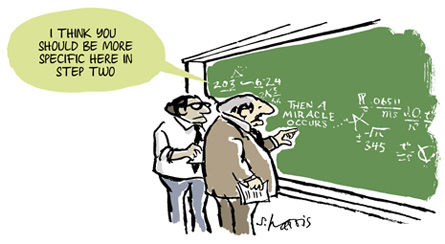
Don Boudreaux resurrects a cartoon about a “miracle” central to a certain analytical theme in economics. He castigates a large contingent within the profession for failing to acknowledge, or even recognize, that effective government action to rectify market failures often requires such a miracle. In fact, it would usually require a miracle for government action to avoid creating additional welfare losses. It’s something we should know well. 

Religion? Defense Against Guilt? Or Sanctimony?

Tags

Image

The Rise of Secular Religion — This is a fascinating book review, and I think I know exactly what the author and the reviewer are talking about. Among other interesting twists: the apparent thirst for an alternative form of salvation among the secular Left. A sense of guilt abounds, so I don’t think this kind of behavior qualifies as mere sanctimony. Are secular humanist Libertarians guilty of the same tendencies?

The Regressive Impact of Obamacare On Income

Tags

An attempt to quantify Obamacare’s impact on compensation at the lower end of the income distribution. This is based on the CBO’s estimate of a 1% reduction in labor compensation. For the years 2017-2024, that’s a cool $1 trillion, but the reduction in hours worked is expected to fall mostly on low earners. Obama thinks he can replace this lost income through an increased minimum wage (which will also put a up to 1 million out of work), an expanded EITC and other entitlements. Hold out that rice bowl.

Only “Team Players” Help Perpetuate The Public Bureaucracy

Tags

Image

“The director of the U.S. government office that monitors scientific misconduct in biomedical research has resigned after 2 years out of frustration with the ‘remarkably dysfunctional’ federal bureaucracy.” Here’s the link, somehow missing from my post earlier. Well, it is the federal government. While David Wright’s insights are not exactly news, it’s nice to see his rebuke of the culture inside the Leviathan.

“The Commanding General is well aware that the forecasts are no good”

Tags

,

“However, he needs them for planning purposes.” That quote, given in this piece, is from a “war story” told by Kenneth Arrow, a well-known economist. Economic forecasts are often inaccurate. OECD economists released an assessment of their own forecasts last month, which was rather harsh. But give them credit: it’s rare to see economists publicly compare their forecasts to actual outcomes at horizons longer than a few quarters. That doesn’t reduce the demand for long-term forecasts and policy simulations. Planners just can’t help themselves, because a plan requires a rationale, and a rationale requires a forecast conditional on plan assumptions, which ultimately provides an excuse for an inaccurate forecast.

One qualification: I submit that not ALL economists are statists! I would say most of us recognize the pernicious effects of regulation and attempts at “planning” on economic growth.