• About

Sacred Cow Chips

Sacred Cow Chips

Tag Archives: Carbon Forcings

Lords of the Planetary Commons Insist We Banish Sovereignty, Growth

29 Thursday Feb 2024

Posted by Nuetzel in Central Planning, Environmental Fascism, Global Warming, Liberty

≈ Leave a comment

Tags

Anthropocene, Beamed Solar Power, Carbon Capture, Carbon Forcings, Cliff Mass, Common Pool Resources, Elinor Ostrom, Externalities, Fusion Power, Geoengineering, Geothermal Power, global warming, Heat Islands, Interspecies Justice, IPCC, Lula Da Silva, Munger Test, Nuclear power, Orbital Solar Collection, Paris Climate Accords, Planetary Commons, Polycentrism, Private Goods, Property Rights, Public goods, Redistribution, Solar Irradiance, Spillovers, Tipping points
We all share Planet Earth as our home, so there’s a strong sense in which it qualifies as a “commons”. That’s one sensible premise of a new paper entitled “The planetary commons: A new paradigm for safeguarding Earth-regulating systems in the Anthropocene”. The title is a long way of saying that the authors desire broad-based environmental regulation, and that’s what ultimately comes across.

First, a preliminary issue: many resources qualify as commons in the very broadest sense, yet free societies have learned over time that many resources are used much more productively when property rights are assigned to individuals. For example, modern agriculture owes much to defining exclusive property rights to land so that conflicting interests don’t have to compete (e.g,, the farmer and the cowman). Federal land is treated as a commons, however. There is a rich history on the establishment of property rights, but within limits, the legal framework in place can define whether a resource is treated as a commons, a club good, or private property. The point here is that there are substantial economic advantages to preserving strong property rights, rather than treating all resources as communal.

The authors of the planetary commons (PC) paper present a rough sketch for governance over use of the planet’s resources, given their belief that a planetary crisis is unfolding before our eyes. The paper has two main thrusts as I see it. One is to broadly redefine virtually all physical resources as common pool interests because their use, in the authors’ view, may entail some degree of external cost involving degradation of the biosphere. The second is to propose centralized, “planetary” rule-making over the amounts and ways in which those resources are used.

It’s an Opinion Piece

The PC paper is billed as the work product of a “collaborative team of 22 leading international researchers”. This group includes four attorneys (one of whom was a lead author) and one philosopher. Climate impact researchers are represented, who undoubtedly helped shape assumptions about climate change and its causes that drive the PC’s theses. (More on those assumptions in a section below.) There are a few social scientists of various stripes among the credited authors, one meteorologist, and a few “sustainability”, “resilience”, and health researchers. It’s quite a collection of signees, er… “research collaborators”.

Grabby Interventionists

The reasoning underlying a “planetary commons” (PC) is that the planet’s biosphere qualifies as a commons. The biosphere must include virtually any public good like air and sunshine, any common good like waterways, or any private good or club good. After all, any object can play host to tiny microbes regardless of ownership status. So the PC authors characterization of the planet’s biosphere as a commons is quite broad in terms of conventional notions of resource attributes.

We usually think of spillover or external costs as arising from some use of a private resource that imposes costs on others, such as air or water pollution. However, mere survival requires that mankind exploit both public and non-public resources, acts that can always be said to impact the biosphere in some way. Efforts to secure shelter, food, and water all impinge on the earth’s resources. To some extent, mankind must use and shape the biosphere to succeed, and it’s our natural prerogative to do so, just like any other creature in the food chain.

Even if we are to accept the PC paper’s premise that the entire biosphere should be treated is a commons, most spillovers are de minimus. From a public policy perspective, it makes little sense to attempt to govern over such minor externalities. Monitoring behavior would be costly, if not impossible, at such an atomistic level. Instead, free and civil societies rely on a high degree of self-governance and informal enforcement of ethical standards to keep small harms to a minimum.

Unfortunately, the identification and quantification of meaningful spillover costs is not always clear-cut. This has led to an increasingly complex regulatory environment, an increasingly litigious business environment, and efforts by policymakers to manage the detailed inputs and outputs of the industrial economy.

All of that is costly in its own right, especially because the activities giving rise to those spillovers often enable large welfare enhancements. Regulators and planners face great difficulties in estimating the costs and benefits of various “correctives”. The very undertaking creates risk that often exceeds the cost of the original spillover. Nevertheless, the PC paper expands on the murkiest aspects of spillover governance by including “… all critical biophysical Earth-regulating systems and their functions, irrespective of where they are located…” as part of a commons requiring “… additional governance arrangements….”

Adoption of the PC framework would authorize global interventions (and ultimately local interventions, including surveillance) on a massive scale based on guesswork by bureaucrats regarding the evolution of the biosphere.

Ostrom Upside Down

Not only would the PC framework represent an expansion of the grounds for intervention by public authorities, it seeks to establish international authority for intervention into public and private affairs within sovereign states. The authors attempt to rationalize such far-reaching intrusions in a rather curious way:

“Drawing on the legacy of Elinor Ostrom’s foundational research, which validated the need for and effectiveness of polycentric approaches to commons governance (e.g., ref. 35, p. 528, ref. 36, p. 1910), we propose that a nested Earth system governance approach be followed, which will entail the creation of additional governance arrangements for those planetary commons that are not yet adequately governed.”

Anyone having a passing familiarity with Elinor Ostrom’s work knows that she focused on the identification of collaborative solutions to common goods problems. She studied voluntary and often strictly private efforts among groups or communities to conserve common pool resources, as opposed to state-imposed solutions. Ostrom accepted assigned rights and pricing solutions to managing common resources, but she counseled against sole reliance on market-based tools.

Surely the PC authors know they aren’t exactly channeling Ostrom:

“An earth system governance approach will require an overarching global institution that is responsible for the entire Earth system, built around high-level principles and broad oversight and reporting provisions. This institution would serve as a universal point of aggregation for the governance of individual planetary commons, where oversight and monitoring of all commons come together, including annual reporting on the state of the planetary commons.”

Polycentricity was used by Ostrom to describe the involvement of different, overlapping “centers of authority”, such as individual consumers and producers, cooperatives formed among consumers and producers, other community organizations, local jurisdictions, and even state or federal regulators. Some of these centers of authority supersede others in various ways. For example, solutions developed by cooperatives or lower centers of authority must align with the legal framework within various government jurisdictions. However, as David Henderson has noted, Ostrom observed that management of pooled resources at lower levels of authority was generally superior to centralized control. Henderson quotes Ostrom and a co-author on this point:

“When users are genuinely engaged in decisions regarding rules affecting their use, the likelihood of them following the rules and monitoring others is much greater than when an authority simply imposes rules.”

The authors of the PC have something else in mind, and they bastardize the spirit of Ostrom’s legacy in the process. For example, the next sentence is critical for understanding the authors’ intent:

“If excessive emissions and harmful activities in some countries affect planetary commons in other areas—for example, the melting of polar ice—strong political and legal restrictions for such localized activities would be needed.”

Of course, there are obvious difficulties in measuring impacts of various actions on polar ice, assigning responsibility, and determining the appropriate “restrictions”. But in essence, the PC paper advocates for a top-down model of governance. Polycentrism is thus reduced to “you do as we say”, which is not in the spirit of Ostrom’s research.

Planetary Governance

Transcending national sovereignty on questions of the biosphere is key to the authors’ ambitions. At a bare minimum, the authors desire legally-binding commitments to international agreements on environmental governance, unlike the unenforceable promises made for the Paris Climate Accords:

“At present, the United Nations General Assembly, or a more specialized body mandated by the Assembly, could be the starting point for such an overarching body, even though the General Assembly, with its state-based approach that grants equal voting rights to both large countries and micronations, represents outdated traditions of an old European political order.”

But the votes of various “micronations” count for zilch when it comes to real “claims” on the resources of other sovereign nations! Otherwise, there is nothing “voluntary” about the regime proposed in the PC paper.

“A challenge for such regimes is to duly adapt and adjust notions of state sovereignty and self-determination, and to define obligations and reciprocal support and compensation schemes to ensure protection of the Earth system, while including comprehensive stewardship obligations and mandates aimed at protecting Earth-regulating systems in a just and inclusive way.”

So there! The way forward is to adopt the broadest possible definition of market failure and global regulation of any and all private activity touching on nature in any way. And note here a similarity to the Paris Accords: achieving commitments would fall to national governments whose elites often demonstrate a preference for top-down solutions.

Ah Yes, Redistribution

It should be apparent by now that the PC paper follows a now well-established tradition in multi-national climate “negotiations” to serve as subterfuge for redistribution (which, incidentally, includes the achievement of interspecies justice):

“For instance, a more equal sharing of the burdens of climate stabilization would require significant multilateral financial and technology transfers in order not to harm the poorest globally (116).”

The authors insist that participation in this governance would be “voluntary”, but the following sentence seems inconsistent with that assurance:

“… considering that any move to strengthen planetary commons governance would likely be voluntarily entered into, the burdens of conservation must be shared fairly (115).”

Wait, what? “Voluntary” at what level? Who defines “fairness”? The authors approvingly offer this paraphrase of the words of Brazilian President Lula da Silva,

“… who affirmed the Amazon rainforest as a collective responsibility which Brazil is committed to protect on behalf of all citizens around the world, and that deserves and justifies compensation from other nations (117).”

Let Them Eat Cake

Furthermore, PC would require de-growth and so-called “sufficiency” for thee (i.e., be happy with less), if not for those who’ll design and administer the regime.

“… new principles that align with novel Anthropocene dynamics and that could reverse the path-dependent course of current governance. These new principles are captured under a new legal paradigm designed for the Anthropocene called earth system law and include, among others, the principles of differentiated degrowth and sufficiency, the principle of interconnectivity, and a new planetary ethic (e.g., principle of ecological sustainability) (134).”

If we’re to take the PC super-regulators at their word, the regulatory regime would impinge on fertility decisions as well. Just who might we trust to govern humanity thusly? If we’re wise enough to apply the Munger Test, we wouldn’t grant that kind of power to our worst enemy!

Global Warmism

The underlying premise of the PC proposal is that a global crisis is now unfolding before our eyes: anthropomorphic global warming (AGW). The authors maintain that emissions of carbon dioxide are the cause of rising temperatures, rapidly rising sea levels, more violent weather, and other imminent disasters.

“It is now well established that human actions have pushed the Earth outside of the window of favorable environmental conditions experienced during the Holocene…”

“Earth system science now shows that there are biophysical limits to what existing organized human political, economic, and other social systems can appropriate from the planet.”

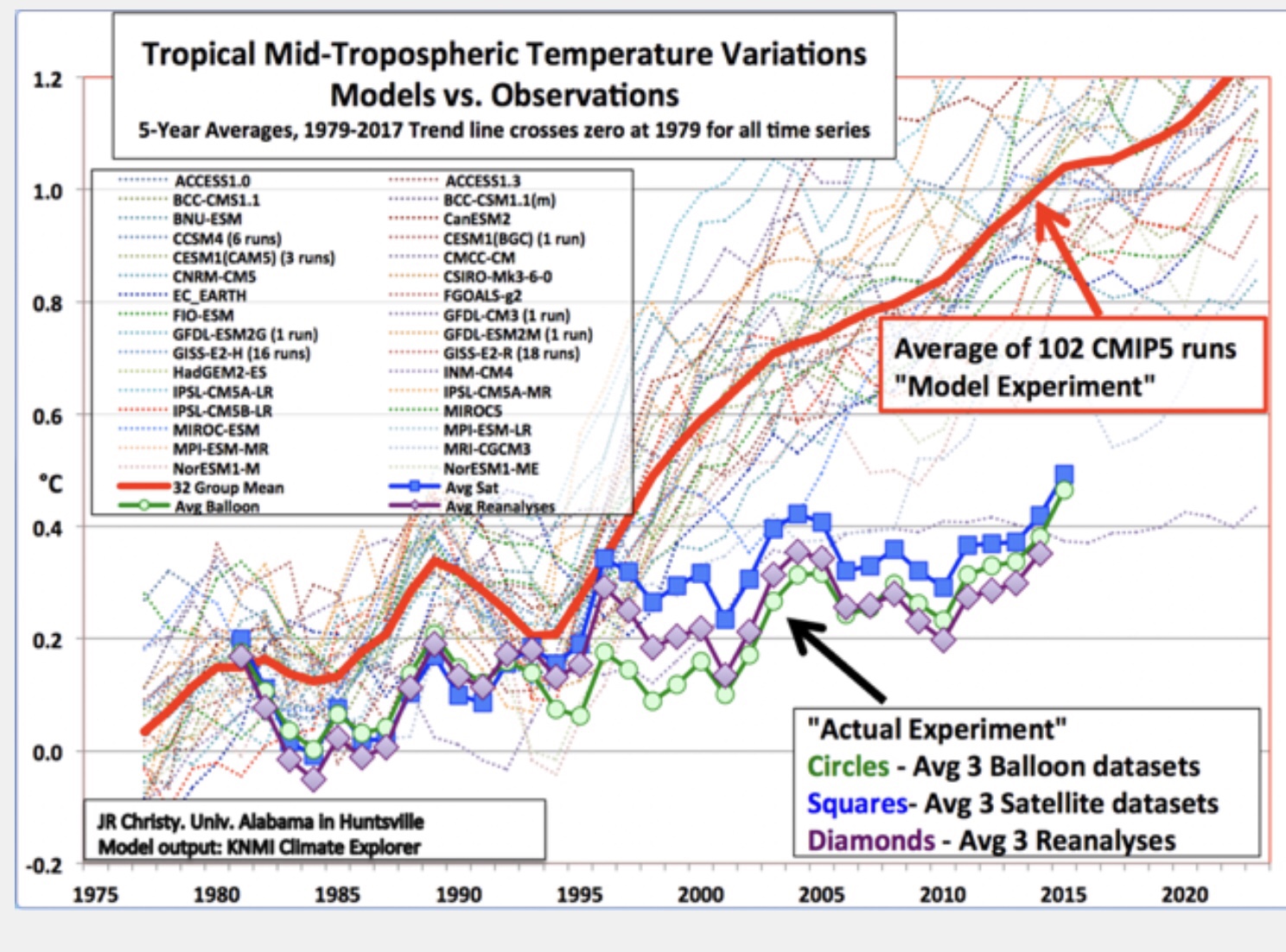
For a variety of reasons, both of these claims are more dubious than one might suppose based on popular narratives. As for the second of these, mankind’s limitless capacity for innovation is a more powerful force for sustainability than the authors would seem to allow. On the first claim, it’s important to note that the PC paper’s forebodings are primarily based on modeled, prospective outcomes, not historical data. The models are drastically oversimplified representations of the earth’s climate dynamics driven by exogenous carbon forcing assumptions. Their outputs have proven to be highly unreliable, overestimating warming trends almost without exception. These models exaggerate climate sensitivity to carbon forcings, and they largely ignore powerful natural forcings such as variations in solar irradiance, geological heating, and even geological carbon forcings. The models are also notorious for their inadequate treatment of feedback effects from cloud cover. Their predictions of key variables like water vapor are wildly in error.

The measurement of the so-called “global temperature” is itself subject to tremendous uncertainty. Weather stations come and go. They are distributed very unevenly across land masses, and measurement at sea is even sketchier. Averaging all these temperatures would be problematic even if there were no other issues… but there are. Individual stations are often sited poorly, including distortions from heat island effects. Aging of equipment creates a systematic upward bias, but correcting for that bias (via so-called homogenization) causes a “cooling the past” bias. It’s also instructive to note that the increase in global temperature from pre-industrial times actually began about 80 years prior to the onset of more intense carbon emissions in the 20th century.

Climate alarmists often speak in terms of temperature anomalies, rather than temperature levels. In other words, to what extent do temperatures differ from long-term averages? The magnitude of these anomalies, using the past several decades as a base, tend to be anywhere from zero degrees to well above one degree Celsius, depending on the year. Relative to temperature levels, the anomalies are a small fraction. Given the uncertainty in temperature levels, the anomalies themselves are dwarfed by the noise in the original series!

Pick Your Own Tipping Point

It seems that “tipping point” scares are heavily in vogue at the moment, and the PC proposal asks us to quaff deeply of these narratives. Everything is said to be at a tipping point into irrecoverable disaster that can be forestalled only by reforms to mankind’s unsustainable ways. To speak of the possibility of other causal forces would be a sacrilege. There are supposed tipping points for the global climate itself as well as tipping points for the polar ice sheets, the world’s forests, sea levels and coastal environments, severe weather, and wildlife populations. But none of this is based on objective science.

For example, the 1.5 degree limit on global warming is a wholly arbitrary figure invented by the IPCC for the Paris Climate Accords, yet the authors of the PC proposal would have us believe that it was some sort of scientific determination. And it does not represent a tipping point. Cliff Mass explains that climate models do not behave as if irreversible tipping points exist.

Consider also that there has been absolutely no increase in the frequency or intensity of severe weather.

Likewise, the rise of sea levels has not accelerated from prior trends, so it has nothing to do with carbon forcing.

One thing carbon forcings have accomplished is a significant greening of the planet, which if anything bodes well for the biosphere

What about the disappearance of the polar ice sheets? On this point, Cliff Mass quotes Chapter 3 of the IPCC’s Special Report on the implications of 1.5C or more warming:

“there is little evidence for a tipping point in the transition from perennial to seasonal ice cover. No evidence has been found for irreversibility or tipping points, suggesting that year-round sea ice will return given a suitable climate.”

The PC paper also attempts to connect global warming to increases in forest fires, but that’s incorrect: there has been no increasing trend in forest fires or annual burned acreage. If anything, trends in measures of forest fire activity have been negative over the past 80 years.

Concluding Thoughts

The alarmist propaganda contained in the PC proposal is intended to convince opinion leaders and the public that they’d better get on board with draconian and coercive steps to curtail economic activity. They appeal to the sense of virtue that must always accompany consent to authoritarian action, and that means vouching for sacrifice in the interests of environmental and climate equity. All the while, the authors hide behind a misleading version of Elinor Ostrom’s insights into the voluntary and cooperative husbandry of common pool resources.

One day we’ll be able to produce enough carbon-free energy to accommodate high standards of living worldwide and growth beyond that point. In fact, we already possess the technological know-how to substantially reduce our reliance on fossil fuels, but we lack the political will to avail ourselves of nuclear energy. With any luck, that will soften with installations of modular nuclear units.

Ultimately, we’ll see advances in fusion technology, beamed non-intermittent solar power from orbital collection platforms, advances in geothermal power, and effective carbon capture. Developing these technologies and implementing them at global scales will require massive investments that can be made possible only through economic growth, even if that means additional carbon emissions in the interim. We must unleash the private sector to conduct research and development without the meddling and clumsy efforts at top-down planning that typify governmental efforts (including an end to mandates, subsidies, and taxes). We must also reject ill-advised attempts at geoengineered cooling that are seemingly flying under the regulatory radar. Meanwhile, let’s save ourselves a lot of trouble by dismissing the interventionists in the planetary commons crowd.

Doomsayers Batting Zero, Draft Kids To Cause

22 Sunday Sep 2019

Posted by Nuetzel in Environmental Fascism, Global Warming

≈ Leave a comment

Tags

Al Gore, Arthur Chrenkoff, Capitalism, Carbon Forcings, Chicken Little, Child Advocacy, Climate Alarmism, Climate Deaths, David Viner, Goose Eggs, Greta Thunberg, Michael Oppenheimer, Model Bias, Over-Prediction, Paul Erlich, Prince Charles, Scott Adams, Seeing CO2, United Nations

Empiricists, take note: The kids were out in the streets on Friday, skipping school to warn us of a climate doomsday fast approaching. Like Greta Thunberg, one of several teenage girls billed as modern-day Cassandras, they just know it. But wait, I think I heard the same thing many years ago… doomsday is nigh! In fact, I’ve heard it over and over through my entire adulthood. And here’s the empirical regularity: “Goose Eggs: No Climate Doomsday Warning Has Come True“. Ever. From the link:

     “Some examples:

    • 1967 — Stanford … expert Paul Erlich predicted “time of famines” in 1975.
    • 1971 — A top NASA expert predicted an “ice age” by 2021.
    • 1988 — It was predicted that the Maldives would be under water by last year.
    • 2008 — Gore said the Arctic would be free of ice by 2013.
    • 2009 — [Prince] Charles said there was just 96 months left to save the world.”

Here are a few other warnings that haven’t panned out:

“Within a few years ‘children just aren’t going to know what snow is.’ Snowfall will be ‘a very rare and exciting event.’” — Dr. David Viner, senior research scientist at the climatic research unit (CRU) of the University of East Anglia [March 2000]”

“[By] 1995, the greenhouse effect would be desolating the heartlands of North America and Eurasia with horrific drought, causing crop failures and food riots…[By 1996] The Platte River of Nebraska would be dry, while a continent-wide black blizzard of prairie topsoil will stop traffic on interstates, strip paint from houses and shut down computers. — Michael Oppenheimer in 1990″

There have been many others (also see here and here). Oh, but you just wait, they say. This time it’s different  and it won’t be long!. You know, people just love to worry. Even so, what kind of daft world do we inhabit with children and adults completely freaked out about “problems” that don’t approximate reality.

Predictions of a more clinical variety, such as upward temperature trends, have been way off on a consistent basis: much too high, that is. But here’s the key: all of the other calamitous developments said to be in our future are predicated on those temperature forecasts. The warnings are not based on data per se, but on on crappy climate models (and see here), which are simplifications of reality, loosely calibrated to capture a relatively short period of historical records. And the models are crappy because they often rely on one input, CO2 forcings. The modelers have difficulty addressing the empirical sensitivity of temperature to carbon, the net effects of radiative forcing, clouds, and ocean circulation. In many prominent cases they don’t even try. Hey look, we’re all gonna die!

A striking misconception one hears repeatedly is that we experience many more hot days, and they are hotter, hot days than in the past. Sure, extremely hot days are bad, but not as bad as extremely cold days, and probably worse than warm nights. The truth is, however, that nearly all of the warming experienced over the past few decades has been in nighttime lows, not daytime highs. More “seasoned” climate alarmists don’t seem to have any memory of the hot days of their youth, and the kids… well, they just fell off the turnip truck, so they have no idea.

One of the great perversions of climate alarmism is the notion that the private enterprise system must be heavily regulated or even abolished in order to put an end to global warming. Never mind that governments are directly responsible for a major share of environmental degradation. And as private economies flourish, the environmental efficiency of production actually improves. In fact, if one were to stipulate that climate change is a problem, as I will for just this one sentence, vibrant capitalism offers the best path to environmental solutions. There are several basic reasons. One is that economic growth and higher income levels give consumers the wherewithal to demand and pay for costlier “green” products. More fundamentally, economic growth facilitates development and investment in cleaner technologies by business and government.

Miss Thunberg doesn’t understand any of this, of course, but she’s a pretty good little scold:

“This is all wrong. I shouldn’t be up here. I should be back in school on the other side of the ocean, yet you come to us young people for hope. How dare you.”

Here’s Arthur Chrenkoff’s take on poor Thunberg and her message:

“[She] should be going to Beijing or Bangalore and staging her protests there instead of, or at least in addition to, Sweden or New York. She should be hounding President Xi and Prime Minister Modi about their shameful emissions. She should be leading throngs of Asian kids out of schools for her Friday student strikes. She should be castigating the industries and the consumers of the developing world for destroying the planet and killing humanity in the process. She should be doing all this if she were serious about the global nature of the problem.”

I especially like this quote from Scott Adams on the “child advocate” phenomenon we’re witnessing:

“Adults sometimes like to use children to carry their messages because it makes it hard for the other side to criticize them without seeming like monsters. If adults have encouraged you to panic about climate change without telling you what I am telling you here, they do not have your best interests at heart. They are using you.“

Of course, Thunberg is thoroughly propagandized and a useful theatrical tool for the alarmist establishment. She has made all sorts of ridiculous and unquestioned claims before the United Nations and elsewhere (e.g., people are dying from climate change (no); that she can “see” CO2 (okay, her mother said that, but what a hoot!). Don’t think for a second that “we have to listen to the children” is uttered sincerely by any adult climate alarmist. It’s manipulation. I feel sorry for Thunberg not least because she is probably deeply frightened about the climate, but also because she is a tool of a death cult.

You really can’t blame kids for being worried about bogeymen foisted upon them by foolish elders, but you can blame the adults for their own frightened acceptance of chicken-little climate augury. And that’s what the kids are being taught. The schools certainly won’t penalize them for missing classes. In fact, many of their teachers accompanied them to the protests.

The climate scare is part of a larger agenda to dismantle not just capitalism, but a host of innocent individual liberties. Scaring children and making teens into miserable pessimists will groom them as good (if neurotic) environmental soldiers for life. They’ll be fit as compliant subjects of a new, environmental fascist state, never to know the sweet freedom and growth possible without the needless bindings imposed by climate cranks. Children, the protection you’ve been told to demand isn’t necessary or worth it. You’re fighting for goose eggs!


Climate Activists Run From Rigor

02 Tuesday Jul 2019

Posted by Nuetzel in Climate science

≈ 1 Comment

Tags

Carbon Forcings, Chicken Little, Global Energy Budget, IPCC, John Christy, Richard Feynman, Testable Hypotheses, Unfalsifiable Claims

Climate activists are seemingly averse to empiricism, and to the scientific method for that matter. Esteemed climatologist John Christy makes that point abundantly clear in a recent speech entitled “Putting Climate Change Claims To the Test“. Christy was one of two lead authors of the third Assessment Report (AR3) of the United Nations Intergovernmental Panel on Climate Change (IPCC), published in 2001, but his research into systematic discrepancies between climate models and actual temperature trends put him in the doghouse with the IPCC. He hasn’t been asked to serve as a lead author since. The transcript linked above is awkward in a few spots where Christy makes informal references to slides, which do, however, accompany and align with the transcript. He covers a lot of ground in this speech, but I’ll cover just a few points. Read the whole thing!

Christy notes that all of the climate models used by the IPCC have substantially over-predicted temperatures for the past thirty years, by an average across models of more than 2.5 times! He measured the errors 17 years ago and again recently, and the magnitude of those errors was almost identical. Yet little progress has been made in correcting the climate models. And why bother? The press simply won’t report the errors, and the IPCC and the activist community are too enraptured by their religious, end-of-days narrative to give it up.

Christy uses a stylized global “energy budget” to illustrate the various sources of climate forcing. He attributes the climate model errors to a failure to adequately account for the escape of energy from the atmosphere into space. He also demonstrates that the magnitude of carbon forcing from human activity represents a tiny contribution to the impact of Earth’s total energy forcings.

Another major point from Christy is that the climate research community has lost its scientific bearings. The very title of his speech refers to testable hypotheses, which is what real science is all about. Christy provides a punchy quote from Richard Feynman on this issue: “Science is a belief in the ignorance of experts.” Today it is routine for climate scientists to report results based on extrapolations from models hinging on mere assumptions they claim to have backtested. Those backtests are often based on flimsy standards and tend to receive little scrutiny, just as long as they are consistent with the so-called “expert consensus”. In other words, those claims amount to a big “what-if” exercise, and the underlying assumptions often lack rigorous testing. Christy goes on:

“Michael Crichton says that in science consensus is irrelevant, what is relevant is reproducible results, consensus is inappropriate. So, as an aside, there’s a strange thing happening in climate science: the proliferation of unfalsifiable claims, in other words the unfalsifiable hypothesis.  Remember I said that scientific method: you make a claim and the claim has to be testable and falsifiable and then you check and see if it’s the real thing.

Well here’s the claim. Whatever happens is consistent with global warming.  Maybe it’s snow or no snow. More hurricanes? Less hurricanes? This method says wait for something to happen and then claim that human-caused warming is to blame. That’s the unfalsifiable hypothesis and it has no information value and there is no way to test it, it has no testable parameter and so it is not science. The unfalsifiable hypothesis predicts anything is possible therefore nothing is testable.“

In other words, today climate research is infested with “fake science”. Christy marches through a variety of climate-related phenomena in his speech, offering evidence on each that is sometimes mixed but often contrary to the implications of climate models and claims made by activists. The big picture is nothing short of damning to the catastrophic warming narrative. Yet the dire scenarios feared by the Chicken Littles of the world, which never come to pass, continue to be reported eagerly by the media and pressed for costly political action.

Imprecision and Unsettled Science

21 Friday Apr 2017

Posted by Nuetzel in Global Warming, Propaganda

≈ 2 Comments

Tags

Abatement Cost, Carbon Abatement, Carbon Forcings, Carbon Limits, Charles Hooper, Climate models, Cloud Formation, Confidence Interval, David Henderson, Earth Day, Measurement Error, Natural Climate Variation, Solar Forcings, Statistical Precision, Surface Temperatures, Temperature Aggregation, William Nordhaus

Last week I mentioned some of the inherent upward biases in the earth’s more recent surface temperature record. Measuring a “global” air temperature at the surface is an enormously complex task, requiring the aggregation of measurements taken using different methods and instruments (land stations, buoys, water buckets, ship water intakes, different kinds of thermometers) at points that are unevenly distributed across latitudes, longitudes, altitudes, and environments (sea, forest, mountain, and urban). Those measurements must be extrapolated to surrounding areas that are usually large and environmentally diverse. The task is made all the more difficult by the changing representation of measurements taken at these points, and changes in the environments at those points over time (e.g., urbanization). The spatial distribution of reports may change systematically and unsystematically with the time of day (especially onboard ships at sea).

The precision with which anything can be measured depends on the instrument used. Beyond that, there is often natural variation in the thing being measured. Some thermometers are better than others, and the quality of these instruments has varied tremendously over the roughly 165-year history of recorded land temperatures. The temperature itself at any location is subject to variation as the air shifts, but temperature readings are like snapshots taken at points in time, and may not be representative of areas nearby. In fact, the number of land weather stations used in constructing global temperatures has declined drastically since the 1970s, which implies an increasing error in approximating temperatures within each expanding area of coverage.

The point is that a statistical range of variation exists around each temperature measurement, and there is additional error introduced by vagaries of the aggregation process. David Henderson and Charles Hooper discuss the handling of temperature measurement errors in aggregation and in discussions of climate change. The upward trend in the “global” surface temperature between 1856 and 2004 was about 0.8° C, but a 95% confidence interval around that change is ±0.98° C. (I believe that is probably small given the sketchiness of the early records.) In other words, from a statistical perspective, one cannot reject the hypothesis that the global surface temperature was unchanged for the full period.

Henderson and Hooper make some other salient points related to the negligible energy impulse from carbon forcings relative to the massive impact of variations in solar energy and the uncertainty around the behavior of cloud formation. It’s little wonder that climate models relying on a carbon-forcing impact have erred so widely and consistently.

In addition to reinforcing the difficulty of measuring surface temperatures and modeling the climate, the implication of the Henderson and Hooper article is that policy should not be guided by measurements and models subject to so much uncertainty and such minor impulses or “signals”. The sheer cost of abating carbon emissions is huge, though some alternative means of doing so are better than others. Costs increase as the degree of abatement increases (or replacement of low-carbon alternatives), and I suspect that the incremental benefit decreases. Strict limits on carbon emissions reduce economic output. On a broad scale, that would impose a sacrifice of economic development and incomes in the non-industrialized world, not to mention low-income minorities in the developed world. One well-known estimate by William Nordhaus involved a 90% reduction in world carbon emissions by 2050. He calculated a total long-run cost of between $17 trillion and $22 trillion. Annually, the cost was about 3.5% of world GDP. The climate model Nordhaus used suggested that the reduction in global temperatures would be between 1.3º and 1.6º C, but in view of the foregoing, that range is highly speculative and likely to be an extreme exaggeration. And note the small width of the “confidence interval”. That range is not at all a confidence interval in the usual sense; it is a “stab” at the uncertainty in a forecast of something many years hence.  Nordhaus could not possibly have considered all sources of uncertainty in arriving at that range of temperature change, least of all the errors in measuring global temperature to begin with.

Climate change activists would do well to spend their Earth Day educating themselves about the facts of surface temperature measurement. Their usual prescription is to extract resources and coercively deny future economic gains in exchange for steps that might or might not solve a problem they insist is severe. The realities are that the “global temperature” is itself subject to great uncertainty, and its long-term trend over the historical record cannot be distinguished statistically from zero. In terms of impacting the climate, natural forces are much more powerful than carbon forcings. And the models on which activists depend are so rudimentary, and so error prone and biased historically, that taking your money to solve the problem implied by their forecasts is utter foolishness.

Follow Sacred Cow Chips on WordPress.com

Recent Posts

  • Immigration and Merit As Fiscal Propositions
  • Tariff “Dividend” From An Indigent State
  • Almost Looks Like the Fed Has a 3% Inflation Target
  • Government Malpractice Breeds Health Care Havoc
  • A Tax On Imports Takes a Toll on Exports

Archives

  • December 2025
  • November 2025
  • October 2025
  • September 2025
  • August 2025
  • July 2025
  • June 2025
  • May 2025
  • April 2025
  • March 2025
  • February 2025
  • January 2025
  • December 2024
  • November 2024
  • October 2024
  • September 2024
  • August 2024
  • July 2024
  • June 2024
  • May 2024
  • April 2024
  • March 2024
  • February 2024
  • January 2024
  • December 2023
  • November 2023
  • August 2023
  • July 2023
  • June 2023
  • May 2023
  • April 2023
  • March 2023
  • February 2023
  • January 2023
  • December 2022
  • November 2022
  • October 2022
  • September 2022
  • August 2022
  • July 2022
  • June 2022
  • May 2022
  • April 2022
  • March 2022
  • February 2022
  • January 2022
  • December 2021
  • November 2021
  • October 2021
  • September 2021
  • August 2021
  • July 2021
  • June 2021
  • May 2021
  • April 2021
  • March 2021
  • February 2021
  • January 2021
  • December 2020
  • November 2020
  • October 2020
  • September 2020
  • August 2020
  • July 2020
  • June 2020
  • May 2020
  • April 2020
  • March 2020
  • February 2020
  • January 2020
  • December 2019
  • November 2019
  • October 2019
  • September 2019
  • August 2019
  • July 2019
  • June 2019
  • May 2019
  • April 2019
  • March 2019
  • February 2019
  • January 2019
  • December 2018
  • November 2018
  • October 2018
  • September 2018
  • August 2018
  • July 2018
  • June 2018
  • May 2018
  • April 2018
  • March 2018
  • February 2018
  • January 2018
  • December 2017
  • November 2017
  • October 2017
  • September 2017
  • August 2017
  • July 2017
  • June 2017
  • May 2017
  • April 2017
  • March 2017
  • February 2017
  • January 2017
  • December 2016
  • November 2016
  • October 2016
  • September 2016
  • August 2016
  • July 2016
  • June 2016
  • May 2016
  • April 2016
  • March 2016
  • February 2016
  • January 2016
  • December 2015
  • November 2015
  • October 2015
  • September 2015
  • August 2015
  • July 2015
  • June 2015
  • May 2015
  • April 2015
  • March 2015
  • February 2015
  • January 2015
  • December 2014
  • November 2014
  • October 2014
  • September 2014
  • August 2014
  • July 2014
  • June 2014
  • May 2014
  • April 2014
  • March 2014

Blogs I Follow

  • Passive Income Kickstart
  • OnlyFinance.net
  • TLC Cholesterol
  • Nintil
  • kendunning.net
  • DCWhispers.com
  • Hoong-Wai in the UK
  • Marginal REVOLUTION
  • Stlouis
  • Watts Up With That?
  • Aussie Nationalist Blog
  • American Elephants
  • The View from Alexandria
  • The Gymnasium
  • A Force for Good
  • Notes On Liberty
  • troymo
  • SUNDAY BLOG Stephanie Sievers
  • Miss Lou Acquiring Lore
  • Your Well Wisher Program
  • Objectivism In Depth
  • RobotEnomics
  • Orderstatistic
  • Paradigm Library
  • Scattered Showers and Quicksand

Blog at WordPress.com.

Passive Income Kickstart

OnlyFinance.net

TLC Cholesterol

Nintil

To estimate, compare, distinguish, discuss, and trace to its principal sources everything

kendunning.net

The Future is Ours to Create

DCWhispers.com

Hoong-Wai in the UK

A Commonwealth immigrant's perspective on the UK's public arena.

Marginal REVOLUTION

Small Steps Toward A Much Better World

Stlouis

Watts Up With That?

The world's most viewed site on global warming and climate change

Aussie Nationalist Blog

Commentary from a Paleoconservative and Nationalist perspective

American Elephants

Defending Life, Liberty and the Pursuit of Happiness

The View from Alexandria

In advanced civilizations the period loosely called Alexandrian is usually associated with flexible morals, perfunctory religion, populist standards and cosmopolitan tastes, feminism, exotic cults, and the rapid turnover of high and low fads---in short, a falling away (which is all that decadence means) from the strictness of traditional rules, embodied in character and inforced from within. -- Jacques Barzun

The Gymnasium

A place for reason, politics, economics, and faith steeped in the classical liberal tradition

A Force for Good

How economics, morality, and markets combine

Notes On Liberty

Spontaneous thoughts on a humble creed

troymo

SUNDAY BLOG Stephanie Sievers

Escaping the everyday life with photographs from my travels

Miss Lou Acquiring Lore

Gallery of Life...

Your Well Wisher Program

Attempt to solve commonly known problems…

Objectivism In Depth

Exploring Ayn Rand's revolutionary philosophy.

RobotEnomics

(A)n (I)ntelligent Future

Orderstatistic

Economics, chess and anything else on my mind.

Paradigm Library

OODA Looping

Scattered Showers and Quicksand

Musings on science, investing, finance, economics, politics, and probably fly fishing.

  • Subscribe Subscribed
    • Sacred Cow Chips
    • Join 128 other subscribers
    • Already have a WordPress.com account? Log in now.
    • Sacred Cow Chips
    • Subscribe Subscribed
    • Sign up
    • Log in
    • Report this content
    • View site in Reader
    • Manage subscriptions
    • Collapse this bar
 

Loading Comments...