• About

Sacred Cow Chips

Sacred Cow Chips

Tag Archives: Critical Theory

Riding the DEI Weimar Curve: What’s Next on the Pogrom?

24 Friday Nov 2023

Posted by Nuetzel in anti-Semitism, DEI, fascism, Liberty

≈ Leave a comment

Tags

Adolf Hitler, anti-Semitism, Banality of Evil, Bari Weiss, C.S. Lewis, Class Struggle, Critical Theory, David Foster, DEI, Diversity, Equity, Federalist Society, Gaza, Great Depression, Hamas, Inclusion, Inner Ring, Institutionalized Racism, Jamie Kirchick, Marxism, Naziism, Oppressors, Philip Carl Salzman, Protected Groups, Reverse Discrimination, Ricochet, Social Justice, Tablet, Weimar Republic, Zero-Sum Game
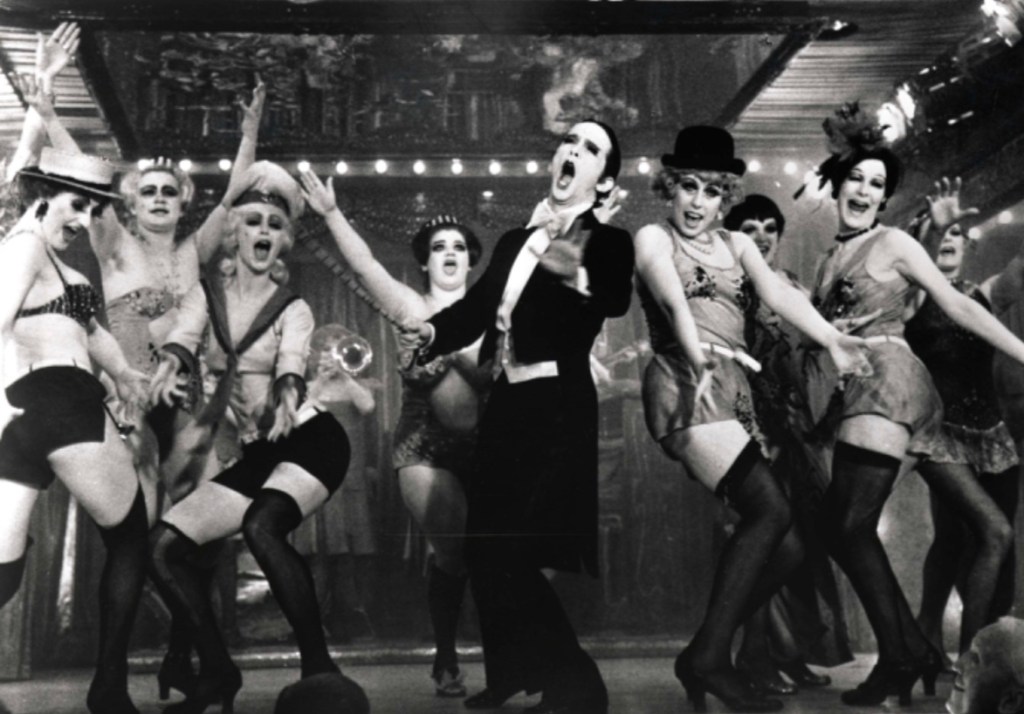
Germany’s inter-war descent into genocidal barbarism is perhaps the most horrifying episode of modern times. Seemingly normal, “nice people” in Germany were persuaded to go along with the murderous pogroms of the anti-Semitic National Socialists, giving truth to the “banality of evil”, as the famous expression goes. Of course, there were plenty of true believers, and multitudes bowed to the Nazis under fierce coercion, but many others went along just to “fit in”.

What could life have felt like in Weimar Germany in the late 1920s and early 1930s as the fascists accumulated power? Were normal people afraid? Well before Adolf Hitler’s rise to power he was known for his hatred of Jews, but German political leaders who enabled his ascent did not take his extreme prejudice as seriously as they should have, or they thought they could at least keep him and his followers in check. Surely there were people who foresaw the approaching cataclysm for what it would be.

Current expressions of anti-Semitism might give us a sense of what life was like during the decline and fall of the Weimar Republic. Just ask Jewish students at NYU and Cornell if they’ve sensed a whiff of it in the wake of Hamas’ slaughter of civilians in southern Israel on October 7th. The harassment these students have endured was motivated in part by claims that Israeli retaliation is morally inferior to the barbarities committed by Hamas, which is preposterous.

Of course, unlike late Weimar Germany, when Jews were blamed for economic (and other) problems, the Jew hatred we’re witnessing in the U.S. today has little to do with the immediate state of the economy. Conditions now are nothing like what prevailed in Germany as the Great Depression took hold, despite current inflationary stresses on real household incomes.

And yet some hold Jews in contempt for their relative economic success, a fact that is bound up with the frequency with which Jews are placed at the center of economic conspiracy theories. One would think Jews to be the ultimate “white oppressors”. But it seems that much of the current wave of anti-Semitism comes from fairly elite quarters, ensconced within major institutions where its sympathizers are insulated from day-to-day economic pressures.

And that brings us to a frightening aspect of the current malaise: how heavily institutionalized the hatred for certain groups or “classes” has already become. This owes to the blame directed toward whites, men, Jews, and Asians presumed to have been endowed with an inside track on success at the expense of others. Success of any kind, in the narrative of “critical” social justice, is “oppressive”, as if success is a zero-sum game.

Here is Philip Carl Salzman on this point:

“The ‘social justice’ political analysis is founded on the Marxist conviction that society is divided into two classes: oppressors and victims. The corresponding ‘social justice’ ethic is that victims must be raised up and celebrated and that oppressors must be suppressed and eliminated.”

This thinking has been integrated into the policies, practices and rhetoric taught in schools at all levels, corporations and nonprofits, social and traditional media, and government (including intelligence agencies and the military). This level of integration gives diversity, equity, and inclusivity (DEI) policies coercive force on behalf of so-called “protected groups”, in the parlance of anti-discrimination law. When those practices are enforced by government in various ways, the private gains extracted from “unprotected” groups amount to fascism.

Bari Weiss wrote an article in Tablet last week entitled “End DEI” in which she describes her bemused reaction as a student in the early 2000s to nascent DEI rhetoric. (Also see her recent speech to the Federalist Society here.) It’s more obvious today, but even then she recognized the hate inherent in DEI doctrine. She crystallizes the dangers she saw in DEI ideology:

“What I saw was a worldview that replaced basic ideas of good and evil with a new rubric: the powerless (good) and the powerful (bad). It replaced lots of things. Colorblindness with race-obsession. Ideas with identity. Debate with denunciation. Persuasion with public shaming. The rule of law with the fury of the mob.

“People were to be given authority in this new order not in recognition of their gifts, hard work, accomplishments, or contributions to society, but in inverse proportion to the disadvantages their group had suffered, as defined by radical ideologues. According to them, as Jamie Kirchick concisely put it in these pages: ‘Muslim > gay, Black > female, and everybody > the Jews.’”

Weiss says Jewish leaders told her, at that time, not to be hysterical, that these perverse ideas would ultimately pass like any fad. That sounds so eerily familiar. Instead, we’ve witnessed a widespread ideological takeover.

“If underrepresentation is the inevitable outcome of systemic bias, then overrepresentation—and Jews are 2% of the American population—suggests not talent or hard work, but unearned privilege. This conspiratorial conclusion is not that far removed from the hateful portrait of a small group of Jews divvying up the ill-gotten spoils of an exploited world.

“It isn’t only Jews who suffer from the suggestion that merit and excellence are dirty words. It is strivers of every race, ethnicity, and class. That is why Asian American success, for example, is suspicious. The percentages are off. The scores are too high. From whom did you steal all that success?”

The whole DEI enterprise is corrupt and unethical. It denies the meritorious in favor of those having certain superficial characteristics like the “right” skin color. That is evil and economically demented besides. It also breeds hatred that often flows both ways between classes of people, creating an incendiary environment. That we’re talking about systemic, legalized discrimination against any group is disturbing enough, but when small minorities are “othered” in this way, the potential for violent action against them is magnified. But this is just where the DEI mindset leads its proponents and beneficiaries.

Our slide into this monstrous “social justice” regime mirrors the insanity and anger that was fomented against certain “out groups” when the Nazi’s accumulated power in the latter years of the Weimar Republic. Too many today have succumbed to this zero-sum psychology, young and old alike. Fortunately, they are beginning to face some fierce resistance, but those who extol the supposed righteousness of the class struggle via DEI won’t easily give up. Our institutions are infested with their kind.

As long as influential people preach the virtues of DEI and social justice, the danger of a headlong plunge into genocidal madness is possible. And the sad truth is that normal human beings are subject to social manipulation of the most evil kind. David Foster at Ricochet: quotes an address given by C.S. Lewis in which he emphasizes this point. His words are haunting:

“Of all the passions, the passion for the Inner Ring is most skillful in making a man who is not yet a very bad man do very bad things.”

Elsewhere in Lewis’ address, he says:

“And the prophecy I make is this. To nine out of ten of you the choice which could lead to scoundrelism will come, when it does come, in no very dramatic colours. Obviously bad men, obviously threatening or bribing, will almost certainly not appear. Over a drink, or a cup of coffee, disguised as triviality and sandwiched between two jokes, from the lips of a man, or woman, whom you have recently been getting to know rather better and whom you hope to know better still—just at the moment when you are most anxious not to appear crude, or naïf or a prig—the hint will come. It will be the hint of something which the public, the ignorant, romantic public, would never understand: something which even the outsiders in your own profession are apt to make a fuss about: but something, says your new friend, which ‘we’ — and at the word ‘we’ you try not to blush for mere pleasure—something ‘we’ always do.

“And you will be drawn in, if you are drawn in, not by desire for gain or ease, but simply because at that moment, when the cup was so near your lips, you cannot bear to be thrust back again into the cold outer world. It would be so terrible to see the other man’s face—that genial, confidential, delightfully sophisticated face—turn suddenly cold and contemptuous, to know that you had been tried for the Inner Ring and rejected. And then, if you are drawn in, next week it will be something a little further from the rules, and next year something further still, but all in the jolliest, friendliest spirit. It may end in a crash, a scandal, and penal servitude; it may end in millions, a peerage and giving the prizes at your old school. But you will be a scoundrel.”

Critical Gender Theory and Trends in Gender Identity

21 Thursday Apr 2022

Posted by Nuetzel in Gender, Wokeness

≈ Leave a comment

Tags

Babylon aber, Bisexuality, Bryan Caplan, C. Bradley Thompson, Celibacy, Cisgender, Closeting, Critical Gender Theory, Critical Race Theory, Critical Theory, Disney, Emilie Kao, Feminism, Gallup, GayBCs, Gender Dysphoria, Gender Identity, Gender Support Plans, Gender Unicorn, Gender-Affirming Therapy, Generation Z, Grooming, Heritability, Larpers, Laurence S. Mayer, LGBTQ, Libs of TikTok, Marxism, Millenials, Misgender, My Princess Boy, Paul R. McHugh, Paul W. Hruz, Precocious Puberty, Puberty Blockers, Recruitment, Religiosity, Sexual Liberation, Sexual Preference, Social Justice, Socialization, Transgenderism, Transition, Transition Closet, Victimhood

The growing influence of critical gender theory (CGT) in schools is unacceptable to many parents, especially at early grade levels. In fact, it’s been coming from certain areas of pediatric medicine for some time. Like critical race theory, CGT is another branch of critical theory, which was developed by a set of European social thinkers in the 1930s. CT is fundamentally a Marxist construct, and it lies at the heart of nearly all appeals to “social justice”. C. Bradley Thompson offers this concise perspective on critical theory:

“The principal aim of Critical Theory was and is, first, to deconstruct the forms of domination and hierarchy (i.e., the power relations) found in traditional or bourgeois societies, and, second, to reconstruct society toward what it calls ‘real’ or ‘true’ democracy, which is a neologism for socialism. Critical theory seeks to liberate any and all ‘victim’ groups based on their inferior and subjugated social status in capitalist societies (e.g., non-whites, women, and LGBTQ+ persons, etc.).”

LGBTQ+ Numbers

It’s fair to ask whether exposure to CGT in schools has any influence on the sexual orientation and preferences of students as they mature. That can be true only to the extent that these preferences reflect socialization, rather than other environmental factors or heredity. Apparently, most LGBTQ+ individuals are disposed to claim that their sexual preference is genetic. However, the claim that sexual preference is heritable to the exclusion of social influences is dubious. And there are other non-genetic, environmental influences that play a strong role as well.

Bryan Caplan discusses some fascinating generational differences in sexual orientation / identification revealed by a recent Gallup survey. Here, I reproduce the table shown in Caplan’s post. The sum of these categories (not shown) is taken as the LGBTQ+ share of each generation.

Taken at face value, those are extremely large increases over five generations… or even over two generations from millennials to GenZs, the gay proportion being the only category in which millennials and GenZs are reasonably close in 2022.

Another important wrinkle is that the share of older generations identifying as LGBTQ+ has been stable since the last survey conducted by Gallup in 2017, as shown by the Gallup chart below:

Millennials have increased by more than a third, and the LGBTQ+ share among Gen Zs has roughly doubled to 20.8%. Gen Zs surveyed in 2017 ranged from roughly 18 – 20 years of age, but that range was roughly 18 – 24 years of age in the latest survey. Therefore, the 2022 survey might capture a greater share of GenZs having “matured” into acceptance of specific sexual identities. Nevertheless, the levels and changes in these two generations are striking.

Causal Quandary

Caplan wonders how these increases would be possible if sexual orientation was predominantly heritable, especially given that these groups are unlikely to produce offspring at the same rate as the general population. The shrinking genotype / expanding phenotype paradox leads him to conclude that heightened LGBTQ+ socialization is generally responsible for the dramatic increases.

A number of Caplan’s commenters questioned his conclusions for one or several of these categories. At the risk of missing some of the nuance in the comments, I’ll attempt to summarize a few common threads: First, as Caplan himself notes, closeting is much less common than in the past. Therefore, increases in the reported shares of these categories might be illusory. Less closeting has brought little change in the responses of the older generations, however, and perhaps that’s because they tend to associate primarily within their own age cohorts.

Second, there could be environmental influences that have led to a smaller share of cis-gender males and females, as well as more “mis-genders” at birth. For example, anything that changes the flow of testosterone to a fetus in the womb might change a child’s sexual orientation, but whether some force has induced systematic changes in those flows over time, and across the population, is another matter.

Finally, the bulk of those claiming status as LGBTQ+ among millennials and Gen Zs are bisexual. For those who are otherwise heterosexual, identification as bisexual might be fairly “costless”. That suggests a possibility that the bisexual share may be influenced by status-seeking among GenZs, especially females. One joke goes “How can you tell if a girl is bi-sexual? … Don’t worry, she’ll tell you!” Thus, some commenters viewed the large increase in reported bisexuality as inflated by status seeking among what amounts to a kind of “larper” set. There might be so much emphasis on being open-minded about sexual experimentation among younger cohorts that minor incidents from childhood or adolescence are subsequently exaggerated into claims of bisexuality.

Socialization

Obviously the reduction in closeting leads to greater social exposure of non-traditional sexual preferences, including exposure to the nation’s youth. That’s a powerful social change, and it creates an atmosphere increasingly conducive to further socialization of these preferences, if not recruitment. Like many trends, this one feeds on itself: this 2021 study found a positive association between men “coming out” as gay and state legalization of same-sex marriage, the presence of gay communities, and positive attitudes toward gays. Moreover, there are definite signs of social contagion, as demonstrated by this clique of teenagers who, one and all, suddenly decided they were trans!

What forces led to the cascade in LGBTQ+ identification among more recent age cohorts? As a group, the full LGBTQ+ coalition has greater visibility, political power in asserting “victimhood”, and potential for socializing the general population to alternative lifestyles. However, there might not be any single trigger spanning LGBTQ+ identities that can explain the trend’s genesis. Perhaps the trends were set in motion by the sexual liberation of the 1960s and 70s which, as a libertarian, is not otherwise something I find objectionable.

The rise of radical feminism might have provided a basis for some females to reject males as a source of sexual gratification (and companionship), or as an exclusive source thereof, at any rate. There’s a likelihood that this contributed to the rise in lesbianism as well as female bisexuality. Feminism also served as a pretext for identity politics, which relies on claims of victimhood and is therefore fertile ground for critical theorists.

Critical theory first gained significant ground in the U.S. at universities along dimensions of race, but gender and sexual preference weren’t far behind. This “social justice” perspective filtered its way into departments of education, where academic standards are exceptionally forgiving. This, in turn, led to more fertile ground for critical theory in elementary and high school education.

CGT promotes the idea that gender is a social construct. If an individual feels that he or she is not well-suited to their biological sex, then CGT holds that they should identify as members of the opposite sex and pursue any medical paths to transition as might be available. This view has increasingly been applied to younger individuals.

Medical Experts

Paul W. Hruz, Laurence S. Mayer, and Paul R. McHugh (HMM) discuss the 1980s development of certain pharmaceuticals prescribed today to many children suffering from gender dysphoria. One might suspect that these drugs helped to set some of these trends in motion, together with so-called “gender-affirming” therapies that are now widely practiced. The latter involve therapists who accept and support the gender identity with which a patient feels most comfortable. Needless to say, this approach is likely to encourage a gender dysphoric youth to continue their exploration of a change in gender.

Synthetic hormonal “puberty blockers” became available in the early 1990s as a treatment for early puberty (so-called “precocious puberty”). At about the same time, the treatment was tested to stop production of sex hormones in adult males identifying as females. In the 1990s, the treatment was first used to suppress puberty in children with gender dysphoria, but the effects are supposedly reversible. Advancing to a full “transition” protocol involves the subsequent use of cross-sex ­hormones ­and ultimately surgical­ reassignment. Today, puberty suppression techniques are widely used on children with gender dysphoria because it is viewed as a safe choice that might “buy time” while other forms of maturation proceed. Here are HMM on this point:

“The­ use­ of­ puberty­ suppression­ and ­cross-sex hormones ­for­ minors­ is­ a­ radical­ step­ that­ presumes ­a­ great­ deal ­of­ knowledge­ and­ competence­ on­ the­ part ­of­ the­ children­ assenting to­ these­ procedures,­ on­ the­ part ­of­ the­ parents­ or­ guardians­ being­ asked­ to­ give­ legal­ consent­ to­ them,­ and­ on­ the­ part­ of­ the­ scientists­ and­ physicians­ who­ are­ developing­ and­ administering­ them.­ We­ frequently­ hear­ from­ neuroscientists­ that­ the ­adolescent­ brain­ is­ too­ immature­ to­ make­ reliably­ rational­ decisions,­ but­ we­ are­ supposed­ to­ expect­ emotionally­ troubled­ adolescents­ to­ make­ decisions­ about­ their­ gender­ identities ­and­ about­ serious­ medical ­treatments ­at­ the­ age ­of­ 12­ or­ younger.­ And­ we­ are­ supposed ­to­ expect­ parents­ and­ physicIans ­to­ evaluate ­the risks­ and­ benefits ­of­ puberty ­suppression,­ despite­ the­ state­ of­ ignorance ­in­ the­ scientific ­community­ about­ the­ nature­ of­ gender­ identity.”

HMM also discuss the strong influence that activists have had on the medical establishment. This is summarized nicely by Emilie Kao:

“… the largest LGBT lobbying organization, the Human Rights Campaign and World Professional Association for Transgender Health (WPATH) influenced medical organizations like the Endocrine Society and the American Academy of Pediatrics to embrace gender affirmation over the last two decades. Jason Pierceson, author of Sexual Minorities and Politics, explains that ‘political activism and consciousness raising has also changed the way in which the medical community views transgender persons.’ He describes how this activism led the American Psychiatric Association to “abandon the mental illness paradigm of transgenderism” by changing the description in the Diagnostic and Statistical Manual of Mental Disorders (DSM-5) to treat only the stress associated with gender dysphoria as a mental disorder. No breakthroughs in science or medicine led to the change, which was accomplished just by political activism.”

HMM do not claim that puberty blockers and gender-affirming therapy are at the root of increasing transgenderism. However, they express strong reservations about widespread use of puberty blockers among gender dysphoric adolescents.

We know that gender dysphoric youths have high rates of anxiety, depression, and even suicide. Unfortunately, transition doesn’t seem to alleviate those problems as a general rule. Furthermore, it’s important to remember that unhappy adolescents are nothing new. It can be an unhappy time for many kids who are full of self-doubt. Most of them get over it, however, and many with dysphoria get over it as well. One has to ask: does helping dysphoric children along the path to transition so early have any real gains in the aggregate?

Educational Experts

What role have the schools played in the gender confusion? The answer is just as horrifying as the role of the therapists and medical doctors encouraging and overseeing the early encouragement of transitions discussed above.

“As early as 2007, for instance, California’s education code stated that gender pertains not to anything biological but to ‘a person’s gender-related appearance and behavior.’[3] Gender is, in other words, a choice and has no relation to biology. This means that children have a smorgasbord of gender identities to choose from.”

So this is not new and could well have played a role in the Gallup survey results, especially for GenZs. Read at the last link about such things as “Gender Support Plans” in the schools, teacher training in dealing with gender issues, a “children’s garden” where five-year olds can learn the difference between biological sex and “gender”, a kindergarten book called My Princess Boy, the GayBCs for ages 4 – 8, the provision of a “transition closet” in which kids change their clothing once they arrive at school, school nurses who provide puberty blockers to kids they evaluate as dysphoric, pronoun lessons, of course, and many other examples. Also see this article for further information about CGT in schools, including the “Gender Unicorn” first introduced in 2016 and now used nationwide, starting as early as pre-K and kindergarten. And for a running catalog of the outrageous lessons taking place in our schools, check out Libs of Tik Tok.

Other Causal Forces

There are other vaguely plausible explanations for the trend toward more common identification as LGBTQ+ among millennials and GenZs. The internet and especially social media come to mind. Small and large social contagions are frequent on these platforms. Pre-social media, members of certain sub-cultures, and dare I say outcasts, had more difficulty finding, communicating and sharing information with one another. Today there is much less friction in that regard. Social media is also a hotbed of misery for many individuals, afflicted all too often with feelings of inadequacy or a feeling that they are outcasts. Among unhappy youths, the suggestion to try something different, to join a new “tribe”, may be very tempting. The internet serves as a guide.

A phenomenon that might be related to trends in gender identity is an increase in celibacy and decline of “partner sex”, especially among younger individuals and men. While so-called partner sex includes gay sex, the trend in sexual identity is not about any decline in sexual activity per se, but about representations of sexual identity. The uptrend in celibacy is consistent with the hypothesis that some cisgenders, frustrated by a lack of sexual partners (as distinct from the small, mostly male and angry “incel” community), might seek out a broader array of prospects. However, I know of no actual evidence to suggest such a connection.

The entertainment world is certainly no newcomer to controversies surrounding sexual identity. Gayness has long been celebrated in the theatre community, to a fault. I love theatre, but the near ubiquity of the theme in recent years has grown tiresome. There have always been gay stars of the screen, television, and musical entertainment, though it was often closeted in the past. Gay and gender identity themes have become much more common in film, but it was only recently that Disney began to emphasize gender issues explicitly with the children’s audience in mind. Some adults and even adolescents must grapple with gender dysphoria as they always have, with varying degrees of success and failure. However, to subject an audience of young children to themes that are beyond their ability to comprehend, and for whom the early exposure is completely unnecessary, is not acceptable.

Finally, the decline of religiosity might play a role in the trend toward LGBT+ identities. For one thing, church-goers have one more place to meet potential mates. More importantly, traditional religion has nearly always frowned on homosexuality, at least officially, and the LGBT+ coalition is largely areligious. Therefore, it seems likely that the negative trend in religiosity might be related to the positive trend in the LGBTQ+ population.

Conclusion

There is no question that identification as any of various forms of LGBTQ+ has increased dramatically among millennials and GenZs, with the largest increase in the bisexual category. Bryan Caplan hypothesizes that the trend is one of socialization, if not recruitment. It seems likely that this is the case, though much of the LGBTQ+ community’s internal, personal recruitment is probably of the passive variety. In addition, it seems likely that some of the gap relative to older generations is due to a reduction in closeting as well as “costless” status-seeking among individuals who wish to be perceived as enlightened or woke.

It’s also evident that the portion of the medical establishment concerned with issues of gender identity, as well as schools and certain entertainment institutions, have adopted the extreme views espoused by critical gender theory. They are actively encouraging children to learn about and explore various gender identities. This may encourage gender dysphoria, and when children show signs of dysphoria they are encouraged to move to the next stage, which involves affirmative therapy and puberty blockers, A bit later, teenagers might move on to other hormonal treatments and later-still, sex-change surgery. Our major medical, educational, and entertainment institutions appear to be real sources of non-passive recruitment, and indeed, the grooming of children for lives as LGBTQ+ adults.

Credit for the image at the top of this post goes to the Babylon Bee.

The Critical Race Dialectic

07 Sunday Feb 2021

Posted by Nuetzel in Critical Race Theory, Social Justice

≈ Leave a comment

Tags

1619 Project, Critical Race Theory, Critical Theory, criticalrace.org, Equality Under the Law, Immanuel Kant, Jonah Goldberg, Mark Robinson, newdiscourses.com, Overt Discrimination, Privilege, racism, Reparations, Revolutionary War, S.G. Cheah, Social Justice, Systemic Racism, Victimhood

The very notion of impartiality requires decisions that are independent of race, ethnicity, religion, gender, sexual preference, gender identity, or any other component of identity. The great irony of identity politics is its insistence on using characteristics of identity as the key drivers in a broad range of human decisions. It does so in an effort to redress injustices, often in the distant past. This necessarily penalizes individuals bearing no responsibility for the original injustices, and of course those penalties are also assessed on the basis of identity.

That would seem to limit the political viability of reparations for injustices of the distant past, but identity politics seeks to foster a sense of contemporary and immediate relevance to claims of compensable injustice. That’s one way to rationalize the kind of massive redistribution contemplated by this movement. Those who would stand to benefit must be convinced of their ongoing victimhood, and those who would pay must be convinced of their guilt: despite all good intentions, they practice unconscious bias in all of their actions, words, and thoughts. If successful, the possibilities for transfers of wealth and power in all matters are limited only by the negative-sum reality of this scam.

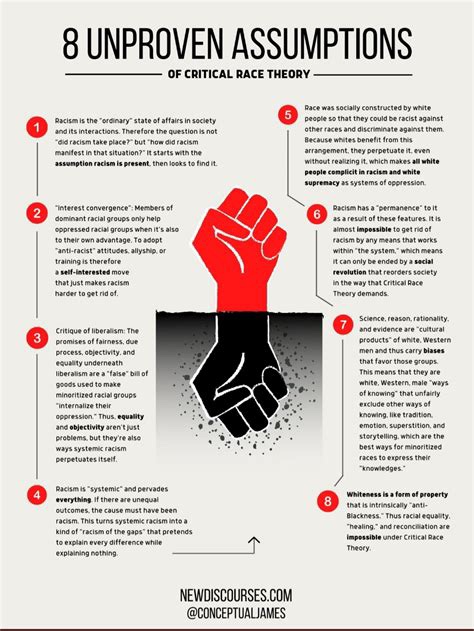
The kind of propaganda referenced above is the province of Critical Race Theory (CRT). S.G.Cheah explains:

“Critical Theory originated from Immanuel Kant’s Critical Philosophy. Critical Philosophy states that ‘proper inquiry is not about what is out there in reality, but rather about the character and foundations of experience itself.’”

For a more detailed analysis of Kant’s “Critiques” of pure reason, practical reason, and judgement, see here. His primary focus was theology, but the adherents obviously found much broader application. The brief explanation quoted above is pretty accurate, and probably offers all the intellectual underpinnings critical race theorists require to push their agenda.

If one’s “experience” is the only evidence that matters, then the ravings of any lunatic must be taken at face value, and as truth. A concession to objective reality is tolerated only when and if it confirms an individual’s mood affiliation. And what defines one’s experience if not one’s inner feelings about events? Thus, regardless of facts, CRT would have us bow to mere feelings, perceptions, and assertions of harm said to be inflicted by the so-called “privileged”.

If I believe I’ve experienced racism, then CRT supports the conclusion that I have experienced racism. It is not confined to situations of overt discrimination. It goes for any conflict I might have with someone of a different race; any transaction in which I might feel disadvantaged; any life circumstance that I experience as “unfair”; or any judgement against me in a court of law. Racism is reality if I “experience” the world as racist (or sexist or homophobic or transphobic, for that matter.) These charges are conveniently leveled against those who have enjoyed any differential success in the world, irrespective of race, but primarily against whites and often Asians regardless of success.

Apparently, under CRT, one’s “experience” may extend to perceptions that today’s culture and institutions are evolved from any version of history one might choose to conjure. A prominent case are the lies promoted by the New York Times’ 1619 Project that the Revolutionary War was fought to preserve slavery. Jonah Goldberg’s thoughts on that topic are worth reading.

CRT has spawned some incredibly bad research. Here’s a review of two academic papers on the connection between the use of the “N-word” in LLP Google searches and 1) gun purchases “motivated by white racial animus”, and 2) “anti-black voting patterns”. The authors of those papers drew behavioral conclusions from mere coincidental events, based more upon their personal biases than objective evidence. They undoubtedly were aware of the weaknesses of using Google trends to gauge attitudes, but they willfully ignored that evidence.

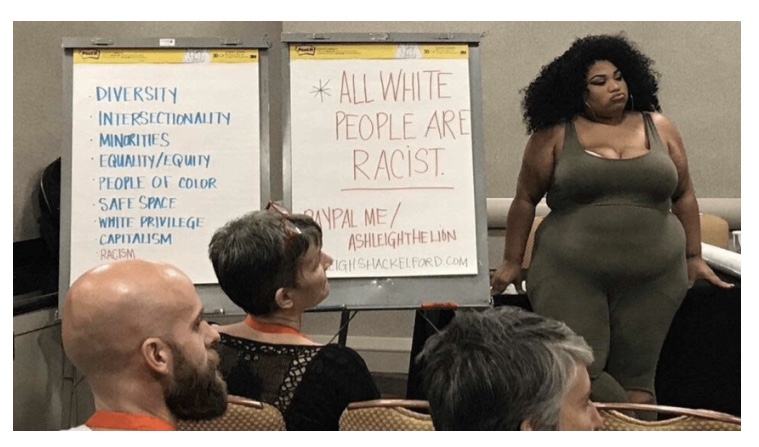
CRT is being taught to our children in public schools and probably in some private schools. This is nothing short of an indoctrination campaign. Of course, CRT made much earlier inroads in higher education. A new web site, criticalrace.org, includes a searchable database on CRT training at U.S. universities, as well as links to a variety of articles on CRT. Many private corporations have been eager to jump on board with CRT. Take a look at the instructor’s notes on the poster boards at the racial struggle session shown below. Here is a longer description.

This is literally a propaganda putsch, and it is meeting with far more success than I would have thought possible. I’ve apparently misjudged the ability of my countrymen to think independently, or to think at all. Here are examples of the success of CRT advocates in convincing whites of their individual and collective guilt. There are individuals now so convinced of the guilt of all white people that they can’t help but make complete fools of themselves:

“We will only achieve tolerance and unity once white people accept that they are evil, repugnant, worthless trash whose very existence is a vomit stain on the fabric of society.”

Speak for yourself! I have to conclude that this poor woman recognizes something quite damning within herself, and she feels it necessary to project her innermost racism onto others who happen to share her skin color.

Now here’s a man to admire: Lt. Governor Mark Robinson of North Carolina. He isn’t having any of the CRT crap, and he knows how to give it back to the petty stringers in the media as well as anyone.

CRT is a lie, or many lies. Racists certainly walk among us, but to condemn all whites of racism, or to allege racism by any class with presumed privilege, is a gross violation of ethics. Guilt of recompensable racism cannot be established by mere claims about anyone else’s “experience” without impartial adjudication. The thoughts and actions of decent people are not dominated by racial animus or repugnance, and any presumption to the contrary must be rejected in the absence of objective proof. Everyone matters, and we must insist on equality under the law. That does not mean equality of outcome, and it is not an excuse for blaming negative outcomes on anyone skilled and/or fortunate enough to have enjoyed more positive outcomes. If the fact that blacks have not achieved average economic parity with whites is evidence of “systemic racism”, I would suggest it has more to do with short-sighted public policy efforts to engineer social outcomes than with racism. More on that in a later post.

Note: the graphic at the top is from New Discourses.

Follow Sacred Cow Chips on WordPress.com

Recent Posts

  • Immigration and Merit As Fiscal Propositions
  • Tariff “Dividend” From An Indigent State
  • Almost Looks Like the Fed Has a 3% Inflation Target
  • Government Malpractice Breeds Health Care Havoc
  • A Tax On Imports Takes a Toll on Exports

Archives

  • December 2025
  • November 2025
  • October 2025
  • September 2025
  • August 2025
  • July 2025
  • June 2025
  • May 2025
  • April 2025
  • March 2025
  • February 2025
  • January 2025
  • December 2024
  • November 2024
  • October 2024
  • September 2024
  • August 2024
  • July 2024
  • June 2024
  • May 2024
  • April 2024
  • March 2024
  • February 2024
  • January 2024
  • December 2023
  • November 2023
  • August 2023
  • July 2023
  • June 2023
  • May 2023
  • April 2023
  • March 2023
  • February 2023
  • January 2023
  • December 2022
  • November 2022
  • October 2022
  • September 2022
  • August 2022
  • July 2022
  • June 2022
  • May 2022
  • April 2022
  • March 2022
  • February 2022
  • January 2022
  • December 2021
  • November 2021
  • October 2021
  • September 2021
  • August 2021
  • July 2021
  • June 2021
  • May 2021
  • April 2021
  • March 2021
  • February 2021
  • January 2021
  • December 2020
  • November 2020
  • October 2020
  • September 2020
  • August 2020
  • July 2020
  • June 2020
  • May 2020
  • April 2020
  • March 2020
  • February 2020
  • January 2020
  • December 2019
  • November 2019
  • October 2019
  • September 2019
  • August 2019
  • July 2019
  • June 2019
  • May 2019
  • April 2019
  • March 2019
  • February 2019
  • January 2019
  • December 2018
  • November 2018
  • October 2018
  • September 2018
  • August 2018
  • July 2018
  • June 2018
  • May 2018
  • April 2018
  • March 2018
  • February 2018
  • January 2018
  • December 2017
  • November 2017
  • October 2017
  • September 2017
  • August 2017
  • July 2017
  • June 2017
  • May 2017
  • April 2017
  • March 2017
  • February 2017
  • January 2017
  • December 2016
  • November 2016
  • October 2016
  • September 2016
  • August 2016
  • July 2016
  • June 2016
  • May 2016
  • April 2016
  • March 2016
  • February 2016
  • January 2016
  • December 2015
  • November 2015
  • October 2015
  • September 2015
  • August 2015
  • July 2015
  • June 2015
  • May 2015
  • April 2015
  • March 2015
  • February 2015
  • January 2015
  • December 2014
  • November 2014
  • October 2014
  • September 2014
  • August 2014
  • July 2014
  • June 2014
  • May 2014
  • April 2014
  • March 2014

Blogs I Follow

  • Passive Income Kickstart
  • OnlyFinance.net
  • TLC Cholesterol
  • Nintil
  • kendunning.net
  • DCWhispers.com
  • Hoong-Wai in the UK
  • Marginal REVOLUTION
  • Stlouis
  • Watts Up With That?
  • Aussie Nationalist Blog
  • American Elephants
  • The View from Alexandria
  • The Gymnasium
  • A Force for Good
  • Notes On Liberty
  • troymo
  • SUNDAY BLOG Stephanie Sievers
  • Miss Lou Acquiring Lore
  • Your Well Wisher Program
  • Objectivism In Depth
  • RobotEnomics
  • Orderstatistic
  • Paradigm Library
  • Scattered Showers and Quicksand

Blog at WordPress.com.

Passive Income Kickstart

OnlyFinance.net

TLC Cholesterol

Nintil

To estimate, compare, distinguish, discuss, and trace to its principal sources everything

kendunning.net

The Future is Ours to Create

DCWhispers.com

Hoong-Wai in the UK

A Commonwealth immigrant's perspective on the UK's public arena.

Marginal REVOLUTION

Small Steps Toward A Much Better World

Stlouis

Watts Up With That?

The world's most viewed site on global warming and climate change

Aussie Nationalist Blog

Commentary from a Paleoconservative and Nationalist perspective

American Elephants

Defending Life, Liberty and the Pursuit of Happiness

The View from Alexandria

In advanced civilizations the period loosely called Alexandrian is usually associated with flexible morals, perfunctory religion, populist standards and cosmopolitan tastes, feminism, exotic cults, and the rapid turnover of high and low fads---in short, a falling away (which is all that decadence means) from the strictness of traditional rules, embodied in character and inforced from within. -- Jacques Barzun

The Gymnasium

A place for reason, politics, economics, and faith steeped in the classical liberal tradition

A Force for Good

How economics, morality, and markets combine

Notes On Liberty

Spontaneous thoughts on a humble creed

troymo

SUNDAY BLOG Stephanie Sievers

Escaping the everyday life with photographs from my travels

Miss Lou Acquiring Lore

Gallery of Life...

Your Well Wisher Program

Attempt to solve commonly known problems…

Objectivism In Depth

Exploring Ayn Rand's revolutionary philosophy.

RobotEnomics

(A)n (I)ntelligent Future

Orderstatistic

Economics, chess and anything else on my mind.

Paradigm Library

OODA Looping

Scattered Showers and Quicksand

Musings on science, investing, finance, economics, politics, and probably fly fishing.

  • Subscribe Subscribed
    • Sacred Cow Chips
    • Join 128 other subscribers
    • Already have a WordPress.com account? Log in now.
    • Sacred Cow Chips
    • Subscribe Subscribed
    • Sign up
    • Log in
    • Report this content
    • View site in Reader
    • Manage subscriptions
    • Collapse this bar
 

Loading Comments...