• About

Sacred Cow Chips

Sacred Cow Chips

Tag Archives: Freedom of Contract

BS Bernie Blames Bezos

12 Wednesday Sep 2018

Posted by Nuetzel in Labor Markets, Living Wage, Price Mechanism, Welfare State

≈ Leave a comment

Tags

Amazon, Bernie Sanders, Freedom of Contract, Jeff Bezos, Living Wage, Ro Khanna, Social Safety Net, Stop BEZOS Act, Welfare State
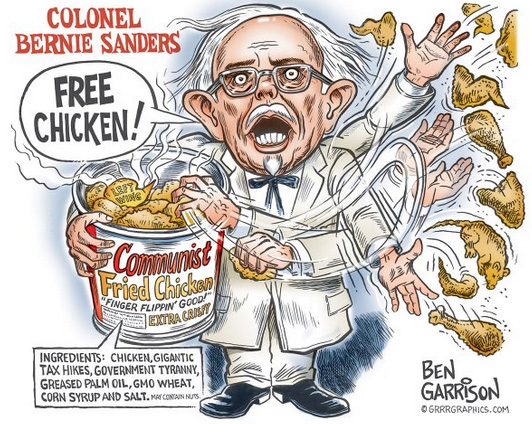
Bernie Sanders keeps probing for ways to create a backdoor minimum income, and he’s eager to loot successful job creators and their customers in the process. Last month I wrote about the folly of his proposed legislation that would offer federal job guarantees to all. A new Sanders bill, introduced jointly with Rep. Ro Khanna (D – CA), is an equally bad idea called the Stop BEZOS Act, or the “Stop Bad Employers by Zeroing Out Subsidies Act”. It’s pretty obvious that the selection of the acronym preceded the naming of the bill. Imagine the fun his Senate staffers had with that! The logical flaws embedded in the title of the act are bad enough. The effort to garner attention by using the title to smear the name of a famous technology entrepreneur is sickening.

Jeff Bezos, of course, is the founder and CEO of Amazon, the online retailer, as well as the owner of the Washington Post. Amazon has been rewarded by consumers for its excellent service and aggressive pricing, and it is now valued at about $1 trillion. That makes Bezos a very wealthy man, and it is no coincidence that Sanders has chosen to make an example of him in an effort to inflame envy and classist passions.

While some details of the bill remain sketchy, firms with more than 500 workers would face a 100% tax on every dollar of federal benefits received by those employees. But the tax would apply only to “low-wage” employees, however that is defined, and not simply any employee receiving federal benefits. If the bill became law (and it won’t any time soon), it would require a costly federal administrative apparatus to coordinate between several agencies, including the IRS. Beyond the tax itself, the compliance costs for firms won’t be cheap, and it will create terrible incentives: if you own a business, you would have a strong incentive to avoid hiring workers with little experience or weak skills, or anyone you might deem likely to be a recipient of federal aid. If you have 499 employees, you’ll probably think hard about how to execute future growth plans. Nothing could do more to improve the return to investment in automation.

Is Amazon really a “bad” employer? That’s what the title of the Sanders bill says. In fact, the company has been accused of harsh labor practices in its fulfillment centers. Life for corporate managers is said to be no picnic, and labor turnover at Amazon is high. Nonetheless, the wages it pays attract plenty of applicants. Unskilled labor does not command a high wage, and that is no fault of an employer willing to provide them with work and experience. Yet the bill would punish those employers, as well as employers having part-time workers drawing federal aid.

An absence of punishment can hardly be described as a “subsidy”, as the bill’s title suggests. But that is exactly how leftists think, at least when they do the punishing. In this respect, the bill’s title is an assault on logic and a misuse of language. It would also represent a violation of constitutional principles like property rights and freedom of contract.

The idea of taxing employers to recoup any public aid received by their workers is intended to affect a de facto “living wage”. However, one benefit of an independent social safety net, as opposed to a living wage tied to that net, is that the former largely preserves the operation of labor markets, despite creating some nasty labor-supply incentives. Wage rates that approximate the value of worker productivity allow efficient matching of jobs with workers having the requisite skills, even if the skills are relatively low-grade. Those wages also minimize distortions in the economics of production within firms and across different industries. Furthermore, prices faced by buyers should reflect the real resource costs associated with demands for various goods. They should not be inflated by political decisions about the level of federal welfare benefits. Quite simply, preserving labor market efficiency enhances the ability of the economy to allocate resources to the uses for which they are most highly-valued.

There are independent questions about whether the structure and level of benefits provided by the welfare state are appropriate. Those are matters of legitimate policy debate, and those benefits must be funded by taxpayers, but they should be funded in the least distortionary way possible. Bernie Sanders imagines that the burden of those taxes can simply be imposed on large employers with no further consequences, but he is badly mistaken. Consumers will shoulder a significant part of that burden under his latest scheme. And, of course, Sanders’ beef with Bezos is a cynical political ploy. It amounts to cheap scapegoating intended to promote another one of Sanders’ bad policy ideas.

Right-To-Work Prop A: Freedom of Speech, Association and Contract

30 Monday Jul 2018

Posted by Nuetzel in Labor Markets, Right to Work, Unions

≈ Leave a comment

Tags

Andrew Wilson, Daniel J. Mitchell, Fifth Amendment, First Amendment, Fourteenth Amendment, Freedom of Association, Freedom of Contract, Freedom of Speech, Missouri 2018 Proposition A, Monopsony, Political Action Committees, Right to Work, Show-Me Institute, Steve Spillman, Union Activism, Union Dues

I’d be angry if my employer forced me to contribute to the company’s Political Action Committee (PAC), and that view is shared by many of my colleagues. It would be illegal, of course, at least as a condition of employment. I love my job, but I give nothing to the PAC because I do not trust it to properly represent my political preferences. That goes for political contributions and lobbying activity that might benefit the company and, by extension, my own economic interests. I simply do not believe the company will refrain from corporatist practices, and I do not under any circumstances want my contributions lavished on politicians with whom I have policy differences.

In my home state of Missouri, unions and their political allies insist that union dues payments should be a condition of employment in unionized workplaces. Like PACs, unions are major political contributors, and I’d be surprised if there weren’t a large number of union members who object to the use of their dues for political contributions and activism. Of course, most of that activism is broadly anti-capitalist. This, quite simply, constitutes compelled speech and is a violation of employees’ First Amendment free-speech rights. Forced membership is a violation of the worker’s freedom of association under the Fourteenth Amendment.

Unions are also presumed to represent the interests of workers in negotiating with management, but not everyone wants that representation, especially given the corruption that has often plagued unions over the years and the poor economic performance of unionized industries in general. That last statement applies to public employee unions no less than private sector unions. Prohibiting non-union workers from employment at a unionized firm violates their freedom of contract under the Fifth and Fourteenth Amendments. I agree, however, that an employee refusing to join a union should not automatically be entitled to the wages and benefits negotiated by the union in collective bargaining with the employer. That should be strictly between the non-union employee and the firm.

Missouri Proposition A, which is on the state’s August 7 ballot, is a referendum on a right-to-work (RtW) law already passed by the general assembly and signed by the governor last year. I’ve discussed reasons why some libertarians have expressed disagreement with this kind of legislation—primarily because it denies an employer the right to hire workers exclusively from a unionized pool of labor. As Daniel J. Mitchell has noted, right-to-work laws are a second-best, compensatory solution to other forms of government intervention in labor markets that essentially grant unions monopsony privileges. Furthermore, giving primacy to an employer’s right to deal exclusively with a union ignores the rights of non-union workers and the rights of union members who do not wish to contribute to a union’s political activities. Trampling on the latter stands in contrast to the established protection of my rights against coerced contributions to my employer’s PAC.

The standard economic argument in favor of RtW laws hinges on the favorability of a state’s business environment and its competitiveness with other states. Andrew Wilson explains how and why Prop A will create jobs in Missouri. He notes that over the ten years ending in 2014:

“…average job growth in the 22 states with RTW laws in place for most or all of that time was more than twice as fast (at 9.1 percent) as in the 28 forced-union states. The RTW states also had considerably faster growth in personal income (at 54.7 percent compared to 43.5 percent) and a much stronger economic growth (50.7 percent compared to 38.0 percent).”

Wilson also remarks on a historical phenomenon which pro-union forces refuse to acknowledge: unions have undermined the competitive position of the industries upon which their members rely. It’s a classic principal-agent problem. Workers appoint an agent for representation, but the agent acts independently to maximize its own gains, often at the expense of the workers. RtW applies discipline to the process, reinforcing the union’s incentive to put members’ interests above of its own. After all, nearly all employers have to compete for workers, and private employers have to compete in product markets. Union workers have been exempt from competition only to the extent that their wage demands have not undermined the business’ competitive position, but they frequently have.

The real rub, according to RtW opponents, is that business interests will simply “crush” unions under RtW and impose lower wages and poor work conditions on workers. But as I alluded above, there are employers that prefer to work with a union for a variety of reasons. Second, suppose that new employees of a unionized firm refuse to join the union, or that some union members opt out. That’s a pretty strong indication that union membership is an unattractive proposition. Whose fault is that?

I favor Proposition A because workers should not be forced to accept representation by any third party, firms should not be forced to hire exclusively from those willing to do so, and because workers should not be required to contribute to union political initiatives. But as Steve Spellman writes, unions could do much to enhance their value to both workers and firms, attracting membership and gaining advantages in bargaining with employers:

“If unions focused on providing helpful, outsourced H.R. functions to companies, such as worker recruitment, drug screening and taking care of all that labor-law-compliance paperwork, it would sure change their reputation. As would standing up for its members, while also taking necessary (and fair) disciplinary actions instead of covering up for the occasional bad apple (even if that is only one worker out of 1,000). … If we can dream a little here, unions could also be best positioned to stand up for workers who are discriminated against, for whatever reason, rather than waiting on the law to catch up with our evolving society.”

Follow Sacred Cow Chips on WordPress.com

Recent Posts

  • The Case Against Interest On Reserves
  • Immigration and Merit As Fiscal Propositions
  • Tariff “Dividend” From An Indigent State
  • Almost Looks Like the Fed Has a 3% Inflation Target
  • Government Malpractice Breeds Health Care Havoc

Archives

  • January 2026
  • December 2025
  • November 2025
  • October 2025
  • September 2025
  • August 2025
  • July 2025
  • June 2025
  • May 2025
  • April 2025
  • March 2025
  • February 2025
  • January 2025
  • December 2024
  • November 2024
  • October 2024
  • September 2024
  • August 2024
  • July 2024
  • June 2024
  • May 2024
  • April 2024
  • March 2024
  • February 2024
  • January 2024
  • December 2023
  • November 2023
  • August 2023
  • July 2023
  • June 2023
  • May 2023
  • April 2023
  • March 2023
  • February 2023
  • January 2023
  • December 2022
  • November 2022
  • October 2022
  • September 2022
  • August 2022
  • July 2022
  • June 2022
  • May 2022
  • April 2022
  • March 2022
  • February 2022
  • January 2022
  • December 2021
  • November 2021
  • October 2021
  • September 2021
  • August 2021
  • July 2021
  • June 2021
  • May 2021
  • April 2021
  • March 2021
  • February 2021
  • January 2021
  • December 2020
  • November 2020
  • October 2020
  • September 2020
  • August 2020
  • July 2020
  • June 2020
  • May 2020
  • April 2020
  • March 2020
  • February 2020
  • January 2020
  • December 2019
  • November 2019
  • October 2019
  • September 2019
  • August 2019
  • July 2019
  • June 2019
  • May 2019
  • April 2019
  • March 2019
  • February 2019
  • January 2019
  • December 2018
  • November 2018
  • October 2018
  • September 2018
  • August 2018
  • July 2018
  • June 2018
  • May 2018
  • April 2018
  • March 2018
  • February 2018
  • January 2018
  • December 2017
  • November 2017
  • October 2017
  • September 2017
  • August 2017
  • July 2017
  • June 2017
  • May 2017
  • April 2017
  • March 2017
  • February 2017
  • January 2017
  • December 2016
  • November 2016
  • October 2016
  • September 2016
  • August 2016
  • July 2016
  • June 2016
  • May 2016
  • April 2016
  • March 2016
  • February 2016
  • January 2016
  • December 2015
  • November 2015
  • October 2015
  • September 2015
  • August 2015
  • July 2015
  • June 2015
  • May 2015
  • April 2015
  • March 2015
  • February 2015
  • January 2015
  • December 2014
  • November 2014
  • October 2014
  • September 2014
  • August 2014
  • July 2014
  • June 2014
  • May 2014
  • April 2014
  • March 2014

Blogs I Follow

  • Passive Income Kickstart
  • OnlyFinance.net
  • TLC Cholesterol
  • Nintil
  • kendunning.net
  • DCWhispers.com
  • Hoong-Wai in the UK
  • Marginal REVOLUTION
  • Stlouis
  • Watts Up With That?
  • Aussie Nationalist Blog
  • American Elephants
  • The View from Alexandria
  • The Gymnasium
  • A Force for Good
  • Notes On Liberty
  • troymo
  • SUNDAY BLOG Stephanie Sievers
  • Miss Lou Acquiring Lore
  • Your Well Wisher Program
  • Objectivism In Depth
  • RobotEnomics
  • Orderstatistic
  • Paradigm Library
  • Scattered Showers and Quicksand

Blog at WordPress.com.

Passive Income Kickstart

OnlyFinance.net

TLC Cholesterol

Nintil

To estimate, compare, distinguish, discuss, and trace to its principal sources everything

kendunning.net

The Future is Ours to Create

DCWhispers.com

Hoong-Wai in the UK

A Commonwealth immigrant's perspective on the UK's public arena.

Marginal REVOLUTION

Small Steps Toward A Much Better World

Stlouis

Watts Up With That?

The world's most viewed site on global warming and climate change

Aussie Nationalist Blog

Commentary from a Paleoconservative and Nationalist perspective

American Elephants

Defending Life, Liberty and the Pursuit of Happiness

The View from Alexandria

In advanced civilizations the period loosely called Alexandrian is usually associated with flexible morals, perfunctory religion, populist standards and cosmopolitan tastes, feminism, exotic cults, and the rapid turnover of high and low fads---in short, a falling away (which is all that decadence means) from the strictness of traditional rules, embodied in character and inforced from within. -- Jacques Barzun

The Gymnasium

A place for reason, politics, economics, and faith steeped in the classical liberal tradition

A Force for Good

How economics, morality, and markets combine

Notes On Liberty

Spontaneous thoughts on a humble creed

troymo

SUNDAY BLOG Stephanie Sievers

Escaping the everyday life with photographs from my travels

Miss Lou Acquiring Lore

Gallery of Life...

Your Well Wisher Program

Attempt to solve commonly known problems…

Objectivism In Depth

Exploring Ayn Rand's revolutionary philosophy.

RobotEnomics

(A)n (I)ntelligent Future

Orderstatistic

Economics, chess and anything else on my mind.

Paradigm Library

OODA Looping

Scattered Showers and Quicksand

Musings on science, investing, finance, economics, politics, and probably fly fishing.

  • Subscribe Subscribed
    • Sacred Cow Chips
    • Join 128 other subscribers
    • Already have a WordPress.com account? Log in now.
    • Sacred Cow Chips
    • Subscribe Subscribed
    • Sign up
    • Log in
    • Report this content
    • View site in Reader
    • Manage subscriptions
    • Collapse this bar
 

Loading Comments...