• About

Sacred Cow Chips

Sacred Cow Chips

Tag Archives: IPCC

Climate Negotiators To Discuss Economic Cannibalism

18 Wednesday Nov 2015

Posted by Nuetzel in Global Warming

≈ 1 Comment

Tags

AGW, Anthropomorphic Global Warming, Bjorn Lomborg, Carbon Emissions, Climate Change, COP 21, Don Boudreaux, economic growth, Foundation For a Positive Planet, Global Carbon Budget, Industrial Pollution, IPCC, Kuznets Curve, Manhattan Institute, Natural Pollution, Oren Cass

globalwarming_vodka_500

There is virtually zero chance that the coming round of international talks on climate change will produce a substantive agreement. The United Nations’ 21st Conference of the Parties (COP 21) on Climate Change is scheduled will be held in Paris, France from November 30 to December 11. The failure of earlier conferences to produce a meaningful pact informs us of the low odds of success: this conference, like the others, will be unproductive in any real sense. As in the past, there are severely conflicting objectives among the parties. Oren Cass explains the reasons in a recent report from the Manhattan Institute, “Leading Nowhere: The Futility and Farce of Global Climate Negotiations“:

“… there is no plausible path to an agreement premised on collective action or compensation: developing nations that must bear the brunt of emissions reductions in any successful scenario cannot achieve those reductions while pursuing rapid economic growth; developed nations cannot sufficiently compensate developing ones for forgoing such growth. Evidence from recent negotiations, as well as preparations for the next round of talks, reinforces this conclusion. … [A] third path to an agreement—coercion—has received little attention. No group of nations appears prepared to employ the approach and risk subsequent conflict.“

Even the President of the Foundation For a Positive Planet asks, “What Purpose Does COP 21 Still Serve?”

It’s worth emphasizing that the the developing world will account for 79% of the world’s cumulative carbon emissions by 2100 under a moderate growth scenario developed by the Intergovernmental Panel on Climate Change (IPCC). Cass points out that even if the world’s developed countries ceased all carbon emissions immediately, developing countries would face an impossible task in cutting emissions sufficiently to stay within the IPCC’s estimated “safe carbon budget” for the globe. The best that can be said is that the IPCC might be trying to set the bar high for negotiators, although that would make claims of success at COP 21 difficult. Perhaps that’s fine for activists, because they’ll have an ongoing “crisis” to meet their insatiable need for doomsaying.

Relatively impoverished developing countries will not wish to sacrifice their own economic growth at the altar of climate worship without compensation. In fact, redistribution might be a better description than compensation, which just might be the real point of the conference for many developing countries. Promises of carbon reductions are not guarantees in any case. Future compensation to the developing world, if any, should be contingent on actual results. But no matter the outcome of the negotiations, the importance of cheap words will be exaggerated.

The magnitude of any negotiated reductions in carbon emissions will be inadequate to put much of a dent in actual, climate outcomes, but they will be costly. Writing in the Wall Street Journal, Bjorn Lomborg describes estimates of lost global output due to proposed carbon cutbacks of $1 – $2 trillion each year by 2030 and beyond. That’s roughly 1% – 2% of projected real GDP. of course, there is considerable uncertainty around those estimates and even more around the magnitude of the possible climate effects. Lomborg estimates a best-case outcome amounting to a reduction in global temperatures of a fraction of a degree Fahrenheit. That difference could easily be swamped by natural climate effects. Worth it?

Indeed, imposed limits on economic growth will compound the difficulty of improving carbon efficiency and would consign third-world populations to an impoverished existence in both economic and environmental terms.

President Obama has promised significant carbon reduction in the U.S. However, the COP 21 negotiations do not fall under the “fast-track” authority that Obama was granted by Congress last May over trade agreements. Instead, the hoped-for climate agreement has been characterized as an update to a 1992 treaty to avoid a Congressional ratification process. In addition, Obama has already issued executive orders to push forward the climate measures he has promised to other parties to COP 21. So much for the separation of powers. However, a number of states are not taking it lying down. In fact, 24 states and others have filed suit against the new regulations, asking the D.C. Circuit Court to stay the regulatory plan while the case moves through the courts.

Anthropomorphic global warming (AGW) has been a preoccupation of the alarmist left since the late 20th century, when surface temperatures trended upward for a few decades. Climate change (10 posts at this link), on the other hand, is and always has been a fact of life, but the satellite temperature record has been trendless since the mid 1990s, while the alarmist climate models have predicted significant warming. Beyond the predictions themselves, there is little to suggest that some warming would constitute a disaster for mankind, and perhaps it would be a boon.

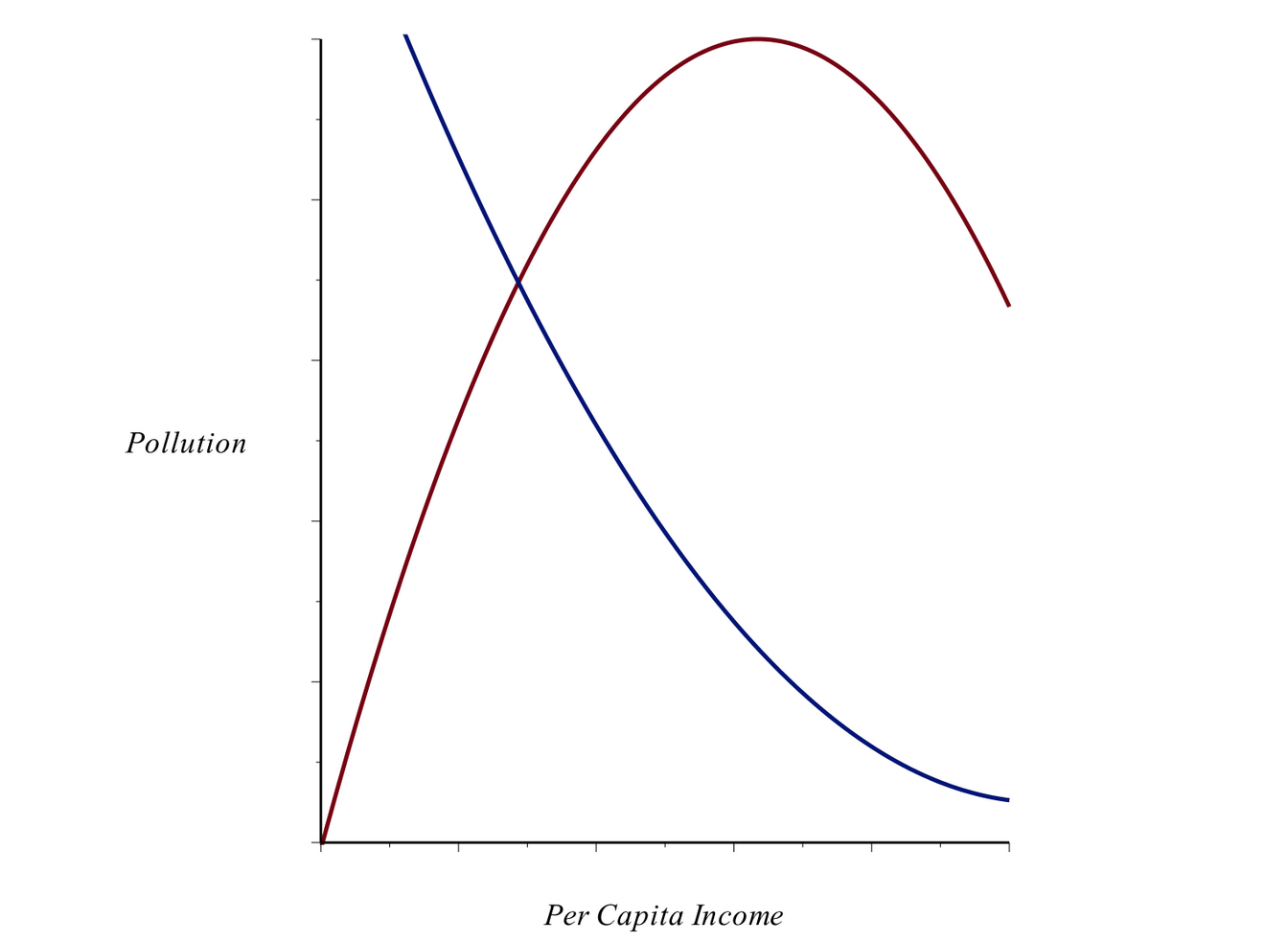
Nevertheless, even if we stipulate that carbon emissions must be reduced, there is an innocuous alternative to government regulatory intrusions and taxes for achieving that end: the enhanced carbon efficiency and technological innovation that economic growth makes possible. One of my favorite bloggers, economist Don Boudreaux, explains the logic of this alternative in this excellent post: “Economic Growth and Pollution Abatement“. He takes a “broad view” of pollution, not simply carbon or other industrial pollutants, because there are many forms of “natural” pollution that inflict greater misery than carbon ever will. With that in mind, Boudreaux appeals to the following relationships between pollution and income (or production):

Pollution Chart

Here is his description of the chart:

“The red curve in the nearby graph is the standard environmental Kuznets curve. This red curve shows the relationship between per-capita income and industrial pollutants. The blue curve shows the relationship between per-capita income and what we might, as a short-hand, call “naturally occurring pollutants” (that is, filth such as bacteria, mud on indoor floors, and rodent and bird droppings from the ceiling of one’s home).“

The red curve implies that a cleaner environment is a “luxury good”. I would also point out that the ascent of the red line at relatively low income levels will be muted by the substitution of cleaner fuels for primitive forms such as dung- and wood-burning, often burned indoors. This is consistent with Boudreaux’s point, though in a way that is not directly addressed by his explanation of the chart:

“… my hypothesis – which I believe is borne out by the historical record – is that people almost immediately start to consume greater cleanliness as they become wealthier.“

The combination of the two lines in the chart shows that economic growth is not unambiguously “bad” for the environment. It has certainly proven to be a good thing in terms of human health and welfare. As a consequence, developing countries should not be so foolish as to sacrifice economic growth for immediate carbon reductions. On the other hand, they may well make “promises” in exchange for massive compensation.

Neither should the world be singularly focused on immediate carbon reductions, because economic growth will be accompanied by improvements in carbon efficiency and the development of technologies far superior to today’s wasteful renewables. The activists attending COP 21 hope to improve the world, but they would saddle humanity with unnecessary burdens. I pity the denizens of countries whose leaders force costly authoritarian energy policies upon them in an effort to set, or comply with, a radical agenda. Oh, wait, that might be us! But I am optimistic that any agreement reached in Paris, if there is any, won’t hold or won’t matter.

Green Hubris: The Flub of Rome

21 Sunday Jun 2015

Posted by Nuetzel in Global Warming

≈ 1 Comment

Tags

Brendan O'Neil, Club of Rome, Fr. Robert Sirico, Free Markets, Green Theology, IPCC, John Hinderaker, Limits to Growth, Matt Ridley, Papal encyclical, Patrick J. Michaels, Politics of Science, Prometheus, Thomas Malthus, Tim Ball

paleo hubris

The Papal Encyclical published last week has generated controversy for venturing into areas about which Pope Francis, and for that matter the Catholic Church, has absolutely no authority or expertise. Pope Francis has noble aims. His compassion for the poor is admirable and even poignant. Nevertheless, the Pope errs in his assessment of scientific, technological and economic issues, and he fails to reference or consider mountains of evidence that contradict the views that dominate this encyclical. It should come as no surprise that he has been swept along by the Leftist orthodoxy, of which he has long been a part.

On one hand, Pope Francis expresses a viewpoint that is almost universally shared: that we are stewards of the natural world and have a moral obligation to treat it well for the benefit of others now and in the future. However, he also believes in the unproven proposition of anthropomorphic global warming (AGW), that human activities are causing global temperatures to rise inexorably. He takes the questionable view that ongoing technological advances will benefit only the rich, leaving the poor behind in increasingly desperate circumstances. And he recklessly questions the morality of free markets and capitalism, asserting that they benefit only the rich and work against the interests of the broader masses.

One of the most interesting pieces of commentary on the Encyclical appeared in The Wall Street Journal, entitled “The Pope’s Green Theology“, written by Fr. Robert Sirico, a Catholic priest. (If the link doesn’t work, Google “wsj Sirico Green Theology”.)

“… capitalism has spurred the greatest reduction in global poverty in world history: The number of people living on $1.25 a day fell to 375 million in 2013 from 811 million in 1991, according to the International Labor Office. This is only one statistic among reams of evidence that vindicate capitalism. An honest debate among experts will lay this canard to rest.

The encyclical unwisely concedes too much to the secular environmental agenda, for example, by denigrating fossil fuels. But it also voices moral statements dismissing popular, ill-conceived positions. The repeated lie that overpopulation is harming the planet—expressed by even some of the advisers for the Vatican—is soundly rejected.“

Much of the evidence on global temperatures contradicts the Pope’s position, yet he sides with the groupthink of the environmental Left based on model predictions that have been consistently wrong over several decades. The models have drastically over-predicted global temperature trends, even before the “pause” in warming that began in the late 1990s.

It is rather early in the game for the Catholic Church to take such an unequivocal position on an issue as far afield from matters of religious faith as climate science. As Dr. Tim Ball notes, the Catholic Church has not always bet well on science, going back to its denunciation of Galileo almost 400 years ago. Apparently, any lessons learned from that episode about the process of scientific inquiry have been forgotten. Matt Ridley has a great (if lengthy) essay on the politics of science and the damage that politicized climate science has done to the cause of real understanding:

“Expertise, authority and leadership should count for nothing in science. The great Thomas Henry Huxley put it this way: ‘The improver of natural knowledge absolutely refuses to acknowledge authority, as such. For him, scepticism is the highest of duties; blind faith the one unpardonable sin.’ Richard Feynman was even pithier: ‘Science is the belief in the ignorance of experts.’”

Climate science is really in its infancy. Recorded history of the climate is in its infancy as well. The scant evidence of global warming during the 20th century is well within the range of natural variation estimated for the past 8,000 years, according to a study by a former lead author for the Intergovernmental Panel On Climate Change (IPCC). For the Pope, or anyone else, to make strong claims about “the science”, or to prescribe draconian limits on individual liberty in an effort to plan “the climate”, is hubris of the first order. That’s ironic given the Pope’s condemnation of what he characterizes as mankind’s Promethean hubris, as if making the world more livable was sinful. The Encyclical condemns technological progress, going so far as to denigrate the use of air conditioning. That attitude is driven by objections to energy use; nevertheless, the Pope reveals a deep mistrust of technology and betrays the soul of a Luddite.

Patrick J. Michaels of CATO’s Center for the Study of Science wrote about the Pope’s climate views and the morality of “dense energy” in April:

“Abundant and dependable energy frees mankind from a menial existence, allowing us to use our given talents for the greater good. The mental capital of the poor in the underdeveloped world is untapped without dense energy. The burning of dung for cooking is a major cause of early death from pulmonary disease. The massive deforestation that must occur without dense energy amplifies floods from ubiquitous tropical downpours.“

Here is a link to some very sarcastic commentary from Brendan O’Neil at Reason on the Pope’s “Dotty Green Theology“. O’Neil mentions the tyrannical fantasies dancing in the minds of some on the environmental Left:

“Christianity’s end-of-worldism is getting a new airing in the apocalypse obsession of greens, who warn of an eco-unfriendly End of Days. Its promise of Godly judgement for our wicked ways has been replaced by greens’ promise that we’ll one day be judged for our planetary destructiveness. A leading British green has fantasised about ‘international criminal tribunals’ for climate-change deniers, who will be ‘partially but directly responsible for millions of deaths.'”

Let’s hope the Pope isn’t on board with that, though he did propose that a worldwide governing body take charge of environmental issues. Please, no favors! John Hinderaker, in the context of the Encyclical, discusses the regressive impact of policies that raise energy prices. That’s consistent with the Pope’s green objectives. Hinderaker cites figures showing that those earning less than $30,000 per year in the U.S. spend 23% of their after-tax income on energy, compared to just 7% for those earning $50,000 or more.

It is extremely late in the game for the Pope to inveigh against capitalism, with all evidence pointing to the long-term success of free markets in lifting the poor from the depths of privation. In fact, the Encyclical is strongly reminiscent of the Malthusian “Limits to Growth” published by the Club of Rome. That “study” contained what has proven to be among the worst collections of prognostications of all time, and the Club persists in purveying doom and gloom to this day.

I have written before on Sacred Cow Chips about Pope Francis’ statist, anti-market inclinations. From that post:

“… it is not just the secular Left that fails to recognize the inherent conflict between big government and religious liberty. Pope Francis himself seems oblivious to the dangerous implications of big government for religious freedom. His apostolic exhortation for greater reliance on the state to care for the poor simultaneously embraces socialism and condemns capitalism. I take no issue in principle with the provision of a social safety net, but the Pope should be more results-oriented in assessing different forms of social organization and their impacts on poverty. Big government typically fails to achieve the kinds of humane objectives usually espoused by the Left. The sad ‘road to serfdom’ has played out too many times in the past.“

Newer posts →
Follow Sacred Cow Chips on WordPress.com

Recent Posts

  • Is “Global Temperature” a Fiction?
  • ESG Contortions: Virtue, Returns, and Politics
  • Grading Trump II, So Far
  • A Warsh Policy Scenario At the Federal Reserve
  • The Coexistence of Labor and AI-Augmented Capital

Archives

  • May 2026
  • April 2026
  • March 2026
  • February 2026
  • January 2026
  • December 2025
  • November 2025
  • October 2025
  • September 2025
  • August 2025
  • July 2025
  • June 2025
  • May 2025
  • April 2025
  • March 2025
  • February 2025
  • January 2025
  • December 2024
  • November 2024
  • October 2024
  • September 2024
  • August 2024
  • July 2024
  • June 2024
  • May 2024
  • April 2024
  • March 2024
  • February 2024
  • January 2024
  • December 2023
  • November 2023
  • August 2023
  • July 2023
  • June 2023
  • May 2023
  • April 2023
  • March 2023
  • February 2023
  • January 2023
  • December 2022
  • November 2022
  • October 2022
  • September 2022
  • August 2022
  • July 2022
  • June 2022
  • May 2022
  • April 2022
  • March 2022
  • February 2022
  • January 2022
  • December 2021
  • November 2021
  • October 2021
  • September 2021
  • August 2021
  • July 2021
  • June 2021
  • May 2021
  • April 2021
  • March 2021
  • February 2021
  • January 2021
  • December 2020
  • November 2020
  • October 2020
  • September 2020
  • August 2020
  • July 2020
  • June 2020
  • May 2020
  • April 2020
  • March 2020
  • February 2020
  • January 2020
  • December 2019
  • November 2019
  • October 2019
  • September 2019
  • August 2019
  • July 2019
  • June 2019
  • May 2019
  • April 2019
  • March 2019
  • February 2019
  • January 2019
  • December 2018
  • November 2018
  • October 2018
  • September 2018
  • August 2018
  • July 2018
  • June 2018
  • May 2018
  • April 2018
  • March 2018
  • February 2018
  • January 2018
  • December 2017
  • November 2017
  • October 2017
  • September 2017
  • August 2017
  • July 2017
  • June 2017
  • May 2017
  • April 2017
  • March 2017
  • February 2017
  • January 2017
  • December 2016
  • November 2016
  • October 2016
  • September 2016
  • August 2016
  • July 2016
  • June 2016
  • May 2016
  • April 2016
  • March 2016
  • February 2016
  • January 2016
  • December 2015
  • November 2015
  • October 2015
  • September 2015
  • August 2015
  • July 2015
  • June 2015
  • May 2015
  • April 2015
  • March 2015
  • February 2015
  • January 2015
  • December 2014
  • November 2014
  • October 2014
  • September 2014
  • August 2014
  • July 2014
  • June 2014
  • May 2014
  • April 2014
  • March 2014

Blogs I Follow

  • Passive Income Kickstart
  • OnlyFinance.net
  • TLC Cholesterol
  • Nintil
  • kendunning.net
  • DCWhispers.com
  • Hoong-Wai in the UK
  • Marginal REVOLUTION
  • Stlouis
  • Watts Up With That?
  • American Elephants
  • The View from Alexandria
  • The Gymnasium
  • A Force for Good
  • Notes On Liberty
  • troymo
  • SUNDAY BLOG Stephanie Sievers
  • Miss Lou Acquiring Lore
  • Your Well Wisher Program
  • Objectivism In Depth
  • RobotEnomics
  • Orderstatistic
  • Paradigm Library
  • Scattered Showers and Quicksand
  • Jam Review

Blog at WordPress.com.

Passive Income Kickstart

OnlyFinance.net

TLC Cholesterol

Nintil

To estimate, compare, distinguish, discuss, and trace to its principal sources everything

kendunning.net

The Future is Ours to Create

DCWhispers.com

Hoong-Wai in the UK

A Commonwealth immigrant's perspective on the UK's public arena.

Marginal REVOLUTION

Small Steps Toward A Much Better World

Stlouis

Watts Up With That?

The world's most viewed site on global warming and climate change

American Elephants

Defending Life, Liberty and the Pursuit of Happiness

The View from Alexandria

In advanced civilizations the period loosely called Alexandrian is usually associated with flexible morals, perfunctory religion, populist standards and cosmopolitan tastes, feminism, exotic cults, and the rapid turnover of high and low fads---in short, a falling away (which is all that decadence means) from the strictness of traditional rules, embodied in character and inforced from within. -- Jacques Barzun

The Gymnasium

A place for reason, politics, economics, and faith steeped in the classical liberal tradition

A Force for Good

How economics, morality, and markets combine

Notes On Liberty

Spontaneous thoughts on a humble creed

troymo

SUNDAY BLOG Stephanie Sievers

Escaping the everyday life with photographs from my travels

Miss Lou Acquiring Lore

Gallery of Life...

Your Well Wisher Program

Attempt to solve commonly known problems…

Objectivism In Depth

Exploring Ayn Rand's revolutionary philosophy.

RobotEnomics

(A)n (I)ntelligent Future

Orderstatistic

Economics, chess and anything else on my mind.

Paradigm Library

OODA Looping

Scattered Showers and Quicksand

Musings on science, investing, finance, economics, politics, and probably fly fishing.

Jam Review

"If you get confused, listen to the music play."

  • Subscribe Subscribed
    • Sacred Cow Chips
    • Join 128 other subscribers
    • Already have a WordPress.com account? Log in now.
    • Sacred Cow Chips
    • Subscribe Subscribed
    • Sign up
    • Log in
    • Report this content
    • View site in Reader
    • Manage subscriptions
    • Collapse this bar

Loading Comments...