• About

Sacred Cow Chips

Sacred Cow Chips

Tag Archives: Manhattan Institute

Immigration and Merit As Fiscal Propositions

10 Wednesday Dec 2025

Posted by Nuetzel in Fiscal Impact, Immigration

≈ Leave a comment

Tags

Assimilation, Birthright Citizenship, Criminal Records, Daniel Di Martino, Denmark Immigration, Deportation, entitlements, Fiscal Contribution, Garret Jones, Illegal Aliens, Immigration, Improper Entry, Jesús Fernández-Villaverde, Manhattan Institute, Merit-Based Immigration, National Academy of Sciences, Remigration, Robby Soave, Security Risks, Welfare State

Immigration into the U.S. can be a powerful force for economic growth. This takes on special importance given low fertility rates in the U.S. and the effective insolvency of our entitlement systems (with dim prospects for reform). But whether a given flow of immigrants will mitigate the negative growth and fiscal effects of unfavorable demographic trends is a conclusion requiring some qualification.

This certainly isn’t a case of “the more, the merrier”. Sharp tradeoffs bear on whether and how immigration can be a part of the solution to our demographic and fiscal woes.

Fiscal Contribution

University of Pennsylvania economist Jesús Fernández-Villaverde asserts that a high volume of immigrants will not solve our fiscal challenges. His reasoning is straightforward: immigrants are concentrated in the lower part of the income distribution, and therefore relatively few provide a surplus contribution to the nation’s fiscal balance. In fact, our large fiscal imbalance is driven by the country’s generous welfare state. With near-open borders, it serves as a magnet for low-income migrants. Thus, a broadly lenient immigration policy will not solve fiscal issues caused by low birth rates. However, Fernandez-Villaverde offers no direct empirical evidence except to say that data from some European countries support his claim.

Daniel Di Martino of the Manhattan Institute recently published a detailed analysis of the fiscal effects of immigration, including the fiscal contributions of both immigrants and two subsequent generations of offspring. He provided an excellent summary in a later tweet:

“… when it comes to immigration, the main question isn’t how many immigrants but which immigrants.”

In particular, highly-educated immigrants engender a surplus fiscal contribution. All else equal, so do immigrants less than 40 years of age. Low-skill immigrants are likely to produce a fiscal deficit, however. Legal immigrants tend to have a positive fiscal effect, while illegal immigrants tend to add to deficits.

This 2017 report from the National Academies of Sciences found similarly mixed results on the fiscal impact of immigrants. Education and age were again important determinants.

Country of Origin

Garret Jones argues that place of origin is a vital indicator of fiscal contribution. Here is a chart he posted at the link (from The Economist):

The chart pertains to immigration into Denmark, so like Jesús Fernández-Villaverde, we’re relying on European data. However, I suspect this generalizes to most other western countries. Of course, the plots above represent averages; individuals from any of the categories shown in the chart might differ substantially. Nevertheless, the average non-western immigrant into Denmark makes a weak or negative fiscal contribution relative to immigrants of western origin. The contrast is especially sharp for immigrants from the category that includes the Middle East, North Africa, Pakistan, and Turkey.

There are a variety of explanations for these disparate results. Westerners emigrating to Denmark probably have a strong advantage in terms of common languages and communication. Average skill levels are probably higher for westerners as well. Cultural differences almost surely make assimilation into society and the workplace more difficult for non-westerners.

A strict ban or quota on immigration from certain countries is probably unwise, however. Given our growth and fiscal objectives, we should seek to attract talented individuals from all over, and humanitarian imperatives suggest acceptance of legitimate refugees from political, religious, racial, or ethnic persecution. That might well mean a greater annual number of legal immigrants into the U.S. But if the question is whether it’s fiscally sound to encourage broad inflows of non-western immigrants, the answer is mostly no.

Vetting

It should go without saying that all potential immigrants must be vetted, and the intensity of the process could be made a function of an individual’s place of origin. Military-age males from hostile countries should receive particular scrutiny so that we can mitigate risks like those described here.

It’s reasonable to demand that those entering the country meet some subset of possible qualifications, some of which might override other criteria. For example, highly productive workers make wonderful immigrants, contribute to economic growth, make a greater fiscal contribution, and are more likely to assimilate successfully. Those are key rationales for a merit-based immigration system. But an overriding consideration might apply to individuals or families fleeing their homeland due to persecution, who have legitimate claims to refugee status regardless of economic potential. It’s also reasonable to extend favorable treatment to individuals having close family members already in the U.S., barring any red flags.

A related concern is birthright citizenship, which is a constitutional right. As long as immigrants clear reasonable hurdles for legal entry, birthright citizenship should stand going forward. The Supreme Court is likely to rule against the Trump Administration’s challenge to birthright citizenship, and it should, though the vast number of illegals who entered the U.S. under Biden certainly creates a birthright burden for U.S. taxpayers. It also sometimes complicates efforts to deport individuals who never should have been allowed to enter.

Merit

Rigid immigration quotas don’t make economic sense. It’s desirable to allow flexibility as labor market conditions evolve. Those capable of work might be ranked by education or skill, and in turn assigned priority based on the strength of domestic opportunities in their areas of experience or expertise. This can accommodate unskilled workers when they are in heavy demand. But merit and labor-market pressures aside, please don’t adopt preferences like the last two sentences shown here (from the White House’s latest national security strategy document).
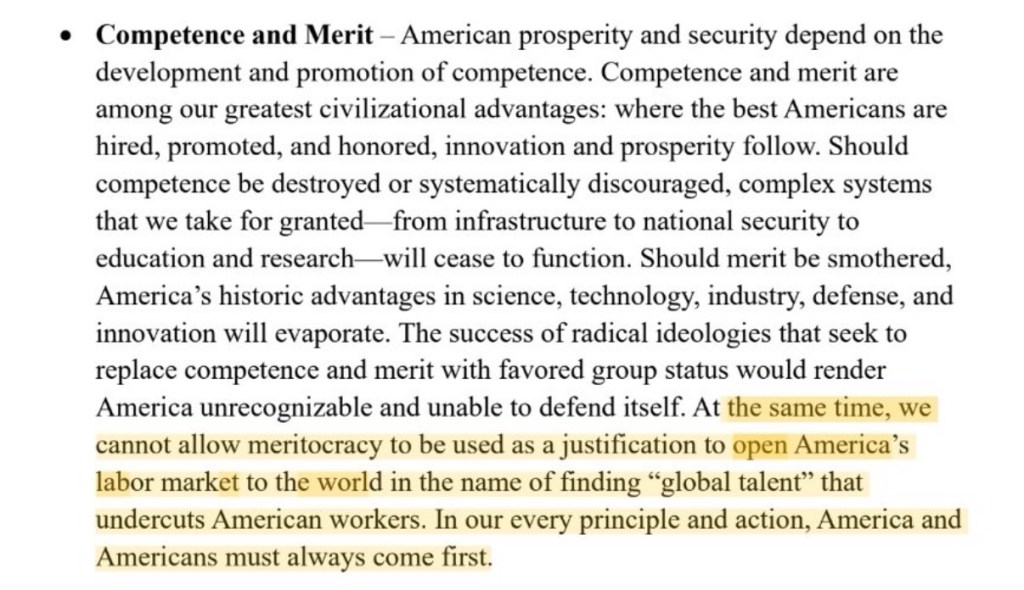
Legal immigration should not be handled as a residual. Employers will often find that an immigrant is more qualified for a certain job. They should be free to hire that individual assuming the immigrant is vetted. As Robby Soave notes at the tweet linked above, the White House position is economically equivalent to hiring on the basis of DEI preferences.

Needless to say, almost any formula or decision tree can be manipulated unless it is spelled out in detail by law. However, that too might subvert economic and fiscal objectives by imparting too much rigidity to the system.

Crimes and Misdemeanors

Notwithstanding protestations from many economists I admire, who make endless assertions that illegal immigrants have lower crime rates than the domestic population, those arguments are beside the point. There seems little justification for allowing anyone having a record of serious crime to enter the country. It is hard to imagine many circumstances under which exceptions should be considered. Yet we have managed to allow large numbers of proven criminals to enter the U.S. (similar numbers reported here). It goes without saying that we cannot properly vet potential immigrants unless they go through the proper legal process for entering the country. For example, this is what happened in Europe as countries allowed unchecked inflows of migrants (and continue to do so).

Illegal immigrants are obviously in violation of immigration laws, which cannot simply be rewarded. Rather than the traditional fines or jail time for improper entry, so-called “remigration” is an increasingly popular solution. Voluntary deportation is one possibility; should the immigrant refuse, there must be a greater price to pay for the violation of law. Involuntary deportation is more controversial but might be warranted if the alternative is state dependency. Other possibilities include private sponsorship with a price tag high enough to pay what would otherwise become an obligation imposed on taxpayers. Factors that could weigh in favor of an illegal immigrant would be employability, a commitment to learn the English language, and a course of study toward meeting the requirements for citizenship.

Summary

An open borders policy is idealized by some libertarians, but it has severe drawbacks. Among those are potential compromises in national security and a blind eye to the ingress of dangerous criminals. Furthermore, many potential immigrants contribute to fiscal deficits due to their reliance on the welfare state and the generous entitlements available to many U.S. residents. A well-designed immigration system would screen for merit across a number of dimensions, with responsiveness to labor market conditions.


Single-Payer: Queue Up and Die Already

19 Sunday Jan 2020

Posted by Nuetzel in Health Care, Health Insurance

≈ 1 Comment

Tags

Australia, Bernie Sanders, Canada, Catastrophic Coverage, Chris Pope, Competitive Payer, Dual Payer, Employer-Paid Coverage, France, Germany, Individual Mandate, Manhattan Institute, Medicaid, Medicare, Netherlands, Out-of-Pocket Costs, Portability, Premium Deductibility, Segmented Payer, Single-Payer, Switzerland, third-party payments, Uncompensated care, United Kingdom, Universal Coverage

I constantly hear this sort of naive remark about health care in “other major countries”, and while Chris Pope’s rejoinder below should chasten the ignorant, they won’t listen (emphasis is mine):

“[Bernie] Sanders recently argued that ‘our idea is to do what every other major country on earth is doing,’ but this claim is … fictitious. In fact, there is not a single country in the world that offers comprehensive coverage with an unlimited choice of providers, fully paid for by taxpayers, without insurer gatekeeping, service rationing, or out-of-pocket payments. In reality, there is a direct trade-off between ease of access to providers and the cost borne by individuals in out-of-pocket expenses.”

Pope’s statement pretty much strips bare the fiction of “universal” coverage, a concept too loosely defined to be of any real use except as a rhetorical device. It also highlights the non-monetary costs inflicted on consumers by non-price rationing of care. The presumption that government must provide universal health care coverage and that all other developed countries actually have that arrangement is incorrect.

Pope has another article at the Manhattan Institute site, written late last year, on the lessons we can learn on health care from experience abroad under various payer systems. This offers a more detailed comparison of the structure of the U.S. payment system versus seven other countries, including Canada, the U.K., Australia, and Germany. Single-payer tends to be the “gold standard” for the Left, but the only systems that “approximate” single-payer are in Canada and the U.K. Here is one blurb about Canada:

“Canadians have easy access to general practitioners, but getting an appointment to see a specialist is more difficult than in all the other nations studied in this report. The Canadian medical system provides the least hospital care, delivers consistently fewer outpatient procedures, and provides much less access to modern diagnostic technology.

Canadians also have limited access to drugs, according to Pope. And out-of-pocket (OOP) spending is about the same as in the U.S. At the first link above, Pope says:

“Canadians spend less on health care than Americans mostly because they are not allowed to use as much — not because they are getting a better deal. … Waiting lists are generally seen as the single-payer budgeter’s friend, as some patients will return to health by themselves, others will be discouraged from seeking treatment, and a large proportion of the most expensive cases will die before any money is due to be spent on them.”

Pope says this about the U.K. at the second link:

“U.K. hospitals often lack cutting-edge technology, and mortality after major emergency hospitalizations compares poorly with that of other nations in this report. Access to specialists is very limited, and the system falls well short of most other nations in the delivery of outpatient surgery.” 

Waiting times in the U.K. tend to be long, but in exchange for all these shortcomings in care, at least OOP costs are low. Relative to other payment systems, single payer seems to be the worst in several respects.

The other systems described by Pope are:

  • “dual payer” in Australia and France, with public entitlements and the choice of some private or supplemental coverage;
  • “competing payer” in Switzerland, Germany, and the Netherlands, whereby subsidies can be used to purchase coverage from private plans (and in Germany some “quasi-public” plans; and
  • “segmented payer” in the U.S., with two public plans for different segments of the population (Medicare for the elderly and Medicaid for the non-elderly poor), employer-sponsored coverage primarily from larger employers, individually-purchased private coverage, and subsidies to providers for “uncompensated care” for the uninsured.

Here is what Pope says about the various “multi-payer” systems:

“Dual-payer and competitive-payer systems blend into each other, according to the extent of the public entitlement in dual-payer countries …

… limitations in access to care are closely tied to the share of the population enrolled in private insurance—with those in Britain and Canada greatly limited, Australians facing moderate restrictions, and those in the other countries studied being more able to get care when they need it. 

The competing-payer model ideally gives insurers the freedom and responsibility to procure health-care services in a way that attracts people to their plans by offering them the best benefits and the lowest medical costs. While all competing-payer systems fall short of this ideal, in practice they consistently offer good access to high-quality medical care with good insurance protection. The competing-payer model is, therefore, best understood as an objective that is sought rather than yet realized—and countries including Germany, the Netherlands, France, and the U.S., which have experienced the most significant health-care reform over recent years, are each moving toward it.”

The U.S. has very high health care costs as a percent of GDP, but OOP costs are roughly in line with the others (except the Swiss, who face very high OOP costs). The U.S. is wealthier than the other countries reviewed by Pope, so a large part of the cost gap can be attributed to demand for health care as a luxury good, especially late in life. Insured U.S. consumers certainly have access to unrivaled technology and high-quality care with minimal delays.

Several countries, including the U.S., are plagued by a lack of competition among hospitals and other providers. Government regulations, hospital subsidies, and pricing rules are at the root of this problem. Third-party payments separate consumers from the pricing consequences of their health-care decisions, which tends to drive up costs. If that weren’t enough, the tax deductibility of employer-paid insurance premiums in the U.S. is an subsidy ironically granted to those best-able to afford coverage, which ultimately heightens demand and inflates prices.

Notably, unlike other countries, there is no longer an individual mandate in the U.S. or any penalty for being uninsured, other than the potential difficulty in qualifying for coverage with pre-existing conditions. Consumers who lack employer-sponsored or individual coverage, but have incomes too high to qualify for Medicaid or premium subsidies, fall into a gap that has been the bane of would-be reformers. There are a few options for an immediate solution: 1) force them to get insured with another go at an individual mandate; 2) offer public subsidies to a broader class; 3) let them rely on emergency-room services (which cannot turn them away) or other forms of uncompensated care; 4) allow them to purchase cheap temporary and/or catastrophic coverage at their own expense; 5) allow portability of coverage for job losers. Recently, the path of least political resistance seems to have been a combination of 3, 4, and 5. But again, the deficient option preferred by many on the Left: single-payer. Again, from Pope:

“Single-payer systems share the common feature of limiting access to care according to what can be raised in taxes. Government revenues consistently lag the growth in demand for medical services resulting from increased affluence, longevity, and technological capacity. As a result, single-payer systems deliver consistently lower quality and access to high-cost specialty care or surgical procedures without reducing overall out-of-pocket costs. Across the countries in this paper, limitations in access to care are closely tied to the share of the population enrolled in private insurance—with those in Britain and Canada greatly limited…”

Climate Negotiators To Discuss Economic Cannibalism

18 Wednesday Nov 2015

Posted by Nuetzel in Global Warming

≈ 1 Comment

Tags

AGW, Anthropomorphic Global Warming, Bjorn Lomborg, Carbon Emissions, Climate Change, COP 21, Don Boudreaux, economic growth, Foundation For a Positive Planet, Global Carbon Budget, Industrial Pollution, IPCC, Kuznets Curve, Manhattan Institute, Natural Pollution, Oren Cass

globalwarming_vodka_500

There is virtually zero chance that the coming round of international talks on climate change will produce a substantive agreement. The United Nations’ 21st Conference of the Parties (COP 21) on Climate Change is scheduled will be held in Paris, France from November 30 to December 11. The failure of earlier conferences to produce a meaningful pact informs us of the low odds of success: this conference, like the others, will be unproductive in any real sense. As in the past, there are severely conflicting objectives among the parties. Oren Cass explains the reasons in a recent report from the Manhattan Institute, “Leading Nowhere: The Futility and Farce of Global Climate Negotiations“:

“… there is no plausible path to an agreement premised on collective action or compensation: developing nations that must bear the brunt of emissions reductions in any successful scenario cannot achieve those reductions while pursuing rapid economic growth; developed nations cannot sufficiently compensate developing ones for forgoing such growth. Evidence from recent negotiations, as well as preparations for the next round of talks, reinforces this conclusion. … [A] third path to an agreement—coercion—has received little attention. No group of nations appears prepared to employ the approach and risk subsequent conflict.“

Even the President of the Foundation For a Positive Planet asks, “What Purpose Does COP 21 Still Serve?”

It’s worth emphasizing that the the developing world will account for 79% of the world’s cumulative carbon emissions by 2100 under a moderate growth scenario developed by the Intergovernmental Panel on Climate Change (IPCC). Cass points out that even if the world’s developed countries ceased all carbon emissions immediately, developing countries would face an impossible task in cutting emissions sufficiently to stay within the IPCC’s estimated “safe carbon budget” for the globe. The best that can be said is that the IPCC might be trying to set the bar high for negotiators, although that would make claims of success at COP 21 difficult. Perhaps that’s fine for activists, because they’ll have an ongoing “crisis” to meet their insatiable need for doomsaying.

Relatively impoverished developing countries will not wish to sacrifice their own economic growth at the altar of climate worship without compensation. In fact, redistribution might be a better description than compensation, which just might be the real point of the conference for many developing countries. Promises of carbon reductions are not guarantees in any case. Future compensation to the developing world, if any, should be contingent on actual results. But no matter the outcome of the negotiations, the importance of cheap words will be exaggerated.

The magnitude of any negotiated reductions in carbon emissions will be inadequate to put much of a dent in actual, climate outcomes, but they will be costly. Writing in the Wall Street Journal, Bjorn Lomborg describes estimates of lost global output due to proposed carbon cutbacks of $1 – $2 trillion each year by 2030 and beyond. That’s roughly 1% – 2% of projected real GDP. of course, there is considerable uncertainty around those estimates and even more around the magnitude of the possible climate effects. Lomborg estimates a best-case outcome amounting to a reduction in global temperatures of a fraction of a degree Fahrenheit. That difference could easily be swamped by natural climate effects. Worth it?

Indeed, imposed limits on economic growth will compound the difficulty of improving carbon efficiency and would consign third-world populations to an impoverished existence in both economic and environmental terms.

President Obama has promised significant carbon reduction in the U.S. However, the COP 21 negotiations do not fall under the “fast-track” authority that Obama was granted by Congress last May over trade agreements. Instead, the hoped-for climate agreement has been characterized as an update to a 1992 treaty to avoid a Congressional ratification process. In addition, Obama has already issued executive orders to push forward the climate measures he has promised to other parties to COP 21. So much for the separation of powers. However, a number of states are not taking it lying down. In fact, 24 states and others have filed suit against the new regulations, asking the D.C. Circuit Court to stay the regulatory plan while the case moves through the courts.

Anthropomorphic global warming (AGW) has been a preoccupation of the alarmist left since the late 20th century, when surface temperatures trended upward for a few decades. Climate change (10 posts at this link), on the other hand, is and always has been a fact of life, but the satellite temperature record has been trendless since the mid 1990s, while the alarmist climate models have predicted significant warming. Beyond the predictions themselves, there is little to suggest that some warming would constitute a disaster for mankind, and perhaps it would be a boon.

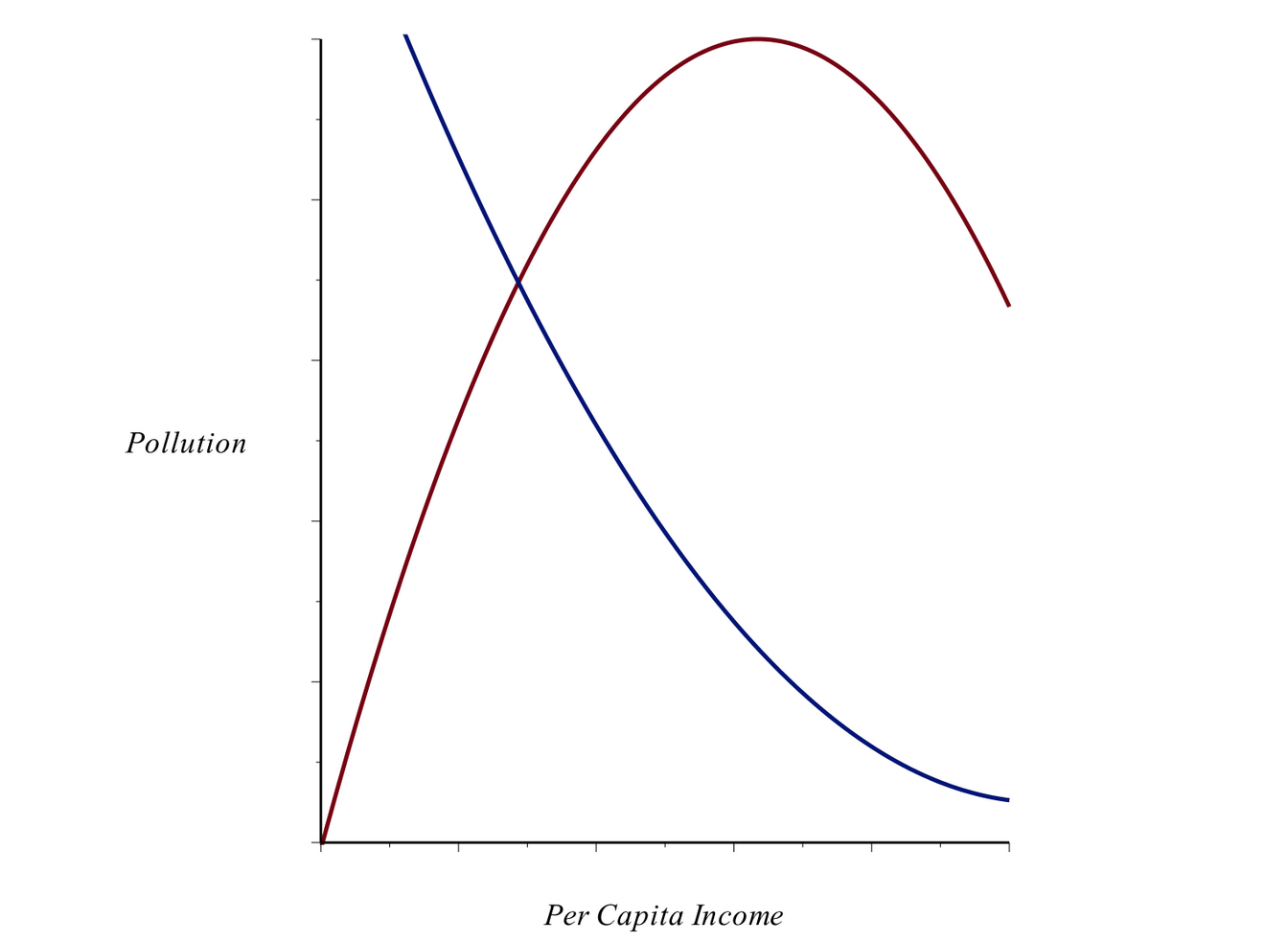
Nevertheless, even if we stipulate that carbon emissions must be reduced, there is an innocuous alternative to government regulatory intrusions and taxes for achieving that end: the enhanced carbon efficiency and technological innovation that economic growth makes possible. One of my favorite bloggers, economist Don Boudreaux, explains the logic of this alternative in this excellent post: “Economic Growth and Pollution Abatement“. He takes a “broad view” of pollution, not simply carbon or other industrial pollutants, because there are many forms of “natural” pollution that inflict greater misery than carbon ever will. With that in mind, Boudreaux appeals to the following relationships between pollution and income (or production):

Pollution Chart

Here is his description of the chart:

“The red curve in the nearby graph is the standard environmental Kuznets curve. This red curve shows the relationship between per-capita income and industrial pollutants. The blue curve shows the relationship between per-capita income and what we might, as a short-hand, call “naturally occurring pollutants” (that is, filth such as bacteria, mud on indoor floors, and rodent and bird droppings from the ceiling of one’s home).“

The red curve implies that a cleaner environment is a “luxury good”. I would also point out that the ascent of the red line at relatively low income levels will be muted by the substitution of cleaner fuels for primitive forms such as dung- and wood-burning, often burned indoors. This is consistent with Boudreaux’s point, though in a way that is not directly addressed by his explanation of the chart:

“… my hypothesis – which I believe is borne out by the historical record – is that people almost immediately start to consume greater cleanliness as they become wealthier.“

The combination of the two lines in the chart shows that economic growth is not unambiguously “bad” for the environment. It has certainly proven to be a good thing in terms of human health and welfare. As a consequence, developing countries should not be so foolish as to sacrifice economic growth for immediate carbon reductions. On the other hand, they may well make “promises” in exchange for massive compensation.

Neither should the world be singularly focused on immediate carbon reductions, because economic growth will be accompanied by improvements in carbon efficiency and the development of technologies far superior to today’s wasteful renewables. The activists attending COP 21 hope to improve the world, but they would saddle humanity with unnecessary burdens. I pity the denizens of countries whose leaders force costly authoritarian energy policies upon them in an effort to set, or comply with, a radical agenda. Oh, wait, that might be us! But I am optimistic that any agreement reached in Paris, if there is any, won’t hold or won’t matter.

Follow Sacred Cow Chips on WordPress.com

Recent Posts

  • Immigration and Merit As Fiscal Propositions
  • Tariff “Dividend” From An Indigent State
  • Almost Looks Like the Fed Has a 3% Inflation Target
  • Government Malpractice Breeds Health Care Havoc
  • A Tax On Imports Takes a Toll on Exports

Archives

  • December 2025
  • November 2025
  • October 2025
  • September 2025
  • August 2025
  • July 2025
  • June 2025
  • May 2025
  • April 2025
  • March 2025
  • February 2025
  • January 2025
  • December 2024
  • November 2024
  • October 2024
  • September 2024
  • August 2024
  • July 2024
  • June 2024
  • May 2024
  • April 2024
  • March 2024
  • February 2024
  • January 2024
  • December 2023
  • November 2023
  • August 2023
  • July 2023
  • June 2023
  • May 2023
  • April 2023
  • March 2023
  • February 2023
  • January 2023
  • December 2022
  • November 2022
  • October 2022
  • September 2022
  • August 2022
  • July 2022
  • June 2022
  • May 2022
  • April 2022
  • March 2022
  • February 2022
  • January 2022
  • December 2021
  • November 2021
  • October 2021
  • September 2021
  • August 2021
  • July 2021
  • June 2021
  • May 2021
  • April 2021
  • March 2021
  • February 2021
  • January 2021
  • December 2020
  • November 2020
  • October 2020
  • September 2020
  • August 2020
  • July 2020
  • June 2020
  • May 2020
  • April 2020
  • March 2020
  • February 2020
  • January 2020
  • December 2019
  • November 2019
  • October 2019
  • September 2019
  • August 2019
  • July 2019
  • June 2019
  • May 2019
  • April 2019
  • March 2019
  • February 2019
  • January 2019
  • December 2018
  • November 2018
  • October 2018
  • September 2018
  • August 2018
  • July 2018
  • June 2018
  • May 2018
  • April 2018
  • March 2018
  • February 2018
  • January 2018
  • December 2017
  • November 2017
  • October 2017
  • September 2017
  • August 2017
  • July 2017
  • June 2017
  • May 2017
  • April 2017
  • March 2017
  • February 2017
  • January 2017
  • December 2016
  • November 2016
  • October 2016
  • September 2016
  • August 2016
  • July 2016
  • June 2016
  • May 2016
  • April 2016
  • March 2016
  • February 2016
  • January 2016
  • December 2015
  • November 2015
  • October 2015
  • September 2015
  • August 2015
  • July 2015
  • June 2015
  • May 2015
  • April 2015
  • March 2015
  • February 2015
  • January 2015
  • December 2014
  • November 2014
  • October 2014
  • September 2014
  • August 2014
  • July 2014
  • June 2014
  • May 2014
  • April 2014
  • March 2014

Blogs I Follow

  • Passive Income Kickstart
  • OnlyFinance.net
  • TLC Cholesterol
  • Nintil
  • kendunning.net
  • DCWhispers.com
  • Hoong-Wai in the UK
  • Marginal REVOLUTION
  • Stlouis
  • Watts Up With That?
  • Aussie Nationalist Blog
  • American Elephants
  • The View from Alexandria
  • The Gymnasium
  • A Force for Good
  • Notes On Liberty
  • troymo
  • SUNDAY BLOG Stephanie Sievers
  • Miss Lou Acquiring Lore
  • Your Well Wisher Program
  • Objectivism In Depth
  • RobotEnomics
  • Orderstatistic
  • Paradigm Library
  • Scattered Showers and Quicksand

Blog at WordPress.com.

Passive Income Kickstart

OnlyFinance.net

TLC Cholesterol

Nintil

To estimate, compare, distinguish, discuss, and trace to its principal sources everything

kendunning.net

The Future is Ours to Create

DCWhispers.com

Hoong-Wai in the UK

A Commonwealth immigrant's perspective on the UK's public arena.

Marginal REVOLUTION

Small Steps Toward A Much Better World

Stlouis

Watts Up With That?

The world's most viewed site on global warming and climate change

Aussie Nationalist Blog

Commentary from a Paleoconservative and Nationalist perspective

American Elephants

Defending Life, Liberty and the Pursuit of Happiness

The View from Alexandria

In advanced civilizations the period loosely called Alexandrian is usually associated with flexible morals, perfunctory religion, populist standards and cosmopolitan tastes, feminism, exotic cults, and the rapid turnover of high and low fads---in short, a falling away (which is all that decadence means) from the strictness of traditional rules, embodied in character and inforced from within. -- Jacques Barzun

The Gymnasium

A place for reason, politics, economics, and faith steeped in the classical liberal tradition

A Force for Good

How economics, morality, and markets combine

Notes On Liberty

Spontaneous thoughts on a humble creed

troymo

SUNDAY BLOG Stephanie Sievers

Escaping the everyday life with photographs from my travels

Miss Lou Acquiring Lore

Gallery of Life...

Your Well Wisher Program

Attempt to solve commonly known problems…

Objectivism In Depth

Exploring Ayn Rand's revolutionary philosophy.

RobotEnomics

(A)n (I)ntelligent Future

Orderstatistic

Economics, chess and anything else on my mind.

Paradigm Library

OODA Looping

Scattered Showers and Quicksand

Musings on science, investing, finance, economics, politics, and probably fly fishing.

  • Subscribe Subscribed
    • Sacred Cow Chips
    • Join 128 other subscribers
    • Already have a WordPress.com account? Log in now.
    • Sacred Cow Chips
    • Subscribe Subscribed
    • Sign up
    • Log in
    • Report this content
    • View site in Reader
    • Manage subscriptions
    • Collapse this bar
 

Loading Comments...