• About

Sacred Cow Chips

Sacred Cow Chips

Tag Archives: Power Outages

Wind, Solar, and the Five Circles of Dormant Capital

22 Monday Apr 2024

Posted by Nuetzel in Energy, Global Warming, Industrial Policy

≈ 1 Comment

Tags

Backup Power, Battery Technology, Capacity Factors, Center of the American Experiment, Climate Change, Dante’s Inferno, Dispatchable Power, Dormant Capital, Fossil Furls, Green Energy, Imposed Costs, Industrial Planning, Isaac Orr, Mackinac Center for Public Policy, Malinvestment, Mitch Rolling, Power Outages, Power Tramsmission, Solar Energy, Space Based Solar Power, Subsidies, Wind Energy

This is a first for me…. The following is partly excerpted from a post of two weeks ago, but I’ve made a number of edits and additions. The original post was way too long. This is a bit shorter, and I hope it distills a key message.

~~~~~~~~~~~~~~~~~~~~~~~~~~~~~~~~~~~~~

Failures of industrial policies are nothing new, but the current manipulation of electric power generation by government in favor of renewable energy technologies is egregious. These interventions are a reaction to an overwrought climate crisis narrative, but they have many shortcomings and risks of their own. Chief among them is whether the power grid will be capable of meeting current and future demand for power while relying heavily on variable resources, namely wind and sunshine. The variability implies idle and drastically underutilized hours every day without any ability to call upon the assets to produce when needed.

The variability is vividly illustrated by the chart above showing a representative daily profile of power demand versus wind and solar output. Below, with apologies to Dante, I describe the energy hellscape into which we’re being driven on the horns of irrational capital outlays. These projects would be flatly rejected by any rational investor but for the massive subsidies afforded by government.

The First Circle of Dormancy: Low Utilization

Wind and solar power assets have relatively low rates of utilization due to the intermittency of wind and sunshine. Capacity factors for wind turbines averaged almost 36% in the U.S. in 2022, while solar facilities averaged only about 24%. This compared with nuclear power at almost 93%, natural gas (66%), and coal (48%).

Despite their low rates of utilization, new wind and solar facilities are always touted at their full nameplate capacity. We hear a great deal about “additions to capacity”, which overstate the actual power-generating potential by factors of three to four times. More importantly, this also means wind and solar power costs per unit of output are often vastly understated. These assets contribute less economic value to the electric grid than more heavily utilized generating assets.

Sometimes wind and solar facilities are completely idle or dormant. Sometimes they operate at just a fraction of capacity. I will use the terms “idle” and dormant” euphemistically in what follows to mean assets operating not just at low levels of utilization, but for those prone to low utilization and also falling within the Second Circle of Dormancy.

The Second Circle of Dormancy: Non-Dispatchability

The First Circle of Dormancy might be more like a Purgatory than a Hell. That’s because relatively low average utilization of an asset could be justifiable if demand is subject to large fluctuations. This is the often case, as with assets like roads, bridges, restaurants, amusement parks, and many others. However, capital invested in wind and solar facilities is idle on an uncontrollable basis, which is more truly condemnable. Wind and solar do not provide “dispatchable” power, meaning they are not “on call” in any sense during idle or less productive periods. Not only is their power output uncontrollable, it is not entirely predictable.

Again, variable but controllable utilization allows flexibility and risk mitigation in many applications. But when utilization levels are uncontrollable, the capital in question has greatly diminished value to the power grid and to power customers relative to dispatchable sources having equivalent capacity and utilization. It’s no wonder that low utilization, variability, and non-dispatchability are underemphasized or omitted by promoters of wind and solar energy. This sort of uncontrollable down-time is a drain on real economic returns to capital.

The Third Circle of Dormancy: Transmission Infrastructure

The idleness that besets the real economic returns to wind and solar power generation extends to the transmission facilities necessary for getting power to the grid. Transmission facilities are costly, but that cost is magnified by the broad spatial distribution of wind and solar generating units. Transmission from offshore facilities is particularly complex. When wind turbines and solar panels are dormant, so are the transmission facilities needed to reach them. Thus, low utilization and the non-dispatchability of those units diminishes the value of the capital that must be committed for both power generation and its transmission.

The Fourth Circle of Dormancy: Backup Power Assets

The reliability of the grid requires that any commitment to variable wind and solar power must also include a commitment to back-up capacity. As another example, consider shipping concerns that are now experimenting with sails on cargo ships. What is the economic value of such a ship without back-up power? Can you imagine these vessels drifting in the equatorial calms for days on end? Even light winds would slow the transport of goods significantly. Idle, non–dispatchable capital, is unproductive capital.

Likewise, solar-powered signage can underperform or fail over the course of several dark, wintry days, even with battery backup. The signage is more reliable and valuable when it is backed-up by another power source. But again, idle, non-dispatchable capital is unproductive capital.

The needed provision of backup power sources represents an imposed cost of wind and solar, which is built into the cost estimates shown in a section below. But here’s another case of dormancy: some part of the capital commitment, either primary energy sources or the needed backups, will be idle regardless of wind and solar conditions… all the time. Of course, back-up power facilities should be dispatchable because they must serve an insurance function. Backup power therefore has value in preserving the stability of the grid even while completely idle. However, at best that value offsets a small part of the social loss inherent in primary reliance on variable and non-dispatchable power sources.

We can’t wholly “replace” dispatchable generating capacity with renewables without serious negative consequences. At the same time, maintaining existing dispatchable power sources as backup carries a considerable cost at the margin for wind and solar. At a minimum, it requires normal maintenance on dispatchable generators, periodic replacement of components, and an inventory of fuel. If renewables are intended to meet growth in power demand, the imposed cost is far greater because backup sources for growth would require investment in new dispatchable capacity.

The Fifth Circle of Dormancy: Outages

The pursuit of net-zero carbon emissions via wind and solar power creates uncontrollably dormant capital, which increasingly lacks adequate backup power. Providing that backup should be a priority, but it’s not.

Perhaps much worse than the cost of providing backup power sources is the risk and imposed cost of grid instability in their absence. That cost would be borne by users in the form of outages. Users are placed at increasing risk of losing power at home, at the office and factories, at stores, in transit, and at hospitals. This can occur at peak hours or under potentially dangerous circumstances like frigid or hot weather.

Outage risks include another kind of idle capital: the potential for economy-wide shutdowns across a particular region of all electrified physical capital. Not only can grid failure lead to economy-wide idle capital, but this risk transforms all capital powered by electricity into non-dispatchable productive capacity.

Reliance on wind and solar power makes backup capacity an imperative. Better still, just scuttle the wind and solar binge and provide for growth with reliable sources of power!

Quantifying Infernal Costs

A “grid report card“ from the Mackinac Center for Public Policy gets right to the crux of the imposed-cost problem:

“… the more renewable generation facilities you build, the more it costs the system to make up for their variability, and the less value they provide to electricity markets.”

The report card uses cost estimates for Michigan from the Center of the American Experiment. Here are the report’s average costs per MWh through 2050, including the imposed costs of backup power:

—Existing coal plant: $33/MWh

—Existing gas-powered: $22

— New wind: $180

—New solar: $278

—New nuclear reactor (light water): $74

—Small modular reactor: $185

—New coal plant: $106 with carbon capture and storage (CCS)

—New natural gas: $64 with CCS

It’s should be no surprise that existing coal and gas facilities are the most cost effective. Preserve them! Of the new installations, natural gas is the least costly, followed by the light water reactor and coal. New wind and solar capacity are particularly costly.

Proponents of net zero are loath to recognize the imposed cost of backup power for two reasons. First, it is a real cost that can be avoided by society only at the risk of grid instability, something they’d like to ignore. To them, it represents something of an avoidable external cost. Second, at present, backup dispatchable power would almost certainly entail CO2 emissions, violating the net zero dictum. But in attempting to address a presumed externality (climate warming) by granting generous subsidies to wind and solar investors, the government and NGOs induce an imposed cost on society with far more serious and immediate consequences.

Deadly Sin: Subsidizing Dormant Capital

Wind and solar capital outlays are funded via combinations of private investment and public subsidies, and the former is very much contingent on the latter. That’s because the flood of subsidies is what allows private investors a chance to profit from uncontrollably dormant capital. Wind and solar power are far more heavily subsidized than fossil fuels, as noted by Mitch Rolling and Isaac Orr:

“In 2022, wind and solar generators received three and eighteen times more subsidies per MWh, respectively, than natural gas, coal, and nuclear generators combined. Solar is the clear leader, receiving anywhere from $50 to $80 per MWh over the last five years, whereas wind is a distant second at $8 to $10 per MWh …. Renewable energy sources like wind and solar are largely dependent on these subsidies, which have been ongoing for 30 years with no end in sight.”

But even generous subsidies often aren’t enough to ensure financial viability. Rent-enabled malinvestments like these crowd out genuinely productive capital formation. Those lost opportunities span the economy and are not limited to power plants that might otherwise have used fossil fuels.

Despite billions of dollars in “green energy” subsidies, bankruptcy has been all too common among wind and solar firms. That financial instability demonstrates the uneconomic nature of many wind and solar investments. Bankruptcy pleadings represent yet another way investors are insulated against wind and solar losses.

Subsidized Off-Hour (Wasted) Output

This almost deserves a sixth circle, except that it’s not about dormancy. Wind and solar power are sometimes available when they’re not needed, in which case the power goes unused because we lack effective power storage technology. Battery technology has a long way to go before it can overcome this problem.

When wind and solar facilities generate unused and wasted power during off-hours, their operators are nevertheless paid for that power by selling it into the grid where it goes unused. It’s another subsidy to wind and solar power producers, and one that undermines incentives for investment in batteries.

A Path To Redemption

Space-based solar power beamed to earth may become a viable alternative to terrestrial wind and solar production within a decade or so. The key advantages would be constancy and the lack of an atmospheric filter on available solar energy, producing power 13 times as efficiently as earth-bound solar panels. From the last link:

“The intermittent nature of terrestrial renewable power generation is a major concern, as other types of energy generation are needed to ensure that lights stay on during unfavorable weather. Currently, electrical grids rely either on nuclear plants or gas and coal fired power stations as a backup…. “

Construction of collection platforms in geostationary orbit will take time, of course, but development of space-based solar should be a higher priority than blanketing vast tracts of land with inefficient solar panels while putting power users at risk of outages.

No Sympathy for Malinvestment

This post identified five ways in which investments in wind and solar power create frequent and often extended periods of damnably dormant physical capital:

  • Low Utilization
  • Nondispatchable Utilization
  • Idle Transmission Infrastructure
  • Idle Backup Generators
  • Outages of All Electrified Capital

Power demand is expected to soar given the coming explosion in AI applications, and especially if the heavily-subsidized and mandated transition to EVs comes to pass. But that growth in demand will not and cannot be met by relying solely on renewable energy sources. Their variability implies substantial idle capacity, higher costs, and service interruptions. Such a massive deployment of dormant capital represents an enormous waste of resources, and the sad fact is it’s been underway for some time.

In the years ahead, the net-zero objective will motivate more bungled industrial planning as a substitute for market-driven forces. Costs will be driven higher by the imposed costs of backup capacity and/or outages. Ratepayers, taxpayers, and innocents will all share these burdens.

Creating idle, non-dispatchable physical capital is malinvestment which diminishes future economic growth. The boom in wind and solar activity began in earnest during the era of negative real interest rates. Today’s higher rates might slow the malinvestment, but they won’t bring it to an end without a substantial shift in the political landscape. Instead, taxpayers will shoulder an even greater burden, as will ratepayers whose power providers are guaranteed returns on their regulated rate bases.
Rejecting Fossil Fuels at Our Great Peril

18 Wednesday May 2022

Posted by Nuetzel in Central Planning, Energy, Risk, Technology

≈ 2 Comments

Tags

Bartley J. Madden, Biden Administration, Dan Ervin, Don Boudreaux, Electric Vehicles, Energy Mandates, Energy subsidies, EV Adoption, External Benefits, External Costs, Fossil fuels, Grid Stability, Intermittancy, Kevin Williamson, Markets, Power Outages, Price Controls, regressivity, Renewable energy, Russia Sanctions, SEC Carbon Mandate, Sustainability

The frantic rush to force transition to a zero-carbon future is unnecessary and destructive to both economic well-being and the global environment. I do not subscribe to the view that a zero-carbon goal is an eventual necessity, but even if we stipulate that it is, a rational transition would eschew the immediate abandonment of fossil fuels and adopt a gradual approach relying heavily on market signals rather than a mad dash via coercion.

I’ve written about exaggerated predictions of temperature trends and catastrophes on a number of occasions (and see here for a similar view from a surprising source). What might be less obvious is the waste inherent in forcing the abandonment of mature and economic technologies in favor of, as yet, under-developed and uneconomic technologies. These failures should be obvious when the grid fails, as it does increasingly. It is often better to leave the development and dispersion of new technologies to voluntary decision-making. In time, advances will make alternative, low- or zero-carbon energy sources cost effective and competitive to users. That will include efficient energy storage at scale, new nuclear technologies, geothermal techniques, and further improvements in the carbon efficiency of fossil fuels themselves. These should be chosen by private industry, not government planners.

Boneheads At the Helm

Production of fossil fuels has been severely hampered by the Biden Administration’s policies. The sanctions on Russian oil that only began to take hold in March have caused an additional surge in the price of oil. Primarily, however, we’ve witnessed an artificial market disruption instigated by Biden’s advisors on environmental policy. After all, neither Russian oil imports nor the more recent entreaties to rogue states as Iraq and Venezuela for oil would have been necessary if not for the Administration’s war on fossil fuels. Take a gander at this White House Executive Order issued in January 2021. It reads like a guidebook on how to kill an industry. In a column this weekend, Kevin Williamson quipped about “the Biden administration’s uncanny ability to get everything everywhere wrong all at once.” That was about policy responses to inflation, but it applies to energy in particular.

Scorning the Miracle

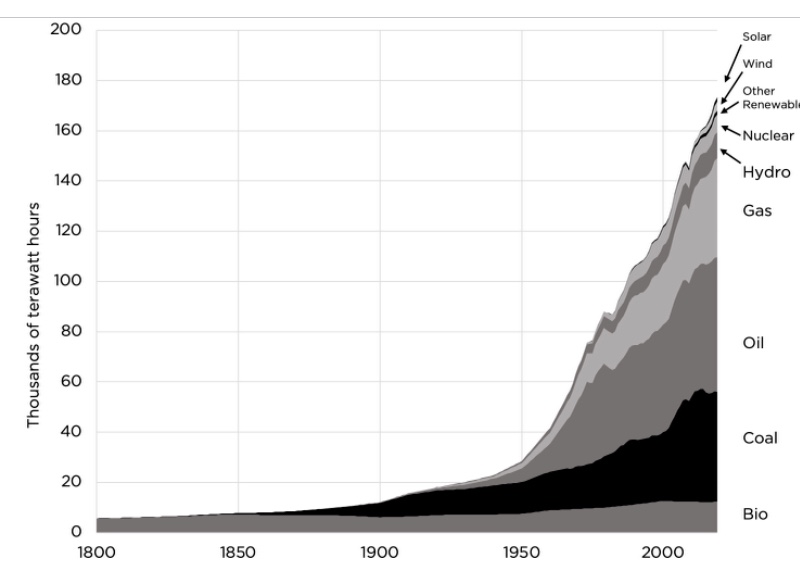
Fossil fuels are the source of cheap and reliable energy that have lifted humanity to an unprecedented level of prosperity. Fossil fuels have given a comfortable existence to billions of people, allowing them to rise out of poverty. This prosperity gives us the luxury of time to develop substitutes, not to mention much greater safety against the kind of weather extremes that have always been a fact of life. The world still gets 80% of its energy from fossil fuels. These fuels are truly a miracle, and we should not discard such valuable technologies prematurely. That forces huge long-term investments in inferior technologies that are likely to be superseded in the future by more economic refinements or even energy sources and methods now wholly unimagined. There are investors who will still wish to pursue those new technologies, perhaps with non pecuniary motives, and there are a few consumers who really want alternatives to fossil fuels.

Biden’s apparent hope that his aggressive climate agenda will be a great legacy of his presidency is at the root of his intransigence toward fossil fuels. His actions in this regard have had a profoundly negative psychological effect on the oil and gas industry. Steps such as cancellations of pipeline projects are immediately impactful in that regard, to say nothing of the supplies that would have ultimately flowed through those pipelines. These cancellations reinforce the message Biden’s been sending to the industry and its investors since his campaign: we mean to shut you down! Who wants to invest in new wells under those circumstances? Other actions have followed: no new federal oil and gas leases, methane restrictions, higher drilling fees on federal land, and a variety of climate change initiatives that bode ill for the industry, such as the SEC’s mandate on carbon disclosures and the Federal Reserve’s proposed role in policing climate impacts.

And now, Democrats are contemplating a move that would make gasoline even more scarce: price controls. As Don Boudreaux says in a recent letter to The Hill:

“Progressives incessantly threaten to tax and regulate carbon fuels into oblivion. These threats cannot but reduce investors’ willingness to fund each of the many steps – from exploration through refining to transporting gasoline to market – that are necessary to keep energy prices low. One reality reflected by today’s high prices at the pump is this hostility to carbon fuels generally and to petroleum especially. And gasoline price controls would only make matters worse by further reducing the attractiveness of investing in the petroleum industry: Why invest in bringing products to market if the prices at which you’re allowed to sell are dictated by grandstanding politicians?”

The kicker is that all these policies are futile in terms of their actual impact on global carbon concentrations, let alone their highly tenuous link to global temperatures. The policies are also severely regressive, inflicting disproportionate harm on the poor, who can least afford such an extravagant transition. Biden wants the country to sacrifice its standard of living in pursuit of these questionable goals, while major carbon-emitting nations like China and India essentially ignore the issue.

Half-Baked Substitution

Market intervention always has downsides to balance against the potential gains of “internalizing externalities”. In this case, the presumed negative externalities are imagined harms of catastrophic climate change from the use of fossil fuels; the presumed external benefits are the avoidance of carbon emissions and climate change via renewables and other “zero-carbon” technologies. With those harms and gains in question, it’s especially important to ask who loses. Taxpayers are certainly on that list. Users of energy produced with fossil fuels end up paying higher prices and are forced to conserve or submit to coerced conversion away from fossil fuels. Then there are the wider impediments to economic growth and, as noted above, the distributional consequences.

Users of immature or inferior energy alternatives might also end up as losers, and there are likely to be external costs associated with those technologies as well. It’s not widely appreciated that today’s so-called clean energy alternatives are plagued by their need to obtain certain minerals that are costly to extract in economic and environmental terms, not to mention highly carbon intensive. And when solar and wind facilities fail or reach the end of their useful lives, disposal creates another set of environmental hazards. In short, the loses imposed through forced internalization of highly uncertain externalities are all too real.

Unfortunately, the energy sources favored by the Administration fail to meet base-load power needs on windless and/or cloudy days. The intermittency of these key renewables means that other power sources, primarily fossil-fuel and nuclear capacity, must remain available to meet demand on an ongoing basis. That means the wind and solar cannot strictly replace fossil fuels and nuclear capacity unless we’re willing to tolerate severe outages. Growth in energy demand met by renewables must be matched by growth in backup capacity.

A call for “energy pragmatism” by Dan Ervin hinges on the use of coal to provide the “bridge to the energy future”, both because there remains a large amount of coal generating capacity and it can stabilize the grid given the intermittency of wind and solar. Ervin also bases his argument for coal on recent increases in the price of natural gas, though a reversal of the Biden EPA’s attacks on gas and coal, which Ervin acknowledges, would argue strongly in favor of natural gas as a pragmatic way forward.

Vehicle Mandates

The Administration has pushed mandates for electric vehicle (EV) production and sales, including subsidized charging stations. Of course, the power used by EVs is primarily generated by fossil fuels. Furthermore, rapid growth in EVs will put a tremendous additional strain on the electric grid, which renewables will not be able to relieve without additional backup capacity from fossil fuels and nuclear. This severely undermines the supposed environmental benefits of EVs.

Once again, mandates and subsidies are necessary because EV technology is not yet economic for most consumers. Those buyers don’t want to spend what’s necessary to purchase an EV, nor do they wish to suffer the inconveniences that re-charging often brings. This is a case in which policy is outrunning the ability of the underlying infrastructure required to support it. And while adoption of EVs is growing, it is still quite low (and see here).

Wising Up

Substitution into new inputs or technologies happens more rationally when prices accurately reflect true benefits and scarcities. The case for public subsidies and mandates in the push for a zero-carbon economy rests on model predictions of catastrophic global warming and a theoretical link between U.S. emissions and temperatures. Both links are weak and highly uncertain. What is certain is the efficiency of fossil fuels to power gains in human welfare.

This Bartley J. Madden quote sums up a philosophy of progress that is commendable for firms, and probably no less for public policymakers:

“Keep in mind that innovation is the key to sustainable progress that jointly delivers on financial performance and taking care of future generations through environmental improvements.”

Madden genuflects to the “sustainability” crowd, who otherwise don’t understand the importance of trusting markets to guide innovation. If we empower those who wish to crush private earnings from existing technologies, we concede the future to central planners, who are likely to choose poorly with respect to technology and timing. Let’s forego the coercive approach in favor of time, development, and voluntary adoption!

Follow Sacred Cow Chips on WordPress.com

Recent Posts

  • Immigration and Merit As Fiscal Propositions
  • Tariff “Dividend” From An Indigent State
  • Almost Looks Like the Fed Has a 3% Inflation Target
  • Government Malpractice Breeds Health Care Havoc
  • A Tax On Imports Takes a Toll on Exports

Archives

  • December 2025
  • November 2025
  • October 2025
  • September 2025
  • August 2025
  • July 2025
  • June 2025
  • May 2025
  • April 2025
  • March 2025
  • February 2025
  • January 2025
  • December 2024
  • November 2024
  • October 2024
  • September 2024
  • August 2024
  • July 2024
  • June 2024
  • May 2024
  • April 2024
  • March 2024
  • February 2024
  • January 2024
  • December 2023
  • November 2023
  • August 2023
  • July 2023
  • June 2023
  • May 2023
  • April 2023
  • March 2023
  • February 2023
  • January 2023
  • December 2022
  • November 2022
  • October 2022
  • September 2022
  • August 2022
  • July 2022
  • June 2022
  • May 2022
  • April 2022
  • March 2022
  • February 2022
  • January 2022
  • December 2021
  • November 2021
  • October 2021
  • September 2021
  • August 2021
  • July 2021
  • June 2021
  • May 2021
  • April 2021
  • March 2021
  • February 2021
  • January 2021
  • December 2020
  • November 2020
  • October 2020
  • September 2020
  • August 2020
  • July 2020
  • June 2020
  • May 2020
  • April 2020
  • March 2020
  • February 2020
  • January 2020
  • December 2019
  • November 2019
  • October 2019
  • September 2019
  • August 2019
  • July 2019
  • June 2019
  • May 2019
  • April 2019
  • March 2019
  • February 2019
  • January 2019
  • December 2018
  • November 2018
  • October 2018
  • September 2018
  • August 2018
  • July 2018
  • June 2018
  • May 2018
  • April 2018
  • March 2018
  • February 2018
  • January 2018
  • December 2017
  • November 2017
  • October 2017
  • September 2017
  • August 2017
  • July 2017
  • June 2017
  • May 2017
  • April 2017
  • March 2017
  • February 2017
  • January 2017
  • December 2016
  • November 2016
  • October 2016
  • September 2016
  • August 2016
  • July 2016
  • June 2016
  • May 2016
  • April 2016
  • March 2016
  • February 2016
  • January 2016
  • December 2015
  • November 2015
  • October 2015
  • September 2015
  • August 2015
  • July 2015
  • June 2015
  • May 2015
  • April 2015
  • March 2015
  • February 2015
  • January 2015
  • December 2014
  • November 2014
  • October 2014
  • September 2014
  • August 2014
  • July 2014
  • June 2014
  • May 2014
  • April 2014
  • March 2014

Blogs I Follow

  • Passive Income Kickstart
  • OnlyFinance.net
  • TLC Cholesterol
  • Nintil
  • kendunning.net
  • DCWhispers.com
  • Hoong-Wai in the UK
  • Marginal REVOLUTION
  • Stlouis
  • Watts Up With That?
  • Aussie Nationalist Blog
  • American Elephants
  • The View from Alexandria
  • The Gymnasium
  • A Force for Good
  • Notes On Liberty
  • troymo
  • SUNDAY BLOG Stephanie Sievers
  • Miss Lou Acquiring Lore
  • Your Well Wisher Program
  • Objectivism In Depth
  • RobotEnomics
  • Orderstatistic
  • Paradigm Library
  • Scattered Showers and Quicksand

Blog at WordPress.com.

Passive Income Kickstart

OnlyFinance.net

TLC Cholesterol

Nintil

To estimate, compare, distinguish, discuss, and trace to its principal sources everything

kendunning.net

The Future is Ours to Create

DCWhispers.com

Hoong-Wai in the UK

A Commonwealth immigrant's perspective on the UK's public arena.

Marginal REVOLUTION

Small Steps Toward A Much Better World

Stlouis

Watts Up With That?

The world's most viewed site on global warming and climate change

Aussie Nationalist Blog

Commentary from a Paleoconservative and Nationalist perspective

American Elephants

Defending Life, Liberty and the Pursuit of Happiness

The View from Alexandria

In advanced civilizations the period loosely called Alexandrian is usually associated with flexible morals, perfunctory religion, populist standards and cosmopolitan tastes, feminism, exotic cults, and the rapid turnover of high and low fads---in short, a falling away (which is all that decadence means) from the strictness of traditional rules, embodied in character and inforced from within. -- Jacques Barzun

The Gymnasium

A place for reason, politics, economics, and faith steeped in the classical liberal tradition

A Force for Good

How economics, morality, and markets combine

Notes On Liberty

Spontaneous thoughts on a humble creed

troymo

SUNDAY BLOG Stephanie Sievers

Escaping the everyday life with photographs from my travels

Miss Lou Acquiring Lore

Gallery of Life...

Your Well Wisher Program

Attempt to solve commonly known problems…

Objectivism In Depth

Exploring Ayn Rand's revolutionary philosophy.

RobotEnomics

(A)n (I)ntelligent Future

Orderstatistic

Economics, chess and anything else on my mind.

Paradigm Library

OODA Looping

Scattered Showers and Quicksand

Musings on science, investing, finance, economics, politics, and probably fly fishing.

  • Subscribe Subscribed
    • Sacred Cow Chips
    • Join 128 other subscribers
    • Already have a WordPress.com account? Log in now.
    • Sacred Cow Chips
    • Subscribe Subscribed
    • Sign up
    • Log in
    • Report this content
    • View site in Reader
    • Manage subscriptions
    • Collapse this bar
 

Loading Comments...