• About

Sacred Cow Chips

Sacred Cow Chips

Tag Archives: Prostitution

Data and Amplifications On Incels

15 Tuesday May 2018

Posted by Nuetzel in Free markets, Prohibition, Redistribution

≈ Leave a comment

Tags

Black Markets, Feminism, General Social Survey, Incels, Institute for Family Studies, Involuntary Celibacy, Kevin Williamson, Lyman Stone, Organized Crime, Patriarchy, Prohibition, Promiscuity, Prostitution, Redistribution, Sex Concentration Ratio, Sex Robots, Sex Trafficking, Sexual Revolution, Shiekha Dalmia, South Caucasus, Virginity

Last week I wrote about some promising avenues through which “incels”, so-called “involuntary celibates” unable to find willing sexual partners, might enjoy some semblance of sex lives without infringing on the rights of others. Several postscripts appear below, but first I describe the findings of Lyman Stone’s examination of survey data on sexual frequency for the Institute for Family Studies blog in which he investigates reasons for the increase in male sexlessness.

The Data On Sex and Celibacy

Involuntary sexlessness is not a new phenomenon, but estimates of its frequency have grown over the past ten years. That’s been an operative assumption made by many writers since the van attack by an “incel” in Toronto in April. Stone examines data from several surveys, such as the General Social Survey (GSS), and focuses mainly on the unmarried 22 – 35 age group. He investigates both the dimensions of involuntary celibacy and aspects of the narrative offered by incels themselves.

  • Incels believe that women have become increasingly promiscuous: No, the GSS data reveal no real trend in female sexual frequency since the year 2000. The share of females reporting no sexual activity within the previous 12 months has not changed much either (~15% on average), about the same as males until more recent years.
  • Stone finds that the share of never-married males who have been sexless for at least a year has increased over the past 10 years.
  • Incels believe that a small share of males dominate sexual activity: No, while the distribution of sex is not equal, it is not nearly as skewed as incels claim: the most sexually active 20% of both men and women have 50-60% of the sex. Those shares have been fairly stable over time. Some of the most promiscuous actually pay for sex, which inflates the measured sex-concentration ratio. However, incels believe the top 20% have 80% of the sex, according to Stone‘s own reporting of on-line commentary. If so, incels exaggerate the success of those would-be sexual competitors.
  • The increase in sexlessness among unmarried men is mostly involuntary. This follows from a decline in the share of never-married, male virgins who abstain from sex for religious reasons and increases in the shares reporting “no suitable partner” and “other” reasons for celibacy.
  • Stone derives a “hard-core” incel population: “the share of never-married men ages 22-35 who have never had sex, and whose reason for never having had sex isn’t abstention for religious, timing, or health reasons.” This share has risen from 2.7% in 2002 to about 4.4% in 2015.
  • Most of the increase in the “hard core” incel share can be attributed to declining marriage rates and to an increase in involuntary virginity among the unmarried.
  • Two factors that covary positively with virginity are the level of education and living with one’s parents, but some of the covariation is due to voluntary celibacy.

Stone concludes that young male sexlessness is:

“… mostly about people spending more years in school and spending more years living at home. But that’s not actually a story about some change in sexual politics; instead, it’s a story about the modern knowledge economy, and to some extent exorbitant housing costs. As such, it’s no surprise that rising sexlessness is being observed in many countries. This, in turn, suggests that finding a solution to help young people pair up may not be as easy.”

Survey data are always suspect, of course, but measuring actual sexual frequency in large populations is difficult if not impossible without surveys. Also, the level of Stone’s analysis does not necessarily align well with particular environments and sub-cultures in which people interact. For example, some argue that the increasing ratio of females to males on college campuses has changed the sexual “terms of trade” between men and women, but Stone didn’t attempt to drill down that far. Finally, Stone doesn’t offer any solutions of his own. My own opinion is that policy should be guided by voluntary choice and adaptation, along with encouraging those who feel overwhelmingly lonely or rejected to get off social media and seek counseling.

Postscripts Re: Last Week’s Article

Sexlessness is not confined to the young-adult population, of course, and there are severely disabled people of all ages who lack a sex life along with others unable to form intimate relationships. In a post last week, I advocated legalized prostitution as a mechanism for effecting a “voluntary redistribution of sex”, allowing those who are unable to find willing partners to enjoy some semblance of a sex life.

Legalized prostitution would remove the business from the grips of organized crime and reduce sex trafficking (which is not the same as voluntary prostitution). It would also improve health and safety, reduce violence, and lead to more humane conditions in an industry that will never be quashed by ham-handed, counterproductive efforts at prohibition. This is a rather mainstream view among economists, most of whom understand the folly of intrusions on private, mutually-beneficial decisions. Here are some thought from an economist in the South Caucasus on the matter. To oppose legal prostitution on moralistic or religious grounds, as comforting and virtuous as it might feel, is to wear blinders to the tragic consequences of a black market in sex.

On a related note, legalization does not in any way imply government-sponsored or taxpayer-subsidized prostitution. That’s something I’d be most unlikely to contemplate. And in that connection, I don’t really care for the term “redistribution” to describe legalization, but following a few others, I used it. A redistribution usually implies a change in the allocation of a fixed quantity across various subgroups or individuals. Perhaps some incels believe in “redistributing” sex, which might suggest a coercive element and certainly not what I have in mind. My use of the qualifier “voluntary” was intended to make that distinction. Unlike forced redistribution, legal access to sexual services does not imply a zero- or negative-sum outcome. I also mentioned sex robots as a possible outlet and a voluntary choice for incels, understood to be unsubsidized by government.

I am sympathetic to the view put forward by Shiekha Dalmia’s in “Incels Are the Product of an Incomplete Sexual Revolution“. She says, “Neither feminists nor social conservatives have the right understanding”, asserting that the problem has to do with the difficulty incels have in navigating the jagged channels between today’s sexual expectations and more traditional gender relations. To that, one might add the negative baggage created by the “anti-patriarchal” sentiment promoted by feminists. That’s worth considering, and it suggests that everyone (including incels) might just be too uptight.

Finally, Kevin Williamson offers some “Advice for Incels: Join a Church“. That’s probably a fine idea for some incels, young and old, who might find a higher purpose from the decision, even if they can’t find a girlfriend there. However, it’s not as if there are no church-going incels to begin with. Furthermore, single women at church are no more likely than anyone to be drawn to men who lack an ability to interact with the opposite sex. And let’s face it: the girls at church are not exactly waiting for the next dashing paraplegic to roll through the doors. Sorry if that sounds cynical or demeaning. The reality is that many disabled individuals lack the relationship opportunities available to most men. The least society can do for them, regarding access to sex services, is to get out of the way.

A Voluntary Redistribution of Sex

11 Friday May 2018

Posted by Nuetzel in Free markets, Prohibition, Redistribution, Uncategorized

≈ 1 Comment

Tags

Abigail Hall, Alex Tabarrok, Incel, Involuntary Celibate, Lux Alptraum, Prohibition, Prostitution, Redistribution of Sex, Robin Hanson, Ross Douthat, Sex Robots

“Incels” have received plenty of bad publicity since the horrifying van attack in Toronto two weeks ago. It was preceded in 2014 by a killing rampage in California perpetrated by an individual with a similar profile. In case you haven’t heard, an incel is an involuntary celibate, either male or female, though male incels have garnered nearly all of the recent attention. Whatever their other characteristics, incels share a loneliness and an unmet desire for intimacy with other human beings.

Lux Alptraum shares her views about the differences between male and female incels. She blames “angry, straight men” and “toxic masculinity” for both the violence that’s recently come to be associated with incels and the relative inattention paid to the plight of female incels. I value her perspective on the issue of female incels. There are obviously extreme misogynists among males in the incel “community”. Some are so enraged by their plight that they engage in on-line bullying, and a plainly deranged segment of incels, including the perpetrators of the crimes mentioned above, have advocated violent retribution against those they deem responsible for their low sexual status. That means just about anyone who can find a partner.

Alptraum paints male incels with a very broad brush, however. Similarly, various leftist writers have categorized incels as predominantly “right wing” and even racist, but involuntary celibacy and misogyny do not lie conveniently along a two-dimensional political spectrum. Incels are present in many groups, crossing racial, religious, and political lines. There are incels among the transgendered and undoubtedly in the gay community. Gay individuals can exist in relative isolation in towns across America. Physical disabilities may condemn individuals to involuntary celibacy. And not all incels are “ugly”; instead, they may suffer from severe social awkwardness. But there are bound to be incels who live quiet lives, unhappy, but adjusted to their circumstances, more or less.

The recent focus on incels has prompted some interesting questions. Ross Douthat’s opinion piece in The New York Times asks whether anyone has a “right to sex”, as some incels have asserted. Robin Hanson discusses the idea of a “redistribution of sex“, noting in a follow-up post that governments throughout history have influenced the distribution of sex through policies enforcing monogamy, for example, or banning prostitution. Voluntary agreements to exchange sex for remuneration are one way to alter the distribution. In fact, to demonstrate the lengths to which a government could go to redistribute sex and intervene against “sex inequality”, Hanson mentions policies of cash redistribution, funded by taxpayers, to compensate incels for the services of prostitutes. There are examples of such benefits for the disabled. Here is Alex Tabarrok on that subject:

“In the UK charities exist to help match sex workers with the disabled. Similar services are available in Denmark and in the Netherlands and in those countries (limited) taxpayer funds can be used to pay for sexual disability services.”

Subsidies and charity aside, it’s easy to understand why prohibition of sexual services for hire would be seen as an injustice by those unable to find partners willing to grant sexual benefits. From a libertarian perspective, trade in sex should be regarded as a natural right, like the freedom to engage in any other mutually beneficial transaction, so long as it does no harm to third parties. One’s body is one’s own property, and it should not be for government — or others — to decide how it will be used.

Laws against prostitution do great harm to society and to the individuals involved in the sex business. Forget about ending prostitution. That will never happen. According to  Abigail Hall, there are about 1 million prostitutes working in the U.S. They almost all work underground, with the exception of those operating in legal brothels in Nevada. Prohibition keeps the price up, but the workers capture a low share of those returns. Their bosses are harsh masters relative to those in legal businesses. These workers cannot report crimes against them, so they are often subject to the worst kinds of abuse. Illegality usually means they don’t have access to good health care, which places customers at greater risk. Legalizing (or decriminalizing) prostitution would reduce or eliminate these problems. From Hall:

“By legalizing the sex trade, we would allow those involved in the sex trade to come out from the shadows, use legitimate business practices and legal channels, and decrease the likelihood that women will be trafficked by violent groups of criminals. … As prostitution becomes a legitimate profession, it allows for prostitutes to be more open with their doctors about their sexual history and seek treatment for STIs and other problems.”

Many object that prostitution exploits women, legal or not, and that it exploits low-income women disproportionately. But there will be voluntary sellers as long as there is a market, again, legal or not. And there will be a market. As for a disparate impact on the poor, Hall says:

“The fact that those who select prostitution as a profession may be poor is inconsequential…. It may be true that some women who work as prostitutes would strongly prefer another profession. Even if this is the case, women who voluntarily choose prostitution as a means of income should be allowed to practice their profession in the safest environment possible.”

The ongoing development of “sex robots” offers an avenue through which incels might enjoy activity that approximates sex with a human being. These robots are becoming increasingly realistic, and their costs are likely to decline dramatically in coming years. For incels with a congenital inability to interact with other human beings, this option might be far preferable to hiring the services of a prostitute. And the introduction of both male and female sex robots into senior care facilities might reduce the likelihood that sexually aggressive residents will abuse others. It happens.

Free markets are amazing in their ability to maximize the well being of both consumers and producers of a good or service. Trades are mutually beneficial and therefore are voluntary, and price signals redirect resources to their most valued uses. The prohibition on prostitution, however, has made it a very dangerous business for practitioners and customers alike. Prohibition has led to dominance by organized crime interests and local strong-men and -women. It has also thickened the intersection of prostitution with other prohibited activities, such as the drug trade. This creates a toxic criminal environment within which women are trapped and abused. Legalizing prostitution would liberate these individuals and create safer conditions for them and their customers. Private solutions would still be available to those who wish to keep prostitution out of their buildings or neighborhoods. And legalization is one way that sex could be made safely and voluntarily accessible to incels. Perhaps, one day soon, the availability of sex robots will help incels satisfy their desires as well. Some incels will still harbor strong resentment toward those for whom sex is not out of reach. Nevertheless, it is reasonable to ask whether such a “voluntary redistribution of sex” would not produce unambiguous social benefits. To deny these benefits to groups like the disabled, or really to anyone with a physical or emotional inability to find a willing partner, and to insist that sex workers be exposed to danger and abuse, is not just priggish, but cruel.

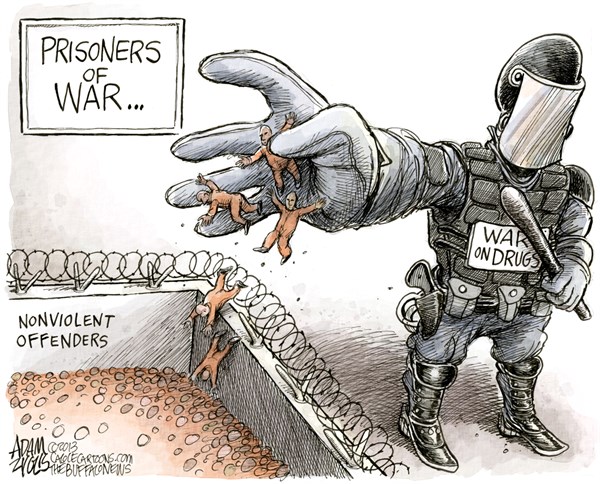
Wanna Help People? End the Drug War!

03 Tuesday Nov 2015

Posted by Nuetzel in War On Drugs

≈ Leave a comment

Tags

Black Markets, Colorado Legalization, Colorado Pot Legalization, Drug Abuse, Drug Cartels, Gangland Violence, Individual Liberty, Jacob Sullum, Milton Friedman, Prohibition, Prostitution, Victimless Crimes, War on Drugs

August 20, 2013

We’re taught that illegal drugs are a scourge on humanity, that their use is immoral and that legalization is out of the question. Yet far more of us, our friends, and our loved ones have been intimate with the destructive effects of alcohol and dependency on legal drugs than on illegal drugs. Pharmacologically, the “worst effects” of illegal drugs are no worse than the well-known effects of alcohol abuse. In fact, the “worst effects” have more to do with prohibition than with the illegal drugs themselves.

Rules are codified into law successfully when widespread agreement exists among the citizenry that a rule is sensible. This should trouble drug prohibitionists: a substantial proportion of the population has used illegal drugs as adults, indicating a strong lack of consensus that recreational drugs should be illegal. For this reason alone, drug prohibition is and always will be ineffectual.

The great economist Milton Friedman was a long-time critic of the drug war. Several of his articles on the topic are linked at this site. One of the links is this interview from 1992, which is lengthy but sticks primarily to the issue of the drug war. I’m not sure that all of the facts Friedman cites have held up over time, especially with respect to trends in alcohol consumption. Nevertheless, it is a great interview:

“There are [sic] an enormous number of innocent victims now. You’ve got the people whose purses are stolen, who are bashed over the head by people trying to get enough money for their next fix. You’ve got the people killed in the random drug wars. You’ve got the corruption of the legal establishment. You’ve got the innocent victims who are taxpayers who have to pay for more and more prisons, and more and more prisoners, and more and more police. You’ve got the rest of us who don’t get decent law enforcement because all the law enforcement officials are busy trying to do the impossible.“

Here is a brief list of the pernicious effects of drug prohibition:

  • Prices are driven upward by the legal risk inherent in black market trade;
  • High prices lead to more crime as heavy users seek means of payment;
  • Impure and more dangerous variants are traded in attempts to stretch quantities and increase potency;
  • Dealers advance “samples” to gain trust and cultivate dependency among users;
  • Addiction is stubbornly resistant to legal barriers;
  • Unnecessary deaths from impure and excessively potent drug varieties;
  • Black market trade leads to violent crime as underworld elements seek to control markets and enforce discipline in their organizations;
  • Unnecessary deaths from gangland violence;
  • Arrest, imprisonment and ruined lives for victimless crimes;
  • A huge burden on taxpayers;
  • A huge burden on the criminal justice system;
  • Inevitable corruption in law enforcement as officials face hefty rewards for protecting the drug trade;
  • Innocent people become casualties of violence instigated by gangs and sometimes by police actions.

A fascinating dynamic of the black market in drugs is the tendency toward monopolization at the top: Large cartels dominate the importation of supplies due to the risk and expense of such operations. As Friedman noted, the war on drugs contributes to the difficulty of entering into competition with established players. At the same time, the drug war guarantees huge rewards to the cartels by inflating drug prices:

“What more could a monopolist want? He’s got a government who makes it very hard for all his competitors and who keeps the price of his products high.“

The drug war creates greater danger for users. In “Prohibition Kills“, Jacob Sullum discusses four recent examples of more dangerous and even deadly drug variants that have been developed as a direct consequence of prohibition. Friedman is often quoted as saying that crack cocaine was a direct consequence of the drug war. Sullum asks whether this could be an intentional strategy by drug warriors for discouraging consumption. I’m not convinced they are quite so nefarious, but it’s something to ponder.

More dangerous varieties of drugs would not vanish overnight if drugs were legalized, though the incentive to develop them would diminish. Of course, if legalization brings prices and risks down, as we’d expect, it would encourage greater recreational use. That should not be viewed as a “bad” any more than better access to cocktails at happy hour. Abuse is unlikely to increase because problem users tend to be undeterred by prohibition. And as unsavory as an increase in recreational drug use might seem to the temperance faction, it would still represent only a small fraction of the real costs of ruined lives imposed by prohibition and the drug war.

Legalization would bring other complexities, as Colorado’s experience with marijuana shows. For example, rules with respect to driving under the influence must be updated, as well as laws prohibiting possession by minors. Colorado went so far as to regulate packaging, and tax treatment of the drug trade will stoke debate, as governments will hope for something of a tax bonanza. But the more that government attempts to regulate and tax drugs, the more that problems similar to those associated with drug prohibition will persist, albeit on a smaller scale.

Economically, legalization should eliminate a burden on taxpayers. It would free up law enforcement resources to battle real crime and should make more funds available for treatment programs. It would also help to improve lives and safety in inner cities and other areas ravaged by black market drug trade and the violence it foments. And of course, legalization would put an end to the ruin of lives caused by the arrest of individuals for victimless crimes.

Prohibition of drugs belongs to a larger class of social problems brought on by efforts to bring the police power of government to bear on private behavior. I already mentioned that alcohol prohibition had similar consequences. To lesser degrees, similar harmful consequences are associated with laws against prostitution, large soft drink containers, sugary foods, and practicing almost any commercial art without a license. The same can be said for price regulations like rent control and the minimum wage. The former has led to the destruction of vast quantities of housing; the latter harms low-skilled workers along non-wage dimensions and makes it difficult for unskilled workers to gain valuable experience in the job market. Government interference with individual liberty might well restrain certain activities deemed “undesirable” by busybodies, but it it also leads to higher prices, greater risk, black market activity, violence, unnecessary legal actions against individuals, and greater expense for society.

Follow Sacred Cow Chips on WordPress.com

Recent Posts

  • Immigration and Merit As Fiscal Propositions
  • Tariff “Dividend” From An Indigent State
  • Almost Looks Like the Fed Has a 3% Inflation Target
  • Government Malpractice Breeds Health Care Havoc
  • A Tax On Imports Takes a Toll on Exports

Archives

  • December 2025
  • November 2025
  • October 2025
  • September 2025
  • August 2025
  • July 2025
  • June 2025
  • May 2025
  • April 2025
  • March 2025
  • February 2025
  • January 2025
  • December 2024
  • November 2024
  • October 2024
  • September 2024
  • August 2024
  • July 2024
  • June 2024
  • May 2024
  • April 2024
  • March 2024
  • February 2024
  • January 2024
  • December 2023
  • November 2023
  • August 2023
  • July 2023
  • June 2023
  • May 2023
  • April 2023
  • March 2023
  • February 2023
  • January 2023
  • December 2022
  • November 2022
  • October 2022
  • September 2022
  • August 2022
  • July 2022
  • June 2022
  • May 2022
  • April 2022
  • March 2022
  • February 2022
  • January 2022
  • December 2021
  • November 2021
  • October 2021
  • September 2021
  • August 2021
  • July 2021
  • June 2021
  • May 2021
  • April 2021
  • March 2021
  • February 2021
  • January 2021
  • December 2020
  • November 2020
  • October 2020
  • September 2020
  • August 2020
  • July 2020
  • June 2020
  • May 2020
  • April 2020
  • March 2020
  • February 2020
  • January 2020
  • December 2019
  • November 2019
  • October 2019
  • September 2019
  • August 2019
  • July 2019
  • June 2019
  • May 2019
  • April 2019
  • March 2019
  • February 2019
  • January 2019
  • December 2018
  • November 2018
  • October 2018
  • September 2018
  • August 2018
  • July 2018
  • June 2018
  • May 2018
  • April 2018
  • March 2018
  • February 2018
  • January 2018
  • December 2017
  • November 2017
  • October 2017
  • September 2017
  • August 2017
  • July 2017
  • June 2017
  • May 2017
  • April 2017
  • March 2017
  • February 2017
  • January 2017
  • December 2016
  • November 2016
  • October 2016
  • September 2016
  • August 2016
  • July 2016
  • June 2016
  • May 2016
  • April 2016
  • March 2016
  • February 2016
  • January 2016
  • December 2015
  • November 2015
  • October 2015
  • September 2015
  • August 2015
  • July 2015
  • June 2015
  • May 2015
  • April 2015
  • March 2015
  • February 2015
  • January 2015
  • December 2014
  • November 2014
  • October 2014
  • September 2014
  • August 2014
  • July 2014
  • June 2014
  • May 2014
  • April 2014
  • March 2014

Blogs I Follow

  • Passive Income Kickstart
  • OnlyFinance.net
  • TLC Cholesterol
  • Nintil
  • kendunning.net
  • DCWhispers.com
  • Hoong-Wai in the UK
  • Marginal REVOLUTION
  • Stlouis
  • Watts Up With That?
  • Aussie Nationalist Blog
  • American Elephants
  • The View from Alexandria
  • The Gymnasium
  • A Force for Good
  • Notes On Liberty
  • troymo
  • SUNDAY BLOG Stephanie Sievers
  • Miss Lou Acquiring Lore
  • Your Well Wisher Program
  • Objectivism In Depth
  • RobotEnomics
  • Orderstatistic
  • Paradigm Library
  • Scattered Showers and Quicksand

Blog at WordPress.com.

Passive Income Kickstart

OnlyFinance.net

TLC Cholesterol

Nintil

To estimate, compare, distinguish, discuss, and trace to its principal sources everything

kendunning.net

The Future is Ours to Create

DCWhispers.com

Hoong-Wai in the UK

A Commonwealth immigrant's perspective on the UK's public arena.

Marginal REVOLUTION

Small Steps Toward A Much Better World

Stlouis

Watts Up With That?

The world's most viewed site on global warming and climate change

Aussie Nationalist Blog

Commentary from a Paleoconservative and Nationalist perspective

American Elephants

Defending Life, Liberty and the Pursuit of Happiness

The View from Alexandria

In advanced civilizations the period loosely called Alexandrian is usually associated with flexible morals, perfunctory religion, populist standards and cosmopolitan tastes, feminism, exotic cults, and the rapid turnover of high and low fads---in short, a falling away (which is all that decadence means) from the strictness of traditional rules, embodied in character and inforced from within. -- Jacques Barzun

The Gymnasium

A place for reason, politics, economics, and faith steeped in the classical liberal tradition

A Force for Good

How economics, morality, and markets combine

Notes On Liberty

Spontaneous thoughts on a humble creed

troymo

SUNDAY BLOG Stephanie Sievers

Escaping the everyday life with photographs from my travels

Miss Lou Acquiring Lore

Gallery of Life...

Your Well Wisher Program

Attempt to solve commonly known problems…

Objectivism In Depth

Exploring Ayn Rand's revolutionary philosophy.

RobotEnomics

(A)n (I)ntelligent Future

Orderstatistic

Economics, chess and anything else on my mind.

Paradigm Library

OODA Looping

Scattered Showers and Quicksand

Musings on science, investing, finance, economics, politics, and probably fly fishing.

  • Subscribe Subscribed
    • Sacred Cow Chips
    • Join 128 other subscribers
    • Already have a WordPress.com account? Log in now.
    • Sacred Cow Chips
    • Subscribe Subscribed
    • Sign up
    • Log in
    • Report this content
    • View site in Reader
    • Manage subscriptions
    • Collapse this bar
 

Loading Comments...