• About

Sacred Cow Chips

Sacred Cow Chips

Tag Archives: Real Interest Rates

Why We Can’t Have Nice Low Rates In the U.S.

08 Tuesday Jul 2025

Posted by Nuetzel in Interest Rates, Monetary Policy

≈ Leave a comment

Tags

Bank of Japan, Donald Trump, European Central Bank, Federal Reserve, Fiscal policy, Inflation, Interest Rates, Investor Expectations, Real Interest Rates, Swiss National Bank, Treasury Debt, Zohran Mamdani
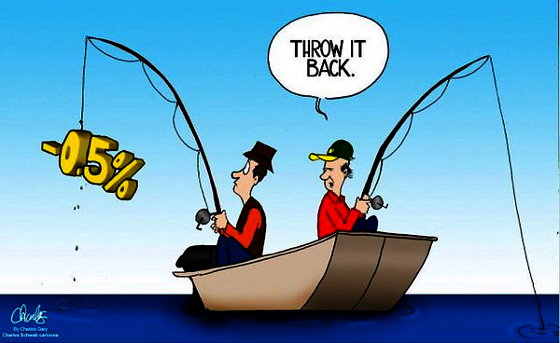
Donald Trump’s latest volley against the Federal Reserve accuses the central bank of fixing interest rates at artificially high levels compared to rates in other developed countries. He repeatedly demands that the Fed make a large cut to its federal funds rate target, in the apparent belief that other rates will immediately fall with it. While a highly imperfect analogy, that’s a bit like saying that long-term parking in New York City would be cheaper if only hourly rates were cut to what’s charged in Omaha, and with only favorable consequences. Don’t tell Mamdani!

Trump believes the Fed’s restrictive monetary policy is preventing the economy from achieving its potential under his policies. He also argues that the Fed’s “high-rate” policy is costing the federal government and taxpayers hundreds of billions in excessive interest on federal debt. High rates can certainly impede growth and raise the cost of debt service. The question is whether there is a policy that can facilitate growth and reduce borrowing costs without risking other objectives, most notably price stability.

Delusions of Control

The financial community understands that the Fed does not directly control rates paid by the Treasury on federal debt. The Fed has its most influence on rates at the short end of the maturity spectrum. Rates on longer-term Treasury notes and bonds are subject to a variety of market forces, including expected inflation, the expected future path of federal deficits, and the perceived direction of the economy, to name a few. The Fed simply cannot dictate investor sentiments and expectations, and the ongoing flood of new Treasury debt complicates matters.

Another fundamental lesson for Trump is that cross-country comparisons of interest rates are meaningless outside the context of differing economic conditions. Market interest rates are driven by things that vary from one country to another, such as expected inflation rates, economic policies, currency values, and the strength of the home economy. Differences in rates are always the result of combinations of circumstances and expectations, which can be highly varied.

A Few Comparisons

A few examples will help reinforce this point. Below, I compare the U.S. to a few other countries in terms of recent short-term central bank rate targets and long-term market interest rates. Then we can ask what conditions explain these divergencies. For reference, the current fed funds rate target range is 4.25 – 4.5%, while 10-year Treasury bonds have traded recently at yields in the same range. Current U.S. inflation is roughly 2.5%.

It’s important to remember that markets attempt to price bonds to compensate buyers for expected future inflation. Currently, the 10-year “breakeven” inflation implied by indexed Treasury bonds is about 2.35% (but it is closer to 3% at short durations). That means unindexed Treasury bonds yielding 4.4% offer an expected real yield just above 2%. Accounting for expected inflation often narrows the gap between U.S. interest rates and foreign rates, but not always.

Switzerland: The Swiss National Bank maintains a policy rate of 0%; the rate on 10-year Swiss government bonds has been in the 0.5 – 0.7% range. Why can’t we have Swiss-like interest rates in the U.S.? Is it merely intransigence on the part of the Fed, as Trump would have us believe?

No. Inflation in Switzerland is near zero, so in terms of real yields, the gap between U.S. and Swiss rates is closer to 1.4%, rather than 3.8%. But what of the remaining difference? Swiss government debt, even more than U.S. Treasury debt, attracts investors due to the nation’s “safe-haven” status. Also, U.S. yields are elevated by our ballooning federal debt and uncertainties related to trade policy. Economic growth is also somewhat stronger in the U.S., which tends to elevate yields.

These factors give the Fed reason to be cautious about cutting its target rate. It needs evidence that inflation will continue to trend down, and that policy uncertainties can be resolved without reigniting inflation.

Euro Area: The European Central Bank’s (ECB) refinancing rate is now 2.15%. Meanwhile, the 10-year German Bund is yielding around 2.6%, so both short-term and long-term rates in the Euro area are lower than in the U.S. In this case, the difference relative to U.S. rates is not large, nor is it likely attributable to lower expected inflation. Instead, sluggish growth in the EU helps explain the gap. Federal deficits and the ongoing issuance of new Treasury debt also keep U.S. yields higher. Treasury yields may also reflect a premium for volatility due to heavier reliance on foreign investors and private funds, who tend to be price sensitive.

Japan: The Bank of Japan’s (BOJ) policy rate is currently 0.5%. Yields on Japanese 10-year government bonds have recently traded just below 1.5%. Expected inflation in Japan has been around 2.5% this year, which means that real yields are sharply negative. The BOJ has tightened policy to bring inflation down. The nearly 3% gap between U.S. and Japanese bond yields reflects very weak economic growth in Japan. In addition, despite a very high debt to GDP ratio, the depressed value of the yen discourages investment abroad, helping to sustain heavy domestic holdings of government debt.

Blame and Backfire

Trump might well understand the limits of the Fed’s control over interest rates, but if he does, then this is exclusively a case of scapegoating. Cross-country differences in interest rates represent equilibria that balance an array of complex conditions. These range from disparate rates of inflation, the strength of economic growth, currency values, fiscal imbalances, and the character of the investor base. .

Investor expectations obviously play a huge role in all this. A central bank like the Fed cannot dictate long-term yields, and it can do much more harm than good by attempting to push the market where it does not want to go. That type of aggressiveness can spark changes in expectations that undermine policy objectives. It’s childish and destructive to insist that interest rates can and should be as low in the U.S. as in countries facing much different circumstances.

So When Can We Expect That Hard Landing, Hmmm?

13 Wednesday Dec 2023

Posted by Nuetzel in Economic Outlook, Monetary Policy

≈ Leave a comment

Tags

Consumer Sentiment, Core PCE, Federal Funds Rate Target, Federal Open Market Committee, Hard Landing, Inflation, Jamie Diamond, Labor Market, Leading Indicators, Long and Variable Lags, Milton Friedman, Money Growth, Neutral Real Rate, Quantitative Tightening, Real Interest Rates, Real Wages, Recession, Scott Sumner, Soft Landing, Tight Money

The joke’s on me, but my “out” on the question above is “long and variable lags” in the impact of monetary policy, a description that goes back to the work of Milton Friedman. If you call me out on my earlier forebodings of a hard landing or recession, I’ll plead that I repeatedly quoted Friedman on this point as a caveat! That is, the economic impact of a monetary tightening will be lagged by anywhere from 9 to 24 months. So maybe we’re just not there yet.

Of course, maybe I’m wrong and we won’t have to get “there”: the rate of inflation has indeed tapered over the past year. A soft landing now seems like a more realistic possibility. Still, there’s a ways to go, and as Scott Sumner says, when it comes to squeezing inflation out of the system, “It’s the final percentage point that’s the toughest.” One might say the Federal Reserve is hedging its bets, avoiding further increases in its target federal funds rate absent evidence of resurging price pressures.

Strong Growth or Mirage?

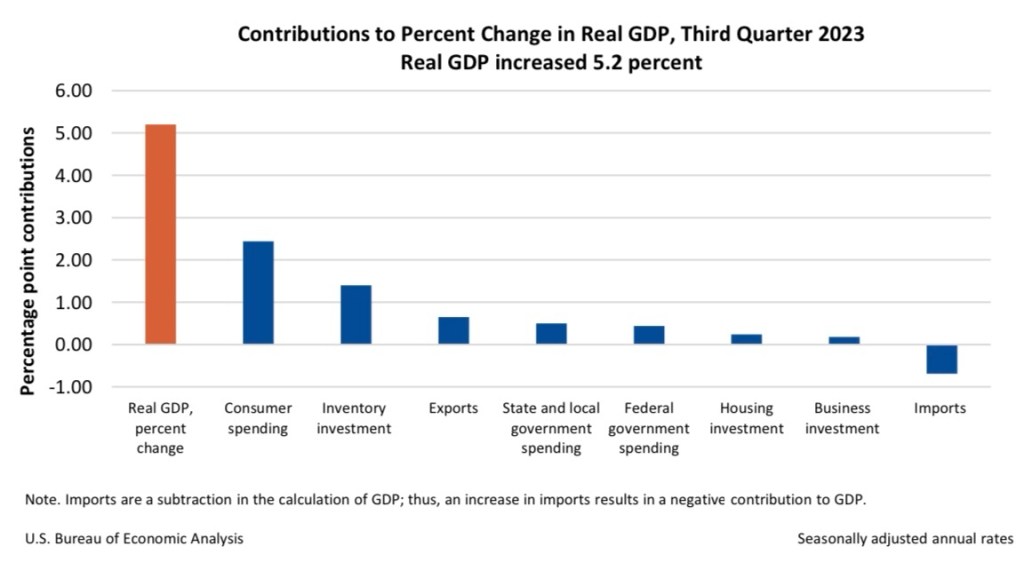
Economic growth is still strong. Real GDP in the third quarter grew at an astonishing 5.2% annual rate. A bulge in inventories accounted for about a quarter of the gain, which might lead to some retrenchment in production plans. Government spending also accounted for roughly a quarter, which corresponds to a literal liability as much as a dubious gain in real output. Unfortunately, fiscal policy is working at cross purposes to the current thrust of monetary policy. Profligate spending and burgeoning budget deficits might artificially prop up the economy for a time, but it adds to risks going forward, not to mention uncertainty surrounding the strength and timing in the effects of tight money.

Consumers accounted for almost half of the third quarter growth despite a slim 0.1% increase in real personal disposable income. That reinforces the argument that consumers are depleting their pandemic savings and becoming more deeply indebted heading into the holidays.

The economy continues to produce jobs at a respectable pace. The November employment report was slightly better than expected, but it was buttressed by the return of striking workers, and retail and manufacturing jobs declined. Still, the unemployment rate fell slightly, so the labor market has remained stronger than expected by most economists.

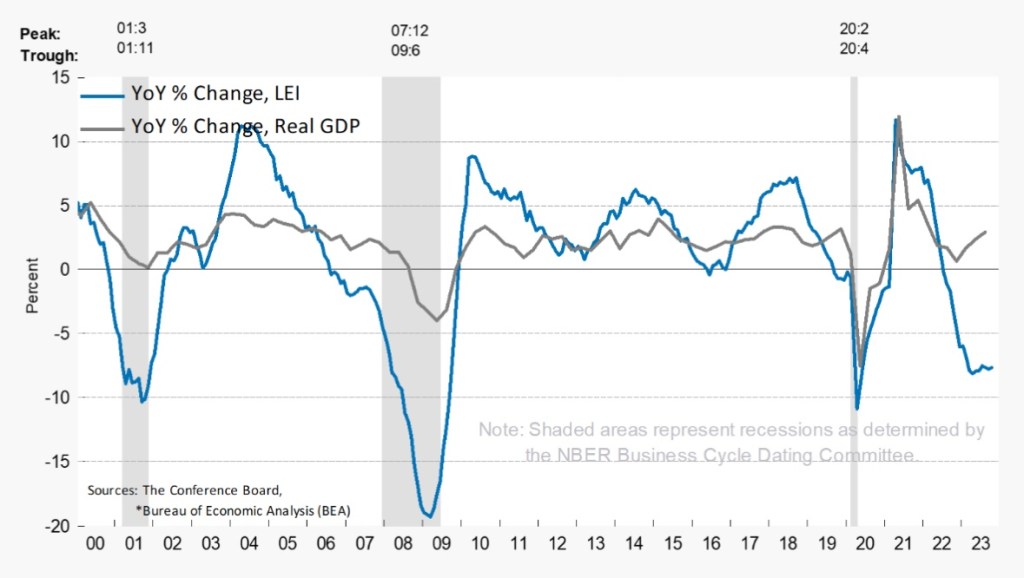
Consumer sentiment had been in the dumps until the University of Michigan report for December, which erased four months of declines. The expectations index is one component of the leading economic indicators, which has been at levels strongly suggesting a recession ahead for well over a year now. See the chart below:

But expectations improved sharply in November, and that included a decline in inflation expectations.

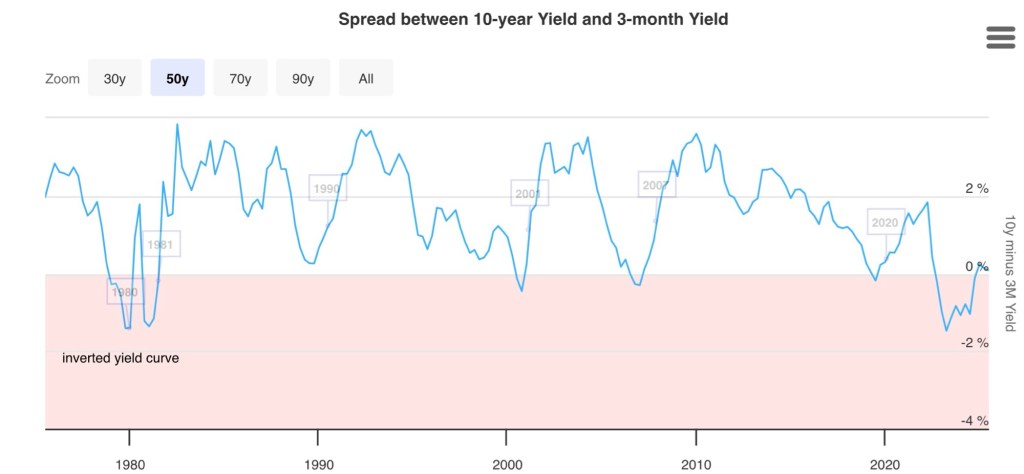
Another component of the LEI is the slope of the yield curve (measured by the difference between the 10-year Treasury bond yield and the federal funds rate). This spread has been a reliable predictor of recessions historically. The 10-year bond yield has declined by over 90 basis points since mid-October, a sign that bond investors think the inflation threat is subsiding. However, that drop steepened the negative slope of the yield curve, meaning that the recession signal has strengthened.

Disinflation, But Still Inflation

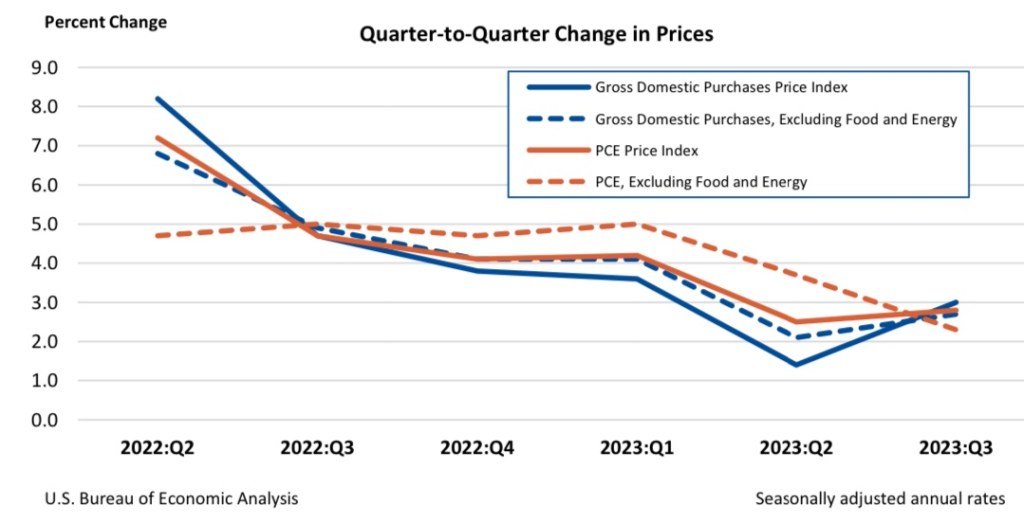
Inflation measures have been slowing, and the Fed’s “target” inflation rate of 2% appears within reach. In the Fed’s view, the most important inflation gauge is the personal consumption expenditures deflator excluding food and energy prices (the “core” PCE). The next chart shows the extent to which it has tapered over the past two quarters. While it’s encouraging that inflation has edged closer to the Fed’s target, it does not mean the inflation fight is over. Still, the decision taken at the December meeting of the Fed’s Open Market Committee (FOMC) to leave its interest rate target unchanged is probably wise.

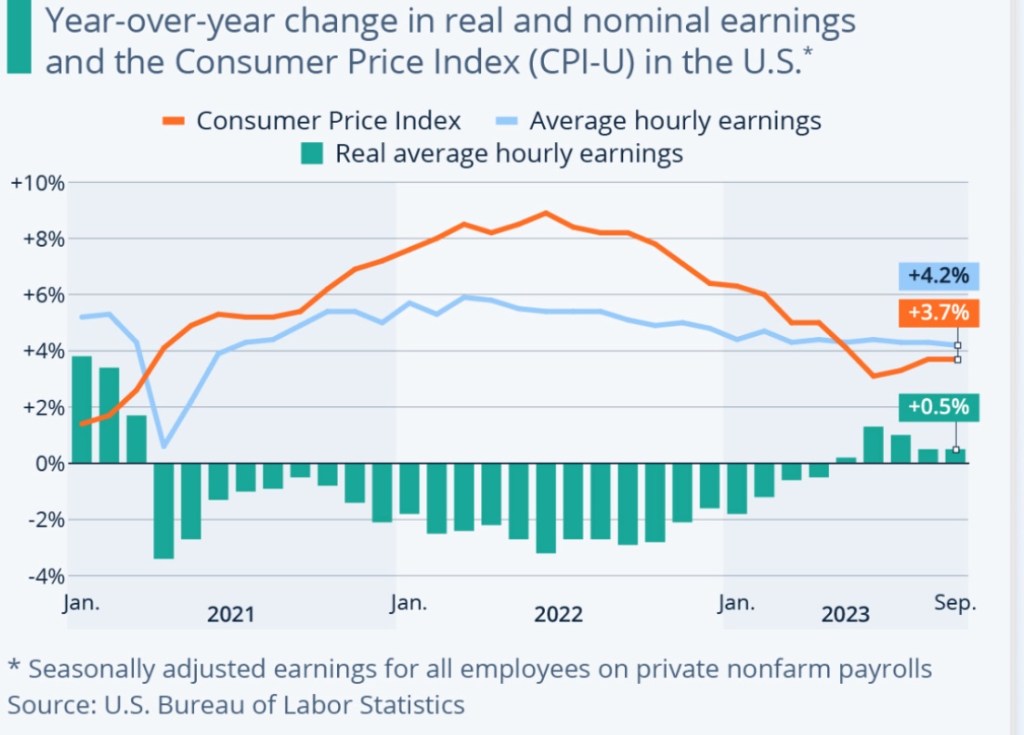
Real wages declined during most of the past three years with the surge in price inflation (see next chart). Some small gains occurred over the past few months, but the earlier declines reinforce the view that consumers need to tighten their belts to maintain savings or avoid excessive debt.

Has Policy Really Been “Tight“?

The prospect of a hard landing presupposes that policy is “tight” and has been tight for some months, but there is disagreement over whether that is, in fact, the case. Scott Sumner, at the link above in the second paragraph, is skeptical that policy is “tight” even now. That’s despite the fact that the Fed hiked its federal funds rate target 11 times between March 2022 and July 2023 (by a total of 5.25%). The Fed waited too long to get started on its upward rate moves, which helps explain the continuing strength of the economy right now.

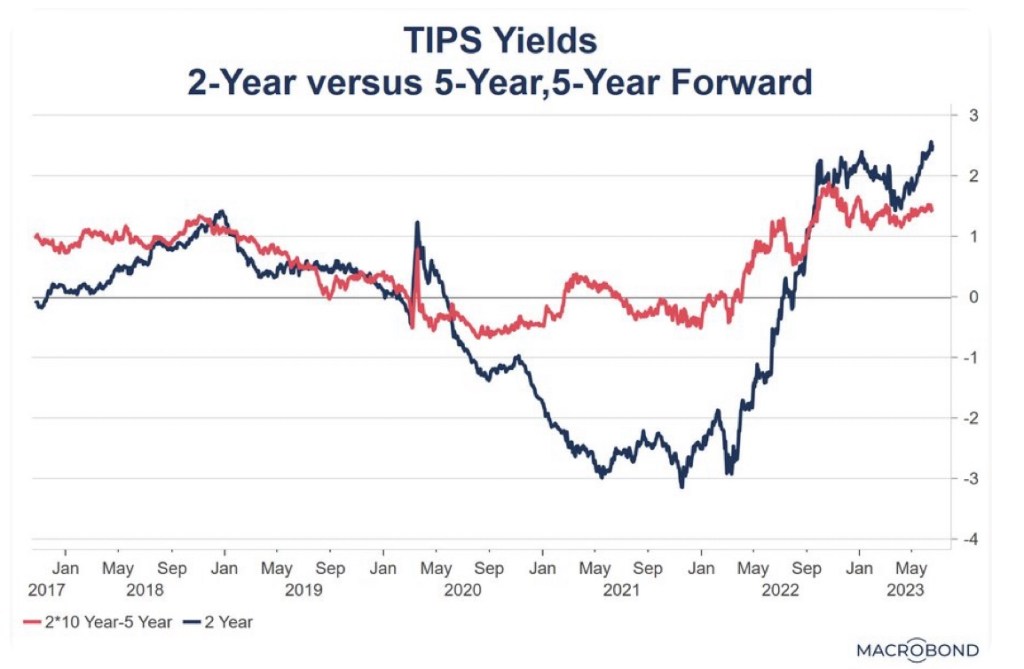
The real fed funds rate turned positive (arguably) as early as last winter as the rate rose and as expected inflation began to decline. There is also solid evidence that real interest rates on the short-end of the maturity spectrum are higher than “neutral” real rates and have been for well over a year (see chart below). If the Fed leaves its rate target unchanged over the next few months, assuming expected inflation continues to taper, the real rate will rise passively and the Fed’s policy stance will have tightened further.

Another view is that the Fed’s policy became “tight” when the monetary aggregates began to decrease (April 2022 for M2). A few months later the Fed began so-called “quantitative tightening” (QT—selling securities to reduce its balance sheet). Thus far, QT has reversed only a portion of the vast liquidity provided by the Fed during the pandemic. However, markets do grow accustomed to generous ongoing flows of liquidity. Cutting them off creates financial tensions that have real economic effects. No doubt the Fed’s commitment to QT established some credibility that a real policy shift was underway. So it’s probably fair to say that policy became “tight” as this realization took hold, which might place the date demarcating “tight” policy around 15 – 18 months ago.

Back to the Lags

Again, changes in monetary policy have a discernible impact only with a lag. The broad range of timing discussed among monetary experts (again, going back to Milton Friedman) is 9 – 24 months. We’re right in there now, which adds to the conviction among many forecasters that the onset of recession is likely during the first half of 2024. That’s my position, and while the tapering of inflation we’ve witnessed thus far is quite encouraging, it might take sustained monetary restraint before we’re at or below the Fed’s 2% target. That also increases the risk that we’ll ultimately suffer through a hard landing. In fact, there are prominent voices like hedge fund boss Bill Ackman who predict the Fed must begin to cut the funds rate soon to avoid a hard landing. Jamie Diamond, CEO of JP Morgan, says the U.S. is headed for a hard landing in 2024.

Looking Forward

If new data over the next few months is consistent with a “soft landing” (and it would take much more than a few months to be conclusive), or especially if the data more strongly indicate an incipient recession, the Fed certainly won’t raise its target rate again. The Fed is likely to begin to cut the funds rate sometime next year, and sooner if a recession seems imminent. Otherwise, my guess is the Fed waits at least until well into the second quarter. The average of FOMC member forecasts at the December meeting works out to three quarter-point rate cuts by year-end 2024. When the Fed does cut its target rate, I hope it won’t at the same time abandon QT, the continuing sales of securities from its currently outsized portfolio. Reducing the Fed’s holdings of securities will restrain money growth and give the central bank more flexibility over future policy actions. QT will also put pressure on Congress and the President to reduce budget deficits.

Real Short-Term Rates Have Been Positive For Months

21 Friday Jul 2023

Posted by Nuetzel in Inflation, Monetary Policy

≈ Leave a comment

Tags

Bidenomics, Cleveland Fed, Inflation Expectations, Joe Biden, Kevin Erdman, Monetary Aggregates, Neutral Fed Funds Rate, Real Interest Rates, Restrictive Policy, TIPS

Note: I’m moving for the first time in many years. We have a lot to do quickly because we’ll close on our new home in early September. It’s in a place with palm trees, but no basements! The clean-up and winnowing of our accumulated papers, possessions, and … junk — not to mention attending to all the details of the move — is taking up all of my time. Anyway, I started the post below a week ago and had to put it aside. Not sure how frequently I’ll be posting till we’re fully settled in the fall, but we’ll see how it goes.

____________________________________________

The inflation news was great last week, with both the Consumer Price Index (CPI) and the Producer Price Index (PPI) reported below expectations. Month-over-month, the increase in the overall CPI was just 0.2%. Year-over-year, CPI inflation was 3%, down from 9% a year ago. Of course, contrary to Joe Biden’s ridiculous claims, this inflation news came despite, and not because of, the pernicious effects of “Bidenomics”. But that aside, just like that, we heard proclamations that the Federal Reserve had finally succeeded in bringing real short-term interest rates into positive territory. Finally, some said, Fed policy had moved into more restrictive territory. But in fact, real rates moved above zero months ago.

The popular rate narrative is based on the fact that the effective Fed Funds rate is now 5.08% while “headline” CPI inflation fell to 2.97%. That would give us a real Fed Funds rate of 3.11%… if that sort of calculation made sense. Here’s an appropriate reaction from Kevin Erdman:

“The short term rate minus trailing 12 month inflation is not a thing. It’s an irrelevant number. Nothing about June 2022 inflation has anything to do with the real fed funds rate in July 2023.”

His statement generalizes to interest rates at any maturity less a corresponding measure of trailing inflation. They are all irrelevant. A proper real rate of interest must incorporate a measure of inflation expectations. Survey data is often used for this purpose, but a better measure can be taken from market expectations by comparing a nominal Treasury rate with a rate on an inflation-indexed Treasury (TIPS) of the same maturity. This is a fairly convenient approach.

Below, we can see that the real one-year Treasury rate has been positive since last November.

And here is the real one-month Treasury rate:

Again, these charts suggest that real short-term rates have been positive much longer than some believe. Whether that represents a “restrictive policy stance” by the Federal Reserve is another matter. We know the Fed has tightened policy, but that began after the notably loose policy conducted throughout the pandemic. Have we truly crossed the threshold into “tightness”?

Here’s the effective (nominal) federal funds rate over the past year.

This rate is under fairly direct control by the Fed, and it is the primary focus of most Fed watchers. It’s an overnight lending rate on loans of reserves between banks, so to adjust it precisely for expected inflation requires an annualized, overnight inflation rate. That’s pretty tricky!

Finding a published measure of expected inflation over durations of less than a year forward is difficult. One can derive one or use a longer-term rate of expected inflation as a proxy, with the proviso that near-term expectations might be more extreme than the proxy, especially if inflation is expected to change from its current pace. Here are one-year inflation expectations over the past year from a Cleveland Fed model that utilizes TIPS returns and other data.

So inflation expectations have declined substantially. If we compare them with short-term interest rates or the effective fed funds rate over the past year, it’s likely the real fed funds rate climbed above zero before the end of the first quarter of 2023. It might even have exceeded the so called “neutral” real Fed funds rate (R*), which was estimated by the Fed to be 1.14% in the first quarter of 2023. A real Fed funds rate above that level would have been deemed restrictive in the first quarter.

My own view is that changes in the Fed funds rate are not at the heart of the transmission mechanism from monetary policy to the real economy. The monetary aggregates are more reliable guides. The broad money stock M2 has been edging lower for well over a year now. That certainly qualifies as a restrictive move, but there is still a lot of excess liquidity out there, left over from the pandemic deluge engineered by the Fed.

The good reports last week might not mark the end of the inflation problem. There are still price pressures from both the demand and supply-sides. Furthermore, to put things in context, the month-to-month increases in May and June of last year were large, which helped to hold down the 12-month increases this May and June. But the CPI was flat during the second half of last year. That means month-to-month inflation over the next six months may well translate into an escalation of year-over-year inflation. That might or might not be turn out to be meaningful, but it would provide a pretext for additional Fed tightening.

The main point of this post is that real interest rates cannot be calculated on the basis of reported inflation over prior months. Doing so at this juncture understates the degree of monetary tightening in terms of short-term rates. Real interest rates can only be determined by nominal rates relative to expectations of future inflation. This gives a more accurate picture of actual credit market conditions and the Fed’s rate policy stance.

Negative Rates and the Thrift Imperative

18 Thursday Aug 2016

Posted by Nuetzel in Monetary Policy

≈ Leave a comment

Tags

Central Banking, Federal Reserve, Income effect, negative interest rates, Nominal Interest Rates, Rate Normalization, Reach For Yield, Real Interest Rates, Retained Earnings, Saving and Negative Interest Rates, saving behavior, Steven R. Beckman, Substitution effect, Supriya Guru, Thrift, Time Preference, Undistributed Corporate Profits, W. James Smith, Wall Street Journal, Working Capital

image

An article of faith among central bankers is that negative interest rates will stimulate spending by consumers and businesses, ending the stagnant growth that has plagued many of the world’s biggest economies. Short-term rates are zero or negative in much of Europe and Japan, and even the Federal Reserve holds out the possibility of bringing rates below zero in the event of a downturn. This policy is almost assuredly counter-productive. It very likely stimulates saving, especially in the context of an aging population, and it distorts the allocation of resources over time and across the risk classes to which saving is applied.

Real vs. Nominal Rates

A preliminary consideration is the distinction between the so-called nominal or stated interest rates, those quoted by banks and bond sellers, and real interest rates, which are net of expected inflation. If the short-term nominal interest rate is zero, but expected inflation is -2%, then the real interest rate is +2%. If expected inflation is +2%, then the real interest rate is -2%. When negative rates are discussed in the media, they generally refer to nominal rates, and central bank interest rate targets are discussed in nominal terms. Again, some central banks are targeting very low or slightly negative nominal rates today. In most of these cases, inflation is low but positive, indicating that real interest rates are negative. With that said, it’s important to note that the discussion below relates to real interest rates, not nominal rates, despite the fact that central banks explicitly target the latter.

Saving Behavior

Most macroeconomists casually assume that lower interest rates discourage saving and thus stimulate spending. However, this is being called into question by observers of recent central bank actions around the world. Those actions have been relatively futile in stimulating spending thus far. In fact, data suggest that the negative-rate policies might be increasing saving rates. These points are discussed in “Are Negative Rates Backfiring? Here’s Some Early Evidence” in the Wall Street Journal (or this Google search if the first link fails).

An examination of the microeconomic foundations of the standard treatment of saving behavior shows that it requires some limiting assumptions. We all face constraints in meeting our future income goals: our current income imposes a limit on what we can save, and the rate of return we can earn on our funds limits what we can accumulate over time from a given level of saving. Those constraints must be balanced against an individual’s preferences for present pleasure relative to future gain.

Time Preference

The rate at which agents are willing to sacrifice future for present consumption is often called the rate of time preference. This differs from one individual to another. A high rate of time preference means that the individual requires a large future reward to induce them to set aside resources today, foregoing present consumption. A low rate of time preference means that little inducement is necessary for saving, so the individual is “thrifty”. It’s generally impossible to directly observe differing rates of time preference across individuals, but they reveal their preferences for present and future consumption via their saving (or borrowing) behavior. If an individual saves more than another with an equal income, it implies that the first has a lower rate of time preference at a given level of present consumption.

Substitution and Income Effects

A lower interest rate always creates a tendency to substitute present for future consumption. That’s because the change is akin to an increase in the price of future consumption. However, that substitution might be offset, or more than offset, by the fact that total achievable lifetime income is diminished: the lower rate at which the individual’s use of resources can be transferred from the present to the future means that some sacrifice is necessary. In other words, the negative “income effect” might cause consumers to reduce consumption in the future and in the present! Thus, saving may increase in response to a lower interest rate. Perhaps that tendency will be exaggerated if rates turn negative, but it all depends on the shape of preferences for present versus future consumption.

Which of these two effects will dominate? The substitution effect, which increases present consumption and reduces saving? Or the income effect, which does the opposite? Again, consumers are diverse in their rates of time preference. There are borrowers who prefer to have more now and less later, and savers who might wish to equalize consumption over time or accumulate assets in pursuit of other goals, such as bequests. A shift from a positive to a negative interest rate would reward borrowers who wish to consume more now and less later. Both their substitution and income effects on present consumption would be positive! In fact, spending by that segment might be the only unambiguously stimulative effect from negative rates. But individuals with low rates of time preference are more likely to spend less in the present, and save more, after the change. Two individuals with identical substitution effects in response to the shift to negative rates may well differ in their income effects: the largest saver of the two will suffer the largest negative income effect.

Ugly Intervention

These uneven impacts on saving are a testament to the pernicious effects of central bank intervention leading to negative rates. Savers are punished, while those who care little about self-reliance and planning for the future are rewarded. Of course, at an aggregate level, saving out of income is positive, so on balance, agents demonstrate  that they have sufficiently low rates of time preference to qualify for some degree of punishment via negative rates. After all, savers will unambiguously suffer a decline in lifetime income given the shift to negative rates.

The Necessity of Thrift

The fact that a standard macroeconomic treatment of saving ignores negative income effects at very low rates of interest is surprising given the very nature of thrift. Savers obviously view future consumption as something of a necessity, especially as they approach retirement. Present and future consumption are locally substitutable, but large substitutions come only with great pain, either now or later. Another way of saying this is that present and future consumption behave more like complements than substitutes. (A more technical treatment of this distinction is given in “Complementarity, Necessity and Preferences“, by Steven R. Beckman and W. James Smith.) This provides a basic rationale for a conflicting assumption often made in macroeconomic literature: that economic agents attempt to “smooth” their consumption over time. If present and future consumption are treated as strict complements, there is no question that the income effect of a shift to negative  rates will increase saving by those who already save.

This is not to imply that savers always respond to lower rates by saving more. In “Choice between Present Consumption and Future Consumption“, Supriya Guru asserts that empirical evidence for the U.S. suggests that the substitution effect dominates. However, extremely low or negative interest rates are a recent phenomenon, and empirical evidence is predominantly from periods of history with much higher rates. Moreover, the advent of very low rates is coincident with demographic shifts favoring more intense efforts to save. The aging populations in the U.S., Europe and Japan might reinforce the tendency to respond to negative rates by saving more out of current income.

Risk As a Relief Valve

Another complexity regarding the shape of preferences is that consumers might never be willing to substitute present consumption for less in the future. That is, their rate of time preference may be bounded at zero, even if the interest rate imposed by the central bank is negative. An earlier post on Sacred Cow Chips dealt with this issue. In that case, saving will increase with a shift to negative rates under two conditions: 1) there is a minimal level of future consumption deemed a necessity by consumers; and 2) that level exceeds the consumption that is possible without saving (endowed or received via transfers). That outcome represents a “corner solution”, however. Chances are that consumers, having been forced to accept an unacceptable tradeoff at negative “risk-free” rates, will lean more heavily on other margins along which they can optimize, such as risk and return.

That eventuality suggests another reason to suspect that very low or negative rates are not stimulative: savers face a range of vehicles in which to place their funds, not simply deposits and short-term money market funds earning low or negative yields. Some of these alternatives earn much higher returns, but only at significant risk. Nevertheless, the poor returns on safe alternatives will lead some savers to “reach for yield” by accepting high risks. That is a rational response to the conditions imposed by central banks, but it leads consumers to accept risk that is otherwise not desired, with a certain number of consumers suffering dire ex post outcomes. It also leads to an allocation of the economy’s capital that is riskier than would otherwise occur.

Furthermore, as mentioned in the WSJ article linked above, consumers might regard negative rates as a foreboding signal about the economic future. The negative rates are bad enough, but even reduced levels of future consumption might be under threat. Thus, risk aversion might lead to greater saving in the context of a shift to negative rates.

Corporate Saving and Capital Investment

A great deal of saving in the economy is done by corporate entities in the form of “undistributed corporate profits”, or retained earnings. It must be said that these flows are not especially dependent on short-term yields, even if those yields have a slight influence on corporate management’s view of the opportunity cost of equity capital. Rather, those flows are more dependent on the firm’s current profitability. To the extent that very low or negative interest rates discourage consumption, their effect on current profitability and the perceived profitability of new business capital projects cannot be positive. To the extent that very low or negative rates portend risk, their effect on capital investment decisions will be negative. Savings out of personal income and from retained earnings is likely to exceed the amount required to fund desired capital investment. The funds accumulated in this way will remain idle (excess working capital) or be put toward unproductive uses, as befits an environment in which real returns are negative.

We Gotta Get Out of This Place

Central banks will be disappointed that the primary rationale for their reliance on negative interest rates lacks validity, and that the policy is counterproductive. Statements from Federal Reserve officials indicate that the next expected move in their interest rate target will be upward. However, they have not ruled out negative rates in the event that economic growth turns down. Perhaps the debate over negative rates is still raging inside the Fed. With any luck, and as evidence piles up from overseas on the futility of negative rates, those arguing for a “normalization” of rates at higher levels will carry the day.

Follow Sacred Cow Chips on WordPress.com

Recent Posts

  • The Case Against Interest On Reserves
  • Immigration and Merit As Fiscal Propositions
  • Tariff “Dividend” From An Indigent State
  • Almost Looks Like the Fed Has a 3% Inflation Target
  • Government Malpractice Breeds Health Care Havoc

Archives

  • January 2026
  • December 2025
  • November 2025
  • October 2025
  • September 2025
  • August 2025
  • July 2025
  • June 2025
  • May 2025
  • April 2025
  • March 2025
  • February 2025
  • January 2025
  • December 2024
  • November 2024
  • October 2024
  • September 2024
  • August 2024
  • July 2024
  • June 2024
  • May 2024
  • April 2024
  • March 2024
  • February 2024
  • January 2024
  • December 2023
  • November 2023
  • August 2023
  • July 2023
  • June 2023
  • May 2023
  • April 2023
  • March 2023
  • February 2023
  • January 2023
  • December 2022
  • November 2022
  • October 2022
  • September 2022
  • August 2022
  • July 2022
  • June 2022
  • May 2022
  • April 2022
  • March 2022
  • February 2022
  • January 2022
  • December 2021
  • November 2021
  • October 2021
  • September 2021
  • August 2021
  • July 2021
  • June 2021
  • May 2021
  • April 2021
  • March 2021
  • February 2021
  • January 2021
  • December 2020
  • November 2020
  • October 2020
  • September 2020
  • August 2020
  • July 2020
  • June 2020
  • May 2020
  • April 2020
  • March 2020
  • February 2020
  • January 2020
  • December 2019
  • November 2019
  • October 2019
  • September 2019
  • August 2019
  • July 2019
  • June 2019
  • May 2019
  • April 2019
  • March 2019
  • February 2019
  • January 2019
  • December 2018
  • November 2018
  • October 2018
  • September 2018
  • August 2018
  • July 2018
  • June 2018
  • May 2018
  • April 2018
  • March 2018
  • February 2018
  • January 2018
  • December 2017
  • November 2017
  • October 2017
  • September 2017
  • August 2017
  • July 2017
  • June 2017
  • May 2017
  • April 2017
  • March 2017
  • February 2017
  • January 2017
  • December 2016
  • November 2016
  • October 2016
  • September 2016
  • August 2016
  • July 2016
  • June 2016
  • May 2016
  • April 2016
  • March 2016
  • February 2016
  • January 2016
  • December 2015
  • November 2015
  • October 2015
  • September 2015
  • August 2015
  • July 2015
  • June 2015
  • May 2015
  • April 2015
  • March 2015
  • February 2015
  • January 2015
  • December 2014
  • November 2014
  • October 2014
  • September 2014
  • August 2014
  • July 2014
  • June 2014
  • May 2014
  • April 2014
  • March 2014

Blogs I Follow

  • Passive Income Kickstart
  • OnlyFinance.net
  • TLC Cholesterol
  • Nintil
  • kendunning.net
  • DCWhispers.com
  • Hoong-Wai in the UK
  • Marginal REVOLUTION
  • Stlouis
  • Watts Up With That?
  • Aussie Nationalist Blog
  • American Elephants
  • The View from Alexandria
  • The Gymnasium
  • A Force for Good
  • Notes On Liberty
  • troymo
  • SUNDAY BLOG Stephanie Sievers
  • Miss Lou Acquiring Lore
  • Your Well Wisher Program
  • Objectivism In Depth
  • RobotEnomics
  • Orderstatistic
  • Paradigm Library
  • Scattered Showers and Quicksand

Blog at WordPress.com.

Passive Income Kickstart

OnlyFinance.net

TLC Cholesterol

Nintil

To estimate, compare, distinguish, discuss, and trace to its principal sources everything

kendunning.net

The Future is Ours to Create

DCWhispers.com

Hoong-Wai in the UK

A Commonwealth immigrant's perspective on the UK's public arena.

Marginal REVOLUTION

Small Steps Toward A Much Better World

Stlouis

Watts Up With That?

The world's most viewed site on global warming and climate change

Aussie Nationalist Blog

Commentary from a Paleoconservative and Nationalist perspective

American Elephants

Defending Life, Liberty and the Pursuit of Happiness

The View from Alexandria

In advanced civilizations the period loosely called Alexandrian is usually associated with flexible morals, perfunctory religion, populist standards and cosmopolitan tastes, feminism, exotic cults, and the rapid turnover of high and low fads---in short, a falling away (which is all that decadence means) from the strictness of traditional rules, embodied in character and inforced from within. -- Jacques Barzun

The Gymnasium

A place for reason, politics, economics, and faith steeped in the classical liberal tradition

A Force for Good

How economics, morality, and markets combine

Notes On Liberty

Spontaneous thoughts on a humble creed

troymo

SUNDAY BLOG Stephanie Sievers

Escaping the everyday life with photographs from my travels

Miss Lou Acquiring Lore

Gallery of Life...

Your Well Wisher Program

Attempt to solve commonly known problems…

Objectivism In Depth

Exploring Ayn Rand's revolutionary philosophy.

RobotEnomics

(A)n (I)ntelligent Future

Orderstatistic

Economics, chess and anything else on my mind.

Paradigm Library

OODA Looping

Scattered Showers and Quicksand

Musings on science, investing, finance, economics, politics, and probably fly fishing.

  • Subscribe Subscribed
    • Sacred Cow Chips
    • Join 128 other subscribers
    • Already have a WordPress.com account? Log in now.
    • Sacred Cow Chips
    • Subscribe Subscribed
    • Sign up
    • Log in
    • Report this content
    • View site in Reader
    • Manage subscriptions
    • Collapse this bar
 

Loading Comments...