• About

Sacred Cow Chips

Sacred Cow Chips

Tag Archives: Risk Aversion

The Bad News Industrial Complex

20 Friday Apr 2018

Posted by Nuetzel in Big Government, Corruption, Risk Management

≈ Leave a comment

Tags

Beepocalypse, Cronyism, Matt Ridley, NASA, News Media, Oxfam, Precautionary Principle, rent-seeking behavior, Risk Aversion, Risk Mitigation, The Lancet

Matt Ridley had an interesting piece on his blog last month entitled “Bad News Is Sudden, Good News Is Gradual“. It’s about the timing of news, as stated, and it’s about our bias toward bad news more generally. There is no question that bad news tends to be more dramatic than good news. But with steadily increasingly lifespans, growing prosperity, and world poverty at an all-time low, surely good news must come as much or more frequently than bad. But good news can be inconvenient to certain narratives. It is therefore often ignored, and some other purported disaster is found as a substitute:

“Poverty and hunger are the business Oxfam is in, but has it shouted the global poverty statistics from the rooftops? Hardly. It has switched its focus to inequality. When The Lancet published a study in 2010 showing global maternal mortality falling, advocates for women’s health tried to pressure it into delaying publication ‘fearing that good news would detract from the urgency of their cause’, The New York Times reported. The announcement by Nasa in 2016 that plant life is covering more and more of the planet as a result of carbon dioxide emissions was handled like radioactivity by most environmental reporters.“

Tales of bad outcomes can be alluring, especially if they haven’t happened yet. In fact, bad things might even happen gradually, but dark visions of a world beyond the horizon impart a spooky sense of immediacy, and indeed, urgency. Ridley notes the tendency of people to regard pessimists as “wise”, while optimists are viewed as Pollyannas. And he recognizes that risk aversion plays an important role in this psychology. That brings me to the point I found most interesting in Ridley’s piece: the many vested interests in disasters, and disasters foretold.

Risk management is big business in an affluent society. There is a lot to lose, and a squeamish populace is easily cowed by good scare stories. The risk management and disaster-prevention narrative can be wrapped around any number of unlikely or exaggerated threats, serving the interests of the administrative state and private rent-seekers. One particular tool that has been most useful to this alliance is the precautionary principle. It is invoked to discourage or regulate activities presumed to pose risks to the public or to the environment. But there are three dimensions to the application of the precautionary principle: it provides a rationale for public funding of research into the risk-du-jour, for funding projects designed to mitigate its consequences, and for subsidizing development of alternative technologies that might help avoid or reduce the severity of the risk, often at great expense. The exaggeration of risk serves to legitimize these high costs. Of course, the entire enterprise would be impossible without the machinery of the state, in all its venality. Where money flows, graft is sure to follow.

Well-publicized disaster scenarios are helpful to statists in other ways. Risk, its causes, and its consequences are not distributed evenly across regions and populations. A risk thought to be anthropomorphic in nature implies that wealthier and more productive communities and nations must shoulder the bulk of the global costs of mitigation. Thus, the risk-management ethic requires redistribution. Furthermore, wealthier regions are better situated to insulate themselves locally against many risks. Impoverished areas, on the other hand, must be assisted. Finally, an incredible irony of our preoccupation with disaster scenarios is the simultaneous effort to subsidize those deemed most vulnerable even while executing other policies that harm them.

Media organizations and their newspeople obviously benefit greatly from the subtle sensationalism of creeping disaster. As Ridley noted, the gradualism of progress is no match for a scare story on the nightly news. There is real money at stake here, but the media is driven not only by economic incentives. In fact, the dominant leftist ideology in media organizations means that they are more than happy to spread alarm as part of a crusade for state solutions to presumed risks. There are even well-meaning users of social media who jump at the chance to signal their virtue by reposting memes and reports that are couched not merely in terms of risks, but as dire future realities.

Mitigating social risks is a legitimate function of government. Unfortunately, identifying and exaggerating risks, and suppressing contradictory evidence, is in the personal interest of politicians, bureaucrats, crony capitalists, and many members of the media. Everything seems to demand government intervention. Carbon concentration, global warming and sea level changes are glaring examples of exaggerated risks. As Ridley says,

“The supreme case of unfalsifiable pessimism is climate change. It has the advantage of decades of doom until the jury returns. People who think the science suggests it will not be as bad as all that, or that humanity is likely to mitigate or adapt to it in time, get less airtime and a lot more criticism than people who go beyond the science to exaggerate the potential risks. That lukewarmers have been proved right so far cuts no ice.”

Other examples include the “beepocalypse“, genetic modification, drug use, school shootings, and certain risks to national security. Ridley offers the consequences of Brexit as well. There, I’ve listed enough sacred cows to irritate just about everyone.

In many cases, the real crises have more to do with government activism than the original issue with which they were meant to reckon. Which brings me to a discomfiting vision of my own: having allowed the administrative state to metastasize across almost every social organ and every aspect of our lives, a huge risk to our future well-being is continuing erosion of personal and economic liberties and our ability to prosper as a society. Here’s Ridley’s close:

“Activists sometimes justify the focus on the worst-case scenario as a means of raising consciousness. But while the public may be susceptible to bad news they are not stupid, and boys who cry ‘wolf!’ are eventually ignored. As the journalist John Horgan recently argued in Scientific American: ‘These days, despair is a bigger problem than optimism.'”
Unequal Pay For Unequal Work

25 Thursday Feb 2016

Posted by Nuetzel in Labor Markets

≈ Leave a comment

Tags

BLS, Claudia Golden, DOL, FiveThirtyEight, Gender Discrimination, Gender Gap, High-Risk Occupations, Job Flexibility, Mark Perry, Millennial Pay Gap, Mutually Beneficial Trade, Non-Wage Compensation, Obama Discrimination Data Mandate, Occupational Choice, Pay Differentials, Risk Aversion, STEM, The Economist, Tyler Cowen

equal-pay-cartoon

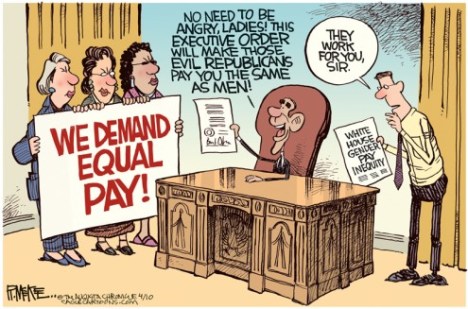
Debates on social issues are often plagued by facile comparisons that distort the underlying facts. The alleged gender pay gap involves such comparisons. The Obama Administration proposed new rules last month intended to address a difference in median earnings between men and women, demanding data reports on various demographics from firms with 100+ employees. Mark Perry points out that the pay gap in the Obama White House is about the same as the national difference. Can there be any reasonable explanation for these disparities?

One key to understanding the debate is that the difference in aggregate pay between men and women (17% in 2014, according to the Bureau of Labor Statistics) is not a divergence in pay for equal work! However, that is the gist of the fraudulent narrative so often heard from the White House and elsewhere. The truth: 17% is the difference in the medians of two large distributions of working adults, one for men, one for women, covering all occupational categories. The discrepancy, which has declined sharply over the past 35 years, is explained today by fewer hours worked among women and “differences in educational attainment, work experience, and occupational choice.” These differences are well known, but gender-gap warriors conveniently overlook the following facts, as established by the Department of Labor:

  • There is more part-time work among women;
  • Women lose more experience to childbirth, child care and elder care;
  • Women demand more job flexibility and non-wage benefits (and that costs);
  • Women are disproportionately under-represented in dangerous occupations;
  • Women are disproportionately under-represented in STEM fields (Science, Technology, Engineering, Math);

Interestingly, the last point may have more to do with a broader range of talents possessed by females who are skilled at math, relative to men, which leads to a greater variety of career options. An implication: non-STEM occupational choices by women are often voluntary and not the result of discrimination. And those choices are often driven by considerations other than cash remuneration.

As to the risk of physical danger, in 2010, men were almost 12 times as likely as women to suffer fatal injuries on the job. There is no question that high-risk occupations have higher wages. Apparently, women choose not to pursue opportunities in these occupations. An earlier study found that single parents, male and female, were the most risk averse in their choice of occupation, and that married women with children are more risk averse than married men with children. Of course, it is possible that some employers have requirements in terms of physical strength that favor men. Either way, the job-risk gap almost certainly contributes to the measured-wage gender gap, but it has little to do with gender discrimination per se.

Earnings are sensitive to factors such as full-time / part-time status, continuous job tenure, and the likelihood of extended leaves of absence. This is supported by a research finding cited in The Economist, that partners in lesbian relationships tend to out-earn married straight females. The division of responsibilities in the home is surely part of the story: lesbian couples tend to split chores more equally than straight couples. Millennial couples (ages 25-34) are also more likely to split household chores equally; the gender pay gap for millennials is much narrower than for older age cohorts, and it is nonexistent for childless millennials. Millennial women have more than closed the education gap as well.

When gender differences in hours, tenure, absences, education, and job hazards are considered, as well as the full menu of compensating non-wage benefits available, the wage gap is essentially nonexistent. Yet President Obama’s proposed data mandate would carry high compliance costs and likely cost jobs as well. The purpose of the regulation is to make it easier for various groups to sue employers on the basis of wage discrimination. But observation of such a gap, wherever it might exist, is not prime facie evidence of discrimination; it is more than likely to be the result of private, voluntary agreement.

Is it possible that certain attitudes or behavioral characteristics of women generalize to poorer outcomes, relative to men, in negotiations? Tyler Cowan reports on research that suggests as much, based on “laboratory” experiments in which participants played repeated games involving actual rewards. In one experiment, the rewards depended on the acceptance of an offer to share a pot, and both men and women made lower offers to female partners than to males. However, when the partner was a woman, females were markedly stingier in their offers than males. Those women are tough! But seldom are real-world “deals” so one-dimensional, and controlling for all considerations of value is often impossible. In any case, trades rarely take place when the parties don’t find them to be mutually beneficial.

Fortunately, in labor markets, when differentials in skills and experience matter, discrimination is practiced only under a self-inflicted penalty on the discriminator. In the case of wage-based gender discrimination, the employer will tend to overpay for equivalently-skilled male help. Discrimination of this sort impairs a firm’s ability to attract the best employees and harms its competitive position. Nevertheless, the extent to which the market’s self-regulation confers benefits on individual participants depends upon their vigilance: buyer beware (caveat emptor) and seller beware (caveat venditor) are keys to real economic freedom. Most importantly, in all things, beware government edicts. Markets are the best regulator.

Sidebar: I was referred to an article on FiveThirtyEight by my friend John Crawford. The main subject matter of the article is off-topic and its conclusions are incorrect (I might post on it soon), but many of the charts are interesting; the third chart is really fascinating! It shows that women, by age 30, tend to belong to households that are higher in the income distribution than men who come from the same point in the distribution of household-income in childhood. This is true at every point in the childhood household-income distribution! Are there advantage(s) for women that can account for this? A few guesses: a lower rate of incarceration of women by age 30; women have higher marriage rates by age 30; women “marry up” more than men, both in terms of the ages and incomes of their spouses; women who don’t marry live with their parents more than men do (?). There could be other explanations, and the relationship may not hold at later ages. Still, it’s noteworthy that such a reverse “gender gap” exists in the data.

I close with a quote from Harvard’s Claudia Golden, from “A Grand Gender Convergence: Its Last Chapter” (HT: Marginal Revolution):

“The gap is much lower than it had once been and the decline has been largely due to an increase in the productive human capital of women relative to men. Education at all levels increased for women relative to men and the fields that women pursue in college and beyond shifted to the more remunerative and career-oriented ones. Job experience of women also expanded with increased labor force participation. The portion of the difference in earnings by gender that was once due to differences in productive characteristics has largely been eliminated. 

What, then, is the cause of the remaining pay gap? Quite simply the gap exists because hours of work in many occupations are worth more when given at particular moments and when the hours are more continuous. That is, in many occupations earnings have a nonlinear relationship with respect to hours. A flexible schedule comes at a high price, particularly in the corporate, finance and legal worlds.“

Follow Sacred Cow Chips on WordPress.com

Recent Posts

  • The Case Against Interest On Reserves
  • Immigration and Merit As Fiscal Propositions
  • Tariff “Dividend” From An Indigent State
  • Almost Looks Like the Fed Has a 3% Inflation Target
  • Government Malpractice Breeds Health Care Havoc

Archives

  • January 2026
  • December 2025
  • November 2025
  • October 2025
  • September 2025
  • August 2025
  • July 2025
  • June 2025
  • May 2025
  • April 2025
  • March 2025
  • February 2025
  • January 2025
  • December 2024
  • November 2024
  • October 2024
  • September 2024
  • August 2024
  • July 2024
  • June 2024
  • May 2024
  • April 2024
  • March 2024
  • February 2024
  • January 2024
  • December 2023
  • November 2023
  • August 2023
  • July 2023
  • June 2023
  • May 2023
  • April 2023
  • March 2023
  • February 2023
  • January 2023
  • December 2022
  • November 2022
  • October 2022
  • September 2022
  • August 2022
  • July 2022
  • June 2022
  • May 2022
  • April 2022
  • March 2022
  • February 2022
  • January 2022
  • December 2021
  • November 2021
  • October 2021
  • September 2021
  • August 2021
  • July 2021
  • June 2021
  • May 2021
  • April 2021
  • March 2021
  • February 2021
  • January 2021
  • December 2020
  • November 2020
  • October 2020
  • September 2020
  • August 2020
  • July 2020
  • June 2020
  • May 2020
  • April 2020
  • March 2020
  • February 2020
  • January 2020
  • December 2019
  • November 2019
  • October 2019
  • September 2019
  • August 2019
  • July 2019
  • June 2019
  • May 2019
  • April 2019
  • March 2019
  • February 2019
  • January 2019
  • December 2018
  • November 2018
  • October 2018
  • September 2018
  • August 2018
  • July 2018
  • June 2018
  • May 2018
  • April 2018
  • March 2018
  • February 2018
  • January 2018
  • December 2017
  • November 2017
  • October 2017
  • September 2017
  • August 2017
  • July 2017
  • June 2017
  • May 2017
  • April 2017
  • March 2017
  • February 2017
  • January 2017
  • December 2016
  • November 2016
  • October 2016
  • September 2016
  • August 2016
  • July 2016
  • June 2016
  • May 2016
  • April 2016
  • March 2016
  • February 2016
  • January 2016
  • December 2015
  • November 2015
  • October 2015
  • September 2015
  • August 2015
  • July 2015
  • June 2015
  • May 2015
  • April 2015
  • March 2015
  • February 2015
  • January 2015
  • December 2014
  • November 2014
  • October 2014
  • September 2014
  • August 2014
  • July 2014
  • June 2014
  • May 2014
  • April 2014
  • March 2014

Blogs I Follow

  • Passive Income Kickstart
  • OnlyFinance.net
  • TLC Cholesterol
  • Nintil
  • kendunning.net
  • DCWhispers.com
  • Hoong-Wai in the UK
  • Marginal REVOLUTION
  • Stlouis
  • Watts Up With That?
  • Aussie Nationalist Blog
  • American Elephants
  • The View from Alexandria
  • The Gymnasium
  • A Force for Good
  • Notes On Liberty
  • troymo
  • SUNDAY BLOG Stephanie Sievers
  • Miss Lou Acquiring Lore
  • Your Well Wisher Program
  • Objectivism In Depth
  • RobotEnomics
  • Orderstatistic
  • Paradigm Library
  • Scattered Showers and Quicksand

Blog at WordPress.com.

Passive Income Kickstart

OnlyFinance.net

TLC Cholesterol

Nintil

To estimate, compare, distinguish, discuss, and trace to its principal sources everything

kendunning.net

The Future is Ours to Create

DCWhispers.com

Hoong-Wai in the UK

A Commonwealth immigrant's perspective on the UK's public arena.

Marginal REVOLUTION

Small Steps Toward A Much Better World

Stlouis

Watts Up With That?

The world's most viewed site on global warming and climate change

Aussie Nationalist Blog

Commentary from a Paleoconservative and Nationalist perspective

American Elephants

Defending Life, Liberty and the Pursuit of Happiness

The View from Alexandria

In advanced civilizations the period loosely called Alexandrian is usually associated with flexible morals, perfunctory religion, populist standards and cosmopolitan tastes, feminism, exotic cults, and the rapid turnover of high and low fads---in short, a falling away (which is all that decadence means) from the strictness of traditional rules, embodied in character and inforced from within. -- Jacques Barzun

The Gymnasium

A place for reason, politics, economics, and faith steeped in the classical liberal tradition

A Force for Good

How economics, morality, and markets combine

Notes On Liberty

Spontaneous thoughts on a humble creed

troymo

SUNDAY BLOG Stephanie Sievers

Escaping the everyday life with photographs from my travels

Miss Lou Acquiring Lore

Gallery of Life...

Your Well Wisher Program

Attempt to solve commonly known problems…

Objectivism In Depth

Exploring Ayn Rand's revolutionary philosophy.

RobotEnomics

(A)n (I)ntelligent Future

Orderstatistic

Economics, chess and anything else on my mind.

Paradigm Library

OODA Looping

Scattered Showers and Quicksand

Musings on science, investing, finance, economics, politics, and probably fly fishing.

  • Subscribe Subscribed
    • Sacred Cow Chips
    • Join 128 other subscribers
    • Already have a WordPress.com account? Log in now.
    • Sacred Cow Chips
    • Subscribe Subscribed
    • Sign up
    • Log in
    • Report this content
    • View site in Reader
    • Manage subscriptions
    • Collapse this bar
 

Loading Comments...