• About

Sacred Cow Chips

Sacred Cow Chips

Tag Archives: Single-Payer System

Health Insurance Profits Are Not the Problem

08 Thursday Jul 2021

Posted by Nuetzel in Health Insurance, Profit Motive

≈ Leave a comment

Tags

Capitalization, COBRA, Community Rating, Cronyism, Death Spiral, Economies of Scale, Health Insurance, Medical Loss Ratio, Monopsony, Obamacare, Premium Subsidies, Profit, Profit Motive, Single-Payer System
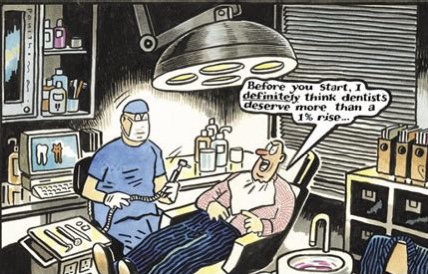
My dentist said, “Oh well, these days it’s really only about whether the insurance company makes a profit….” A giant appliance was in my mouth at the time, propping it open, so I couldn’t respond. But I made a mental note because it reminded me of the hypocrisy so common in how people regard the concept of profit. That’s especially true of the Left, and I happen to know that my dentist, whom I personally like very much, stands well to my left. 

Profit Is Income

It’s worth pointing out that profit is merely compensation. My dentist collects revenue, often paid to him by insurers. If he runs an efficient practice, then he earns an income after paying staff, office rent, various suppliers, and for equipment, including interest on any debt outstanding. You wouldn’t be wrong to call that profit, and he does pretty well for himself, but somehow he thinks it’s different.

My dentist probably feels locked into an adversarial position with my insurer, and of course he is in the short run. He says his price is $750; the insurer says, “Sorry Charlie, you get $250”. So as far as he’s concerned, it’s a zero-sum game. Not so in the long run, however. He needs to partner with insurers to get and keep patients, so the exchange is mutually beneficial. And while he might do some picking and choosing among insurers, he’s essentially a price taker. His “price” of $750 is something of a fiction, as he’s clearly willing to do the work for the insurer’s reimbursement. 

I think the key qualitative difference between my dentist’s income and that of any wage earner is that his income is always at risk. After all, profit is often regarded as a return to entrepreneurial risk-taking. As it happens, he’s taking a loss on my new crown because it cracked as soon as he put it in. Then, he had to start from scratch with new impressions, after painstakingly removing the cemented, cracked pieces with what felt like a tiny circular saw.

Middling Profitability

But what about those profit-hungry health insurers? In fact, they are not known for outrageously high profits, and their earnings are typically not valued as highly by the market as those of other industries, dollar for dollar. Competition helps restrain pricing and enhance performance, of course. And since the advent of Obamacare, profits have been subject to a loose “cap” (more on that below).

The profitability of health insurers improved in 2020, however, because so many tests and elective procedures were postponed or foregone due to the coronavirus pandemic. That also prompted the government to make more generous subsidies available to consumers to pay COBRA insurance premiums.

Profits Drive Efficiency

I’ll put aside concerns about the crony capitalism inherent in the health system-insurer-regulator nexus, at least for a moment. The profit motive is the fundamental driver of efficiency in the production of insurance contracts and pooling of risks, as well as efficient servicing and administration of those contracts. Absent the possibility of profit, these tasks would become mere bureaucratic functions with little regard for cost and resource allocation. Furthermore, managing risk requires a deep pool of capital to ensure the ability of the insurer to meet future claims. Reinvestment and growth of the enterprise also requires capital. That capital is always at risk and it is costly because its owners demand a return as fair compensation. 

Poor Alternatives

Eliminating profit from the insurance function implies that resources must be put at risk without compensation. That’s one of the reasons why non-profit insurers, over the years, have tended to be thinly capitalized and unstable, or limited in their offerings to “health maintenance” benefits, like primary or preventative care, as opposed to insuring against catastrophic events. Capital grants to non-profits (private or governmental) usually come with strings attached, which can severely limit the effectiveness of the capital for meeting existing or future needs of the operation. Growth requires reinvestment, so a profit margin must be earned in order to grow with internal funds. Where non-profits are concerned, you can call the “margin” whatever you want, but it is functionally equivalent to a profit margin. 

On the other hand, insurance provided by the public sector puts the taxpayer at risk, and the potential liability to taxpayer “capital” is never rewarded nor indemnified. But it is not free. Now, you might insist that we’d all benefit from government-sponsored health insurance because of the broader risk pool. The problem with that perspective is that it turns the pricing of risk into a political exercise. We’ve already seen the destructive effects of community rating. Younger, healthier, but budget-constrained individuals tend to opt out due to excessive premiums, leading to a systemic “death spiral” of the pool.

Administrative Costs

A puzzling contention is that private insurers drive up administrative costs, presumably when compared to a single-payer system. Obamacare regulations limit the so-called Medical Loss Ratio of a health plan. To simplify a bit, this requires rebates to customers if premiums exceed claims by a certain threshold, which varies across individual, small, and large group markets. This regulation obviously places a loose cap on profits. It is also arbitrary and probably has hampered competition in the individual market. And of course there have always been suspicions that the ratio can be “gamed”. 

Nevertheless, under a single-payer system, it would be shocking if economies of scale were sufficient to reduce administrative costs to levels below those incurred by private insurers (especially if we exclude profit!). After all, scale is seldom a prescription for government efficiency, and that’s largely due to the absence of a profit motive and any semblance of competition! What administrative savings might be achieved by a monopsony public payer are likely to derive mainly from “one-size-fits-all” decision-making and product design, with little heed to consumer preferences and choice.

I’ll Take the Profit-Maker’s Coverage

There is plenty to criticize about the health insurance industry. In important ways, it has already succeeded in shifting risks to taxpayers with the help of its policy-making cronies. The insurers are further protected by a flow of government premium subsidies to the individual market; and the largest insurers have benefitted from Obamacare regulations, which encourages increased market power by large hospital networks, which are happy to negotiate charges that benefit themselves and insurers. All else equal, however, I’d rather have a few choices from profit-making health insurers than a single, community-rated choice from the government. I’d rather see risk priced correctly, with direct subsidies made available to individuals in high-risk segments unable to afford their premiums. And I’d rather see less government involvement in health care delivery and insurance. We’d all be better off, including my dentist!

Hillary’s “Fix”: Obamacare Squared

26 Wednesday Oct 2016

Posted by Nuetzel in Obamacare

≈ Leave a comment

Tags

Avik Roy, Bill Clinton, Block Grants, Christopher Jacobs, competition, Health Insurer Bailouts, Hillary Clinton, John C. Goodman, Marketplace Regulation, Medicaid, monopoly, Obamacare Exchanges, Obamacare Fixes, Pharmaceutical Patents, Public Option, Reimbursement Rates, Risk corridors, Sally Pipes, Single-Payer System, Wikileaks

hillarys-health-problem

One of Hillary Clinton’s “public positions” is that Obamacare needs a few “fixes”, a considerable understatement. Meanwhile, Wikileaks has revealed that she has “privately” rooted for the failure of Obamacare. For that reason, Bill Clinton’s recent slip-up, in which he portrayed Obamacare as a “crazy” system, had a certain Freudian quality. Indeed, Obamacare looks crazier every year, especially in the middle of premium-hike season.

One of Hillary’s so-called “fixes” is the creation of a “public option”, or health insurance offered by the government to compete on exchanges with private insurance. Private health insurers, with the expiration of the so-called “risk corridors”, do not have continuing access to the public purse to cover their losses; going forward, they must price coverage at rates covering the cost of their respective risk pools. The government, on the other hand, is likely to have pricing flexibility. If exercised, there will be little hope for private insurers to “compete” without bailout money. Health insurance coverage, then, is likely to devolve into a single-payer monopoly, and control over health care delivery will be increasingly monopolized as well.

Sally Pipes says the “public option” is a politically attractive way to make a single-payer system inevitable:

“But progressives face the same problem pushing single-payer they always have — the public won’t stand for it. So they’re dusting off an old idea that will get them to single-payer without using those words.“

So the path from Obamacare to a single-payer system is likely to involve a public option in one form or another. John C. Goodman points out that expanding Medicaid is one way to create a broad public option. Medicaid reimbursement rates are low, however, which is why many doctors refuse to accept patients with Medicaid coverage. Such might be the quality of future coverage under an “affordable” public option. And if Medicaid is enhanced so as to appeal to middle class families, it will be correspondingly more expensive. But for whom? More than likely, the tab will be paid by a combination of insureds and taxpayers. And more than likely, the number of competing Medicaid plans (most of which are now privately offered and managed (e.g., Centene Corporation)) will dwindle.

Christopher Jacobs says that when Obamacare became law, health insurers had every expectation that they’d be bailed out by the government indefinitely. Continuing reimbursement for losses was never guaranteed, however. The pressure to backstop the insurers’ profitability will be stronger as the debate over “fixing” Obamacare advances. But as Jacobs warns, ongoing bailouts mean that these insurers are essentially controlled by the government. The private insurers would essentially become heavily-regulated entities managing the operational details of a de facto single-payer system.

So, there are three distinct possibilities under a Hillary Clinton presidency, assuming she can get any of them though Congress: 1) a public option with no private bailouts; 2) a public option with ongoing bailouts; and 3) no public option with ongoing bailouts. Ultimately, all of these scenarios are likely to devolve toward a de facto single-payer system. So we will have monopoly, central control of health care, and/or bailouts. Who was it that said government is the way we wreck things together?

Hillary has some other “fixes” in mind. Some of these involve more regulation of coverage and pricing, such as mandatory provision of three free “sick” visits with a provider each year and in-network pricing for emergency procedures. These steps will add to the cost burden on private insurers.

Regulating drug companies more heavily is another favorite Hillary Clinton theme, but regulation is perhaps the primary reason why the drug development process is so lengthy and costly. The theory that government will be more effective at negotiating drug prices than insurers is suspect. Outright price regulation is likely to mean reduced availability of various medicines. Patent reform and an expedited drug approval process would be a more effective approach to reducing drug prices.

Clinton has also proposed a tax credit for out-of-pocket health care costs exceeding 5% of income. We’ll need higher tax rates, lower deductions and credits elsewhere, or higher deficits to pay for this one.

Finally, Hillary wants to expand eligibility for Medicare to anyone 55 and older, but as Goodman explains, the kind of Medicare Advantage plans that would be made available to “near seniors” under this proposal are similar to those already offered by private insurers, and at lower cost, and premia for these plans are often payable with pre-tax dollars, or the buyers may be eligible for tax subsidies. This proposal might sound appealing, but it is unlikely to accomplish anything except to create more administrative overhead, regulation and diminish existing offerings.

Obamacare has injected a high degree of central planning into the health care system with disastrous results. It has fallen far short of its own objectives for reducing the number of uninsured, “bending the cost curve” downward, and avoiding disruptions to existing coverage and patient-doctor relationships. Choices have narrowed in terms of coverage options and within networks. Obamacare has imposed unnecessary costs on providers and encouraged a monopolization of health care delivery, hardly a prescription for affordability. And Obamacare has proven to be a budget buster, contrary to the advance hype from its proponents.

I remember standing in a pharmacy shortly after Obamacare was enacted, and I heard a sharp-voiced leftist telling a clerk that Obamacare was just a bridge to single-payer health care. I tried to mind my own business, thinking it unproductive to engage such an individual in public. This fellow was quite pleased with the clever deception that was Obamacare. It was never a secret that the progressive left hoped single-payer would be the ultimate outcome, but it’s interesting to witness their discomfort with the way things are unfolding. Surely they must have known that if “fixes” were necessary, something would have to be broken. Perhaps they thought the politics would get simpler, but the shortcomings of the health care law have inflicted too much pain and shame.

I’m tempted to say that the health care system can be improved only by doing precisely the opposite of everything Clinton has proposed. There’s some truth in that, but it’s not quite that simple. The path to better and more affordable health care is to end the dominant role of third-party payers, placing responsibility on price-sensitive consumers, allowing a variety of choices in coverage, ending tax preferences, reducing regulation and encouraging real competition in the markets for coverage and medical care. Reform of the patent system could introduce more competition to markets for pharmaceuticals. The Medicaid system will have to be relied upon to cover those who otherwise can’t be insured at affordable rates. Proposals for federal funding of Medicaid through block grants to the states is an avenue for achieving greater efficiency and better health care outcomes.

Hillary Clinton’s “fixes” are all likely to exacerbate the worst failings of Obamacare for consumer-patients and taxpayers. More federal spending commitments will not solve the structural problems embedded in the health care law. It will magnify them. The hope among the progressive left remains that single-payer health care will evolve out of the Obamacare system once it is “fixed”. And what will we get? More complete monopolies in coverage and care, higher prices, central regulation, narrowed choice, waiting lists, denial of care, and some combination of higher taxes and deficits. In other words, a more radical version of Obamacare.

Follow Sacred Cow Chips on WordPress.com

Recent Posts

  • The Case Against Interest On Reserves
  • Immigration and Merit As Fiscal Propositions
  • Tariff “Dividend” From An Indigent State
  • Almost Looks Like the Fed Has a 3% Inflation Target
  • Government Malpractice Breeds Health Care Havoc

Archives

  • January 2026
  • December 2025
  • November 2025
  • October 2025
  • September 2025
  • August 2025
  • July 2025
  • June 2025
  • May 2025
  • April 2025
  • March 2025
  • February 2025
  • January 2025
  • December 2024
  • November 2024
  • October 2024
  • September 2024
  • August 2024
  • July 2024
  • June 2024
  • May 2024
  • April 2024
  • March 2024
  • February 2024
  • January 2024
  • December 2023
  • November 2023
  • August 2023
  • July 2023
  • June 2023
  • May 2023
  • April 2023
  • March 2023
  • February 2023
  • January 2023
  • December 2022
  • November 2022
  • October 2022
  • September 2022
  • August 2022
  • July 2022
  • June 2022
  • May 2022
  • April 2022
  • March 2022
  • February 2022
  • January 2022
  • December 2021
  • November 2021
  • October 2021
  • September 2021
  • August 2021
  • July 2021
  • June 2021
  • May 2021
  • April 2021
  • March 2021
  • February 2021
  • January 2021
  • December 2020
  • November 2020
  • October 2020
  • September 2020
  • August 2020
  • July 2020
  • June 2020
  • May 2020
  • April 2020
  • March 2020
  • February 2020
  • January 2020
  • December 2019
  • November 2019
  • October 2019
  • September 2019
  • August 2019
  • July 2019
  • June 2019
  • May 2019
  • April 2019
  • March 2019
  • February 2019
  • January 2019
  • December 2018
  • November 2018
  • October 2018
  • September 2018
  • August 2018
  • July 2018
  • June 2018
  • May 2018
  • April 2018
  • March 2018
  • February 2018
  • January 2018
  • December 2017
  • November 2017
  • October 2017
  • September 2017
  • August 2017
  • July 2017
  • June 2017
  • May 2017
  • April 2017
  • March 2017
  • February 2017
  • January 2017
  • December 2016
  • November 2016
  • October 2016
  • September 2016
  • August 2016
  • July 2016
  • June 2016
  • May 2016
  • April 2016
  • March 2016
  • February 2016
  • January 2016
  • December 2015
  • November 2015
  • October 2015
  • September 2015
  • August 2015
  • July 2015
  • June 2015
  • May 2015
  • April 2015
  • March 2015
  • February 2015
  • January 2015
  • December 2014
  • November 2014
  • October 2014
  • September 2014
  • August 2014
  • July 2014
  • June 2014
  • May 2014
  • April 2014
  • March 2014

Blogs I Follow

  • Passive Income Kickstart
  • OnlyFinance.net
  • TLC Cholesterol
  • Nintil
  • kendunning.net
  • DCWhispers.com
  • Hoong-Wai in the UK
  • Marginal REVOLUTION
  • Stlouis
  • Watts Up With That?
  • Aussie Nationalist Blog
  • American Elephants
  • The View from Alexandria
  • The Gymnasium
  • A Force for Good
  • Notes On Liberty
  • troymo
  • SUNDAY BLOG Stephanie Sievers
  • Miss Lou Acquiring Lore
  • Your Well Wisher Program
  • Objectivism In Depth
  • RobotEnomics
  • Orderstatistic
  • Paradigm Library
  • Scattered Showers and Quicksand

Blog at WordPress.com.

Passive Income Kickstart

OnlyFinance.net

TLC Cholesterol

Nintil

To estimate, compare, distinguish, discuss, and trace to its principal sources everything

kendunning.net

The Future is Ours to Create

DCWhispers.com

Hoong-Wai in the UK

A Commonwealth immigrant's perspective on the UK's public arena.

Marginal REVOLUTION

Small Steps Toward A Much Better World

Stlouis

Watts Up With That?

The world's most viewed site on global warming and climate change

Aussie Nationalist Blog

Commentary from a Paleoconservative and Nationalist perspective

American Elephants

Defending Life, Liberty and the Pursuit of Happiness

The View from Alexandria

In advanced civilizations the period loosely called Alexandrian is usually associated with flexible morals, perfunctory religion, populist standards and cosmopolitan tastes, feminism, exotic cults, and the rapid turnover of high and low fads---in short, a falling away (which is all that decadence means) from the strictness of traditional rules, embodied in character and inforced from within. -- Jacques Barzun

The Gymnasium

A place for reason, politics, economics, and faith steeped in the classical liberal tradition

A Force for Good

How economics, morality, and markets combine

Notes On Liberty

Spontaneous thoughts on a humble creed

troymo

SUNDAY BLOG Stephanie Sievers

Escaping the everyday life with photographs from my travels

Miss Lou Acquiring Lore

Gallery of Life...

Your Well Wisher Program

Attempt to solve commonly known problems…

Objectivism In Depth

Exploring Ayn Rand's revolutionary philosophy.

RobotEnomics

(A)n (I)ntelligent Future

Orderstatistic

Economics, chess and anything else on my mind.

Paradigm Library

OODA Looping

Scattered Showers and Quicksand

Musings on science, investing, finance, economics, politics, and probably fly fishing.

  • Subscribe Subscribed
    • Sacred Cow Chips
    • Join 128 other subscribers
    • Already have a WordPress.com account? Log in now.
    • Sacred Cow Chips
    • Subscribe Subscribed
    • Sign up
    • Log in
    • Report this content
    • View site in Reader
    • Manage subscriptions
    • Collapse this bar
 

Loading Comments...