• About

Sacred Cow Chips

Sacred Cow Chips

Tag Archives: Supremacy Clause

Secession and Other Remedies for Intrastate Revolt

14 Monday May 2018

Posted by Nuetzel in Federalism, Regulation, Tyranny, Uncategorized

≈ Leave a comment

Tags

Federal Supremacy, Federalism, Glenn Reynolds, Guarantee Clause, Representative Democracy, Republican Government, State Secession, Supremacy Clause
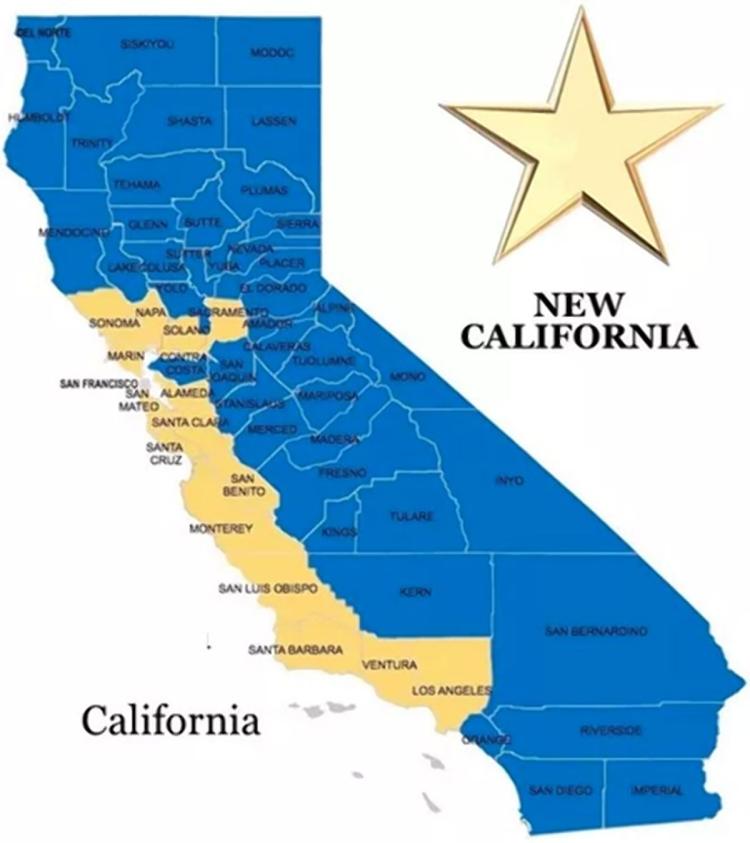
How many states will we have in the Union in twenty years? Probably 50, but there’s an outside chance that the number will be 55 plus. That could include a split of upstate New York from New York City, downstate Illinois from Chicagoland, eastern from western Washington State, eastern from western Oregon (or eastern Oregon combining with Idaho), and a division of California into as many as six states, as one proposal has it. There are secessionist movements alive in all of those states and it has happened before, as Glenn Reynolds notes in his recent paper “Splitsylvania: State Secession and What to Do About It“.

The origins of state boundaries and state governments were probably based on combinations of natural geographic features and confluent economic and political interests existing at the time. It would be surprising if those factors remained in static alignment over time, however. For various reasons, West Virginia seceded from Virginia many years ago, and Tennessee was once part of North Carolina. But to the extent that interests diverge within states, would a series of secessions promote better representative government? Reynolds’ approach to this question is fairly even-handed, though he apparently leans toward less disruptive solutions to the kinds of grievances voiced by secessionists.

Secession is a complex process; it obviously involves a major task in establishing a new state governmental apparatus. Also, legislative roadblocks to secession movements exist at both the state and federal levels. Nevertheless, there is great disaffection among rural interests in the states mentioned above for the policies they say are forced upon them by “urban elites”, as Reynolds calls them. At present, the secession of rural areas would tend to benefit republicans at the federal level, as two new Senate seats would be created to offset the seats held by democrats elected in more urban areas. Conceivably, however, the same process could work in reverse in other states, such as Texas. Even the proposal for six Californias seems designed to at least neutralize any possible negative impact on democrats in national politics.

Reynolds’ paper outline a few ways in which interests represented by legislative minorities, such as rural populations, could be better served without a step so drastic as secession. State regulation is often what rankles secessionists. To add fuel to the fire, states are free to adopt rules that are more strict than rules established under federal legislation, if they so choose, but never rules that are less strict. Today this applies to wages, working conditions, gun regulation, and environmental law. Reynolds suggests turning this on its head:

“The federal government’s legislative role has traditionally been the opposite: To use (as in the case of the 1964 Civil Rights Act) a national majority to ensure that local majorities can’t oppress local minorities. I thus suggest that federal laws regulating these key subject-matter areas be recast to pre-empt more restrictive state laws, meaning that urban regions would be unable to impose stricter laws on less- powerful rural areas. If this seems too inflexible, perhaps that pre-emption should in some cases be defeasible at the county level; if the government of a county affirmatively wants to accept stricter state regulations, then it may do so, but if not, then the federal regulations are a ceiling, as well as a floor.”

Reynolds contends that this approach would be relatively easy to defend against state challenges. The idea that federal rules provide minimum standards of regulation is only one interpretation of the Supremacy Clause of Article VI of the Constitution. There is no reason why federal legislation cannot be written in the way Reynolds describes. Moreover, Reynolds asserts that the Guarantee Clause of Article IV, which assures that mandates are to be established according to republican principles, could be used to buttress this argument. But he offers another remedy to curb secessionism among rural voters that states could exercise:

“There is nothing to stop a state from being mindful of the differences between urban and rural areas when crafting legislation or regulations, after all. States could adopt a local-option regulatory scheme relating to key subject areas on their own, and by doing so would lighten their footprint in rural areas and lessen the likelihood of festering resentments.”

Perhaps that’s hoping for too much. State majorities are unlikely to cede power to rural minorities, but it’s nice to imagine that sort of cooperation. There is no question that this sort of state regulatory approach would protect local interests from the tyranny of one-size-fits-all state regulation, but it wouldn’t eliminate the burdens created by the standard interpretation of federal supremacy.

In general, federal preemption of stricter state laws is no less consistent with the principles of federalism than federal pre-emption of more lenient state laws. One could even argue that the best way to apply federal supremacy depends on the issue, so there is some symmetry in Reynolds’ proposal. In terms of representative democracy, it is less an evil than federal preemption of less restrictive laws. It does what a democratic republic is supposed to do: protect minorities from the tyranny of a majority.

Secession from states is an intriguing possibility. Perhaps it is even the best approach in some cases. Nevertheless, Reynolds’ suggestions for revising federal and state regulatory approaches would be less costly and would avoid a nationwide race to subdivide states in order to gain a federal political advantage.

A Healthy Fetish For Federalism

18 Monday Apr 2016

Posted by Nuetzel in Federalism

≈ Leave a comment

Tags

Civil Rights Act, Conflicts of Law, enumerated powers, Federal Powers, Federalism, Jim Crow Laws, State's Rights, Supremacy Clause

outrage

When I say I’m a federalist, I mean that I support a system in which powers are divided between different levels of government. Federalism establishes co-sovereignty between a central government and regional governments. It does not mean that the federal government is always dominant as is sometimes suggested: the Supremacy Clause under Article VI of the U.S. Constitution covers conflicts of law between the federal government and lower levels of government. Elsewhere, however, the Constitution places strict limits on the powers of the central government by defining an enumerated set of federal powers. All other powers reside with the people or their state governments, ideally constitutional republics in their own right.

Federalism is thought to minimize conflict within a nation by allowing law to be formulated differently within sub-jurisdictions. In this way, it has a limited ability to accommodate different political and social preferences, and it creates a de facto laboratory within which experiments in governance can be assessed. Whether one approves of a particular experiment always depends upon the nature of the question, and experiments imposing limits on individual rights are unconstitutional. Individual rights established by the Constitution are thought to be inviolable and to supersede any federal or state legislation. We should all be absolutists about that. A federalist approach can also be a practical starting point in bringing about broader social recognition of new claims under the Constitution. There are many interesting cases, however, in which legitimate constitutional rights of different parties stand in conflict.

The federalist idea of a social laboratory across jurisdictions is very appealing. When a conflict over legal and social issues seems intractable, federalism makes it possible to see how well different approaches solve the problem. There may be a variety of interesting solutions or political compromises that can be brought to bear, and it can be easier to reach an accord at the state level. Diversity of circumstances and preferences may mean that a good solution in one state will be bad in another. So different states can try different arrangements under federalism. The results of these experiments can guide other states or even federal legislation, if it comes to that. Voters in each state have the power to reward or punish elected representatives, based on these experiments or their outcomes, or to “vote with their feet” by moving to a state that better matches their political preferences.

Today, the country is experiencing an epidemic of grievances on which there is little consensus. These cover issues related to gender identity, gay rights, polyandry, sexual consent, voting rights, due process claims, race and law enforcement, food labeling, drug legalization, censorship, assisted suicide, “micro-aggressions”, and any number of other causes célèbres. These issues may involve novel private or social arrangements, or they may necessitate a weighing of the asserted rights of an aggrieved individual or group against established rights of others protected by the Constitution. It may well be that the asserted rights of the aggrieved have a proper place in the Constitution, and if so, there might be a compelling case for protection relative to other claims. Federalism is one way this can be hashed out: a state legislates, pro or con; the legislation may be challenged in court; the courts rule whether the law is constitutional at the state level or even at the federal level. And the process may start in any number of states.

I have appealed to federalism on several issues in the past. When the rights of different parties stand in conflict, attempting to weigh different sides of an issue based on libertarian and constitutional principles does not always lead to clear-cut answers. However, laws work best when there is consensus among the governed. Political consensus may be more readily achieved at sub-national levels. That doesn’t necessarily protect the people of any state against big government solutions, high taxes or cronyism. However, at least dissenters within a state can register their dissatisfaction at the ballot box, agitate, attempt to persuade others, challenge in court, or move away.

Both left and right take absolutist views on many issues. They often find it difficult to tolerate variances à la federalism. For example, should a legitimate transgender individual be allowed to use the restroom compatible with their gender identity? The left regards that as an inviolable right, regardless of genitalia and potential threats to privacy. If you disagree, they may call you a bigot! Some on the right, however, regard transgenderism as perverse and not worthy of constitutional protection. Both are absolutist positions. There are, in fact, legitimate reasons for taking either side in the restroom debate, as I attempted to outline here last week. Under such circumstances, federalism respects the political balance within any jurisdiction and allows a way forward, short of resorting to federal legislation, which might well be impossible to achieve.

Federalism is usually associated with strong “states rights”, which are sometimes criticized on historical grounds because slavery was often characterized as a “states rights” issue. The horrific treatment of blacks under slavery was obviously based on an arbitrary distinction that should never have been tolerated under our Constitution; ownership of human chattel should never have been defended as a “right”, but it took a civil war and the Thirteenth Amendment to end it officially. The discrimination mandated under Jim Crow laws was based on the same arbitrary distinction, but it took another 100 years after the Civil War to end those laws through enactment of the Civil Rights Act. I grant that federal action was necessary in both cases. However, few of the challenges we face today are based on such arbitrary distinctions. Rather, they often involve constitutional ambiguity and legitimate concerns over protected rights. So let the experiments, the evolution of opinion and the court challenges play out. That is the essence of federalism. It helps us to muddle on through.

Follow Sacred Cow Chips on WordPress.com

Recent Posts

  • Immigration and Merit As Fiscal Propositions
  • Tariff “Dividend” From An Indigent State
  • Almost Looks Like the Fed Has a 3% Inflation Target
  • Government Malpractice Breeds Health Care Havoc
  • A Tax On Imports Takes a Toll on Exports

Archives

  • December 2025
  • November 2025
  • October 2025
  • September 2025
  • August 2025
  • July 2025
  • June 2025
  • May 2025
  • April 2025
  • March 2025
  • February 2025
  • January 2025
  • December 2024
  • November 2024
  • October 2024
  • September 2024
  • August 2024
  • July 2024
  • June 2024
  • May 2024
  • April 2024
  • March 2024
  • February 2024
  • January 2024
  • December 2023
  • November 2023
  • August 2023
  • July 2023
  • June 2023
  • May 2023
  • April 2023
  • March 2023
  • February 2023
  • January 2023
  • December 2022
  • November 2022
  • October 2022
  • September 2022
  • August 2022
  • July 2022
  • June 2022
  • May 2022
  • April 2022
  • March 2022
  • February 2022
  • January 2022
  • December 2021
  • November 2021
  • October 2021
  • September 2021
  • August 2021
  • July 2021
  • June 2021
  • May 2021
  • April 2021
  • March 2021
  • February 2021
  • January 2021
  • December 2020
  • November 2020
  • October 2020
  • September 2020
  • August 2020
  • July 2020
  • June 2020
  • May 2020
  • April 2020
  • March 2020
  • February 2020
  • January 2020
  • December 2019
  • November 2019
  • October 2019
  • September 2019
  • August 2019
  • July 2019
  • June 2019
  • May 2019
  • April 2019
  • March 2019
  • February 2019
  • January 2019
  • December 2018
  • November 2018
  • October 2018
  • September 2018
  • August 2018
  • July 2018
  • June 2018
  • May 2018
  • April 2018
  • March 2018
  • February 2018
  • January 2018
  • December 2017
  • November 2017
  • October 2017
  • September 2017
  • August 2017
  • July 2017
  • June 2017
  • May 2017
  • April 2017
  • March 2017
  • February 2017
  • January 2017
  • December 2016
  • November 2016
  • October 2016
  • September 2016
  • August 2016
  • July 2016
  • June 2016
  • May 2016
  • April 2016
  • March 2016
  • February 2016
  • January 2016
  • December 2015
  • November 2015
  • October 2015
  • September 2015
  • August 2015
  • July 2015
  • June 2015
  • May 2015
  • April 2015
  • March 2015
  • February 2015
  • January 2015
  • December 2014
  • November 2014
  • October 2014
  • September 2014
  • August 2014
  • July 2014
  • June 2014
  • May 2014
  • April 2014
  • March 2014

Blogs I Follow

  • Passive Income Kickstart
  • OnlyFinance.net
  • TLC Cholesterol
  • Nintil
  • kendunning.net
  • DCWhispers.com
  • Hoong-Wai in the UK
  • Marginal REVOLUTION
  • Stlouis
  • Watts Up With That?
  • Aussie Nationalist Blog
  • American Elephants
  • The View from Alexandria
  • The Gymnasium
  • A Force for Good
  • Notes On Liberty
  • troymo
  • SUNDAY BLOG Stephanie Sievers
  • Miss Lou Acquiring Lore
  • Your Well Wisher Program
  • Objectivism In Depth
  • RobotEnomics
  • Orderstatistic
  • Paradigm Library
  • Scattered Showers and Quicksand

Blog at WordPress.com.

Passive Income Kickstart

OnlyFinance.net

TLC Cholesterol

Nintil

To estimate, compare, distinguish, discuss, and trace to its principal sources everything

kendunning.net

The Future is Ours to Create

DCWhispers.com

Hoong-Wai in the UK

A Commonwealth immigrant's perspective on the UK's public arena.

Marginal REVOLUTION

Small Steps Toward A Much Better World

Stlouis

Watts Up With That?

The world's most viewed site on global warming and climate change

Aussie Nationalist Blog

Commentary from a Paleoconservative and Nationalist perspective

American Elephants

Defending Life, Liberty and the Pursuit of Happiness

The View from Alexandria

In advanced civilizations the period loosely called Alexandrian is usually associated with flexible morals, perfunctory religion, populist standards and cosmopolitan tastes, feminism, exotic cults, and the rapid turnover of high and low fads---in short, a falling away (which is all that decadence means) from the strictness of traditional rules, embodied in character and inforced from within. -- Jacques Barzun

The Gymnasium

A place for reason, politics, economics, and faith steeped in the classical liberal tradition

A Force for Good

How economics, morality, and markets combine

Notes On Liberty

Spontaneous thoughts on a humble creed

troymo

SUNDAY BLOG Stephanie Sievers

Escaping the everyday life with photographs from my travels

Miss Lou Acquiring Lore

Gallery of Life...

Your Well Wisher Program

Attempt to solve commonly known problems…

Objectivism In Depth

Exploring Ayn Rand's revolutionary philosophy.

RobotEnomics

(A)n (I)ntelligent Future

Orderstatistic

Economics, chess and anything else on my mind.

Paradigm Library

OODA Looping

Scattered Showers and Quicksand

Musings on science, investing, finance, economics, politics, and probably fly fishing.

  • Subscribe Subscribed
    • Sacred Cow Chips
    • Join 128 other subscribers
    • Already have a WordPress.com account? Log in now.
    • Sacred Cow Chips
    • Subscribe Subscribed
    • Sign up
    • Log in
    • Report this content
    • View site in Reader
    • Manage subscriptions
    • Collapse this bar
 

Loading Comments...