• About

Sacred Cow Chips

Sacred Cow Chips

Tag Archives: The CATO Institute

Dubious Scorecards of Violence By Ideology

02 Thursday Oct 2025

Posted by Nuetzel in Political Violence, Terrorism

≈ Leave a comment

Tags

Alex Nowraste, Amber Duke, Anti-Defamation League, Antifa, Assassination Culture, Black Lives Matter, Brian Thompson, Charlie Kirk, Christopher Rufo, David Harsanyi, George Floyd, Global Terrorism Database, ideological Violence, Islamic Violence, Leftwing Violence, Luigi Mangione, Matt Margolis, National Institute of Justice, Network Contagion Research Institute, Oklahoma City Bombing, Pulse Nightclub, Rightwing Violence, Ryan James Girdusky, The CATO Institute, Timothy McVeigh, Twin Towers Attack, Waukesha, Zizians

There have been many claims about the relative frequency of violent terrorist acts committed by the left and right sides of the political spectrum. Leftists like to focus on fatalities because they believe the data favor them as less violent. Broader measures of violence tell a different story. However, the comparisons are terribly flawed owing to the difficulty of 1) knowing that ideology was definitely the motive in a particular case; and 2) classifying the ideology of a violent actor. Law enforcement statistics are obviously subject to those kinds of classification problems, and so are most studies that purport to measure ideological violence accurately. In short, the comparisons are a mess.

Ideological Homicide

The following are counts of total ideologically-motivated homicides since 1990 according to a 2024 DOJ National Institute of Justice report. Excluding the 9/11/2021 Twin Towers attack, there were 520 total fatalities; 227 were attributed to the far right and 42 to the far left. That report is now available only as an archive on the Wayback Machine. The on-line PDF disappeared just after Charlie Kirk’s murder in September, which seems a little too coincidental. Nevertheless, as we’ll see, the report’s findings were absurd.

Matt Margolis reviews a recent CATO study by Alex Nowrasteh on politically-motivated violence. Here are the totals by year:
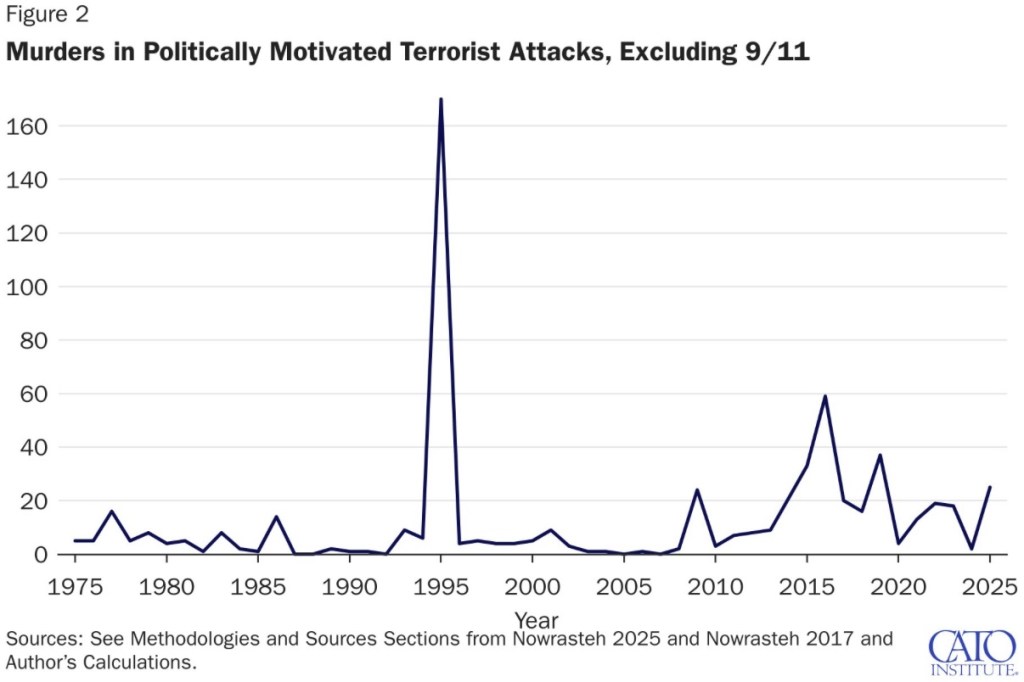
Margolis discusses a couple of major (and questionable) decisions made by the author or his sources:

—The Oklahoma City bombing in 1995 (168 deaths) was committed by Timothy McVeigh, an individual of ambiguous “anti-government” political persuasion who supported abortion rights. Those deaths were attributed to the right.

—The 2020 riots following George Floyd’s death resulted in 19 deaths. Of course, Antifa (which we’re confidently told doesn’t exist) and Black Lives Matter (BLM) were heavily involved, so this was clearly leftist violence. Those deaths aren’t counted,

These two adjustments alone would swing the attribution of deaths to a majority of leftist killers. Margolis then credits Amber Duke for identifying several additional misclassifications that occurred between 2015 and 9/10/2025 (the day prior to Kirk’s murder), during which there were 57 “politically-inspired” killers. She documents nine cases (26 fatalities and a number of serious injuries) of questionable political attribution. Several of these cases involved motives that are arguably nonpolitical, including severe psychological disorders, and at least one killer could have been motivated by a desire to promote a leftist politician (Tim Walz). I would probably accept a couple of these incidents as right-adjacent if not right-wing motivated, but the point is that ambiguities frequently compromise these ideological classifications.

Duke notes the head-scratching exclusion of a couple of incidents attributable to leftist passions: the BLM-affiliated Waukesha killer who plowed into a Christmas parade in his truck, killing six; a killing perpetrated by multiple BLM protestors; and a bomber at an IVF clinic that killed one person. Again, in the nine cases identified by Duke, the perps were either questionably classified ideologically or not classified at all. Correcting all of these errors swings the tally to 20 left-wing and 19 right-wing killers from 2015-9/10/2025.

Oddly, Duke takes no issue with the non-classification of the Pulse Nightclub shooting in 2016 (treated separately as Islamic terror). The killer was said to have had “issues” with gays, but apparently he was gay! And there were reports that he was motivated by opposition to U.S. foreign policy, which usually codes as left.

The ADL Weighs In

Duke also directs us to a critique by Ryan James Girdusky of some agitprop produced by the Anti-Defamation League (ADL). Of course, the ADL has a left-wing bias that comes through loud and clear in this report. As Duke summarizes,

“… they lump white nationalist inter-gang killings, domestic violence, and other non-ideologically motivated murders into its ‘right-wing political violence’ category.“

And here is David Harsanyi:

“The [ADL] list includes murders that occurred during attempted prison escapes, sex crimes, robberies, and family squabbles, none of which have anything to do with furthering the tenets of white supremacy or any cause. In one of the incidents, the police have yet to find a motive for the homicide.“

In case you still harbor any doubt about the ADL’s bias, their report actually excludes six deaths connected with the Zizians, a murderous trans cult. They also ascribe no political motive for Luigi Mangioni’s assassination of United Health Care CEO Brian Thompson because:

“… hostility towards the healthcare system or health insurance companies is not in itself an ideology and because a good portion of the anger on Mangione’s part may have stemmed from purely personal reasons .…”

The list, however, includes “right-wing” murders that occurred during attempted prison escapes, sex crimes, robberies, and family squabbles, none of which had anything to do with furthering the tenets of white supremacy or any cause. In one of these incidents, the police have yet to find a motive for the homicide.

Harsanyi offers further criticism of the FBI’s classifications and the Global Terrorism Database. Of the latter, he notes:

“It counted the Las Vegas mass shooter who murdered 59 people in 2017 as a right-wing ‘anti-government extremist.’ In truth, we have no clue what the shooter’s motivations were, unless the GTD has inside information from the FBI. Of the 32 other incidents the organization labeled right-wing terrorism that year, 12 were merely ‘suspected’ of being on the Right (mostly because they had white skin).“

More Systemic Misclassification

The CATO and ADL reports, as well as government statistics, are uniform in treating violence by Islamic extremists as a category apart from violence on the left and right. The Islamist category dominates the data on terrorist homicides due to 9/11 (87% of terrorist fatalities since 1975; excluding 9/11, Islamist attacks account for 23%). Separate treatment is based on alleged religious motives behind these acts. However, Islamic causes have garnered increasing support from the Left in the years since 9/11 and the War in Iraq. That became more palpable during the Obama years. It has culminated in a surge of aggressive anti-Zionism and support for not just a Palestinian state, but one extending from the river to the sea, which is code for genocide in Israel. Apparently, Hamas’ murderous raid into Israel on 10/7/2023 was a major touch point for this activism.

At present, there isn’t much ambiguity surrounding the leftist-Islamic alignment, despite what should seem like obvious points of tension. These include Islamic subjugation of women and harsh treatment of homosexuals. But in the West, leftists identify with the presumed victimhood status of Islamic populations. Certain cases of violence by Islamic actors in the U.S. can reasonably be counted now as leftist terror attacks. However, the reports aren’t tallied that way, which helps to foster the impression that the right instigates a larger share of violent and homicidal attacks.

Also problematic: “anti-government” actors have almost always been classified as right-wing. This is highly misleading. Both left-and right-wing anti-government violence tend to vary with which side is in power.

Non-Lethal But Could Be Lethal

Despite its severe shortcomings, the CATO report at least gives lip service to non-lethal violence … or what, for the grace of God, might have turned out to be non-lethal. This encompasses foiled efforts to harm, injuries of all sorts, arson, smashed windows, stolen merchandise, other property damage, and even threats to individuals or institutions, which tend to inflict emotional distress and other costs. Too much commentary hints at praise for the left’s “restraint” in perpetrating non-lethal violence! Protests accompanied by riots are described as “mostly peaceful”.

There is no question about the recent surge in left-wing violence, especially in 2025. Over the past few years, there have been several assassination attempts against high-profile individuals on the right, including Donald Trump and Charlie Kirk. Trans activists have perpetrated other killings. There have been multiple attacks on ICE agents and other law enforcement officers. We’ve witnessed persecution, intimidation, and attacks against Jews on college campuses and elsewhere. Riots have erupted in Portland, LA, New York, Atlanta, and other cities. The trend is not new, but the levels of unrest have been disquieting.

They Say, “Don’t Overreact”

Another factor is prosecutorial leniency. Violent leftist actions tend to be concentrated in urban areas where prosecutors are likely to share the actors’ ideology and give them a pass. This does nothing to discourage destructive behavior. As a civil libertarian, however, Nowrasteh warns in his CATO report:

“The big fear from politically motivated terrorism is that the pursuit of justice will overreach, result in new laws and policies that overreact to the small threat, and end up killing far more people while diminishing all our freedoms.“

I too have strong libertarian leanings, but the balance of risks should favor action to protect individuals and their property from threats of violent action, maintain public order, while not prejudging the intent of disturbances as “peaceful”.

Views on Violence

Official statistics and other reports on political violence by the left and right are unreliable. They tend to overstate right-wing inspired violence and understate left-wing inspired violence. The recent swing toward leftist acts of terror has been difficult to hide, however.

I’ll close by noting that the mainstream right and left seem to have considerably different attitudes toward politically-motivated violence. In my observation, when some fringe right-wing maniac, white supremacist, or militia group perpetrates violence (or so much as stages a public demonstration), the mainstream right tends to react with revulsion. When fringe leftists do the same, the mainstream left tends to rationalize and even support the uglies.

The Network Contagion Research Institute (NCRI) has noted the rise of “assassination culture”. Surveys show that violence against political opposition has more support from the left than the right. Social media has become a breeding ground upon which these sentiments can turn into action. From the last link:

“NCRI’s analysis, based on troves of social media data, reveals how fringe internet culture has helped build what the group calls ‘permission structures’ for violence. These are social environments—online or offline—where violent acts are no longer condemned but tacitly accepted, if not outright encouraged.“

This is what Christopher Rufo calls the “left-wing terror memeplex”, and it’s often less tacit than right out loud! It’s almost enough to make a sham of the explicit exceptions to protected speech defined by the First Amendment.

Taxes and the Labor “Discount”: What Could Go Wrong?

29 Wednesday Nov 2017

Posted by Nuetzel in Labor Markets

≈ 2 Comments

Tags

BEA, Bureau of Economic Analysis, CBO, Congressional Budget Office, Federal Discount, Federal Wages, Labor Discount, Labor Supply, Pass-Through Income, Private Sector Wages, Procyclical Effect, The CATO Institute, Tyler Cowan

A supposed labor market distortion that I’d never considered is that government receives a “discount” on labor services because public employees’ income tax liability is returned to the very government coffers from which they are paid. Tyler Cowen regards this as a “wacky” idea, but not easy to refute. Suppose the income tax rate is 20%. If the government pays a worker $10, then $2 is returned to that same government via the tax. The net cost to government is just $8. But a tax “discount” on cost is not unique to government, though the form it takes may differ.

Who Gets a Labor “Discount”?

Does it cost a private employer more than government to pay a worker $10? It depends on the situation. Maybe more, maybe less. If the private employer pays the same 20% tax rate on its profits, the wage payment creates a tax deduction worth $2 in avoided tax. The net cost is $8, so there is no difference. However, a firm must be profitable to get that deduction, so unprofitable startups, strugglers, and nonprofits do not get the same wage “discount” as government. Of course, losses can be carried forward to reduce taxes if the firm ever becomes profitable, and non-profits have tax advantages of their own.

The value of the tax deduction (the private “discount”) depends on the tax rate paid by the firm. A profitable C corporation with a marginal tax rate of 35% (under current law) gets a steeper discount than a small businessperson in the 28% tax bracket. To some extent, a steeper discount subsidizes the cost of hiring employees who are highly compensated. A highly successful pass-through entity like a sole proprietorship, partnership or S corporation can face the highest individual marginal rates, so the “discount” for such a firm could be the largest relative to wages.

Economic Distortions

There are a couple of potential distortions involved here: one is the standard wedge driven between the value of workers’ marginal product and the after-tax wage they receive. This discourages labor supply. There is a second distortion to the extent that the “discount” gives government and profitable firms an artificial competitive advantage of over unprofitable buyers of labor services. Furthermore, the loss of the labor discount for firms falling into unprofitable positions imparts an undesirable procyclical element into the tax system, potentially aggravating episodes of under-production and high unemployment.

The government’s labor “discount” may reduce the available supply of labor to the private sector. Government does not operate under the profit motive, and unlike private firms, it need not concern itself with efficiency standards for survival. Government production does not face a market test, so it is difficult to measure worker productivity, which is the key to the efficient pricing and use of labor in the private sector. The penalty to government for paying an above-market wage is zero.

The same “discount” argument can be made for government contracts with private firms. The profits earned on those contracts are taxed by the government payer, so the total cost to the government is essentially discounted. Contracts between private firms are on the same footing if the payer is profitable, since the paying firm can deduct its costs from taxable profits. A payer that is not profitable is at a disadvantage. The government “discount” might not be the primary reason to suspect that government contracting is subject to distortion and inflated values, but it is a reason nevertheless. One could be forgiven for thinking that the “discount” creates additional leeway for graft!

Does the government labor “discount” really impinge on the federal agency budget process? I doubt that anyone having a critical role in the Congressional or executive budget process thinks much about it, to say nothing of agency hiring and compensation managers. Yet spending levels may “bake-in” a certain amount of over-payment of wages or fat in government contracts. In any case, historically, federal spending has not been tightly constrained by the flow of tax revenue.

Federal Wages vs. Private Wages

There is empirical evidence on government vs. private wages. These data are of interest in their own right, but since so much of the private sector receives the same tax “discount” as government, it’s not clear that it should cause much if any differential in pay. The Congressional Budget Office (CBO) compared differences in compensation from 2005-2010 and again from 2011-2015 and found that federal wages and benefits exceeded private sector wages and benefits over both periods. The gap decreased with increases in education. For workers with a bachelor’s degree or less (71% of the CBO’s latest federal workforce sample), the gap was substantial. The difference was just a few thousand dollars for those with a master’s degree. The professional degree/Ph.D. category stood in fairly sharp contrast to the others, with private workers having a fairly large advantage. It is possible that the most highly-educated category, being the most scarce and probably the most specialized, has unique market characteristics. It should also be noted that the sample of federal workers was about 4 years older, on average, than the private sector sample, which might have skewed the results.

The CATO Institute used data from the U.S. Bureau of Economic Analysis (BEA) and found that federal civilian workers earned 80% more than private sector workers in 2016. The CATO report cites several other studies, including the CBO’s, which consistently find that federal workers earn more. This could be partly attributable to the government labor discount, bureaucratic laxity, the heavy unionization of the federal work force, and even the geographical distribution of federal workers.

Discount My Taxes, Please

The worst aspect of the tax “discount” on federal and many private-sector wage payments is the taxation itself. However, the fact that some firms and organizations don’t qualify for the discount represents a significant distortion. To some extent, labor input is discouraged for unprofitable startup firms, firms struggling for survival, and of course the non-profit sector. These organizations are at a distinct disadvantage in terms of resource allocation relative to those who qualify for the “discount”.

Nevertheless, this unevenly applied discount may be an unfortunate mathematical implication of a public sector with income-taxing and spending powers. The discount on wages and contract payments provides additional margin along which government can be wasteful. A partial solution is to maintain whatever firewalls exist between taxing and spending authorities, but that won’t unwind past distortions. Of course, the best solution is to shrink government: reduce taxes and reduce the federal role in everything from infrastructure to public health, dismantle the administrative state, and reduce military spending. I didn’t really need another reason to warn of the dangers of big government, but count this one as duly noted!

Can Health Care Bill Get GOP Off the Schneid?

29 Thursday Jun 2017

Posted by Nuetzel in Health Insurance, Obamacare

≈ Leave a comment

Tags

AHCA, Avik Roy, BCRA, Better Care Reconciliation Act, CATO Institute, CBO, Community Rating, Corporatism, David Harsanyi, John C. Goodman, Means Testing, Medicaid Reform, Michael Cannon, Obamacare Exchanges, Peter Suderman, Planned Parenthood, Refundable Tax Credits, Seth Chandler, Stabilization Funds, State Waivers, The CATO Institute, Yuval Levin

health insurer bailout

For those who are “woke” to Obamacare’s failures, the Senate GOP’s health insurance reform bill has plenty to hate and maybe some things to love. There are likely to be some changes in the bill before it goes to a vote, which now has been delayed until sometime after Congress’ July 4th recess. Known as the Better Care Reconciliation Act of 2017 (BCRA), the bill is another mixed bag of GOP health care reforms and non-reforms. It is the Senate Republicans’ effort to improve upon the bill passed by the House of Representatives in May. The non-reforms are tied to an inability to repeal all aspects of Obamacare (the Affordable Care Act, or ACA) within the context of budget reconciliation, a process which permits a simple majority for approval of changes linked in some way to the budget (the so-called Byrd rule). Yuval Levin offers an excellent discussion of the bill and the general motivations for the form it has taken:

“They are choosing to address discrete problems with Obamacare within the framework it created and to pursue some significant structural reforms to Medicaid beyond that, and they should want the merits of their proposal judged accordingly. Their premise is politically defensible — it is probably more so than my premise — and the proposal they have developed makes some sense in light of it.“

It’s necessary to get one thing out of the way at the outset: the CBO’s scoring of the Senate bill is flawed in a massive way, like the earlier score of the House bill. The estimate of lost coverage for 22 million individuals is based on the CBO’s errant predictions of Obamacare coverage levels. (See here and here, and see Avik Roy’s latest entry on this topic.) Does anyone believe that enrollment on the exchanges will decline by 15 million in 2018 due to the elimination of the individual mandate? That’s over 40% more than total enrollment in 2017, by the way. Even if we attribute the CBO’s prediction to the elimination of both the individual and employer mandates, it would be an incredible plunge, especially given the means-tested tax credits in the BCRA. Does anyone believe that coverage levels under Obamacare would increase by 18 – 19 million by 2026 (mostly on account of the individual mandate)? That is the baseline assumed by the CBO in its scoring of the BCRA, which is laughable. A more realistic estimate of lost coverage under the BCRA might be 2 to 3 million, but remember that many of those coverage losses would not be “forced” in any sense. Rather, they would be purposeful refusals to take coverage with the demise of the individual mandate. But they would tend to be the healthiest of the current, coerced enrollees.

A related point has to do with hysterical claims that the BCRA will “kill thousands of people”. Someone cooked-up this talking (screaming?) point to rally the ignorant left and perhaps frighten the ignorant right (including a few GOP Senators). As Ira Stoll explains, there are several reasons to dismiss these assertions, not least of which is its tradeoff-free conceit. More ugly detail on the basis of these claims can be found here.

Will the BCRA “gut” Medicaid, as Charles Schumer, Nancy Pelosi and other have claimed? Program spending would not decline by any means, only its growth rate. Enrollment would decline with tougher eligibility rules, but as noted above, tax credits more generous than the Medicaid savings (relative to Obamacare) would help replace lost Medicaid coverage with private insurance. Steve Chapman has contributed one of the most nitwitted commentaries on Medicaid reform that I have seen. Not only do critics consistently ignore the proposed tax credits for coverage at low incomes, but they never address the monumental waste in the program., something that would likely improve under the budgeting requirements and additional discretion given to states by the BCRA.

An even crazier scare story going around is that the Senate bill will cut Medicare benefits. That is not the case, though the bill repeals an Obamacare Medicare tax increase on the self-employed.

Getting back to the broader BCRA, here are some of the major provisions:

  • Medicaid reform to replace the budgetary disaster of federal matching with per capita caps or block grants, and state program control.
  • Means-tested tax credits for insurance purchases would extend to low-income individuals who might otherwise lose their expanded Medicaid eligibility. According to Levin, this group is heavily weighted toward the unmarried and childless.
  • Greater state authority over regulation of the individual insurance market. This is accomplished through the availability of state waivers from many Obamacare regulations, including essential health benefits.
  • Almost all Obamacare tax provisions would be repealed. One exception is the “Cadillac” tax on high-cost employer plans starting in 2026 (after a temporary hiatus). Many of these repeals would benefit individuals broadly as taxpayers, employees, business people, and patients.
  • Expanded allowable age rating to 5/1 from 3/1. This helps limit adverse selection by pricing more risk where it exists, and the means-tested credits would help offset higher premiums for older individuals with low incomes.
  • Provides about $130 billion in “stabilization” funds for insurers over a three-year period. This is an attempt to keep premiums down during a transition over which the GOP probably hopes to enact additional deregulatory measures. Is this a practical maneuver? Yes, but it also reflects a bit of “corporatism-when-it’s-convenient” hypocrisy.
  • Eliminates funding for Planned Parenthood. Presumably funding could be restored later were the organization to split off its abortion services into a financially distinct division, which the Hyde Amendment would seem to require.
  • Retains coverage for pre-existing conditions.
  • Elimination of the individual and employer mandates, including the tax penalty. However, individuals who go without coverage for two months would face a six-month waiting period before they could re-qualify for coverage.

Eliminating the mandates is great from a libertarian and an economic perspective. The coercion inherent in those requirements is bad enough. In practice, the individual mandate has proven less effective in encouraging enrollment than Obamacare’s architects had hoped, which makes the CBO’s conclusions all the more puzzling. The employer mandate gives firms an incentive to reduce hours and employment, so it has extremely undesirable labor-market implications.

Most criticism of the BCRA from the right has centered on its failure to fully repeal Obamacare insurance and health care regulations. The continuation of Obamacare community rating is a major shortcoming of the bill, as it distributes the financial risks of medical needs in ways that do not correspond to the actual distribution of health risks. The result is the very same adverse selection problem we have witnessed on the Obamacare exchanges. Unfortunately, this raises the specter that we’ll be stuck with some form of community rating in the long-term, along with employer-provided coverage and the ill-advised premium tax deductions, which tend to inflate premium levels.

Michael F. Cannon of the CATO Institute calls the BCRA an Obamacare rescue package. John C. Goodman is largely in agreement with Cannon, stating that Republicans have no real desire to repeal Obamacare. Peter Suderman at Reason has many of the same concerns. In addition to community rating, Cannan (and Senator Rand Paul) are unhappy that Medicaid spending continues to grow under the bill with a new program of subsidies (tax credits) to boot! They also condemn the so-called “stabilization” or “cost-sharing” subsidies that would be paid to insurers under the bill. While a broader range of plans would become available, there is little confidence that insurers will be able to  bring down premiums and/or deductibles substantially without the added subsidies.

Avik Roy has defended the Senate bill for its proposed reforms to Medicaid, replacement of Obama’s Medicaid expansion with tax credits for private coverage, and transitional tax credits to smooth jumps in premium levels as income rises from low levels. This is an improvement over the House bill. However, marginal tax rates would be high under the BCRA for individuals in the range of income over which the credits phase out, which is a legitimate “welfare trap” criticism.

David Harsanyi also believes the bill is a good start:

“If Republican leadership had told conservatives in 2013 that they could pass a bill that would eliminate the individual and employer mandates, phase out Obamacare’s Medicaid expansion, cut an array of taxes, and lay out the conditions for full repeal later, I imagine most would have said ‘Sign me up!’“

Naturally, most critics of Obamacare have strong misgivings about a bill that would leave major components of the ACA’s structure in place. That includes Obamacare’s regulation of health care delivery itself, not just health insurance coverage. The BCRA might incorporate signifiant changes before it goes to a vote, however. One can only hope! Rand Paul has suggested breaking the bill into two parts: repeal of the ACA and other spending provisions, though it’s not clear how a repeal bill would qualify under the Byrd rule. Either way, the GOP intends to follow-up with additional health care legislation and administrative changes. Were a bill enacted soon, there is some chance that additional legislation could garner limited bi-partisan support. Long-term stability of the health insurance and health care markets would be better-served by a stronger semblance of political equilibrium than we have seen in the years since Obama was elected.


Follow Sacred Cow Chips on WordPress.com

Recent Posts

  • Immigration and Merit As Fiscal Propositions
  • Tariff “Dividend” From An Indigent State
  • Almost Looks Like the Fed Has a 3% Inflation Target
  • Government Malpractice Breeds Health Care Havoc
  • A Tax On Imports Takes a Toll on Exports

Archives

  • December 2025
  • November 2025
  • October 2025
  • September 2025
  • August 2025
  • July 2025
  • June 2025
  • May 2025
  • April 2025
  • March 2025
  • February 2025
  • January 2025
  • December 2024
  • November 2024
  • October 2024
  • September 2024
  • August 2024
  • July 2024
  • June 2024
  • May 2024
  • April 2024
  • March 2024
  • February 2024
  • January 2024
  • December 2023
  • November 2023
  • August 2023
  • July 2023
  • June 2023
  • May 2023
  • April 2023
  • March 2023
  • February 2023
  • January 2023
  • December 2022
  • November 2022
  • October 2022
  • September 2022
  • August 2022
  • July 2022
  • June 2022
  • May 2022
  • April 2022
  • March 2022
  • February 2022
  • January 2022
  • December 2021
  • November 2021
  • October 2021
  • September 2021
  • August 2021
  • July 2021
  • June 2021
  • May 2021
  • April 2021
  • March 2021
  • February 2021
  • January 2021
  • December 2020
  • November 2020
  • October 2020
  • September 2020
  • August 2020
  • July 2020
  • June 2020
  • May 2020
  • April 2020
  • March 2020
  • February 2020
  • January 2020
  • December 2019
  • November 2019
  • October 2019
  • September 2019
  • August 2019
  • July 2019
  • June 2019
  • May 2019
  • April 2019
  • March 2019
  • February 2019
  • January 2019
  • December 2018
  • November 2018
  • October 2018
  • September 2018
  • August 2018
  • July 2018
  • June 2018
  • May 2018
  • April 2018
  • March 2018
  • February 2018
  • January 2018
  • December 2017
  • November 2017
  • October 2017
  • September 2017
  • August 2017
  • July 2017
  • June 2017
  • May 2017
  • April 2017
  • March 2017
  • February 2017
  • January 2017
  • December 2016
  • November 2016
  • October 2016
  • September 2016
  • August 2016
  • July 2016
  • June 2016
  • May 2016
  • April 2016
  • March 2016
  • February 2016
  • January 2016
  • December 2015
  • November 2015
  • October 2015
  • September 2015
  • August 2015
  • July 2015
  • June 2015
  • May 2015
  • April 2015
  • March 2015
  • February 2015
  • January 2015
  • December 2014
  • November 2014
  • October 2014
  • September 2014
  • August 2014
  • July 2014
  • June 2014
  • May 2014
  • April 2014
  • March 2014

Blogs I Follow

  • Passive Income Kickstart
  • OnlyFinance.net
  • TLC Cholesterol
  • Nintil
  • kendunning.net
  • DCWhispers.com
  • Hoong-Wai in the UK
  • Marginal REVOLUTION
  • Stlouis
  • Watts Up With That?
  • Aussie Nationalist Blog
  • American Elephants
  • The View from Alexandria
  • The Gymnasium
  • A Force for Good
  • Notes On Liberty
  • troymo
  • SUNDAY BLOG Stephanie Sievers
  • Miss Lou Acquiring Lore
  • Your Well Wisher Program
  • Objectivism In Depth
  • RobotEnomics
  • Orderstatistic
  • Paradigm Library
  • Scattered Showers and Quicksand

Blog at WordPress.com.

Passive Income Kickstart

OnlyFinance.net

TLC Cholesterol

Nintil

To estimate, compare, distinguish, discuss, and trace to its principal sources everything

kendunning.net

The Future is Ours to Create

DCWhispers.com

Hoong-Wai in the UK

A Commonwealth immigrant's perspective on the UK's public arena.

Marginal REVOLUTION

Small Steps Toward A Much Better World

Stlouis

Watts Up With That?

The world's most viewed site on global warming and climate change

Aussie Nationalist Blog

Commentary from a Paleoconservative and Nationalist perspective

American Elephants

Defending Life, Liberty and the Pursuit of Happiness

The View from Alexandria

In advanced civilizations the period loosely called Alexandrian is usually associated with flexible morals, perfunctory religion, populist standards and cosmopolitan tastes, feminism, exotic cults, and the rapid turnover of high and low fads---in short, a falling away (which is all that decadence means) from the strictness of traditional rules, embodied in character and inforced from within. -- Jacques Barzun

The Gymnasium

A place for reason, politics, economics, and faith steeped in the classical liberal tradition

A Force for Good

How economics, morality, and markets combine

Notes On Liberty

Spontaneous thoughts on a humble creed

troymo

SUNDAY BLOG Stephanie Sievers

Escaping the everyday life with photographs from my travels

Miss Lou Acquiring Lore

Gallery of Life...

Your Well Wisher Program

Attempt to solve commonly known problems…

Objectivism In Depth

Exploring Ayn Rand's revolutionary philosophy.

RobotEnomics

(A)n (I)ntelligent Future

Orderstatistic

Economics, chess and anything else on my mind.

Paradigm Library

OODA Looping

Scattered Showers and Quicksand

Musings on science, investing, finance, economics, politics, and probably fly fishing.

  • Subscribe Subscribed
    • Sacred Cow Chips
    • Join 128 other subscribers
    • Already have a WordPress.com account? Log in now.
    • Sacred Cow Chips
    • Subscribe Subscribed
    • Sign up
    • Log in
    • Report this content
    • View site in Reader
    • Manage subscriptions
    • Collapse this bar
 

Loading Comments...