• About

Sacred Cow Chips

Sacred Cow Chips

Tag Archives: WalMart

Attack Private Sector With Tariffs, Then Attack Pricing

26 Saturday Jul 2025

Posted by Nuetzel in Tariffs, Tax Incidence

≈ 1 Comment

Tags

Amazon, Beige Book, Capitalism, Chad Wolf, Consumer Sovereignty, Costco, Eating Tariffs, Free Markets, Import Competing Goods, Mussolini, New Right, Price Gouging, Profit Motive, Protectiinism, Retail Margins, Target, Tariffs, Tax Incidence, WalMart

An opinion piece caught my eye written by one Chad Wolf. It’s entitled: “Retailers caught red-handed using Trump’s tariffs as cover for price gouging”. A good rule is to approach allegations of “price gouging” with a strong suspicion of economic buffoonery. You tend to hear such gripes just when prices should rise to discourage over-consumption and encourage production. The Wolf article, however, typifies the kind of attack on capitalism we hear increasingly from the “new right” (and see this).

Wolf, a former Homeland Security official in the first Trump Administration, says that large retailers like Walmart and Target are ripping off American consumers by raising prices on goods that are, in his judgement, “unaffected” by tariffs.

We’ll get into that, but first a quick disclaimer: I have no connection to Walmart or Target. Sure, I’ve shopped at those stores and I’ve filled a few prescriptions at a Walmart pharmacy. Maybe I have an ETF with an interest, but I have no idea.

Competition and Consumer Choice

Of course, no one forces consumers to shop at Walmart or Target. Those stores compete with a wide variety of outlets, including Costco and Amazon, the latter just a few clicks away. In a market, sellers price goods at what the market will bear, which ultimately serves to signal scarcity: a balancing between the cost of required resources and the value assigned by buyers. Unfortunately, in the case of tariffs, buyers and sellers of imports must deal with an artificial form of scarcity designed to extract revenue while benefitting other interests.

Wolf touts the “gift” of a free market for American businesses, as if private rights flow from government beneficence. He then decries a so-called betrayal by large retailers who would “price gouge” the American consumer in an effort to protect their profit margins. The free market is indeed a great thing! But his indignance is highly ironic as a pretext for defending tariffs and protectionism, given their destructive effect on the free operation of markets.

Broader Impacts

Wolf might be unaware that tariffs have an impact on a large number of domestically-produced goods that are not imported, but nevertheless compete with imports. When a tariff is charged to buyers of imports, producers of domestic substitutes experience greater demand for their products. That means the prices of these import-competing goods must rise. Furthermore, the effect can manifest even before tariffs go into effect, as consumers begin to seek out substitutes and as producers anticipate higher input costs.

Obviously, tariffs also impinge on producers who rely on imports as inputs to production. It’s not clear that Wolf understands how much tariffs, which represent a direct increase in costs, hurt these firms and their competitive positions.

“Expected” Does Not Mean “Unaffected”

Wolf cites the Federal Reserve’s Beige Book report (which he calls a “study”) to support his claim that businesses are gouging buyers for goods “unaffected” by tariffs. Here is one quote he employs:

“A heavy construction equipment supplier said they raised prices on goods unaffected by tariffs to enjoy the extra margin before tariffs increased their costs,” the Beige Book report said.“

Read that again carefully! Apparently Wolf, and whoever added this to the Fed’s Beige Book, thinks that being “unaffected by tariffs” includes firms whose future costs, including replacement of inventories, will be affected by tariffs! He goes on to say:

“… Walmart has already issued price hikes under the guise of tariff costs.“

The examples at his “price hikes” link were for Chinese goods in April and May, after Trump announced 145% tariffs on China in April. In mid-May, Trump said China would face a lower 30% tariff rate during a 90-day “pause” while a trade agreement was negotiated. It is now 55%, but the point is that retailers were forced to play a guessing game with respect to inventory replacement costs due to uncertainty imposed by Trump. They had a sound reason for marking up those items.

Fibbing on the Margin

Here’s an excerpt from Wolf’s diatribe that demonstrates his cluelessness even more convincingly:

“We all know many of these large retailers are sitting on comfortable, even expanded, profit margins because of the price hikes from COVID-19 that never came down. But it’s not enough for them. They want to fleece the American consumer and blame it on President Trump’s America First agenda.“

So let’s take a look at those profit margins that “never came down” after the pandemic, but in a longer historical context. Here are gross margins for Walmart since 2010:
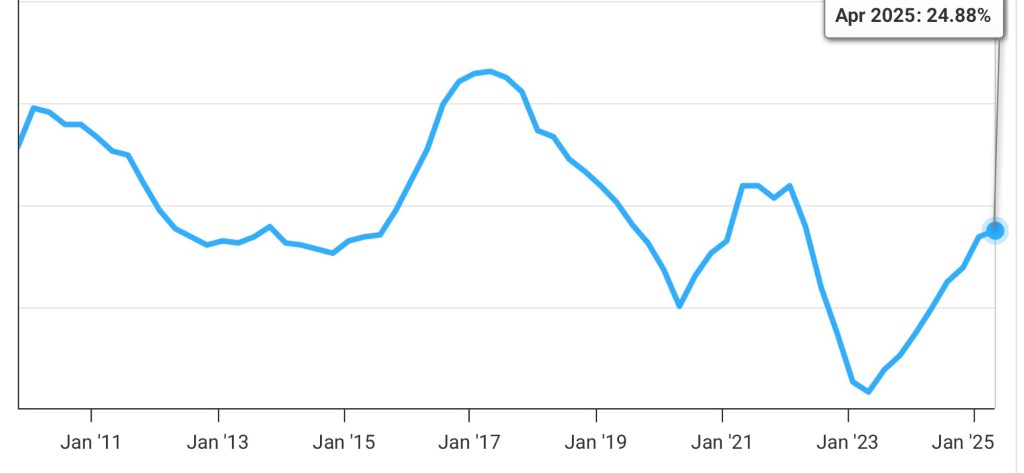
Walmart’s margin today is about the same as the average for discount stores, and it is lower than for department stores, retailers of household and personal products, groceries, and footwear. Furthermore, it is lower today than it was ten years ago. While the margin increased a little during the pandemic, it fell in its aftermath, contrary to Wolf’s assertion. That the company has rebuilt margins steadily since 2023 should be viewed not as an indictment, but perhaps as a testament to improved managerial performance.

Wolf goes on to quote a former Walmart CEO who says that the 25 basis point increase in the gross margin in the latest quarter (from ~24.7% to 24.94%) indicates that the chain can “manage” the tariff impact. Of course it can, but that would not constitute “price gouging”.

A Trump Lackey

Of course, Wolf is taking his cues from Donald Trump, who has been bullying American businesses to “eat” the cost of his tariff onslaught, rather than passing them along to the ultimate buyers of imported goods. However, private businesses should not be expected to take orders from the President. This is not Mussolini’s Italy. Moreover, anyone familiar with tax incidence will understand that sellers are likely to eat some portion of a tariff (sharing the burden with buyers) without jawboning from the executive branch. That’s because buyers demand less at higher prices and sellers wish to avoid losing profitable sales, to the extent they can. But the dynamics of this adjustment process might take time to play out.

It’s also worth noting that a retailer might attempt to hold the line on certain prices in an uncertain cost environment. This uncertainty is a real cost inflicted by Trump. Meanwhile, pointing to increased prices for domestic goods, even if they are truly unaffected by tariffs, proves nothing without knowledge of the relevant cost and market conditions for those goods. It certainly doesn’t prove an “unpatriotic” attempt to cross subsidize imported goods.

In fact, one might say it’s unpatriotic for the federal government to restrict the market choices faced by American consumers and businesses, and for the President to tell American sellers that they better “eat” the cost of tariffs (or else?). And say, what happened to the contention that tariffs aren’t taxes?

Conclusion

Attacks on sellers attempting to recoup tariff costs are unfair and anti-capitalist. They are also somewhat disdainful of the economic sovereignty of American consumers, though not as much as the tariffs themselves. In the case described above, Chad Wolf would have us believe that sellers should not act on their expectations of near-term tariff increases. He also fails to recognize the impact of tariffs on import-competing goods and the cost of tariffs borne by producers who must rely on imported goods as inputs to production. Even worse, Wolf misrepresents some of the evidence he uses to make his case.

More generally, American businesses should not be bullied into taking a hit just because they serve customers who wish to buy imported goods. There is nothing unpatriotic about the freedom to choose what to goods to buy, what goods to stock, and how to maintain profitability in the face of government interference.

Costco Labor Productivity Drives Its Wages

26 Thursday May 2016

Posted by Nuetzel in Minimum Wage, Uncategorized

≈ 2 Comments

Tags

Bloomberg, Caveat Emptorium, Costco Productivity, Costco Wages, Glassdoor.com, Gone With The Wind, Living Wage, Low-skilled labor, Margaret Mitchell, MarketWatch, Megan McArdle, Minimum Wage, Price floors, Productivity and Costs, Wage floor, Wage Mandates, WalMart, Warehouse Stores

image

Buyer beware: various memes promoting a higher minimum wage, or a mandated “living wage” of $15, cite Costco as “proof” that a higher wage floor does not imply that product prices must rise. In fact, Costco pays relatively high wages to its hourly workers and it is a discount retailer, but it is highly misleading to treat these facts in isolation or to suggest that they imply anything about cost-price causality and the consequences of changes in costs. A higher wage floor would add cost pressure to any business employing low-skilled labor and even some employing more skilled workers like Costco. Many of these firms would have to raise prices to remain viable.

Costco says that it pays an average wage of $17 plus benefits. A quick glance at Glassdoor.com shows starting pay rates well below that average, which is no surprise. Costco recently increased its lowest pay rates for the first time in eight years, to $13 and $13.50 an hour from $11.50 and $12. However, there may be some slight-of-hand used to support other quotes of Costco’s average wage. It’s been claimed elsewhere that the company pays an average wage of $20, and President Obama asserted that Costco’s average wage is $21. Typically, quotes of hourly wages do not include the value of benefits. One blogger suggests that these higher figures may have been calculated by averaging across job classifications, rather than dividing the company’s total hourly wage bill by the number of worker-hours. One other qualification is that roughly 10% of the workers in a typical Costco warehouse store dispense free samples but are not employed by Costco. The average hourly wage of “workers at Costco” would likely be lower than $17 if they were included.

Nevertheless, it’s true that Costco pays a relatively high wage rate to its hourly workers. How can they afford to do so? As it happens, Costco has relatively few workers relative to other retail operations, and its average revenue per transaction is high. According to Megan McArdle at Bloomberg, in 2013, Costco’s average square-feet of floor space per employee was almost twice WalMart’s; according to MarketWatch, Costco’s average revenue per employee is now nearly three times the comparable figure for WalMart (enter COST and WMT). Obviously, Costco employees are highly productive in terms of revenue, and that is closely associated with higher wages.

The high productivity at Costco is not an accident. While a good wage is certainly a motivating factor, the productivity of Costco’s work force starts with screening during the hiring process, where the company is known to prefer significant retail experience. They also emphasize the demanding physical requirements of certain jobs, and given their thin staffing, a relatively high level of responsibility for a retail worker. Newcomers are said to be under a watchful eye, and effective performers are rewarded. It takes four to five years to reach the top of the wage scale in a job category. Many of those categories involve specialized skills, such as licensed opticians, butchers, cake decorators, forklift drivers, licensed hearing aid dispensers, and registered pharmacists (these categories drive up the average wage). The company provides training opportunities in various areas, and average employee turnover is low, which reduces costs. The Costco warehouse stores are without typical retail amenities; they are bare-bones with goods sitting on pallets rather than displayed on shelves. This also lowers costs, giving the company additional leeway in shaping its generous wage policy.

Returning to the question of pricing, Costco’s example cannot be generalized. First, it might not be such a good example of price restraint in the face of higher wages to begin with. To bolster earnings, Costco is expected to raise its membership fees by about 9% in 2017; undoubtedly there is also room for retail margins to increase. Time will tell. Second, again, Costco’s wage policy works fairly well because its business model rests largely on high labor productivity. Basic economics teaches us that higher productivity drives higher wages. Workers who earn less than Costco wages are, in general, less productive. This is a consequence of more limited skill sets, less experience, and sometimes weak desire. Those earning at the minimum wage are handicapped by an inability to contribute at high levels, or an inability to demonstrate that they can at their hiring date. Thus, they work in jobs that do not require developed skills. For their employers, higher wages are not a path to profitability.

Mandating an increase in the wage floor is not possible without other market adjustments. First, like anything else, the demand curve for low-skilled labor slopes downward, so a higher wage floor reduces the desired labor input. Job losses befall the least skilled in such a scenario. This consequence has greater breadth in a world in which opportunities for automation are plentiful. Another possible adjustment is an increase in the price charged to customers, which might be a reflexive response among business operators. However, they must compromise when confronted with the competitive effects of passing along an increase in costs. There could be other cost-reducing changes in job structure, benefits, break times, and any number of other conditions and circumstances of employment. Finally, some business owners might accept a lower level of profitability, depending on their disposition and the competitive tenor of the markets in which they operate. Some Costco shareholders believe that might be the case, as the company’s earnings have softened recently.

The final outcome is likely to be a combination of the adjustments described above. Unfortunately for proponents of a higher wage floor, the economy cannot and will not transform itself into a community of Costco clones. With limited skills, the motivational power of higher wages goes only so far. All price floors create excess supply, in this context unemployment. Excess supplies tend to consist of the most marginal units, in this case, the least productive workers. Perhaps sheer ignorance causes agitators for wage mandates to overlook this inevitable marginalization. The real minimum wage is zero.

A note on the cartoon above: It reminded me of an amusing passage in Margaret Mitchell’s “Gone With The Wind” when Rhett Butler, in a sardonic moment, suggests to Scarlett O’Hara that she change the name of Kennedy’s General Store in Atlanta to “Caveat Emptorium, assuring her that it would be a title most in keeping with the type of goods sold in the store. She thought it had an imposing sound and even went so far as to have the sign painted….” Later, Rhett learns that she actually had the sign made, but an embarrassed Ashley Wilkes clued her in to the meaning. She is furious, and Rhett laughs hysterically.

Follow Sacred Cow Chips on WordPress.com

Recent Posts

  • The Case Against Interest On Reserves
  • Immigration and Merit As Fiscal Propositions
  • Tariff “Dividend” From An Indigent State
  • Almost Looks Like the Fed Has a 3% Inflation Target
  • Government Malpractice Breeds Health Care Havoc

Archives

  • January 2026
  • December 2025
  • November 2025
  • October 2025
  • September 2025
  • August 2025
  • July 2025
  • June 2025
  • May 2025
  • April 2025
  • March 2025
  • February 2025
  • January 2025
  • December 2024
  • November 2024
  • October 2024
  • September 2024
  • August 2024
  • July 2024
  • June 2024
  • May 2024
  • April 2024
  • March 2024
  • February 2024
  • January 2024
  • December 2023
  • November 2023
  • August 2023
  • July 2023
  • June 2023
  • May 2023
  • April 2023
  • March 2023
  • February 2023
  • January 2023
  • December 2022
  • November 2022
  • October 2022
  • September 2022
  • August 2022
  • July 2022
  • June 2022
  • May 2022
  • April 2022
  • March 2022
  • February 2022
  • January 2022
  • December 2021
  • November 2021
  • October 2021
  • September 2021
  • August 2021
  • July 2021
  • June 2021
  • May 2021
  • April 2021
  • March 2021
  • February 2021
  • January 2021
  • December 2020
  • November 2020
  • October 2020
  • September 2020
  • August 2020
  • July 2020
  • June 2020
  • May 2020
  • April 2020
  • March 2020
  • February 2020
  • January 2020
  • December 2019
  • November 2019
  • October 2019
  • September 2019
  • August 2019
  • July 2019
  • June 2019
  • May 2019
  • April 2019
  • March 2019
  • February 2019
  • January 2019
  • December 2018
  • November 2018
  • October 2018
  • September 2018
  • August 2018
  • July 2018
  • June 2018
  • May 2018
  • April 2018
  • March 2018
  • February 2018
  • January 2018
  • December 2017
  • November 2017
  • October 2017
  • September 2017
  • August 2017
  • July 2017
  • June 2017
  • May 2017
  • April 2017
  • March 2017
  • February 2017
  • January 2017
  • December 2016
  • November 2016
  • October 2016
  • September 2016
  • August 2016
  • July 2016
  • June 2016
  • May 2016
  • April 2016
  • March 2016
  • February 2016
  • January 2016
  • December 2015
  • November 2015
  • October 2015
  • September 2015
  • August 2015
  • July 2015
  • June 2015
  • May 2015
  • April 2015
  • March 2015
  • February 2015
  • January 2015
  • December 2014
  • November 2014
  • October 2014
  • September 2014
  • August 2014
  • July 2014
  • June 2014
  • May 2014
  • April 2014
  • March 2014

Blogs I Follow

  • Passive Income Kickstart
  • OnlyFinance.net
  • TLC Cholesterol
  • Nintil
  • kendunning.net
  • DCWhispers.com
  • Hoong-Wai in the UK
  • Marginal REVOLUTION
  • Stlouis
  • Watts Up With That?
  • Aussie Nationalist Blog
  • American Elephants
  • The View from Alexandria
  • The Gymnasium
  • A Force for Good
  • Notes On Liberty
  • troymo
  • SUNDAY BLOG Stephanie Sievers
  • Miss Lou Acquiring Lore
  • Your Well Wisher Program
  • Objectivism In Depth
  • RobotEnomics
  • Orderstatistic
  • Paradigm Library
  • Scattered Showers and Quicksand

Blog at WordPress.com.

Passive Income Kickstart

OnlyFinance.net

TLC Cholesterol

Nintil

To estimate, compare, distinguish, discuss, and trace to its principal sources everything

kendunning.net

The Future is Ours to Create

DCWhispers.com

Hoong-Wai in the UK

A Commonwealth immigrant's perspective on the UK's public arena.

Marginal REVOLUTION

Small Steps Toward A Much Better World

Stlouis

Watts Up With That?

The world's most viewed site on global warming and climate change

Aussie Nationalist Blog

Commentary from a Paleoconservative and Nationalist perspective

American Elephants

Defending Life, Liberty and the Pursuit of Happiness

The View from Alexandria

In advanced civilizations the period loosely called Alexandrian is usually associated with flexible morals, perfunctory religion, populist standards and cosmopolitan tastes, feminism, exotic cults, and the rapid turnover of high and low fads---in short, a falling away (which is all that decadence means) from the strictness of traditional rules, embodied in character and inforced from within. -- Jacques Barzun

The Gymnasium

A place for reason, politics, economics, and faith steeped in the classical liberal tradition

A Force for Good

How economics, morality, and markets combine

Notes On Liberty

Spontaneous thoughts on a humble creed

troymo

SUNDAY BLOG Stephanie Sievers

Escaping the everyday life with photographs from my travels

Miss Lou Acquiring Lore

Gallery of Life...

Your Well Wisher Program

Attempt to solve commonly known problems…

Objectivism In Depth

Exploring Ayn Rand's revolutionary philosophy.

RobotEnomics

(A)n (I)ntelligent Future

Orderstatistic

Economics, chess and anything else on my mind.

Paradigm Library

OODA Looping

Scattered Showers and Quicksand

Musings on science, investing, finance, economics, politics, and probably fly fishing.

  • Subscribe Subscribed
    • Sacred Cow Chips
    • Join 128 other subscribers
    • Already have a WordPress.com account? Log in now.
    • Sacred Cow Chips
    • Subscribe Subscribed
    • Sign up
    • Log in
    • Report this content
    • View site in Reader
    • Manage subscriptions
    • Collapse this bar
 

Loading Comments...