• About

Sacred Cow Chips

Sacred Cow Chips

Monthly Archives: June 2015

Fitting Data To Models At NOAA

08 Monday Jun 2015

Posted by Nuetzel in Global Warming

≈ 6 Comments

Tags

AGW, Anthony WAtts, Anthropomorphic Global Warming, buoy vs ship temperatures, Carl Beisner, Global Mean Temperature, Global Warming Hiatus, Judith Curry, National Oceanic and Atmospheric Administration, NOAA, Ross McKitrick, Temperature adjustments, Watt's Up With That?

Dilbert Made Up Numbers

If the facts don’t suit your agenda, change them! The 18-year “hiatus” in global warming, which has made a shambles of climate model predictions, is now said to have been based on “incorrect data”, according to researchers at National Oceanic and Atmospheric Administration (NOAA). Translation: they have created new data “adjustments” that tell a story more consistent with their preferred narrative, namely, that man-made carbon emissions are forcing global temperatures upward, more or less steadily. The New York Times’ report on the research took a fairly uncritical tone, despite immediate cautions and rebuttals from a number of authorities. On balance, the NOAA claims seem rather laughable.

Ross McKitrick has an excellent discussion of the NOAA adjustments on the Watts Up With That? blog (WUWT). His post reinforces the difficulty of aggregating temperature data in a meaningful way. A given thermometer in a fixed location can yield drifting temperatures over time due to changes in the surrounding environment, such as urbanization. In addition, weather stations are dispersed in irregular ways with extremely uneven coverage, and even worse, they have come and gone over time. There are gaps in the data that must be filled. There might be international differences in reporting practices as well. Sea surface temperature measurement is subject to even greater uncertainty. They can be broadly classified into temperatures collected on buoys and those collected by ships, and the latter have been taken in a variety of ways, from samples collected in various kinds of buckets, hull sensors, engine room intakes, and deck temperatures. The satellite readings, which are a recent development, are accurate in tracking changes, but the levels must be calibrated to other data. Here’s McKitrick on the measurements taken on ships:

“… in about half the cases people did not record which method was used to take the sample (Hirahari et al. 2014). In some cases they noted that, for example, ERI readings were obtained but they not indicate the depth. Or they might not record the height of the ship when the MAT reading is taken.“

The upshot is that calculating a global mean temperature is a statistical exercise fraught with uncertainty. A calculated mean at any point in time is an estimate of a conceptual value. The estimate is one of many possible estimates around the “true” value. Given the measurement difficulties, any meaningful confidence interval for the true mean would likely be so broad as to render inconsequential the much-discussed temperature trends of the past 50 years.

McKitrick emphasizes the three major changes made by NOAA, all having to do with sea surface temperatures:

  1. NOAA has decided to apply an upward adjustment to bring buoy temperature records into line with ship temperatures. This is curious, because most researchers have concluded that the ship temperatures are subject to greater bias. Also, the frequency of buoy records has been rising as a share of total sea temperature readings.
  2. NOAA added extra weight to the buoy readings, a decision which was unexplained.
  3. They applied a relatively large downward adjustment to temperatures collected by ships during 1998-2000.

Even the difference between the temperatures measured by ships and buoys (0.12 degrees Celsius), taken at face value, has a confidence interval (95%?) that is about 29 times as large as the difference. That adjustments such as those above are made with a straight face is nothing short of preposterous.

A number of other researchers have weighed in on the NOAA adjustments. Carl Beisner summarizes some of this work. He quotes McKitrick as well as Judith Curry:

“I think that uncertainties in global surface temperature anomalies is [sic] substantially understated. The surface temperature data sets that I have confidence in are the UK group and also Berkeley Earth. This short paper in Science is not adequate to explain and explore the very large changes that have been made to the NOAA data set. The global surface temperature datasets are clearly a moving target.“

There are a number of other posts this week on WUWT regarding the NOAA adjustments. Some of the experts, like Judith Curry, emphasize the new disparities created by NOAA’s adjustments with other well-regarded temperature series. It will be interesting to see how these differences are debated. Let’s hope that the discussion is driven wholly by science and not politics, but I fear that the latter will have a major impact on the debate. It has already.

Major Mistake: The Minimum Opportunity Wage

06 Saturday Jun 2015

Posted by Nuetzel in Price Controls

≈ 1 Comment

Tags

Alan Krueger, Brian Doherty, competition, Coyote Blog, David Card, Don Boudreaux, Economic justice, Fast food robots, Mark Perry, Minimum Wage, Monopsony, Reason Magazine, Rise of the Machines, Robert Reich, Robot replacements, Show-Me Institute, Steve Chapman, Substitutability, Tim Worstall, Unintended Consequences, Wage compression, Warren Meyer

government-problem

City leaders in St. Louis and Kansas City are the latest to fantasize that market manipulation can serve as a pathway to “economic justice”. They want to raise the local minimum wage to $15 by 2020, following similar actions in Los Angeles, Oakland  and Seattle. They will harm the lowest-skilled workers in these cities, not to mention local businesses, their own local economies and their own city budgets. Like many populists on the national level with a challenged understanding of market forces (such as Robert Reich), these politicians won’t recognize the evidence when it comes in. If they do, they won’t find it politically expedient to own up to it. A more cynical view is that the hike’s gradual phase-in may be a deliberate attempt to conceal its negative consequences.

There are many reasons to oppose a higher minimum wage, or any minimum wage for that matter. Prices (including wages) are rich with information about demand conditions and scarcity. They provide signals for owners and users of resources that guide them toward the best decisions. Price controls, such as a wage floor like the minimum wage, short-circuit those signals and are notorious for their disastrous unintended (but very predictable) consequences. Steve Chapman at Reason Magazine discusses the mechanics of such distortions here.

Supporters of a higher minimum wage usually fail to recognize the relationship between wages and worker productivity. That connection is why the imposition of a wage floor leads to a surplus of low-skilled labor. Those with the least skills and experience are the most likely to lose their jobs, work fewer hours or not be hired. In another Reason article, Brian Doherty explains that this is a thorny problem for charities providing transitional employment to workers with low-skills or employability. He also notes the following:

“All sorts of jobs have elements of learning or training, especially at the entry level. Merely having a job at all can have value down the line worth enormously more than the wage you are currently earning in terms of a proven track record of reliable employability or moving up within a particular organization.“

The negative employment effects of a higher wage floor are greater if the employer cannot easily pass higher costs along to customers. That’s why firms in highly competitive markets (and their workers) are more vulnerable. This detriment is all the worse when a higher wage floor is imposed within a single jurisdiction, such as the city of St. Louis. Bordering municipalities stand to benefit from the distorted wage levels in the city, but the net effect will be worse than a wash for the region, as adjustments to the new, artificial conditions are not costless. Again, it is likely that the least capable workers and least resourceful firms will be harmed the most.

The negative effects of a higher wage floor are also greater when substitutes for low-skilled labor are available. Here is a video on the robot solution for fast food order-taking. In fact, today there are robots capable of preparing meals, mopping floors, and performing a variety of other menial tasks. Alternatively, more experienced workers may be asked to perform more menial tasks or work longer hours. Either way, the employer takes a hit. Ultimately, the best alternative for some firms will be to close.

The impact of the higher minimum on the wage rates of more skilled workers is likely to be muted. A correspondent of mine mentioned the consequences of wage compression. From the link:

“In some cases, compression (or inequity) increases the risk of a fight or flee phenomonon [sic]–disgruntlement culminating in union organizing campaigns or, in the case of flee, higher turnover as the result of employees quitting. … all too often, companies are forced to address the problem by adjusting their entire compensation systems–usually upward and across-the-board. .. While wage adjustments may sound good for those who do not have to worry about profits and losses, the real impact for a company typically means it must either increase productivity or lay people off.“

For those who doubt the impact of the minimum wage hike on employment decisions, consider this calculation by Mark Perry:

“The pending 67% minimum wage hike in LA (from $9 to $15 per hour by 2020), which is the same as a $6 per hour tax (or $12,480 annual tax per full-time employee and more like $13,500 per year with increased employer payroll taxes…)….“

Don Boudreaux offers another interesting perspective, asking whether a change in the way the minimum wage is enforced might influence opinion:

“... if these policies were enforced by police officers monitoring workers and fining those workers who agreed to work at hourly wages below the legislated minimum – would you still support minimum wages?“

Proponents of a higher minimum wage often cite a study from 1994 by David Card and Alan Krueger purporting to show that a higher minimum wage in New Jersey actually increased employment in the fast food industry. Tim Worstall at Forbes discussed a severe shortcoming of the Card/Krueger study (HT: Don Boudreaux): Card and Krueger failed to include more labor-intensive independent operators in their analysis, instead focusing exclusively on employment at fast-food chain franchises. The latter were likely to benefit from the failure of independent competitors.

Another common argument put forward by supporters of higher minimum wages is that economic theory predicts positive employment effects if employers have monopsony power in hiring labor, or power to influence the market wage. This is a stretch: it describes labor market conditions in very few localities. Of course, any employer in an unregulated market is free to offer noncompetitive wages, but they will suffer the consequences of taking less skilled and less experienced hires, higher labor turnover and ultimately a competitive disadvantage. Such forces lead rational employers to offer competitive wages for the skills levels they require.

Minimum wages are also defended as an anti-poverty program, but this is a weak argument. A recent post at Coyote Blog explains “Why Minimum Wage Increases are a Terrible Anti-Poverty Program“. Among other points:

“Most minimum wage earners are not poor. The vast majority of minimum wage jobs are held as second jobs or held by second earners in a household or by the kids of affluent households. …

Most people in poverty don’t make the minimum wage. In fact, the typically [sic] hourly income of the poor appears to be around $14 an hour. The problem is not the hourly rate, the problem is the availability of work. The poor are poor because they don’t get enough job hours. …

Many young workers or poor workers with a spotty work record need to build a reliable work history to get better work in the future…. Further, many folks without much experience in the job market are missing critical skills — by these I am not talking about sophisticated things like CNC machine tool programming. I am referring to prosaic skills you likely take for granted (check your privilege!) such as showing up reliably each day for work, overcoming the typical frictions of working with diverse teammates, and working to achieve management-set goals via a defined process.”

Some of the same issues are highlighted by the Show-Me Institute, a Missouri think tank, in “Minimum Wage Increases Not Effective at Fighting Poverty“.

A higher minimum wage is one of those proposals that “sound good” to the progressive mind, but are counter-productive in the extreme. The cities of St. Louis and Kansas City would do well to avoid market manipulation that is likely to backfire.

Haunted By Food Demons

03 Wednesday Jun 2015

Posted by Nuetzel in Biotechnology

≈ Leave a comment

Tags

GE crops, Glyphosate, GMOs, Herbicides, Pesticides, Roundup, The Credible Hulk, Toxicity

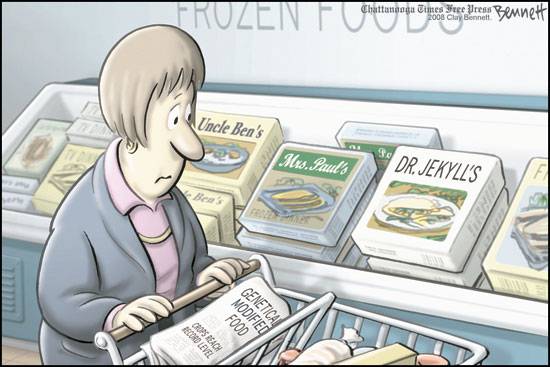
dr-jekyll gmo Glyphosate herbicide usage (as in Roundup) in the U.S. has increased dramatically over the last two decades, replacing the use of far more toxic herbicides on many crops. That’s one of the major points in a post at The Credible Hulk blog entitled “About those more caustic herbicides that glyphosate helped replace“. The increased use of glyphosate corresponded to heavier reliance on glyphosate-tolerant strains of genetically-engineered crops. The author provides charts and other details on the changing use of a number of different herbicides both over time and across crop varieties.

“… the purpose of this [post] is to show that when opponents of GE technology and of glyphosate claim that GR crops are bad on the grounds that they increased glyphosate use, they are leaving out critical information that would be highly inconvenient for their narrative.“

The use of insect-resistant GE crops has also been associated with a declines in total pesticide use. [The links above are all given in The Credible Hulk post].

There is a great deal of distortion prompted by certain interest groups who oppose the use of synthetic herbicides and insecticides and GMOs. Irrational fears among consumers are inflamed by this sort of propaganda. This post and this post give farmers’ perspectives on some of the misinformation with respect to glyphosate. No, farmer’s do not “drench” their crops with glyphosate prior to harvest. That claim is pure hyperbole.

It’s also important to note that organic crops are not free of treatments. So-called organic pesticides are often just as toxic as synthetic pesticides, and they are often used in heavier quantities. Furthermore, organic foods carry undeniable health risks to consumers. A balanced view must acknowledge the benefits of crop treatments to consumers (whether the treatments are organic or nonorganic), that residues on produce in the U.S. are minimal, that safety still dictates that consumers wash their produce, and that consumers deserve a free choice between crops grown conventionally or organically.

Busted Big Government

01 Monday Jun 2015

Posted by Nuetzel in National Debt

≈ Leave a comment

Tags

Alan Greenspan, bailouts, Contingent liabilities, Default, Disability Insurance Fund, entitlements, Inflation, Lawrence Lindsey, Medicare, Nicholas Ballasy, Social Security Trust Fund, Taxes

accounting or accountability

Alan Greenspan says we are “way underestimating” the U.S. national debt. His statements on this point make a great follow-up to last night’s post on bailouts. Here are a couple of recent Greeenspan quotes from an article by Nicholas Ballasy:

“Largely because we are not including what I would call contingent liabilities, that is the issue of, which is answered by a question: what is the probability that in today’s environment JP Morgan would be allowed to default? The answer is zero or less.”

Now, that means that whole balance sheet is a contingent liability. Now to be sure, while it’s contingent, there’s no interest payments but ultimately that overhangs the structure because we have committed in so many different ways to guarantee this, that and the other thing. It’s not only Fannie and Freddie but it’s a whole series of financial institutions and, regrettably, it is also non-financial institutions.”

The bailout barometer I mentioned last night is an eye-opener, but it reflects a very incomplete view of the contingent liabilities faced by the government. Ballasy discusses some massive unfunded liabilities associated with programs like Social Security, which has a trust fund that Greenspan calls “meaningless”:

“The Social Security and Medicare Trustees 2014 annual report said while legislation is needed to address all of Social Security’s financial imbalances, ‘the need has become most urgent with respect to the program’s disability insurance component. Lawmakers need to act soon to avoid automatic reductions in payments to DI beneficiaries in late 2016.’”

Lawrence Lindsey, an economic official in the Bush Administration, says the real national debt is closer to 300 percent of GDP when unfunded obligations for Social Security and Medicare are added. The fast-dissipating disability insurance fund was the subject of another post here two days ago. It is a case study in irresponsible governance. Here is Ballasy with another Greenspan quote:

“According to Greenspan, entitlement spending in the U.S. was 4.7 percent of GDP in 1967 compared to more than 14 percent today. ‘Had we kept it at that level, our productivity would be far higher today. The average wage would be very significantly higher, the standard of living would be higher and what we have to do is think about how we are going to shrink that pie back and, to me, that is the single most important problem that confronts this country,’ he said.“

Shrinking the ongoing flow of entitlements is a tall political order. Avoiding the contingencies that would add to existing obligations calls for economic policies that promote stability, rather than boom and bust cycles that follow misguided efforts to stimulate the economy. Still another matter is to deal with the obligations that already exist. Higher taxes, inflation and default do not represent attractive policy options, but our activist government has placed us squarely in that corner.

Newer posts →
Follow Sacred Cow Chips on WordPress.com

Recent Posts

  • A Warsh Policy Scenario At the Federal Reserve
  • The Coexistence of Labor and AI-Augmented Capital
  • The Case Against Interest On Reserves
  • Immigration and Merit As Fiscal Propositions
  • Tariff “Dividend” From An Indigent State

Archives

  • February 2026
  • January 2026
  • December 2025
  • November 2025
  • October 2025
  • September 2025
  • August 2025
  • July 2025
  • June 2025
  • May 2025
  • April 2025
  • March 2025
  • February 2025
  • January 2025
  • December 2024
  • November 2024
  • October 2024
  • September 2024
  • August 2024
  • July 2024
  • June 2024
  • May 2024
  • April 2024
  • March 2024
  • February 2024
  • January 2024
  • December 2023
  • November 2023
  • August 2023
  • July 2023
  • June 2023
  • May 2023
  • April 2023
  • March 2023
  • February 2023
  • January 2023
  • December 2022
  • November 2022
  • October 2022
  • September 2022
  • August 2022
  • July 2022
  • June 2022
  • May 2022
  • April 2022
  • March 2022
  • February 2022
  • January 2022
  • December 2021
  • November 2021
  • October 2021
  • September 2021
  • August 2021
  • July 2021
  • June 2021
  • May 2021
  • April 2021
  • March 2021
  • February 2021
  • January 2021
  • December 2020
  • November 2020
  • October 2020
  • September 2020
  • August 2020
  • July 2020
  • June 2020
  • May 2020
  • April 2020
  • March 2020
  • February 2020
  • January 2020
  • December 2019
  • November 2019
  • October 2019
  • September 2019
  • August 2019
  • July 2019
  • June 2019
  • May 2019
  • April 2019
  • March 2019
  • February 2019
  • January 2019
  • December 2018
  • November 2018
  • October 2018
  • September 2018
  • August 2018
  • July 2018
  • June 2018
  • May 2018
  • April 2018
  • March 2018
  • February 2018
  • January 2018
  • December 2017
  • November 2017
  • October 2017
  • September 2017
  • August 2017
  • July 2017
  • June 2017
  • May 2017
  • April 2017
  • March 2017
  • February 2017
  • January 2017
  • December 2016
  • November 2016
  • October 2016
  • September 2016
  • August 2016
  • July 2016
  • June 2016
  • May 2016
  • April 2016
  • March 2016
  • February 2016
  • January 2016
  • December 2015
  • November 2015
  • October 2015
  • September 2015
  • August 2015
  • July 2015
  • June 2015
  • May 2015
  • April 2015
  • March 2015
  • February 2015
  • January 2015
  • December 2014
  • November 2014
  • October 2014
  • September 2014
  • August 2014
  • July 2014
  • June 2014
  • May 2014
  • April 2014
  • March 2014

Blogs I Follow

  • Passive Income Kickstart
  • OnlyFinance.net
  • TLC Cholesterol
  • Nintil
  • kendunning.net
  • DCWhispers.com
  • Hoong-Wai in the UK
  • Marginal REVOLUTION
  • Stlouis
  • Watts Up With That?
  • Aussie Nationalist Blog
  • American Elephants
  • The View from Alexandria
  • The Gymnasium
  • A Force for Good
  • Notes On Liberty
  • troymo
  • SUNDAY BLOG Stephanie Sievers
  • Miss Lou Acquiring Lore
  • Your Well Wisher Program
  • Objectivism In Depth
  • RobotEnomics
  • Orderstatistic
  • Paradigm Library
  • Scattered Showers and Quicksand

Blog at WordPress.com.

Passive Income Kickstart

OnlyFinance.net

TLC Cholesterol

Nintil

To estimate, compare, distinguish, discuss, and trace to its principal sources everything

kendunning.net

The Future is Ours to Create

DCWhispers.com

Hoong-Wai in the UK

A Commonwealth immigrant's perspective on the UK's public arena.

Marginal REVOLUTION

Small Steps Toward A Much Better World

Stlouis

Watts Up With That?

The world's most viewed site on global warming and climate change

Aussie Nationalist Blog

Commentary from a Paleoconservative and Nationalist perspective

American Elephants

Defending Life, Liberty and the Pursuit of Happiness

The View from Alexandria

In advanced civilizations the period loosely called Alexandrian is usually associated with flexible morals, perfunctory religion, populist standards and cosmopolitan tastes, feminism, exotic cults, and the rapid turnover of high and low fads---in short, a falling away (which is all that decadence means) from the strictness of traditional rules, embodied in character and inforced from within. -- Jacques Barzun

The Gymnasium

A place for reason, politics, economics, and faith steeped in the classical liberal tradition

A Force for Good

How economics, morality, and markets combine

Notes On Liberty

Spontaneous thoughts on a humble creed

troymo

SUNDAY BLOG Stephanie Sievers

Escaping the everyday life with photographs from my travels

Miss Lou Acquiring Lore

Gallery of Life...

Your Well Wisher Program

Attempt to solve commonly known problems…

Objectivism In Depth

Exploring Ayn Rand's revolutionary philosophy.

RobotEnomics

(A)n (I)ntelligent Future

Orderstatistic

Economics, chess and anything else on my mind.

Paradigm Library

OODA Looping

Scattered Showers and Quicksand

Musings on science, investing, finance, economics, politics, and probably fly fishing.

  • Subscribe Subscribed
    • Sacred Cow Chips
    • Join 128 other subscribers
    • Already have a WordPress.com account? Log in now.
    • Sacred Cow Chips
    • Subscribe Subscribed
    • Sign up
    • Log in
    • Report this content
    • View site in Reader
    • Manage subscriptions
    • Collapse this bar
 

Loading Comments...