• About

Sacred Cow Chips

Sacred Cow Chips

Category Archives: Art & Politics

State Aesthetics: Taxes for Art and Dogma

07 Tuesday Jan 2025

Posted by Nuetzel in Art & Politics, Subsidies

≈ Leave a comment

Tags

Agitprop, Americans for the Arts, Arts Education, Arts Funding, Corporation for Public Broadcasting, crowding out, DOGE, Exclusivity, Externalities, National Endowment for the Arts, Propaganda, Public goods, Public Radio, Samuel Andreyev, Subsidies, Thomas Jefferson
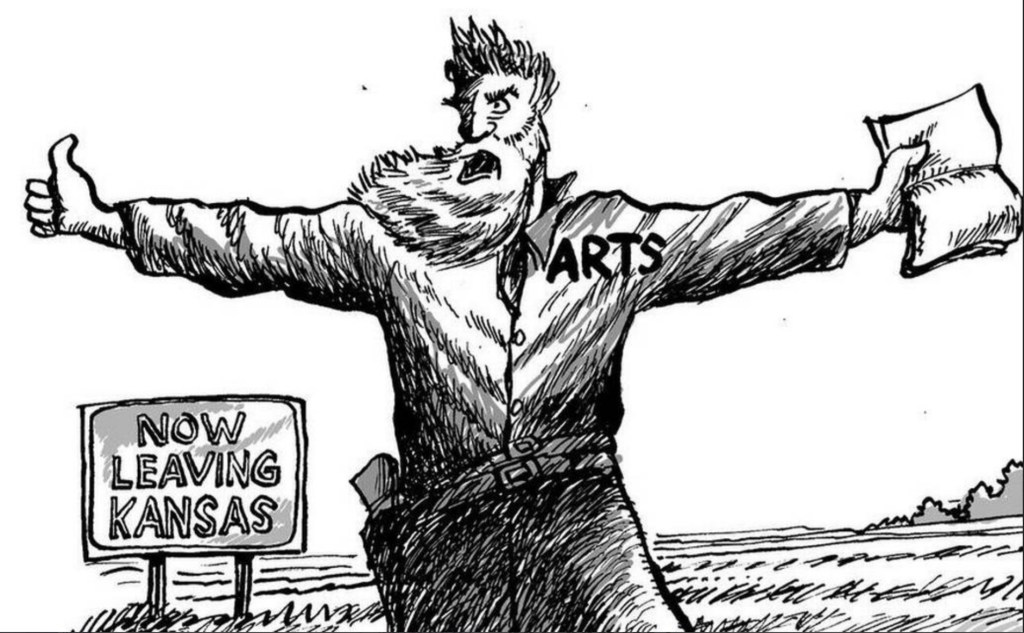
In a post a few years ago entitled “The National Endowment for Rich Farts”, I discussed a point that should be rather obvious: federal funding of the arts too often subsidizes the upper class, catering to their artistic tastes and underwriting a means through which they conduct social and professional networking. The topic is back in the news, with reports that the incoming Trump Administration, at the recommendation of the Department of Government Efficiency (DOGE), will attempt to eliminate funding for the Corporation for Public Broadcasting.

Great Big Stuff and Crowding Out

To opponents of federal arts funding, public radio is probably the bête noire of arts organizations due to its left-wing political orientation and the general affluence of its subscriber base. However, public arts funding goes way beyond subsidies for public radio.

Large nonprofits receive the bulk of government arts funding. Despite claims to the contrary, these organizations won’t go broke without the gravy provided by public funding. The federal government contributes about 3% of the revenue taken in by non-profit arts organizations, according to Americans For the Arts. These organizations are already heavily subsidized: their surpluses are tax exempt and private contributions are tax deductible. Tax deductions are worth more to those in high income-tax brackets, and involvement in such visible organizations is highly prized by elites.

Furthermore, there is no evidence that additional government funding “multiplies” private giving. If anything, increases in public funding reduce private giving (and see here).

Public Funds for Private Gain

It’s often argued that government should subsidize the arts because art has the qualities of a public good, but that’s a false premise. A good can be classified as “public” only when its consumption is non-exclusive and non-rivalrous. Can individuals be excluded from enjoying music? Of course. Can they be excluded from viewing a theatrical performance, a film, or any other piece of visual art? Generally yes, and art exhibitions and artistic performances are nearly always subject to paid and limited attendance.

In some contexts art is, or can be made, less excludable. Architecture can be admired (or detested) by anyone on the street. So can public monuments and street art. A concert or play can be performed free of charge, perhaps at a large, outdoor venue. Amplification and large video monitors can make a big difference in terms of non-exclusion. Museums can offer admission to the general public at no charge. And we can broaden the definition of a work to include copies or reproductions that might be available via public display or broadcast (on NPR!).

All these steps will help increase exposure to the arts. But you can’t make it mandatory. People will always self-exclude because they can. So, in which cases should taxpayers bear the costs of art, and of making it less exclusive? On the spectrum of legitimate functions of government, it’s hard to rank this sort of activity highly.

A claim less absurd than the public goods argument is that art has some positive spillover effects, or externalities. It should therefore be subsidized or underwritten with public funds lest it be underprovided. Unfortunately, the spillover effects of a piece of art (where relevant) are not always positive. After all, tastes vary considerably. One man’s art can be another man’s annoyance or provocation. This undermines the case for public funding, at least for art that is controversial in nature.

Perhaps a better interpretation of art externalities is that exposure to the arts has positive spillover effects. Thus, additional art confers benefits to society above and beyond the edification of those exposed to it. Perhaps it makes us nicer and more interesting, but that’s a highly speculative rationale for public funding.

Less questionably, more art and more exposure to the arts does enrich society in ways that have nothing to do with external benefits. Culture and arts are by-products of normal social interactions between private individuals. The benefits of art exposure (and art education) are largely accrued privately. When artistic knowledge is shared to nourish or broaden one’s network, the benefits flow from private social interactions that arise naturally, rather than as a consequence of phantom external benefits.

Public Funding and Agitprop

The selection of recipients and projects for government grants or subsidies is especially prone to influence by entrenched political interests. That is indeed the case when it comes to federal agencies that offer grants for the arts.

The same danger looms when government provides a venue or manages aspects of a presentation of art, including curation of content. It’s an avenue through which art can become politicized. The problem, however, is not so much that a particular work might have political implications. As Samuel Andreyev, a Canadian composer says:

“Like any other subject, it is possible for political subjects to be handled sensitively by an artist, provided there is a strong enough element of abstraction and symbolism so that the work does not become merely journalistic.”

Andreyev makes a good point, but government funding and direction can create incentives to politicize art, encouraging more blatant expressions of political viewpoints at the expense of taxpayers.

I’ve certainly admired art despite subtle political implications with which I differed. One can hardly imagine a treatment of the human condition that would not invite tangential political commentary. Still, politicization of art should always be left as a private exercise, not one over which the government of a free society wields influence.

Do Markets Undervalue Art?

What about the artists themselves? The premise that artists deserve subsidies relies on the questionable presumption that the value of their work exceeds its commercial or market value. Thus, taxpayers are asked to pay handsomely for art that is not valued as highly by private buyers.

Artists who benefit from government arts funding are often well established professionally. Less fortunate artists scrape by, finding what market they can while working side gigs. In fact, many less celebrated artists work at their craft on a part-time basis while earning most of their income from day jobs. Should the government support these artists, or artists having few opportunities to promote their work?

It’s not clear that public funding should override the private market’s basis of valuation for established or unestablished artists. However, some government funding finds its way into less celebrated corners of the art world. This report uses data at the census tract level to show that arts organizations located in low income tracts, while receiving less, still get a disproportionate share of federal grant dollars relative to their share of the population. This finding should be viewed cautiously, as data at this level of aggregation has limitations. The findings do not imply that “starving artists” receive a disproportionate share of those dollars. Nor do they prove that federal grants benefit low-income individuals disproportionately via improved access to the arts. Again, the findings are based on the location of organizations. And again, large organizations receive the bulk of these grants.

Drawing the Line

So where do we draw the line on taxpayer subsidies for the arts? The standard, public-goods justification is false. While externalities may exist, they are not always positive, and it is hardly the state’s proper role to fund art that “challenges” notions about good and bad art. In that vein, just as law tends to be ineffective when it lacks consensus, public arts funding breeds dissent when the art is controversial.

The legitimacy of public arts funding ultimately depends on whether the art itself has a true public purpose. To varying degrees, this might include the architecture and interior design of public buildings, landscaping of parks, as well as certain monuments and statuary. Even within these disciplines, the selection of form, content, and the artists who will execute the work can be controversial. That might be unavoidable, though controversy will be minimized when the content of publicly-funded art remains within cultural norms.

Beyond those limited purposes, funding art at the federal level is difficult to justify. That role simply does not fall within the constitutionally-enumerated powers of the federal government. The tenuous rationale for subsidies implies that art is undervalued, despite the existence of a vibrant private ecosystem for art, including private support foundations and markets. To the extent that public subsidies line the pockets of elites or support art that would otherwise fail a market test, they represent a wasteful misallocation of resources.

Funding art might seem less troublesome at lower levels of government, where elected representatives and policymakers are in more intimate contact with voters and taxpayers. Still, the same economic reservations apply. At local levels, institutions like community orchestras and concerts series might be broadly supported. Publicly-funded museums, theatrical venues, and other facilities might be accepted by voters as well. If parents have educational choices and expect schools to teach art, it should be funded at public schools, so long as the content stays within cultural norms and is age-appropriate. Of course, all of these matters are up to local voters.

The greatest danger of public funding for the arts is that it tends to be utilized as a tool of political propaganda. Having the state select winners and losers in the arts invites politicization, undermining freedom and our system of government. On that point, Thomas Jefferson once made this observation:

“To compel a man to furnish contributions of money for the propagations of opinions which he disbelieves and abhors, is sinful and tyrannical.“
A Funny Thing Happened On the Way to the Blobum

25 Thursday Feb 2021

Posted by Nuetzel in Architecture, Art & Politics, Free markets

≈ Leave a comment

Tags

Adolph Loos, Asymmetry, Blobitecture, Brianna Rennix, Capitalism, Classical Style, Contemporary Design, Current Affairs, Evelyn Waugh, Form Follows Function, International Style, Louis Sullivan, Modern Architecture, Nathan J. Robinson, Ornamentation, Peter Eisenman, The Decline and Fall

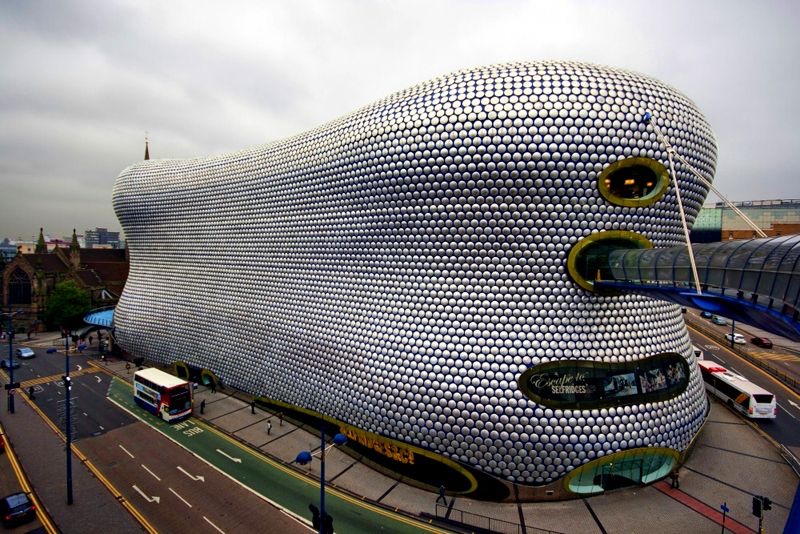
I like interesting “shapes” as much as the next guy, but I have to agree with this piece in Current Affairs: much about modern architecture has gone badly wrong. Brianna Rennix and Nathan J. Robinson’s (R&R) entertaining piece decries what they call “blobitecture”, among other errant aesthetic trends in the design of modern buildings. The article includes a number of great photos depicting very good and very bad architecture, along with a few amusing captions like the following:

“If It doesn’t make you feel desperately, crushingly alone, it’s probably not a piece of prize-winning contemporary architecture.”

“Oh my fucking God, just look at it. Look at it! Does this make you happy? Does it nourish your spirit? What’s with all the little random protrusions? Aaaaagghh.”

Calling of the Moderns

By “modern”, R&R really mean a philosophy of design having roots in the early twentieth century. “Form follows function” was the dictum set down by the famed architect Louis Sullivan. R&R quickly aver that Sullivan did not intend to condemn all ornamentation, but his statement was often interpreted as such. The misunderstanding was reinforced by Adolph Loos, who likened more austere designs to demonstrations of “spiritual strength”. So, modern design was not only superior from a practical perspective, but it was “honest”, imbued with a kind of valor and perhaps devine aspiration.

Form, and To Hell With Function

A delicious irony in R&R’s discussion is the fact that modern architecture has subverted its objectives in at least one fundamental respect. The utilitarian emphasis, with few or starkly simplified adornments, morphed into a celebration of asymmetry, then shape-shifted into a brave new world of three-dimensional manifolds. But buildings with unusual shapes can present difficulties in using the space effectively. So much for “form follows function”! As an illustration, R&R offer this vignette about Peter Eisenman:

“… one Eisenman-designed house so departed from the normal concept of a house that its owners actually wrote an entire book about the difficulties they experienced trying to live in it. For example, Eisenman split the master bedroom in two so the couple could not sleep together, installed a precarious staircase without a handrail, and initially refused to include bathrooms. In his violent opposition to the very idea that a real human being might actually attempt to live (and crap, and have sex) in one of his houses, Eisenman recalls the self-important German architect from Evelyn Waugh’s novel Decline and Fall, who becomes exasperated [by] the need to include a staircase between floors: ‘Why can’t the creatures stay in one place? The problem of architecture is the problem of all art: the elimination of the human element from the consideration of form. The only perfect building must be the factory, because that is built to house machines, not men.’”

But Sometimes It’s Okay

My tastes must be more eclectic than R&R’s, because when it comes to modern buildings, my opinion is “it all depends….” I’ve never liked the boxy international style that still dominates most skylines, but some modern buildings really are interesting. Sometimes I like asymmetry and sometimes I don’t. The shapes of buildings, whatever they are, might contribute to a city-scape in appealing ways. But it probably depends on the presence of certain things like surrounding greenery, which R&R value highly, or even a stylized nod to classical aesthetics. A building — the whole of a structure— can have an ornamental quality of its own, even if it lacks the kind of minutia R&R yearn for. Some skyscrapers, which R&R find so damnable, do indeed soar gracefully.

Cost, From Both Sides of the Mouth

One of the more interesting points made by R&R has to do with cost. They contend that architects are reluctant to propose ornamentation and aesthetic minutia because of the presumed addition to cost of the final design. And likewise, clients are presumed to view those elements as lacking a return on investment. But as R&R note, this logic does not always stand up to scrutiny: unusual structural elements can be extremely expensive to engineer. In the end, a more traditional structure with decorative elements might be far less costly.

Is Capitalism To Blame?

Finally, I take issue with a point R&R make more strongly toward the end of their essay: that capitalism is a primary driver of the ugliness of modern design. They seem to equate capitalism with the sort of corporatist fascism that relies so heavily on government for its viability. This is the meaning of capitalism only in the imagination of the Left, even as the Left increasingly embraces the state-dominated mechanics of corporatism.

The large private entities that thrive under such a regime might well be inclined to build the sort of stark monoliths assailed by R&R. An ancient, didactic finance professor once cautioned me against investing in companies that build glitzy offices, essentially monuments to themselves. He said it’s a sure sign of trouble ahead, of managerial waste. Fair enough, but today, in a world of “too big to fail”, it might be more symbolic of prospective bailouts from ravaged taxpayers. The problem is these corporate managers don’t pay enough attention to ROI precisely because they are protected from downside risks by public policy makers. So they bring on the monoliths!

In contrast, capitalism means truly private enterprise with no guarantee against failure. It relies on the sovereignty of individual actors in pursuit of their self-interest. Yes, costs matter, but they must be balanced against benefits in order to reach rational, efficient outcomes. In this sense, tastes guide decisions, including decisions about design. The abominations of modern architecture are not purely cost-driven, capitalist phenomena, independent of tastes. Whether it is an office, a storefront, or a home, tastes matter, not just costs. People and businesses are usually willing to pay more for things they find attractive. But again, there’s no accounting for tastes.

Of course, commercial developers can and sometimes do make bad design choices, but that’s hardly uniform. At the same time, to label better design choices “pastiche” or “Disneyfied” sounds like a bit of a cop-out when we’re entertaining thoughts of ornamentation and adornment. Perhaps it’s a thin line. But I find a great deal of variety in the design of residential and commercial construction today, and I quite like some of it.

Tyranny of the Critics

R&R give frequent nods to “democratic” ideals, as if some sort of majoritarian principle should guide design. The ideal is more closely approximated by the free market in which people can express their preferences through purchase decisions, whether those be residential or commercial structures, or even simple decisions about which stores to frequent. Sure, most people might hate contemporary architecture, but alternatives are available. I very much enjoyed R&R’s article and agree with many of their sentiments, but what they really crave is the hand of a central planner who thinks just like them.

Art and Its Political Hijacking

15 Friday Dec 2017

Posted by Nuetzel in Art & Politics

≈ Leave a comment

Tags

Annie, Art for Art's Sake, Bob Weir, Che Guevara, Edgar Allan Poe, Hamilton The Musical, John Perry Barlow, Joseph Campbell, Karl Marx, Pareto-Improvement, Tendentious Art, The Grateful Dead, The Music Never Stopped

Art and politics have a long connection that is often quite awkward. One philosophy holds that art cannot be divorced from its social origins, that it is a legitimate platform from which to confront injustice and oppression, and indeed, that art must “serve some moral or didactic purpose”. In the nineteenth century, the contrary view was expressed by the phrase “art for art’s sake“, which has been credited to several individuals including Edgar Allen Poe. At the time, Marxists said the slogan served to prop-up the “petty bourgeois”, as if artistic beauty and exploration must themselves be inspired by political interests. Exploiting art to promote a point of view is not the exclusive domain of the Left, however. The Right has its own variations on political expression through art. But all such varieties on the Left and Right make me cringe just a bit; I cringe even when the intent of art is to promote views with which I strongly agree.

Art and Advocacy

Great art derives from an amorphous combination of talent, certain acquired technical skills, and inspiration. Inspiration can come from anything that might be, strictly speaking, non-art, such as natural beauty, any kind of human drama, the spiritual, or even politics. While many of us can agree that certain artistic works are great, it will always be a subjective matter to one degree or another.

Art may cross subjective boundaries of propriety, and it may offend. No matter the specific topic or the intent, art becomes confrontational and political when some parties object to whatever is portrayed, and especially when attempts are made to suppress it. A work of art is tendentious if the intent is to promote a political viewpoint or a policy, either as a matter of protest or when it is used by either the state or “subversive elements” in an effort to propagandize. It ranges from state-sponsored “artistic” propaganda to private but jingoistic expression, to “protest art”, and to any kind of politically-motivated art.

Obviously, tendentious art can be good from a purely technical perspective even while the subject matter is unappealing to a particular observer. As well, TA can appeal to the emotions effectively, and it can be interesting as a sociological exercise. However, art can portray conditions, dire or otherwise, and appeal to emotions without advocating social policy, and art can be abstract and devoid of any political implication whatsoever.

Even worse than tendentious art are attempts to either censor it or subsidize it. May tendentious art live on as a tool in the marketplace of ideas, free of government involvement. However, on the whole, public or private, I find it unappealing.

Why I’m Averse to Tendentious Art 

Here are several propositions about tendentious art (TA) to which I subscribe. They are overlapping to some extent, and I emphasize they are often matters of degree rather than kind:

  1. It compromises artistic standards;
  2. Persuasion is its purpose, making art subsidiary to the politics;
  3. It demotes art to a tool of delivery, subservient to the message;
  4. TA exploits art for political purposes;
  5. Art often functions as a refuge or escape; TA cannot;
  6. TA is often angry;
  7. the appeal of TA is often self-reverential;
  8. It confuses artistic value and political “virtue”;
  9. practitioners of TA often engage in willful historical distortion;
  10. TA can be self-antiquating;
  11. TA often recycles and co-opts existing art;
  12. It is never Pareto-improving.

I’ll elaborate on some of these points:

TA demotes the art part: To the extent that the art and the political message are separable, art becomes subsidiary to the message, and that is almost always true when the message is explicit. In fact, art becomes a mere conveyance.

Artistic compromise: Your political message does not make you an artist. This is worth extra emphasis in the age of the meme and the meme “artist”. I’ve seen what I consider bad art. I’ve seen a great deal of bad TA. It is as if the artist can be forgiven for an unimpressive artistic effort so long as the message is valued by like-minded partisans. In this way, TA creates confusion over artistic value relative to political “virtue”.

Politics attempts to exploit art: I am appalled at the recent treatment of certain celebrities, artists or otherwise, who are facing demands to publicly state their political views, to support or denounce this or that person or policy. Whether or not one’s work intersects with the political sphere should be up to the artist. It is within one’s rights to be apolitical.

TA is Pareto-violating: Tendentiousness makes art unappealing to certain observers, and that might even be what the artist intends. A particular policy position embodied in TA, if adopted, might actually be threatening to some individuals in terms of their economic welfare or personal liberties. Even worse, extreme forms of TA might serve to incite violent action (free speech demands that government may not engage in “prior restraint”). The point I’m making here is distinct from any issues posed by physical presentation, such as high volume or lighting, that might make a third-party worse off.

In economics, exchange is said to be Pareto-improving if two trading parties are made better-off while no one is made worse off. Of course, one can always ignore certain forms of art, or one can try to if its expression is non-threatening. But someone may well be made worse-off by an exercise of TA, and in a value-free sense, that makes TA inferior to other art.

Trapped like a rat: TA tends to be ineffective as a refuge or escape, no matter how cathartic some might find the message. The observer is bound by the political reality and the conflict it implies. Art doesn’t have to transcend reality to serve as an escape, but it can transcend explicit advocacy.

Your art and your virtue: I don’t think it’s unfair to say that an observer who enjoys tendentious art indulges in a pleasure that is strongly self-reverential. They feel virtuous, and that is the wrong sentiment to derive from art. TA derives some of its value and power by stroking the ego of the observer.

Distorting history: I have seen many examples of inaccurate historical accounts in theatre and elsewhere. The musical Hamilton is prominent in this respect. The musical Annie has its share of distortions regarding the largely similar policies of Herbert Hoover and Franklin Delano Roosevelt. Che Guevara is sometimes depicted in art as heroic, yet he was murderous, misogynistic, and tyrannical. Got any Stalin shirts? I could go on….

TA can get stale: In some circumstances, TA can make art self-antiquating: captive to the time in which it is created and reducing its relevance as times change, especially if the artist is on the losing side of the politics.

What Prompted This? A Band Beyond Description

This post was motivated by my observation of comments on “fan pages” to which I belong on-line. I’ve been an avid follower of a certain group of musicians over the years, and these fan pages give me an opportunity to interact with other enthusiasts, view concert video, and get news about the band. The fans tend to be affable and we share a certain cultural zeitgeist. However, there is division on these pages over politics, and while I’d describe many of the fans as leftist, there is more diversity of opinion than one might guess. One fan page actually has a “no politics” rule, as it’s proven to create unwelcome strife on other pages. I believe the page administrators are correct in viewing politics as “off-topic”. That is not censorship; it is private governance — house rules, as it were, to which I can’t object. Some fans just can’t help violating the rule, however. There, and on other fan pages, a significant segment of fans seem to believe that one cannot really “get” the band and their music without sharing certain political opinions. That doesn’t surprise me, but I dislike the “groupthink” attitude it reflects.

I realized early-on that the band tended to avoid tendentious art, greatly to their credit. Their music often focuses on traditional themes like love, love lost, celebration, the human condition, and many fascinating stories populated with colorful characters. They even cover some biblical topics that are just great stories. Other frequent musical themes are quite abstract, by turns sinister and dreamy.

There is no doubt that the members of the band have opinions about politics. They have supported a number of causes such as the anti-war movement, ending the drug war, environmental causes, and gay rights. But I believe they have intentionally avoided explicit advocacy in their music. They tend not to use the stage as a pulpit, except generally as a pulpit of musical celebration and fun. They sing sweetly (mostly) and they can rock!

Again, the distinctions I’m making are matters of degree. For example, occasionally the group plays concerts to benefit causes or even candidates for office. That’s fine. I might not support their candidate, or I might disagree with a policy position, but that sort of explicit advocacy seldom if ever intersects with their music. It imposes little or nothing on me.

The band has written and performed a few songs expressing concerns that I don’t fully share. In my opinion (in seeming violation of some of the principles I listed above), I consider those songs to be great from a purely musical perspective; the lyrics are well-turned; and they tend to reveal general sentiment and anxiety about things we’d all like to resolve, rather than direct advocacy of specific policies. I like those songs, though I might disagree with the policy prescriptions of the musicians themselves. In any case, they don’t claim technical expertise in those subject areas. I like their art and don’t really care about their policy preferences, unless they rub my nose in them. But they don’t.

Again, while these are matters of degree, this band has always tended not to use their music as a political soapbox. Perhaps the band’s greatest luminary once said the following:

“You need music, I don’t know why. It’s probably one of those Joe Campbell questions [who said, ‘Follow your bliss.’], why we need ritual. We need magic, and bliss, and power, myth, and celebration and religion in our lives, and music is a good way to encapsulate a lot of it.“

Denouement

My admittedly subjective opinion is that the explicit messaging of tendentious art cheapens artistic expression in several ways: it demotes art in favor of political messaging; it subverts the role of art as an escape; it may be inferior by making third-parties worse off; its enjoyment is something of a self-reverential exercise; it confuses artistic value with political “virtue”; it makes art less durable to the extent that the message it embodies may become less relevant with time; and it is usually angry.

The band I’ve referenced in this discussion is the Grateful Dead. I’ll continue to celebrate their great music with anyone who appreciates it as music. (The name of the band originally appealed to the group partly because it seemed somewhat repellent to conformists. That’s a bit confrontational, perhaps, but the name is folkloric.) Their politics don’t much matter to me because I believe they are artists first. They have kept their art largely free of politics.

I close with lyrics to a Grateful Dead song about music and it’s effect on the human spirit, written by John Perry Barlow and Bob Weir. It is non-tendentious:

The Music Never Stopped

[First voice]
There’s mosquitoes on the river
Fish are rising up like birds
It’s been hot for seven weeks now
Too hot to even speak now
Did you hear what I just heard?

Say, it might have been a fiddle
Or it could have been the wind
But there seems to be a beat now
I can feel it in my feet now
Listen here it comes again

[Second voice]
There’s a band out on the highway
They’re high-stepping into town

It’s a rainbow full of sound
It’s fireworks, calliopes and clowns
Everybody’s dancing

[First voice]
Come on children, come on children
Come on clap your hands

The sun went down in honey
And the moon came up in wine
You know stars were spinning dizzy
Lord the band kept us so busy
We forgot about the time

They’re a band beyond description
Like Jehovah’s favorite choir
People joining hand in hand
While the music plays the band
Lord they’re setting us on fire

Crazy rooster crowing midnight
Balls of lightning roll along
Old men sing about their dreams
Women laugh and children scream
And the band keeps playing on

[Second voice]
Keep on dancing through to daylight
Greet the morning air with song
No one’s noticed but the band’s all packed and gone
Was it ever here at all?
But they kept on dancing

[First voice]
Come on children, come on children
Come on clap your hands

Well the cool breeze came on Tuesday
And the corn’s a bumper crop
And the fields are full of dancing
Full of singing and romancing
The music never stopped

Follow Sacred Cow Chips on WordPress.com

Recent Posts

  • Immigration and Merit As Fiscal Propositions
  • Tariff “Dividend” From An Indigent State
  • Almost Looks Like the Fed Has a 3% Inflation Target
  • Government Malpractice Breeds Health Care Havoc
  • A Tax On Imports Takes a Toll on Exports

Archives

  • December 2025
  • November 2025
  • October 2025
  • September 2025
  • August 2025
  • July 2025
  • June 2025
  • May 2025
  • April 2025
  • March 2025
  • February 2025
  • January 2025
  • December 2024
  • November 2024
  • October 2024
  • September 2024
  • August 2024
  • July 2024
  • June 2024
  • May 2024
  • April 2024
  • March 2024
  • February 2024
  • January 2024
  • December 2023
  • November 2023
  • August 2023
  • July 2023
  • June 2023
  • May 2023
  • April 2023
  • March 2023
  • February 2023
  • January 2023
  • December 2022
  • November 2022
  • October 2022
  • September 2022
  • August 2022
  • July 2022
  • June 2022
  • May 2022
  • April 2022
  • March 2022
  • February 2022
  • January 2022
  • December 2021
  • November 2021
  • October 2021
  • September 2021
  • August 2021
  • July 2021
  • June 2021
  • May 2021
  • April 2021
  • March 2021
  • February 2021
  • January 2021
  • December 2020
  • November 2020
  • October 2020
  • September 2020
  • August 2020
  • July 2020
  • June 2020
  • May 2020
  • April 2020
  • March 2020
  • February 2020
  • January 2020
  • December 2019
  • November 2019
  • October 2019
  • September 2019
  • August 2019
  • July 2019
  • June 2019
  • May 2019
  • April 2019
  • March 2019
  • February 2019
  • January 2019
  • December 2018
  • November 2018
  • October 2018
  • September 2018
  • August 2018
  • July 2018
  • June 2018
  • May 2018
  • April 2018
  • March 2018
  • February 2018
  • January 2018
  • December 2017
  • November 2017
  • October 2017
  • September 2017
  • August 2017
  • July 2017
  • June 2017
  • May 2017
  • April 2017
  • March 2017
  • February 2017
  • January 2017
  • December 2016
  • November 2016
  • October 2016
  • September 2016
  • August 2016
  • July 2016
  • June 2016
  • May 2016
  • April 2016
  • March 2016
  • February 2016
  • January 2016
  • December 2015
  • November 2015
  • October 2015
  • September 2015
  • August 2015
  • July 2015
  • June 2015
  • May 2015
  • April 2015
  • March 2015
  • February 2015
  • January 2015
  • December 2014
  • November 2014
  • October 2014
  • September 2014
  • August 2014
  • July 2014
  • June 2014
  • May 2014
  • April 2014
  • March 2014

Blogs I Follow

  • Passive Income Kickstart
  • OnlyFinance.net
  • TLC Cholesterol
  • Nintil
  • kendunning.net
  • DCWhispers.com
  • Hoong-Wai in the UK
  • Marginal REVOLUTION
  • Stlouis
  • Watts Up With That?
  • Aussie Nationalist Blog
  • American Elephants
  • The View from Alexandria
  • The Gymnasium
  • A Force for Good
  • Notes On Liberty
  • troymo
  • SUNDAY BLOG Stephanie Sievers
  • Miss Lou Acquiring Lore
  • Your Well Wisher Program
  • Objectivism In Depth
  • RobotEnomics
  • Orderstatistic
  • Paradigm Library
  • Scattered Showers and Quicksand

Blog at WordPress.com.

Passive Income Kickstart

OnlyFinance.net

TLC Cholesterol

Nintil

To estimate, compare, distinguish, discuss, and trace to its principal sources everything

kendunning.net

The Future is Ours to Create

DCWhispers.com

Hoong-Wai in the UK

A Commonwealth immigrant's perspective on the UK's public arena.

Marginal REVOLUTION

Small Steps Toward A Much Better World

Stlouis

Watts Up With That?

The world's most viewed site on global warming and climate change

Aussie Nationalist Blog

Commentary from a Paleoconservative and Nationalist perspective

American Elephants

Defending Life, Liberty and the Pursuit of Happiness

The View from Alexandria

In advanced civilizations the period loosely called Alexandrian is usually associated with flexible morals, perfunctory religion, populist standards and cosmopolitan tastes, feminism, exotic cults, and the rapid turnover of high and low fads---in short, a falling away (which is all that decadence means) from the strictness of traditional rules, embodied in character and inforced from within. -- Jacques Barzun

The Gymnasium

A place for reason, politics, economics, and faith steeped in the classical liberal tradition

A Force for Good

How economics, morality, and markets combine

Notes On Liberty

Spontaneous thoughts on a humble creed

troymo

SUNDAY BLOG Stephanie Sievers

Escaping the everyday life with photographs from my travels

Miss Lou Acquiring Lore

Gallery of Life...

Your Well Wisher Program

Attempt to solve commonly known problems…

Objectivism In Depth

Exploring Ayn Rand's revolutionary philosophy.

RobotEnomics

(A)n (I)ntelligent Future

Orderstatistic

Economics, chess and anything else on my mind.

Paradigm Library

OODA Looping

Scattered Showers and Quicksand

Musings on science, investing, finance, economics, politics, and probably fly fishing.

  • Subscribe Subscribed
    • Sacred Cow Chips
    • Join 128 other subscribers
    • Already have a WordPress.com account? Log in now.
    • Sacred Cow Chips
    • Subscribe Subscribed
    • Sign up
    • Log in
    • Report this content
    • View site in Reader
    • Manage subscriptions
    • Collapse this bar
 

Loading Comments...