• About

Sacred Cow Chips

Sacred Cow Chips

Category Archives: Human Welfare

Artwork or Art Work? Effort or Value?

21 Wednesday Oct 2015

Posted by Nuetzel in Human Welfare, Liberty

≈ Leave a comment

Tags

Carl Menger, Karl Marx, Labor Theory of Value, Liberty.me, Marginal Product, Michael Bunch, Mises Wire, Ryan McMaken Frederic Bastiat, Value Creation

Theory of Coffee Value

I know a talented artist who refuses to sell his paintings for less than he values the hours spent rendering them. His work is vibrant and arresting, but he doesn’t sell many paintings, which frustrates him greatly. I know very little about marketing artwork, but I do know that his pricing rationale is foolish. For one thing, the hours expended on a particular work are a sunk cost that he should forget if he wants to sell. And he doesn’t know this, but his opinion on pricing is an implication of Karl Marx’s labor theory of value, the flawed proposition that all value derives from the labor necessary to produce it.

Of course, value is in the eye of the beholder. In any potential exchange, value is determined in the first instance by the subjective assessment of a prospective buyer. Their willingness to pay is based on the enjoyment or utility they expect to gain from the transaction. There is no deal if the seller is unwilling to trade at that price; no one benefits unless the seller is thrilled to do the work without compensation, happy to consume or enjoy their own output, or gratified to simply hold it in inventory. My artist friend isn’t happy with that outcome, but his valuation has not passed a market test. Exactly where is the economic value of his labor? This is a cruel reality to those who scrape by in pursuits that often fail market tests, but it’s a reality that allows resources to be guided into uses that are most highly-valued and that satisfy wants most effectively.

It is surprising to me that the labor theory of value is so thoroughly embedded in the public’s thinking. Ryan McMaken at Mises Wire addresses this point in “Nobody Cares How Hard You Work“. Employers and employees often mistake hours worked and even effort for economic value. Working hard is thought to be admirable, but it is not always consistent with value creation:

“… too many workplaces still subtly communicate to employees the idea that intense effort, usually in the form of long hours, is the best route to a promotion. In fact, though, if you can do your job brilliantly and still leave at 3 p.m. each day, a really good boss shouldn’t object. And by the same token, you shouldn’t cite all the effort you put in when making your case for a raise. Why should a results-focused boss even care?“

At Liberty.me, Michael Bunch’s “A Misunderstanding of Labor and Value” offers some excellent quotes on the distinction, including this from Carl Menger:

“Value is a judgment economizing men make about the importance of the goods at their disposal for the maintenance of their lives and well-being. Hence value does not exist outside the consciousness of men.“

Ignoring the contribution of existing capital to production is an obvious error made by proponents of the labor theory of value, who argue that all value creation should be returned to labor as a reward. Bunch quotes Frederic Bastiat on this topic:

“Without these things [i.e., capital], the labor of man would be unproductive, and almost void; yet these very things have required much work, especially at first. This is the reason that so much value has been attached to the possession of them, and also that it is perfectly lawful to exchange and to sell them, to make a profit of them if used, to gain remuneration from them if lent.“

Yes, capital is man-made wealth, and labor plays an obvious role in its creation. Once extant, however, capital is a productive asset that enhances the productivity of labor as well. As property, its owners must be rewarded at least its marginal product, just as labor must be rewarded at least its marginal product. If the total product is deemed of sufficient value by buyers, then the activity will continue to the benefit of all concerned.

Bunch’s real intent is a bit off-topic: he seeks to refute the notion that patriarchy in the U.S. is active in assigning under-compensated roles to women. I’m not convinced that it’s necessary to debunk the labor theory of value to make that point. 

Is the labor theory of value irrational? Yes! Behavioral economists agree, as the links above point out. There are certainly times when the theory drives the subjective market valuations of buyers. Some behavioral economists use this as a rationale for government intrusion, but there is every reason to believe that an external authority would produce more distorted valuations and allocate resources less efficiently than the flawed market participants. And after all, in a free society, it is not incumbent on an authority to second guess private decisions. A good outcome is whatever floats your boat.

Anti-Capitalists Prescribe Third-World Phlebotomy

12 Monday Oct 2015

Posted by Nuetzel in Free Trade, Human Welfare

≈ Leave a comment

Tags

Benjamin Powell, Economic Development, Fair Trade, Huffington Post, International Food Policy Research Institute, James Bovard, Johan Norberg, Penn Jillette, Protectionism, Sweatshops, Texas Tech University, The Freeman, Third-World Wages, World Bank

nike-sweatshop-cartoon3

Working conditions and wages in the third-world usually look so undesirable to observers in developed countries that we commonly use the term “sweatshops” to describe production facilities serving global markets in developing countries. Those facilities, however, are relatively modern by their domestic standards. The wages and working conditions are far superior to traditional opportunities available to the workers, offering them a rare opportunity to get out of poverty. But it is not uncommon to hear a narrow view that these workers are “exploited”, as if shutting down those operations was a better alternative. Calls for boycotts and other measures to punish firms with ties to those facilities are a common refrain from the Left, but if successful, the real victims of such activists would be the very workers whose interests they claim to represent.

Johan Norberg makes this all too clear in the Huffington Post, in “How Your T-Shirt Saves the World“, citing reports from the World Bank and the International Food Policy Research Institute: 

“The number of extremely poor in Bangladesh fell from 44 to 26 million between 2000 and 2010, despite the population growing by 15 million. Since 2004, the level of poverty in Cambodia has more than halved, from 52 to just over 20 percent. It is ‘one of the best performers in poverty reduction worldwide’, according to the World Bank.

This is a stunning success in the countries that need it the most, and the export sector has been instrumental in bringing it about. It increases the workers’ productivity, and therefore also their wages and working conditions, which has been especially important for women. In a study from the International Food Policy Research Institute, the researchers show that the increase in Bangladeshi wages from the garment sector ‘dwarfed’ the rise attributed to government programs. …

Obviously even the best jobs in very poor countries look bad compared to what we are used to in Europe and America, but that is not the alternative in an economy at a low level of capital and education. As a worker I interviewed in Vietnam once put it, the main complaint to management was that she wanted the factories to expand so that her relatives could get the same kinds of jobs.“

This is a very basic lesson in the process of economic development, and no one pretends that it’s easy. In this interview of Professor Benjamin Powell of Texas Tech University in The Freeman, he quotes Penn Jillette of Penn & Teller:

“The way Penn … put it once when he interviewed me is that ‘it’s better than tilling the soil with Grandpa’s femur.’ That is a bit crass . . . but true. Wishing away reality doesn’t give these workers better alternatives. Workers choose to work in sweatshops because it is their best available option. Sweatshops, however, are better than just the least bad option. They bring with them the proximate causes of economic development (capital, technology, the opportunity to build human capital) that lead to greater productivity—which eventually raises pay, shortens working hours, and improves working conditions.“

When you hear anyone talk about “exploitation” of workers in the third world by capitalists, ask them what alternatives they have in mind for lifting those workers out of poverty. Chances are they will pretend that firms can offer pay at levels far exceeding the current productivity of the workers — a prescription for closing the operations. Or they might offer naive suggestions that rely heavily on government as a benefactor, which are unlikely to succeed in ending poverty. They might even advocate for “fair trade”, which is leftist ear-candy code for protectionism. Nothing could be worse for first-world consumers or more harmful to the cause of economic development in the third world. As Norberg says of the so-called “sweatshops”: “The world needs more jobs like these, not fewer.“

Capitalism Is The Bounce In Nature’s Rebound

04 Friday Sep 2015

Posted by Nuetzel in Free markets, Human Welfare, Technology

≈ 1 Comment

Tags

Agricultural productivity, CropMobster, Dematerialization, Elon Musk, External costs and benefits, Fish Farms, Food Cowboy, Forest plantations, Global Greening, Hydrogen production, Hyperloop, Jesse H. Ausubel, Luxury public goods, Peak use, Property Rights, Reforestation, Rewilding

image

What forces account for the great shift toward “rewilding” now taking place in our world? Is it green activism and government action? Not from the looks of the photo above, which shows a giant field of solar panels powering an airport in India. Hailed as a great accomplishment by greens, the view from above provides a clue to the absurdity of absorbing vast resources to replace cheap, traditional power sources with politically-favored solar for just a few buildings. Fry the birds, burn the taxpayers! That’s certainly not rewilding, nor will it get us there. Neither will a cluttered landscape of giant, noisy windmills that slice up avian life, provide only intermittent power, and are left to decay once taxpayer subsidies go away.

Rather, the world is returning to nature via many forms of technology, resource productivity and capitalism. How is that possible? Here is a monograph by Jesse H. Ausubel on “rewilding”, the rebound of nature taking place around the globe. It might make you feel more optimistic about prospects for human prosperity and the joint survival of mankind and planet Earth. There is no question that the changes he describes are primarily driven by powerful private incentives. However, Ausubel’s positions are largely technical, not oriented toward a particular social or economic philosophy. He presents compelling graphical evidence and references to support his technical claims. In what follows, I’ll try to summarize some of the most salient points he makes in the report. Some [bracketed comments] in the bullet points are my own thoughts:

  • Land once used in agriculture is being returned to nature as “acreage and yield [have] decoupled. Since about 1940 American farmers have quintupled corn while using the same or even less land.” The same is true in other parts of the world. “The great reversal of land use that I am describing is not only a forecast, it is a present reality in Russia and Poland as well as Pennsylvania and Michigan.” Moreover, there is no cap in sight for farm yields. He credits “precision agriculture, in which we use more bits, not more kilowatts or gallons.“
  • Even more impressive is the fact that “rising yields have not required more tons of fertilizer or other inputs. The inputs to agriculture have plateaued and then fallen, not just cropland but nitrogen, phosphates, potash, and even water.“
  • A tremendous quantity of food is wasted, but Ausubel cites new web-enabled initiatives such as Food Cowboy and CropMobster that hold great promise in rerouting wasted surplus to areas of need. “The 800 million or so hungry humans worldwide are not hungry because of inadequate production.” [Well, production might be inadequate in their vicinity. And “waste” is relative, so to speak. It is typically uneconomic to avoid all wastage, and social pockets of hunger exist for many reasons unrelated to the operation of markets in food. But improvements in technology can make it feasible to reduce wastage at little cost.]
  • “If we keep lifting average yields toward the demonstrated levels …, stop feeding corn to cars [corn ethanol – another activity subsidized by government], restrain our diets lightly, and reduce waste, then an area the size of India or the USA east of the Mississippi could be released globally from agriculture over the next 50 years or so.“
  • Land released from agriculture contributes to reforestation, a process that is underway in a number of countries. “In the USA, the forest transition began around 1900, when states such as Connecticut had almost no forest, and now encompasses dozens of states. The thick green cover of New England, Pennsylvania, and New York today would be unrecognizable to Teddy Roosevelt, who knew them as wheat fields, pastures mown by sheep, and hillsides denuded by logging.“
  • Our demand for forest products is in decline, which also contributes to reforestation. Forest plantations (accounting for about 1/3 of wood production) are much more productive than harvesting wood from natural forests. Land devoted to wood plantations can displace the harvesting of a much larger area of natural forest. 
  • Carbon dioxide (as well as nitrogen) is adding to “global greening“, which according to Ausubel is “the most important ecological trend on Earth today. The biosphere on land is getting bigger, year by year, by 2 billion tons or even more.” [Importantly, this greening provides an important offset to any tendency for human greenhouse gas emissions to warm the environment.]
  • “Dematerialization”: After the 1970s “…a surprising thing happened, even as our population kept growing. The intensity of use of the resources began to fall. For each new dollar in the economy, we used less copper and steel than we had used before.” Ausubel and some colleagues studied the use of 100 commodities in the U.S. over time. “… we found that 36 have peaked in absolute use; … Good riddance to asbestos and cadmium. … 53 commodities we consider poised to fall. These include not only cropland and nitrogen, … but even electricity and water…. Only 11 of the 100 commodities are still growing in both relative and absolute use in America.“
  • Ausubel shows that certain emissions in the U.S. have decreased in relative terms, and sometimes in absolute terms. [The latter were mostly induced by public demands for pollution control regulation, but relative declines also reflect the ability of the private economy to generate growth. However, the value of certain regulations is questionable from both a public finance and a public health perspective.]
  • He is very high on maglev technology and especially the “hyperloop”, Elon Musk’s proposed tube for high-speed maglev travel between LA and San Francisco. [I do not share his enthusiasm for some of the reasons discussed in “High-Speed Third Rail For Taxpayers“. Large-scale, publicly-subsidized infrastructure projects often fail in terms of costs vs. benefits. However, the economics of the hyperloop might prove more compelling.]
  • Fertility has been in decline throughout the world for decades. Slower population growth obviously complements technological advance in providing for material human welfare.
  • Oceans and aquatic life are an area of real concern, in Ausubel’s view. “Fish biomass in intensively exploited fisheries appears to be about one-tenth the level of the fish in those seas a few decades or hundred [of] years ago.” [This is a classic tragedy of the commons in which no property rights are defined until the catch is in.] Fish farming is a promising alternative that can reduce the strain on wild fish populations. 
  • A final section on potential changes in the human diet is provocative. Ausubel discusses the promise of hydrogen supplies in creating proteins for our diet. “A single spherical fermenter of 100 yards diameter could produce the primary food for the 30 million inhabitants of Mexico City. The foods would, of course, be formatted before arriving at the consumer. Grimacing gourmets should observe that our most sophisticated foods, such as cheese and wine, are the product of sophisticated elaboration by microorganisms of simple feedstocks such as milk and grape juice. … Globally, such a food system would allow humanity to release 90 percent of the land and sea now exploited for food.“

In concluding his monograph, Ausubel addresses whether his optimism is misplaced, having focused so much on positive trends in the developed world and relatively little on less developed countries. Here is his response:

“My view is that the patterns described are not exceptional to the US and that within a few decades, the same patterns, already evident in Europe and Japan, will be evident in many more places.“

None of this is to deny the existence of external costs and benefits to the natural environment, which private parties might ignore in cases of ill-defined property rights or difficulties in litigating damages. Regulation may be a reasonable alternative for internalizing obvious external costs and benefits, but even then, markets can play a valuable role in fashioning the most efficient regulatory approach. In fact, with advances in environmental consciousness, private parties often find it in their best interest to internalize obvious external costs.

Having achieved a sufficient level of prosperity, a society may decide to convert some of the gains into public benefits through various forms of regulation or other public initiatives. In essence, these may be characterized as “luxury public goods”. The danger lies in the mistakes government often makes in the imposition of costly measures, and in allowing excessive taxes and regulation to subvert the very market processes giving rise to prosperity. This is particularly dangerous to welfare and growth in the underdeveloped world, as illustrated by opposition from environmentalists to efficient fossil fuels. That leaves the poor no alternative but to continue to burn wood indoors for heating and cooking.

It’s worth emphasizing that the nature rebound already taking place in the developed world is largely a product of free market capitalism and the growth in wealth and technology they have made possible. A great benefit of secure property rights for society, and for the environment, is that owners have powerful incentives to husband their resources. Likewise, the profit motive gives producers strong incentives to reduce waste and improve productivity. As economic development becomes more widespread, these incentives are promoting a healthier balance between man and nature. Greenies: capitalism can be your friend!

Frittered Freedoms and Secular Stagnation

23 Tuesday Jun 2015

Posted by Nuetzel in Government, Human Welfare

≈ Leave a comment

Tags

Economic Freedom, Economic Freedom of the World, Fraser Institute, Freedom capital, Freedom Index, J.D. Tuccille, Pope Francis, Richard Alm, SMU Cox School of Business, W. Michael Cox, William J. O'Neil Center for Global Markets and Freedom

Dying Economy

Economic freedom is strongly associated with higher living standards, but the United States is steadily working to reverse its historical gains. That conclusion is supported by the work of W. Michael Cox and Richard Alm from the William J. O’Neil Center for Global Markets and Freedom at the SMU Cox School of Business. They make use of an index of economic freedom published by Canada’s Fraser Institute, which is available for 94 countries going back to 1970. It incorporates 43 components such as tax rates, inflation, trade barriers, various regulations and the availability of credit.

“Hong Kong and Singapore, two former British outposts in Asia, have the highest freedom capital stocks, followed by the United States. India and China have adopted market-oriented reforms in recent years, but they’re still among the countries ranking low in freedom capital — a hangover from decades of central planning. Populism left Venezuela with a meager freedom capital stock.“

Cox and Alm fit a cross-country statistical model linking the freedom index to annual per capita consumption, which is a measure of the average standard of living. The data can be explored here. (I was hoping to see interactive scatter plots, but that may require the additional inconvenience of a download).

That freedom should be strongly associated with a society’s ability to consume may not be obvious to everyone, but it follows from some basic axioms: a more productive capital stock generates more choices and more consumables, and the capital will be more highly valued as a result. More freedom means broader choice and more flexibility over the use of capital, which enhances its value. There are many ways that freedoms can enhance the value of capital, such as lower taxes, fewer regulatory burdens and compliance costs, low inflation, and well-developed markets for capital funding. So it should be easy to recognize that the stock and value of a country’s capital are dependent on the freedoms under which it was cultivated. Cox and Alm refer to this contribution as “freedom capital”.

Comparing a country’s actual consumption to the level predicted by the freedom index measures the extent to which the county is consuming over or under a budget defined by its freedom capital. An under-prediction implies that the country’s actual level of consumption is not sustainable given the freedoms and/or constraints embedded in its institutions. A negative trend in the freedom index may also portend declines in the country’s standard of living.

The U.S. does not fare well based on these criteria. According to Cox and Alm, the U.S. consumes at a level 22% above what is afforded by its freedom index, and the index has declined over the past eight years. These facts do not bode well for our future standard of living.

The Cox and Alm research is also reviewed by J.D. Tuccille in Reason. He adds some interesting details from the Fraser Institute’s “Economic Freedom of the World” report showing the dramatic way in which the poor around the world are affected by economic freedoms:

“Annual per capita income is $11,610 in ‘most free’ countries, abruptly falling off to $3,929 in the second quartile, and declining from there [to $1,358 in the lowest quartile].

Economic freedom is also closely connected with civil liberties. Relatively free countries tend to respect people’s autonomy across the board. Authoritarian governments don’t confine their predations to any one area of human life. Freedom is a package deal.

So, if the United States is in for economic stagnation because of decayed economic freedom, we should expect that the poor will be hit hardest.“

I wish that Cox and Alm could arrange an audience with Pope Francis, whose ideas about helping the poor run precisely counter to these lessons.

Conscious Design, the Collective Mind and Social Decline

20 Wednesday May 2015

Posted by Nuetzel in Big Government, Human Welfare, Spontaneous Order

≈ 1 Comment

Tags

Aggregate demand, Aggregation problem, Conscious Design, David Kreps, F.A. Hayek, Interventionism, Library of Economics and Liberty, Norman Barry, Spontaneous Social Order, The Counter-Revolution of Science

All those in favor

The great gains in human welfare over the past few hundred years are not the result of some conscious design by a central authority. They are due instead to the emergence of conditions under which a “spontaneous social order” could bear fruit. Yet most people toil under the illusion that the progress of humanity and civilization are impossible without the imposition of some conscious design and intervention by human planners. In “The Counter-Revolution of Science“, F.A. Hayek noted that conscious direction was unnecessary to the development of such fundamental institutions as language, markets, money, the legal system and morals:

“We flatter ourselves undeservedly if we represent human civilization as entirely the product of conscious reason or as the product of human design, or when we assume that it is necessarily in our power deliberately to re-create or to maintain what we have built without knowing what we were doing.“

A liberal, spontaneous social order arose against a backdrop of secure rights that encouraged voluntary exchange. Individuals, free to act on their preferences, capabilities and personal resources forged their own trade relationships and contractual arrangements. In this sort of environment, the prices established by free exchange not only direct goods and resources in the present, but also direct their availability over time by balancing the time preferences of savers and investors. Again, it was this set of unplanned but voluntary private arrangements that brought such dramatic material progress to humanity. The chief contributions of central authority were the provision of a reasonably stable legal environment and, ironically, the constitutional framework in the U.S. that imposed limits on government power.

On the other hand, there is a long history of attempts to impose “conscious” designs by edict. They have met with consistent failure, and for good reason: human authorities cannot possess the dispersed knowledge needed to balance the diverse needs and preferences of millions of economic agents with the abilities of others to produce and provide for those demands. Nor would human authorities have the correct incentives to properly direct resources to their most valued uses, even if they possessed the requisite knowledge. In fact, the imposition of a “collective” plan implies a degree of coercion. The plan, no matter how well meaning, will necessarily conflict with the objectives of some individuals. Efforts to work around the plan will lead to additional coercive steps to bring all parties into compliance.

Still, there seems to be a deeply ingrained belief that advances can only be a product of conscious design and central direction. The idea dovetails with the tendency to view policies and objectives as things that must be achieved by “society” as a collective. But the details of deliberate social policies must be promulgated by relatively few policymakers and then executed by technocrats, even if the policies themselves are the product of representative democracy.

The elites who administer central plans must rely on aggregate measures of economic activity and broad categories or class groupings, which grossly over-simplify and misrepresent the complexities of human activity. This aggregation problem afflicts a wide variety of measurements and attempts to analyze behavior. Gary Galles discusses various aggregation problems in “How Economic Aggregation Hides The Problems of Interventionism“.

By analyzing things at aggregate levels, we may deceive ourselves by thinking that the aggregates can represent meaningful outcomes, or even worse, policy levers. The aggregates become constructs to which theories of “behavior” are applied, often rationalized by so-called “micro-foundations” of “representative agent behavior”. This effectively elides the fundamental reasons for engaging in voluntary market exchanges in the first place: differences in preferences, abilities, knowledge, and endowments of resources create opportunities for gain through trade. David Kreps is quoted at a link above on a prominent example of this phenomenon, the weak foundations of “aggregate demand”:

“… total demand will shift about as a function of how individual incomes are distributed even holding total (societal) income fixed. So it makes no sense to speak of aggregate demand as a function of price and societal income ….“

In short, the theoretical relationships between aggregates do not describe real economic behavior. Hayek noted that relying on aggregates fosters the all-too common but mistaken view among policymakers, pundits and the public that the economy can be shaped and managed much as an engineer designs a machine, or as a manager runs his factory. That is an incorrect but insidious viewpoint. Hayek explains that engineers or factory managers are able to perform their functions with relative precision because they are able to take so much for granted: prices or the availability of certain materials and resource flows, and reliable, technical relationships between inputs and outputs. Again, the economy and society encompass too many complex relationships and details that are unknowable to any central authority to manage effectively from the top down.

Some kinds of differences between individuals are recognized by planners and collectivists. Policies divide the population into groups subject to disparate treatments in an effort to meet social goals deemed worthwhile by the collective conscience. As my friend John Crawford said in a recent email: “… to have public policy the individual must be subjugated to the group simply for ease of understanding.” These disparate treatments imply that:

“… the simple act of generating public policy requires racism, ageism, sexism, classism, whatever-ism. Some ‘-ism’ must be conceived of simply so individuals can be grouped into bins, measured so a public policy action can be justified.“

These sorts of policies do not encourage a productive society. Instead, they promote political competition rather than economic competition, division rather than unity, and rent seeking and cronyism instead of productive effort, saving and economic growth. Norman Barry discusses the negative consequences of this shift in orientation in his essay “The Tradition of Spontaneous Order“:

“Hayek is no doubt correct in identifying the main disruptive threat to the preservation of a spontaneous order as the inevitable formation, under present democratic rules, of coalitions of interests which divert the stream of income in a catallaxy to politically-favored groups—to the ultimate harm of all.“

Progressives Identify Twin Evils: Progress and People

20 Monday Apr 2015

Posted by Nuetzel in Human Welfare

≈ Leave a comment

Tags

Big Coffee Table Book of Doom, Depopulation, Dismal Science, Don Beaudreaux, Fixed Supply, Free Markets, Infinite Resource, Kevin Williamson, Overdevelopment, Overpopulation, Overshoot, Ramez Naam, Reason, Ron Bailey, Scarcity, Thomas Malthus

doom and gloom

“The Big Coffee Table Book of Doom” is an entertaining review of an actual coffee table book entitled “Overdevelopment Overpopulation Overshoot“, which appeals to the progressive Left’s neo-Malthusian mindset. I am almost tempted to buy this book for my coffee table as fodder for my own amusement, sort of like the board game “Class Struggle” I bought for laughs when I was in grad school. The review, written by Ron Bailey in Reason, pokes fun at the selection of photos in the book, which are chosen to reinforce such fables as over-population, climate change and the supposed evils of capitalism. Of course, this sort of nonsense will never die, primarily because people love a good scare story and because it aligns with the privileged Left’s sense of righteousness and noblesse oblige. Bailey highlights several actual trends that contradict the doomsday narrative:

“Agricultural productivity per acre is improving faster than the demand for food; as a result, fewer acres are needed to grow crops. These trends suggest that as much as 400 million hectares could be restored to nature by 2060, an area nearly double the size of the United States east of the Mississippi River.“

“… the total global fertility rate has fallen from over 5 children per woman in 1970 to 2.45 today, rapidly approaching the 2.1 rate that is the threshold of population stability.“

And on the “perils” of urbanization:

“Urban dwellers have greater access to education, market opportunities, and medicine, and they have fewer kids.“

As Kevin Williamson has pointed out, an egregious distortion of the neo-Malthusian perspective is an attitude that human beings are liabilities rather than assets. This is underscored by the recent comments of a UN official calling for depopulation as a serious objective. One wonders how she might propose to attain that objective. Can the eliminationists be far behind? In rebuttal to such thinking, Bailey quotes Ramez Naam, author of “Infinite Resource“:

“‘Would your life be better off if only half as many people had lived before you?’ In this thought experiment, you don’t get to pick which people are never born. Perhaps there would have been no Newton, Edison, or Pasteur, no Socrates, Shakespeare, or Jefferson. ‘Each additional idea is a gift to the future,’ Naam writes. ‘Each additional idea producer is a source of wealth for future generations.’ Fewer people means fewer new ideas about how to improve humanity’s lot and to further decouple our endeavors from the natural world. ‘If we fix our economic system and invest in the human capital of the poor,’ Naam writes, ‘then we should welcome every new person born as a source of betterment for our world and all of us on it.'”

Population growth has traditionally been a source of economic growth and enhanced welfare, and that is likely to remain the case. I do not claim that population growth will always be an imperative. Rather, fertility decisions are properly the business of families and individuals, not central authorities or public policy, which should take a neutral stance with respect to these decisions.

Malthusian doom is related to the economic law of scarcity, but it is not a direct implication of that law: scarcity means that resource availability is limited relative to potentially limitless demand. The law of scarcity does not assert that there are absolute limits to raw materials or production in the long run, only that human wants, if unrestrained, will always exceed available supplies. There are many ways in which supplies of resources increase over time. Exploration reveals new supplies and technology makes new supplies accessible at lower cost. More fundamentally, growth in the productivity of utilized resources causes effective economic supplies to grow. This is illustrated in Don Beaudreaux’s recent essay on the productivity of land (and see a follow-ups on the topic here):

“The economic supply of land, like that of any other resources you can name, is not a physical phenomenon. As long as people are free and inspired to innovate – and as long as input and output prices are free to adjust to changes in supply and demand – the economic supplies of even the most ‘fixed’ and ‘nonrenewable’ resources will expand.“

Prognostications of doom for humanity appeal to the ignorance of those with no perspective on the mechanisms by which well-being has improved in the developed world over the past few centuries. This has occurred largely by virtue of human ingenuity and free markets. The growth has also enabled greatly improved environmental conditions. The developing world will share in the prosperity only when those governments embrace real market liberalization.

Human Achievement, Comfort and Joy

28 Saturday Mar 2015

Posted by Nuetzel in Human Welfare

≈ 1 Comment

Tags

Alex Epstein, Competitive Enterprise Institute, Earth Hour, Fossil fuels, Free Markets, Human Achievement Hour, International Dateline, Matt Ridley, Ronald Bailey, The Rational Optimist, Tonga

sisyphus-when-you-ve-got-a-minute

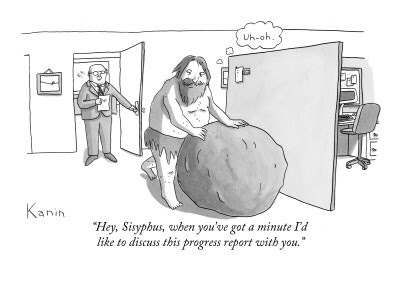
2015’s Human Achievement Hour (HAH) starts at 8:30 p.m. on Saturday, March 28. That’s tomorrow night! It starts at 8:30  p.m. in every time zone, so it’s a rolling celebration. But you can celebrate human achievement for a full 24 hours, starting Saturday at about 2:30 a.m. Central Daylight Time, when it will be 8:30 p.m. Saturday in Tonga, just over the international date line. It’s coming up soon! This will be my third year of celebrating HAH. To mark the occasion I just might start celebrating with the Tongans. Here is the Facebook event page for HAH. The Competitive Enterprise Institute is the sponsor of HAH. Here is the first part of their description, followed by their suggestion for how to celebrate.

“Observing Human Achievement Hour is about paying tribute to the human innovations that have allowed people around the globe to live better, fuller lives, while also defending the basic human right to use energy to improve the quality of life of all people.” “In order to celebrate with CEI and friends worldwide, we invite you to enjoy the benefits of energy, capitalism, and human innovation by utilizing your favorite innovation or human advancement…“

Once again this year, I will illuminate every lightbulb in my home to pay homage to the wonder of widely distributed electricity and the tremendous benefits derived from our ability to harness the power of fossil fuels. In a review of Alex Epstein’s The Moral Case for Fossil Fuels, Ronald Bailey of Reason says:

“As humanity burned more fossil fuels and increased carbon dioxide in the atmosphere, human lives dramatically improved. ‘Weather, climate, and climate change matter—but not nearly as much as they used to, thanks to technology,’ Epstein writes. For example, the death rate from extreme weather events has dropped 98 percent since 1920. Indeed, the chief benefit of burning fossil fuels has been longer and healthier human lives. The central idea of Epstein’s book is that ‘more energy means more ability to improve our lives; less energy mean less ability—more helplessness, more suffering, and more death.’“

Matt Ridley adds his thoughts on the benefits of fossil fuels at The Rational Optimist blog. Both Ridley and Bailey are confident that humans will one day achieve such efficiencies in the production of energy from renewable sources as to be competitive with fossil fuels. That will be worth celebrating. We are not there yet, however, and we do ourselves no favor in attempting to restrict fossil fuel consumption in the meantime. In fact, the risks of anthropomorphic global warming are far less severe than climate activists insist. Moreover, a warmer climate would not be unambiguously bad for people.

It is no accident that HAH is scheduled to coincide with Earth Hour, a “celebration” that stands in stark contrast to HAH in its antipathy for free market institutions and its condemnation of humankind’s relatively recent success in adapting to our planet’s environment. But there is no doubt that our progress in reducing poverty has hinged on the complementary nature of human ingenuity and the free market, the latter being a fairly recent (on historical scales) and most powerful innovation for promoting voluntary human cooperation and enrichment. Here is a recent Ridley post in which he elaborates on reasons for continued optimism. A quote:

“For 200 years, pessimists have had all the headlines-even though optimists have far more often been right. There is immense vested interest in pessimism. No charity ever raised money by saying things are getting better. No journalist ever got the front page writing a story about how disaster was now less likely. Pressure groups and their customers in the media search even the most cheerful statistics for glimmers of doom. Don’t be browbeaten-dare to be an optimist!“

Let’s celebrate for the right reasons. The flourishing of human welfare in the face of a harsh natural environment is real achievement.

Newer posts →
Follow Sacred Cow Chips on WordPress.com

Recent Posts

  • The Case Against Interest On Reserves
  • Immigration and Merit As Fiscal Propositions
  • Tariff “Dividend” From An Indigent State
  • Almost Looks Like the Fed Has a 3% Inflation Target
  • Government Malpractice Breeds Health Care Havoc

Archives

  • January 2026
  • December 2025
  • November 2025
  • October 2025
  • September 2025
  • August 2025
  • July 2025
  • June 2025
  • May 2025
  • April 2025
  • March 2025
  • February 2025
  • January 2025
  • December 2024
  • November 2024
  • October 2024
  • September 2024
  • August 2024
  • July 2024
  • June 2024
  • May 2024
  • April 2024
  • March 2024
  • February 2024
  • January 2024
  • December 2023
  • November 2023
  • August 2023
  • July 2023
  • June 2023
  • May 2023
  • April 2023
  • March 2023
  • February 2023
  • January 2023
  • December 2022
  • November 2022
  • October 2022
  • September 2022
  • August 2022
  • July 2022
  • June 2022
  • May 2022
  • April 2022
  • March 2022
  • February 2022
  • January 2022
  • December 2021
  • November 2021
  • October 2021
  • September 2021
  • August 2021
  • July 2021
  • June 2021
  • May 2021
  • April 2021
  • March 2021
  • February 2021
  • January 2021
  • December 2020
  • November 2020
  • October 2020
  • September 2020
  • August 2020
  • July 2020
  • June 2020
  • May 2020
  • April 2020
  • March 2020
  • February 2020
  • January 2020
  • December 2019
  • November 2019
  • October 2019
  • September 2019
  • August 2019
  • July 2019
  • June 2019
  • May 2019
  • April 2019
  • March 2019
  • February 2019
  • January 2019
  • December 2018
  • November 2018
  • October 2018
  • September 2018
  • August 2018
  • July 2018
  • June 2018
  • May 2018
  • April 2018
  • March 2018
  • February 2018
  • January 2018
  • December 2017
  • November 2017
  • October 2017
  • September 2017
  • August 2017
  • July 2017
  • June 2017
  • May 2017
  • April 2017
  • March 2017
  • February 2017
  • January 2017
  • December 2016
  • November 2016
  • October 2016
  • September 2016
  • August 2016
  • July 2016
  • June 2016
  • May 2016
  • April 2016
  • March 2016
  • February 2016
  • January 2016
  • December 2015
  • November 2015
  • October 2015
  • September 2015
  • August 2015
  • July 2015
  • June 2015
  • May 2015
  • April 2015
  • March 2015
  • February 2015
  • January 2015
  • December 2014
  • November 2014
  • October 2014
  • September 2014
  • August 2014
  • July 2014
  • June 2014
  • May 2014
  • April 2014
  • March 2014

Blogs I Follow

  • Passive Income Kickstart
  • OnlyFinance.net
  • TLC Cholesterol
  • Nintil
  • kendunning.net
  • DCWhispers.com
  • Hoong-Wai in the UK
  • Marginal REVOLUTION
  • Stlouis
  • Watts Up With That?
  • Aussie Nationalist Blog
  • American Elephants
  • The View from Alexandria
  • The Gymnasium
  • A Force for Good
  • Notes On Liberty
  • troymo
  • SUNDAY BLOG Stephanie Sievers
  • Miss Lou Acquiring Lore
  • Your Well Wisher Program
  • Objectivism In Depth
  • RobotEnomics
  • Orderstatistic
  • Paradigm Library
  • Scattered Showers and Quicksand

Blog at WordPress.com.

Passive Income Kickstart

OnlyFinance.net

TLC Cholesterol

Nintil

To estimate, compare, distinguish, discuss, and trace to its principal sources everything

kendunning.net

The Future is Ours to Create

DCWhispers.com

Hoong-Wai in the UK

A Commonwealth immigrant's perspective on the UK's public arena.

Marginal REVOLUTION

Small Steps Toward A Much Better World

Stlouis

Watts Up With That?

The world's most viewed site on global warming and climate change

Aussie Nationalist Blog

Commentary from a Paleoconservative and Nationalist perspective

American Elephants

Defending Life, Liberty and the Pursuit of Happiness

The View from Alexandria

In advanced civilizations the period loosely called Alexandrian is usually associated with flexible morals, perfunctory religion, populist standards and cosmopolitan tastes, feminism, exotic cults, and the rapid turnover of high and low fads---in short, a falling away (which is all that decadence means) from the strictness of traditional rules, embodied in character and inforced from within. -- Jacques Barzun

The Gymnasium

A place for reason, politics, economics, and faith steeped in the classical liberal tradition

A Force for Good

How economics, morality, and markets combine

Notes On Liberty

Spontaneous thoughts on a humble creed

troymo

SUNDAY BLOG Stephanie Sievers

Escaping the everyday life with photographs from my travels

Miss Lou Acquiring Lore

Gallery of Life...

Your Well Wisher Program

Attempt to solve commonly known problems…

Objectivism In Depth

Exploring Ayn Rand's revolutionary philosophy.

RobotEnomics

(A)n (I)ntelligent Future

Orderstatistic

Economics, chess and anything else on my mind.

Paradigm Library

OODA Looping

Scattered Showers and Quicksand

Musings on science, investing, finance, economics, politics, and probably fly fishing.

  • Subscribe Subscribed
    • Sacred Cow Chips
    • Join 128 other subscribers
    • Already have a WordPress.com account? Log in now.
    • Sacred Cow Chips
    • Subscribe Subscribed
    • Sign up
    • Log in
    • Report this content
    • View site in Reader
    • Manage subscriptions
    • Collapse this bar
 

Loading Comments...