• About

Sacred Cow Chips

Sacred Cow Chips

Tag Archives: Interventionism

The Rise of the GOP “Common Good” Socialists

02 Wednesday Sep 2026

Posted by Nuetzel in Capitalism, Socialism

≈ Leave a comment

Tags

central planning, China Shock, Common Good Capitalism, Covenant Capitalism, Data Centers, Democratic Socialists of America, Don Boudreaux, Donald Trump, Financialization, Government Equity Stakes, Industrial Policy, Interventionism, J.D. Vance, Josh Hawley, Lindsay Craig, Living Wage, MAGA, Marco Rubio, National Review Institute, Nationalism, NIMBYism, Oren Cass, Protectionism, Share Buybacks, Stakeholder Capitalism, Veronique de Rugy

Socialism has gained ground among democrats at a feverish pitch, and “mere socialism” and “democratic socialism” do not convey the tenor of the movement. The Democratic Socialists of America (DSA) wants not just bigger government: the majority of its governing board would like to completely dismantle our governing institutions and replace them with a communist state. While the DSA is formally independent, it doesn’t field candidates as a party. Instead, it essentially operates as a faction of the Democrats, who have long given cover to the far left. There are still plenty of moderate democrats who see the DSA as anathema and a threat to their electoral hopes.

New Ground On the Right

While the socialists’ ascendance among democrats is getting all the media coverage, a different trend is more remarkable: the outright embrace of socialist policies by an influential wing of the Republican Party. This despite the GOP’s rhetorical tradition as the party of “small government”, which of course it has failed to live up to. Pay no attention to the House resolution condemning socialism “in all its forms”, which was narrowly passed this week. The bill does put opposing representatives on record as having failed to condemn socialism. Otherwise it’s fairly meaningless, especially in the context of “GOP socialism”, which has gone largely unrecognized as such, or willfully ignored, by most republicans. In any case, the resolution is more focused on calling for the enactment of the SAVE America Act (Voter ID) than on socialism itself.

The government equity stakes launched by the Trump Administration are but one manifestation of this statist philosophical trap into which republicans began to stumble several years ago: “Common Good Capitalism” (CGC). Vice President Marco Rubio is widely credited with coining that name in a 2019 speech at Catholic University. In policy terms, it overlaps with MAGA dogma in several areas, but not all. Oren Cass, who is the “chief economist” of American Compass (and he is not an economist), was probably most instrumental in the development of CGC. It’s not all socialism, of course. Every ideological offshoot has its nuances. While often cited for its compatibility with religious policy motives, it’s nevertheless a mishmash of populist-nationalist, postliberal “DO SOMETHING” ideas that would grant a far greater role for the state in economic and social affairs. There are variations of CGC: Senator Josh Hawley calls his own version “covenant capitalism”, which suggests an even heavier emphasis on themes of family and faith.

Burned At the Equity Stake

Veronique de Rugy calls out GOP hypocrisy regarding socialism and state ownership of the means of production in a recent article “The GOP Is Warning About Socialism While Quietly Embracing It”. Trump’s aggressive effort to acquire equity stakes is now at 30 companies plus a giant Venezuelan oil development interest held by … the Pentagon? (A defense bill pending in the Senate would authorize the Department of War to take equity stakes in key contractors, but this deal seems to have happened without it.) I’m passionately opposed to government equity stakes and a federal sovereign wealth fund. I’ve discussed it on this blog several times (here and here, for example).

De Rugy covers several failings of state ownership in private companies:

  • Concentrated power over economic decisions in the hands of shifting partisan interests. Influence here extends well beyond the government’s share of ownership;
  • Every government policy tool influences the value of its equity stake, creating conflicts of interest between government, private shareholders, and taxpayers;
  • Irresponsible use of public funding in a time of severe fiscal imbalance;
  • Inefficient allocation of capital to politically-favored and often boneheaded uses; efficient uses tend not to require public money;
  • These firms might well be too state-invested and state-controlled to fail, so taxpayer bailouts become a much greater possibility.

Government equity stakes ultimately provide a subsidy to select firms and penalize others based on political considerations. They offer some of the worst shortfalls of central planning. And if there is spare change rattling around at the Treasury, which is unlikely, it would be better deployed in paying down the existing federal debt. That gets you an immediate and ongoing reduction in now burgeoning interest costs, less rate risk as debt rolls over, and it avoids reliance on the tenuous equity returns on shares of companies subject to heavy government control.

Cloaked Collectivism

Trump’s equity stakes fit seamlessly with the policy agenda of CGC. The following is taken from the web site of the Common Good Capitalism Movement:

“Common Good Capitalism is when in a free market economy individuals and organizations freely choose to give priority to the common good and second priority to profit or mission. They can act alone. Or they can join in an association with competitors to reach agreements to voluntarily raise the level labor, environmental, and social playing field beyond what governments have demanded of them while continuing to compete as a secondary priority.”

That sounds so nice! Be very, very good and generous to everyone, at your owners’ expense, and then join hands with your competitors. Then we’ll either buy-in or simply leave you alone. Sure they will!

The GOP is enamored with the vacuous concept of “common good” for electoral purposes. It’s certainly alluring to populist instincts. Thus, many republicans have come to believe in an array of policies that incorporate practices involving more than a small degree of statism. It’s partly based on the myth of a shrinking middle class and that the affordability of the American dream is out of reach for many Americans.

Pieces of a Platform

So let‘s review a few positions and tenets now associated with CGC. These appear in no particular order, but several are intended by their advocates to encourage American self-sufficiency and national security:

  • Industrial policy is promoted by CGC devotees as a tool for achieving the common good. They favor interventions that would favor small businesses, and they believe active industrial policy can promote job growth, national self-reliance, and national security. Equity stakes in private companies fall under this heading, which may include coercive reviews or approvals for certain business activities. Industrial policy is a form of central economic planning, and it often boils down to the picking of winners and losers by the state.
  • Protectionism, including tariffs, presumed to encourage reindustrialization and high-wage job growth, self-sufficiency, and national security. This is the wrong approach, and it too is a form of statist central economic planning. Its proponents don’t seem to realize that Trump’s tariffs represent a huge tax increase on consumers as well as firms that rely on imported inputs.
  • “Stakeholder capitalism“, they say, is necessary to ensure that businesses weigh not only the interests of their owners, but more importantly their workers and “communities”, broadly defined. No one should expect firms pursuing such ends to maximize value, and buyers should not expect them to produce superior products. Codified stakeholder capitalism would represent an abrogation of the property rights of actual shareholders. The identification of “stakeholders” has no limiting principle, so it’s an open invitation to loot.
  • Data center derangement has crept into the talking points made by many republicans and the CGC faithful. This is mostly run-of-the mill anti-development activism, not socialism per se. Plain old NIMBYism can be a visceral response to almost any development, and an honest aesthetic revulsion, but data center developers are more than willing to negotiate compromises that bring massive benefits to communities. Almost everything you hear about the external costs inflicted by data center is fictitious. Should data center opponents prevail in slowing the buildout of information infrastructure, it would be a blow to prospects for U.S. leadership in AI, economic growth, competitiveness, and national security. I think more moderate voices within the CGC movement recognize these dangers.
  • Price controls just might be put to broader use in the hope of serving the “common good”: living wage arguments have been welcomed into the CGC intellectual milieu, despite the unproductive and often destructive results of minimum wage legislation. Trump has been railing against the oil companies for supposedly profiting off American consumers. Probably just jawboning, but price ceilings might not be out of the question. Commodity price ceilings seem to be only a mild flirtation of CGC, so let’s hope Trump doesn’t normalize the idea. However, Trump and Josh Hawley have proposed capping credit card interest rates, a sure path to limiting the availability of credit to the most credit-challenged consumers. You can quibble here, but the revocation of pricing authority is every bit as much a taking as a levy on asset values.
  • CGC is union-friendly, which is unusual for a movement dominated by republicans. It insists that broad-based collective bargaining will promote more prosperous and stable families. I support the right to collective bargaining for all except public employees, and with the qualification that workers should have complete freedom of representation. However, unions raise business costs and introduce rigidities that ultimately make unionized firms less competitive and less innovative, so the hoped-for stability is likely to be short-lived for many workers.
  • Another tenet of CGC is to restrict legal immigration, despite the aging U.S. population, an insolvent pay–as-you-go public retirement system, and birth rates below replacement levels. Imposing sharp limits on immigration is a nationalist position, or even nativist, though some notorious socialists were and are both nativistic and nationalistic. Either way, this is an intrusive, statist position, and it is often xenophobic. But to be clear, I am not arguing for open borders or any form of illegal entry. Rather, I advocate for liberalized legal immigration based on merit.
  • To its credit, CGC is more oriented toward “sound money” and an independent Federal Reserve than is the Trump Administration. Trump almost seems to prefer replacing Fed authority with money printing at the whim of the executive, and in support of a far broader economic role for the state.
  • CGC calls for restrictions on certain private financial decisions, such as outlawing share buybacks and private equity. This would represent another intrusion into private affairs. This is connected to CGC’s disdain for the “financialization” of the American economy. The ban would come on top of Trump’s 1% tax of share repurchases and prohibition of buybacks by defense contractors. However, there is evidence that legalizing share repurchases tends to stimulate corporate investment by redirecting investor funds from “mature firms” to newer, relatively cash-strapped firms having unfunded growth opportunities. An implication is that prohibiting buybacks is more like shooting yourself in the foot. It would be another coercive intrusion into the private sphere, a “taking” of private decision-making authority and a form of social control.
  • The CGC movement would like to use the tax code to achieve social objectives such as family formation. These steps would include higher per-child tax credits, subsidies (family income supports), and private business mandates (e.g., required paid parental leave). I‘m all for family formation, but whether you call this socialist or authoritarian, these incentives should remain private, not subject to the whims of the state.
  • Investment incentives: I’m loath to criticize policies that improve investment incentives, such as immediate expensing of investments of physical capital. On the other hand, were it not for the existence of a distortionary tax system that double-taxes corporate income, business tax breaks would be wholly unnecessary. So let’s start with the root problem by reforming business taxation, not doubling down on distortions. Furthermore, the reliance on so-called tax subsidies represents another avenue through which government manipulates the character of economic activity, with impacts that persist for years. Central planning!
  • Perceptions of the “national interest” are always in flux, shaped by current politics and those holding power. But among CGC adherents, their view of today’s national interest must always take priority over market efficiency. This is used to justify a wide range of policies: tariffs, equity stakes, manufacturing subsidies, often based on claims that a fictitious “China Shock” has hollowed out American manufacturing. Please… this is a weak excuse for state intervention. And though the argument might not be uniquely inspired by socialism, the “national interest” makes a convenient talking point for any socialist.
  • Finally, MAGA and CGC have somewhat divergent views on regulation and intervention. MAGA, despite its embrace of government planning and its apparent rejection of fiscal conservatism, at least continues its efforts to reduce regulatory burdens on the private sector. In some cases, CGC might do that too, but CGC embraces a variety of interventions under a variety of circumstances to change business incentives or safeguard against what they judge to be violations against public welfare. CGC’s approach to managing the business environment might include antitrust actions, efforts to discourage plant or office closures, and restrictions on certain business practices such as H-1B visas and non-compete agreements. This is in addition to items discussed above, like discouraging “financialization”, strict oversight of private equity, enforcing a balanced labor bargaining environment, and fostering representation of stakeholders in corporate decision-making.

But here’s a fundamental truth, courtesy of Don Boudreaux in a 2024 letter to the National Review Institute’s then-President Lindsay Craig, regarding Oren Cass‘ advocacy for CGC:

“… one of the merits of the liberal market order is that it allows each of us to pursue our individual ends absent any need to agree on, or to aim for, anything called the ‘common good.’ …

“… Because of the diversity of individuals’ particular interests, ends, and understandings of ‘the good,’ to impose any specific ‘common good’ goal of the sort that Mr. Cass favors necessarily requires coercing the majority of people to abandon their own ends in order to assist in the pursuit of the particular ends enforced by those who currently hold political power.”

If not socialism, many of the positions listed above are at odds with the ideals of small government, individual liberty, and free market capitalism. But it’s not the least unfair to say many of them veer into socialism. The extent to which the collectivist mindset, often disguised as mere populism, has permeated republican circles is rather astonishing. I should be happy they haven’t proposed anything as socially suicidal as a wealth tax… yet!

Vance and Rubio

In leadership circles, Trump has areas of agreement as well as departures from CGC, but it’s a different story among his most likely successors to the helm of the party and the presidency. Vice President J.D. Vance is an ardent critic of capitalism, and strongly believes that the state must intervene to correct the “failures” of the market economy. I empathize with his outrage over the plant closures and economic decline that have afflicted certain communities. He experienced the effects himself growing up, but his current diagnosis assigns blame to the market order. He does not acknowledge that buyer preferences and high costs made operating those plants unviable in the first place. Market competition can both reward and punish, but it is a process that ultimately improves the general welfare. Government planning is wholly incapable of replacing the market process, and government (and taxpayers) cannot be called upon to preserve former income levels or even a former way of life.

Vance has a beef with the pursuit of measured economic growth. In his view, it comes at the expense of the traditional values he most cherishes. For example, unpaid household work is not counted in official GDP statistics, nor is elder care at home. Therefore, says Vance, the statistics themselves contain a bias against single-income and multi-generational households. Those measurement issues have long been acknowledged by economists, but he goes so far as to suggest that policy should ignore the official statistics. He has slammed holiday shifts for retail workers as exploitive. And he believes that trade deficits represent a threat to the nation (complete nonsense) and strongly supports tariffs on imports of foreign goods.

Marco Rubio is another potential CGC contender for the presidency in 2028, and he’s given credit for bringing CGC into broad discussion within the GOP. His version strikes me as hewing closer to MAGA principles than Vance does. Rubio’s take on GCG is quite focused on national security and Sino-American trade and relations. He is strongly for tight control of immigration. He supports deregulation and free market principles, with qualifications. But he also says free markets must guarantee “dignified work” to all working or job-seeking Americans at decent wages. What exactly does “dignified work” mean? And how does one simply wave away frictions in the job market that will always persist. What does “decent wages” mean? Is Rubio suggesting a mandated living wage?

Rubio statements are riddled with misconceptions about economic and technological issues. For example, his anti-trade arguments are just as moronic as Trump’s; his emphasis on redirecting activity toward production in the “physical economy” is vapid (except perhaps in markets with implications for national security); he supports more industrial policy despite a history of central planning failures; his comparison of stock buybacks to dividend income for shareholders is daft; he holds a childish view of internet development as a social media phenomenon; and far too broadly, he characterizes U.S. innovation as historically driven by defense and public-private partnerships. On the whole, Rubio might seem to have a healthier market orientation than Vance, but he still talks like an interventionist in many respects.

Conclusion

The whole CGC attack on free markets reflects a poor understanding of basic economics. It requires massive value judgements that stand in contrast to the values that emerge from the impersonal, voluntary interactions of many participants in free markets. Just as damning is CGC’s failure to recognize the many opportunities for rent seeking and corruption are enabled by government intervention. But to drive all this home, I’ll close with another quote from Don Boudreaux, which I took from a 2023 post on his blog:

“In reality, the best economic system for promoting the common good is what I, in these discussions, call ‘capitalism unprefixed’ – that is, capitalism as understood and championed by people such as Hayek and Friedman. Not only is there no need for government to interfere with capitalism unprefixed in order to ensure that the common good is served, such interference is far too likely to bestow unearned benefits on politically favored groups, or to satisfy the particular ideological preferences of politically influential intellectuals, all at the larger expense – material and nonmaterial – of the people as a whole.

“If ‘common good capitalism’ means anything other than capitalism unprefixed, its pursuit necessarily requires government to elevate the particular preferences of some individuals over those of other individuals – a move that mocks the meaning of ‘common good’ as understood by true liberals.

“In short, ‘common good capitalism’ implies the ability of ‘common good capitalists’ to determine which particular ends are, and which aren’t, consistent with the common good, and the right of these ‘capitalists’ to commandeer the state to impose their determination on everyone.“

Hey, Careful With Those Economic Aggregates!

16 Friday May 2025

Posted by Nuetzel in Economic Aggregates, Macroeconomics

≈ 1 Comment

Tags

Activist Policy, Argentina, Benchmark Revisions, Charles Manski, Creative Destruction, Double Counting, Fischer Black, Hong Kong, Identification Problem, Interventionism, John von Neumann, Market Monetarism, Measurement Errors, Oskar Morgenstern, Paul Romer, Phlogiston, Policy Uncertainly, Price Aggregates, Real Business Cycle Model, Real GDP, Reuben Brenner, Scott Sumner, Simon Kuznets, Tyler Cowen

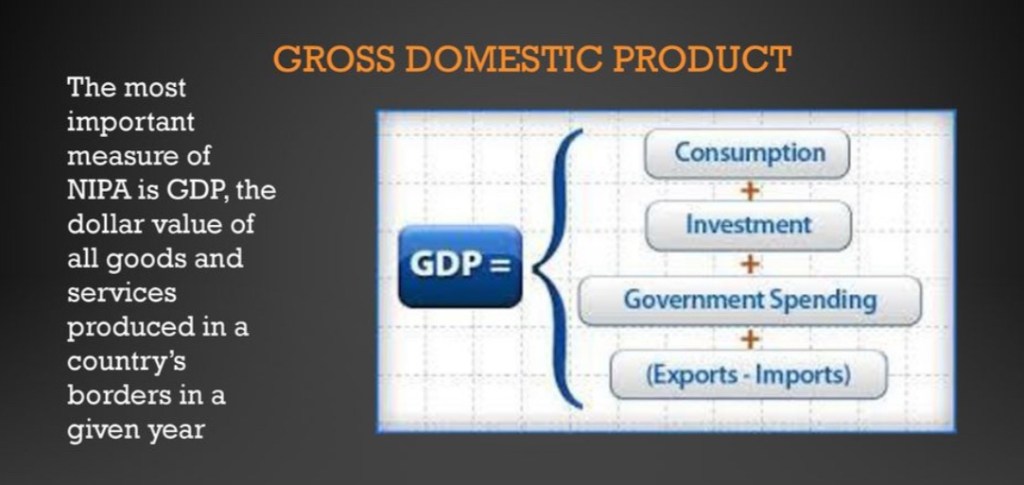
As a long-time user of macroeconomic statistics, I admit to longstanding doubts about their accuracy and usefulness for policymaking. Almost any economist would admit to the former, not to mention the many well known conceptual shortcomings in government economic statistics. However, few dare question the use of most macro aggregates in the modeling and discussion of policy actions. One might think conceptual soundness and a reasonable degree of accuracy would be requirements for serious policy deliberation, but uncertainties are almost exclusively couched in terms of future macro developments; they seldom address variances around measures of the present state of affairs. In many respects, we don’t even know where we are, let alone where we’re going!

Early and Latter Day Admonitions

In the first of a pair of articles, Reuven Brenner discusses the hazards of basing policy decisions on economic aggregates, including critiques of these statistics by a few esteemed economists of the past. The most celebrated developer of national income accounting, Simon Kuznets, was clear in expressing his reservations about the continuity of the U.S. National Income and Product Accounts during the transition to a peacetime economy after World War II. The government controlled a large share of economic activity and prices during the war, largely suspending the market mechanism. After the war, market pricing and private decision-making quickly replaced government and military planners. Thus, the national accounts began to reflect values of production inherent in market prices. That didn’t necessarily imply accuracy, however, as the accounts relied (and still do) on survey information and a raft of assumptions.

The point is that the post-war economic results were not remotely comparable to the data from a wartime economy. Comparisons and growth rates over this span are essentially meaningless. As Brenner notes, the same can be said of the period during and after the pandemic in 2020-21. Activity in many sectors completely shut down. In many cases prices were simply not calculable, and yet the government published aggregates throughout as if everything was business as usual.

More than a decade after Kuznets, the game theorists Oskar Morgenstern and John von Neumann both argued that the calculations of economic aggregates are subject to huge degrees of error. They insisted that the government should never publish such data without also providing broad error bands.

Morgenstern delineated several reasons for the inaccuracies inherent in aggregate economic data. These include sampling errors, both private and political incentives to misreport, systematic biases introduced by interview processes, and inherent difficulties in classifying components of production. Also, myriad assumptions must be fed into the calculation of most economic aggregates. A classic example is the thorny imputation of services provided by owner-occupied homes (akin to the value of services generated by rental units to their occupants). More recently. Charles Manski reemphasized Morganstern’s concerns about the aggregates, reaching similar conclusions as to the wisdom of publishing wide ranges of uncertainty.

Real or Unreal?

Estimates of real spending and production are subject to even larger errors than estimates of nominal values. The latter are far simpler to measure, to the extent that they represent a simple adding up of current amounts spent (or income earned) over the course of a given time period. In other words, nominal aggregates represent the sum of prices times quantities. To estimate real quantities, nominal values must be adjusted (deflated) by price aggregates, the measurement of which are fraught with difficulties. Spending patterns change dramatically over time as preferences shift; technology advances, new goods and services replace others, and the qualities of goods and services evolve. A “unit of output” today is usually far different than what it was in the past, and adjusting prices for those changes is a notorious challenge.

This difficulty offers a strong rationale for relying on nominal quantities, rather than real quantities, in crafting certain kinds of policy. Perhaps the best example of the former is so-called market monetarism and monetary policy guided by nominal GDP-level targeting, as championed by Scott Sumner.

Government’s Contribution

Another fundamental qualm is the inconsistency between data on government’s contribution to aggregate production versus private sector contributions. This is similar in spirit to Kuznets’ original critique. Private spending is valued at market prices of final output, whereas government spending is often valued at administered prices or at input cost.

An even deeper objection is that much of the value of government output is already subsumed in the value of private production. Kuznets himself thought so! For example, to choose two examples, public infrastructure and law enforcement contribute services which enhance the private sector’s ability to reliably produce and deliver goods to market. To add the government’s “output” of these services separately to the aggregate value of private production is to double count in a very real sense. Even Tyler Cowen is willing to entertain the notion that including defense spending in GDP is double counting. The article to which he links goes further than that.

Nevertheless, our aggregate measures allow for government spending to drive fluctuations in our estimates of GDP growth from one period to another. It’s reasonable to argue that government spending should be reported as a separate measure from private GDP.

But what about the well known Keynesian assertion that an increase in government spending will lift output by some multiple of the change? That proposition is considered valid (by Keynesians) only when resources are idle. Of course, today we see steady growth of government even at full employment, so the government’s effort to commandeer resources creates scarcity that crowds out private activity.

Measurement and Policy Uncertainty

Acting on published estimates of economic aggregates is hazardous for a number of other reasons. Perhaps the most basic is that these aggregates are backward-looking. A policy activist would surely agree that interventions should be crafted in recognition of concurrent data (were it available) or, even better, on the basis of reliable predictions of the future. Financial market prices are probably the best source of such forward-looking information.

In addition, revising the estimates of aggregates and their underlying data is an ongoing process. Initial published estimates are almost always based on incomplete data. Then the estimates can change substantially over subsequent months, underscoring uncertainty about the state of the economy. It is not uncommon to witness consistent biases over time in initial estimates, further undermining the credibility of the effort.

Even worse, substantial annual revisions and so-called “benchmark revisions” are made to aggregates like GDP, inflation, and employment data. Sometimes these revisions alter economic history substantially, such as the occurrence and timing of recessions. All this implies that decisions made on the basis of initial or interim estimates are potentially counterproductive (and on a long enough timeline, every aggregate is an “interim” estimate). At a minimum, the variable nature of revisions, which is an unavoidable aspect of publishing aggregate statistics, magnifies policy uncertainty.

Case Studies?

Brenner cites two historical episodes as support for his argument that aggregates are best ignored by policymakers. They are interesting anecdotes, but he gives few details and they hardly constitute proof of his thesis. In 1961, Hong Kong’s financial secretary stopped publishing all but “the most rudimentary statistics”. Combined with essentially non-interventionist policy including low tax rates, Hong Kong ran off three decades of impressive growth. On the other hand, Argentina’s long economic slide is intended by Brenner to show the downside of relying on economic aggregates and interventionism.

Bad Models, Bad Policy

It’s easy to see that economic aggregates have numerous flaws, rendering them unreliable guides for monetary and fiscal policy. Nevertheless, their publication has tended to encourage the adoption of policy interventions. This points to another issue lurking in the background: the role of economic aggregates in shaping the theory and practice of macroeconomics and the models on which policy recommendations are based. The conceptual difficulties surrounding aggregates, and the errors embedded within measured aggregates, have helped to foster questionable model treatments from a scientific perspective. For example, Paul Romer has said:

“Macroeconomists got comfortable with the idea that fluctuations in macroeconomic aggregates are caused by imaginary shocks, instead of actions that people take, after Kydland and Prescott (1982) launched the real business cycle (RBC) model. … [which] explains recessions as exogenous decreases in phlogiston.”

This is highly reminiscent of a quip by Brenner that macroeconomics has become a bit like astrology. A succession of macro models after the RBC model inherited the dependence on phlogiston. Romer goes on to note that model dependence on “imaginary” forces has aggravated the longstanding problem of statistically identifying individual effects. He also debunks the notion that adding expectations to models helps solve the identification problem. In fact, Romer insists that it makes it worse. He goes on to paint a depressing picture of the state of macroeconomics, one to which its reliance on faulty aggregates has surely contributed.

Aggregates also mask the detailed, real-world impacts of policies that invariably accompany changes in spending and taxes. While a given fiscal policy initiative might appear to be neutral in aggregate terms, it is almost always distortionary. For example, spending and tax programs always entail a redirection of resources, whether a consequence of redistribution, large-scale construction, procurement, or efforts to shape the industrial economy. These are usually accompanied by changes in the structure of incentives, regulatory requirements, and considerable rent seeking activity. Too often, outlays are dedicated to shoring up weak sectors of the economy, short-circuiting the process of creative destruction that serves to foster economic growth. Yet the macro models gloss over all the messy details that can negate the efficacy of activist fiscal policies.

Conclusion

The reliance of macroeconomic policy on aggregates like GDP, employment, and inflation statistics certainly has its dangers. These measures all suffer from theoretical problems, and they simply cannot be calculated without errors. They are backward-looking, and the necessity of making ongoing revisions leads to greater uncertainty. But compared to what? There are ways of shifting the focus to measures subject to less uncertainty, such as nominal income rather than real income. A number of theorists have proposed market-based methods of guiding policy, including Fischer Black. This deserves broader discussion.

The problems of aggregates are not solely confined to measurement. For example, national income accounting, along with the Keynesian focus on “underconsumption” during recessions, led to the fallacious view that spending decisions drive the economy. This became macroeconomic orthodoxy, driving macro mismanagement for decades and leading to inexorable growth in the dominance of government. Furthermore, macroeconomic models themselves have been corrupted by the effort to explain away impossibly error-prone measurements of aggregate activity.

Brenner has a point: it might be more productive to ignore the economic aggregates and institute stable policies which reinforce the efficacy of private markets in allocating resources. If nothing else, it makes sense to feature the government and private components separately.

JoyPolitik: Greed, Gouging, and Gullability

18 Wednesday Sep 2024

Posted by Nuetzel in Inflation, Price Controls

≈ 1 Comment

Tags

Antitrust, Greed, Ham Sandwich Nation, Hoarding, Inflation, Interventionism, Kamala Harris, Mark-Ups, Market Concentration, Markets, Michael Munger, Monetary policy, Predatory Pricing, Price Fixing, Price Gouging, Price Rationing, Shortages, Supply Shocks

Economic ignorance and campaign politics seem to go hand-in-hand, especially when it comes to the rhetoric of avowed interventionists. They love “easy” answers. If they get their way, negative but predictable consequences are always “unintended” and/or someone else’s fault. Unfortunately, too many journalists and voters like “easy” answers, and they repeatedly fall for the ploy.

This post highlights one of many bad ideas coming out of the Kamala Harris campaign. I probably won’t have time to cover all of her bad ideas before the election. There are just too many! I hope to highlight a few from the Trump campaign as well. Unfortunately, the two candidates have more than one bad idea in common.

Price Gouging

Here I’ll focus on Harris’ destructive proposal for a federal ban on “price gouging”. Unfortunately, she has yet to define precisely what she means by that term. On its face, she’d apparently support legislation authorizing the DOJ to go after grocers, gas stations, or other sellers in visible industries charging prices deemed excessive by the federal bureaucracy. This is a form of price control and well in keeping with the interventionist mindset.

As Michael Munger has said, when you charge “too much” you are “gouging”; when you charge “too little” you are “predatory”; and when you charge the same price as competitors you’ve engaged in a price fixing conspiracy. The fact that Harris’ proposal is deliberately vague is an even more dangerous invitation to arbitrary caprice by federal enforcers. It might be hard to price a ham sandwich without breaking such a law.

The great advantage of the price system is its impersonal coordination of the actions of disparate agents, creating incentives for both buyers and sellers to direct resources toward their most valued uses. Price controls of any kind short circuit that coordination, inevitably leading to shortages (or surpluses), misallocations, and diminished well being.

Inflation As Aggregate Macro Gouging

Aside from vote buying, Harris has broader objectives than the usual “anti-gouging” sentiment that accompanies negative supply shocks. She’s faced mounting pressure to address prices that have soared during the Biden Administration. The inflation during and after the COVID pandemic was induced by supply shortfalls first and then a spending/money-printing binge by the federal government. The pandemic induced shortages in some key areas, but the Treasury and the Fed together engineered a gigantic cash dump to accommodate that shock. This stimulated demand and turned temporary dislocations into permanently higher prices.

There were howls from the Left that greed in the private sector was to blame, despite plentiful evidence to the contrary. Blaming “price gouging” for inflated prices dovetails with Harris’ proclivity to inveigh against “corporate greed”. It’s typical leftist blather intended to appeal to anyone harboring suspicions of private property and the profit motive.

The profit motive is a compelling force for social good, motivating the performance of large corporations and small businesses alike. Diatribes against “greed” coming from the likes of a career politician with no private sector experience are not only unconvincing. They reveal childlike misapprehensions regarding economic phenomena.

More substantively, some have noted that mark-ups rose during and after the pandemic, but these markups are explained by normal cyclical fluctuations and the growing dominance of services in the spending mix. High margins are difficult to sustain without persistently high levels of demand. The Fed’s shift toward monetary restraint has dissipated much of that excessive demand pressure, but certainly not enough to bring prices back to pre-pandemic levels, which would require a severe economic contraction.

Claims that concentration among sellers has risen in some markets are also cited as evidence that greedy, price-gouging corporations are fueling inflation. If that is a real concern, then we might expect Harris to lean more heavily on antitrust policy. She should be circumspect in that regard: antitrust enforcement is too often used for terrible reasons (and also see here). In any case, rising market concentration does not necessarily imply a reduction in competitive pressures. Indeed, it might reflect the successful efforts of a strong competitor to please customers, delivering better value via quality and price. Moreover, mergers and acquisitions often result in stronger challenges to dominant players, energizing innovation, improved quality, and price competition.

If Harris is serious about minimizing inflation she should advocate for fiscal and monetary restraint. We’ve heard nothing of that from her campaign, however. No credible plans other than vaguely-defined price controls and promises to tax and spend our way to a joyful “opportunity economy”.

Disaster Supply Gouging

There is already a federal law against hoarding “scarce items” in times of war or national crisis and reselling at more than the (undefined) “prevailing market price”. There are also laws in 34 states with varying “anti-gouging” provisions, mostly applicable during emergencies only. These laws are counterproductive as they tend to “gouge” the flow of supplies.

In the aftermath of terrible storms or earthquakes, there are almost always shortages of critical goods like food, water, and fuel, not to mention specialized manpower, machinery, and materials needed for cleanup and restoration. As I pointed out some time ago, retailers often fail to adjust their prices under these circumstances, even as shelves are rapidly emptied. They are sometimes prohibited from repricing aggressively. If not, they are conflicted by the predictable hoarding that empties shelves, the higher costs of replenishing inventory, and the knowledge that price rationing creates undeservedly bad public relations. So retailers typically act with restraint to avoid any hint of “gouging” during crises.

Disasters often disrupt production and create physical barriers that hinder the very movement of goods. When prices are flexible and can respond to scarcity on the ground, suppliers can be very creative in finding ways to deliver badly needed supplies, despite the high costs those are likely to entail. Private sellers can do all this more nimbly and with greater efficiency than government, but they need price incentives to cover the costs and various risks. Price controls prevent that from happening, prolonging shortages at the worst possible time.

The chief complaint of those who oppose this natural corrective mechanism is that higher prices are “unfair”. And it is true that some cannot afford to pay higher prices induced by severe scarcity. The answer here is that government can write checks or even distribute cash, much as the government did nationwide during the pandemic. That’s about the only thing at which the state excels. Then people can afford to pay prices that reflect true levels of scarcity. If done selectively and confined to a regional level, the broader inflationary consequences are easily neutralized.

Instead, the knee-jerk reaction is to short-circuit the price mechanism and insist that available supplies be rationed equally. That might be a fine way for retailers to respond in the short run. Share the misery and prevent hoarding. But supplies will run low. When the shelves are empty, the price is infinite! That’s why sellers must have flexibility, not prohibitions.

Blame Game

Harris is engaged in a facile blame game at both the macro and micro level. She claims that inflation could be controlled if only corporations weren’t so greedy. Forget that they must cover their own rising costs, including the costs of compensating risk-averse investors. For that matter, she probably hasn’t gathered that a return to capital is a legitimate cost. Like many others, Harris seems ignorant of the elevated costs of bringing goods to market following either unpredictable disasters or during a general inflation. She also lacks any understanding of the benefits of relying on unfettered markets to bridge short-term gaps in supply. But none of this is surprising. She follows in a long tradition of ignorant interventionism. Let’s hope we have enough voters who aren’t that gullible.

Conscious Design, the Collective Mind and Social Decline

20 Wednesday May 2015

Posted by Nuetzel in Big Government, Human Welfare, Spontaneous Order

≈ 1 Comment

Tags

Aggregate demand, Aggregation problem, Conscious Design, David Kreps, F.A. Hayek, Interventionism, Library of Economics and Liberty, Norman Barry, Spontaneous Social Order, The Counter-Revolution of Science

All those in favor

The great gains in human welfare over the past few hundred years are not the result of some conscious design by a central authority. They are due instead to the emergence of conditions under which a “spontaneous social order” could bear fruit. Yet most people toil under the illusion that the progress of humanity and civilization are impossible without the imposition of some conscious design and intervention by human planners. In “The Counter-Revolution of Science“, F.A. Hayek noted that conscious direction was unnecessary to the development of such fundamental institutions as language, markets, money, the legal system and morals:

“We flatter ourselves undeservedly if we represent human civilization as entirely the product of conscious reason or as the product of human design, or when we assume that it is necessarily in our power deliberately to re-create or to maintain what we have built without knowing what we were doing.“

A liberal, spontaneous social order arose against a backdrop of secure rights that encouraged voluntary exchange. Individuals, free to act on their preferences, capabilities and personal resources forged their own trade relationships and contractual arrangements. In this sort of environment, the prices established by free exchange not only direct goods and resources in the present, but also direct their availability over time by balancing the time preferences of savers and investors. Again, it was this set of unplanned but voluntary private arrangements that brought such dramatic material progress to humanity. The chief contributions of central authority were the provision of a reasonably stable legal environment and, ironically, the constitutional framework in the U.S. that imposed limits on government power.

On the other hand, there is a long history of attempts to impose “conscious” designs by edict. They have met with consistent failure, and for good reason: human authorities cannot possess the dispersed knowledge needed to balance the diverse needs and preferences of millions of economic agents with the abilities of others to produce and provide for those demands. Nor would human authorities have the correct incentives to properly direct resources to their most valued uses, even if they possessed the requisite knowledge. In fact, the imposition of a “collective” plan implies a degree of coercion. The plan, no matter how well meaning, will necessarily conflict with the objectives of some individuals. Efforts to work around the plan will lead to additional coercive steps to bring all parties into compliance.

Still, there seems to be a deeply ingrained belief that advances can only be a product of conscious design and central direction. The idea dovetails with the tendency to view policies and objectives as things that must be achieved by “society” as a collective. But the details of deliberate social policies must be promulgated by relatively few policymakers and then executed by technocrats, even if the policies themselves are the product of representative democracy.

The elites who administer central plans must rely on aggregate measures of economic activity and broad categories or class groupings, which grossly over-simplify and misrepresent the complexities of human activity. This aggregation problem afflicts a wide variety of measurements and attempts to analyze behavior. Gary Galles discusses various aggregation problems in “How Economic Aggregation Hides The Problems of Interventionism“.

By analyzing things at aggregate levels, we may deceive ourselves by thinking that the aggregates can represent meaningful outcomes, or even worse, policy levers. The aggregates become constructs to which theories of “behavior” are applied, often rationalized by so-called “micro-foundations” of “representative agent behavior”. This effectively elides the fundamental reasons for engaging in voluntary market exchanges in the first place: differences in preferences, abilities, knowledge, and endowments of resources create opportunities for gain through trade. David Kreps is quoted at a link above on a prominent example of this phenomenon, the weak foundations of “aggregate demand”:

“… total demand will shift about as a function of how individual incomes are distributed even holding total (societal) income fixed. So it makes no sense to speak of aggregate demand as a function of price and societal income ….“

In short, the theoretical relationships between aggregates do not describe real economic behavior. Hayek noted that relying on aggregates fosters the all-too common but mistaken view among policymakers, pundits and the public that the economy can be shaped and managed much as an engineer designs a machine, or as a manager runs his factory. That is an incorrect but insidious viewpoint. Hayek explains that engineers or factory managers are able to perform their functions with relative precision because they are able to take so much for granted: prices or the availability of certain materials and resource flows, and reliable, technical relationships between inputs and outputs. Again, the economy and society encompass too many complex relationships and details that are unknowable to any central authority to manage effectively from the top down.

Some kinds of differences between individuals are recognized by planners and collectivists. Policies divide the population into groups subject to disparate treatments in an effort to meet social goals deemed worthwhile by the collective conscience. As my friend John Crawford said in a recent email: “… to have public policy the individual must be subjugated to the group simply for ease of understanding.” These disparate treatments imply that:

“… the simple act of generating public policy requires racism, ageism, sexism, classism, whatever-ism. Some ‘-ism’ must be conceived of simply so individuals can be grouped into bins, measured so a public policy action can be justified.“

These sorts of policies do not encourage a productive society. Instead, they promote political competition rather than economic competition, division rather than unity, and rent seeking and cronyism instead of productive effort, saving and economic growth. Norman Barry discusses the negative consequences of this shift in orientation in his essay “The Tradition of Spontaneous Order“:

“Hayek is no doubt correct in identifying the main disruptive threat to the preservation of a spontaneous order as the inevitable formation, under present democratic rules, of coalitions of interests which divert the stream of income in a catallaxy to politically-favored groups—to the ultimate harm of all.“

Dismal Implications of Aggregate Analysis

12 Thursday Feb 2015

Posted by Nuetzel in Macroeconomics

≈ Leave a comment

Tags

Aggregate demand, Aggregation, Collectivism, FEE, Gary Galles, I Pencil, incentives, Interventionism, Keynesians, Leonard Read, Macroeconomics, Mises Institute, Scarcity, Stabilization policy, statism

keynesian cartoon

Economic aggregation is basic to traditional macroeconomic analysis, but it distorts and drastically oversimplifies the enormous number of transactions and the vast network of decision-makers that comprise almost any economic system, especially a market economy. There are some basic problems with aggregating across individuals and markets, but these are typically glossed over in macro-policy analyses. Instead, the focus is on a few key outcomes, such as aggregate spending by sector and saving, masquerading as collective “decisions” amenable to behavioral analysis. In this kind of framework, the government sector occupies an equal place to consumers and business investors. It is usually depicted as a great exogenous demander of goods and services, capable of “stabilizing” demand in the event of underconsumption, for example.

An insightful post by Gary Galles at the Mises blog drives home the inherent distortion involved in the analysis of macro-aggregates: “How Economic Aggregation Hides the Problems of Interventionism“.  The problems start with a nearly complete misapplication (if not neglect) of the basic problem of scarcity, as if that problem can be solved via manipulation of aggregate constructs. Galles offers a simple example of the macro distortion of “net taxes,” or aggregate taxes minus government transfer payments. Both taxes and transfers are complicated subjects, and both are subject to negative incentive effects. The net-tax aggregation is of little use, even if some rudimentary supply function is given treatment in a macro model.

By its very nature, aggregate government activity is distorted by the prices at which it is valued relative to market activity, and intervention in markets by government makes market aggregates less useful:

“For example, if government gives a person a 40 percent subsidy for purchasing a good, all we know is that the value of each unit to the buyer exceeded 60 percent of its price. There is no implication that such purchases are worth what was paid, including the subsidy. And in areas in which government produces or utilizes goods directly, as with defense spending, we know almost nothing about what it is worth. Citizens cannot refuse to finance whatever the government chooses to buy, on pain of prison, so no willing transaction reveals what such spending is worth to citizens. And centuries of evidence suggest government provided goods and services are often worth far less than they cost. But such spending is simply counted as worth what it cost in GDP accounts.”

Galles article emphasizes the unintended (and often unpleasant) consequences that are bound to flow from policies rationalized on the basis of aggregate macro variables, since they can tell us little about the impact on individual incentives and repercussions on the ability of markets to solve the problem of scarcity. In fact, the typical Keynesian macro perspective lends itself to slow and steady achievement of the goals of collectivists, but the process is destined to be perverse: more G stabilizes weak aggregate demand, or so the story goes, but as G expands, government entwines itself into the fabric of the economy, and it seldom shrinks. Taxes creep up, dependencies arise, regulation grows and non-productive cronies capture resources bestowed by their public sector enablers. At the same time, the politics of taxes almost ensures tat they grow more slowly that government spending, so that the government must borrow. This absorbs saving that would otherwise be available for productive, private investment. As investment languishes, so does growth in productivity. When economic malaise ultimately appears, we hear the same policy refrain: more G to stabilize aggregate demand! All the way down! Perhaps unemployed dependents are simpler to aggregate.

Aggregation masks the most basic issues in economics. A classic lesson in the complexity of creating even a simple product is told in “I, Pencil“, by Leonard Read. In it, he allows the pencil itself to tell the story of it’s own creation:

“Here is an astounding fact: Neither the worker in the oil field nor the chemist nor the digger of graphite or clay nor any who mans or makes the ships or trains or trucks nor the one who runs the machine that does the knurling on my bit of metal nor the president of the company performs his singular task because he wants me. Each one wants me less, perhaps, than does a child in the first grade. Indeed, there are some among this vast multitude who never saw a pencil nor would they know how to use one. Their motivation is other than me. Perhaps it is something like this: Each of these millions sees that he can thus exchange his tiny know-how for the goods and services he needs or wants. I may or may not be among these items.

There is a fact still more astounding: The absence of a master mind, of anyone dictating or forcibly directing these countless actions which bring me into being. No trace of such a person can be found. Instead, we find the Invisible Hand at work. This is the mystery to which I earlier referred. “

How many individual decisions and transactions are involved, throughout all intermediate and final stages of the process? How many calculations of marginal value and marginal cost are involved, and ultimately how many prices? While the consumer may think only of the simple pencil, it would be a mistake for a would-be “pencil czar” to confine their planning to final pencil transactions. But macro-analysts and policymakers go a giant leap further: they lump all final transactions together, from pencils to pineapples (to say nothing of the heroics involved in calculating “real values”, an issue mentioned by Galles). They essentially ignore the much larger set of decisions and activities that are precedents to the final transactions they aggregate.

Follow Sacred Cow Chips on WordPress.com

Recent Posts

  • The Rise of the GOP “Common Good” Socialists
  • Trial Lawyers Reveal Preference For Less Safety
  • Funding Private Social Security Accounts
  • Chinese State, CCP, Cronies Exploit Wage Earners
  • Some Dimensions Of the AI/Data Center Freakout

Archives

  • September 2026
  • August 2026
  • July 2026
  • June 2026
  • May 2026
  • April 2026
  • March 2026
  • February 2026
  • January 2026
  • December 2025
  • November 2025
  • October 2025
  • September 2025
  • August 2025
  • July 2025
  • June 2025
  • May 2025
  • April 2025
  • March 2025
  • February 2025
  • January 2025
  • December 2024
  • November 2024
  • October 2024
  • September 2024
  • August 2024
  • July 2024
  • June 2024
  • May 2024
  • April 2024
  • March 2024
  • February 2024
  • January 2024
  • December 2023
  • November 2023
  • August 2023
  • July 2023
  • June 2023
  • May 2023
  • April 2023
  • March 2023
  • February 2023
  • January 2023
  • December 2022
  • November 2022
  • October 2022
  • September 2022
  • August 2022
  • July 2022
  • June 2022
  • May 2022
  • April 2022
  • March 2022
  • February 2022
  • January 2022
  • December 2021
  • November 2021
  • October 2021
  • September 2021
  • August 2021
  • July 2021
  • June 2021
  • May 2021
  • April 2021
  • March 2021
  • February 2021
  • January 2021
  • December 2020
  • November 2020
  • October 2020
  • September 2020
  • August 2020
  • July 2020
  • June 2020
  • May 2020
  • April 2020
  • March 2020
  • February 2020
  • January 2020
  • December 2019
  • November 2019
  • October 2019
  • September 2019
  • August 2019
  • July 2019
  • June 2019
  • May 2019
  • April 2019
  • March 2019
  • February 2019
  • January 2019
  • December 2018
  • November 2018
  • October 2018
  • September 2018
  • August 2018
  • July 2018
  • June 2018
  • May 2018
  • April 2018
  • March 2018
  • February 2018
  • January 2018
  • December 2017
  • November 2017
  • October 2017
  • September 2017
  • August 2017
  • July 2017
  • June 2017
  • May 2017
  • April 2017
  • March 2017
  • February 2017
  • January 2017
  • December 2016
  • November 2016
  • October 2016
  • September 2016
  • August 2016
  • July 2016
  • June 2016
  • May 2016
  • April 2016
  • March 2016
  • February 2016
  • January 2016
  • December 2015
  • November 2015
  • October 2015
  • September 2015
  • August 2015
  • July 2015
  • June 2015
  • May 2015
  • April 2015
  • March 2015
  • February 2015
  • January 2015
  • December 2014
  • November 2014
  • October 2014
  • September 2014
  • August 2014
  • July 2014
  • June 2014
  • May 2014
  • April 2014
  • March 2014

Blogs I Follow

  • Passive Income Kickstart
  • OnlyFinance.net
  • TLC Cholesterol
  • Nintil
  • kendunning.net
  • DCWhispers.com
  • Hoong-Wai in the UK
  • Marginal REVOLUTION
  • Stlouis
  • Watts Up With That?
  • American Elephants
  • The View from Alexandria
  • The Gymnasium
  • A Force for Good
  • Notes On Liberty
  • troymo
  • SUNDAY BLOG Stephanie Sievers
  • Miss Lou Acquiring Lore
  • Your Well Wisher Program
  • Objectivism In Depth
  • RobotEnomics
  • Orderstatistic
  • Paradigm Library
  • Scattered Showers and Quicksand
  • Jam Review

Blog at WordPress.com.

Passive Income Kickstart

OnlyFinance.net

TLC Cholesterol

Nintil

To estimate, compare, distinguish, discuss, and trace to its principal sources everything

kendunning.net

The Future is Ours to Create

DCWhispers.com

Hoong-Wai in the UK

A Commonwealth immigrant's perspective on the UK's public arena.

Marginal REVOLUTION

Small Steps Toward A Much Better World

Stlouis

Watts Up With That?

The world's most viewed site on global warming and climate change

American Elephants

Defending Life, Liberty and the Pursuit of Happiness

The View from Alexandria

In advanced civilizations the period loosely called Alexandrian is usually associated with flexible morals, perfunctory religion, populist standards and cosmopolitan tastes, feminism, exotic cults, and the rapid turnover of high and low fads---in short, a falling away (which is all that decadence means) from the strictness of traditional rules, embodied in character and inforced from within. -- Jacques Barzun

The Gymnasium

A place for reason, politics, economics, and faith steeped in the classical liberal tradition

A Force for Good

How economics, morality, and markets combine

Notes On Liberty

Spontaneous thoughts on a humble creed

troymo

SUNDAY BLOG Stephanie Sievers

Escaping the everyday life with photographs from my travels

Miss Lou Acquiring Lore

Gallery of Life...

Your Well Wisher Program

Attempt to solve commonly known problems…

Objectivism In Depth

Exploring Ayn Rand's revolutionary philosophy.

RobotEnomics

(A)n (I)ntelligent Future

Orderstatistic

Economics, chess and anything else on my mind.

Paradigm Library

OODA Looping

Scattered Showers and Quicksand

Musings on science, investing, finance, economics, politics, and probably fly fishing.

Jam Review

"If you get confused, listen to the music play."

  • Subscribe Subscribed
    • Sacred Cow Chips
    • Join 128 other subscribers
    • Already have a WordPress.com account? Log in now.
    • Sacred Cow Chips
    • Subscribe Subscribed
    • Sign up
    • Log in
    • Report this content
    • View site in Reader
    • Manage subscriptions
    • Collapse this bar
Loading Comments...