• About

Sacred Cow Chips

Sacred Cow Chips

Tag Archives: Alan D. Viard

The Dirt On the Corporate Income Tax

23 Tuesday Mar 2021

Posted by Nuetzel in Fiscal policy, Tax Incidence

≈ 2 Comments

Tags

Alan D. Viard, Biden Administration, Compliance Costs, corporate income tax, Edward Lane, Investment Incentives, Joseph Sullivan, L. Randall Wray, Milton Friedman, Off-Shoring, Peggy Musgrave, Physical Capital, Pricing Power, Regressive Tax, Richard Musgrave, Shifting the Burden, Tax Avoidance, Tax Foundation, Transfer Pricing, Transparency
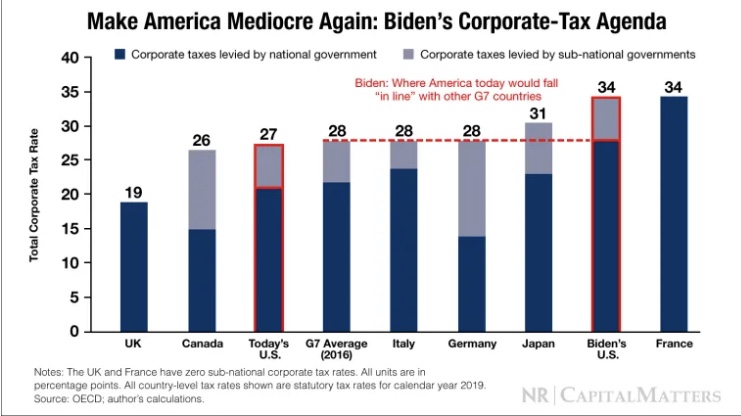
The Biden Administration is proposing a substantial increase in the corporate income tax rate from 21% to 28%. This is another case of a self-destructive policy that serves as a virtue signal to the progressive Left. See? We’re taxing the rich and their powerful corporations! What none of them realize is that the tax on corporate income is actually a regressive tax on consumers and workers; it is a disincentive to the formation of productive capital; and it is a highly wasteful tax due to compliance costs and the impact of avoidance. And the Biden proposal would make the U.S. less competitive internationally, as the chart above from Joseph Sullivan demonstrates. Maybe some of the proponents realize it, but they still like it because it sounds so good to their base!

It’s not as if all these unhealthy characteristics of the corporate tax are new findings. Milton Friedman explained some of the basics in 1971 when he said:

“The elementary fact is that ‘business’ does not and cannot pay taxes. Only people can pay taxes. Corporate officials may sign the check, but the money that they forward to Internal Revenue comes from the corporation’s employees, customers or stockholders. A corporation is a pure intermediary through which its employees, customers and stockholders cooperate for their mutual benefit.”

In 1984, two giants of public finance economics, Richard and Peggy Musgrave, investigated how the corporate tax was shifted to households. Here’s a description of their findings from a recent paper by Edward Lane and L. Randall Wray:

“… the bottom quintile pays 4.6–5.5 percent of its income toward the corporate profits tax, the top decile pays 2.5–3.7 percent of its income, and the ninth decile pays 2.4–2.9 percent of its income. They conclude that the corporate profits tax is largely regressive while the federal personal income tax is progressive.”

The incidence of the corporate tax rate falls primarily on workers in the form of lower wages and lost jobs, and on consumers in the form of higher prices. Lane and Wray cite several influential studies over the years showing a substantial negative association between corporate taxes and wages. As the authors note, major corporations often have pricing power in both product and labor markets, at least relative to their power in capital markets where they must raise capital. Capital markets are highly competitive, so they don’t provide much opportunity for shifting the burden of the tax to owners of equity and debt. There are limits on a firm’s ability to pass the tax along to customers and workers as well, of course, but shareholders are relatively well-insulated from the burden of the tax.

There are still other reasons to avoid increasing the corporate income tax rate. It currently raises about $200 billion annually for the U.S. Treasury, or about 7% of estimated federal tax revenue for the 2021 fiscal year. It also has extremely high compliance costs. Lane and Wray quote a 2016 Tax Foundation estimate that U.S. businesses face tax compliance costs on the order of $193 billion a year. Not all of that figure applies to corporations, and not all of it is for federal tax compliance, but a great deal of it is. There are also a number of ways the tax can be avoided, such as off-shoring operations and using overstated transfer prices of inputs obtained from units overseas. This is not an economically efficient way to generate tax revenue.

Moreover, the corporate income tax creates perverse incentives. When new investment in productive, physical capital is penalized at the margin, you can expect less capital investment, lower wages, and fewer jobs. Alan D. Viard explains that the dynamics of this mechanism take time to play out, but the longer-run decay in the capital stock is perhaps the most damaging aspect of a high corporate tax rate. And indeed, while there are probably short-run effects, the reduction in the incentive to invest is the real mechanism linking a higher corporate tax to reduced wages and higher prices, not to mention reduced economic growth.

Finally, there is a pernicious political-economic aspect of the corporate income tax owing to the difficulty for the general public in identifying its true incidence. This was also discussed by Milton Friedman:

“… Indirect effects make it difficult to know who ‘really’ pays any tax. But this difficulty is greatest for taxes levied on business. That fact is at one and the same time the chief political appeal of the corporation income tax, and its chief political defect. The politician can levy taxes, as it appears, on no one, yet obtain revenue. The result is political irresponsibility. Levying most taxes directly on individuals would make it far clearer who pays for government programs.

If the government intends to tax the owners of corporate wealth (a significant share of which is held in retirement savings accounts), it should be honest about doing so. That would mean taxing capital income in a more consolidated way, as Lane and Wray put it, at the individual level. That kind of transparency might be too much to hope for because the politics of doing so are much less favorable.

Meanwhile, the Biden Administration wants to have it all: higher corporate taxes and higher taxes on relatively high-earning individuals. But a significant burden of the corporate tax increase ultimately is shifted to individual workers and consumers. It is a regressive tax, and it is an inefficient tax with outrageously high compliance costs. It is a destructive tax because it undermines the economy’s growth in productive capacity. And it offers tax revenue to politicians who have little budgetary resolve, and with little political consequence.

Pawning Growth For Redistribution

15 Monday Feb 2016

Posted by Nuetzel in Equality, Redistribution

≈ Leave a comment

Tags

Alan D. Viard, American Enterprise Institute, Angela Ranchidi, Bernie Sanders, Chelsea German, Dan Mitchell, Double Taxation, Economic Mobility, Fallacy of Redistribution, First Theorem of Government, Gallup, Household structure, Income Growth, John Cochrane, Minimum Wage, Poverty, Progressive Taxes, Redistribution, Third Way, Thomas Sowell, Welfare State

govt here to help

The following is no mystery: if you want prosperity, steer clear of policies that inhibit production and physical investment. This too: if you want to lift people out of poverty and dependency, don’t promote policies that discourage hiring and work incentives. Yet those are exactly the implications of policies repeatedly advocated by so-called redistributionists. The ignorance flows, in large part, from a distraction, a mere byproduct of economic life that has no direct relation to economic welfare, but upon which followers of Bernie Sanders are absolutely transfixed: income and wealth inequality. Attempts to manipulate the degree of inequality via steeply progressive taxes, transfers and market intervention is a suckers game of short-termism. It ultimately reduces the value of the economy’s capital stock, chases away productive activity, destroys jobs, and leaves us all poorer.

Absolute income growth is a better goal, and encouraging production is the best way to raise incomes in the long-run. Unless envy is your thing, income inequality is largely irrelevant as a policy goal. In “Why and How We Care About Inequality“, John Cochrane emphasizes that inequality may be a symptom of other problems, or perhaps no problem at all. His point is that treating a symptom won’t fix the underlying problem:

“A segment of America is stuck in widespread single motherhood … terrible early-child experiences, awful education, substance abuse, and criminality. 70% of male black high school dropouts will end up in prison, hence essentially unemployable and poor marriage prospects. Less than half are even looking for legal work.

This is a social and economic disaster. And it has nothing to do with whether hedge fund managers fly private or commercial. It is immune to floods of Government cash, and, as Casey Mulligan reminded us, Government programs are arguably as much of the problem as the solution. So are drug laws….“

The writers of the center-left Third Way blog give some details on income growth that might disappoint some progressives. They agree that the emphasis on redistribution is misplaced. Solving economic problems requires a different approach:

“From 1980 to 2010, income gains (after taxes and government transfers are included) favored the wealthy but were still spread across all income brackets: a 53% increase for the bottom quintile; a 41% increase for the next two; a 49% increase for the 4th; and a 90% increase for the richest fifth. Thus, while income inequality may offend our sense of justice, its actual impact on the middle class may be small.

With a singular focus on income inequality, the left’s main solutions are greater re-distribution and a re-writing of the rules to ‘un-rig’ the system. But, however well motivated, some of the biggest ideas into which they are directing their energy do not remotely address the underlying ‘Kodak’ conundrum—how do Americans find their place in a rapidly changing world? In fact, some would actually make the task of increasing shared prosperity significantly harder.“

The hubbub over inequality and redistribution is fueled by misconceptions. One is that the rich face low tax burdens, often lower than the middle class, a mistaken notion that Alan D. Viard debunks using 2013 data from a report from the Congressional Budget Office. The CBO report accounts for double taxation of dividends and capital gains at the corporate level and at the personal level (though capital gains are taxed to individuals now, while the anticipated corporate income is taxed later). The CBO study also accounts for employers’ share of payroll taxes (because it reduces labor income) so as to avoid exaggerating the tax system’s progressivity. Before accounting for federal benefits, which offset the tax burden, the middle 20% of income earners paid an average tax rate of less than 15%, while “the 1%” paid more than 29%. However, after correcting for federal benefits, the middle quintile paid a negative average tax rate, while the top 1% still paid almost 29%. That is a steeply graduated impact.

Rising income inequality in the U.S. is more a matter of changes in household structure than in the distribution of rewards. This conclusion is based on the fact that income inequality has risen steadily over the past 50 years for households, but there has been no change in inequality across individuals. An increasing number of single-person households, primarily women over the age of 65, accounts for rising inequality at the household level. The greedy corporate CEOs of the “occupier” imagination are really not to blame for this trend, though I won’t defend corporate rent-seeking activities intended to insulate themselves from competition.

Measures of income inequality hide another important fact: one’s position in the income distribution is not static. Chelsea German notes that Americans have a high degree of economic mobility. According to a Cornell study, only 6% of individuals in the top 1% in a given year remain there in the following year. German adds that over half of income earners in the U.S. find themselves in the top 10% for at least one year of their working lives.

There are several reasons why redistributionist policies fail to meet objectives and instead reduce opportunities for the presumed beneficiaries to prosper. Dan Mitchell covers several of these issues, citing work on: the rational response of upper-income taxpayers to  punitive taxes; the insufficiency of funding an expanded welfare state by merely taxing “the rich”; the diversion of most anti-poverty funds to service providers (rather than directly to the poor); the meager valuation of benefits from recipients of Medicaid, and the fact that the program lacks any favorable impact on mortality and health measures. Mitchell features the “First Theorem of Government” in a sidebar:

“Above all else, the public sector is a racket for the enrichment of insiders, cronies, bureaucrats and interest groups.“

A few years back, the great Thomas Sowell explained “The Fallacy of Redistribution” thusly:

“You can only confiscate the wealth that exists at a given moment. You cannot confiscate future wealth — and that future wealth is less likely to be produced when people see that it is going to be confiscated.“

That future wealth can and should be enjoyed across the income spectrum, but punitive taxes destroy productive capital and jobs.

A great truth about poverty comes from Angela Ranchidi of the American Enterprise Institute: low wages are not at the root of poverty; it’s a lack of jobs. She quotes a Gallup report on this point, relative to the working-age poor in 2014:

“Census data show that, 61.7% did not work at all and another 26.6% worked less than full-time for the entire year. Only 11.7% of poor working-age adults worked full-time for the entire year in 2014. Low wages are not the primary cause of poverty; low work rates are. And if Gallup is correct, the full-time work rate may already be peaking.“

More than 88.3% of the working-age poor were either unemployed or underemployed! And here’s the kicker: redistributionists clamor for policies that would place an even higher floor on wage rates, yet the floor already in place has succeeded in compromising the ability of low-skilled workers to find full-time work.

Cochrane sums up the inequality debate by noting the obvious political motives of progressive redistributionists:

“Finally, why is “inequality” so strongly on the political agenda right now? Here I am not referring to academics. … All of economics has been studying various poverty traps for a generation…. 

[The] answer seems pretty clear. Because [the politicians and pundits] don’t want to talk about Obamacare, Dodd-Frank, bailouts, debt, the stimulus, the rotten cronyism of energy policy, denial of education to poor and minorities, the abject failure of their policies to help poor and middle class people, and especially sclerotic growth. Restarting a centuries-old fight about “inequality” and “tax the rich,” class envy resurrected from a Huey Long speech in the 1930s, is like throwing a puppy into a third grade math class that isn’t going well. You know you will make it to the bell.

That observation, together with the obvious incoherence of ideas the political inequality writers bring us leads me to a happy thought that this too will pass, and once a new set of talking points emerges we can go on to something else.“

Follow Sacred Cow Chips on WordPress.com

Recent Posts

  • The Case Against Interest On Reserves
  • Immigration and Merit As Fiscal Propositions
  • Tariff “Dividend” From An Indigent State
  • Almost Looks Like the Fed Has a 3% Inflation Target
  • Government Malpractice Breeds Health Care Havoc

Archives

  • January 2026
  • December 2025
  • November 2025
  • October 2025
  • September 2025
  • August 2025
  • July 2025
  • June 2025
  • May 2025
  • April 2025
  • March 2025
  • February 2025
  • January 2025
  • December 2024
  • November 2024
  • October 2024
  • September 2024
  • August 2024
  • July 2024
  • June 2024
  • May 2024
  • April 2024
  • March 2024
  • February 2024
  • January 2024
  • December 2023
  • November 2023
  • August 2023
  • July 2023
  • June 2023
  • May 2023
  • April 2023
  • March 2023
  • February 2023
  • January 2023
  • December 2022
  • November 2022
  • October 2022
  • September 2022
  • August 2022
  • July 2022
  • June 2022
  • May 2022
  • April 2022
  • March 2022
  • February 2022
  • January 2022
  • December 2021
  • November 2021
  • October 2021
  • September 2021
  • August 2021
  • July 2021
  • June 2021
  • May 2021
  • April 2021
  • March 2021
  • February 2021
  • January 2021
  • December 2020
  • November 2020
  • October 2020
  • September 2020
  • August 2020
  • July 2020
  • June 2020
  • May 2020
  • April 2020
  • March 2020
  • February 2020
  • January 2020
  • December 2019
  • November 2019
  • October 2019
  • September 2019
  • August 2019
  • July 2019
  • June 2019
  • May 2019
  • April 2019
  • March 2019
  • February 2019
  • January 2019
  • December 2018
  • November 2018
  • October 2018
  • September 2018
  • August 2018
  • July 2018
  • June 2018
  • May 2018
  • April 2018
  • March 2018
  • February 2018
  • January 2018
  • December 2017
  • November 2017
  • October 2017
  • September 2017
  • August 2017
  • July 2017
  • June 2017
  • May 2017
  • April 2017
  • March 2017
  • February 2017
  • January 2017
  • December 2016
  • November 2016
  • October 2016
  • September 2016
  • August 2016
  • July 2016
  • June 2016
  • May 2016
  • April 2016
  • March 2016
  • February 2016
  • January 2016
  • December 2015
  • November 2015
  • October 2015
  • September 2015
  • August 2015
  • July 2015
  • June 2015
  • May 2015
  • April 2015
  • March 2015
  • February 2015
  • January 2015
  • December 2014
  • November 2014
  • October 2014
  • September 2014
  • August 2014
  • July 2014
  • June 2014
  • May 2014
  • April 2014
  • March 2014

Blogs I Follow

  • Passive Income Kickstart
  • OnlyFinance.net
  • TLC Cholesterol
  • Nintil
  • kendunning.net
  • DCWhispers.com
  • Hoong-Wai in the UK
  • Marginal REVOLUTION
  • Stlouis
  • Watts Up With That?
  • Aussie Nationalist Blog
  • American Elephants
  • The View from Alexandria
  • The Gymnasium
  • A Force for Good
  • Notes On Liberty
  • troymo
  • SUNDAY BLOG Stephanie Sievers
  • Miss Lou Acquiring Lore
  • Your Well Wisher Program
  • Objectivism In Depth
  • RobotEnomics
  • Orderstatistic
  • Paradigm Library
  • Scattered Showers and Quicksand

Blog at WordPress.com.

Passive Income Kickstart

OnlyFinance.net

TLC Cholesterol

Nintil

To estimate, compare, distinguish, discuss, and trace to its principal sources everything

kendunning.net

The Future is Ours to Create

DCWhispers.com

Hoong-Wai in the UK

A Commonwealth immigrant's perspective on the UK's public arena.

Marginal REVOLUTION

Small Steps Toward A Much Better World

Stlouis

Watts Up With That?

The world's most viewed site on global warming and climate change

Aussie Nationalist Blog

Commentary from a Paleoconservative and Nationalist perspective

American Elephants

Defending Life, Liberty and the Pursuit of Happiness

The View from Alexandria

In advanced civilizations the period loosely called Alexandrian is usually associated with flexible morals, perfunctory religion, populist standards and cosmopolitan tastes, feminism, exotic cults, and the rapid turnover of high and low fads---in short, a falling away (which is all that decadence means) from the strictness of traditional rules, embodied in character and inforced from within. -- Jacques Barzun

The Gymnasium

A place for reason, politics, economics, and faith steeped in the classical liberal tradition

A Force for Good

How economics, morality, and markets combine

Notes On Liberty

Spontaneous thoughts on a humble creed

troymo

SUNDAY BLOG Stephanie Sievers

Escaping the everyday life with photographs from my travels

Miss Lou Acquiring Lore

Gallery of Life...

Your Well Wisher Program

Attempt to solve commonly known problems…

Objectivism In Depth

Exploring Ayn Rand's revolutionary philosophy.

RobotEnomics

(A)n (I)ntelligent Future

Orderstatistic

Economics, chess and anything else on my mind.

Paradigm Library

OODA Looping

Scattered Showers and Quicksand

Musings on science, investing, finance, economics, politics, and probably fly fishing.

  • Subscribe Subscribed
    • Sacred Cow Chips
    • Join 128 other subscribers
    • Already have a WordPress.com account? Log in now.
    • Sacred Cow Chips
    • Subscribe Subscribed
    • Sign up
    • Log in
    • Report this content
    • View site in Reader
    • Manage subscriptions
    • Collapse this bar
 

Loading Comments...