• About

Sacred Cow Chips

Sacred Cow Chips

Tag Archives: Assimilation

Immigration and Merit As Fiscal Propositions

10 Wednesday Dec 2025

Posted by Nuetzel in Fiscal Impact, Immigration

≈ Leave a comment

Tags

Assimilation, Birthright Citizenship, Criminal Records, Daniel Di Martino, Denmark Immigration, Deportation, entitlements, Fiscal Contribution, Garret Jones, Illegal Aliens, Immigration, Improper Entry, Jesús Fernández-Villaverde, Manhattan Institute, Merit-Based Immigration, National Academy of Sciences, Remigration, Robby Soave, Security Risks, Welfare State

Immigration into the U.S. can be a powerful force for economic growth. This takes on special importance given low fertility rates in the U.S. and the effective insolvency of our entitlement systems (with dim prospects for reform). But whether a given flow of immigrants will mitigate the negative growth and fiscal effects of unfavorable demographic trends is a conclusion requiring some qualification.

This certainly isn’t a case of “the more, the merrier”. Sharp tradeoffs bear on whether and how immigration can be a part of the solution to our demographic and fiscal woes.

Fiscal Contribution

University of Pennsylvania economist Jesús Fernández-Villaverde asserts that a high volume of immigrants will not solve our fiscal challenges. His reasoning is straightforward: immigrants are concentrated in the lower part of the income distribution, and therefore relatively few provide a surplus contribution to the nation’s fiscal balance. In fact, our large fiscal imbalance is driven by the country’s generous welfare state. With near-open borders, it serves as a magnet for low-income migrants. Thus, a broadly lenient immigration policy will not solve fiscal issues caused by low birth rates. However, Fernandez-Villaverde offers no direct empirical evidence except to say that data from some European countries support his claim.

Daniel Di Martino of the Manhattan Institute recently published a detailed analysis of the fiscal effects of immigration, including the fiscal contributions of both immigrants and two subsequent generations of offspring. He provided an excellent summary in a later tweet:

“… when it comes to immigration, the main question isn’t how many immigrants but which immigrants.”

In particular, highly-educated immigrants engender a surplus fiscal contribution. All else equal, so do immigrants less than 40 years of age. Low-skill immigrants are likely to produce a fiscal deficit, however. Legal immigrants tend to have a positive fiscal effect, while illegal immigrants tend to add to deficits.

This 2017 report from the National Academies of Sciences found similarly mixed results on the fiscal impact of immigrants. Education and age were again important determinants.

Country of Origin

Garret Jones argues that place of origin is a vital indicator of fiscal contribution. Here is a chart he posted at the link (from The Economist):

The chart pertains to immigration into Denmark, so like Jesús Fernández-Villaverde, we’re relying on European data. However, I suspect this generalizes to most other western countries. Of course, the plots above represent averages; individuals from any of the categories shown in the chart might differ substantially. Nevertheless, the average non-western immigrant into Denmark makes a weak or negative fiscal contribution relative to immigrants of western origin. The contrast is especially sharp for immigrants from the category that includes the Middle East, North Africa, Pakistan, and Turkey.

There are a variety of explanations for these disparate results. Westerners emigrating to Denmark probably have a strong advantage in terms of common languages and communication. Average skill levels are probably higher for westerners as well. Cultural differences almost surely make assimilation into society and the workplace more difficult for non-westerners.

A strict ban or quota on immigration from certain countries is probably unwise, however. Given our growth and fiscal objectives, we should seek to attract talented individuals from all over, and humanitarian imperatives suggest acceptance of legitimate refugees from political, religious, racial, or ethnic persecution. That might well mean a greater annual number of legal immigrants into the U.S. But if the question is whether it’s fiscally sound to encourage broad inflows of non-western immigrants, the answer is mostly no.

Vetting

It should go without saying that all potential immigrants must be vetted, and the intensity of the process could be made a function of an individual’s place of origin. Military-age males from hostile countries should receive particular scrutiny so that we can mitigate risks like those described here.

It’s reasonable to demand that those entering the country meet some subset of possible qualifications, some of which might override other criteria. For example, highly productive workers make wonderful immigrants, contribute to economic growth, make a greater fiscal contribution, and are more likely to assimilate successfully. Those are key rationales for a merit-based immigration system. But an overriding consideration might apply to individuals or families fleeing their homeland due to persecution, who have legitimate claims to refugee status regardless of economic potential. It’s also reasonable to extend favorable treatment to individuals having close family members already in the U.S., barring any red flags.

A related concern is birthright citizenship, which is a constitutional right. As long as immigrants clear reasonable hurdles for legal entry, birthright citizenship should stand going forward. The Supreme Court is likely to rule against the Trump Administration’s challenge to birthright citizenship, and it should, though the vast number of illegals who entered the U.S. under Biden certainly creates a birthright burden for U.S. taxpayers. It also sometimes complicates efforts to deport individuals who never should have been allowed to enter.

Merit

Rigid immigration quotas don’t make economic sense. It’s desirable to allow flexibility as labor market conditions evolve. Those capable of work might be ranked by education or skill, and in turn assigned priority based on the strength of domestic opportunities in their areas of experience or expertise. This can accommodate unskilled workers when they are in heavy demand. But merit and labor-market pressures aside, please don’t adopt preferences like the last two sentences shown here (from the White House’s latest national security strategy document).
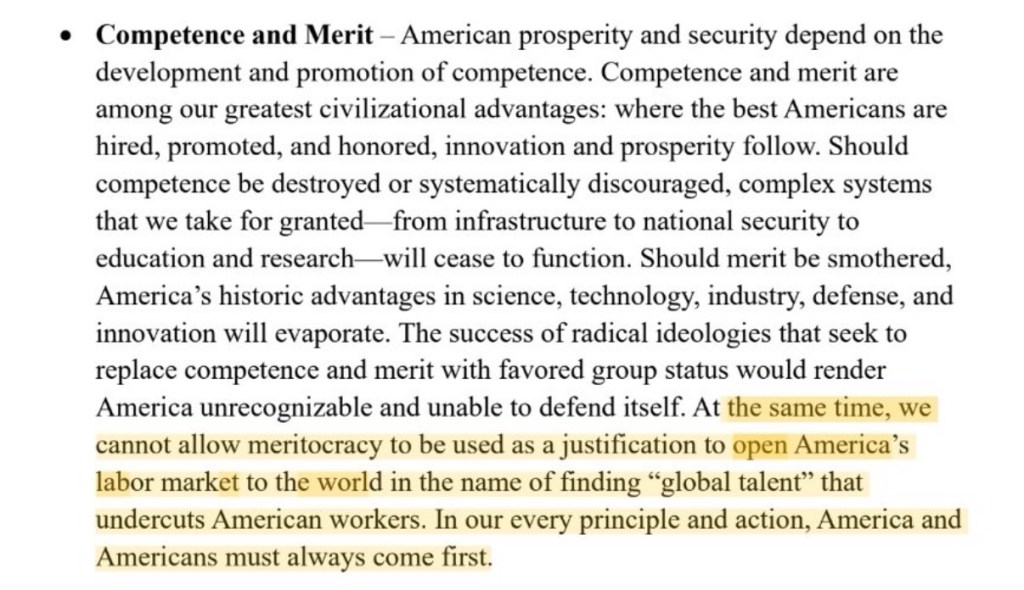
Legal immigration should not be handled as a residual. Employers will often find that an immigrant is more qualified for a certain job. They should be free to hire that individual assuming the immigrant is vetted. As Robby Soave notes at the tweet linked above, the White House position is economically equivalent to hiring on the basis of DEI preferences.

Needless to say, almost any formula or decision tree can be manipulated unless it is spelled out in detail by law. However, that too might subvert economic and fiscal objectives by imparting too much rigidity to the system.

Crimes and Misdemeanors

Notwithstanding protestations from many economists I admire, who make endless assertions that illegal immigrants have lower crime rates than the domestic population, those arguments are beside the point. There seems little justification for allowing anyone having a record of serious crime to enter the country. It is hard to imagine many circumstances under which exceptions should be considered. Yet we have managed to allow large numbers of proven criminals to enter the U.S. (similar numbers reported here). It goes without saying that we cannot properly vet potential immigrants unless they go through the proper legal process for entering the country. For example, this is what happened in Europe as countries allowed unchecked inflows of migrants (and continue to do so).

Illegal immigrants are obviously in violation of immigration laws, which cannot simply be rewarded. Rather than the traditional fines or jail time for improper entry, so-called “remigration” is an increasingly popular solution. Voluntary deportation is one possibility; should the immigrant refuse, there must be a greater price to pay for the violation of law. Involuntary deportation is more controversial but might be warranted if the alternative is state dependency. Other possibilities include private sponsorship with a price tag high enough to pay what would otherwise become an obligation imposed on taxpayers. Factors that could weigh in favor of an illegal immigrant would be employability, a commitment to learn the English language, and a course of study toward meeting the requirements for citizenship.

Summary

An open borders policy is idealized by some libertarians, but it has severe drawbacks. Among those are potential compromises in national security and a blind eye to the ingress of dangerous criminals. Furthermore, many potential immigrants contribute to fiscal deficits due to their reliance on the welfare state and the generous entitlements available to many U.S. residents. A well-designed immigration system would screen for merit across a number of dimensions, with responsiveness to labor market conditions.

American Homicide Rates: Which America?

12 Thursday Oct 2017

Posted by Nuetzel in Discrimination, Gun Control, Immigration

≈ 1 Comment

Tags

Affirmative Action, Assimilation, Bretigne Shaffer, Diversity, Economic Mobility, Heterogeneity, Illegal Immigration, On the Banks, Rent Controls, Ryan McMaken, School Choice, Segregation, Sponsorship, Violent Victimization, War on Drugs

A heterogenious society and the successful assimilation of minorities are two very different things, as much as we might wish otherwise. Two populations within a region will come into contact, but conditions promoting real assimilation are complex. (I’m avoiding use of the term “diversity” because it has come to imply the successful assimilation of distinct groups.) While cultural differences can enrich the lives of both populations, sharp economic gaps between minority and majority populations (and even some cultural differences) will tend to slow the process of assimilation. This is often associated with social dysfunction, such as high crime and homicide rates, especially among the minority group. This is a fairly common phenomenon in countries with racial and ethnic minority or immigrant populations, as Ryan McMaken writes in a recent piece on international differences in heterogeneity and homicide rates.

Heterogeneity In the West

Countries in the Western Hemisphere tend to have relatively high immigrant and minority populations, as McMaken describes:

“… when considering the Americas, … nation-states are in most cases frontier states with populations heavily affected by immigration, a history of conflict with indigenous populations, and institutionalized chattel slavery that lasted until the 19th century. The factors are significant through the region, and the United States cannot be held apart in this regard from the Caribbean, Brazil, Colombia, and other states impacted by all these factors. 

Importantly, these factors also make the Americas significantly different from Western Europe and other areas — Japan and Korea, for example — where the present situation is marked by much higher levels of cultural uniformity and quite different recent histories and current demographic trends.“

Homicides

McMaken questions popular theories of cross-country differences in homicide rates based on the degree of gun control and gun ownership rates. Homicides and violent victimization have been declining in the U.S. for many years even as gun ownership has soared. Furthermore, international comparisons are traditionally plagued by arbitrary country classifications and exclusions, as well as inconsistent definitions of homocide and gun ownership. However, McMaken points to other explanations for violent crime found to be fairly robust in the academic literature: poverty and population heterogeneity:

“… these factors contribute to lower levels of social cohesion, and thus higher levels of criminality and other socially-undesirable behaviors.“

McMaken cites research involving ethnic minority populations of Slavs in Germany, Italians in Argentina and the U.S., and Arabs in Europe, all of whom had crime rates far exceeding those in their countries of origin. The connection between heterogeneity and crime might have nothing to do with particular ethnic groups, though it seems all too easy for observers within individual countries to blame specific “others” for crime. It is a symptom of alienation from the majority as well as economic desperation and vulnerability to opportunities and threats arising from the underground economy. Illegal activities might truly provide the best alternatives available to low-skilled, minority job seekers. Needless to say, underground economic activity, such as the drug trade, involves high risk and often violence among users and between competing factions. This is an important source of the high crime and victimization that typifies many minority communities.

Despite declines since the 1970s, the U.S. still has a higher homicide rate than many other industrialized countries. Beyond the weakness cited above, such comparisons fail to control for other confounding effects, including the degree of heterogeneity across countries.

Policies

Heterogeneity poses a problem in the context of involuntary and often voluntary segregation of sub-cultures. If you don’t believe the “voluntary” part, take a close look at the different clusters of individuals in the cafeteria at almost any “diverse” university or corporate office. Judge for yourself. Differences in language, fertility, demographics, religion and cultural traditions may be noteworthy, but where crime is associated with effectively segregated minorities, there is usually a gap in economic status and mobility relative to society at large.

What policies can mitigate these conditions and their impact on crime? It would be nice to approach this question strictly from the perspective that heterogeneity is a given, but the degree of heterogeneity is, to some extent, an endogenous outcome. Restrictive immigration policies might leap to mind as a way of restraining heterogeneity, and there is little doubt that illegal immigrants are less likely to assimilate (many contend that their crime rate is low). Policies allowing less restricted flows of legal immigrants tend to be salutary if they are based on domestic economic need, economic potential, or compassion for those seeking asylum or a haven from political oppression. A legal immigrant receiving a welcome on new shores is more likely to assimilate successfully than an illegal immigrant, all else equal. Citizenship and language education are avenues through which assimilation might be encouraged. And there could be ways to improve sponsorships and even temporary visa programs so as to encourage assimilation.

What can be done to encourage more effective assimilation of all minorities? And what can be done to reduce the crime associated with unassimilated populations? One major corrective is a strong economy. Policies that encourage economic growth will lead to greater participation in markets and society, with consequent interaction and mixing of sub-cultures. Growth policies include low and non-distortionary taxes and light regulation.

The war on drugs also accounts for a major share of homicides, and that war interacts with non-assimilation in perverse ways. It is crippling to disadvantaged communities precisely because it creates risky “opportunities” in the underground economy. It also produces high levels of incarceration and dangerous forms of “cut” contraband. As I’ll discuss in my next post, ending the war on drugs would reduce violent crime and lead to safer drugs in relatively short order.

A short list of other policies that would foster assimilation and economic mobility would include: improved education: school choice and apprenticeship programs; better labor market outcomes: reduce the minimum wage or create sub-minimum wage categories to enhance opportunities to gain experience and skills; better housing: eliminate rent controls.

Assimilation is always more effective when it occurs “organically”. Affirmative action and forced diversity initiatives often fail to achieve effective assimilation. Beyond the obvious infringement on liberty, these policies may sow resentment among those who suffer reverse discrimination, and among those who witness it, to the probable detriment of efforts to eliminate bias. Even worse, these policies often put their intended beneficiaries into vulnerable, un-winnable situations: jobs or programs for which their skills are not adequate. There are undoubtedly excellent candidates among those placed in positions under quotas, but there is a likelihood that many will be unsuccessful in their roles.

Conclusion

The anti-gun left is eager to attribute differences in homicide rates to the impact of gun control policies, but a close examination of the facts reveals better explanations. A prominent factor contributing to differences in homicide rates is the degree of heterogeneity across countries. Those with more homogeneous populations tend to have lower homicide rates and vice versa. But the problem is not merely heterogeneity, but the difficulty of economic and cultural assimilation of minority populations. These factors appear to lead to greater crime within many minority populations. The U.S. is not unique in its experience with high minority crime rates, but it is a relatively heterogenous nation. This is an important factor in explaining why the homicide rate tends to be higher in the U.S. than in other industrialized countries. To close, I’ll offer something cogent from Bretigne Shaffer’s On the Banks blog, in which she offers this quote from an individual named Michael Owen (the soccer player?):

“... we don’t really have a single America with a moderately high rate of gun deaths. Instead, we have two Americas, one of which has very high rates of gun ownership but very low murder rates, very comparable to the rest of the First World democracies such as those in western & northern Europe, Australia, New Zealand, Canada, Japan, South Korea. The other America has much lower rates of gun ownership but much, much higher murder rates, akin to violent third world countries.“

Leftist Ad Hominid Species Screams “White Racists!”

03 Wednesday Feb 2016

Posted by Nuetzel in Discrimination, Equality, racism

≈ Leave a comment

Tags

A Taste For Discrimination, Assimilation, Celebrating Diversity, Cultural Sorting, Davis Bacon Act, discrimination, Economics of Discrimination, Jim Crow Laws, Minimum Wage, Racial Quotas, racism, Rent Controls, Social Mobility, Systemic Racism, Unintended Consequences, Virtue Signaling, Voluntary Sorting, War on Drugs


Lately I hear that all white people are racists, and I feel compelled to examine the intellectual grounding of such an inflamatory claim. Consciousness of race is not racism, as some would suggest. Indeed, solutions to racial division offered by activists usually require that we bear race in mind as a primary differentiator. Insofar as one must consider the worth of another person in any context, people of good faith simply do not care about a person’s race. Rather, they care about traits that count, such as honesty, skills, work ethic and perhaps affability. Should they somehow care more? What would vindicate them?

Inflammatory Claims

There are probably several motives for the charge of universal white racism. On one level, it represents political agitation. Posts carrying the charge on social media always involve a measure of “virtue signaling” to like-minded friends, or perhaps before the Gods. (I’m sure the posters will be forgiven.) Such posts might represent acts of social contrition to allay deep-seated feelings of guilt. The posters might fancy that they are raising the consciousness of others, proudly imagining the important lesson they are teaching. The bad news for them is that most people of good faith are rightly skeptical of proselytization like this. In fact, the agitation probably does more to breed skepticism than anything else.

Voluntary Sorting Behavior

What some view as racial division is often an innocent consequence of voluntary sorting based upon the shared subcultures most compelling to individuals at a given time. There are many subcultures into which a person might fit: work, school, profession, sports, music, religion, politics, hobbies, geography, ancestry, ethnicity and race. And there are micro-cultures within all of these categories. These cultural segments differ in many respects, and they may overlap in many cases. The extent of sub-cultural overlap may be viewed as a gauge of assimilation.

In any given context, people tend to voluntarily sort themselves into the sub-culture they find most compelling. This voluntary sorting does not yield a fixed social distribution of individuals across groups. Individuals can choose to associate with different sub-cultures to which they belong on a day-to-day basis.

There is a pronounced tendency for sorting to occur within larger “populations”, such as cafeteria-goers in a large office or in a large school. People from particular work groups might sit together: there is some sorting by age, by gender, and by race. African-Americans often sit together. There is mixing of members of these subgroups as well. People are brought together by work or school, but the shared work or school culture is frequently less compelling to individuals in their choice of a lunch table than other sub-cultures to which they belong.

Isolation or Assimilation

Assimilation does not mean that cultural differences must disappear, but it does mean that subcultures must at least be tolerant of others. A key question is whether one subgroup would welcome a member of another subgroup to join them. There might be reasons to refuse in some circumstances, such as a group of accountants who wish to avoid economists. Lol. However, a group of Caucasians who prefer to remain exclusive, making African Americans feel unwelcome, are guilty of racism, and vice-versa. As for the converse, an African American individual who prefers not to join a group of Caucasians, and vice versa, there is usually a good rationale for presuming the individual to be innocent of racism: they are simply choosing a more compelling sub-culture.

Certain sub-cultures may be especially amenable to selection from across sub-groups. For example, team sports often foster racial mixing, as do music and various professions. Religion and economic stratum can be powerful shared sub-cultures, drawing members across racial groups. In other words, mixing of sub-cultures will occur when a compelling sub-culture is shared. That is a form of successful assimilation.

When voluntary sorting takes place, the parties seek commonalities. That’s a form of discrimination that may be quite healthy and not racist in any way. On the other hand, accepting diversity implies respect for other cultures and subcultures. Voluntary sorting allows those cultures to function, but it does not necessarily imply exclusion of others who might be curious and wish to learn and take part in a culture’s traditions, or who might even wish to become a part of a different community.

Counterproductive Compulsion

The insistence that racism is widespread is often an expression of support for compelled remedies or paying reparations of some kind to alleged victims. In a free society, the kind of voluntary sorting discussed above will always be a reality; any attempt to prevent it would require extreme coercion. Reparations for historical injustices, legal or economic, raise ethical questions about the treatment of those who must bear the costs. They also carry high administrative costs and tend to breed resentment and division. There are well-known downsides to quotas in hiring and in school admissions. Not only do quotas lead to reverse discrimination, they also can place the intended beneficiaries into situations of vulnerability to failure.

Markets Are Not Racist

Then there is the allegation that private markets are a source of “systemic racism”, having “disparate impacts” on certain minorities. However, it should be noted that the market mechanism tends to penalize racism. A consumer who chooses to avoid sellers of a different race will tend to pay a higher price for the privilege. An employer with a “taste for discrimination” must choose from a smaller labor pool and may lose the opportunity to hire the best talent. In other words, racists must pay for their preference. They also forego the creative benefits that diverse organizations tend to enjoy.

Certain minorities have struggled to achieve success in the private economy, but there are much better explanations for that difficulty than market forces, which provide the best opportunity for growth and assimilation. There is no question that institutional obstacles have had extremely harsh effects on groups starting from lower rungs of the socioeconomic ladder. A few examples: the failed public education has been especially burdensome for urban and rural minorities; various public policies have effectively excluded minorities from markets, including Jim Crow laws, the minimum wage and the Davis-Bacon Act; the so-called social safety net is rife with features that penalize work and reward fragmentation of families, making it as much a trap as a net; the drug war creates illicit market opportunities which present catastrophic but unappreciated risks for both the participants and their families; rent controls, zoning laws and restrictions on new construction limit the stock of affordable housing; heavy regulation makes starting a business difficult for those without the financial and legal resources to deal with it; and the ugly tradition of cronyism tends to reduce social mobility by entrenching privilege rather than rewarding economic value. The deck is stacked in many ways against economic mobility by public policy, and racial minirities have borne much of the burden.

Immigration Hotspot

Another controversy is whether racism is manifest in the negative views of many Americans toward immigrants. These claims allege ethnic and religious discrimination, including the hatred of Muslims. No doubt there are Americans who harbor racist attitudes toward immigrants. Some of this is grounded in unreasonable economic fears. There are also fears that terrorists may be among new immigrant populations, especially refugees, but that fear is hardly unreasonable given the recent experience of Europe and the difficulty of establishing reliable background information on some of these individuals.

Sharing Freedom

Racism still exists and it will never go away entirely. However, our dedication to freedom compels us to protect speech as long as it is not threatening. Racial discrimination by participants in markets can be difficult to detect, but racists must pay an economic price imposed by the market mechanism, and there are often legal remedies if racial discrimination in markets can be proven. Fortunately, racism today is not as widespread as the agitators would have you believe. The best policy for assimilation and acceptance is to promote a shared culture of freedom and economic opportunity.

Follow Sacred Cow Chips on WordPress.com

Recent Posts

  • The Case Against Interest On Reserves
  • Immigration and Merit As Fiscal Propositions
  • Tariff “Dividend” From An Indigent State
  • Almost Looks Like the Fed Has a 3% Inflation Target
  • Government Malpractice Breeds Health Care Havoc

Archives

  • January 2026
  • December 2025
  • November 2025
  • October 2025
  • September 2025
  • August 2025
  • July 2025
  • June 2025
  • May 2025
  • April 2025
  • March 2025
  • February 2025
  • January 2025
  • December 2024
  • November 2024
  • October 2024
  • September 2024
  • August 2024
  • July 2024
  • June 2024
  • May 2024
  • April 2024
  • March 2024
  • February 2024
  • January 2024
  • December 2023
  • November 2023
  • August 2023
  • July 2023
  • June 2023
  • May 2023
  • April 2023
  • March 2023
  • February 2023
  • January 2023
  • December 2022
  • November 2022
  • October 2022
  • September 2022
  • August 2022
  • July 2022
  • June 2022
  • May 2022
  • April 2022
  • March 2022
  • February 2022
  • January 2022
  • December 2021
  • November 2021
  • October 2021
  • September 2021
  • August 2021
  • July 2021
  • June 2021
  • May 2021
  • April 2021
  • March 2021
  • February 2021
  • January 2021
  • December 2020
  • November 2020
  • October 2020
  • September 2020
  • August 2020
  • July 2020
  • June 2020
  • May 2020
  • April 2020
  • March 2020
  • February 2020
  • January 2020
  • December 2019
  • November 2019
  • October 2019
  • September 2019
  • August 2019
  • July 2019
  • June 2019
  • May 2019
  • April 2019
  • March 2019
  • February 2019
  • January 2019
  • December 2018
  • November 2018
  • October 2018
  • September 2018
  • August 2018
  • July 2018
  • June 2018
  • May 2018
  • April 2018
  • March 2018
  • February 2018
  • January 2018
  • December 2017
  • November 2017
  • October 2017
  • September 2017
  • August 2017
  • July 2017
  • June 2017
  • May 2017
  • April 2017
  • March 2017
  • February 2017
  • January 2017
  • December 2016
  • November 2016
  • October 2016
  • September 2016
  • August 2016
  • July 2016
  • June 2016
  • May 2016
  • April 2016
  • March 2016
  • February 2016
  • January 2016
  • December 2015
  • November 2015
  • October 2015
  • September 2015
  • August 2015
  • July 2015
  • June 2015
  • May 2015
  • April 2015
  • March 2015
  • February 2015
  • January 2015
  • December 2014
  • November 2014
  • October 2014
  • September 2014
  • August 2014
  • July 2014
  • June 2014
  • May 2014
  • April 2014
  • March 2014

Blogs I Follow

  • Passive Income Kickstart
  • OnlyFinance.net
  • TLC Cholesterol
  • Nintil
  • kendunning.net
  • DCWhispers.com
  • Hoong-Wai in the UK
  • Marginal REVOLUTION
  • Stlouis
  • Watts Up With That?
  • Aussie Nationalist Blog
  • American Elephants
  • The View from Alexandria
  • The Gymnasium
  • A Force for Good
  • Notes On Liberty
  • troymo
  • SUNDAY BLOG Stephanie Sievers
  • Miss Lou Acquiring Lore
  • Your Well Wisher Program
  • Objectivism In Depth
  • RobotEnomics
  • Orderstatistic
  • Paradigm Library
  • Scattered Showers and Quicksand

Blog at WordPress.com.

Passive Income Kickstart

OnlyFinance.net

TLC Cholesterol

Nintil

To estimate, compare, distinguish, discuss, and trace to its principal sources everything

kendunning.net

The Future is Ours to Create

DCWhispers.com

Hoong-Wai in the UK

A Commonwealth immigrant's perspective on the UK's public arena.

Marginal REVOLUTION

Small Steps Toward A Much Better World

Stlouis

Watts Up With That?

The world's most viewed site on global warming and climate change

Aussie Nationalist Blog

Commentary from a Paleoconservative and Nationalist perspective

American Elephants

Defending Life, Liberty and the Pursuit of Happiness

The View from Alexandria

In advanced civilizations the period loosely called Alexandrian is usually associated with flexible morals, perfunctory religion, populist standards and cosmopolitan tastes, feminism, exotic cults, and the rapid turnover of high and low fads---in short, a falling away (which is all that decadence means) from the strictness of traditional rules, embodied in character and inforced from within. -- Jacques Barzun

The Gymnasium

A place for reason, politics, economics, and faith steeped in the classical liberal tradition

A Force for Good

How economics, morality, and markets combine

Notes On Liberty

Spontaneous thoughts on a humble creed

troymo

SUNDAY BLOG Stephanie Sievers

Escaping the everyday life with photographs from my travels

Miss Lou Acquiring Lore

Gallery of Life...

Your Well Wisher Program

Attempt to solve commonly known problems…

Objectivism In Depth

Exploring Ayn Rand's revolutionary philosophy.

RobotEnomics

(A)n (I)ntelligent Future

Orderstatistic

Economics, chess and anything else on my mind.

Paradigm Library

OODA Looping

Scattered Showers and Quicksand

Musings on science, investing, finance, economics, politics, and probably fly fishing.

  • Subscribe Subscribed
    • Sacred Cow Chips
    • Join 128 other subscribers
    • Already have a WordPress.com account? Log in now.
    • Sacred Cow Chips
    • Subscribe Subscribed
    • Sign up
    • Log in
    • Report this content
    • View site in Reader
    • Manage subscriptions
    • Collapse this bar
 

Loading Comments...