• About

Sacred Cow Chips

Sacred Cow Chips

Tag Archives: Block Grants

Medicaid Funding Scam Tolerated For Years

18 Tuesday Mar 2025

Posted by Nuetzel in Medicaid, rent seeking

≈ 1 Comment

Tags

Affordable Care Act, Block Grants, DOGE, Federal Matching Funds, Federal Medical Assistance Percentages, FMAP, Government Accountability Office, Issues & Insights, Joe Biden, Medicaid, National Library of Medicine, Obamacare, Provider Reimbursements, Provider Taxes, Supplemental Reimbursements
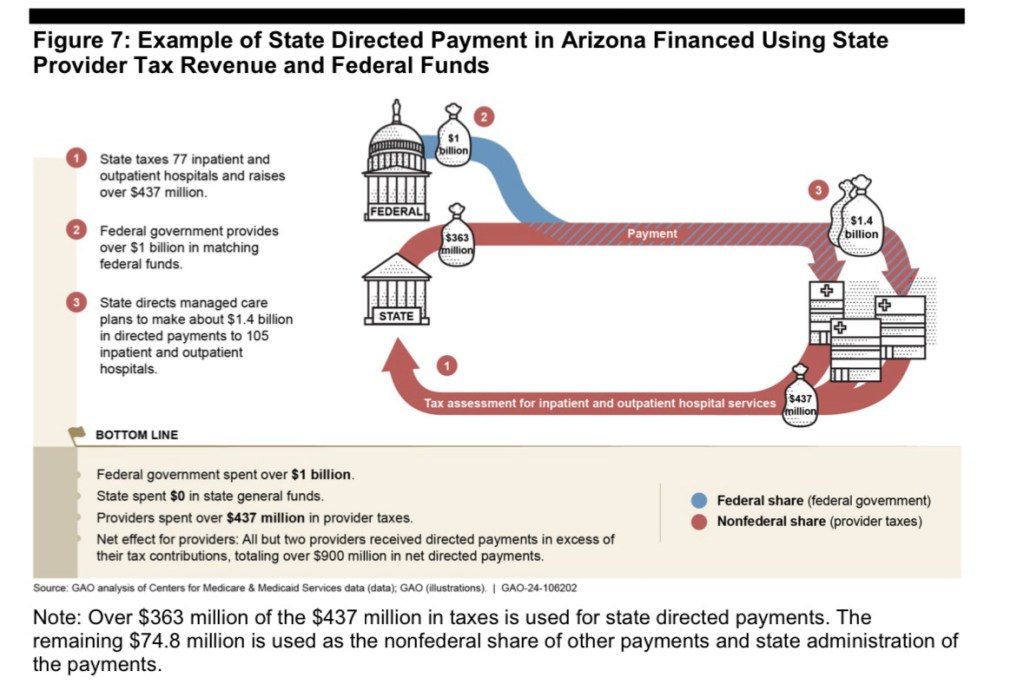
It’s been underway in various forms for a long time, at least since the early 1980s. It’s a basic variant of what the National Library of Medicine once called “creative financing” by some states “to get more federal dollars than they otherwise would qualify for” under Medicaid. It was even recognized as a scam by Joe Biden during Barack Obama’s presidency, and more recently by a number of legislators. Perhaps DOGE can do something to bring it under scrutiny, but ending it would probably take legislation.

Here’s the gist of it: increases in state Medicaid reimbursements qualify for a federal match at a rate known as the Federal Medical Assistance Percentage (FMAPs). First, increases in Medicaid reimbursements must be funded at the state level. To do this, states tax Medicaid providers, but then the revenue is kicked back to providers in higher reimbursements. The deluge of matching federal dollars follows, and states are free to use those dollars in their general budgets.

FMAPs vary based on state income level, so states with poorer residents have higher matching rates. The minimum FMAP is 50%, and it ranges up to 90% for marginal reimbursements falling under expanded Medicaid under Obamacare. The dollar value of the federal match is not capped.

The graphic at the top of this post highlights the circularity of this funding scheme. The graphic is taken from the Government Accountability Office’s “Medicaid Managed Care: Rapid Spending Growth In State Directed Payments Needs Enhanced Oversight and Transparency”. Here’s how Issues & Insights puts it:

“Let’s say, for example, a state imposes a provider tax on hospitals that raises $100 million. And then it returns that $100 million to the hospitals in the form of higher Medicaid reimbursement rates. There’s been no increase in benefits. Providers aren’t better off. But the state gets an extra $50 million from the federal government’s matching fund, money that it can use for anything it wants.“

However, whatever the increment to state coffers, and no matter what state programs are funded as a result, the increment is always expressed as a federal contribution to state Medicaid spending. That bit of shading helps cover for the convoluted and pernicious nature of the scheme. The lack of transparency is obvious, cloaking the circular nature of the flow of funds from providers to states and then back to providers. It’s possible that the arrangement inflates total annual Medicaid costs by as $50 – $65 billion a year, or by 6% – 8%.

Of course, this is also a blatant example of bureaucratic waste, and the allocation of “supplemental reimbursements” are a potential seedbed for cronyism and graft.

It would be better for the federal government to simply give states the money under block grants without the rigmarole. But of course that would change the character of the rent seeking already taking place, and the political daylight might not serve beneficiary states and providers well.

Putting aside the deception inherent in the funding mechanism, states vary tremendously in their reliance on federal matching revenue. States with large populations and high average incomes rely more heavily on the circular inflating of Medicaid reimbursements. California and New York lead the way in both Medicaid provider taxes and federal matching funds. Alaska, however, imposes no Medicaid provider taxes, and smaller states like Wyoming collect little in provider taxes.

High income states receive lower FMAPs, which seemingly encourages both higher Medicaid provider taxes and more “generous” provider reimbursements in order to harvest more federal matching funds. In addition, states have an incentive to participate in expanded Medicaid under the Affordable Care Act in order to receive higher matching rates.

The reciprocal nature of state-level Medicaid provider taxes and provider reimbursements implies a substantial but fictitious component of state Medicaid costs. The purpose is to qualify for federal matching dollars under Medicaid. The governments of 49 states have carried on with this escapade for years. Their misguided defenders insist that the federal contribution is necessary to protect benefits that states might otherwise have to cut. But even that stipulation would not justify the pairing of taxes on and reimbursements to Medicaid providers, which inflates the spending base upon which federal reimbursements are calculated. You have to wonder whether federal taxpayers should forgive the overstatement of costs and misallocation of funds.

Musings On Health Insurance Reform

10 Wednesday May 2017

Posted by Nuetzel in Health Care, Obamacare

≈ 1 Comment

Tags

AHCA, American Health Care Act, Block Grants, Catastrophic Coverage, Congressional Budget Office, Cross Subsidies, Essential Benefit Requirements, Health Care Freeloaders, High-Risk Pools, Mandated Benefits, McArthur Amendment, Medicaid Reform, Obamacare, Pre-Existing Conditions, Right To Health Care, Tyler Cowan, Uncompensated care

An acquaintance of mine is a cancer patient who just made the following claim on Facebook: the only people complaining about Obamacare are hypocrites because they don’t have to purchase their health insurance on the exchanges. That might be her experience. It certainly isn’t mine. I know several individuals who purchase their coverage on the exchanges and complain bitterly about Obamacare. But her assertion reveals its own bit of hypocrisy: it’s apparently okay to defend Obamacare if you are a net beneficiary, but you may not complain if you are a net payer. Of course, I would never begrudge this woman the care she needs, but it is possible to arrange for that care without destroying the health care industry and insurance markets in the process. Forgive me for thinking that Obamacare was designed with the cynical intent to do exactly that! Well, at least insurance markets. The damage to the health care industry was brought on by simple buffoonery and rent seeking.

Depending on developments in Congress over the next few months (3? 6? 9?), Obamacare could be a thing of the past. We’ve all probably heard hyperbolic claims that the new health care bill “will kill people”, which is another absurdity given the law’s dislocations. That was the subject of “Death By Obamacare“, posted in January on Sacred Cow Chips. AHCA detractors base their accusations of murderous intent on a fictitious notion of reduced access to care under the plan, as well as a Congressional Budget Office (CBO) report that viewed the future of Obamacare through rose-colored glasses. I discussed the CBO report at greater length in “The CBO’s Obamacare Fantasy Forecast“.

Before anyone gets too excited about what they like or dislike about the health care bill passed by the House of Representatives last week, remember that a final health care bill, should one actually get through Congress, is unlikely to bear a close resemblance to the House bill. The next step will be the drafting of a Senate bill, which might be assembled from parts of the House’s American Health Care Act (AHCA) and other ideas, or it might take a different form. It could take a while. Then, the House and Senate will attempt to shape a compromise in conference committee and bring it to a vote in both houses. President Trump, looking for a “win”, is likely to sign whatever gets through, even if he has to bargain with democrats to win votes.

So relax! If your legislators are democrats, tell them to participate in the shaping of new policies, rather than throwing petulant barbs from the sidelines. First, of course,  you’ll have to face up to the fact that Obamacare is a failed policy.

Another recent post on Sacred Cow Chips, “Cleaving the Health Care Knot… Or Not“, covered some of the most important provisions of the AHCA. By the time of the vote, a few new provisions had been added to the House bill. The McArthur Amendment allows states to waive the Obamacare essential benefits requirements. Fewer mandated benefits would allow insurance companies to offer simpler policies covering truly insurable health care events, as opposed to predictable health maintenance costs. Let’s face it: if you must have insurance coverage for your annual checkup, then it is not really insurance against risk; either the premium or the deductible must rise to cover the expenses, ceteris paribus.

The other change in the AHCA is an additional $8 billion dollars allocated to state high-risk pools for pre-existing conditions, for a total of $138 billion. These risks are too high to blend with standard risks in a well-functioning insurance market. (In a perfect insurance market, there would be no cross-subsidies between groups on an ex ante basis.) As a separate risk pool, these high-risk individuals would face very high premia, so the idea is to allow states the latitude to subsidize their health care costs in ways they see fit. This is a federalist approach to the problem of subsidizing coverage for pre-existing conditions, and it has the advantage of restoring the ability of insurers to underwrite standard risks at reasonable rates, correcting one of Obamacare’s downfalls. However, some GOP senators are advocating a combination of standard risks and those with pre-existing conditions, which obviously distorts the efficient pricing of risk and exaggerates the need for broader subsidies.

And what about the uninsured poor? A major focus of health care insurance reform, now and in the past, has been to find a way for the poor to afford coverage. Obamacare fell far short of its goals in this respect, as any enthusiasm for subsidized (though high) premia was dampened by shockingly high deductibles. This week, Tyler Cowan reported on some research suggesting that low-income individuals place a low value on insurance. Their responsiveness to subsidies is so low that few are persuaded to pay anything close to the premium required. Cowan quotes the authors as saying that even 90% subsidies for these individuals would leave about 25% of this population unwilling to pay for the balance. Cowen quotes the study’s authors:

“‘We conclude that the size of uncompensated care for low-income populations provides a plausible explanation for their low [willingness-to-pay].’ In other words, many of the poor do not value health insurance nearly as much as many planners feel they ought to, in large part because they are already getting some health care.“

This has several implications. First, these individuals are not without health care, regardless of their coverage status. One of the great misapprehensions among Obamacare supporters is that the poor had no access to care before the law’s passage. Never mind that emergency room utilization is still quite high. Uninsured individuals can go to a public hospital and get treatment in the emergency room and get admitted if that is deemed medically necessary. If the illness causes a loss of income, the individual might qualify for Medicaid if they hadn’t before, and Medicaid has no exclusion for pre-existing conditions. In fact, I’m told the hospital staff might even help you apply right there at the hospital! So who needs insurance before a health crisis?

Many of the poor have continued to do what they did before: go without coverage. Obamacare’s complex system of subsidies is almost beside the point, as is almost any other effort to sign up everyone prior to the onset of major health care needs. Eventual enrollment in Medicaid will pay some of the hospital bills, though it’s true that not all can qualify for the program. Either way, the hospital will swallow a share of the cost — that is, the taxpayer will. Providers would rather not rely on low Medicaid reimbursement rates or perform charity work. This coalition will grapple with the failure of many low-income individuals to arrive at their emergency room doors with coverage as long as we rely on direct subsidies as an inducement to purchase insurance. Unfortunately, a policy offering a separate guarantee of financial health for providers would create another set of awful incentives.

The unfortunate truth is that Medicaid is unsustainable at current funding levels. The AHCA would convert the federal share of the program to one of block grants to states, wnich have always managed the program under federal mandates. The AHCA would free the states to manage the program more flexibly, but caps on the grants would create pressure to manage costs. It is not yet clear whether the Senate will offer a different approach to Medicaid reform, but it was the primary driver of increased health care coverage under Obamacare.

Finally, there are certain individuals with higher incomes who can afford to pay for coverage but prefer to freeload. Those who experience catastrophic health problems will be a burden to others, not necessarily through distortions in insurance pricing, but via taxes and deficits. To an extent, the situation is a classic problem of the commons. In this case, the “commons” is an invention of government and the presumed “right to health care”: there is no solution to the freeloader problem faced by taxpayers short of denying the existence of that right to those who can afford catastrophic coverage but would refuse to pay. Only then would the burdens be internalized to the cost-causes. Charity can and should go partway to relieving individuals of the consequences of their bad decisions, but EMS will still arrive if called, providers will render care, and a chunk of the costs will be on the public dime.


Hillary’s “Fix”: Obamacare Squared

26 Wednesday Oct 2016

Posted by Nuetzel in Obamacare

≈ Leave a comment

Tags

Avik Roy, Bill Clinton, Block Grants, Christopher Jacobs, competition, Health Insurer Bailouts, Hillary Clinton, John C. Goodman, Marketplace Regulation, Medicaid, monopoly, Obamacare Exchanges, Obamacare Fixes, Pharmaceutical Patents, Public Option, Reimbursement Rates, Risk corridors, Sally Pipes, Single-Payer System, Wikileaks

hillarys-health-problem

One of Hillary Clinton’s “public positions” is that Obamacare needs a few “fixes”, a considerable understatement. Meanwhile, Wikileaks has revealed that she has “privately” rooted for the failure of Obamacare. For that reason, Bill Clinton’s recent slip-up, in which he portrayed Obamacare as a “crazy” system, had a certain Freudian quality. Indeed, Obamacare looks crazier every year, especially in the middle of premium-hike season.

One of Hillary’s so-called “fixes” is the creation of a “public option”, or health insurance offered by the government to compete on exchanges with private insurance. Private health insurers, with the expiration of the so-called “risk corridors”, do not have continuing access to the public purse to cover their losses; going forward, they must price coverage at rates covering the cost of their respective risk pools. The government, on the other hand, is likely to have pricing flexibility. If exercised, there will be little hope for private insurers to “compete” without bailout money. Health insurance coverage, then, is likely to devolve into a single-payer monopoly, and control over health care delivery will be increasingly monopolized as well.

Sally Pipes says the “public option” is a politically attractive way to make a single-payer system inevitable:

“But progressives face the same problem pushing single-payer they always have — the public won’t stand for it. So they’re dusting off an old idea that will get them to single-payer without using those words.“

So the path from Obamacare to a single-payer system is likely to involve a public option in one form or another. John C. Goodman points out that expanding Medicaid is one way to create a broad public option. Medicaid reimbursement rates are low, however, which is why many doctors refuse to accept patients with Medicaid coverage. Such might be the quality of future coverage under an “affordable” public option. And if Medicaid is enhanced so as to appeal to middle class families, it will be correspondingly more expensive. But for whom? More than likely, the tab will be paid by a combination of insureds and taxpayers. And more than likely, the number of competing Medicaid plans (most of which are now privately offered and managed (e.g., Centene Corporation)) will dwindle.

Christopher Jacobs says that when Obamacare became law, health insurers had every expectation that they’d be bailed out by the government indefinitely. Continuing reimbursement for losses was never guaranteed, however. The pressure to backstop the insurers’ profitability will be stronger as the debate over “fixing” Obamacare advances. But as Jacobs warns, ongoing bailouts mean that these insurers are essentially controlled by the government. The private insurers would essentially become heavily-regulated entities managing the operational details of a de facto single-payer system.

So, there are three distinct possibilities under a Hillary Clinton presidency, assuming she can get any of them though Congress: 1) a public option with no private bailouts; 2) a public option with ongoing bailouts; and 3) no public option with ongoing bailouts. Ultimately, all of these scenarios are likely to devolve toward a de facto single-payer system. So we will have monopoly, central control of health care, and/or bailouts. Who was it that said government is the way we wreck things together?

Hillary has some other “fixes” in mind. Some of these involve more regulation of coverage and pricing, such as mandatory provision of three free “sick” visits with a provider each year and in-network pricing for emergency procedures. These steps will add to the cost burden on private insurers.

Regulating drug companies more heavily is another favorite Hillary Clinton theme, but regulation is perhaps the primary reason why the drug development process is so lengthy and costly. The theory that government will be more effective at negotiating drug prices than insurers is suspect. Outright price regulation is likely to mean reduced availability of various medicines. Patent reform and an expedited drug approval process would be a more effective approach to reducing drug prices.

Clinton has also proposed a tax credit for out-of-pocket health care costs exceeding 5% of income. We’ll need higher tax rates, lower deductions and credits elsewhere, or higher deficits to pay for this one.

Finally, Hillary wants to expand eligibility for Medicare to anyone 55 and older, but as Goodman explains, the kind of Medicare Advantage plans that would be made available to “near seniors” under this proposal are similar to those already offered by private insurers, and at lower cost, and premia for these plans are often payable with pre-tax dollars, or the buyers may be eligible for tax subsidies. This proposal might sound appealing, but it is unlikely to accomplish anything except to create more administrative overhead, regulation and diminish existing offerings.

Obamacare has injected a high degree of central planning into the health care system with disastrous results. It has fallen far short of its own objectives for reducing the number of uninsured, “bending the cost curve” downward, and avoiding disruptions to existing coverage and patient-doctor relationships. Choices have narrowed in terms of coverage options and within networks. Obamacare has imposed unnecessary costs on providers and encouraged a monopolization of health care delivery, hardly a prescription for affordability. And Obamacare has proven to be a budget buster, contrary to the advance hype from its proponents.

I remember standing in a pharmacy shortly after Obamacare was enacted, and I heard a sharp-voiced leftist telling a clerk that Obamacare was just a bridge to single-payer health care. I tried to mind my own business, thinking it unproductive to engage such an individual in public. This fellow was quite pleased with the clever deception that was Obamacare. It was never a secret that the progressive left hoped single-payer would be the ultimate outcome, but it’s interesting to witness their discomfort with the way things are unfolding. Surely they must have known that if “fixes” were necessary, something would have to be broken. Perhaps they thought the politics would get simpler, but the shortcomings of the health care law have inflicted too much pain and shame.

I’m tempted to say that the health care system can be improved only by doing precisely the opposite of everything Clinton has proposed. There’s some truth in that, but it’s not quite that simple. The path to better and more affordable health care is to end the dominant role of third-party payers, placing responsibility on price-sensitive consumers, allowing a variety of choices in coverage, ending tax preferences, reducing regulation and encouraging real competition in the markets for coverage and medical care. Reform of the patent system could introduce more competition to markets for pharmaceuticals. The Medicaid system will have to be relied upon to cover those who otherwise can’t be insured at affordable rates. Proposals for federal funding of Medicaid through block grants to the states is an avenue for achieving greater efficiency and better health care outcomes.

Hillary Clinton’s “fixes” are all likely to exacerbate the worst failings of Obamacare for consumer-patients and taxpayers. More federal spending commitments will not solve the structural problems embedded in the health care law. It will magnify them. The hope among the progressive left remains that single-payer health care will evolve out of the Obamacare system once it is “fixed”. And what will we get? More complete monopolies in coverage and care, higher prices, central regulation, narrowed choice, waiting lists, denial of care, and some combination of higher taxes and deficits. In other words, a more radical version of Obamacare.

Follow Sacred Cow Chips on WordPress.com

Recent Posts

  • Immigration and Merit As Fiscal Propositions
  • Tariff “Dividend” From An Indigent State
  • Almost Looks Like the Fed Has a 3% Inflation Target
  • Government Malpractice Breeds Health Care Havoc
  • A Tax On Imports Takes a Toll on Exports

Archives

  • December 2025
  • November 2025
  • October 2025
  • September 2025
  • August 2025
  • July 2025
  • June 2025
  • May 2025
  • April 2025
  • March 2025
  • February 2025
  • January 2025
  • December 2024
  • November 2024
  • October 2024
  • September 2024
  • August 2024
  • July 2024
  • June 2024
  • May 2024
  • April 2024
  • March 2024
  • February 2024
  • January 2024
  • December 2023
  • November 2023
  • August 2023
  • July 2023
  • June 2023
  • May 2023
  • April 2023
  • March 2023
  • February 2023
  • January 2023
  • December 2022
  • November 2022
  • October 2022
  • September 2022
  • August 2022
  • July 2022
  • June 2022
  • May 2022
  • April 2022
  • March 2022
  • February 2022
  • January 2022
  • December 2021
  • November 2021
  • October 2021
  • September 2021
  • August 2021
  • July 2021
  • June 2021
  • May 2021
  • April 2021
  • March 2021
  • February 2021
  • January 2021
  • December 2020
  • November 2020
  • October 2020
  • September 2020
  • August 2020
  • July 2020
  • June 2020
  • May 2020
  • April 2020
  • March 2020
  • February 2020
  • January 2020
  • December 2019
  • November 2019
  • October 2019
  • September 2019
  • August 2019
  • July 2019
  • June 2019
  • May 2019
  • April 2019
  • March 2019
  • February 2019
  • January 2019
  • December 2018
  • November 2018
  • October 2018
  • September 2018
  • August 2018
  • July 2018
  • June 2018
  • May 2018
  • April 2018
  • March 2018
  • February 2018
  • January 2018
  • December 2017
  • November 2017
  • October 2017
  • September 2017
  • August 2017
  • July 2017
  • June 2017
  • May 2017
  • April 2017
  • March 2017
  • February 2017
  • January 2017
  • December 2016
  • November 2016
  • October 2016
  • September 2016
  • August 2016
  • July 2016
  • June 2016
  • May 2016
  • April 2016
  • March 2016
  • February 2016
  • January 2016
  • December 2015
  • November 2015
  • October 2015
  • September 2015
  • August 2015
  • July 2015
  • June 2015
  • May 2015
  • April 2015
  • March 2015
  • February 2015
  • January 2015
  • December 2014
  • November 2014
  • October 2014
  • September 2014
  • August 2014
  • July 2014
  • June 2014
  • May 2014
  • April 2014
  • March 2014

Blogs I Follow

  • Passive Income Kickstart
  • OnlyFinance.net
  • TLC Cholesterol
  • Nintil
  • kendunning.net
  • DCWhispers.com
  • Hoong-Wai in the UK
  • Marginal REVOLUTION
  • Stlouis
  • Watts Up With That?
  • Aussie Nationalist Blog
  • American Elephants
  • The View from Alexandria
  • The Gymnasium
  • A Force for Good
  • Notes On Liberty
  • troymo
  • SUNDAY BLOG Stephanie Sievers
  • Miss Lou Acquiring Lore
  • Your Well Wisher Program
  • Objectivism In Depth
  • RobotEnomics
  • Orderstatistic
  • Paradigm Library
  • Scattered Showers and Quicksand

Blog at WordPress.com.

Passive Income Kickstart

OnlyFinance.net

TLC Cholesterol

Nintil

To estimate, compare, distinguish, discuss, and trace to its principal sources everything

kendunning.net

The Future is Ours to Create

DCWhispers.com

Hoong-Wai in the UK

A Commonwealth immigrant's perspective on the UK's public arena.

Marginal REVOLUTION

Small Steps Toward A Much Better World

Stlouis

Watts Up With That?

The world's most viewed site on global warming and climate change

Aussie Nationalist Blog

Commentary from a Paleoconservative and Nationalist perspective

American Elephants

Defending Life, Liberty and the Pursuit of Happiness

The View from Alexandria

In advanced civilizations the period loosely called Alexandrian is usually associated with flexible morals, perfunctory religion, populist standards and cosmopolitan tastes, feminism, exotic cults, and the rapid turnover of high and low fads---in short, a falling away (which is all that decadence means) from the strictness of traditional rules, embodied in character and inforced from within. -- Jacques Barzun

The Gymnasium

A place for reason, politics, economics, and faith steeped in the classical liberal tradition

A Force for Good

How economics, morality, and markets combine

Notes On Liberty

Spontaneous thoughts on a humble creed

troymo

SUNDAY BLOG Stephanie Sievers

Escaping the everyday life with photographs from my travels

Miss Lou Acquiring Lore

Gallery of Life...

Your Well Wisher Program

Attempt to solve commonly known problems…

Objectivism In Depth

Exploring Ayn Rand's revolutionary philosophy.

RobotEnomics

(A)n (I)ntelligent Future

Orderstatistic

Economics, chess and anything else on my mind.

Paradigm Library

OODA Looping

Scattered Showers and Quicksand

Musings on science, investing, finance, economics, politics, and probably fly fishing.

  • Subscribe Subscribed
    • Sacred Cow Chips
    • Join 128 other subscribers
    • Already have a WordPress.com account? Log in now.
    • Sacred Cow Chips
    • Subscribe Subscribed
    • Sign up
    • Log in
    • Report this content
    • View site in Reader
    • Manage subscriptions
    • Collapse this bar
 

Loading Comments...