• About

Sacred Cow Chips

Sacred Cow Chips

Tag Archives: Caronavirus

The Federal Reserve and Coronatative Easing

09 Monday Mar 2020

Posted by Nuetzel in Monetary Policy, Pandemic

≈ Leave a comment

Tags

Caronavirus, Covid-19, Donald Trump, Externality, Federal Reserve, Fiscal Actions, Flight to Safety, Glenn Reynolds, Influenza, Liquidity, Michael Fumento, Monetary policy, Network Effects, Nonpharmaceutical Intervention, Paid Leave, Pandemic, Payroll Tax, Quarantines, Scott Sumner, Solvency, Wage Assistance

Laughs erupted all around when the Federal Reserve reduced its overnight lending rate by 50 basis points last week: LIKE THAT’LL CURE THE CORANAVIRUS! HAHAHA! It’s easy to see why it seemed funny to people, even those who think the threat posed by Covid-19 is overblown. But it should seem less silly with each passing day. That’s not to say I think we’re headed for disaster. My own views are aligned with this piece by Michael Fumento: it will run its course before too long, and “viruses hate warm weather“. Nevertheless, the virus is already having a variety of economic effects that made the Fed’s action prudent.

Of course, the Fed did not cut its rate to cure the virus. The rate move was intended to deal with some of the economic effects of a pandemic. The spread of the virus has been concentrated in a few countries thus far: China, Iran, Italy, and South Korea. Fairly rapid growth is expected in the number of cases in the U.S. and the rest of the world over the next few weeks, especially now with the long-awaited distribution of test kits. But already in the U.S., we see shortages of supplies hitting certain industries, as shipments from overseas have petered. And now efforts to control the spread of the virus will involve more telecommuting, cancellation of public events, less travel, less dining out, fewer shopping trips, missed work, hospitalizations, and possibly widespread quarantines.

The upshot is at least a temporary slowdown in economic activity and concomitant difficulties for many private businesses. We’ve been in the midst of a “flight to safety”, as investors incorporate these expectations into stock prices and interest rates. Firms in certain industries will need cash to pay bills during a period of moribund demand, and consumers will need cash during possible layoffs. All of this suggests a need for liquidity, but even worse, it raises the specter of a solvency crisis.

The Fed’s power can attempt to fill the shortfall in liquidity, but insolvency is a different story. That, unfortunately, might mean either business failures or bailouts. Large firms and some small ones might have solid business continuation plans to help get them through a crisis, at least one of short to moderate duration, but many businesses are at risk. President Trump is proposing certain fiscal and regulatory actions, such as a reduction in the payroll tax, wage payment assistance, and some form of mandatory paid leave for certain workers. Measures might be crafted so as to target particular industries hit hard by the virus.

I do not object to these pre-emptive measures, even as an ardent proponent of small government, because the virus is an externality abetted by multiplicative network effects, something that government has a legitimate role in addressing. There are probably other economic policy actions worth considering. Some have suggested a review of laws restricting access to retirement funds to supplement inadequate amounts of precautionary savings.

Last week’s Fed’s rate move can be viewed as pre-emptive in the sense that it was intended to assure adequate liquidity to the financial sector and payment system to facilitate adjustment to drastic changes in risk appetites. It might also provide some relief to goods suppliers who find themselves short of cash, but their ability to benefit depends on their relationships to lenders, and lenders will be extremely cautious about extending additional credit as long as conditions appear to be deteriorating.

In an even stronger sense, the Fed’s action last week was purely reactive. Scott Sumner first raised an important point about ten days before the rate cut: if the Fed fails to reduce its overnight lending target, it represents a de facto tightening of U.S. monetary policy, which would be a colossal mistake in a high-risk economic and social environment:

“When there’s a disruption to manufacturing supply chains, that tends to reduce business investment, puts downward pressure on demand for credit. That will tend to reduce equilibrium interest rates. In addition, with the coronavirus, there’s also a lot of uncertainty in the global economy. And when there’s uncertainty, there’s sort of a rush for safe assets, people buy treasury bonds, that puts downward pressure on interest rates. So you have this downward pressure on global interest rates. Now while this is occurring, if the Fed holds constant its policy rate, it targets the, say fed funds rate at a little over 1.5 percent. While the equilibrium rates are falling, then essentially the Fed will be making monetary policy tighter.

… what I’m saying is, if the Fed actually wants to maintain a stable monetary policy, they may have to move their policy interest rate up and down with market conditions to keep the effective stance of monetary policy stable. So again, it’s not trying to solve the supply side problem, it’s trying to prevent it from spilling over and also impacting aggregate demand.”

The Fed must react appropriately to market rates to maintain the tenor of its policy, as it does not have the ability to control market rates. Its powers are limited, but it does have a responsibility to provide liquidity and to avoid instability in conducting monetary policy. Fiscal actions, on the other hand, might prove crucial to restoring economic confidence, but ultimately controlling the spread of the virus must be addressed at local levels and within individual institutions. While I am strongly averse to intrusions on individual liberty and I desperately hope it won’t be necessary, extraordinary measures like whole-city quarantines might ultimately be required. In that context, this post on the effectiveness of “non-pharmaceutical interventions” such as school closures, bans on public gatherings, and quarantines during the flu pandemic of 1918-19 is fascinating.


Not Obama’s Economy

01 Sunday Mar 2020

Posted by Nuetzel in economic growth, Macroeconomics

≈ Leave a comment

Tags

Barack Obama, Caronavirus, Chuck Jones, Donald Trump, Federal Reserve, Forbes, Great Recession, Joe Biden, Minority Unemployment, Minority Wage Growth, Monetary policy, NPR.org, Shovel-Ready Projects, Trump Economy

The “Trump economy” hasn’t been half bad, though one can’t attribute all of the results to the economic policies of his administration. In fact, the economy was growing when he took office, though it took several years after the Great Recession to recover under Barack Obama, and various sectors were showing strains before Trump took office. And yes, Obama inherited a very bad economy, but he went off the rails a few weeks ago in a pathetic attempt to take credit for ten-plus years of economic growth. Here is one of his tweets:

“Eleven years ago today, near the bottom of the worst recession in generations, I signed the Recovery Act, paving the way for more than a decade of economic growth and the longest streak of job creation in American history,”

The tweet was immediately ridiculed by Trump, as is his habit, but at best Obama received lukewarm support from his usually adoring media outlets. How interesting, however, that just a few days before Obama’s tweet, Chuck Jones, a regular Forbes contributor who really needn’t prove he’s an Obama hack, submitted a scorecard of economic performance covering President Trump’s first three years in office. It was an exercise in throwing shade at a series of good numbers. Then, a week later, Jones had the chutzpah to claim the Obama’s “shovel-ready” stimulus program of a decade ago, which proved anemic in its effects, was the proximate cause of healthy growth under Trump’s watch. Who gave him that idea?

Jones’ effort to diminish Trump’s economic accomplishments is music to the ears of leftists wistful for the days of Obama. They fancy Jones’ appearance in what they assume to be a right-leaning outlet as an enhancement to the credibility of his claims. Forbes, however, is certainly not the bastion of conservatism the Left would have you believe. Their model pays contributors who drive circulation, which has little to do with political alignment. To the extent that Jones is able to stroke the predilections of the Left, he probably can play well at that game.

The truth is it’s difficult to attribute variations in economic growth to different presidential administrations. This fairly well-balanced piece at NPR.org gives one very simple reason:

“Let’s stipulate that presidents of both parties often get more credit and blame for economic conditions than they deserve, given that much of what happens is outside their control.”

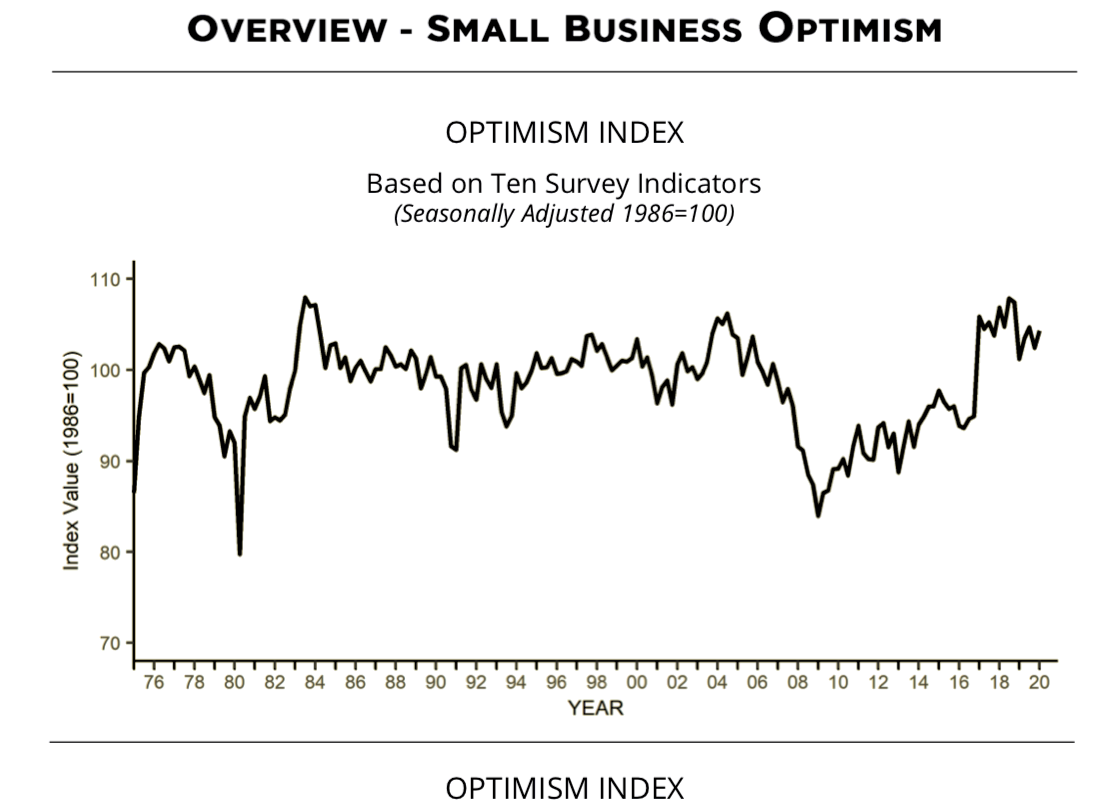
It is true that a new administration inherits economic conditions and policies from its predecessor. Trump inherited an economy that was growing, but there were plenty of strains, including sluggish wage growth, low labor force participation, weak business startups, and a languid housing sector, as this link makes clear. Moreover, economic expansions have lasted an average of only about five years in the post-WW2 era. The current expansion was about 90 months running at the time of Trump’s inauguration, a stage at which vulnerabilities might develop. But new policies often lead to new economic realities. In Trump’s case, that included tax cuts, and especially corporate tax cuts that spurred hiring and wage growth, and more liberalized regulation. Accommodative monetary policy by the Federal Reserve also provided an assist. As the chart at the top shows, Trump’s platform lifted small business enthusiasm considerably, which is a broad indicator of economic vibrancy. Of course, his trade initiatives have probably had negative effects thus far, but his way of negotiating new trade agreements might well end up making a positive contribution, on balance.

Now, the danger of a caronavirus pandemic is presenting major economic challenges. It’s unlikely to produce as many deaths as a bad flu season in the U.S., in part because the Trump Administration took quick action to limit domestic exposure. Nevertheless, the economic consequences of the virus and attempts to control its spread will be significant. At least the economy was strong when the shock occurred, so it is reasonable to expect a rebound if the outbreak runs its course over the next month or two.

The economic record since Trump took office has been impressive given the stage of the business cycle at which he took office. Not only that, but minority wage growth has surged, and minority unemployment has fallen substantially. Let’s face it: Obama and Joe Biden are eager to neutralize any plaudits a strong economy might earn Trump in an election year, but they shouldn’t embarrass themselves by trying to take credit for it, and Chuck Jones could do better than carrying their water.


Follow Sacred Cow Chips on WordPress.com

Recent Posts

  • The Case Against Interest On Reserves
  • Immigration and Merit As Fiscal Propositions
  • Tariff “Dividend” From An Indigent State
  • Almost Looks Like the Fed Has a 3% Inflation Target
  • Government Malpractice Breeds Health Care Havoc

Archives

  • January 2026
  • December 2025
  • November 2025
  • October 2025
  • September 2025
  • August 2025
  • July 2025
  • June 2025
  • May 2025
  • April 2025
  • March 2025
  • February 2025
  • January 2025
  • December 2024
  • November 2024
  • October 2024
  • September 2024
  • August 2024
  • July 2024
  • June 2024
  • May 2024
  • April 2024
  • March 2024
  • February 2024
  • January 2024
  • December 2023
  • November 2023
  • August 2023
  • July 2023
  • June 2023
  • May 2023
  • April 2023
  • March 2023
  • February 2023
  • January 2023
  • December 2022
  • November 2022
  • October 2022
  • September 2022
  • August 2022
  • July 2022
  • June 2022
  • May 2022
  • April 2022
  • March 2022
  • February 2022
  • January 2022
  • December 2021
  • November 2021
  • October 2021
  • September 2021
  • August 2021
  • July 2021
  • June 2021
  • May 2021
  • April 2021
  • March 2021
  • February 2021
  • January 2021
  • December 2020
  • November 2020
  • October 2020
  • September 2020
  • August 2020
  • July 2020
  • June 2020
  • May 2020
  • April 2020
  • March 2020
  • February 2020
  • January 2020
  • December 2019
  • November 2019
  • October 2019
  • September 2019
  • August 2019
  • July 2019
  • June 2019
  • May 2019
  • April 2019
  • March 2019
  • February 2019
  • January 2019
  • December 2018
  • November 2018
  • October 2018
  • September 2018
  • August 2018
  • July 2018
  • June 2018
  • May 2018
  • April 2018
  • March 2018
  • February 2018
  • January 2018
  • December 2017
  • November 2017
  • October 2017
  • September 2017
  • August 2017
  • July 2017
  • June 2017
  • May 2017
  • April 2017
  • March 2017
  • February 2017
  • January 2017
  • December 2016
  • November 2016
  • October 2016
  • September 2016
  • August 2016
  • July 2016
  • June 2016
  • May 2016
  • April 2016
  • March 2016
  • February 2016
  • January 2016
  • December 2015
  • November 2015
  • October 2015
  • September 2015
  • August 2015
  • July 2015
  • June 2015
  • May 2015
  • April 2015
  • March 2015
  • February 2015
  • January 2015
  • December 2014
  • November 2014
  • October 2014
  • September 2014
  • August 2014
  • July 2014
  • June 2014
  • May 2014
  • April 2014
  • March 2014

Blogs I Follow

  • Passive Income Kickstart
  • OnlyFinance.net
  • TLC Cholesterol
  • Nintil
  • kendunning.net
  • DCWhispers.com
  • Hoong-Wai in the UK
  • Marginal REVOLUTION
  • Stlouis
  • Watts Up With That?
  • Aussie Nationalist Blog
  • American Elephants
  • The View from Alexandria
  • The Gymnasium
  • A Force for Good
  • Notes On Liberty
  • troymo
  • SUNDAY BLOG Stephanie Sievers
  • Miss Lou Acquiring Lore
  • Your Well Wisher Program
  • Objectivism In Depth
  • RobotEnomics
  • Orderstatistic
  • Paradigm Library
  • Scattered Showers and Quicksand

Blog at WordPress.com.

Passive Income Kickstart

OnlyFinance.net

TLC Cholesterol

Nintil

To estimate, compare, distinguish, discuss, and trace to its principal sources everything

kendunning.net

The Future is Ours to Create

DCWhispers.com

Hoong-Wai in the UK

A Commonwealth immigrant's perspective on the UK's public arena.

Marginal REVOLUTION

Small Steps Toward A Much Better World

Stlouis

Watts Up With That?

The world's most viewed site on global warming and climate change

Aussie Nationalist Blog

Commentary from a Paleoconservative and Nationalist perspective

American Elephants

Defending Life, Liberty and the Pursuit of Happiness

The View from Alexandria

In advanced civilizations the period loosely called Alexandrian is usually associated with flexible morals, perfunctory religion, populist standards and cosmopolitan tastes, feminism, exotic cults, and the rapid turnover of high and low fads---in short, a falling away (which is all that decadence means) from the strictness of traditional rules, embodied in character and inforced from within. -- Jacques Barzun

The Gymnasium

A place for reason, politics, economics, and faith steeped in the classical liberal tradition

A Force for Good

How economics, morality, and markets combine

Notes On Liberty

Spontaneous thoughts on a humble creed

troymo

SUNDAY BLOG Stephanie Sievers

Escaping the everyday life with photographs from my travels

Miss Lou Acquiring Lore

Gallery of Life...

Your Well Wisher Program

Attempt to solve commonly known problems…

Objectivism In Depth

Exploring Ayn Rand's revolutionary philosophy.

RobotEnomics

(A)n (I)ntelligent Future

Orderstatistic

Economics, chess and anything else on my mind.

Paradigm Library

OODA Looping

Scattered Showers and Quicksand

Musings on science, investing, finance, economics, politics, and probably fly fishing.

  • Subscribe Subscribed
    • Sacred Cow Chips
    • Join 128 other subscribers
    • Already have a WordPress.com account? Log in now.
    • Sacred Cow Chips
    • Subscribe Subscribed
    • Sign up
    • Log in
    • Report this content
    • View site in Reader
    • Manage subscriptions
    • Collapse this bar
 

Loading Comments...