• About

Sacred Cow Chips

Sacred Cow Chips

Tag Archives: Che Guevara

Socialist Supremacy’s Dark History of Culling the Race

26 Wednesday Feb 2020

Posted by Nuetzel in racism, Socialism

≈ Leave a comment

Tags

Adolph Hitler, Che Guevara, Class Struggle, Disparate impact, FEE, Fidel Castro, Foundation for Economic Education, Friedrich Engels, Joseph Stalin, Karl Marx, Liberalism Unrelinquished, Marion Tupy, National Socialism, racism, Sidney and Beatrice Webb, Socialism

Can you think of a social philosophy steeped in many years of blame-making and hatred for “others”, including massive persecution, more than a passing flirtation with racism, and genocide. Why, that would be socialism! Marion Tupy’s 2017 article on racism and socialism at the Foundation for Economic Education (FEE) blog is a good reminder, just in case you know anyone having a romantic fascination with collectivist ideology. I know too many! And if they subscribe to the notion that socialism eschews racism, they are sadly mistaken. In fact, to put it kindly, socialists ultimately eschew anyone standing in their way. Here are a few excerpts from Tupy’s article:

“… Sidney and Beatrice Webb, who were both socialists and eugenicists, bemoaned the falling birthrates among so-called higher races in the New Statesman in 1913. They warned that ‘a new social order [would be] developed by one or other of the colored races, the Negro, the Kaffir or the Chinese’.

Che Guevara, the Argentine revolutionary and friend of the Cuban dictator Fidel Castro, offered his views on race in his 1952 memoir The Motorcycle Diaries, writing, ‘The Negro is indolent and lazy and spends his money on frivolities, whereas the European is forward-looking, organized and intelligent.’ …

In the New York Tribune in 1853, Karl Marx came close to advocating genocide, writing, “The classes and the races, too weak to master the new conditions of life, must give way.” His friend and collaborator, Engels, was more explicit.

In 1849, Engels published an article in Marx’s newspaper, Neue Rheinische Zeitung. In it, Engels condemned the rural populations of the Austrian Empire for failing enthusiastically to partake in the revolution of 1848. …

‘The Austrian Germans and Magyars will be set free and wreak a bloody revenge on the Slav barbarians,’ he continued. ‘The next world war will result in the disappearance from the face of the earth not only of reactionary classes and dynasties, but also of entire reactionary peoples. And that, too, is a step forward.’

Here Engels clearly foreshadows the genocides of the 20th-century totalitarianism in general and the Soviet regime in particular. In fact, Joseph Stalin loved Engels’ article and commended it to his followers in The Foundations of Leninism in 1924. He then proceeded to suppress Soviet ethnic minorities, including the Jews, Crimean Tatars, and Ukrainians.”

As Tupy notes, socialists are given to dressing-up their repressions as “class struggles”, as opposed to racism when it suits them, ideological eliminationism, and genocidal paroxysm. And these fits have often had pronounced “disparate impacts” on ethnic, racial and national minorities. In this sense, Hitler, the national socialist was no exception. Again, from Tupy:

“Hitler’s hatred of the Jews, for example, was partly rooted in his belief that capitalism and international Jewry were two sides of the same coin. As he once famously asked, ‘How, as a socialist, can you not be an anti-Semite?'”

Socialism is not an ideology of “kindness”. As a practical matter, it is an ideology of coercion, control, and extreme inequality of outcomes. It is antithetical to the ideal of personal liberty, not “liberal” in any real sense of the word. It should come as no surprise that the practitioners of socialism have indulged in virulent intolerance and racism. And it’s not simply a matter of “my way or the highway”. It’s often my way or death for those who don’t fall in line, and a highway to hell on earth for those who do.

Bernie Sanders and the Brutal Bros

24 Friday Jan 2020

Posted by Nuetzel in Collectivism, Leftism, Tyranny, Uncategorized

≈ Leave a comment

Tags

Antifa, Barack Obama, Bernie Bros, Bernie Sanders, Black Lives Matter, Che Guevara, David Burge, Fidel Castro, Gulags, Hillary Clinton, Iowahawk, James Hodgekinson, John Hinderaker, Joseph Stalin, Leftism, Mao Zedong, Pol Pot, PowerLineblog.com, Project Veritas, Re-Education, Steve Scalise

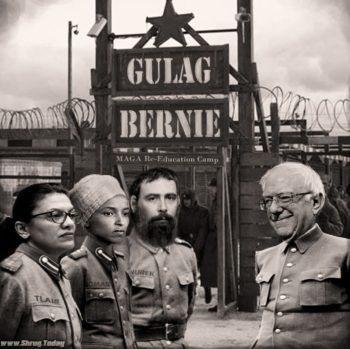
Some of Bernie Sanders’ most devoted fans have an unfortunate brutalitarian streak. The violent strain of so-called Bernie Bros aren’t as isolated as one might hope. First, of course, there was James Hodgkinson, the BB who attempted to assassinate Republican members of Congress at a congressional baseball game practice, seriously injuring Rep. Steve Scalise. Now, campaign field organizers for Sanders in Iowa and South Carolina have been captured on film proposing gulags, re-education camps, sentencing billionaires to hard labor, and shooting or beheading those opposed to Sanders’ policies. And much more. And they say this in all seriousness. What nice people have been assigned positions of responsibility within the Sanders campaign organization! Watch it for yourself at the link above.

Should we be surprised? No: these are advocates of forced collectivism, and if their favorable perspective on coercive power wasn’t enough of a tip-off, recent history suggests that many among them are truly ready and willing to do violence. The brutal and murderous history of collectivist regimes the world over demonstrates the tendency well enough. Stalin, Mao, Pol Pot, Castro and too many other leftist tyrants left bodies strewn in their wake as they sought to enforce their ideology. It’s no coincidence that the American Left holds the murderous Che Guevara in such high esteem. Black Lives Matter and Antifa have both perpetrated violent acts, and members of the Leftist media have openly advocated physical attacks on their political opponents. And then we have these Bernie Bros.

I feel compelled to review a bit of background on Bernie Sanders, the batty old communist who has managed to convince large numbers of poorly educated “intellectuals” that he knows the path to utopia. The nicer ones imagine that he’s a man of the people, though he hasn’t worked a day in his life at anything except agitation and rent seeking. He is an inveterate public mooch. His life history as a politician and as a person is rather unflattering.

I’ve used this Iowahawk (David Burge) quote about Sanders before:

“Who better to get America back to work than a guy who was actually fired from a Vermont hippie commune for being too lazy.”

Apparently, Barack Obama is not a Bernie Bro:

“Obama has told people in private that Sanders is both temperamentally and politically unfit to beat Trump in the 2020 general election, these people say. Among his concerns are Sanders’ strident form of politics and confrontational manners where he was known not to seek compromise during his long years in the US senate.”

And say what you will about Hillary Clinton, but her opinion of Sanders comports with much of what we know about The Bern:

“He was in Congress for years. He had one senator support him. Nobody likes him, nobody wants to work with him, he got nothing done.”

At least the Bernie Bros have taken their masks off before getting too far. Give Leftists power and they all will.

Francis, Papal Perónista, Courts Redistributional Mirage

15 Thursday Mar 2018

Posted by Nuetzel in Markets, Marxism, Redistribution, statism, Welfare State

≈ Leave a comment

Tags

Argentina, Che Guevara, Daniel J. Mitchell, Economic Freedom, Eva Peron, Juan Peron, Judialismo, Maureen Mullarkey, Pope Francis, Property Rights, Robert P. Murphy, Vatican, World Bank, World Poverty

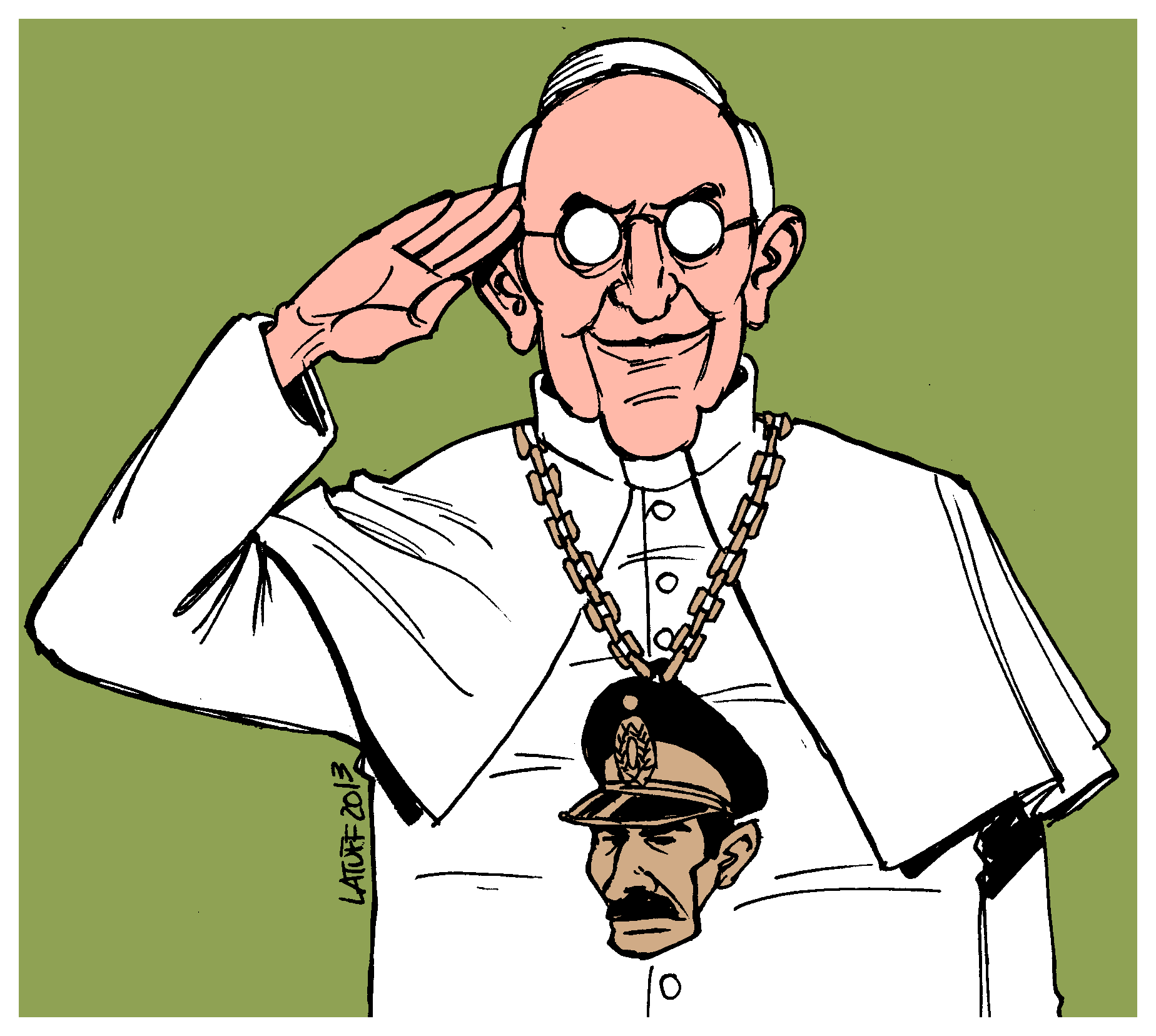
Is world poverty really increasing? Actually, no, quite the opposite, and you can blame economic liberalism, capitalism, and free markets for that. Yet we hear exactly the contrary from Pope Francis who, despite his evident compassion, has an amazingly poor understanding of economics. He misstates basic facts, offers dimly reasoned analyses of human rights, and promotes ill-considered policies. Now that the Vatican is set to release the Pope’s first feature film, no doubt a stirring piece of social justice propaganda, it seems as good a time as any to review the confounded state of Francis’ economic reasoning. This is not the first time I’ve discussed the Pope’s policy views: this link contains three previous posts from SacredCowChips on which Francis was tagged.

The False Narrative

My inspiration for this post comes from Robert P. Murphy, whose recent commentary on Francis’ pronouncements is trenchant. Murphy covers this speech written by Francis for the World Economic Forum, but delivered by a Vatican proxy, in which the Pope asserts the following:

“… governments must confront … the growth of unemployment, the increase in various forms of poverty, the widening of the socio-economic gap and new forms of slavery, often rooted in situations of conflict, migration and various social problems.“

Francis refers to increasing unemployment and poverty, and I could let that phrase pass if he was referring to certain nations or locales that have experienced chronically depressed economic growth. But Francis’ description is rather general, as evidenced by his diagnosis of causes. More on that below. Regarding his statement about trends in poverty, he is flatly incorrect. Here is Murphy:

“As the World Bank reports, the global “extreme poverty” rate in 1990 was cut in half by 2010. Back in 1990, 1.85 billion people lived on less than $1.90 per day, but by 2013, the figure had dropped to 767 million such people—meaning that more than a billion people had been lifted out of crushing poverty.“

After the Great Recession, world unemployment decreased from 2009-2015, according to the World Bank, though it is estimated to have crept up slightly in 2016-17. Again, the Pope’s woeful tale of growing unemployment and increasing poverty is nonsense.

But the world is a difficult place. In the underdeveloped world, the range and quality of goods available is extremely limited, and $1.90 represents bare subsistence, yet it’s a condition that exceeds the historical norm in many places. Movement above that threshold can represent a meaningful improvement in economic well-being.

Francis may lack an appreciation for the general enrichment in material conditions that has been taking place over the last two centuries, which is ongoing, or perhaps he believes that even greater achievements are easily within reach but for certain injustices, though he offers no qualifications. Perhaps he is mistakenly generalizing specific instances of exploitation in the underdeveloped world, which often occur with the explicit blessing of the state apparatus in exchange for kickbacks.

Rights and Markets

Even more egregious is the Pope’s presumption that private markets are at fault for any stagnation that he has identified. A notable difference between countries with successful, growing economies and those mired in stagnation is the degree to which their citizens enjoy freedoms, especially economic freedom. That is a well-established empirical fact, as Murphy explains. But the Pontiff goes further with preposterous dogma on the meaning of human rights. Again, from Murphy:

“Although inspired by concern for the poor and the marginalized, the Vatican’s message is seriously flawed…. On a conceptual level, Pope Francis posits a false dichotomy between economic freedom and human rights. … ‘Economic freedom must not prevail over the practical freedom of man and over his rights, and the market must not be absolute, but honour the exigencies of justice.’ 

What does the concept of “economic freedom” entail? It means freedom to work in any occupation of one’s choice, without permission from the government, and certainly without being conscripted into service against one’s will. It means the freedom to start a business. It means the freedom to keep what you have produced, without having your assets seized by a rapacious regime. It means the freedom to trade with people who live in another country. It means the rule of law, where contracts are interpreted fairly and government officials can’t exercise arbitrary power.“

Economic freedom, more than anything else, means that individuals are endowed with property rights. To deny such rights is to banish any reward for work and differential rewards for work well done. If free individuals are rewarded, it is a matter of their own discretion as to whether they immediately consume the reward or save it in order to accumulate wealth. Yet Francis takes the misanthropic and childish view that economic freedom, private property and markets imply exploitation. He lacks a basic understanding of the revolutionary power of markets as a form of social organization.

Within just a few hundred years, a small fraction of the many millennia during which mankind was mired in poverty and pestilence, markets have dramatically transformed the existence of most human populations. Peaceful, arms length transactions made in mutual self-interest exploit only one thing: gains from trade that would otherwise be wasted. And only a form of social organization that enables those gains can dovetail with the human rights and justice that Francis so strongly desires. The denial of economic freedom, property rights, and self-interest prohibits those gains, however, denying humanity of the wealth necessary to achieve anything like justice.

Pope Francis is a redistributionist, and that goes well beyond the charitable giving, good works and service performed voluntarily by individuals. In fact, he is a statist, advocating an economic system in which property rights are abrogated, wholly or in part, and wages above a politically determined threshold are confiscated.

The Pope and Perón

Francis is often described as a “Perónist”, after Juan Perón of Argentina, the so-called “right-wing socialist” (and sometime associate of the murderous Che Guevara). Anyone familiar with the economic history of Argentina should know that’s not praise. Here is Maureen Mullarkey from the last link:

“Both Juan and Eva understood the enchantments of populism. A charismatic pair, they ruled more by dint of personality—personalismo—than democratic procedure. Ushers of an ‘option for the poor,’ they glorified the lower classes and denigrated the wealthy. (This, while they amassed a huge personal fortune from the Eva Perón Welfare Foundation.) …

When Francis speaks of ‘the people’ as a revolutionary vanguard that ‘overflows the logical procedures of formal democracy,’ he is lapsing toward that ecstatic Peronist vision of a Third Way—justicialismo. That the disposition and design of it ended in economic collapse and misery is nothing against the splendor of the mystique.

In his youth, Francis absorbed the myth but not its lessons. Chief among them is how much Argentina’s fiscal catastrophe owed to an extravagant welfare system that favored enforced wealth redistribution over development. Among the many factors of Argentina’s historic economic crisis, one cries for attention: Perón’s increasing reliance on redistributing income, not only between industries and occupations but between skilled and unskilled workers.“

For further perspective on Francis, Perónism, and the disastrous Argentine “experiment”, see this piece by Daniel J. Mitchell.

For many years, naive Marxists have accepted the myth that central economic planners could and would direct productive and distributional activities with foresight, efficiency, and integrity. None of those is possible. The only form of social organization capable of registering and processing the myriad and dynamic signals on preferences and scarcity is free market capitalism. It is the only system capable of spontaneously harnessing appropriate responses based on the complex incentives faced by consumers and producers, and all at a minimal administrative cost for society, free of the government intervention that typifies the Peronist welfare state and corporatism.

Conclusion

Pope Francis should know better than to make claims having no empirical support. He should also have the wisdom to understand and advocate for the empowering nature of private property rights and markets. Elevating the human condition is possible only by allowing people to be free — economically free — and endowed with opportunities to earn private rewards and build wealth. Francis should realize that the massive private gains afforded by the market mechanism enable rewards which spill over, inuring to the benefit of parties external to a given exchange. On the other hand, state domination and control of economic activity gives over decision-making to selfish and ill-informed public commandants, who are all too pleased to grant special advantages to those in a position to return private favors. Such graft and mismanagement of resources comes at the expense of others. That way lies decay and a return to the much more brutal conditions of the past, unlike the mutually beneficial promise of market exchange.

Art and Its Political Hijacking

15 Friday Dec 2017

Posted by Nuetzel in Art & Politics

≈ Leave a comment

Tags

Annie, Art for Art's Sake, Bob Weir, Che Guevara, Edgar Allan Poe, Hamilton The Musical, John Perry Barlow, Joseph Campbell, Karl Marx, Pareto-Improvement, Tendentious Art, The Grateful Dead, The Music Never Stopped

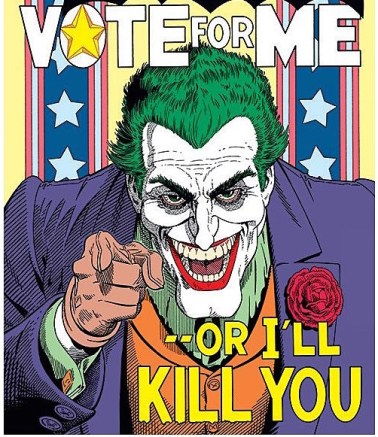
Art and politics have a long connection that is often quite awkward. One philosophy holds that art cannot be divorced from its social origins, that it is a legitimate platform from which to confront injustice and oppression, and indeed, that art must “serve some moral or didactic purpose”. In the nineteenth century, the contrary view was expressed by the phrase “art for art’s sake“, which has been credited to several individuals including Edgar Allen Poe. At the time, Marxists said the slogan served to prop-up the “petty bourgeois”, as if artistic beauty and exploration must themselves be inspired by political interests. Exploiting art to promote a point of view is not the exclusive domain of the Left, however. The Right has its own variations on political expression through art. But all such varieties on the Left and Right make me cringe just a bit; I cringe even when the intent of art is to promote views with which I strongly agree.

Art and Advocacy

Great art derives from an amorphous combination of talent, certain acquired technical skills, and inspiration. Inspiration can come from anything that might be, strictly speaking, non-art, such as natural beauty, any kind of human drama, the spiritual, or even politics. While many of us can agree that certain artistic works are great, it will always be a subjective matter to one degree or another.

Art may cross subjective boundaries of propriety, and it may offend. No matter the specific topic or the intent, art becomes confrontational and political when some parties object to whatever is portrayed, and especially when attempts are made to suppress it. A work of art is tendentious if the intent is to promote a political viewpoint or a policy, either as a matter of protest or when it is used by either the state or “subversive elements” in an effort to propagandize. It ranges from state-sponsored “artistic” propaganda to private but jingoistic expression, to “protest art”, and to any kind of politically-motivated art.

Obviously, tendentious art can be good from a purely technical perspective even while the subject matter is unappealing to a particular observer. As well, TA can appeal to the emotions effectively, and it can be interesting as a sociological exercise. However, art can portray conditions, dire or otherwise, and appeal to emotions without advocating social policy, and art can be abstract and devoid of any political implication whatsoever.

Even worse than tendentious art are attempts to either censor it or subsidize it. May tendentious art live on as a tool in the marketplace of ideas, free of government involvement. However, on the whole, public or private, I find it unappealing.

Why I’m Averse to Tendentious Art 

Here are several propositions about tendentious art (TA) to which I subscribe. They are overlapping to some extent, and I emphasize they are often matters of degree rather than kind:

  1. It compromises artistic standards;
  2. Persuasion is its purpose, making art subsidiary to the politics;
  3. It demotes art to a tool of delivery, subservient to the message;
  4. TA exploits art for political purposes;
  5. Art often functions as a refuge or escape; TA cannot;
  6. TA is often angry;
  7. the appeal of TA is often self-reverential;
  8. It confuses artistic value and political “virtue”;
  9. practitioners of TA often engage in willful historical distortion;
  10. TA can be self-antiquating;
  11. TA often recycles and co-opts existing art;
  12. It is never Pareto-improving.

I’ll elaborate on some of these points:

TA demotes the art part: To the extent that the art and the political message are separable, art becomes subsidiary to the message, and that is almost always true when the message is explicit. In fact, art becomes a mere conveyance.

Artistic compromise: Your political message does not make you an artist. This is worth extra emphasis in the age of the meme and the meme “artist”. I’ve seen what I consider bad art. I’ve seen a great deal of bad TA. It is as if the artist can be forgiven for an unimpressive artistic effort so long as the message is valued by like-minded partisans. In this way, TA creates confusion over artistic value relative to political “virtue”.

Politics attempts to exploit art: I am appalled at the recent treatment of certain celebrities, artists or otherwise, who are facing demands to publicly state their political views, to support or denounce this or that person or policy. Whether or not one’s work intersects with the political sphere should be up to the artist. It is within one’s rights to be apolitical.

TA is Pareto-violating: Tendentiousness makes art unappealing to certain observers, and that might even be what the artist intends. A particular policy position embodied in TA, if adopted, might actually be threatening to some individuals in terms of their economic welfare or personal liberties. Even worse, extreme forms of TA might serve to incite violent action (free speech demands that government may not engage in “prior restraint”). The point I’m making here is distinct from any issues posed by physical presentation, such as high volume or lighting, that might make a third-party worse off.

In economics, exchange is said to be Pareto-improving if two trading parties are made better-off while no one is made worse off. Of course, one can always ignore certain forms of art, or one can try to if its expression is non-threatening. But someone may well be made worse-off by an exercise of TA, and in a value-free sense, that makes TA inferior to other art.

Trapped like a rat: TA tends to be ineffective as a refuge or escape, no matter how cathartic some might find the message. The observer is bound by the political reality and the conflict it implies. Art doesn’t have to transcend reality to serve as an escape, but it can transcend explicit advocacy.

Your art and your virtue: I don’t think it’s unfair to say that an observer who enjoys tendentious art indulges in a pleasure that is strongly self-reverential. They feel virtuous, and that is the wrong sentiment to derive from art. TA derives some of its value and power by stroking the ego of the observer.

Distorting history: I have seen many examples of inaccurate historical accounts in theatre and elsewhere. The musical Hamilton is prominent in this respect. The musical Annie has its share of distortions regarding the largely similar policies of Herbert Hoover and Franklin Delano Roosevelt. Che Guevara is sometimes depicted in art as heroic, yet he was murderous, misogynistic, and tyrannical. Got any Stalin shirts? I could go on….

TA can get stale: In some circumstances, TA can make art self-antiquating: captive to the time in which it is created and reducing its relevance as times change, especially if the artist is on the losing side of the politics.

What Prompted This? A Band Beyond Description

This post was motivated by my observation of comments on “fan pages” to which I belong on-line. I’ve been an avid follower of a certain group of musicians over the years, and these fan pages give me an opportunity to interact with other enthusiasts, view concert video, and get news about the band. The fans tend to be affable and we share a certain cultural zeitgeist. However, there is division on these pages over politics, and while I’d describe many of the fans as leftist, there is more diversity of opinion than one might guess. One fan page actually has a “no politics” rule, as it’s proven to create unwelcome strife on other pages. I believe the page administrators are correct in viewing politics as “off-topic”. That is not censorship; it is private governance — house rules, as it were, to which I can’t object. Some fans just can’t help violating the rule, however. There, and on other fan pages, a significant segment of fans seem to believe that one cannot really “get” the band and their music without sharing certain political opinions. That doesn’t surprise me, but I dislike the “groupthink” attitude it reflects.

I realized early-on that the band tended to avoid tendentious art, greatly to their credit. Their music often focuses on traditional themes like love, love lost, celebration, the human condition, and many fascinating stories populated with colorful characters. They even cover some biblical topics that are just great stories. Other frequent musical themes are quite abstract, by turns sinister and dreamy.

There is no doubt that the members of the band have opinions about politics. They have supported a number of causes such as the anti-war movement, ending the drug war, environmental causes, and gay rights. But I believe they have intentionally avoided explicit advocacy in their music. They tend not to use the stage as a pulpit, except generally as a pulpit of musical celebration and fun. They sing sweetly (mostly) and they can rock!

Again, the distinctions I’m making are matters of degree. For example, occasionally the group plays concerts to benefit causes or even candidates for office. That’s fine. I might not support their candidate, or I might disagree with a policy position, but that sort of explicit advocacy seldom if ever intersects with their music. It imposes little or nothing on me.

The band has written and performed a few songs expressing concerns that I don’t fully share. In my opinion (in seeming violation of some of the principles I listed above), I consider those songs to be great from a purely musical perspective; the lyrics are well-turned; and they tend to reveal general sentiment and anxiety about things we’d all like to resolve, rather than direct advocacy of specific policies. I like those songs, though I might disagree with the policy prescriptions of the musicians themselves. In any case, they don’t claim technical expertise in those subject areas. I like their art and don’t really care about their policy preferences, unless they rub my nose in them. But they don’t.

Again, while these are matters of degree, this band has always tended not to use their music as a political soapbox. Perhaps the band’s greatest luminary once said the following:

“You need music, I don’t know why. It’s probably one of those Joe Campbell questions [who said, ‘Follow your bliss.’], why we need ritual. We need magic, and bliss, and power, myth, and celebration and religion in our lives, and music is a good way to encapsulate a lot of it.“

Denouement

My admittedly subjective opinion is that the explicit messaging of tendentious art cheapens artistic expression in several ways: it demotes art in favor of political messaging; it subverts the role of art as an escape; it may be inferior by making third-parties worse off; its enjoyment is something of a self-reverential exercise; it confuses artistic value with political “virtue”; it makes art less durable to the extent that the message it embodies may become less relevant with time; and it is usually angry.

The band I’ve referenced in this discussion is the Grateful Dead. I’ll continue to celebrate their great music with anyone who appreciates it as music. (The name of the band originally appealed to the group partly because it seemed somewhat repellent to conformists. That’s a bit confrontational, perhaps, but the name is folkloric.) Their politics don’t much matter to me because I believe they are artists first. They have kept their art largely free of politics.

I close with lyrics to a Grateful Dead song about music and it’s effect on the human spirit, written by John Perry Barlow and Bob Weir. It is non-tendentious:

The Music Never Stopped

[First voice]
There’s mosquitoes on the river
Fish are rising up like birds
It’s been hot for seven weeks now
Too hot to even speak now
Did you hear what I just heard?

Say, it might have been a fiddle
Or it could have been the wind
But there seems to be a beat now
I can feel it in my feet now
Listen here it comes again

[Second voice]
There’s a band out on the highway
They’re high-stepping into town

It’s a rainbow full of sound
It’s fireworks, calliopes and clowns
Everybody’s dancing

[First voice]
Come on children, come on children
Come on clap your hands

The sun went down in honey
And the moon came up in wine
You know stars were spinning dizzy
Lord the band kept us so busy
We forgot about the time

They’re a band beyond description
Like Jehovah’s favorite choir
People joining hand in hand
While the music plays the band
Lord they’re setting us on fire

Crazy rooster crowing midnight
Balls of lightning roll along
Old men sing about their dreams
Women laugh and children scream
And the band keeps playing on

[Second voice]
Keep on dancing through to daylight
Greet the morning air with song
No one’s noticed but the band’s all packed and gone
Was it ever here at all?
But they kept on dancing

[First voice]
Come on children, come on children
Come on clap your hands

Well the cool breeze came on Tuesday
And the corn’s a bumper crop
And the fields are full of dancing
Full of singing and romancing
The music never stopped

Follow Sacred Cow Chips on WordPress.com

Recent Posts

  • Immigration and Merit As Fiscal Propositions
  • Tariff “Dividend” From An Indigent State
  • Almost Looks Like the Fed Has a 3% Inflation Target
  • Government Malpractice Breeds Health Care Havoc
  • A Tax On Imports Takes a Toll on Exports

Archives

  • December 2025
  • November 2025
  • October 2025
  • September 2025
  • August 2025
  • July 2025
  • June 2025
  • May 2025
  • April 2025
  • March 2025
  • February 2025
  • January 2025
  • December 2024
  • November 2024
  • October 2024
  • September 2024
  • August 2024
  • July 2024
  • June 2024
  • May 2024
  • April 2024
  • March 2024
  • February 2024
  • January 2024
  • December 2023
  • November 2023
  • August 2023
  • July 2023
  • June 2023
  • May 2023
  • April 2023
  • March 2023
  • February 2023
  • January 2023
  • December 2022
  • November 2022
  • October 2022
  • September 2022
  • August 2022
  • July 2022
  • June 2022
  • May 2022
  • April 2022
  • March 2022
  • February 2022
  • January 2022
  • December 2021
  • November 2021
  • October 2021
  • September 2021
  • August 2021
  • July 2021
  • June 2021
  • May 2021
  • April 2021
  • March 2021
  • February 2021
  • January 2021
  • December 2020
  • November 2020
  • October 2020
  • September 2020
  • August 2020
  • July 2020
  • June 2020
  • May 2020
  • April 2020
  • March 2020
  • February 2020
  • January 2020
  • December 2019
  • November 2019
  • October 2019
  • September 2019
  • August 2019
  • July 2019
  • June 2019
  • May 2019
  • April 2019
  • March 2019
  • February 2019
  • January 2019
  • December 2018
  • November 2018
  • October 2018
  • September 2018
  • August 2018
  • July 2018
  • June 2018
  • May 2018
  • April 2018
  • March 2018
  • February 2018
  • January 2018
  • December 2017
  • November 2017
  • October 2017
  • September 2017
  • August 2017
  • July 2017
  • June 2017
  • May 2017
  • April 2017
  • March 2017
  • February 2017
  • January 2017
  • December 2016
  • November 2016
  • October 2016
  • September 2016
  • August 2016
  • July 2016
  • June 2016
  • May 2016
  • April 2016
  • March 2016
  • February 2016
  • January 2016
  • December 2015
  • November 2015
  • October 2015
  • September 2015
  • August 2015
  • July 2015
  • June 2015
  • May 2015
  • April 2015
  • March 2015
  • February 2015
  • January 2015
  • December 2014
  • November 2014
  • October 2014
  • September 2014
  • August 2014
  • July 2014
  • June 2014
  • May 2014
  • April 2014
  • March 2014

Blogs I Follow

  • Passive Income Kickstart
  • OnlyFinance.net
  • TLC Cholesterol
  • Nintil
  • kendunning.net
  • DCWhispers.com
  • Hoong-Wai in the UK
  • Marginal REVOLUTION
  • Stlouis
  • Watts Up With That?
  • Aussie Nationalist Blog
  • American Elephants
  • The View from Alexandria
  • The Gymnasium
  • A Force for Good
  • Notes On Liberty
  • troymo
  • SUNDAY BLOG Stephanie Sievers
  • Miss Lou Acquiring Lore
  • Your Well Wisher Program
  • Objectivism In Depth
  • RobotEnomics
  • Orderstatistic
  • Paradigm Library
  • Scattered Showers and Quicksand

Blog at WordPress.com.

Passive Income Kickstart

OnlyFinance.net

TLC Cholesterol

Nintil

To estimate, compare, distinguish, discuss, and trace to its principal sources everything

kendunning.net

The Future is Ours to Create

DCWhispers.com

Hoong-Wai in the UK

A Commonwealth immigrant's perspective on the UK's public arena.

Marginal REVOLUTION

Small Steps Toward A Much Better World

Stlouis

Watts Up With That?

The world's most viewed site on global warming and climate change

Aussie Nationalist Blog

Commentary from a Paleoconservative and Nationalist perspective

American Elephants

Defending Life, Liberty and the Pursuit of Happiness

The View from Alexandria

In advanced civilizations the period loosely called Alexandrian is usually associated with flexible morals, perfunctory religion, populist standards and cosmopolitan tastes, feminism, exotic cults, and the rapid turnover of high and low fads---in short, a falling away (which is all that decadence means) from the strictness of traditional rules, embodied in character and inforced from within. -- Jacques Barzun

The Gymnasium

A place for reason, politics, economics, and faith steeped in the classical liberal tradition

A Force for Good

How economics, morality, and markets combine

Notes On Liberty

Spontaneous thoughts on a humble creed

troymo

SUNDAY BLOG Stephanie Sievers

Escaping the everyday life with photographs from my travels

Miss Lou Acquiring Lore

Gallery of Life...

Your Well Wisher Program

Attempt to solve commonly known problems…

Objectivism In Depth

Exploring Ayn Rand's revolutionary philosophy.

RobotEnomics

(A)n (I)ntelligent Future

Orderstatistic

Economics, chess and anything else on my mind.

Paradigm Library

OODA Looping

Scattered Showers and Quicksand

Musings on science, investing, finance, economics, politics, and probably fly fishing.

  • Subscribe Subscribed
    • Sacred Cow Chips
    • Join 128 other subscribers
    • Already have a WordPress.com account? Log in now.
    • Sacred Cow Chips
    • Subscribe Subscribed
    • Sign up
    • Log in
    • Report this content
    • View site in Reader
    • Manage subscriptions
    • Collapse this bar
 

Loading Comments...