• About

Sacred Cow Chips

Sacred Cow Chips

Tag Archives: East Anglia University

Climate Change, Hurricanes and Noisy Statistics

22 Friday Sep 2017

Posted by Nuetzel in Global Warming

≈ Leave a comment

Tags

AGW, Atlantic Multi-Decadal Oscillation, Climate Change, Cool the Past, East Anglia University, El Nino, Fabius Maximus, global warming, Hurricane Harvey, Hurricane Irma, Hurricane Maria, Michael Mann, NOAA, Roger Pielke Sr, Roy Spencer, Ryan Maue, Sea Surface Temperatures, Signal-to-Noise, Statistical Noise, Storm Intensity, Watt's Up With That?
IMG_4919

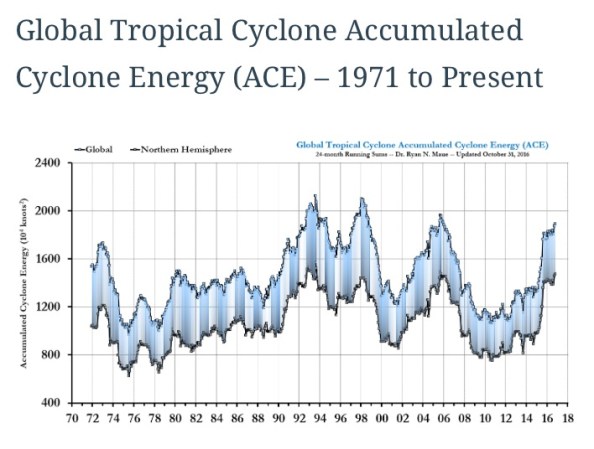
The nasty spate of hurricanes this year has been a catch-up of sorts following a decade of subdued activity. In fact, global hurricane activity has been flat to declining in frequency since 1970. Until the recent increase, hurricane activity had been trending down in terms of 24-month cumulative energy since the 1990s, as the chart above shows. The historical data on the number of U.S. landfalls extends back to 1900, and it has had a negative trend as well. Nevertheless, we hear from climate alarmists that Hurricanes Harvey and Irma, which ended a drought of record length in U.S hurricane landfalls, and now presumably Maria, were a consequence of anthropomorphic global warming (AGW), er… climate change.

The implication is that increases in the atmospheric concentration of CO2 led to these hurricanes or their high intensity. Apparently, the paucity of hurricane activity over the previous ten years can be waved off as a fluke. A further implication of the alarmist view is that the longer negative trends in hurricane frequency and energy can be ignored in the context of any relation to CO2 concentration. But how so? One confounding factor I’ve seen mentioned blames El Nino warming in the Pacific, and a consequent increase in Atlantic wind shear, for the long lull in activity after 2005. That has a ring of plausibility, but a closer look reveals that actual El Nino activity during those years was hardly impressive, with the exception of 2015-16.

More historical data can be seen in the charts on the tropical cyclone page on the Watts Up With That? blog. (The charts in question start about two-thirds of the way down the page.) Hurricane expert Ryan Maue compiled a number of these charts, including the one above. He authored an editorial in the Wall Street Journal this week bemoaning the climate-change hype surrounding Harvey and Irma (if the link doesn’t work, it is available at the WSJ’s Opinion page on Facebook, posted on 9/17). Maue believes that both the climate science community and the media share in the blame for that hype. But he also says the following:

“Although a clear scientific consensus has emerged over the past decade that climate change influences hurricanes in the long run, its effect upon any individual storm is unclear.“

Maue provides a link to this NOAA web site offering cautious support for the proposition that there is a link between global warming and hurricane intensity, though the data it cites ends about ten years ago, so it does not capture the recent lull. Also, some of the information it provides is based on modeled global temperatures and hurricane activity through 2100. As is well-known by now, or should be, long-term climate forecasts based on carbon forcings are notoriously inaccurate, and NOAA admits that the association between those predicted temperatures and future hurricanes is tenuous:

“It is premature to conclude that human activities–and particularly greenhouse gas emissions that cause global warming–have already had a detectable impact on Atlantic hurricane or global tropical cyclone activity.“

Perhaps the idea that there is consensus regarding the relationship between climate change and hurricanes is more of a stretch than Maue and NOAA let on. Here is a summary of 30 peer-reviewed studies showing no connection to either hurricane frequency or intensity. Most of these studies are more recent than the end of the data record cited by NOAA. And in fact, many of these studies find support for a negative link between global temperatures and hurricane activity.

One of the prominent alarmists in the climate research community is Penn State’s Michael Mann, who has famously claimed that hurricanes are more frequent now than at any time in the past 1,000 years. He based his conclusions on highly speculative hurricane “proxies” identified in layers of sediment. Mann’s claims and research technique have been called into questioned by other climate scientists, who have arrived at contrary results in their own research. Lest anyone forget, Mann was implicated in a  data manipulation fraud related to the East Anglia climate scandal. Though cleared by a group of tenured professors at his own university, there are a number of climate scientists who believe Mann violated scientific standards.

The claim that global warming will cause hurricanes to become increasingly intense relies on elevated sea surface temperatures. This year, temperatures in the Gulf of Mexico are elevated and are said to have had a role in strengthening Harvey as it approached the Gulf Coast. Texas, however, has experienced as many landfalls of major hurricanes with cooler Gulf waters as with warmer waters. And Irma strengthened in a part of the Atlantic without such warm temperatures. Instead, minimal wind shear was implicated as a factor contributing to Irma’s strength.

In general, Atlantic temperatures have been relatively warm since the late 1990s, a fact that most scientists would at least partially attribute to the “Atlantic multi-decadal oscillation“, a regular cycle in water temperatures that repeats with a period of multiple decades. Potentially adding to that temperature increase is a controversial change in NOAA’s calibration of sea surface temperatures, as an increasing share of those readings are taken from buoys rather than ship-board measurement. There is some suspicion that NOAA’s adjustments “cool the past” more than is justified, a suspicion that was heightened by allegations from one whistle-blowing NOAA scientist early this year. Then, there is the contention that the sea surface temperature makes little difference if it is matched by an increase in air temperature.

Overall, NOAA says the combination of frequency and intensity of tropical cyclones will increase by 2%-11% over the rest of this century. As Roy Spencer notes, that is not a terribly alarming figure given the risks people have always willingly accepted by living in coastal areas. In any case, the range is based on models of climate behavior that are of questionable reliability. And like past temperature predictions produced by carbon-forcing climate models, it is likely to be a gross overestimate. Here is Roger Pielke, Sr., who is quoted in this wide-ranging post on hurricanes and climate at the Fabius Maximus web site:

“Model projections of hurricane frequency and intensity are based on climate models. However, none have shown skill at predicting past (as hindcasts) variations in hurricane activity (or long term change in their behavior) over years, decades, and longer periods. Thus, their claim of how they will change in the future remains, at most, a hypothesis (i.e. speculation). When NOAA, IPCC and others communicate to the media and public, to be scientifically honest, they should mention this.”

Despite the spike in activity this year, strong hurricanes are intermittent and fairly rare. Establishing reliable statistical connections with other forces is difficult with emergent events like hurricanes. Moreover, the degree of error in measuring global or regional temperature itself is much larger than is generally acknowledged, and the global warming “signal” is very weak. As we say in the statistical analysis business, noisy data are compatible with diverse hypotheses. The relationship between hurricanes and climate change is a prime example.

Playing Pretend Science Over Cocktails

13 Thursday Apr 2017

Posted by Nuetzel in Global Warming

≈ 2 Comments

Tags

97% Consensus, AGW, Carbon Forcing Models, Climate Feedbacks, CO2 and Greening, East Anglia University, Hurricane Frequency, Judith Curry, Matt Ridley, NOAA, Paleoclimate, Peer Review Corruption, Ross McKitrick, Roy Spencer, Sea Levels, Steve McIntyre, Temperature Proxies, Urbanization Bias

It’s a great irony that our educated and affluent classes have been largely zombified on the subject of climate change. Their brainwashing by the mainstream media has been so effective that these individuals are unwilling to consider more nuanced discussions of the consequences of higher atmospheric carbon concentrations, or any scientific evidence to suggest contrary views. I recently attended a party at which I witnessed several exchanges on the topic. It was apparent that these individuals are conditioned to accept a set of premises while lacking real familiarity with supporting evidence. Except in one brief instance, I avoided engaging on the topic, despite my bemusement. After all, I was there to party, and I did!

The zombie alarmists express their views within a self-reinforcing echo chamber, reacting to each others’ virtue signals with knowing sarcasm. They also seem eager to avoid any “denialist” stigma associated with a contrary view, so there is a sinister undercurrent to the whole dynamic. These individuals are incapable of citing real sources and evidence; they cite anecdotes or general “news-say” at best. They confuse local weather with climate change. Most of them haven’t the faintest idea how to find real research support for their position, even with powerful search engines at their disposal. Of course, the search engines themselves are programmed to prioritize the very media outlets that profit from climate scare-mongering. Catastrophe sells! Those media outlets, in turn, are eager to quote the views of researchers in government who profit from alarmism in the form of expanding programs and regulatory authority, as well as researchers outside of government who profit from government grant-making authority.

The Con in the “Consensus”

Climate alarmists take assurance in their position by repeating the false claim that  97% of climate scientists believe that human activity is the primary cause of warming global temperatures. The basis for this strong assertion comes from an academic paper that reviewed other papers, the selection of which was subject to bias. The 97% figure was not a share of “scientists”. It was the share of the selected papers stating agreement with the anthropomorphic global warming (AGW) hypothesis. And that figure is subject to other doubts, in addition to the selection bias noted above: the categorization into agree/disagree groups was made by “researchers” who were, in fact, environmental activists, who counted several papers written by so-called “skeptics” among the set that agreed with the strong AGW hypothesis. So the “97% of scientists” claim is a distortion of the actual findings, and the findings themselves are subject to severe methodological shortcomings. On the other hand, there are a number of widely-recognized, natural reasons for climate change, as documented in this note on 240 papers published over just the first six months of 2016.

Data Integrity

It’s rare to meet a climate alarmist with any knowledge of how temperature data is actually collected. What exactly is the “global temperature”, and how can it be measured? It is a difficult undertaking, and it wasn’t until 1979 that it could be done with any reliability. According to Roy Spencer, that’s when satellite equipment began measuring:

“… the natural microwave thermal emissions from oxygen in the atmosphere. The intensity of the signals these microwave radiometers measure at different microwave frequencies is directly proportional to the temperature of different, deep layers of the atmosphere.“

Prior to the deployment of weather satellites, and starting around 1850, temperature records came only from surface temperature readings. These are taken at weather stations on land and collected at sea, and they are subject to quality issues that are generally unappreciated. Weather stations are unevenly distributed and they come and go over time; many of them produce readings that are increasingly biased upward by urbanization. Sea surface temperatures are collected in different ways with varying implications for temperature trends. Aggregating these records over time and geography is a hazardous undertaking, and these records are, unfortunately, the most vulnerable to manipulation.

The urbanization bias in surface temperatures is significant. According to this paper by Ross McKitrick, the number of weather stations counted in the three major global temperature series declined by more than 4,500 since the 1970s (over 75%), and most of those losses were rural stations. From McKitrick’s abstract:

“The collapse of the sample size has increased the relative fraction of data coming from airports to about 50% (up from about 30% in the late 1970s). It has also reduced the average latitude of source data and removed relatively more high altitude monitoring sites. Oceanic data are based on sea surface temperature (SST) instead of marine air temperature (MAT)…. Ship-based readings changed over the 20th century from bucket-and-thermometer to engine-intake methods, leading to a warm bias as the new readings displaced the old.“

Think about that the next time you hear about temperature records, especially NOAA reports on a “new warmest month on record”.

Data Manipulation

It’s rare to find alarmists having any awareness of the scandal at East Anglia University, which involved data falsification by prominent members of the climate change “establishment”. That scandal also shed light on corruption of the peer-review process in climate research, including a bias against publishing work skeptical of the accepted AGW narrative. Few are aware now of a very recent scandal involving manipulation of temperature data at NOAA in which retroactive adjustments were applied in an effort to make the past look cooler and more recent temperatures warmer. There is currently an FOIA outstanding for communications between the Obama White House and a key scientist involved in the scandal. Here are Judith Curry’s thoughts on the NOAA temperature manipulation.

Think about all that the next time you hear about temperature records, especially NOAA reports on a “new warmest month on record”.

Other Warming Whoppers

Last week on social media, I noticed a woman emoting about the way hurricanes used to frighten her late mother. This woman was sharing an article about the presumed negative psychological effects that climate change was having on the general public. The bogus premises: we are experiencing an increase in the frequency and severity of storms, that climate change is causing the storms, and that people are scared to death about it! Just to be clear, I don’t think I’ve heard much in the way of real panic, and real estate prices and investment flows don’t seem to be under any real pressure. In fact, the frequency and severity of severe weather has been in decline even as atmospheric carbon concentrations have increased over the past 50 years.

I heard another laughable claim at the party: that maps are showing great areas of the globe becoming increasingly dry, mostly at low latitudes. I believe the phrase “frying” was used. That is patently false, but I believe it’s another case in which climate alarmists have confused model forecasts with fact.

The prospect of rising sea levels is another matter that concerns alarmists, who always fail to note that sea levels have been increasing for a very long time, well before carbon concentrations could have had any impact. In fact, the sea level increases in the past few centuries are a rebound from lows during the Little Ice Age, and levels are now back to where the seas were during the Medieval Warm Period. But even those fluctuations look minor by comparison to the increases in sea levels that occurred over 8,000 years ago. Sea levels are rising at a very slow rate today, so slowly that coastal construction is proceeding as if there is little if any threat to new investments. While some of this activity may be subsidized by governments through cheap flood insurance, real money is on the line, and that probably represents a better forecast of future coastal flooding than any academic study can provide.

Old Ideas Die Hard

Two enduring features of the climate debate are 1) the extent to which so-called “carbon forcing” models of climate change have erred in over-predicting global temperatures, and 2) the extent to which those errors have gone unnoticed by the media and the public. The models have been plagued by a number of issues: the climate is not a simple system. However, one basic shortcoming has to do with the existence of strong feedback effects: the alarmist community has asserted that feedbacks are positive, on balance, magnifying the warming impact of a given carbon forcing. In fact, the opposite seems to be true: second-order responses due to cloud cover, water vapor, and circulation effects are negative, on balance, at least partially offsetting the initial forcing.

Fifty Years Ain’t History

One other amazing thing about the alarmist position is an insistence that the past 50 years should be taken as a permanent trend. On a global scale, our surface temperature records are sketchy enough today, but recorded history is limited to the very recent past. There are recognized methods for estimating temperatures in the more distant past by using various temperature proxies. These are based on measurements of other natural phenomenon that are temperature-sensitive, such as ice cores, tree rings, and matter within successive sediment layers such as pollen and other organic compounds.

The proxy data has been used to create temperature estimates into the distant past. A basic finding is that the world has been this warm before, and even warmer, as recently as 1,000 years ago. This demonstrates the wide range of natural variation in the climate, and today’s global temperatures are well within that range. At the party I mentioned earlier, I was amused to hear a friend say, “Ya’ know, Greenland isn’t supposed to be green”, and he meant it! He is apparently unaware that Greenland was given that name by Viking settlers around 1000 AD, who inhabited the island during a warm spell lasting several hundred years… until it got too cold!

Carbon Is Not Poison

The alarmists take the position that carbon emissions are unequivocally bad for people and the planet. They treat carbon as if it is the equivalent of poisonous air pollution. The popular press often illustrates carbon emissions as black smoke pouring from industrial smokestacks, but like oxygen, carbon dioxide is a colorless gas and a gas upon which life itself depends.

Our planet’s vegetation thrives on carbon dioxide, and increasing carbon concentrations are promoting a “greening” of the earth. Crop yields are increasing as a result; reforestation is proceeding as well. The enhanced vegetation provides an element of climate feedback against carbon “forcings” by serving as a carbon sink, absorbing increasing amounts of carbon and converting it to oxygen.

Matt Ridley has noted one of the worst consequences of the alarmists’ carbon panic and its influence on public policy: the vast misallocation of resources toward carbon reduction, much of it dedicated to subsidies for technologies that cannot pass economic muster. Consider that those resources could be devoted to many other worthwhile purposes, like bringing electric power to third-world families who otherwise must burn dung inside their huts for heat; for that matter, perhaps the resources could be left under the control of taxpayers who can put it to the uses they value most highly. The regulatory burdens imposed by these policies on carbon-intensive industries represent lost output that can’t ever be recouped, and all in the service of goals that are of questionable value. And of course, the anti-carbon efforts almost certainly reflect a diversion of resources to the detriment of more immediate environmental concerns, such as mitigating truly toxic industrial pollutants.

The priorities underlying the alarm over climate change are severely misguided. The public should demand better evidence than consistently erroneous model predictions and manipulated climate data. Unfortunately, a media eager for drama and statism is complicit in the misleading narrative.

FYI: The cartoon at the top of this post refers to the climate blog climateaudit.org. The site’s blogger Steve McIntyre did much to debunk the “hockey stick” depiction of global temperature history, though it seems to live on in the minds of climate alarmists. McIntyre appears to be on an extended hiatus from the blog.

Follow Sacred Cow Chips on WordPress.com

Recent Posts

  • The Case Against Interest On Reserves
  • Immigration and Merit As Fiscal Propositions
  • Tariff “Dividend” From An Indigent State
  • Almost Looks Like the Fed Has a 3% Inflation Target
  • Government Malpractice Breeds Health Care Havoc

Archives

  • January 2026
  • December 2025
  • November 2025
  • October 2025
  • September 2025
  • August 2025
  • July 2025
  • June 2025
  • May 2025
  • April 2025
  • March 2025
  • February 2025
  • January 2025
  • December 2024
  • November 2024
  • October 2024
  • September 2024
  • August 2024
  • July 2024
  • June 2024
  • May 2024
  • April 2024
  • March 2024
  • February 2024
  • January 2024
  • December 2023
  • November 2023
  • August 2023
  • July 2023
  • June 2023
  • May 2023
  • April 2023
  • March 2023
  • February 2023
  • January 2023
  • December 2022
  • November 2022
  • October 2022
  • September 2022
  • August 2022
  • July 2022
  • June 2022
  • May 2022
  • April 2022
  • March 2022
  • February 2022
  • January 2022
  • December 2021
  • November 2021
  • October 2021
  • September 2021
  • August 2021
  • July 2021
  • June 2021
  • May 2021
  • April 2021
  • March 2021
  • February 2021
  • January 2021
  • December 2020
  • November 2020
  • October 2020
  • September 2020
  • August 2020
  • July 2020
  • June 2020
  • May 2020
  • April 2020
  • March 2020
  • February 2020
  • January 2020
  • December 2019
  • November 2019
  • October 2019
  • September 2019
  • August 2019
  • July 2019
  • June 2019
  • May 2019
  • April 2019
  • March 2019
  • February 2019
  • January 2019
  • December 2018
  • November 2018
  • October 2018
  • September 2018
  • August 2018
  • July 2018
  • June 2018
  • May 2018
  • April 2018
  • March 2018
  • February 2018
  • January 2018
  • December 2017
  • November 2017
  • October 2017
  • September 2017
  • August 2017
  • July 2017
  • June 2017
  • May 2017
  • April 2017
  • March 2017
  • February 2017
  • January 2017
  • December 2016
  • November 2016
  • October 2016
  • September 2016
  • August 2016
  • July 2016
  • June 2016
  • May 2016
  • April 2016
  • March 2016
  • February 2016
  • January 2016
  • December 2015
  • November 2015
  • October 2015
  • September 2015
  • August 2015
  • July 2015
  • June 2015
  • May 2015
  • April 2015
  • March 2015
  • February 2015
  • January 2015
  • December 2014
  • November 2014
  • October 2014
  • September 2014
  • August 2014
  • July 2014
  • June 2014
  • May 2014
  • April 2014
  • March 2014

Blogs I Follow

  • Passive Income Kickstart
  • OnlyFinance.net
  • TLC Cholesterol
  • Nintil
  • kendunning.net
  • DCWhispers.com
  • Hoong-Wai in the UK
  • Marginal REVOLUTION
  • Stlouis
  • Watts Up With That?
  • Aussie Nationalist Blog
  • American Elephants
  • The View from Alexandria
  • The Gymnasium
  • A Force for Good
  • Notes On Liberty
  • troymo
  • SUNDAY BLOG Stephanie Sievers
  • Miss Lou Acquiring Lore
  • Your Well Wisher Program
  • Objectivism In Depth
  • RobotEnomics
  • Orderstatistic
  • Paradigm Library
  • Scattered Showers and Quicksand

Blog at WordPress.com.

Passive Income Kickstart

OnlyFinance.net

TLC Cholesterol

Nintil

To estimate, compare, distinguish, discuss, and trace to its principal sources everything

kendunning.net

The Future is Ours to Create

DCWhispers.com

Hoong-Wai in the UK

A Commonwealth immigrant's perspective on the UK's public arena.

Marginal REVOLUTION

Small Steps Toward A Much Better World

Stlouis

Watts Up With That?

The world's most viewed site on global warming and climate change

Aussie Nationalist Blog

Commentary from a Paleoconservative and Nationalist perspective

American Elephants

Defending Life, Liberty and the Pursuit of Happiness

The View from Alexandria

In advanced civilizations the period loosely called Alexandrian is usually associated with flexible morals, perfunctory religion, populist standards and cosmopolitan tastes, feminism, exotic cults, and the rapid turnover of high and low fads---in short, a falling away (which is all that decadence means) from the strictness of traditional rules, embodied in character and inforced from within. -- Jacques Barzun

The Gymnasium

A place for reason, politics, economics, and faith steeped in the classical liberal tradition

A Force for Good

How economics, morality, and markets combine

Notes On Liberty

Spontaneous thoughts on a humble creed

troymo

SUNDAY BLOG Stephanie Sievers

Escaping the everyday life with photographs from my travels

Miss Lou Acquiring Lore

Gallery of Life...

Your Well Wisher Program

Attempt to solve commonly known problems…

Objectivism In Depth

Exploring Ayn Rand's revolutionary philosophy.

RobotEnomics

(A)n (I)ntelligent Future

Orderstatistic

Economics, chess and anything else on my mind.

Paradigm Library

OODA Looping

Scattered Showers and Quicksand

Musings on science, investing, finance, economics, politics, and probably fly fishing.

  • Subscribe Subscribed
    • Sacred Cow Chips
    • Join 128 other subscribers
    • Already have a WordPress.com account? Log in now.
    • Sacred Cow Chips
    • Subscribe Subscribed
    • Sign up
    • Log in
    • Report this content
    • View site in Reader
    • Manage subscriptions
    • Collapse this bar
 

Loading Comments...