• About

Sacred Cow Chips

Sacred Cow Chips

Tag Archives: European Union

Hiring Discrimination In the U.S., Canada, and Western Europe

10 Monday Oct 2022

Posted by Nuetzel in Discrimination

≈ Leave a comment

Tags

Alex Tabarrok, Anti-Discrimination Laws, Ban the Box, Disparate impact, European Union, Hiring Discrimination, Protected Groups, Racial Proxies, Segregation, Slavery
Some people have the impression that the U.S. is uniquely bad in terms of racial, ethnic, gender, and other forms of discrimination. This misapprehension is almost as grossly in error as the belief held in some circles that the history of slavery is uniquely American, when in fact the practice has been so common historically, and throughout the world, as to be the rule rather than the exception.

This week, Alex Tabarrok shared some research I’d never seen on one kind of discriminatory behavior. In his post, “The US has Relatively Low Rates of Hiring Discrimination”, he cites the findings of a 2019 meta-study of “… 97 Field Experiments of Racial Discrimination in Hiring”. The research focused on several Western European countries, Canada, and the U.S. The experiments involved the use of “faux applicants” for actual job openings. Some studies used applications only and were randomized across different racial or ethnic cues for otherwise similar applicants. Other studies paired similar individuals of different racial or ethnic background for separate in-person interviews.

The authors found that hiring discrimination is fairly ubiquitous against non-white groups across employers in these countries. The authors were careful to note that the study did not address levels of hiring discrimination in countries outside the area of the study. They also disclaimed any implication about other forms of discrimination within the covered countries, such as bias in lending or housing.

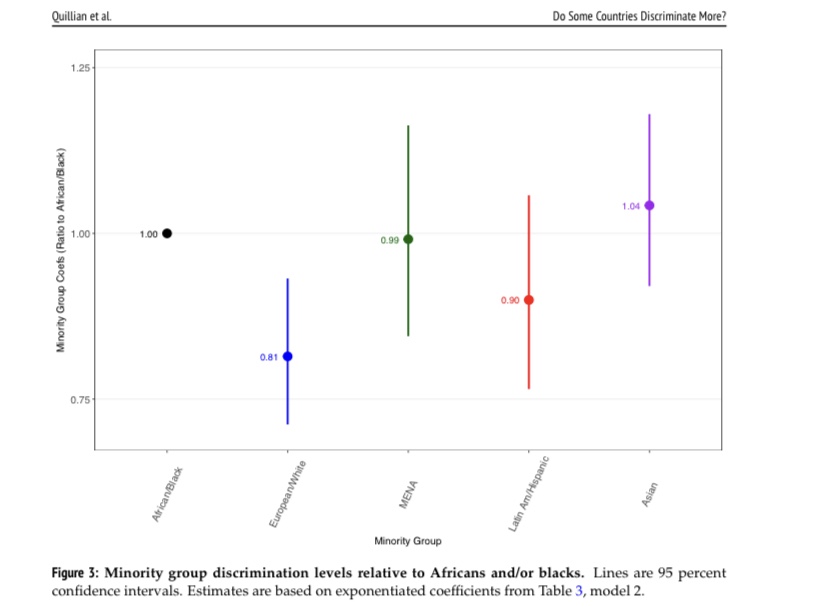
The study’s point estimates indicated “ubiquitous hiring discrimination”, though not all the estimates were statistically significant. My apologies if the chart below is difficult to read. If so, try zooming in, clicking on it, or following the link to the study above.

Some of the largest point estimates were highly imprecise due to less coverage by individual studies. The impacted groups and severity varied across countries. Blacks suffered significant discrimination in the U.S., Canada, France, and Great Britain. For Hispanics, the only coverage was in the U. S. and sparsely in Canada. The point estimates showed discrimination in both counties, but it was (barely) significant only in the U.S. For Middle Eastern and North African (MENA) applicants, discrimination was severe in France, the Netherlands, Belgium, and Sweden. Asian applicants faced discrimination in France, Norway, Canada, and Great Britain.

Across all countries, the group suffering the least hiring discrimination was white immigrants, followed by Latin Americans / Hispanics (but only two countries were covered). Asians seemed to suffer the most discrimination, though not significantly more than Blacks (and less in the U.S. than in France, Norway, Canada, and Great Britain). Blacks and MENA applicants suffered a bit less than Asians from hiring discrimination, but again, not significantly less.
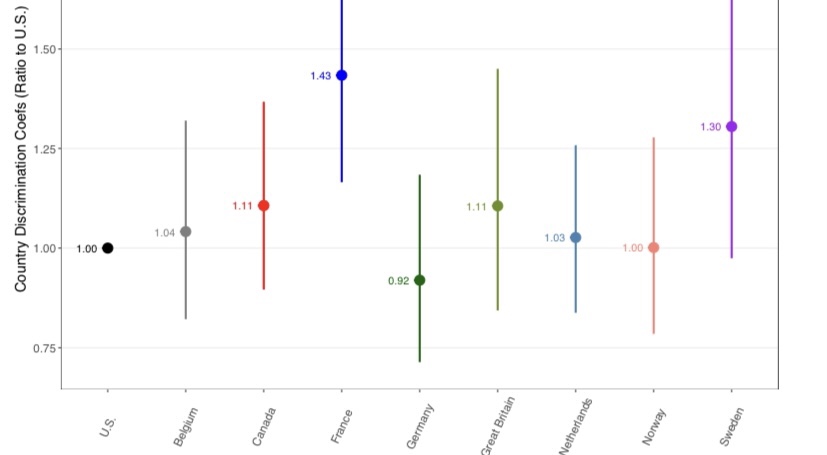
Comparing countries, the authors used U.S. hiring discrimination as a baseline, assigning a value of one. France had the most severe hiring discrimination and at a high level of significance. Sweden was next highest, but it was not significantly higher than in the U.S. Belgium, Canada, the Netherlands and Great Britain had higher point estimates of overall discrimination than the U. S., though none of those differences were significant. Employers in Norway were about as discriminatory as the U.S., and German employers were less discriminatory, though not significantly.
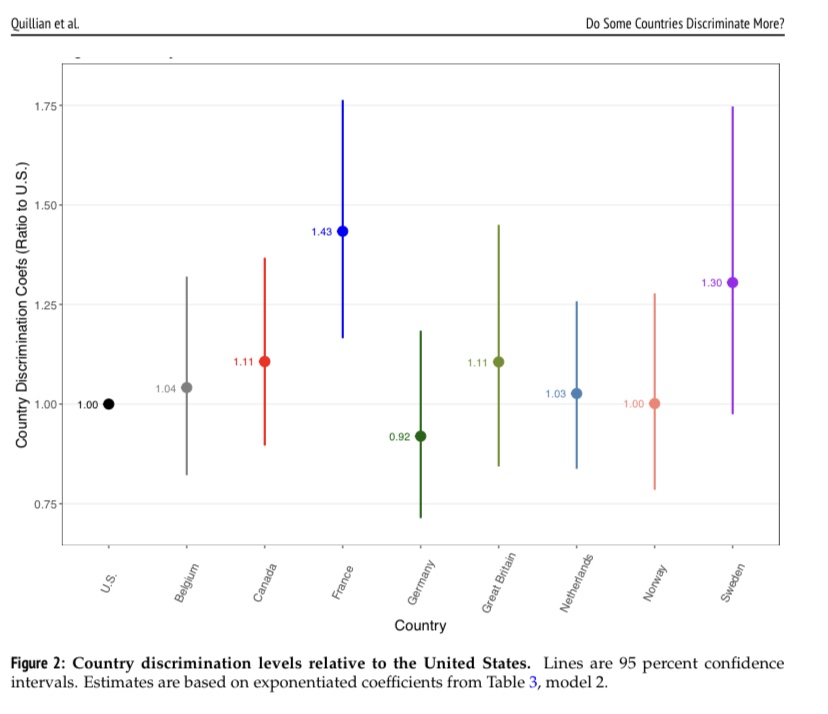
The upshot is that as a group, U.S. employers are generally at the low end of the spectrum in terms of discriminatory hiring. Again, the intent of this research was not to single out the selected countries. Rather, these countries were chosen because relevant studies were available. In fact, Tabarrok makes the following comment, which the authors probably wouldn’t endorse and is admittedly speculative, but I suspect it’s right:

“I would bet that discrimination rates would be much higher in Japan, China and Korea not to mention Indonesia, Iraq, Nigeria or the Congo. Understanding why discrimination is lower in Western capitalist democracies would reorient the literature in a very useful way.”

So the U.S. is not on the high-side of this set of Western countries in terms of discriminatory hiring practices. While discrimination against blacks and Hispanics in the U.S. appears to be a continuing phenomenon, overall hiring discrimination in the U.S. is, at worst, comparable to many European countries.

To anticipate one kind of response to this emphasis, the U.S. is not alone in its institutional efforts to reduce discrimination. In fact, the study’s authors say:

“A fairly similar set of antidiscrimination laws were adopted in North America and many Western European countries from the 1960s to the 1990s. In 2000, the European Union passed a series of race directives that mandated a range of antidiscrimination measures to be adopted by all member states, putting their legislative frameworks on racial discrimination on highly similar footing.”

Despite these similarities, there are a few institutional details that might have some bearing on the results. For example, France bans the recording and “formal discussion” of race and ethnicity during the hiring process. (However, photos are often included in job applications in European countries.) Does this indicate that reporting mandates and prohibiting certain questions reduce hiring discrimination? That might be suggestive, but the evidence is not as clear cut as the authors seem to believe. They cite one piece of conflicting literature on that point. Moreover, it does not explain why Great Britain had a greater (and highly significant) point estimate of discrimination against Asians, or why Canada and Norway were roughly equivalent to France on this basis. Nor does it explain why Sweden and Belgium did not differ from France significantly in terms of discrimination against MENA applicants. Or why Canada was not significantly different from France in terms of hiring discrimination against Blacks. Overall, discrimination in Sweden was not significantly less than in France. Still, at least based on the three applicant groups covered by studies of France, that country had the highest overall level of discrimination. France also had the most significant departure from the U.S., where recording the race and ethnicity of job applicants is institutionalized.

Germany had the lowest overall point estimates of hiring discrimination in the study. According to the authors, employers in German-speaking countries tend to collect a fairly thorough set of background information on job applications. This detail can actually work against discrimination in hiring. Tabarrok notes that so-called “ban the box” policies, or laws that prohibit employers from asking about an applicant’s criminal record, are known to result in greater racial disparities in hiring. The same is true of policies that threaten sanctions against the use of objective job qualifications which might have disparate impacts on “protected” groups. That’s because generalized proxies based on race are often adopted by hiring managers, consciously or subconsciously.

Discrimination in hiring based on race and ethnicity might actually be reasonable when a job entails sensitive interactions requiring high levels of trust with members of a minority community. This statement acknowledges that we do not live in a perfect world in which racial and ethnic differences are irrelevant. Still, aside from exceptions of that kind, overt hiring discrimination based on race or ethnicity is a negative social outcome. The conundrum we face is whether it is more or less negative than efforts to coerce nondiscrimination on those bases across a broad range of behaviors, most of which are nondiscriminatory to begin with, and when interventions often have perverse discriminatory effects. Policymakers and observers in the U.S. should maintain perspective. Discriminatory behavior persists in the U.S., especially against Blacks, but some of this discrimination is likely caused by prohibitions on objective tests of relevant job skills. And as the research discussed above shows, employers here appear to be a bit less discriminatory than those in most other Western democracies.


Election Snafus, Fraud: Invite and They Will Come

12 Wednesday Aug 2020

Posted by Nuetzel in Democracy, Pandemic, Voter Fraud

≈ 2 Comments

Tags

19th Amendment, Absentee Ballots, Amy Klobuchar, Atlantic County NJ, Ballot Harvesting, CalTech, CBS, Charles Stewart III, Eric Boehm, European Union, Fraud Risk, J Christian Adams, Logan Churchwell, Mail-In Voting, Mark Harris, Massachusetts Institute of Technology, New York Times, PILF, Postal Voting, Public Interest Legal Foundation, Reason.com, Ron Wyden

There is understandable controversy over the prospect of more mail-in voting, but it’s reasonable to believe that some additional mail-in or postal voting may be necessary in light of the pandemic. Social distancing reduces the volume of activity that polling places can handle in a single day, and administrative decisions about the voting process can’t be deferred until late October in order to observe the state of the pandemic and make last-minute changes. Most states already permit voters to request a mail-in ballot for a variety of reasons: travel, illness, or other exigencies are usually sufficient, if a reason is even required. In the context of the pandemic, such a request should certainly be granted to those most concerned about contracting the coronavirus. So the option to vote by mail seems reasonable, at least in the abstract, as long as those who prefer to cast their ballots in person can do so.

“Universal” mail-in voting is another story, but the term first requires some qualification. I construe “universal” in this case to mean voting by citizens of the United States, a right protected and reserved to citizens by the 19th Amendment to the Constitution. That also means voters must be registered and must comply with state requirements for identification, if any, before receiving a ballot. In other words, under current state laws, a voter might be required to appear before an election authority to obtain a ballot for return by mail. The proponents of universal postal mail, however, seem to think states should simply mail ballots to the addresses of all registered voters. Many proponents go further, suggesting that all individuals of voting age should be mailed ballots.

The first major problem with a large expansion of postal voting is administrative complexity. It would represent a significant challenge for many jurisdictions to arrange in short order. It’s bound to create major delays in counting and reporting results, and it is likely to create doubt as to the reliability of the official election results. Here are some administrative issues and examples worth considering:

This recent experiment by CBS revealed delays in the official receipt of mailed ballots, a problem that will be more acute given plans in some jurisdictions to send ballots to postal voters only a week prior to the November election. The study also revealed some mis-sorting and misplacement of returned ballots. It concluded that a percentage of voters is likely to be “disenfranchised” by mail-in voting.

In early August, primary balloting by mail in Atlantic County, NJ was said to be especially problematic. Signatures on ballots were difficult to match to DMV records signed on “screen”; there was an extra step in delivering ballots to a central post office location and then on to election officials, causing delays; the voter registration system was plagued by technical glitches related to heavy demand for updated records; and there was insufficient time between sending ballots to voters and the deadline.

New York City’s primary election in June was similarly afflicted with a high rate of invalid mailed ballots. “The city BOE received 403,103 mail-in ballots for the June 23 Democratic presidential primary. … But the certified results released Wednesday revealed that only 318,995 mail-in ballots were counted. … That means 84,108 ballots were not counted or invalidated — 21 percent of the total. … One out of four mail-in ballots were disqualified for arriving late, lacking a postmark or failing to include a voter’s signature, or other defects. The Post reported Tuesday that roughly 30,000 mail-in ballots were invalidated in Brooklyn alone. … The high invalidation rate provides more proof that election officials and the Postal Service were woefully underprepared to handle and process the avalanche of mail-in ballots that voters were encouraged to fill out to avoid having to go to the polls during the coronavirus pandemic, critics said.”

From the New York Times, “In the last presidential election, 35.5 million voters requested absentee ballots, but only 27.9 million absentee votes were counted, according to a study [NYT link is bad] by Charles Stewart III, a political scientist at the Massachusetts Institute of Technology. He calculated that 3.9 million ballots requested by voters never reached them; that another 2.9 million ballots received by voters did not make it back to election officials; and that election officials rejected 800,000 ballots. That suggests an overall failure rate of as much as 21 percent.”

The problem of rejected mail-in ballots is all too common throughout the country. For example, redistricting can cause mail-in voters to cast their votes in the wrong precinct at a higher rate; people move frequently, especially low-income voters, so updating voter rolls is a tremendous challenge; and voters often fail to follow instructions carefully, and there is no one at hand to offer assistance.

Again, these are just the administrative problems. The upshot is that mail-in voting is likely to introduce uncertainties and delays in determining election outcomes, and is likely to result in numerous legal challenges as well.

This piece by Eric Boehm in Reason is skeptical of our ability to vote by mail without major complications of that kind. Boehm then turns to the question of mail-in ballots and fraud, however, quoting a variety of experts who claim that election fraud is a miniscule problem and that fraud has not had a partisan bias in the past. But partisan bias is not really the critical issue… fraud is, party by party, district by district, and state by state.

Despite Boehm’s protestations and widespread denial in the news media, election fraud is a “thing”. More importantly, the risk of election fraud is a thing. It’s instructive that two U.S. Senators (Ron Wyden (OR) and Amy Klobuchar (MN)) have introduced legislation that not only would authorize more widespread voting by mail, but “ballot harvesting” as well. The latter is the practice of visiting homes and “offering” to collect residents’ postal ballots for delivery to collection points. It has been a flagrant form of vote fraud in the past.

So what is our experience with fraud? Here is a “sampling” of 1,290 cases of election fraud, many of which involved absentee ballots and ballot harvesting. Detail on most of these cases can be found here.

The following testimonial reinforces the ease with which fraud can be perpetrated via mail-in voting:”I know because I did it“:

“Last year, a political operative working for North Carolina Republican congressional candidate Mark Harris was charged with fraud for directing a group of people to fill out as many as one thousand absentee ballot requests on behalf of voters — most of whom were unaware the ballots were being requested. … These people then collected the ballots and filled them out themselves. … 

Also in 2019, a Democratic city clerk in Southfield, Michigan, was arrested and charged with six felonies for falsifying absentee ballot records to say that 193 of the ballots in one election were missing signatures or a return date, when in fact they had both. The correct records were found in the trash can in her office.

… J. Christian Adams of the Public Interest Legal Foundation (PILF) says if states aren’t careful, they’ll be issuing ‘an open invitation to fraud. … There are two big problems with vote by mail,’ Adams told InsideSources. ‘Number one … people voting the ballot for other people through undue influence. … The second one — the voter rolls are a mess.’ … Adams’ organization has sued several states and counties for refusing to maintain accurate voter rolls, allowing the names of thousands of dead voters, felons and non-citizens to remain in the system.”

Fraud risk always exists even if detected and proven levels of fraud are low, and the level of risk scales with the extent to which ballots are cast by mail. The sudden, massive expansion in mail-in voting now contemplated by some would create unprecedented opportunities for fraud.

Consider the 28 million mail-in ballots that went missing between 2012 and 2018, roughly 20% of mail-in ballots issued during those years. According to Logan Churchwell of PILF:

“So what do people that really focus on the election process do about that? They go into ballot harvesting. If there’s so many ballots out there in the wind unaccounted for by election officials, surely some manpower could be dedicated to go bring them in. And that’s another part of the system where you have weaknesses and risk.”

It takes only a small percentage of the vote to swing many elections, so ballot harvesting, enabled by more widespread voting-by-mail, is a serious threat to the integrity of the democratic process. The last link cites a few reports that should give mail voting proponents some pause:

“There’s little doubt that as the number of mail-in ballots increases, so does fraud. A 2012 report in The New York Times noted that voter fraud involving mail-in ballots ‘is vastly more prevalent than the in-person voting fraud that has attracted far more attention, election administrators say. In Florida, absentee-ballot scandals seem to arrive like clockwork around election time.’ According to a Wall Street Journal report on voter exploitation in Hispanic communities in Texas, mail-in ballots have ‘spawned a mini-industry of consultants who get out the absentee vote, sometimes using questionable techniques.’ Poor, elderly, and minority communities are most likely to be preyed upon by so-called ballot ‘brokers.’

Concerns about fraud in mail-in ballots were serious enough that a 2008 report produced by the CalTech/MIT Voting Technology Project recommended that states ‘restrict or abolish on-demand absentee voting in favor of in-person early voting.'”

It’s no coincidence that most countries in the European Union restrict mail-in voting to those who are unable to vote in-person, such as those working or studying abroad, as well as the sick and elderly. There are exceptions, of course, but many of these developed countries reject the notion that mail-in voting is worth the risks.

It’s reasonable to expect many cautious voters to request ballots for return by mail. But at a minimum, any large-scale transition to postal voting should be done with care for the security and integrity of the voting process. It is not an exercise to be done in haste, as proponents now demand. The result of such a drastic change would be significant delays, legal challenges, and reduced confidence in the outcome of elections. And there will almost certainly be fraud. As in almost all things, a voluntary option subject to jurisdictional risk controls is far preferable to either mandatory or “universal” postal voting.

The EU Chokes the Free Flow of Information

14 Sunday Apr 2019

Posted by Nuetzel in Censorship, Free Speech

≈ Leave a comment

Tags

Brexit, Catarina Midoes, Censorship Machines, Cory Doctorow, crony capitalism, Electronic Frontier Foundation, European Copyright Directive, European Union, Facebook, Fair Use, Google, Link Tax, Mark Zuckerberg, Scott Shackford, Stan Adams, Takedown Notice, Warren Meyer

The European Union wants to force me to pay “news sites” for links with “snippets” of content I might quote on this blog, and it wants the WordPress platform to flag and censor anything that might qualify as copyright infringement. The EU also wants search engines like Google and platforms like Facebook to pay for links and “snippets” or else censor them. Most members in the EU Parliament apparently think the best way to regulate information services is to choke off the flow of information. As Warren Meyer says, if you weren’t for Brexit, this single EU action might well convert you (though British statists have their own designs on censorship, Brexit or not). And if you think government involvement won’t ruin the internet, think again.

These restrictive demands are the essence of two controversial provisions of the so-called European Copyright Directive (ECD) passed by the EU Parliament on March 26th. My summary here leaves out lots of detail, but be assured that administering the Directive will require a massive regulatory apparatus:

The Link Tax: If you link to a source and quote a “snippet” of text from that source, you will have to obtain a license from the source, or else the link you use may be blocked. Keep in mind the rule applies despite full attribution to the original source! It remains to be seen how these licenses will be negotiated, but it will almost certainly impose costs on users.

Censorship Machines: Platforms will be required to monitor and assess everything posted for possible copyright infringement. That will require the development of automated “filters” to flag and remove material that might be in violation. That’s a stark change in the treatment of speech on platforms that, heretofore, have not been required to police their users. The responsibility was on those holding copyrights to go after unauthorized use with takedown notices.

Cory Doctorow of the Electronic Frontier Foundation (EFF) wrote an informative position paper on the ECD a week before the vote. He has been an active and articulate opponent of the legislation. Here are some of his comments (his emphasis):

“… text that contains more than a ‘snippet’ from an article are covered by a new form of copyright, and must be licensed and paid by whoever quotes the text …[the ECD] has a very vague definition of ‘news site’ and leaves the definition of ‘snippet’ up to each EU country’s legislature. … no exceptions to protect small and noncommercial services, including Wikipedia but also your personal blog. The draft doesn’t just give news companies the right to charge for links to their articles—it also gives them the right to ban linking to those articles altogether, (where such a link includes a quote from the article) so sites can threaten critics writing about their articles.”

The ECD seems intended as a gift to large news organizations, but it will discourage the free exposure now given to those news sites on the internet. It’s therefore not clear that the ECD will generate much incremental cash flow for news sites or other content providers. However, collecting the new license revenue will come at some expense, so it won’t be of much help to smaller “rights holders”. Therefore, the rule is likely to benefit large platforms and news outlets disproportionately, as they are in a better position to negotiate licenses for the use of material.

As for censorship machines, perhaps rights holders prefer a shift in the burden of policing the use of copyrighted material away from themselves and to the platforms. Some might suggest that it will achieve efficiencies, but that seems unlikely. These filters are costly and are likely to suffer from an excess of false positives. Moreover, the ECD creates risks that demand conservatism on the part of the platforms, so their censorship machines will systematically side against users. There is also a reasonable possibility that filters will be used to control political speech.

All of this is contrary to the doctrine of fair use, as codified and practiced in the U.S. This involves four conditions giving fairly broad latitude to users, described at the last link by Stan Adams:

“The relevant statutory provision (17 U.S.C. § 107) describes four factors to consider when determining whether a particular use of a work is “fair”: the purpose and character of the use; the nature of the copyrighted work; the amount and substantiality of the portion used in relation to the work as a whole; and the effect of the use on the potential market for, or value of, the original work.”

Copyright protection has never been absolute nor intended to guarantee perfect exclusivity. Ever lend a book to a friend? Ever heard a cover band perform pop hits? Ever offered a quote to forward a written argument? All of this falls broadly under fair use, and much of it serves to promote the economic interests of rights holders, as opposed to infringing on the market for their original work. The EU, however, has no provisions for fair use in its copyright laws (though EU countries may have limitations and exclusions to copyright protection).

It’s bad enough that Europeans will suffer the consequences of this ill-considered piece of legislation, but can the platforms be counted upon to apply their censorship machines only to select geographies? Adams encapsulates the difficulties the ECD presents to users elsewhere:

“… the rest of the world must rely on private companies to ensure that the EU’s misguided copyright policies do not restrict freedoms enjoyed elsewhere in the world.”

Internet regulations in Europe and the U.S. seem to be following different cronyist disease vectors. The ECD favors large news organizations at the expense of social media platforms, and ultimately consumers and the cause of free speech. The large tech platforms are of course equipped to survive, but perhaps not small ones. In the U.S., we have Mark Zuckerberg begging for regulation of Facebook, including the regulation of speech. That’s a spectacularly bad idea for public policy. It too would disadvantage smaller competitors in the social media space. Ultimately, in Europe and the U.S, these steps will come at the expense of consumers, possibly in higher monetary costs, but definitely in restrained trade in online services and in the marketplace of ideas. So goes the cause of free speech when government has the power to regulate the flow of information.

For further reading on the ECF, see Catarina Midoes: “Is this blog post legal (under new EU copyright law)?” She discusses how different factions view the ECD, gives additional perspective on the controversial provisions, and discusses some potential unintended consequences. Also see Scott Shackford’s “Hide Those Meme’s Folks…”


Preserve the Separation of Google and State

28 Friday Sep 2018

Posted by Nuetzel in Antitrust, Censorship, Privacy

≈ Leave a comment

Tags

Anti-Competitive, Antitrust, Biased Search Results, China, Do the Right Thing, European Union, FICO Score, Google, Government Monopoly, J.D. Tuccille, Limited government, Liu Hu, Personal Information, Privatized Authoritarianism, Social Credit Score, Surveillance, Unenumerated Rights

Little did we suspect that Google’s collection of personal data and manipulation of search results was mere practice for the job of censoring, curating, and providing behavioral surveillance for repressive governments (more on search manipulation here and here). Actually, some of us have expressed trepidation that our own individual liberty might face such a vulnerability, with Google working in concert with our own government:

“As a firm like Google attains the status of an arm of the state, or multiple states, it could provide a mechanism whereby those authorities could manipulate behavior and coerce their citizens, making the internet into a tool of tyranny rather than liberty. ‘Don’t be evil’ is not much of a guarantee.”

Now, however, the company is working with the government of mainland China to implement a version of its search engine that meets the needs of the Communist regime. J.D. Tuccille calls this “Privatized Authoritarianism”. Search results from Google’s Chinese utility might come back blank, or certain sites might be banned, or at least banned from the first page of results (e.g., Wikipedia, the BBC).

Not only that, the Chinese government is building a system of “social credit scores” for its citizens, essentially a one-number report card like the FICO credit score in the West. This one, however, is driven by more than financial transactions; it’s intended to account for a variety of behaviors including one’s record in criminal and civil matters, anything reflecting one’s “trustworthiness”, general comportment, and alignment with official doctrine. The country is building a gargantuan network of surveillance cameras with visual recognition technology and artificial intelligence that will be used to generate inputs to the social score. And Google’s Chinese search platform?

“… users’ interest in pursuing forbidden paths of inquiry will certainly become part of their permanent record. That’s no joke in a country that’s rapidly modernizing the hoary old mechanisms of the police state with a modern ‘social credit’ system that can effectively place people under house arrest with nary a trench coat in sight.

‘A poor Chinese social credit score can lead to bans from travel, certain schools, luxury hotels, government positions, and even dating apps,’ notes the Brookings Institution. Liu Hu, an investigative journalist, incurred the Chinese government’s wrath for exposing corruption among Communist Party officials. He’s among millions who have been punished with a tanked social credit score that prevents him from easily working or even leaving his hometown.”

Political search activity is one thing. What happens if you search for information on foreign news sources? Certain medications or certain disfavored goods? Movies? Books? Sex? What are the consequences of actually clicking on a particular link in a search result? Could the governments place “honey pots” into search results? Could the system be used by the government to entrap citizens? You bet it could!

The Chinese government is everything a liberal should hate, classical or otherwise. But they do what they do. Google, which takes pride in its “do the right thing” mantra, is most certainly not doing the right thing by contributing to this intrusive effort. And it could happen here in the West. In fact, it is probably already happening here to some degree.

Google was fined $2.7 billion by the European Union in 2017 for biasing its search results in favor of its own services. That ruling was made on traditional antitrust grounds: the bias in search results was judged to have anti-competitive effects on the searched-for service markets. But apart from a direct connection to some other form of commerce, traditional antitrust arguments are difficult to make against a free search engine. The company has a high market share but by no means a monopoly over search results, at least in the U.S.

Still, a partnership between Google and government is potentially troublesome, and more so than run-of-the-mill corporatism, though there is that, too. Many individuals are blasé about managing their privacy on social media, while many others seek a level of anonymity to those outside of their social circle. The latter may be wise, but it won’t do them much good if the government gains access to their on-line behavior. The real issue is ownership of our personal information, and that is an unsettled area of the law. Google acquires that information for free in exchange for providing a free search engine. But can Google or any other company with an online platform legally use your personal data as it likes? No, at least not in principle, but that’s no guarantee that the data won’t be used in ways to which you’d object. If anyone should have rightful monopoly rights over the use of individual data, it’s the individual. But strict data privacy might mean we’ll have to pay to use the search engine.

Government has a monopoly on force, but one can hardly bring antitrust action against government, Google partnership or not. That monopoly on force is why our constitutional rights are so critical. Those rights are primarily unenumerated in the U.S. Constitution, while the powers of the federal government are explicitly limited and enumerated. Individual liberty, including the right to privacy, must be respected and protected by our institutions. That should include data privacy. As the reach of government social programs grows, however, participation requires that personal data is increasingly shared with the government. That’s another good reason to keep government small!

God Save the Brexit

28 Tuesday Jun 2016

Posted by Nuetzel in Big Government, European Union

≈ Leave a comment

Tags

Bank of England, Brexit, European Union, Joel Kotkin, Liquidity Crisis, Megan McArdle, Paul Craig Roberts, Sohrab Ahmari, Tyler Cowan, U.K. Independence Party, United Kingdom


The British might have a bumpy transition to full independence following last week’s Brexit vote, but the European Union (EU) may now face a challenge to its very existence: the outcome of the British referendum amounts to a revolt against overbearing rule by a distant, authoritarian central government. The vote demonstrates resentment by many Brits to absurd regulation of many aspects of life, to the loss of sovereignty inherent in EU membership, and to the EU’s controversial immigration policies. Other members of the EU may face popular exit movements of their own, as sentiment in France and elsewhere is running strongly against the Union. Economist Joel Kotkin writes the following in his assessment of the Brexit vote:

“In the last economic expansion, something close to 70 percent of all the new jobs created went to non-U.K. citizens. …  In the media and polite circles in both parties, opposition to EU immigration has been widely denounced as racist. But, in reality, UKIP’s [U.K. Independence Party] leader, Nigel Farage, has spoken positively about continuing migration, largely non-white, from the Commonwealth, particularly for skilled workers. In contrast, Cameron’s failure to slow down the largely unregulated EU migration may have been the single largest factor behind the Brexit result.“

This was a vote for self-determination and also a vote for cultural identity. The left has been quick to call it racism, but Tyler Cowan, himself in the Remain camp, thinks that label is misleading in important ways:

 “Quite simply, the English want England to stay relatively English, and voting Leave was the instrument they were given. …  Much has been made of the supposed paradox that opposition to immigration is highest where the number of immigrants is lowest. Yes, some of that is the racism and xenophobia of less cosmopolitan areas, but it would be a big mistake to dismiss it as such or even to mainly frame it as such. Most of all it is an endowment effect. Those are the regions which best remember — and indeed still live — some earlier notion of what England was like. And they wish to hold on to that, albeit with the possibility of continuing evolution along mostly English lines. … The regularity here [comparing England to Denmark and Japan] is that the coherent, longstanding nation states are most protective of their core identities. Should that come as a huge surprise?“

Megan McArdle also takes a stab at illuminating the disconnect between those who believe in forging a European “nation” and those who prefer independence:

“Surrendering traditional powers and liberties to a distant state is a lot easier if you think of that state as run by ‘people like me,’ … particularly if that surrender is done in the name of empowering ‘people who are like me’ in our collective dealings with other, farther ‘strangers who aren’t.’ … The EU never did this work. When asked ‘Where are you from?’ almost no one would answer ‘Europe,’ because after 50 years of assiduous labor by the eurocrats, Europe remains a continent, not an identity.“

Those who had hoped for Britain to remain in the EU include elites who stood to gain from crony capitalism that benefits from heavy regulation, as well as collectivists whose naive ideals dictate government planning and a borderless world. Others may have hoped to profit from another upshot of a remain vote: the U.K., unlike other member states, still has its own currency and its own monetary authority (the Bank of England — BOE); as Paul Craig Roberts says, a British commitment to the EU, and adoption of the euro, would have greatly diminished London as a financial center, bringing potentially significant windfalls to major U.S. financial institutions.

Great Britain has its own economic problems, of course, and there is no guarantee that exit from the EU will pave an easy road to prosperity. The country is attempting to reign in budget deficits, but relatively slow economic growth is making that more difficult. The steep slide in the value of the pound after the Brexit vote will stimulate exports, but it makes imported goods more costly and has inflationary consequences. That makes the BOE’s job of conducting monetary policy tricky. Fears of a post-Brexit liquidity crisis and recession must be balanced against the inflationary impact of the cheaper pound.

Even worse, with or without the EU, politics in the U.K. tends increasingly toward statism. This is from Sohrab Ahmari in his article “Illiberalism: The Worldwide Crisis“:

“Then there is Britain, where the hard-left wing of Labour has taken over the party. Rising to the leadership in the aftermath of last year’s electoral rout, Jeremy Corbyn has broken the party’s peace with free enterprise and individual responsibility—the main reformist achievement of Tony Blair’s New Labour. The party once again longs for socialism and speaks the language of class warfare at home, while anti-Americanism, pacifism, and blame-the-West attitudes dominate its foreign policy. at home.“

From my perspective, the worst-case scenario for Britain is that post-Brexit economic policy will be marked by a continued drift toward government activism, and that “softening the Brexit blow” will be an additional pretext. I believe the British have something to gain from Brexit, but much of it will be frittered away by giving things over to government control. But then again, perhaps homegrown authoritarianism is preferable to imported varieties.

Unfortunately, the exit itself will be a bonanza to the rent-seeking class, as negotiation of its terms with the EU, and implementing the exit, promise to be complex exercises involving an army of technocrats. They should not be too eager to make regulatory concessions to the EU, or anyone else, in order to maintain close ties. The best approach would be to reduce trade barriers unilaterally, blunting the impact of the cheap pound on import prices while enjoying the favorable effect on exports.

My hope is that Brexit will prove to be an economic and cultural tonic for the U.K. in the long run. It would be far better for the country to use its power of self-governance to the good of private individuals, steering clear of government domination of economic activity and excessive regulation. Authorities should cultivate a light touch, allowing markets in the U.K. to do what they do best: promote the general welfare.


The EU Opts For Agro-Federalism

14 Wednesday Jan 2015

Posted by Nuetzel in Uncategorized

≈ Leave a comment

Tags

Biotechnology, EU, European Union, Federalism, GE crops, genetic engineering, GMOs, Green Movement, Matt Ridley, Organics, The Times

MOHR-europe-law

An opinion piece by Matt Ridley in The Times (UK) alerted me to the European Union’s imminent decision to allow member states to adopt their own rules regarding the planting and cultivation of genetically modified crops. The measure was approved overwhelmingly by the EU Parliament today. The talking points released by the EU emphasize that a member country can ban a GM crop even if it has been approved by the EU’s food safety authority. And the rules state:

“While cultivation is recognised to be an issue with strong national or local dimensions, current EU legislation on GMOs offers limited possibilities to Member State to decide on GMO cultivation on their territory.”

It is likely that the additional flexibility for members to impose their own bans will lead to more flexibility in the process of authorizing new varieties at the centralized level. Contrary to much of the reporting offered by Greens, who would have us believe that GE crops are all but prohibited in Europe, there are many varieties of GE crops that are already authorized by the EU. If you don’t believe it, this database may convince you.

Ridley provides an interesting account of the politicking that led to the legislation. Among EU members, the UK and Spain are the most eager to expand cultivation of GE crops, while other nations supported the measure since it seems to enhance their own sovereignty on an important agricultural issue. Nevertheless, critics of the legislation complain that it is poorly worded. Greens are unhappy because they see it as an entry for GE crops through the “back-door.” One biotech group complained that the law allows members to ban GE crops on “non-scientific grounds.”

Ridley also emphasizes some changes in thinking among traditional opponents of GE in Europe. The Greens are aware that the use of pesticides might be curtailed by the use of GE varieties. The yield-challenged organic movement also has much to gain via adoption of GE crops, and Ridley points out the inherent fallacy at the root of their past opposition:

“Ironically, the organic movement happily uses crops whose genetic material has been modified in a much less careful way — by gamma rays or chemical mutagens — for these are categorised as ‘conventional’ crops and lightly regulated. Golden Promise barley, used by organic brewers, for example, was made in a nuclear reactor.”

Federalism is a good way to promote the union of sovereign entities with disparate views on a range of issues, such as agricultural practices. However, sustaining a federalist approach requires a determination to restrain central government bureaucrats and busy-bodies who cannot control their urges to control others. For the good of humanity, let’s hope the EU can succeed in this instance.

Follow Sacred Cow Chips on WordPress.com

Recent Posts

  • Immigration and Merit As Fiscal Propositions
  • Tariff “Dividend” From An Indigent State
  • Almost Looks Like the Fed Has a 3% Inflation Target
  • Government Malpractice Breeds Health Care Havoc
  • A Tax On Imports Takes a Toll on Exports

Archives

  • December 2025
  • November 2025
  • October 2025
  • September 2025
  • August 2025
  • July 2025
  • June 2025
  • May 2025
  • April 2025
  • March 2025
  • February 2025
  • January 2025
  • December 2024
  • November 2024
  • October 2024
  • September 2024
  • August 2024
  • July 2024
  • June 2024
  • May 2024
  • April 2024
  • March 2024
  • February 2024
  • January 2024
  • December 2023
  • November 2023
  • August 2023
  • July 2023
  • June 2023
  • May 2023
  • April 2023
  • March 2023
  • February 2023
  • January 2023
  • December 2022
  • November 2022
  • October 2022
  • September 2022
  • August 2022
  • July 2022
  • June 2022
  • May 2022
  • April 2022
  • March 2022
  • February 2022
  • January 2022
  • December 2021
  • November 2021
  • October 2021
  • September 2021
  • August 2021
  • July 2021
  • June 2021
  • May 2021
  • April 2021
  • March 2021
  • February 2021
  • January 2021
  • December 2020
  • November 2020
  • October 2020
  • September 2020
  • August 2020
  • July 2020
  • June 2020
  • May 2020
  • April 2020
  • March 2020
  • February 2020
  • January 2020
  • December 2019
  • November 2019
  • October 2019
  • September 2019
  • August 2019
  • July 2019
  • June 2019
  • May 2019
  • April 2019
  • March 2019
  • February 2019
  • January 2019
  • December 2018
  • November 2018
  • October 2018
  • September 2018
  • August 2018
  • July 2018
  • June 2018
  • May 2018
  • April 2018
  • March 2018
  • February 2018
  • January 2018
  • December 2017
  • November 2017
  • October 2017
  • September 2017
  • August 2017
  • July 2017
  • June 2017
  • May 2017
  • April 2017
  • March 2017
  • February 2017
  • January 2017
  • December 2016
  • November 2016
  • October 2016
  • September 2016
  • August 2016
  • July 2016
  • June 2016
  • May 2016
  • April 2016
  • March 2016
  • February 2016
  • January 2016
  • December 2015
  • November 2015
  • October 2015
  • September 2015
  • August 2015
  • July 2015
  • June 2015
  • May 2015
  • April 2015
  • March 2015
  • February 2015
  • January 2015
  • December 2014
  • November 2014
  • October 2014
  • September 2014
  • August 2014
  • July 2014
  • June 2014
  • May 2014
  • April 2014
  • March 2014

Blogs I Follow

  • Passive Income Kickstart
  • OnlyFinance.net
  • TLC Cholesterol
  • Nintil
  • kendunning.net
  • DCWhispers.com
  • Hoong-Wai in the UK
  • Marginal REVOLUTION
  • Stlouis
  • Watts Up With That?
  • Aussie Nationalist Blog
  • American Elephants
  • The View from Alexandria
  • The Gymnasium
  • A Force for Good
  • Notes On Liberty
  • troymo
  • SUNDAY BLOG Stephanie Sievers
  • Miss Lou Acquiring Lore
  • Your Well Wisher Program
  • Objectivism In Depth
  • RobotEnomics
  • Orderstatistic
  • Paradigm Library
  • Scattered Showers and Quicksand

Blog at WordPress.com.

Passive Income Kickstart

OnlyFinance.net

TLC Cholesterol

Nintil

To estimate, compare, distinguish, discuss, and trace to its principal sources everything

kendunning.net

The Future is Ours to Create

DCWhispers.com

Hoong-Wai in the UK

A Commonwealth immigrant's perspective on the UK's public arena.

Marginal REVOLUTION

Small Steps Toward A Much Better World

Stlouis

Watts Up With That?

The world's most viewed site on global warming and climate change

Aussie Nationalist Blog

Commentary from a Paleoconservative and Nationalist perspective

American Elephants

Defending Life, Liberty and the Pursuit of Happiness

The View from Alexandria

In advanced civilizations the period loosely called Alexandrian is usually associated with flexible morals, perfunctory religion, populist standards and cosmopolitan tastes, feminism, exotic cults, and the rapid turnover of high and low fads---in short, a falling away (which is all that decadence means) from the strictness of traditional rules, embodied in character and inforced from within. -- Jacques Barzun

The Gymnasium

A place for reason, politics, economics, and faith steeped in the classical liberal tradition

A Force for Good

How economics, morality, and markets combine

Notes On Liberty

Spontaneous thoughts on a humble creed

troymo

SUNDAY BLOG Stephanie Sievers

Escaping the everyday life with photographs from my travels

Miss Lou Acquiring Lore

Gallery of Life...

Your Well Wisher Program

Attempt to solve commonly known problems…

Objectivism In Depth

Exploring Ayn Rand's revolutionary philosophy.

RobotEnomics

(A)n (I)ntelligent Future

Orderstatistic

Economics, chess and anything else on my mind.

Paradigm Library

OODA Looping

Scattered Showers and Quicksand

Musings on science, investing, finance, economics, politics, and probably fly fishing.

  • Subscribe Subscribed
    • Sacred Cow Chips
    • Join 128 other subscribers
    • Already have a WordPress.com account? Log in now.
    • Sacred Cow Chips
    • Subscribe Subscribed
    • Sign up
    • Log in
    • Report this content
    • View site in Reader
    • Manage subscriptions
    • Collapse this bar
 

Loading Comments...