• About

Sacred Cow Chips

Sacred Cow Chips

Tag Archives: Free expression

Rent Seeking For Social Justice At Mizzou

15 Sunday Nov 2015

Posted by Nuetzel in Education

≈ Leave a comment

Tags

Billy Donley, Columbia MO, Concerned Student 1950, Eugene Volokh, First Amendment, Forced Diversity, Free expression, Gary Pinkel, Jason Whitlock, Jonathan Butler, Legion of Black Collegians, Missouri Students Association, Mizzou, Mizzou Tigers Football, Obamacare, Payton Head, Planned Parenthood, R. Bowen Loftin, rent seeking, Tim Wolfe, University of Missouri
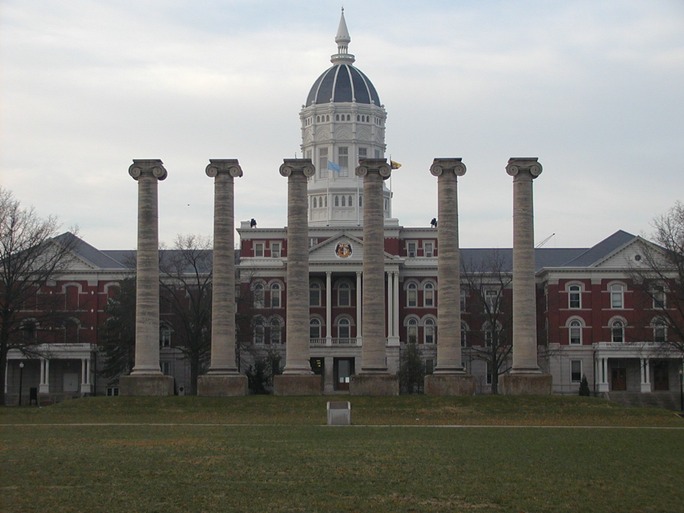
Mizzou

Pre-blog postscript: In the wake of the tumultuous week discussed below, tonight Mizzou’s football team, which has struggled on the field this year, defeated a very good squad from Brigham Young University. Despite my strong misgivings about the actions of team members last week, tonight I am very proud of Mizzou, white, black and gold. Go Tigers!

~~~~~~~~~~~~~~~~~~~~~~~~~~~~~~~~~~~~~~~~~~~~~~~~~

There is weak justification at best for the uproar over supposed racism and social injustice at Mizzou (the University of Missouri’s main campus in Columbia, MO). A protest highlighted by a hunger strike by one graduate student, a boycott by football players, and the threat of a walkout by faculty in nine academic departments led to the resignation last week of the university system’s president and the Mizzou chancellor, who were accused of inadequate sensitivity to the grievances of African-American students. The broader context for the protest is a nationwide assault on free speech, especially on college campuses, with demands for “safe spaces” and “trigger warnings” to protect students from words and acts that they might find offensive. This sensitivity is unbounded, and there is no limit to the censorship and fascism it brings forth in its proponents. From such sentiments are book-burners made.

It is a shame to see a great university like Mizzou reduced to groveling at the feet of petulant children who, ostensibly, have come to be educated, and often with financial support from the school. Full disclosure: Mizzou is my alma mater, so I am especially saddened by these developments. At the end of this post, I provide details on incidents that occurred at Mizzou over nearly three months leading up to the protest. Several of the incidents involved unproven and even false claims by the protestors.

Like it or not, speech outside the classroom by students at public universities has broad protection under the First Amendment. According to Eugene Volokh:

“Most clearly, students generally may not be expelled, suspended, or otherwise disciplined for what they say in student newspapers, at demonstrations, in out-of-class conversations, and the like… even if it’s offensive, wrongheaded, racist, contemptuous, anti-government, or anti-administration. Of course, it’s not protected from university criticism. The university is itself free to publicly speak to condemn student statements that university officials find to be unsound or improper.“

There are exceptions to this protection in the case of “fighting words” and “incitement”, but that kind of offense must be proven before an individual can be punished. It is absurd to demand that a university engage in unconstitutional restrictions on speech. Even if that were legal, it is unreasonable to expect a university to effectively police all speech on campus.

The Mizzou administration did take action this semester in the only case in which an individual engaging in racist speech was identified. The offender was intoxicated and disrupted an organization’s private rehearsal (see below). Whether he used “fighting words” is unknown, but a “conduct process” is still underway in his case. In addition, mandatory diversity training for students and faculty was announced by the chancellor in early October. It appears that the president, responsible for four campuses, may have delegated responsibility for managing the controversies in Columbia to the chancellor, but the failure of the president to respond directly was taken as dismissive. But in fact, Mizzou already had processes in place to address diversity issues, and the chancellor was active in communicating the administration’s concerns and support to minority students via social media. Still, the protestors assert that they were ignored and that no action was taken, among other falsehoods (see below).

In addition to an apology and removal of the University System president for “inaction”, the protestors demanded that the University meet a number of other conditions. These included a “racial awareness and inclusion curriculum throughout all campus departments” to be vetted by “students, staff, and faculty of color.” The protesters also demanded: “an increase the percentage of black faculty and staff campus-wide to 10%“; a 10-year strategic plan to improve retention of “marginalized students“; increased funding “for the purpose of hiring additional mental health professionals — particularly those of color“; and increased “funding and personnel for the social justice centers on campus for the purpose of hiring additional professionals, particularly those of color…”

The demands of the student protestors (and their faculty supporters) represent an exercise in rent seeking. They are attempting to commandeer resources at the cost of academic and educational efforts not explicitly dedicated to the theme of diversity and inclusion. If all of the demands are met, damage will be sustained by nearly all fields of study at Mizzou.

One of my frequent complaints about the Left is their inability to understand that rewards in a market economy are not zero-sum. Instead, they are earned by creating new value to be used in trade and enjoyed by others. The rent-seeking process disrupts that flow of benefits by using the power of government to extract resources from others for one’s private benefit, which then yields a negative-sum outcome for society. However, the resources sought by the Mizzou protestors must come from a public educational system for which funding is scarce. Funds provided to Mizzou by the state of Missouri have fallen significantly over the years, yet state law prohibits tuition increases for undergraduate residents exceeding the growth in the CPI. While the protestors might view their demands as reparation for past and ongoing injustices, many are already subsidized by an institution of higher learning that is strapped, and one that is already at their disposal for purposes of building their human capital. They should avail themselves of that opportunity so they can use that capital later in positive sum activities.

I also think the protests at Mizzou are symptomatic of misplaced priorities on the Left. I highly recommend this excellent essay by Jason Whitlock, an African-American sports journalist who notes that the protests at Mizzou have been given rapt attention by the Left, while the far more serious problem of black-on-black violence receives proportionately little play.

Much like other demands for “social justice”, the Mizzou protestors do not recognize the counterproductive nature of their activities and the measures they advocate. Merit will always be relied upon as as a standard by which people judge others. In a market system, it is a fairly objective standard at that. To a truly neutral observer, diversity is fine, but it is beside the point, and forced diversity often leads to suspicions of unfair play and resentment.

I find the attitude of the protestors appalling on several levels: the lies and the rent-seeking behavior, the damage they will inflict on Mizzou and their fellow students, and their rejection of good-faith efforts to address their concerns. To cap it all off, please read the childish posts shown in this article, in which the Mizzou protestors selfishly complain that the terrorist attacks in Paris have taken attention away from them, going so far as to characterize as “racist” the relative balance of coverage. Simply disgusting!

Sadly, there have been threats of violence on campus in the wake of recent developments. This week, a white teen in Rolla, Missouri, 100 miles from Columbia, was arrested and is being held without bond for making posts on social media that threatened black students at Mizzou. At the same time, hostility and threats toward campus greeks led to a lock-down at fraternities and sororities. As to racism, there is no doubt that it exists, but Mizzou is not exceptional in that regard. On campus, I believe that more racial tension is borne out of agitation from protestors than by any racist sentiments held by others. When the protestors acknowledge examples of apparently neutral, non-racist behavior by others, they insist that the racism they are fighting at Mizzou is systemic. Appeasing these complainants requires a ongoing series of reparations in the form of financial support, control over hiring, quotas and mandatory indoctrination. But here’s a clue: the social justice rap will never win the rewards and respect that arise naturally from hard work.

MIZ – ZOU!

~~~~~~~~~~~~~~~~~~~~~~~~~~~~~~~~~~~~~~~~~~~~~~~~~

Here are key events or claims that led up to the present brouhaha at Mizzou, along with my editorial comments:

August 14: The university announced that it would no longer offer direct subsidies to graduate assistants for the purchase of health insurance. The reason? Obamacare prohibits the kind of low-cost, “individual market” policies (per IRS interpretation) offered by many schools. Mizzou, however, promised to provide a one-time fellowship to cover the economic loss suffered by grad students in the fall semester. When students threatened a walk-out, the university reinstated the subsidies, but with the proviso that a later review would be necessary. This incident had nothing to do with racism, but it inflamed passions. An African-Americam grad student named Jonathan Butler was very upset, even though his family is quite affluent and more than capable of affording his coverage.

August – September 2015: Mizzou cancelled contracts with Planned Parenthood (PP) clinics in the wake of the release of videos showing PP officials discussing the sale of fetal “tissue”. There was pressure on the school’s administration to cut ties with PP and revoke the “refer and follow” privileges of an abortion surgeon from St. Louis. These developments were very upsetting to the campus Left, and while gender-equality activists probably thought they had a legitimate gripe, the action should not be conflated with racism. Nevertheless, Jonathan Butler listed this issue as one of his grievances, and it helped to broaden support for his cause among the student Left.

October 3: The President of the Missouri Student Association, Payton Head, claimed that several men riding in the back of a pickup truck screamed racial slurs as he walked across campus. That is awful, but unless he can identify the individuals or the truck, nothing can be done about that particular incident. It was featured in Butler’s grievance letter to the university. Presumably, the school needs to racially-sensitize anyone with access to campus.

October 6: A white student, apparently drunk, interrupts a rehearsal of the Royalty Court of the Legion of Black Collegians with racial epithets. The student was identified the next day and removed from campus by the Office of Student Conduct pending the outcome of an ongoing disciplinary procedure.

October 10: The Homecoming parade is interrupted when University System President Tim Wolfe’s car is surrounded by students from an organization called Concerned Student 1950. (1950 was the first year that black students were admitted to Mizzou.) Wolfe instructs his driver to back away from the students. With more space between the car and the protestors, the driver attempts to proceed slowly to the right around the group. In this video, Jonathan Butler can then be seen rushing toward the moving car and planting his knees into the bumper. He later accused Wolfe and his driver of running into him. As the narrator on the video states, if this were an insurance case, that sort of fraud might get Butler arrested. After a short blank segment on the video, a so-called “townie” and a few other Mizzou football fans step forward to act as a barrier between Wolfe’s car and the protesters. Ultimately, Wolfe asked police to remove the protestors from the parade route. That was characterized as evidence of neglect on Wolfe’s part. Andrew McCarthy notes the following about Jonathon Butler:

“By the way, the racism is apparently so bad at Mizzou that Mr. Butler has chosen to pursue his Master’s degree (in education) there after attending the university as an undergraduate. Now in his eighth year at Mizzou, he hopes, according to NBC News, ‘to become an advocate and ‘social entrepreneur.””

October 24, 2015: Human feces is discovered on the floor of a restroom in a university residence hall; it had been used to smear a swastika on the wall. This is now confirmed by a campus police report, though no photographs of the “poop swastika” have been produced. (Apparently, a one-year-old photo of similar graffiti was circulated by protestors). The “poopetrator” has not been identified. The act could have been inspired by anti-Semitism, white supremism, simple pranksterism (albeit viciously expressed) , or quite possibly fraudulent agitation meant to incite fears on campus. The incident really did incite fears when it was communicated on social media by Residence Halls Association President Billy Donley. The poop swastika was taken as additional evidence of a bad racial climate at Mizzou, though the affair is suspect.

November 3: Butler begins a hunger strike in an impromptu “tent city” on campus. A student boycott of classes is announced the next day. I have strong doubts about Butler’s credibility (see below) and whether the hunger strike was authentic. He did not look or act like a hungry man before he ate his first post-strike sandwich, but I could be wrong.

November 8: Black football players announce their support of Butler by refusing to practice or play until President Wolfe apologizes and resigns. The next day, Coach Gary Pinkel tweets his support for the black players, and the athletic director agrees. Many of the white players also express support for the player boycott by appearing in a group photo, but it has been reported that not all of them agreed. (I personally believe that the whole lot of the boycotters were played by Butler and his organization.) On November 13, Coach Pinkel resigns, effective December 31, but the reason is a recent diagnosis of non-Hodgkins lymphoma (non-fatal). Some things are simply more important than in-fighting at the university. Coach Pinkel’s announcement, as sad as it is, may well help to defuse the immediate tensions.

November 10: President Wolfe and Chancellor R. Bowen Loftin resign. Butler ends his hunger strike with a sandwich as his friends urge him on with the expression “Yay N—–“, an utterance that may strike some as hypocritical. The football player boycott ends the next day.

On the evening of November 10 at about 11 p.m., Payton Head, the student body president, posted the following on Facebook:

“Students please take precaution. Stay away from windows in residence halls. The KKK has been confirmed to be cited on campus. I’m working with the MUPD, the state trooper [sic], and the National Guard.“

The news spread quickly. Head deleted the post by 11:30 and later apologized and accepted blame for spreading false information. Good for his accountability. His advice at that time was to trust only the @MUalert system, which had posted: “There is no immediate threat to campus. Please do not spread rumors…” 19 minutes before Head’s KKK post.

Suit Me, Or Face a Lawsuit: Adventures In Litigationland

06 Monday Apr 2015

Posted by Nuetzel in Discrimination, Presumptive rights

≈ 2 Comments

Tags

14th Amendment, 1st Amendment, Anti-discrimination law, Constitutional rights, Economics of Discrimination, Eugene Volokh, Free exercise, Free expression, Freedom of Association, Gary Becker, Gay rights, Indiana, New Mexico, Presumptive rights, Private discrimination, Religious Freedom Restoration Act, SCOTUS, Taste for discrimination, Tolerance and profit

Racism-cartoon

Suppose that Jim and Bob, who are life partners, own and operate a company that produces signage. A church group requests a banner to read “Only one man and one woman make a marriage”. Jim and Bob are likely to be offended by the suggestion that they use their art to express such a sentiment, and I think they are entitled to refuse the business. The freedom of expression granted by the First Amendment to the U.S. Constitution protects individuals against compulsion to express things they find objectionable. Will Jim and Bob engage in discrimination if they refuse the business? You bet, but I do not think the government has a “compelling interest” to intervene on behalf of the religious group, especially if there are other businesses capable of producing the banner or if the group can produce it themselves.

Has the exercise of free expression been tested as a defense against charges of illegal discrimination? The example above dealt with discrimination by a private company against a religious group. A similar case involved New Mexico photographers who refused to shoot photos at a same-sex wedding. The plaintiffs alleged discrimination on the basis of sexual orientation, but the photographers claimed that compulsion to accept that work constituted a violation of their freedom of expression. The New Mexico Supreme Court ruled against the photographers. They appealed to the U.S. Supreme Court (SCotUS), which refused to hear the case without additional comment. While this case established a precedent in New Mexico for the compelling interest of government to enforce anti-discrimination law, the refusal of SCotUS to get involved did not create a wider precedent in favor of anti-discrimation law over free speech. There are a number of reasons why the Court might have refused to hear the case, including the fact that the suit was brought under state law, not federal law; simple prioritization across many competing cases for an always full docket; or the lack of any conflict with other court decisions.

At the link above, which was written just after the New Mexico court’s ruling, Eugene Volokh offered his views on the case:

“Is it permissible for the law to require freelance writers, composers, artists, editors, and the like to create speech that they don’t want to create? Might it even be permissible for the law to require other conduits, such as bookstores and movie theaters, to distribute speech that they don’t want to distribute? (I use ‘speech’ here in the standard First Amendment sense, which includes music, pictures, video, and the like.) … It seems to me that having to create speech, using your own creative abilities and judgments as an artist, musician, writer, or what have you, is an even deeper ‘foster[ing]’ of ‘an idea [you might] find morally objectionable’ — an even deeper intrusion on ‘individual freedom of mind’”

We often couch discussions like this in terms of “rights”, which is easily understood. However, there is a strong distinction between this framing and the actual structure of the Constitution. Rather than granting specific rights to individuals, that document presumes the existence of those rights and instead enumerates powers held by the federal government and restrictions on its exercise of those powers. For example, here is the First Amendment:

“Congress shall make no law respecting an establishment of religion, or prohibiting the free exercise thereof; or abridging the freedom of speech, or of the press; or the right of the people peaceably to assemble, and to petition the Government for a redress of grievances.”

And below is a key excerpt from the Fourteenth Amendment, upon which much anti-discrimination law is based. Note that its prohibitions apply only to government action, not private action:

“No State shall make or enforce any law which shall abridge the privileges or immunities of citizens of the United States; nor shall any State deprive any person of life, liberty, or property, without due process of law; nor deny to any person within its jurisdiction the equal protection of the laws.”

One right that should be presumptive is that of individuals to form a union in marriage. It is not addressed explicitly in the Constitution, and perhaps that would be less important if the government were not so intricately involved in the marriage business. Property rights, estate law, taxes, and legal benefits to employees and significant others can all be dependent on the legal status of a marriage. Still, it is not obvious why the government should be anything but neutral with respect to who can be married. Even if we concede a government interest in certifying marriages (it is a source of license fee revenue), are there other reasons for government authority in this area? Call me a skeptic. In any case, the legal recognition of marriage has been left up to the states.

Laws against private discrimination are thought to derive their authority from an enumerated power in the commerce clause, in Article 1 of the Constitution. This allows Congress to “regulate commerce among the several states“. This power was traditionally held to relate only to interstate commerce, consistent with the preservation of federalist principles and states’ rights. The courts have interpreted the power more broadly at times, but it is certainly not unlimited. In the traditional context of interstate commerce, and in view of the presumptive nature of individual rights under the Constitution, this seems to be a strikingly thin rationale for regulating many kinds of private behavior, or for compelling certain activities that burden the exercise of other rights.

Returning to the example above, defending Jim and Bob for turning away the church group’s business is similar in most respects to defending the photographer in the New Mexico case, or the baker who refuses, on religious grounds, to decorate a cake with a gay wedding theme. The cases all involve a form of private discrimination and a conflict between anti-discrimination law and forms of free expression. Whether presumptive rights to free speech, religious practice, or even freedom of association can trump statutory prohibitions against discrimination, or vice versa, is unlikely to be resolved once and for all, at least not any time soon. The individual circumstances surrounding a dispute of this nature will always be helpful, if not determinative. But what sort of test can be applied in order to achieve a resolution?

When sufficient tension exists, it is up to the courts to consider the specific nature of the discrimination in question, its rationale under any presumptive rights, and whether the claimant has “protected” status under a relevant anti-discrimination law. In terms of anti-discrimination law, a line is often drawn by insisting on the universal, non-discriminatory provision of “public accommodations”. The exact meaning of this term can differ by jurisdiction, but it generally implies a sales channel for which the “doors are open”. The presence of competition and alternative providers would argue against the state’s contravention of the presumptive rights of individual sellers in order to satisfy a statuary requirement. The competitive landscape and presence of viable alternatives should be an important consideration in balancing interests in these kinds of conflicts.

Choosing to discriminate against a specific group is not costless, even when legally sanctioned. It is obvious to most business people that tolerance is more profitable than intolerance. The acceptance of this disparity was clearly articulated as a “taste” for discrimination by Gary Becker in his 1957 book, “The Economics of Discrimination“. Becker’s analysis of discrimination in the labor market noted that employers with such a “taste” are willing to pay higher wages in order to avoid hiring certain minorities. In the examples above, Bob and Jim are willing to turn away otherwise profitable business, as are the baker and the photographer. However, their tastes for discrimination do not imply economic irrationality. In all three cases, the business people hold the maintenance of certain principles to be of greater value than the foregone profits.

These issues are relevant to the recent controversy surrounding Indiana’s new Religious Freedom Restoration Act (RFRA). The context for RFRAs is narrower, as they relate to religious expression as opposed to expression generally. The first RFRA was a federal law supported by liberals in response to a conservative SCotUS decision in a dispute over the use of peyote for religious purposes. Generally, RFRAs require that the government have a compelling interest in burdening religious exercise and then must do so using the least restrictive means available. A number of individual states have passed their own RFRAs in order to carve out religious exemptions to various rules. In a recent post, Eugene Volokh discusses the history that gave rise to RFRAs, and the irony that many liberals now decry their existence, while conservatives tend to support them. The principles underlying these laws were once championed by prominent liberal members of SCotUS.

The version of the Indiana RFRA originally signed by Governor Pence would have allowed religious expression to be used as a defense in a discrimination lawsuit. Subsequently, the Indiana state legislature amended the bill with a provision stating that the law does not authorize a “provider” to refuse business from a range of protected groups, including gays and lesbians (ministers, churches and non-profits are exempted). Does this nullify the impact of the bill on free exercise of religion? Many believe so. However, the absence of positive “authorization” may not mean the courts will decide that the state of Indiana has a compelling interest in preventing a particular case of discrimination.

[An aside: One interesting approach has been suggested for businesses in the wedding industry whose owners believe that accepting work at same-sex weddings would violate their religious principles. These businesses should continue to accept business through their “public accommodations” except for customized wedding goods and services. According to this approach, they should offer the latter exclusively through binding contracts with specific churches or places of worship, thereby operating  exemptions granted to those institutions.]

Critics of the original Indiana RFRA were generally silent regarding RFRAs in 19 other states, as well as a federal RFRA signed by President Clinton. Moreover, it is clear that there has been some contrived activity from partisans on both sides (see here, here and here). At least the contrived activity demonstrates a greater depth of understanding than some of the hateful speech that I have witnessed on social media. Some would claim my example of Jim and Bob is contrived as well, but it is a plausible scenario and it shows that the tension between rights can cut both ways. A call for the legal supremacy of anti-discrimination law over presumptive rights means that the freedoms of protected groups can be abrogated as well when in conflict with another protected group.

Persecution is well known to both gays and people of faith. Both groups are certainly aware that there will always be others who do not share their views, strictures and practices, and some who may well disapprove. Both groups should be sympathetic to the notion of “live and let live”, and they should have the forbearance to avoid insisting on everyone’s direct participation in their celebrations. Some might even call this good manners. Participation (even for profit) cannot be compelled any more than approval. Regardless of what one might think of the values of outsiders who do not wish to participate, the “discriminatory” actions (or failures to act) in question are not prima facie evidence of hatred.

Jim and Bob, as well as the baker and the photographer, have broad presumptive rights under the constitution, whether they involve free speech or religious exercise. No one should be compelled to engage in expression they find objectionable without the ability to challenge it in court. Protections against discrimination are important, but they certainly do not confer the power to force others to participate in your celebrations. And why bother? Live and let live.

Postscript: Why bother, indeed! And here is Jonathan Turley on the key issue of defining an “expressive act”.

Follow Sacred Cow Chips on WordPress.com

Recent Posts

  • Immigration and Merit As Fiscal Propositions
  • Tariff “Dividend” From An Indigent State
  • Almost Looks Like the Fed Has a 3% Inflation Target
  • Government Malpractice Breeds Health Care Havoc
  • A Tax On Imports Takes a Toll on Exports

Archives

  • December 2025
  • November 2025
  • October 2025
  • September 2025
  • August 2025
  • July 2025
  • June 2025
  • May 2025
  • April 2025
  • March 2025
  • February 2025
  • January 2025
  • December 2024
  • November 2024
  • October 2024
  • September 2024
  • August 2024
  • July 2024
  • June 2024
  • May 2024
  • April 2024
  • March 2024
  • February 2024
  • January 2024
  • December 2023
  • November 2023
  • August 2023
  • July 2023
  • June 2023
  • May 2023
  • April 2023
  • March 2023
  • February 2023
  • January 2023
  • December 2022
  • November 2022
  • October 2022
  • September 2022
  • August 2022
  • July 2022
  • June 2022
  • May 2022
  • April 2022
  • March 2022
  • February 2022
  • January 2022
  • December 2021
  • November 2021
  • October 2021
  • September 2021
  • August 2021
  • July 2021
  • June 2021
  • May 2021
  • April 2021
  • March 2021
  • February 2021
  • January 2021
  • December 2020
  • November 2020
  • October 2020
  • September 2020
  • August 2020
  • July 2020
  • June 2020
  • May 2020
  • April 2020
  • March 2020
  • February 2020
  • January 2020
  • December 2019
  • November 2019
  • October 2019
  • September 2019
  • August 2019
  • July 2019
  • June 2019
  • May 2019
  • April 2019
  • March 2019
  • February 2019
  • January 2019
  • December 2018
  • November 2018
  • October 2018
  • September 2018
  • August 2018
  • July 2018
  • June 2018
  • May 2018
  • April 2018
  • March 2018
  • February 2018
  • January 2018
  • December 2017
  • November 2017
  • October 2017
  • September 2017
  • August 2017
  • July 2017
  • June 2017
  • May 2017
  • April 2017
  • March 2017
  • February 2017
  • January 2017
  • December 2016
  • November 2016
  • October 2016
  • September 2016
  • August 2016
  • July 2016
  • June 2016
  • May 2016
  • April 2016
  • March 2016
  • February 2016
  • January 2016
  • December 2015
  • November 2015
  • October 2015
  • September 2015
  • August 2015
  • July 2015
  • June 2015
  • May 2015
  • April 2015
  • March 2015
  • February 2015
  • January 2015
  • December 2014
  • November 2014
  • October 2014
  • September 2014
  • August 2014
  • July 2014
  • June 2014
  • May 2014
  • April 2014
  • March 2014

Blogs I Follow

  • Passive Income Kickstart
  • OnlyFinance.net
  • TLC Cholesterol
  • Nintil
  • kendunning.net
  • DCWhispers.com
  • Hoong-Wai in the UK
  • Marginal REVOLUTION
  • Stlouis
  • Watts Up With That?
  • Aussie Nationalist Blog
  • American Elephants
  • The View from Alexandria
  • The Gymnasium
  • A Force for Good
  • Notes On Liberty
  • troymo
  • SUNDAY BLOG Stephanie Sievers
  • Miss Lou Acquiring Lore
  • Your Well Wisher Program
  • Objectivism In Depth
  • RobotEnomics
  • Orderstatistic
  • Paradigm Library
  • Scattered Showers and Quicksand

Blog at WordPress.com.

Passive Income Kickstart

OnlyFinance.net

TLC Cholesterol

Nintil

To estimate, compare, distinguish, discuss, and trace to its principal sources everything

kendunning.net

The Future is Ours to Create

DCWhispers.com

Hoong-Wai in the UK

A Commonwealth immigrant's perspective on the UK's public arena.

Marginal REVOLUTION

Small Steps Toward A Much Better World

Stlouis

Watts Up With That?

The world's most viewed site on global warming and climate change

Aussie Nationalist Blog

Commentary from a Paleoconservative and Nationalist perspective

American Elephants

Defending Life, Liberty and the Pursuit of Happiness

The View from Alexandria

In advanced civilizations the period loosely called Alexandrian is usually associated with flexible morals, perfunctory religion, populist standards and cosmopolitan tastes, feminism, exotic cults, and the rapid turnover of high and low fads---in short, a falling away (which is all that decadence means) from the strictness of traditional rules, embodied in character and inforced from within. -- Jacques Barzun

The Gymnasium

A place for reason, politics, economics, and faith steeped in the classical liberal tradition

A Force for Good

How economics, morality, and markets combine

Notes On Liberty

Spontaneous thoughts on a humble creed

troymo

SUNDAY BLOG Stephanie Sievers

Escaping the everyday life with photographs from my travels

Miss Lou Acquiring Lore

Gallery of Life...

Your Well Wisher Program

Attempt to solve commonly known problems…

Objectivism In Depth

Exploring Ayn Rand's revolutionary philosophy.

RobotEnomics

(A)n (I)ntelligent Future

Orderstatistic

Economics, chess and anything else on my mind.

Paradigm Library

OODA Looping

Scattered Showers and Quicksand

Musings on science, investing, finance, economics, politics, and probably fly fishing.

  • Subscribe Subscribed
    • Sacred Cow Chips
    • Join 128 other subscribers
    • Already have a WordPress.com account? Log in now.
    • Sacred Cow Chips
    • Subscribe Subscribed
    • Sign up
    • Log in
    • Report this content
    • View site in Reader
    • Manage subscriptions
    • Collapse this bar
 

Loading Comments...