• About

Sacred Cow Chips

Sacred Cow Chips

Tag Archives: Intergovernmental Panel on Climate Change

Climate Alarmism and Junk Science

02 Thursday Dec 2021

Posted by Nuetzel in Climate, Research Bias, Uncategorized

≈ 8 Comments

Tags

Carbon Forcing Models, Climate Alarmism, Green Subsidies, Intergovernmental Panel on Climate Change, IPCC, Kevin Trenberth, Model Bias, Model Ensembles, National Center for Atmospheric Research, Norman Rogers, Redistribution, rent seeking
The weak methodology and accuracy of climate models is the subject of an entertaining Norman Rogers post. I want to share just a few passages along with a couple of qualifiers.

Rogers quotes Kevin Trenberth, former Head of Climate Analysis at the National Center for Atmospheric Research, with apparent approval. Oddly, Rogers does not explain that Trenberth is a strong proponent of the carbon-forcing models used by the UN’s Intergovernmental Panel on Climate Change (IPCC). He should have made that clear, but Trenberth actually did say the following:

“‘[None of the] models correspond even remotely to the current observed climate [of the Earth].’“

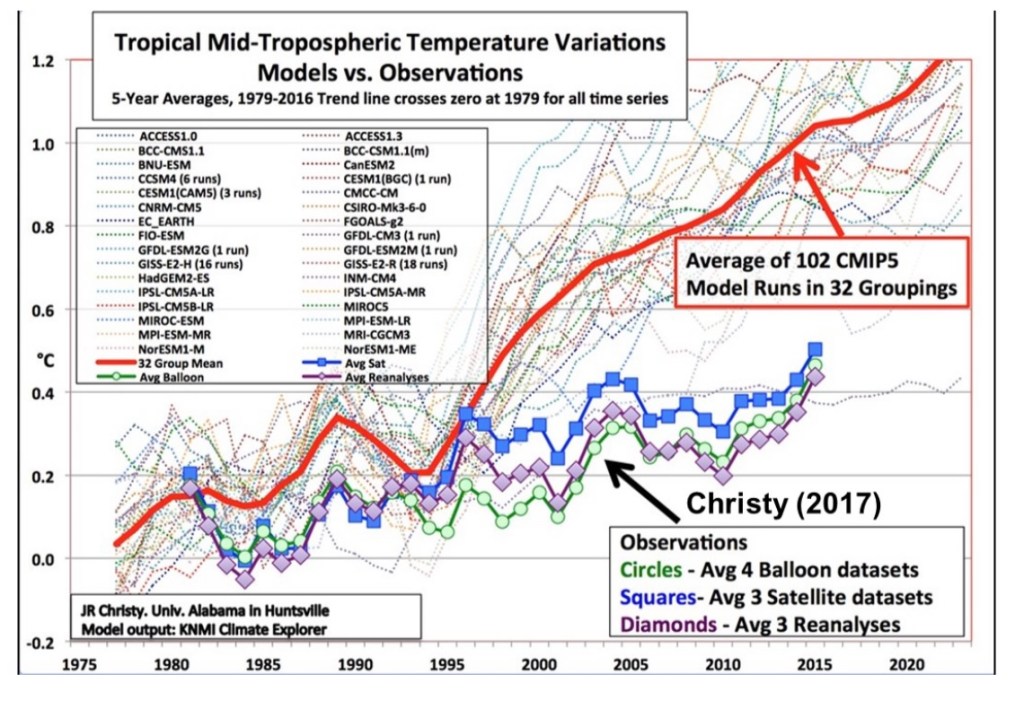
I’ll explain the context of this comment below, but it constitutes a telling admission of the poor foundations on which climate alarmism rests. The various models used by the IPCCc are all a little different and they are calibrated differently. I’ve noted elsewhere that their projections are consistently biased toward severe over-predictions of temperature trends. Rogers goes on from there:

“The models can’t properly model the Earth’s climate, but we are supposed to believe that, if carbon dioxide has a certain effect on the imaginary Earths of the many models it will have the same effect on the real earth.”

But how on earth can a modeler accept the poor track record of these models? It’s not as if the bias is difficult to detect! On this question, Rogers says:

“The climate models are an exemplary representation of confirmation bias, the psychological tendency to suspend one’s critical facilities in favor of welcoming what one expects or desires. Climate scientists can manipulate numerous adjustable parameters in the models that can be changed to tune a model to give a ‘good’ result.“

And why are calamitous projections desirable from the perspective of climate modelers? Follow the money and the status rewards of reinforcing the groupthink:

“Once money and status started flowing into climate science because of the disaster its denizens were predicting, there was no going back. Imagine that a climate scientist discovers gigantic flaws in the models and the associated science. Do not imagine that his discovery would be treated respectfully and evaluated on its merits. That would open the door to reversing everything that has been so wonderful for climate scientists. Who would continue to throw billions of dollars a year at climate scientists if there were no disasters to be prevented? “

Indeed, it has been a gravy train. Today, it is reinforced by green-preening politicians, the many billions of dollars committed by investors seeking a continuing flow of public subsidies for renewables, tempting opportunities for international redistribution (and graft), and a mainstream media addicted to peddling scare stories. The parties involved all rely on, and profit by, alarmist research findings.

Rogers’ use of the Trenberth quote above might suggest that Trenberth is a critic of the climate models used by the IPCC. However, the statement was in-line with Trenberth’s long-standing insistence that the IPCC models are exclusively for constructing “what-if” scenarios, not actual forecasting. Perhaps his meaning also reflected his admission that climate models are “low resolution” relative to weather forecasting models. Or maybe he was referencing longer-term outcomes that are scenario-dependent. Nevertheless, the quote is revealing to the extent that one would hope these models are well-calibrated to initial conditions. That is seldom the case, however.

As a modeler, I must comment on a point made by Rogers about the use of ensembles of models. That essentially means averaging the predictions of multiple models that differ in structure. Rogers denigrates the approach, and while it is agnostic with respect to theories of the underlying process generating the data, it certainly has its uses in forecasting. Averaging the predictions of two different models with statistically independent and unbiased predictions will generally produce more accurate forecasts than the individual models. Rogers may or may not be aware of this, but he has my sympathies in this case because the IPCC is averaging across a large number of models that are clearly biased in the same direction! Rogers adds this interesting tidbit on the IPCC’s use of model ensembles:

“There is a political reason for using ensembles. In order to receive the benefits flowing from predicting a climate catastrophe, climate science must present a unified front. Dissenters have to be canceled and suppressed. If the IPCC were to select the best model, dozens of other modeling groups would be left out. They would, no doubt, form a dissenting group questioning the authority of those that gave the crown to one particular model.”

Rogers discusses one more aspect of the underpinnings of climate models, one that I’ve covered several times on this blog. That is the extent to which historical climate data is either completely lacking, plagued by discontinuities or coverage, or distorted by imperfections in measurement. The data used to calibrate climate models has been manipulated, adjusted, infilled, and estimated over lengthy periods by various parties to produce “official” and unofficial temperature series. While these efforts might seem valiant as exercises in understanding the past, they are fraught with uncertainty. Rogers provides a link to the realclimatescience blog, which details many of the data shortcomings as well as shenanigans perpetrated by researchers and agencies who have massaged, imputed, or outright created these historical data sets out of whole cloth. Rogers aptly notes:

“The purported climate catastrophe ahead is 100% junk science. If the unlikely climate catastrophe actually happens, it will be coincidental that it was predicted by climate scientists. Most of the supporting evidence is fabricated.”


Hyperbolic Scenarios, Crude Climate Models, and Scientism

07 Sunday Nov 2021

Posted by Nuetzel in Climate science, Global Warming

≈ 6 Comments

Tags

Carbon Efficiency, Carbon forcing, carbon Sensitivity, Cloud Feedback, COP26, G20, Global Temprature, IEA, Intergovernmental Panel on Climate Change, International Energy Agency, IPCC, Joe Biden, Joe Brandon, Judith Curry, Justin Ritchie, Net Zero Emissions, Nic Lewis, Precautionary Principle, Prince Charles, RCP8.5, rent seeking, Representative Concentration Pathway, Roger Pielke Jr., Scientism, United Nations

What we hear regarding the dangers of climate change is based on predictions of future atmospheric carbon concentrations and corresponding predictions of global temperatures. Those predictions are not “data” in the normal, positive sense. They do not represent “the way things are” or “the way things have been”, though one might hope the initial model conditions align with reality. Nor can the predictions be relied upon as “the way things will be”. Climate scientists normally report a range of outcomes produced by models, yet we usually hear only one type of consequence for humanity: catastrophe!

Models Are Not Reality

The kinds of climate models quoted by activists and by the UN’s Intergovernmental Panel on Climate Change (IPCC) have been around for decades. Known as “carbon forcing” models, they are highly simplified representations of the process determining global temperatures. The primary forecast inputs are atmospheric carbon concentrations over time, which again are themselves predictions.

It’s usually asserted that climate model outputs should guide policy, but we must ask: how much confidence can we have in the predictions to allow government to take coercive actions having immediate, negative impacts on human well being? What evidence can be marshaled to show prospective outcomes under proposed policies? And how well do these models fit the actual, historical data? That is, how well do model predictions track our historical experience, given the historical paths of inputs like carbon concentrations?

Faulty Inputs

The IPCC has been defining and updating sets of carbon scenarios since 1990. The scenarios outline the future paths of greenhouse gas emissions (and carbon forcings). They were originally based on economic and demographic modeling before an apparent “decision by committee” to maintain consistency with scenarios issued in the past. Roger Pielke Jr. and Justin Ritchie describe the evolution of this decision process, and they call for change:

“Our research (and that of several colleagues) indicates that the scenarios of greenhouse gas (GHG) emissions through the end of the twenty-first century are grounded in outdated portrayals of the recent past. Because climate models depend on these scenarios to project the future behavior of the climate, the outdated scenarios provide a misleading basis both for developing a scientific evidence base and for informing climate policy discussions. The continuing misuse of scenarios in climate research has become pervasive and consequential—so much so that we view it as one of the most significant failures of scientific integrity in the twenty-first century thus far. We need a course correction.”

One would certainly expect the predicted growth of atmospheric carbon to evolve over time. However, as Pielke and Ritchie note, the IPCC’s baseline carbon scenario today, known as RCP8.5 (“Representative Concentration Pathway”), is remarkably similar to the “business as usual” (BAU) scenario it first issued in 1990:

“The emissions scenarios the climate community is now using as baselines for climate models depend on portrayals of the present that are no longer true. And once the scenarios lost touch with reality, so did the climate, impact, and economic models that depend on them for their projections of the future. Yet these projections are a central part of the scientific basis upon which climate policymakers are now developing, debating, and adopting policies.”

The authors go on to discuss a few characteristics of the BAU scenario that today seem implausible, including:

“… RCP8.5 foresees carbon dioxide emissions growing rapidly to at least the year 2300 when Earth reaches more than 2,000 ppm of atmospheric carbon dioxide concentrations. But again, according to the IEA and other groups, fossil energy emissions have likely plateaued, and it is plausible to achieve net-zero emissions before the end of the century, if not much sooner.”

Pielke and Ritchie demonstrate that the IPCC’s baseline range of carbon emissions by 2045 is centered well above (actually double) the mid-range of scenarios developed by the International Energy Agency (IEA), and there is very little overlap between the two. However, global carbon emissions have been flat over the past decade. Even if we extrapolate the growth in atmospheric CO2 parts per million over the past 20 years, it would rise to less than 600 ppm by 2100, not 1,200 ppm. It’s true that a few countries (China comes to mind) continue to exploit less “carbon efficient” energy resources like coal, but the growth trend in concentrations is likely to continue to taper over time.

It therefore appears that the IPCC’s climate scenarios, which are used broadly as model inputs by the climate research community, are suspect. As one might suspect: garbage in, garbage out. But what about the climate models themselves?

Faulty Models

The model temperature predictions have been grossly in error. They have been and continue to be “too hot”. The chart at the top of this post is typical of the comparisons of model projections and actual temperatures. Before the year 2000, most of the temperature paths projected by the particular model charted above ran higher than actual temperatures. However, the trends subsequently diverged and the gap has become more extreme over the past two decades.

The problem is not merely one of faulty inputs. The models themselves are deeply flawed, as they fail to account adequately for natural forces that strongly influence our climate. It’s been clear for many years that the sun’s radiative energy has a massive impact on temperatures, and it is affected not only by the intensity of the solar cycle but also by cloud cover on Earth. Unfortunately, carbon forcing models do not agree on the role that increased clouds might have in amplifying warming. However, a reduction in cloud cover over the past 20 years, and a corresponding increase in radiative heat, can account for every bit of the warming experienced over that time.

This finding not only offers an alternative explanation for two decades of modest warming, it also strikes at the very heart of the presumed feedback mechanism usually assumed to amplify carbon-induced warming. The overall effect is summarized by the so-called carbon sensitivity, measured as the response of global temperature to a doubling of carbon concentration. The IPCC puts that sensitivity in a range of 1.5C to 4.5C. However, findings published by Nic Lewis and Judith Curry are close to the low end of that range, as are those found by Frank Bosse reported here. The uncertainties surrounding the role of cloud cover and carbon sensitivities reveal that the outputs relied upon by climate alarmists are extreme model simulations, not the kind of reliable intelligence upon which drastic policy measures should be taken.

The constant anxiety issued from the Left on the issue of climate change, and not a little haranguing of the rest of us, is misplaced. The IPCC’s scenarios for the future paths of carbon concentration are outdated and seriously exaggerated, and they represent a breach of scientific protocol. Yet the scenarios are widely used as the basis of policy discussions at both the domestic and international levels. The climate models themselves embed questionable assumptions that create a bias toward calamitous outcomes.

Yet Drastic Action Is Urged

The UN’s 2021 climate conference, or COP26 (“Conference of the Parties …”) is taking place in Glasgow, Scotland this month. Like earlier international climate conferences, the hope is that dire forecasts will prompt broad agreement on goals and commitments, and that signatory countries will translate these into policy at the national level.

Things got off to a bad start when, before COP26 even began, the G20 nations failed to agree on a goal of “net-zero” carbon emissions by 2050. Another bad portent for the conference is that China and India, both big carbon emitters, will not attend, which must be tremendously disappointing to attendees. After all, COP26 has been billed by Prince Charles himself as “the last chance saloon, literally”, for saving the world from catastrophe. He said roughly the same thing before the Paris conference in 2014. And Joe Brandon … er, Biden, blurted some hyperbole of his own:

“Climate change is already ravaging the world. … It’s destroying people’s lives and livelihoods and doing it every single day. … It’s costing our nations trillions of dollars.”

All this is unadulterated hogwash. But it is the stuff upon which a crisis-hungry media feeds. This hucksterism is but one form of climate rent-seeking. Other forms are much more troubling: scary scenarios and model predictions serve the self-interest of regulators, grant-seeking researchers, interventionist politicians, and green investors who suckle at the public teat. It is a nightmare of scientism fed by the arrogance of self-interested social planners. The renewable energy technologies promoted by these investors, politicians, and planners are costly and land-intensive, providing only intermittent output (requiring backup fossil fuel capacity), and they have nasty environmental consequences of their own.

The precautionary principle is no excuse for the extreme policies advocated by alarmists. We already have economically viable “carbon efficient” and even zero-carbon energy alternatives, such as natural gas, modular nuclear power, and expanded opportunities for exploiting geothermal energy. This argues against premature deployment of wasteful renewables. The real crisis is the threat posed by the imposition of draconian green policies to our long-term prosperity, and especially to the world’s poor.

Green Climate Policy Wreaks Poverty

03 Friday Sep 2021

Posted by Nuetzel in Climate science, Environmental Fascism

≈ 6 Comments

Tags

Assessment Report #6, Carbon Emissions, Cooling the Past, Deforestation, Democratic Republic of Congo, Diablo Canyon, Disparate impact, Economic Development, Energy Poverty, Fossil fuels, Hügo Krüger, Intergovernmental Panel on Climate Change, IPCC, Jennifer Marohasy, Jim Crow Environmentalism, Joel Kotkin, Judith Curry, Michael Schellenberger, Natural Gas, Net Zero Carbon, Nuclear power, Rare Earth Minerals, Regressive Policy, Remodeled Temperatures, Renewable energy, Steve Koonin

Have no doubt: climate change warriors are at battle with humanity itself, ostensibly on behalf of the natural world. They would have us believe that their efforts to eliminate the use of fossil fuels are necessary to keep our planet from becoming a blazing hothouse. However, the global temperature changes we’ve witnessed over the past 150 years, based on the latest Assessment Report (AR6) from the Intergovernmental Panel on Climate Change (IPCC), are well within the range of historical variation.

“Remodeled” History

Jennifer Marohasy posted an informative discussion of the IPCC’s conclusions last month, putting them into a broader climatological context and focusing in particular on measurement issues. In short, discussing “global” temperatures with any exactitude is something of a sham. Moreover, the local temperature series upon which the global calculations are based have been “remodeled.” They are not direct observations. I don’t think it’s too crude to say they’ve been manipulated because the changed records are almost always in one direction: to “cool” the past.

Judith Curry is succinct in her criticism of the approach to climate change adopted by alarmist policymakers and many climate researchers: 

“In a nutshell, we’ve vastly oversimplified both the problem and its solutions. The complexity, uncertainty, and ambiguity of the existing knowledge about climate change is being kept away from the policy and public debate. The solutions that have been proposed are technologically and politically infeasible on a global scale.”

We need a little more honesty!

The Real Victims

I want to focus here on some of the likely casualties of the war on fossil fuels. Those are, without a doubt, the world’s poor, who are being consigned by climate activists to a future of abject suffering. Joel Kotkin and Hügo Krüger are spot-on in their recent piece on the inhumane implications of anti-carbon ideology.

Energy-poor areas of the world are now denied avenues through which to enhance their peoples’ well being. Attempts to fund fossil-fuel power projects are regularly stymied by western governments and financial institutions in the interests of staving off political backlash from greens. Meanwhile, far more prosperous nations power their economies with traditional carbon-based energy sources. Most conspicuously, China continues to fuel its rapid growth with coal and other fossil fuels, getting little pushback from climate activists. If you’re wondering how the composition of energy output has evolved, this time-lapse chart is a pretty good guide.

One of the most incredible aspects of this situation is how nuclear energy has been spurned, despite its status as a proven and safe solution to carbon-free power. This excellent thread by Michael Schellenberger covers the object lesson in bad public policy offered by the proposed closing of the Diablo Canyon nuclear plant in California.

In both the U.S. and other parts of the world, as Kotkin and Krüger note, it is not just the high up-front costs that lead to the rejection of these nuclear projects. The green lobby and renewable energy interests are now so powerful that nuclear energy is hardly considered. Much the same is true of low-carbon natural gas: 

“Sadly, the combination of virtue-signaling companies and directives shaped by green activists in rich countries – often based on wildly exaggerated projections, notes former Barack Obama advisor Steve Koonin – make such a gradual, technically feasible transition all but impossible. Instead, it is becoming increasingly unlikely that developing countries will be able to tap even their own gas.”

Energy is the lifeblood of every economy. Inadequate power creates obstacles to almost any form of production and renders some kinds of production impossible. And ironically, the environmental consequences of “energy poverty” are dire. Many under-developed economies are largely dependent on deforestation for energy. Without a reliable power grid and cheap energy, consumers must burn open fires in their homes for heat and cooking, a practice responsible for 50% of child pneumonia deaths worldwide, according to Kotkin and Krüger.

Green Environmental Degradation

Typically, under-developed countries are reliant on the extraction of natural resources demanded by the developed world:

“The shift to renewables in the West, for example, has increased focus on developing countries as prime sources for critical metals – copper, lithium, and rare-earth minerals, in particular – that could lead to the devastation of much of the remaining natural and agricultural landscape. … Lithium has led to the depletion of water resources in Latin America and the further entrenchment of child labor in the Democratic Republic of the Congoas the search for cobalt continues.”

Unfortunately, the damage is not solely due to dependence on resource extraction:

“The western greens, albeit unintentionally, are essentially turning the Third World into the place they send their dirty work. Already, notes environmental author Mike Shellenberger, Africans are stuck with loads of discarded, highly toxic solar panels that expose both the legions of rag-pickers and the land itself to environmental degradation – all in the name of environmentalism.”

Battering the Poor In the West

Again, wealthy countries are in far better shape to handle the sacrifices required by the climate calamitists, but it still won’t be easy. In fact, lower economic strata will suffer far more than technocrats, managers, and political elites. The environmental left leans on the insidious lever of energy costs in order to reduce demand, but making energy more costly takes a far larger bite out of the budgets of the poor. In another recent piece, “Jim Crow Returns to California,” Kotkin discusses the disparate impact these energy policies have on minorities. 

“This surge in prices derives from the state’s obsession — shared by the ruling tech oligarchs — with renewable energy and the elimination of fossil fuels. Yet as a recent Massachusetts Institute of Technology (MIT) report has shown, over-reliance on renewables is costly, because it requires the production of massive (and environmentally unfriendly) battery-storage capacity — the price of which is invariably passed on to the taxpayer.

This is not bad news for the tech oligarchs, who have been prominent among those profiting from ‘clean energy’ investments. But many other Californians, primarily those in the less temperate interior, find themselves falling into energy poverty or are dependent on state subsidies that raise electricity prices for businesses and the middle class. Black and Latino households are already forced to pay from 20 to 43% more of their household incomes on energy than white households. Last year, more than 4 million households in California (30% of the total) experienced energy poverty.”

Kotkin touches on other consequences of these misguided policies to minority and non-minority working people. In addition to jobs lost in the energy sector, a wide variety of wage earners will suffer as their employers attempt to deal with escalating energy costs. The immediate effects are bad enough, but in the long-run the greens’ plans would scale back the economy’s productive machinery in order to eliminate carbon emissions — net zero means real incomes will decline! 

Energy costs have a broad impact on consumer’s budgets. Almost every product imaginable is dependent on energy, and consumer prices will reflect the higher costs. In addition, the “green” effort to curtail development everywhere except in high-density transit corridors inflates the cost of housing, inflicting more damage on workers’ standards of living.

Tighten Your Belts

These problems won’t be confined to California if environmental leftists get their version of justice. Be prepared for economic stagnation for the world’s poor and a sharply reduced standard of living in the developed world, but quite unnecessarily. We’ll all pay in the long run, but the poor will pay much more in relative terms.

Follow Sacred Cow Chips on WordPress.com

Recent Posts

  • Immigration and Merit As Fiscal Propositions
  • Tariff “Dividend” From An Indigent State
  • Almost Looks Like the Fed Has a 3% Inflation Target
  • Government Malpractice Breeds Health Care Havoc
  • A Tax On Imports Takes a Toll on Exports

Archives

  • December 2025
  • November 2025
  • October 2025
  • September 2025
  • August 2025
  • July 2025
  • June 2025
  • May 2025
  • April 2025
  • March 2025
  • February 2025
  • January 2025
  • December 2024
  • November 2024
  • October 2024
  • September 2024
  • August 2024
  • July 2024
  • June 2024
  • May 2024
  • April 2024
  • March 2024
  • February 2024
  • January 2024
  • December 2023
  • November 2023
  • August 2023
  • July 2023
  • June 2023
  • May 2023
  • April 2023
  • March 2023
  • February 2023
  • January 2023
  • December 2022
  • November 2022
  • October 2022
  • September 2022
  • August 2022
  • July 2022
  • June 2022
  • May 2022
  • April 2022
  • March 2022
  • February 2022
  • January 2022
  • December 2021
  • November 2021
  • October 2021
  • September 2021
  • August 2021
  • July 2021
  • June 2021
  • May 2021
  • April 2021
  • March 2021
  • February 2021
  • January 2021
  • December 2020
  • November 2020
  • October 2020
  • September 2020
  • August 2020
  • July 2020
  • June 2020
  • May 2020
  • April 2020
  • March 2020
  • February 2020
  • January 2020
  • December 2019
  • November 2019
  • October 2019
  • September 2019
  • August 2019
  • July 2019
  • June 2019
  • May 2019
  • April 2019
  • March 2019
  • February 2019
  • January 2019
  • December 2018
  • November 2018
  • October 2018
  • September 2018
  • August 2018
  • July 2018
  • June 2018
  • May 2018
  • April 2018
  • March 2018
  • February 2018
  • January 2018
  • December 2017
  • November 2017
  • October 2017
  • September 2017
  • August 2017
  • July 2017
  • June 2017
  • May 2017
  • April 2017
  • March 2017
  • February 2017
  • January 2017
  • December 2016
  • November 2016
  • October 2016
  • September 2016
  • August 2016
  • July 2016
  • June 2016
  • May 2016
  • April 2016
  • March 2016
  • February 2016
  • January 2016
  • December 2015
  • November 2015
  • October 2015
  • September 2015
  • August 2015
  • July 2015
  • June 2015
  • May 2015
  • April 2015
  • March 2015
  • February 2015
  • January 2015
  • December 2014
  • November 2014
  • October 2014
  • September 2014
  • August 2014
  • July 2014
  • June 2014
  • May 2014
  • April 2014
  • March 2014

Blogs I Follow

  • Passive Income Kickstart
  • OnlyFinance.net
  • TLC Cholesterol
  • Nintil
  • kendunning.net
  • DCWhispers.com
  • Hoong-Wai in the UK
  • Marginal REVOLUTION
  • Stlouis
  • Watts Up With That?
  • Aussie Nationalist Blog
  • American Elephants
  • The View from Alexandria
  • The Gymnasium
  • A Force for Good
  • Notes On Liberty
  • troymo
  • SUNDAY BLOG Stephanie Sievers
  • Miss Lou Acquiring Lore
  • Your Well Wisher Program
  • Objectivism In Depth
  • RobotEnomics
  • Orderstatistic
  • Paradigm Library
  • Scattered Showers and Quicksand

Blog at WordPress.com.

Passive Income Kickstart

OnlyFinance.net

TLC Cholesterol

Nintil

To estimate, compare, distinguish, discuss, and trace to its principal sources everything

kendunning.net

The Future is Ours to Create

DCWhispers.com

Hoong-Wai in the UK

A Commonwealth immigrant's perspective on the UK's public arena.

Marginal REVOLUTION

Small Steps Toward A Much Better World

Stlouis

Watts Up With That?

The world's most viewed site on global warming and climate change

Aussie Nationalist Blog

Commentary from a Paleoconservative and Nationalist perspective

American Elephants

Defending Life, Liberty and the Pursuit of Happiness

The View from Alexandria

In advanced civilizations the period loosely called Alexandrian is usually associated with flexible morals, perfunctory religion, populist standards and cosmopolitan tastes, feminism, exotic cults, and the rapid turnover of high and low fads---in short, a falling away (which is all that decadence means) from the strictness of traditional rules, embodied in character and inforced from within. -- Jacques Barzun

The Gymnasium

A place for reason, politics, economics, and faith steeped in the classical liberal tradition

A Force for Good

How economics, morality, and markets combine

Notes On Liberty

Spontaneous thoughts on a humble creed

troymo

SUNDAY BLOG Stephanie Sievers

Escaping the everyday life with photographs from my travels

Miss Lou Acquiring Lore

Gallery of Life...

Your Well Wisher Program

Attempt to solve commonly known problems…

Objectivism In Depth

Exploring Ayn Rand's revolutionary philosophy.

RobotEnomics

(A)n (I)ntelligent Future

Orderstatistic

Economics, chess and anything else on my mind.

Paradigm Library

OODA Looping

Scattered Showers and Quicksand

Musings on science, investing, finance, economics, politics, and probably fly fishing.

  • Subscribe Subscribed
    • Sacred Cow Chips
    • Join 128 other subscribers
    • Already have a WordPress.com account? Log in now.
    • Sacred Cow Chips
    • Subscribe Subscribed
    • Sign up
    • Log in
    • Report this content
    • View site in Reader
    • Manage subscriptions
    • Collapse this bar
 

Loading Comments...