• About

Sacred Cow Chips

Sacred Cow Chips

Tag Archives: Intermittancy

Net Zero: It Ain’t Gonna Happen

15 Thursday Sep 2022

Posted by Nuetzel in Central Planning, Environmental Fascism, Renewable Energy

≈ 4 Comments

Tags

Backup Capacity, Brad Allenby, Carbon Capture, Cost Parity, Decarbonization, El Hierro, Ezra Klein, Francis Minton, Geothermal, Green Energy, Green Mandates, Hydrocarbons, Intermittancy, Joseph Sternberg, Land Use Requirements, Legal Insurrection, Lithium Batteries, Manhattan Contrarian, Mark P. Mills, Murtaza Hussain, Net Zero, Rare Earth Minerals, Renewable, Solar Power, The Intercept, Tuomas Malinen, Walter Jacobson, Wind Power

A number of countries have targeted net zero carbon dioxide emissions, to be achieved within various “deadlines” over the next few decades. The target dates currently range from 2030 -2050. Political leaders around the world are speaking in the tongues favored by climate change fundamentalism, as Brad Allenby aptly named the cult some years ago. The costly net zero goal is a chimera, however. The effort to completely substitute renewables — wind and solar — for fossil fuels will fail without question. In fact, net zero carbon emissions is unlikely to be achieved anywhere in this century without massive investments in nuclear power. Wind and solar energy suffer from a fatal flaw: intermittency. They will never be able to provide for all energy needs without a drastic breakthrough in battery technology, which is not on the horizon. Geothermal power might make a contribution, but it won’t make much of a dent in our energy needs any time soon. Likewise, carbon capture technology is still in its infancy, and it cannot be expected to offset much of the carbon released by our unavoidable reliance on fossil fuels.

Exposing Green Risks

The worst of it is that net zero mandates will inflict huge costs on society. Indeed, various efforts to force conversion to “green” energy technologies have already raised costs and exposed humanity to immediate threats to health and well being. These realities are far more palpable than the risks posed by speculative model predictions of climate change decades ahead. As Joseph Sternberg notes at the link above, climate policies:

“… have created an energy system of dangerous rigidity and inefficiency incapable of adapting to a blow such as Russia’s partial exit from the European gas market. It’s almost inevitable that the imminent result will be a recession in Europe. We can only hope that it won’t also trigger a global financial crisis.”

Escalating energy costs are inflicting catastrophic harm on businesses large and small throughout the West, but especially in Europe and the UK. A Finnish economist recently commented on these conditions, as quoted by Walter Jacobson at the Legal Insurrection blog:

“I saw this tweet thread by Finnish economist and professor Tuomas Malinen:

I am telling you people that the situation in #Europe is much worse than many understand. We are essentially on the brink of another banking crisis, a collapse of our industrial base and households, and thus on the brink of the collapse of our economies.”

Jacobson also offers the following quote from Murtaza Hussain of The Intercept:

“If you turned the electricity off for a few months in any developed Western society 500 years of supposed philosophical progress about human rights and individualism would quickly evaporate like they never happened.”

Where’s the Proof of Concept?

This is not all about Russian aggression, however. We’ve seen the cost consequences of “green” mandates and forced conversion to wind and solar in places like California, Texas, and Germany even before Russia invaded Ukraine and began starving Europe of natural gas.

Frances Minton at the Manhattan Contrarian blog points to one of the most remarkable aspects of the singular focus on net zero: the complete absence of any successful demonstration project anywhere on the globe! The closest things to such a test are cited by Minton. One is on El Hierro in Spain’s Canary Islands, which has wind turbine capacity of more than double average demand, It also has pumped storage with hydro generators for more than double average demand. In 2020, however, El Hierro took all of its power from the combined wind/storage system only about 15% of the time. 2021 didn’t look much better. Diesel power is used to fill in the frequent “shortfalls”.

Land Use

The land use requirements of a large scale transition to wind and solar are incredible, given projected technological capabilities. Ezra Klein explains:

“The center of our decarbonization strategy is an almost unimaginably large buildup of wind and solar power. To put some numbers to that: A plausible path to decarbonization, modeled by researchers at Princeton, sees wind and solar using up to 590,000 square kilometers – which is roughly equal to the land mass of Connecticut, Illinois, Indiana, Kentucky, Massachusetts, Ohio, Rhode Island and Tennessee put together. ‘The m footprint is very, very large, and people don’t really understand that,’ Danny Cullenward, co author of ‘Making Climate Policy Work’, told me.”

That’s a major obstacle to accelerating the transition to wind and solar power, but there are many others.

A Slap of Realism

Mark P. Mills elaborates on the daunting complexity and costs of the transition, and like land use requirements, they are all potential show stoppers. It’s a great article excepting a brief section that reveals a poor understanding of monetary theory. Putting that aside, it’s first important to reemphasize what should be obvious: shutting down production of fossil fuels makes them scarce and more costly,. This immediately reduces our standard of living and hampers our future ability to respond to tumultuous circumstances as are always likely to befall us. Mills makes that abundantly clear:

“… current policies and two decades of mandates and spending on a transition have led to escalating energy prices that help fuel the destructive effects of inflation. The price of oil, which powers nearly 97% of all transportation, is on track to reach or exceed half-century highs, and gasoline prices have climbed. The price of natural gas, accounting for 40% of all industrial energy use and one-fourth of global electricity, has soared past a decadal high. Coal prices are also at a decadal high. Coal fuels 40% of global electricity; it is also used to make 70% of all steel and accounts for half its cost of production.

It bears noting that energy prices started soaring, and oil breached $100 a barrel, well before Russia invaded Ukraine in late February. The fallout from that invasion has hardened, not resolved, the battle lines between those advocating for and those skeptical of government policies directed at accelerating an energy transition. …

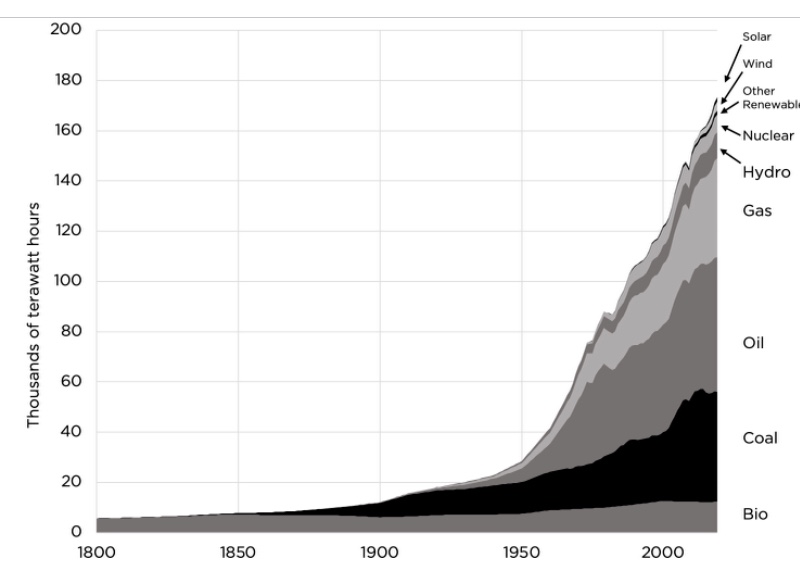
Civilization still depends on hydrocarbons for 84% of all energy, a mere two percentage points lower than two decades ago. Solar and wind technologies today supply barely 5% of global energy. Electric vehicles still offset less than 0.5% of world oil demand.”

As Mills says, it surprises most people that today’s high tech sectors, such as electronic devices like phones and computers, and even drugs, require much more energy relative to product size and weight than traditional manufactured goods. Even the cloud uses vast quantities of energy. Yet U.S. carbon intensity per dollar of GDP has declined over the past 20 years. That’s partly due to the acquisition of key components from abroad, mitigation efforts here at home, and the introduction of renewables. However, the substitution of natural gas for other fossil fuels played a major role. Still, our thirst for energy intensive technologies will cause worldwide demand for energy to continue to grow, and renewables won’t come close to meeting that demand.

Capacity Costs

Policy makers have been deceived by cost estimates associated with additions of renewable capacity. That’s due to the fiction that renewables can simply replace hydrocarbons, but the intermittency of solar and wind power mean that demand cannot be continuously matched by renewables capacity. Additions to renewables capacity requires reliable and sometimes redundant backup capacity. At the risk of understatement, this necessity raises the marginal cost of renewable additions significantly if the hope is to meet growth in demand.

Furthermore, as Mills points out, renewables have not reached cost parity with fossil fuels, contrary to media hype and an endless flow of propaganda from government and the “green” investors seeking rents from government. Subsidies to renewables have created an illusion that costs that are lower than they are in reality.

So Many Snags

From Mills, here are a few of the onerous cost factors that will present severe obstacles to even a partial transition to renewables:

  • Even with the best battery technology now available, using lithium, storing power is still extremely expensive. Producing and storing it at scale for periods long enough to serve as a true source of power redundancy is prohibitive.
  • The infrastructure buildout required for a hypothetical transition to zero-carbon is massive. The quantity of raw materials needed would be far in excess of those used in our investments in energy infrastructure over at least the past 60 years.
  • Even the refueling infrastructure required for a large increase in the share of electronic vehicles on the road would require a massive investment, including more land and at much greater expense than traditional service stations. That’s especially true considering the grid enhancements needed to deliver the power.
  • The transition would place a huge strain on the world’s ability to mine minerals such as lithium, graphite, nickel, and rare earths. Mills puts the needed increases in supply at 4,200%, 2,500%, 1,900%, and 700%, respectively, by 2040. In fact, the known global reserves of these minerals are inadequate to meet these demands.
  • Mining today is heavily reliant on hydrocarbon power, of course. Moreover, all this mining activity would have devastating effects on the environment, as would disposal of “green” components as they reach their useful lives. The latter is a disaster we’re already seeing played out in the third world, where we are exporting much of our toxic, high-tech waste.
  • The time it would take to make the transition to zero carbon would far exceed the timetable specified in the mandates already in place. It’s realistic to admit that development of new mines, drastic alterations of land use patterns, construction of new generating capacity, and the massive infrastructure buildout will stretch out for many decades.
  • Given U.S. dependence on imports of a large number of minerals now considered “strategic”, decarbonization will require a major reconfiguration of supply chains. In fact, political instability in parts of the world upon which we currently rely for supplies of these minerals makes the entire enterprise quite brittle relative to reliance on fossil fuels.

Conclusion

The demands for raw materials, physical capital and labor required by the imagined transition to net zero carbon dioxide emissions will put tremendous upward pressure on prices. The coerced competition for resources will mean sacrifices in other aspects of our standard of living, and it will have depressing effects on other markets, causing their relative prices to decline.

For all the effort and cost of the mandated transition, what will we get? Without major investments in reliable but redundant backup capacity, we’ll get an extremely fragile electric grid, frequent power failures, a diminished standard of living, and roughly zero impact on climate. In other words, it will be a major but unnecessary and predictably disastrous exercise in central planning. We’ve already seen the futility of this effort in the few, small trials that have been undertaken, but governments, rent-seeking investors, and green activists can’t resist plunging us headlong into the economic abyss. Don’t let them do it!
Rejecting Fossil Fuels at Our Great Peril

18 Wednesday May 2022

Posted by Nuetzel in Central Planning, Energy, Risk, Technology

≈ 2 Comments

Tags

Bartley J. Madden, Biden Administration, Dan Ervin, Don Boudreaux, Electric Vehicles, Energy Mandates, Energy subsidies, EV Adoption, External Benefits, External Costs, Fossil fuels, Grid Stability, Intermittancy, Kevin Williamson, Markets, Power Outages, Price Controls, regressivity, Renewable energy, Russia Sanctions, SEC Carbon Mandate, Sustainability

The frantic rush to force transition to a zero-carbon future is unnecessary and destructive to both economic well-being and the global environment. I do not subscribe to the view that a zero-carbon goal is an eventual necessity, but even if we stipulate that it is, a rational transition would eschew the immediate abandonment of fossil fuels and adopt a gradual approach relying heavily on market signals rather than a mad dash via coercion.

I’ve written about exaggerated predictions of temperature trends and catastrophes on a number of occasions (and see here for a similar view from a surprising source). What might be less obvious is the waste inherent in forcing the abandonment of mature and economic technologies in favor of, as yet, under-developed and uneconomic technologies. These failures should be obvious when the grid fails, as it does increasingly. It is often better to leave the development and dispersion of new technologies to voluntary decision-making. In time, advances will make alternative, low- or zero-carbon energy sources cost effective and competitive to users. That will include efficient energy storage at scale, new nuclear technologies, geothermal techniques, and further improvements in the carbon efficiency of fossil fuels themselves. These should be chosen by private industry, not government planners.

Boneheads At the Helm

Production of fossil fuels has been severely hampered by the Biden Administration’s policies. The sanctions on Russian oil that only began to take hold in March have caused an additional surge in the price of oil. Primarily, however, we’ve witnessed an artificial market disruption instigated by Biden’s advisors on environmental policy. After all, neither Russian oil imports nor the more recent entreaties to rogue states as Iraq and Venezuela for oil would have been necessary if not for the Administration’s war on fossil fuels. Take a gander at this White House Executive Order issued in January 2021. It reads like a guidebook on how to kill an industry. In a column this weekend, Kevin Williamson quipped about “the Biden administration’s uncanny ability to get everything everywhere wrong all at once.” That was about policy responses to inflation, but it applies to energy in particular.

Scorning the Miracle

Fossil fuels are the source of cheap and reliable energy that have lifted humanity to an unprecedented level of prosperity. Fossil fuels have given a comfortable existence to billions of people, allowing them to rise out of poverty. This prosperity gives us the luxury of time to develop substitutes, not to mention much greater safety against the kind of weather extremes that have always been a fact of life. The world still gets 80% of its energy from fossil fuels. These fuels are truly a miracle, and we should not discard such valuable technologies prematurely. That forces huge long-term investments in inferior technologies that are likely to be superseded in the future by more economic refinements or even energy sources and methods now wholly unimagined. There are investors who will still wish to pursue those new technologies, perhaps with non pecuniary motives, and there are a few consumers who really want alternatives to fossil fuels.

Biden’s apparent hope that his aggressive climate agenda will be a great legacy of his presidency is at the root of his intransigence toward fossil fuels. His actions in this regard have had a profoundly negative psychological effect on the oil and gas industry. Steps such as cancellations of pipeline projects are immediately impactful in that regard, to say nothing of the supplies that would have ultimately flowed through those pipelines. These cancellations reinforce the message Biden’s been sending to the industry and its investors since his campaign: we mean to shut you down! Who wants to invest in new wells under those circumstances? Other actions have followed: no new federal oil and gas leases, methane restrictions, higher drilling fees on federal land, and a variety of climate change initiatives that bode ill for the industry, such as the SEC’s mandate on carbon disclosures and the Federal Reserve’s proposed role in policing climate impacts.

And now, Democrats are contemplating a move that would make gasoline even more scarce: price controls. As Don Boudreaux says in a recent letter to The Hill:

“Progressives incessantly threaten to tax and regulate carbon fuels into oblivion. These threats cannot but reduce investors’ willingness to fund each of the many steps – from exploration through refining to transporting gasoline to market – that are necessary to keep energy prices low. One reality reflected by today’s high prices at the pump is this hostility to carbon fuels generally and to petroleum especially. And gasoline price controls would only make matters worse by further reducing the attractiveness of investing in the petroleum industry: Why invest in bringing products to market if the prices at which you’re allowed to sell are dictated by grandstanding politicians?”

The kicker is that all these policies are futile in terms of their actual impact on global carbon concentrations, let alone their highly tenuous link to global temperatures. The policies are also severely regressive, inflicting disproportionate harm on the poor, who can least afford such an extravagant transition. Biden wants the country to sacrifice its standard of living in pursuit of these questionable goals, while major carbon-emitting nations like China and India essentially ignore the issue.

Half-Baked Substitution

Market intervention always has downsides to balance against the potential gains of “internalizing externalities”. In this case, the presumed negative externalities are imagined harms of catastrophic climate change from the use of fossil fuels; the presumed external benefits are the avoidance of carbon emissions and climate change via renewables and other “zero-carbon” technologies. With those harms and gains in question, it’s especially important to ask who loses. Taxpayers are certainly on that list. Users of energy produced with fossil fuels end up paying higher prices and are forced to conserve or submit to coerced conversion away from fossil fuels. Then there are the wider impediments to economic growth and, as noted above, the distributional consequences.

Users of immature or inferior energy alternatives might also end up as losers, and there are likely to be external costs associated with those technologies as well. It’s not widely appreciated that today’s so-called clean energy alternatives are plagued by their need to obtain certain minerals that are costly to extract in economic and environmental terms, not to mention highly carbon intensive. And when solar and wind facilities fail or reach the end of their useful lives, disposal creates another set of environmental hazards. In short, the loses imposed through forced internalization of highly uncertain externalities are all too real.

Unfortunately, the energy sources favored by the Administration fail to meet base-load power needs on windless and/or cloudy days. The intermittency of these key renewables means that other power sources, primarily fossil-fuel and nuclear capacity, must remain available to meet demand on an ongoing basis. That means the wind and solar cannot strictly replace fossil fuels and nuclear capacity unless we’re willing to tolerate severe outages. Growth in energy demand met by renewables must be matched by growth in backup capacity.

A call for “energy pragmatism” by Dan Ervin hinges on the use of coal to provide the “bridge to the energy future”, both because there remains a large amount of coal generating capacity and it can stabilize the grid given the intermittency of wind and solar. Ervin also bases his argument for coal on recent increases in the price of natural gas, though a reversal of the Biden EPA’s attacks on gas and coal, which Ervin acknowledges, would argue strongly in favor of natural gas as a pragmatic way forward.

Vehicle Mandates

The Administration has pushed mandates for electric vehicle (EV) production and sales, including subsidized charging stations. Of course, the power used by EVs is primarily generated by fossil fuels. Furthermore, rapid growth in EVs will put a tremendous additional strain on the electric grid, which renewables will not be able to relieve without additional backup capacity from fossil fuels and nuclear. This severely undermines the supposed environmental benefits of EVs.

Once again, mandates and subsidies are necessary because EV technology is not yet economic for most consumers. Those buyers don’t want to spend what’s necessary to purchase an EV, nor do they wish to suffer the inconveniences that re-charging often brings. This is a case in which policy is outrunning the ability of the underlying infrastructure required to support it. And while adoption of EVs is growing, it is still quite low (and see here).

Wising Up

Substitution into new inputs or technologies happens more rationally when prices accurately reflect true benefits and scarcities. The case for public subsidies and mandates in the push for a zero-carbon economy rests on model predictions of catastrophic global warming and a theoretical link between U.S. emissions and temperatures. Both links are weak and highly uncertain. What is certain is the efficiency of fossil fuels to power gains in human welfare.

This Bartley J. Madden quote sums up a philosophy of progress that is commendable for firms, and probably no less for public policymakers:

“Keep in mind that innovation is the key to sustainable progress that jointly delivers on financial performance and taking care of future generations through environmental improvements.”

Madden genuflects to the “sustainability” crowd, who otherwise don’t understand the importance of trusting markets to guide innovation. If we empower those who wish to crush private earnings from existing technologies, we concede the future to central planners, who are likely to choose poorly with respect to technology and timing. Let’s forego the coercive approach in favor of time, development, and voluntary adoption!

Markets Deal With Scarcity, Left Screams “Price Gouging”

11 Monday Apr 2022

Posted by Nuetzel in Antitrust, Environmental Fascism, Oil Prices

≈ Leave a comment

Tags

Antitrust, Barack Obama, central planning, ESG Scores, FDR, Fossil fuels, Gas Prices, Green New Deal, Intermittancy, Joe Biden, Keystone Pipeline, Lawrence Summers, Oil Prices, Oil Profits, OPEC, Power Grid, Price Gouging, Profit Margins, Profiteering, Renewable energy, Strategic Petroleum Reserve, Ukraine Invasion, Vladimir Putin, West Texas Intermediate

Democrats claim profiteering by oil companies is responsible for the sustained rise in oil prices since Joe Biden’s inauguration (really, his election). That’s among the more laughable attempts at gaslighting in recent memory, right up there with blaming market concentration for the sustained increase in inflation since Biden’s inauguration. At a hearing this week, congressional Democrats, frightened by the prospect of a beat-down just ahead in the mid-term elections, couldn’t resist making “price-gouging” accusations against oil producers. These pols stumble over their own contradictory talking points, insisting on more oil production only when they aren’t hastily sabotaging oil and gas output. Their dishonestly is galling, but so is the foolishness of voters who blindly accept the economic illiteracy issuing from that side of the aisle.

Break It Then Blame It

Those who level “price gouging” charges at oil companies are often the same people seeking to eliminate fossil fuel consumption by making those energy choices unaffordable. The latter is a bad look this close to mid-term elections, so they follow the playbook I described recently in “Break the Market, Blame It, Then Break It Some More“. And this post is instructive: “House Dem: Big Oil is profiteering by, er … doing what we demanded”.

Not only have the Democrats’ policies caused oil prices to soar; for many years they’ve been undermining the stability of the power grid via forced conversion into intermittent renewable energy sources like wind and solar, all while preventing the expansion of safe and carbon-free nuclear power generation. It’s ironic that these would-be industrial planners seem so eager to botch the job, though failure is all too typical of central planning. Just ask the Germans about their own hapless efforts at energy planning.

As economist Lawrence Summers, former Treasury Secretary under Barack Obama, said recently:

“Look, the net effect of the things the administration talks about in terms of micro policies to reduce inflation, this gouging talk is frivolous, nonserious, and utterly ineffectual. A gas price holiday would, ultimately, push up prices by raising demand. … The student loan relief … is injecting resources into the economy at a hundred billion dollar a year annual rate when the economy needs to be cooled off, not heated up. … The administration could be much more constructive than it has been with respect to energy supply.”

The market functions to allocate scarce resources. When conditions of scarcity become more acute, the market mechanism responds by pricing available supplies to both curtail use and incentivize delivery of additional quantities. That involves the processing of vast amounts of information, and it is a balancing at which the market performs extremely well relative to bumbling politicians and central planners, whose actions are too often at the root of acute scarcities.

Antitrust Nonsense

Of course, the Democrats have seized upon the inescapable fact that soaring oil prices cause profits to soar for anyone producing oil or holding stocks of oil. But oil company profits are notoriously volatile. Margins were negative for most of 2020, when demand weakened in the initial stages of the pandemic. And now, some companies are bracing for massive write-downs on abandoned drilling projects in Russia. The oil and gas business is certainly not known for high profit margins. Short-term profits, while they last, must be used to meet the physical or financial needs of the business.

The threats of antitrust action by the Biden Administration are an extension of the price-gouging narrative, even if the threat reflects an injudicious grasp of what it takes to prove collusion. It takes a fertile imagination to think western oil companies could successfully collude on pricing in a market dominated by the following players:

Fat chance. In any case, it’s a global market, and it’s impossible for western oil producers to dictate pricing. Even the OPEC cartel has been unable to dictate prices, not to mention keeping it’s members from violating production quotas. But if a successful conspiracy among oil companies to raise prices was possible, one would guess they’d have done it a lot sooner!

Nor is it possible for the oil majors to dictate prices at the pump, because retail prices are set independently. While the cost of crude oil is only about 54% of the cost of refined gas at retail, fluctuations in prices at the pump correlate strongly with crude oil prices. Here is a ten-year chart of daily price data, where the blue line is the price of West Texas Intermediate crude oil and the orange line is the average price of regular gas in the U.S.:

Here are the same two series for 2022 year-to-date:

Coerced Scarcity

Again, oil prices have been under upward pressure for over a year until a break in early March, following the steep run-up in the immediate wake of the Ukraine invasion. First there was Biden’s stultifying rhetoric, before and after the 2020 election, assisted by radical members of Congress. Then there were executive orders halting drilling on federal lands, killing the Keystone pipeline, efforts to shut down several other existing pipelines, and the imposition of regulatory penalties on drillers. In addition, unrest in certain parts of the Middle East curtailed production, compounded this year by the boycott on Russian oil (which, as a foreign policy matter, was far too late in coming).

However, existing facilities have been capable of squeezing out more oil and gas. Lo and behold, supply curves slope upward, even in the short-run! Despite all of Biden’s efforts to cripple domestic oil production, higher crude prices have brought forth some additional supplies. Biden’s raid on the Strategic Petroleum Reserve has also boosted supply for now, but its magnitude won’t help much, and it must be replaced for use during real U.S. national emergencies, which the war in Ukraine is not, as awful as it is.

That said, investing in new drilling capacity is not wise given the political climate created by Biden and the Democrats: they have been quite clear that they mean to crush the fossil fuel industry. For some time, the oil companies have been busy investing cash flows in “green” initiatives in an effort to bolster their ESG scores, a dubious exercise to say the least. Arguably, in this policy environment, the most responsible thing to do is to return some of the capital over which these firms are stewards to its rightful owners, many of whom are middle-class savers who hold oil stocks in their 401(k) funds. That approach is manifest in the recent stock buybacks and dividend payments oil companies have announced and defended before Congress.

Conclusion

A forced shutdown of fossil fuel energy was much ballyhooed by the Left as a part of Joe Biden’s agenda. Biden himself bought into the “Green New Deal”, imagining it might win him a vaunted place alongside FDR’s legacy in American history. The effort was unwise, but Biden is trying to hang onto the narrative and maintain his punitive measures against American oil companies. All the while, he begs OPEC producers to step up production, bending a knee to despots in countries such as Iran and Venezuela. Why, it’s as if their fossil fuels are somehow cleaner than those extracted in the U.S! The feeble Biden and congressional Democrats are proving just how mendacious they are. They can rightfully blame Vladimir Putin for the recent escalation in oil prices, but they bear much responsibility themselves for the burden of high gas prices, energy bills, and the unnecessary, ongoing scarcity victimizing the American public.

Renewables and Preempted Prosperity

10 Wednesday Jul 2019

Posted by Nuetzel in Central Planning, Renewable Energy

≈ Leave a comment

Tags

carbon Sensitivity, David Middleton, Economic Cost of Carbon, Fossil fuels, Intermittancy, John Barry, Los Angeles Eland Project, Martin Heidegger, Matt Ridley, Michael Schellenberger, Murray Bookchin, Renewable energy

Coerced conversion to renewable energy sources will degrade human living conditions. That’s certainly true relative to a voluntary conversion actuated by purely private incentives. It’s likely to be true even in an absolute sense, depending on the speed and severity of the forced transition. A coerced conversion will mean lower real incomes during the transition (one recent estimate: $42,000 total loss per U.S. household to transition by 2030), and the losses will continue after the transition, with little redeeming improvement in environmental conditions or risk.

The Reality

There are several underpinnings for the assertions above. One is that the sensitivity of global temperatures to carbon forcings is relatively low. We know all too well that the climate models relied upon by warming alarmists have drastically over-estimated the extent of warming to date. The models are excessively sensitive to carbon emissions and promote an unwarranted urgency to DO SOMETHING… with other people’s money. There is also the question of whether moderate warming is really a bad thing given that it is likely to mean fewer cold-weather fatalities, increased agricultural productivity, and significant reforestation.

Another underpinning is that the real economics of renewable energy are vastly inferior to fossil fuels and will remain so for some time to come. Proponents of renewables tend to quote efficiencies under optimal operating conditions, free of pesky details like the cost of installing a vast support infrastructure and environmental costs of producing components. Solar and wind energy are tremendously inefficient in terms of land use. One estimate is that meeting a 100% renewable energy target in the U.S. today would require acreage equivalent to the state of California. And of course rare earth minerals must be mined for wind turbines and solar panels, and fossil fuels are needed to produce materials like the steel used to build them.

But the chief renewable bugaboo is that the power generated by wind and solar is intermittent. Our ability to store power is still extremely limited, so almost all surplus energy production is lost. Therefore, intermittency necessitates redundant generating capacity, which imposes huge costs. When the winds are calm and the sun isn’t shining, traditional power sources are needed to meet demand. That redundant capacity must be maintained and kept on-line, as these facilities are even costlier to power up from a dead start.

LA Hucksterism

These issues are typified by the unrealistic expectations of Los Angeles’ plan to replace 7% of the city’s power consumption with renewables. The cost predicted by LA regulators is slightly less than 2 cents per kilowatt hour for solar and even less for battery power, which are unrealistically low. For one thing, those are probably operating costs that do not account for capital requirements. The plan promises to provide power 16 hours a day at best, but it’s not clear that the 7% estimate of the renewable share takes that into account or whether the real figure should be 4.2% of LA’s power needs. The project will require 2,600 acres for solar panels, and if it’s like other solar plant installations, the stated capacity is based on the few hours of the day when the sun’s rays are roughly perpendicular to the panels. So it’s likely that the real cost of the power will be many times the estimates, though taxpayers will subsidize 30% or more of the total. And then there is the negative impact on birds and other wildlife.

The Question of Intent

Michael Schellenberger goes so far as to say that a degraded standard of living is precisely what many fierce renewable advocates have long intended. Modern comforts are simply not compatible with 100% renewable energy any time soon, or perhaps ever given the investment involved, but a target of 100% was not really intended to be compatible with modern comforts. In fact, the renewable proposition was often intermingled with celebration of a more austere, agrarian lifestyle. Schellenberger discusses the case of Martin Heidegger, an early anti-technologist who said in 1954 that modern technology “puts to nature the unreasonable demand that it supply energy....” Of course, Heidegger was not talking about the use of solar panels. Others, like Murray Bookchin, were ultimately quite explicit about the “promise” of renewables to dial-back industrial society in favor of an agrarian ideal. And here’s a quote from a new book by John Barry, Professor of “Green Political Economy” (!) at Queen’s University Belfast:

“The first question which serves as the starting point of this chapter is to ask if the objective of economic growth is now ecologically unsustainable, socially divisive and has in many countries passed the point when it is adding to human wellbeing?”

If that’s the question, the answer is no! The quote is courtesy of David Middleton. Green Professor Barry has one thing right, however: growing anything will be tough after crowding erstwhile farm and forest land with solar panels and wind turbines. But at least someone “green” is willing to admit some economic realities, something many alarmists and politicians are loath to do.

Welfare Loss

Involuntary actions always involve a welfare loss, as “subjects” must sacrifice the additional value they’d otherwise derive from their own choices. So it is that coerced adoption of renewables implies a starker outcome than zero economic growth. Objective measurement of all welfare costs is difficult, but we know that the adoption of renewables implies measurable up-front and ongoing economic losses. Matt Ridley notes that the impact of those losses falls hardest on the poor, whose energy needs absorb a large fraction of income. This, along with fundamental impracticality and high costs, accounts for the populist backlash against radical efforts to promote renewables in some European states. The politics of forced adoption of renewables is increasingly grim, but attempts to sell a centrally-planned energy sector based on renewables continue.

Ridley is rightly skeptical of carbon doomsday scenarios, but the pressure to curb carbon emissions will remain potent. He advocates a different form of intervention: essentially a carbon tax on producers with proceeds dedicated to new, competing sequestration or carbon capture technologies. Still coercive, the tax itself requires an estimate of the “economic cost of carbon”, which is of tremendously uncertain magnitude. The tax, of course, has the potential to do real harm to the economy. On the other hand, Ridley is correct in asserting that the effort to fund competing carbon-capture projects would leverage powerful market forces and perhaps hasten breakthroughs.

Mandated Misery

The attempt to force a complete conversion to renewable energy sources is meeting increasing political challenges as its cost is revealed more clearly by experience. Alarmists have long recognized the danger of economic damage, however. Thus, they try to convince us that economic growth and our current standards of living aren’t as good as we think they are, and they continue to exaggerate claims about the promise of renewable technologies. One day, some of these technologies will be sufficiently advanced that they will be economically viable without taxpayer subsidies. The conversion to renewables should be postponed until that day, when users can justify the switch in terms of costs and benefits, and do so voluntarily without interference by government planners.

Follow Sacred Cow Chips on WordPress.com

Recent Posts

  • Immigration and Merit As Fiscal Propositions
  • Tariff “Dividend” From An Indigent State
  • Almost Looks Like the Fed Has a 3% Inflation Target
  • Government Malpractice Breeds Health Care Havoc
  • A Tax On Imports Takes a Toll on Exports

Archives

  • December 2025
  • November 2025
  • October 2025
  • September 2025
  • August 2025
  • July 2025
  • June 2025
  • May 2025
  • April 2025
  • March 2025
  • February 2025
  • January 2025
  • December 2024
  • November 2024
  • October 2024
  • September 2024
  • August 2024
  • July 2024
  • June 2024
  • May 2024
  • April 2024
  • March 2024
  • February 2024
  • January 2024
  • December 2023
  • November 2023
  • August 2023
  • July 2023
  • June 2023
  • May 2023
  • April 2023
  • March 2023
  • February 2023
  • January 2023
  • December 2022
  • November 2022
  • October 2022
  • September 2022
  • August 2022
  • July 2022
  • June 2022
  • May 2022
  • April 2022
  • March 2022
  • February 2022
  • January 2022
  • December 2021
  • November 2021
  • October 2021
  • September 2021
  • August 2021
  • July 2021
  • June 2021
  • May 2021
  • April 2021
  • March 2021
  • February 2021
  • January 2021
  • December 2020
  • November 2020
  • October 2020
  • September 2020
  • August 2020
  • July 2020
  • June 2020
  • May 2020
  • April 2020
  • March 2020
  • February 2020
  • January 2020
  • December 2019
  • November 2019
  • October 2019
  • September 2019
  • August 2019
  • July 2019
  • June 2019
  • May 2019
  • April 2019
  • March 2019
  • February 2019
  • January 2019
  • December 2018
  • November 2018
  • October 2018
  • September 2018
  • August 2018
  • July 2018
  • June 2018
  • May 2018
  • April 2018
  • March 2018
  • February 2018
  • January 2018
  • December 2017
  • November 2017
  • October 2017
  • September 2017
  • August 2017
  • July 2017
  • June 2017
  • May 2017
  • April 2017
  • March 2017
  • February 2017
  • January 2017
  • December 2016
  • November 2016
  • October 2016
  • September 2016
  • August 2016
  • July 2016
  • June 2016
  • May 2016
  • April 2016
  • March 2016
  • February 2016
  • January 2016
  • December 2015
  • November 2015
  • October 2015
  • September 2015
  • August 2015
  • July 2015
  • June 2015
  • May 2015
  • April 2015
  • March 2015
  • February 2015
  • January 2015
  • December 2014
  • November 2014
  • October 2014
  • September 2014
  • August 2014
  • July 2014
  • June 2014
  • May 2014
  • April 2014
  • March 2014

Blogs I Follow

  • Passive Income Kickstart
  • OnlyFinance.net
  • TLC Cholesterol
  • Nintil
  • kendunning.net
  • DCWhispers.com
  • Hoong-Wai in the UK
  • Marginal REVOLUTION
  • Stlouis
  • Watts Up With That?
  • Aussie Nationalist Blog
  • American Elephants
  • The View from Alexandria
  • The Gymnasium
  • A Force for Good
  • Notes On Liberty
  • troymo
  • SUNDAY BLOG Stephanie Sievers
  • Miss Lou Acquiring Lore
  • Your Well Wisher Program
  • Objectivism In Depth
  • RobotEnomics
  • Orderstatistic
  • Paradigm Library
  • Scattered Showers and Quicksand

Blog at WordPress.com.

Passive Income Kickstart

OnlyFinance.net

TLC Cholesterol

Nintil

To estimate, compare, distinguish, discuss, and trace to its principal sources everything

kendunning.net

The Future is Ours to Create

DCWhispers.com

Hoong-Wai in the UK

A Commonwealth immigrant's perspective on the UK's public arena.

Marginal REVOLUTION

Small Steps Toward A Much Better World

Stlouis

Watts Up With That?

The world's most viewed site on global warming and climate change

Aussie Nationalist Blog

Commentary from a Paleoconservative and Nationalist perspective

American Elephants

Defending Life, Liberty and the Pursuit of Happiness

The View from Alexandria

In advanced civilizations the period loosely called Alexandrian is usually associated with flexible morals, perfunctory religion, populist standards and cosmopolitan tastes, feminism, exotic cults, and the rapid turnover of high and low fads---in short, a falling away (which is all that decadence means) from the strictness of traditional rules, embodied in character and inforced from within. -- Jacques Barzun

The Gymnasium

A place for reason, politics, economics, and faith steeped in the classical liberal tradition

A Force for Good

How economics, morality, and markets combine

Notes On Liberty

Spontaneous thoughts on a humble creed

troymo

SUNDAY BLOG Stephanie Sievers

Escaping the everyday life with photographs from my travels

Miss Lou Acquiring Lore

Gallery of Life...

Your Well Wisher Program

Attempt to solve commonly known problems…

Objectivism In Depth

Exploring Ayn Rand's revolutionary philosophy.

RobotEnomics

(A)n (I)ntelligent Future

Orderstatistic

Economics, chess and anything else on my mind.

Paradigm Library

OODA Looping

Scattered Showers and Quicksand

Musings on science, investing, finance, economics, politics, and probably fly fishing.

  • Subscribe Subscribed
    • Sacred Cow Chips
    • Join 128 other subscribers
    • Already have a WordPress.com account? Log in now.
    • Sacred Cow Chips
    • Subscribe Subscribed
    • Sign up
    • Log in
    • Report this content
    • View site in Reader
    • Manage subscriptions
    • Collapse this bar
 

Loading Comments...