• About

Sacred Cow Chips

Sacred Cow Chips

Tag Archives: Iran

To End War and Poverty in the Middle East

09 Friday Aug 2024

Posted by Nuetzel in Middle East, Terrorism

≈ Leave a comment

Tags

Abraham Accords, anti-Semitism, Ashkenazi, David Post, Egypt, Gaza Blockade, Gaza Strip, Genocide, Golan Heights, Hamas, Hezbollah, Houthis, Human Shields, Iran, Israel, Israeli Defence Forces, Jacob Sullum, Jerusalem, Jordan, League of Nations, Levant, Mizrahim, October 7th Massacre, Palestine, Palestinian Authority, Separation Wall, Six-Day War, Syria, Two-State Solution, UN Partition Plan, Volokh Conspiracy, West Bank
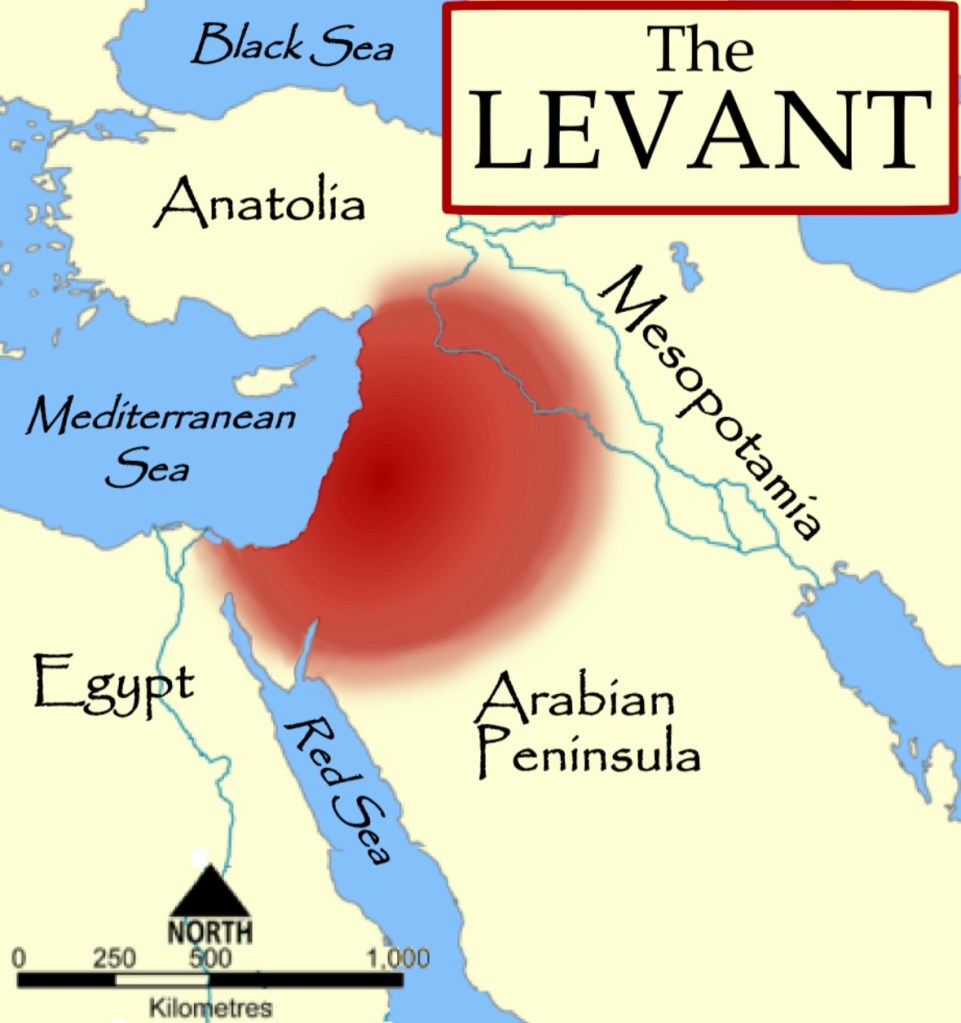
The timing of this post might be awkward given the escalation of threats by Iran and its client militia groups toward Israel. But I’m posting it anyway because this blog is a way for me to get things off my chest. Read on…

In the West there is fairly broad agreement that the Palestinian people should have a sovereign state of their own. There is much less agreement over the geographic boundaries of such a state and the sequence of events that must take place in order for it to be established. Among Palestinians there is some support for a two-state solution, but it is far from a majority.

The UN Partition Plan

The following map might be helpful in what follows. It shows the proposed boundaries of an Israeli state and an Arab state under the Partition Plan adopted by UN Resolution in 1947. The Resolution called for replacing a League of Nations mandate for British administration of the region requiring the establishment of a Jewish homeland. Likewise, the Arab state was intended to accommodate Palestinian nationalists. Together the two states were expected to comprise an economic union.
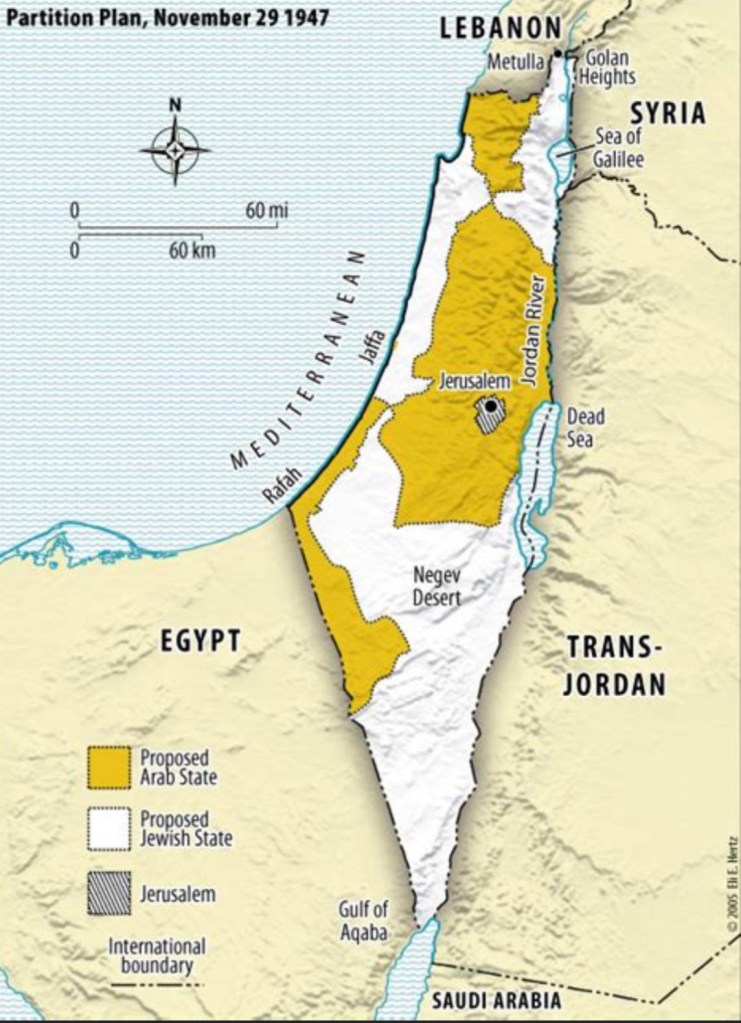
What is striking is the discontinuity of the lands assigned to each state, and this surely contributed to almost immediate border challenges. More on that below.

The Gaza Strip is the region along the shore of the Mediterranean on the lower left, which was designated as Palestinian. The Golan Heights is the Israeli region on the upper right. The West Bank is the Palestinian region in the middle. Jerusalem and its vicinity was designated as an international zone to be administered by the UN.

Border Battles

Today, the geography of a prospective Palestinian state would certainly include the Gaza Strip. There doesn’t seem to be any great dispute there, but the West Bank is another story. In this context, it’s important to remember some key details about the history of this region since 1947. David Post writes at the Volokh Conspiracy that the Palestinian state was obliterated by other Arab states in 1948:

“The State of Palestine was strangled in its infancy, not by the Israelis, who accepted the U.N. partition plan, but by the neighboring Arab States—Egypt, Syria, and Jordan—who did not. The day after the British pulled their forces out, the Arab armies marched in, and the first Arab-Israeli War began.“

The hostilities were formally ended with the signing of three different Armistices in 1949:

“The boundaries fixed in those agreements gave to each of the four countries involved more-or-less the territory that their armies had managed to control as of the date that ceasefires had been declared. The West Bank became part of Jordan; Gaza became part of Egypt; the Golan Heights became part of Syria. Israel got—or kept—the rest. The Palestinians, who had no army of their own, got nothing.“

Here are the boundaries under the 1949 Armistices:
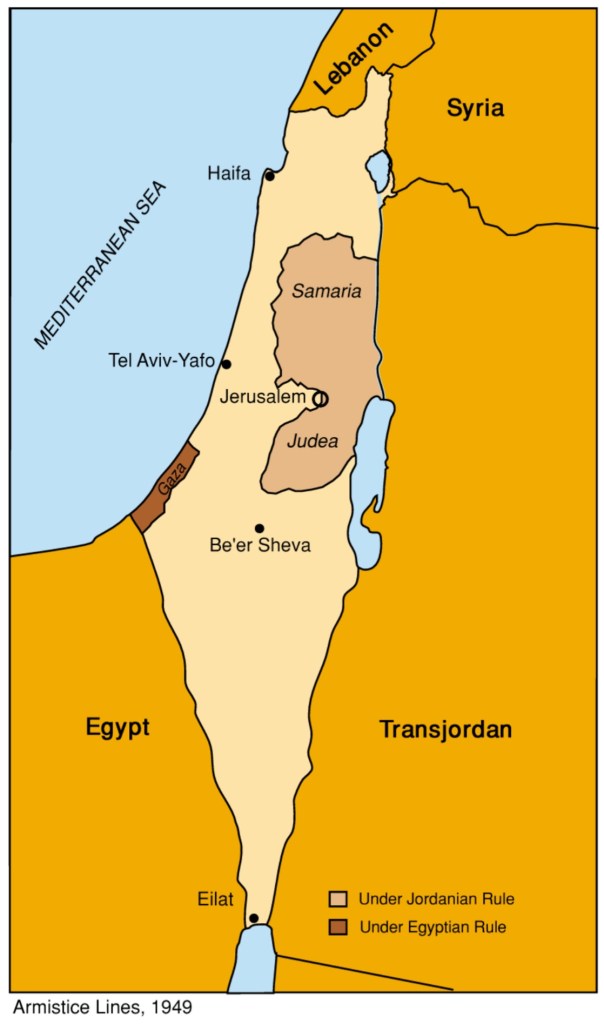
The three Arab states, which refused to recognize Israel’s right to exist, attacked again in 1967. In a matter of six days and on three fronts, the Israelis drove them back and took Gaza, the West Bank, and retook the Golan Heights. Post asks:

“Why is it that only starting then, now that Israel was in control of these areas, did the world rouse itself to Palestinian grievances, and demand that ‘Palestinian lands’ be given back to the Palestinians?“

It’s worth noting that these conflicts led to the displacement of a great many Palestinians, but Israel did not provoke the attacks.

Indigenous Populations

Enemies of Israel, including those in the West, go so far as to say the Israelis are not entitled to a homeland in the Levant. Even worse, they chant “from the river to the sea”, often ignorant that it is a thinly veiled call for genocide. But Jews have as great a claim to a homeland in the Levant as the Palestinians. Jacob Sullum wrote of this truth last October, in the wake of the Hamas butchery on October 7, 2023. Israeli Jews are characterized by enemies as “colonizers”. This, as Sullum says:

“… is a ‘simplistic morality tale’, that pits white European oppressors against ‘indigenous’ people, eliding Israel’s demographic roots and the ancient Jewish connection to the land. “

Sullum goes on to discuss research on the genetic origins of modern Jewish populations. For example, one paper found that the ancestors of Ashkenazi Jews, who account for almost a third of Jews in Israel, likely descended from a “diverse population in the Middle East.” And Sullum points out that Mizrahim Jews of Middle Eastern and North African origin represent almost 45% of Israeli Jews. Furthermore, another study found that Jews and Arabs in the Middle East both share high percentages of Y chromosomes with a single gene pool, which suggests a common origin. Therefore, both Palestinians and Israeli Jews have legitimate claims to a homeland in the Levant.

Israel and Gaza

Contrary to claims by Hamas supporters, there was no occupation of Gaza by Israel at the time of the October 7th massacre. Israel’s prior occupation of Gaza ended almost 20 years ago, in 2005. However, Israel has restricted the movement of goods in and out of the Gaza Strip since the 1990s. Israel and Egypt tightened the blockade on Gaza in 2007 after Hamas took control there, though it was eased in steps from 2010 – 2013. Given the uncompromising belligerence of Hamas and its proclivity for diverting resources to support aggression against Israel, it’s fair to say the blockade is, and has been, a legitimate instrument of defense, as long as Gaza is “governed” by Hamas.

Last year, less than a week after the October 7th massacre and hostage taking, the Israeli Defense Forces (IDF) began ground operations in Gaza in an effort to root out Hamas fighters, destroy their war-making infrastructure, and rescue hostages held by Hamas in Gaza. Of course, that fight goes on.

Hamas has fought against Israel’s retaliatory action in ways that have propaganda value, especially given the naïveté of much of the Western press. Its fighters are often embedded among civilians within residential areas and facilities like schools and hospitals. The use of human shields is a war crime for which Hamas bears full responsibility, and Hamas has made it clear that their aim is to kill Israelis, civilian and military alike. Hamas has made a practice of exaggerating Palestinian death counts, a distortion that has been more obvious to statisticians than journalists.

The Israeli blockade of the Gaza Strip will be tough to end without a complete surrender by Hamas and release of the hastages. Even then, the current IDF occupation is unlikely to end until efforts are well underway to flesh out the details of a new Palestinian government, if not statehood.

The West Bank

Perhaps even more thorny for an eventual two-state solution is that Israel occupies the West Bank and has established settlements that Palestinians strongly oppose. Jordan might also have designs on retaking West Bank territory, which would once again leave Palestinians as the odd people out. Israel took the land in its own defense during the Six-Day War in 1967 and kept it as a security buffer:

“… Israel insisted that it should not, and would not, simply return to the pre-war situation — the dangerous combination of precarious armistice lines and aggressive neighbors that had prevailed for 19 years. …

The idea that Israeli security depended on continued control over parts of the West Bank was held not only by Israeli officials, but also by the American Joint Chiefs of Staff. … Referring to the West Bank, they argued that Israel required a new boundary that would ‘widen the narrow portion of Israel’ and help protect Tel Aviv.“

Israel splits aspects of governance with the Palestinian Authority in parts of the West Bank, but most of the security apparatus is run by Israel.

The continued West Bank occupation is as fraught with controversy as ever. Today there is bitter resentment over new Israeli settlements and the construction of the “Separation Wall” just inside the western border of the West Bank. The situation is made all the more intractable by Hamas’ presence there amid ongoing attacks against Israeli interests.

Withdrawing from the West Bank would create a huge vulnerability for Israel, so one can hardly expect it to cede control of the entire territory. Yet it is hard to imagine an economically viable Palestinian state confined to the Gaza Strip. In fact, some feel that more than the West Bank should be in play for creating a contiguous corridor to Gaza, which would help promote a new Palestinian state’s economic viability.

Iran

Obviously Hamas is not the only threat to Israel’s security. To the north in Lebanon, Hezbollah is a well-armed adversary. And like Hamas, it receives considerable support from Iran. It’s difficult to imagine that Iran could maintain this support, not to mention its nuclear ambitions, without the flow of oil revenue made possible by U.S. acquiescence. Reaching a peaceful resolution to the conflicts between Israel and its neighbors will be very difficult without somehow neutralizing the Iranian threat. Regime change there would be key to this effort.

What Must Happen

The obstacles to establishing a peaceful, two-state solution for Palestinians and Israelis are so steep that the prospect seems almost unimaginable. A complete defeat of both Hamas and Hezbollah would be critical, and the Palestinian Authority or any other successor regime must be counted on to negotiate in good faith and with the legitimate support of the Palestinian people. Likewise, Israel must be willing to negotiate meaningful concessions, at least in terms of its occupied territories in the West Bank.

For a successful resolution, the role of other Arab states can’t be emphasized enough. These states should apply pressure to Israel’s neighbors like Syria and Jordan to rein-in their own territorial ambitions. In a positive sign, there is now growing pressure on Iran from other Arab states to end its belligerence.

A reconstituted Abraham Accords framework could strengthen diplomatic and economic ties across the region, promoting cross-investment, trade, and cultural exchange. The framework should include a mechanism to encourage aid from the Arab states and Israel to help Palestinians build a new, peaceful, and prosperous state.

Finally, a peaceful two-state solution hinges on continued U.S. support for Israel and a new Palestinian homeland. Unfortunately, in recent years we’ve witnessed a drift toward anti-Zionism (and even anti-Semitism) among Democrats. This sort of foolishness on the far Left knows no bounds. If the anti-Zionist position comes to be accepted by the mainstream of the party, it could severely compromise Israel’s leverage in negotiations.

Summary

A resolution that would ultimately bring peace to the Middle East seems remote in the midst of the current hostilities. It would require a dramatic softening of views among nearly all parties to solve the impasse over nation-state homelands for both Jews and Palestinians. In no particular order, the following are all necessary:

  • Israel’s neighboring states must not covet territory originally intended for the Palestinians, or for that matter the state of Israel.
  • Iran must butt out one way or another (in the language of high diplomacy), which would do much to neutralize militant factions like Hamas, Hezbollah, and the Houthis.
  • Other Arab states must come to the table along with the Israelis to negotiate economic and political accords, including aid to the Palestinian people.
  • The U.S. must resist internal calls from the Left to withdraw support for Israel.
  • More immediately, Israel must do its best to root out and defeat Hamas, Hezbollah, and the Houthis.
  • The Palestinian people must decide they want peace and a prosperous civilization.
  • Israel must show a willingness to negotiate concessions to Palestinians in the West Bank, and to aid in the rebuilding of Gaza.

Taken together that’s a very tall order! The U.S. can and should do its part to support Israel and the Palestinian people, penalize Iran, and help to bring all parties to the negotiating table. A refashioning of the Abraham Accords could contribute to peace in the region, including a stable, prosperous, and well-governed Palestinian homeland.

3 Cheers, No Tears for Strike on Master of Iranian Terror

08 Wednesday Jan 2020

Posted by Nuetzel in Middle East, War

≈ Leave a comment

Tags

AL Monitor, Al-Quds, Anderson Cooper, Avi Melamed, Bloomberg, Charles De Gaulle, Decapitation, Deterrence, Donald Trump, Iran, Iranian Mullah Regime, Iraq, Kataeb Hezbollah, Politico, Qassim Soleimani, Regime Change, Retaliation, Reuters, Saudi Arabia, Self-Defense, Syria, Terrorism, Tyler Cowen, Victor Davis Hanson, World War III

Note: As I finish this post, Iran has fired missiles at U.S. bases in Iraq, so we know a bit more about their response to the killing of Qassim Soleimani. Tonight’s response by Iran looks to have been impotent. There are risks of other kinds of action, of course. We shall see.

Last week’s killing of Iranian General Qassim Soleimani was not prompted solely by the attack on the U.S. embassy in Iraq by Kataeb Hezbollah, the Iranian-backed militia. Iran, perhaps the largest state-sponsor of terrorism in the world, has been guilty of provocation and aggression in Iraq, Syria, Saudi Arabia and elsewhere under Soleimani’s direction for many years. And he was reviled for his ruthless treatment of protestors within Iran’s borders. In recent weeks there had been a series of rocket attacks on U.S. bases, and there was “chatter” that much more was planned. It’s been noted that the presence of so-many high-level officials in one place at the time of the attack on Soleimani indicated that something big was in the works. This Reuters article gives some insight into Soleimani’s suspicious activities in the weeks prior to his death, of which the U.S. was surely aware. While the attack on the U.S. embassy provided additional pretext (as if it was needed), all of this indicates that Soleimani’s assassination was not an impulsive decision, but deliberated, contrary to assertions by critics of President Trump’s decision to act. It was both retaliatory and preemptive. Soleimani’s travels and whereabouts were well known, and it’s highly likely that a “decapitation” had been planned as a contingency for some time. This report in Politico provides details of the decision making leading up to the strike. The attack was executed brilliantly by all accounts.

The U.S. had retaliated to earlier rocket attacks with strikes against Kataeb Hezbollah positions. That the strike on Soleimani was more than retaliation and an act of self-defense against additional threats is, I believe, the flaw in arguments against the strike like the one Tyler Cowen seemed to make in Bloomerg (though his main point was different). The value of the strike goes far beyond retaliation. This was not intended to be another volley in an ongoing series of “tits-for-tats”.

In addition to Soleimani, several other high-level Iranian military personnel were killed. This undoubtedly disrupted plans that would have threatened U.S. soldiers and assets, yet some describe the strike as an “impulsive” act on Trump’s part, and an “act of war”, as if unprovoked. And as if Iran had not been warring on the U.S. for the past 40 years. What to make of those who take this position?  Of course, most are reflexively anti-Trump, refusing to evaluate the decision on it’s own merits. They pretend that Soleimani and the Iranian overseers of the stooge government in Iraq have legitimacy. Anderson Cooper actually compared Soleimani to Charles De Gaulle. It would be more accurate to compare him to the murderous Che Guevara, but then again, many on the Left worship Che’s memory as well! These fools will tell you that Soleimani was “worshipped” in Iran. In fact, there are a great many Iranians who are quietly celebrating his death.

Middle East analyst Avi Melamed does not mince words in describing the impact Soleimani has had on the Middle East (emphasis his):

“Some argue that the assassination of Soleimani will increase tensions in the Middle East. This outlook confuses cause and effect: Tensions in the Middle East have intensified over the past decade because of the violent Iranian aggression which Soleimani spearheaded. Aggression which has led to Syria’s destruction and the disintegration of Lebanon and Iraq. Aggression that threatens maritime routes and safe passage in the Arab (Persian) Gulf and the Red Sea, a direct attack on Saudi Arabia’s oil facilities that spiked oil prices and compromised the world’s oil supply. Aggression that has fueled and intensified tensions – including direct military confrontations – between Iran and its proxies and Israel.

General Soleimani and the Al-Quds force led the escalation in the region in the service of the hegemonic vision of the Iranian Mullah regime. Their actions have so far claimed the lives of hundreds of thousands of people, led to the destruction of states, the disintegration of cities, and caused a wave of millions of refugees. Killing Soleimani is not the cause of the escalation – but the result.”

Malamed expected Iran to take retaliatory actions in Iraq, where it already has a strong military presence and good reconnaissance. Missiles have now been fired at U.S. bases from Iran (as of tonight), but with few or no casualties. It remains to be seen how effective a response the Iranians can mount. Any short-term U.S. casualties should probably not be viewed as incremental, given the high likelihood of casualties had Soleimani lived. Perhaps Iran will fire missiles at Israel from western Iraq or Syria, or at Saudi Arabian oil assets, as it did last September. Or it might make a bold military intervention in Iraq to strengthen its control there, which Iran considers crucial to its own security.

Al Monitor believes the assassination “leaves Iran with very few options to retaliate” with any strength, at least in the short-run:

“… the economic hardship in Iran — in addition to the challenges the government is facing internally — would not allow Tehran to increase the tension. Iran’s past conduct against Israel strikes on Iranian bases in Syria also shows it will not seek revenge if its national security and interests are in danger. … This all indicates that Iran and its proxies in the region most likely would not seek revenge in the near future and — in regard to Iraq, in particular — would not lead Iraq to fall into a civil war or mass destruction, because it would lose even more in Iraq if it takes such a risk.”

So despite the brash talk, Iran is weak and spread thin across commitments outside its borders, and the regime has real fear of retaliation by its enemies that can only have been reinforced by the strike against Soleimani. Of what other retaliatory actions is Iran capable, assuming the regime can survive in the longer run? And assuming the Mullah regime itself is willing to take existential risks? It has threatened actions against civilians in the West. Can it bring down planes? Can it bomb targets in the U.S.? Can it develop or buy a small nuclear device? It can try any of those things, of course, but with uncertain odds and with risks it might not want to take. Survival is of the utmost importance to the regime, and it is already on shaky ground.

Trump’s critics claim that he authorized the “decapitation” without a plan for its aftermath. Trump has made clear his intent to “punch back twice as hard”, as it were, in response to any additional force from Iran. This is, first and foremost, a game of deterrence. Beyond that, however, and despite talk of “changing the Iranian regime’s behavior”, it appears that the larger plan pursued by Trump is to continue undermining the regime with sanctions and targeted strikes, if necessary. “Maximum pressure”. But there will be no World War III. The markets seem pretty comfortable about that as well, including the oil market.

I do take issue with Trump’s mention of the possibility of striking “cultural sites” in Iran, though he seems to have retracted it. On that point, however, I fully agree with Tyler Cowan (linked above). The only plausible rationale for such a statement is to frighten Iran’s leadership, especially if it has located military and intelligence functions within cultural sites.

Trump still maintains that our ultimate goal should be withdrawal from Iraq. That assumes stabilization in the region and fair elections, which would be well-served by a weaker Iran or a regime change there. As Victor Davis Hanson explains, the Middle East is of declining importance in world energy markets and trade generally. That’s one reason we’re unlikely to ever again send a huge ground force to the region, and it’s a good reason to scale back our presence in the Middle East generally.

Follow Sacred Cow Chips on WordPress.com

Recent Posts

  • Immigration and Merit As Fiscal Propositions
  • Tariff “Dividend” From An Indigent State
  • Almost Looks Like the Fed Has a 3% Inflation Target
  • Government Malpractice Breeds Health Care Havoc
  • A Tax On Imports Takes a Toll on Exports

Archives

  • December 2025
  • November 2025
  • October 2025
  • September 2025
  • August 2025
  • July 2025
  • June 2025
  • May 2025
  • April 2025
  • March 2025
  • February 2025
  • January 2025
  • December 2024
  • November 2024
  • October 2024
  • September 2024
  • August 2024
  • July 2024
  • June 2024
  • May 2024
  • April 2024
  • March 2024
  • February 2024
  • January 2024
  • December 2023
  • November 2023
  • August 2023
  • July 2023
  • June 2023
  • May 2023
  • April 2023
  • March 2023
  • February 2023
  • January 2023
  • December 2022
  • November 2022
  • October 2022
  • September 2022
  • August 2022
  • July 2022
  • June 2022
  • May 2022
  • April 2022
  • March 2022
  • February 2022
  • January 2022
  • December 2021
  • November 2021
  • October 2021
  • September 2021
  • August 2021
  • July 2021
  • June 2021
  • May 2021
  • April 2021
  • March 2021
  • February 2021
  • January 2021
  • December 2020
  • November 2020
  • October 2020
  • September 2020
  • August 2020
  • July 2020
  • June 2020
  • May 2020
  • April 2020
  • March 2020
  • February 2020
  • January 2020
  • December 2019
  • November 2019
  • October 2019
  • September 2019
  • August 2019
  • July 2019
  • June 2019
  • May 2019
  • April 2019
  • March 2019
  • February 2019
  • January 2019
  • December 2018
  • November 2018
  • October 2018
  • September 2018
  • August 2018
  • July 2018
  • June 2018
  • May 2018
  • April 2018
  • March 2018
  • February 2018
  • January 2018
  • December 2017
  • November 2017
  • October 2017
  • September 2017
  • August 2017
  • July 2017
  • June 2017
  • May 2017
  • April 2017
  • March 2017
  • February 2017
  • January 2017
  • December 2016
  • November 2016
  • October 2016
  • September 2016
  • August 2016
  • July 2016
  • June 2016
  • May 2016
  • April 2016
  • March 2016
  • February 2016
  • January 2016
  • December 2015
  • November 2015
  • October 2015
  • September 2015
  • August 2015
  • July 2015
  • June 2015
  • May 2015
  • April 2015
  • March 2015
  • February 2015
  • January 2015
  • December 2014
  • November 2014
  • October 2014
  • September 2014
  • August 2014
  • July 2014
  • June 2014
  • May 2014
  • April 2014
  • March 2014

Blogs I Follow

  • Passive Income Kickstart
  • OnlyFinance.net
  • TLC Cholesterol
  • Nintil
  • kendunning.net
  • DCWhispers.com
  • Hoong-Wai in the UK
  • Marginal REVOLUTION
  • Stlouis
  • Watts Up With That?
  • Aussie Nationalist Blog
  • American Elephants
  • The View from Alexandria
  • The Gymnasium
  • A Force for Good
  • Notes On Liberty
  • troymo
  • SUNDAY BLOG Stephanie Sievers
  • Miss Lou Acquiring Lore
  • Your Well Wisher Program
  • Objectivism In Depth
  • RobotEnomics
  • Orderstatistic
  • Paradigm Library
  • Scattered Showers and Quicksand

Blog at WordPress.com.

Passive Income Kickstart

OnlyFinance.net

TLC Cholesterol

Nintil

To estimate, compare, distinguish, discuss, and trace to its principal sources everything

kendunning.net

The Future is Ours to Create

DCWhispers.com

Hoong-Wai in the UK

A Commonwealth immigrant's perspective on the UK's public arena.

Marginal REVOLUTION

Small Steps Toward A Much Better World

Stlouis

Watts Up With That?

The world's most viewed site on global warming and climate change

Aussie Nationalist Blog

Commentary from a Paleoconservative and Nationalist perspective

American Elephants

Defending Life, Liberty and the Pursuit of Happiness

The View from Alexandria

In advanced civilizations the period loosely called Alexandrian is usually associated with flexible morals, perfunctory religion, populist standards and cosmopolitan tastes, feminism, exotic cults, and the rapid turnover of high and low fads---in short, a falling away (which is all that decadence means) from the strictness of traditional rules, embodied in character and inforced from within. -- Jacques Barzun

The Gymnasium

A place for reason, politics, economics, and faith steeped in the classical liberal tradition

A Force for Good

How economics, morality, and markets combine

Notes On Liberty

Spontaneous thoughts on a humble creed

troymo

SUNDAY BLOG Stephanie Sievers

Escaping the everyday life with photographs from my travels

Miss Lou Acquiring Lore

Gallery of Life...

Your Well Wisher Program

Attempt to solve commonly known problems…

Objectivism In Depth

Exploring Ayn Rand's revolutionary philosophy.

RobotEnomics

(A)n (I)ntelligent Future

Orderstatistic

Economics, chess and anything else on my mind.

Paradigm Library

OODA Looping

Scattered Showers and Quicksand

Musings on science, investing, finance, economics, politics, and probably fly fishing.

  • Subscribe Subscribed
    • Sacred Cow Chips
    • Join 128 other subscribers
    • Already have a WordPress.com account? Log in now.
    • Sacred Cow Chips
    • Subscribe Subscribed
    • Sign up
    • Log in
    • Report this content
    • View site in Reader
    • Manage subscriptions
    • Collapse this bar
 

Loading Comments...