• About

Sacred Cow Chips

Sacred Cow Chips

Tag Archives: Jeff Bezos

More Attacks On Private Charity

25 Saturday Jan 2020

Posted by Nuetzel in Charity

≈ Leave a comment

Tags

Bill Gates, Charitable Deduction, David Rubenstein, Jeff Bezos, Karl Zinsmeister, Philanthropy Magazine, Private charity

The social corrosion brought on by the growth of government, and from advocates of greater government dominance, has many symptoms, but hostility to private giving and charitable work is one of its ugliest manifestations. There is a notion among leftists that almost any charitable gift could better serve its intended purpose were it simply turned over to a government agency tasked with an “appropriate” role. The attitude is partly explained by a fallacy of central planning, that charitable efforts scale so readily that the state should always be in charge, and indeed, a fallacy that the state has better information, is more effective at guiding outcomes, and could accomplish more were it not for obstacles created by pesky private efforts.

Even worse, private gifts and charitable efforts are often characterized as buy-offs to excuse evils perpetrated elsewhere by givers. That’s one of the themes I covered in “You’re Welcome: Charitable Gifts Prompt Statist Ire“. Karl Zinsmeister of Philanthropy magazine bemoans the extent to which private good works are condemned in “No Giver Is Safe: How the Left Is Poisoning Philanthropy“:

“Names are being pried off of college buildings, museums are getting picketed, companies are facing boycotts. No giver is safe. Long-time tax protections for charitable giving, churches, and charities are being attacked and proposed for repeal. Activists demand that government be given the right to appoint board members at nonprofits. Privacy protections for donors and charities are being eroded.

The deep odium for personal wealth and private problem-solving nursed by fashionable chatterers today often surges into view when businesspeople take up philanthropy. Jeff Bezos donates a million Australian dollars to fire recovery and the plute-smashers swing their axes. David Rubenstein offers to renovate the Jefferson Memorial and other historical landmarks and gets attacked for being a private-equity villain. For crusading against malaria, Bill Gates is portrayed as a vainglorious megalomaniac.”

The income tax deduction for charitable giving is presumed by critics to benefit mainly the wealthy. But without the deduction, our system of income taxation would make it more difficult for all Americans to carve charitable donations from their household budgets. And as Zinsmeister notes, most charitable giving does not come from the wealthy. In fact, he says 36% is given by those earning less than $100,000 annually.

Antipathy for the wealthy is nothing new, and the haters never give a thought to how wealth is created: by producing things of value that otherwise would be unavailable, and that we purchase willingly. That goes for “big wealth” and “little wealth” alike. The attack on philanthropy is merely another front in the effort to delegitimize private wealth and ultimately its confiscation. That is both evil and short-sighted. Private charity is more efficient and cost effective than government aid (and see here and here), and it is an act of true virtue no matter how small, something that can’t be said for those who pretend that confiscating the wealth of others is an of caring.

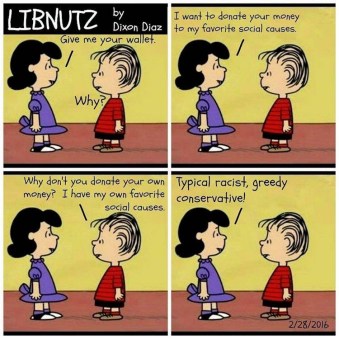
A shout out to Dixon Diaz and thefederalistpapers.org for the great cartoon!


Amazon, Happy Users Face Lust for Antitrust

02 Thursday May 2019

Posted by Nuetzel in Antitrust, Capitalism, Regulation

≈ Leave a comment

Tags

Amazon, Amazon Marketplace, Apple, e-Commerce, eBay, Elizabeth Warren, Home Depot, Jeff Bezos, Lina M. Kahn, Market Concentration, monopoly, Monopsony, Predatory Pricing, QVC, Was Mart, Wayfair

It’s almost always best to resist the temptation to “fix” perceived market failures, perceptions that are often incorrect to begin with. An equivalent truism is that government intervention in any market will almost always damage outcomes for consumers and producers alike. So it is with ill-advised calls to bring antitrust action against Amazon. Elizabeth Warren is a prominent voice among the would-be meddlers. She tells the story of a hypothetical pillow manufacturer reliant on sales through Amazon’s platform. But alas, the small company is squeezed out of its market because Amazon gives its own brand of pillows superior placement and pricing. Is this a clear case of anti-competitive behavior? And if so, what’s to be done?

In this Yale Law Journal article Lina M. Kahn asserts that there is an antitrust case against Amazon. From the abstract:

“We cannot cognize the potential harms to competition posed by Amazon’s dominance if we measure competition primarily through price and output. Specifically, current doctrine underappreciates the risk of predatory pricing and how integration across distinct business lines may prove anticompetitive. These concerns are heightened in the context of online platforms for two reasons. First, the economics of platform markets create incentives for a company to pursue growth over profits, a strategy that investors have rewarded. Under these conditions, predatory pricing becomes highly rational—even as existing doctrine treats it as irrational and therefore implausible. Second, because online platforms serve as critical intermediaries, integrating across business lines positions these platforms to control the essential infrastructure on which their rivals depend. This dual role also enables a platform to exploit information collected on companies using its services to undermine them as competitors.”

A basic argument against anti-trust action is that the retail market and e-commerce market are not as concentrated as Kahn and Warren suggest. Amazon’s share of U.S. retail sales was an estimated 5% in 2018, but its share of e-commerce is the more worrisome to modern-day trust busters: Amazon is estimated to have controlled about 49% of U.S. online sales in 2018.

Obviously 49% is not close to monopolization, but the company is far ahead of other on-line rivals: eBay’s share was slightly less than 7%; Apple and Walmart each had less than 4%, and an assortment of sellers such as Home Depot, QVC and Wayfair, had shares of 1.5% share or less. The point is, however, that there are prominent rivals, some with aggressive plans to compete in the space. For example, apart from its traditional auction model, eBay is instituting a number of changes to its platform and offerings that it hopes will help it to compete with Amazon, some of which are very much like the practices for which Amazon is now criticized, such as preferential placement for big advertisers. Wal Mart is investing heavily in an effort to expand its online sales.

Companies like these rivals have the resources and access to capital to pose a legitimate threat to Amazon’s online dominance. That sort of competitive pressure, or even its mere possibility, imposes a far more effective form of market discipline than government regulators can hope to achieve, assuming they wouldn’t break the market. The governance imposed by the market itself keeps the focus squarely on bringing value to customers, which for Amazon means both buyers and third-party sellers. And while Amazon’s business model and platform are highly successful, no one, including Amazon management, can anticipate the shape of new technological developments that could lead to the next revolution in retail. Again, there are potent incentives for those who might be in a position to foment such a revolution.

But what about those sellers who rely so heavily on Amazon’s platform? Does Amazon exercise monopsony power to the detriment of these sellers, as Kahn and Warren contend? Again, sellers have alternatives. While it might be a burden for the smallest startups to compete on several different platforms, they do have choices. Therefore, the monopsony story just doesn’t hold up. Amazon has a large marketplace precisely because so many third-party sellers have chosen to compete there. But they can compete elsewhere.

If barriers to entry are created by Amazon’s platform management, it would involve a loss of revenue earned from hosting third-party sellers and create market opportunities for competitive platforms. The same can be said of “predatory placement” of Amazon’s own first-party product offerings. This practice bears a similarity to grocery stores giving preferred placement to certain brands in exchange for fees, which allow grocers to offer those products at lower prices. Indeed, few if any grocery stores carry all national brands, but those brands are usually available at competing stores. If anything, it would seem that getting a product listed on an online platform is relatively easy compared to getting space on grocery shelves, though like grocery brands, preferred placement is another matter. Building a brand has never been easy, and it may be necessary for less established products to be marketed on multiple platforms, including platforms based on auction models.

It would be very difficult to prove that Amazon engages in predatory pricing of their own offerings (also see here). That involves pricing below cost (including the loss of revenue from third-party sellers). Amazon might practice what has been described as loss leadership: offering products below cost from time-to-time in oder to spur sales of other products, which is a time-honored marketing tradition. The following quote, taken from the first link in this paragraph, is from a judge in a recent price fixing case involving Apple and Amazon:

“… the Complaint asserts that Amazon’s e-books business was ‘consistently profitable.’ Moreover, to hold a competitor liable for predatory pricing under the Sherman Act, one must prove more than simply pricing ‘below an appropriate measure of . . . costs.’ There must also be a ‘dangerous probability’ that the alleged predator will ‘recoup its investment in below-cost prices’ in the future. None of the comments demonstrate that either condition for predatory pricing by Amazon existed or will likely exist. Indeed, while the comments complain that Amazon’s $9.99 price for newly-released and bestselling e-books was ‘predatory,’ none of them attempts to show that Amazon’s e-book prices as a whole were below its marginal costs.” 

The basic considerations discussed above are couched in terms of traditional anti-trust thinking: monopoly, concentration, competitive threats, and predatory pricing. However, there is another, more fundamental point to be made: Amazon’s massive success is due precisely to the popularity of their platform as well as service to consumers and third-party sellers. That’s capitalism, baby! Does Amazon extract a price from users? Yes, it engages in mutually beneficial trade! If it tries to extract too much, it will suffer at its own hands by creating market opportunities for others. It is Amazon’s platform, asset, and private property. The Amazon Marketplace belongs to Amazon, and the company is free to manage it as shareholders allow. There is no social value in interfering with private property and voluntary arrangements that bring unambiguous benefits to customers on both sides of the transactions sponsored on the platform. Such interference would diminish those benefits and destroy private value belonging to Amazon shareholders.

Jeff Bezos’ recent letter to Amazon shareholders tells of third-party sellers “kicking our first-part butt.” Amazon’s total sales have grown fast over the past two decades, and while its sales in first-party transactions have grown at a robust 20% a year, third-party sales on the platform have grown at a rate of 52%! The last link provides this Bezos quote:

“Why did independent sellers do so much better selling on Amazon than they did on eBay? And why were independent sellers able to grow so much faster than Amazon’s own highly organized first-party sales organization? There isn’t one answer, but we do know one extremely important part of the answer: We helped independent sellers compete against our first-party business by investing in and offering them the very best selling tools we could imagine and build.”

Bezos also tells of the heavy investments Amazon makes in efforts to improve its platform, which have brought tremendous successes and a few noteworthy failures. His letter is obviously self-serving, both as an effort to engage shareholders and as an implicit appeal against anti-trust action. Nevertheless, it is hard to deny the company’s outstanding performance, the benefits it brings to the consuming public, and the opportunities it creates for enterprising sellers and entrepreneurs. The unfortunate fact is we must always be vigilant for the itchy fingers of leftists grasping for the value created by private effort.

You’re Welcome: Charitable Gifts Prompt Statist Ire

14 Friday Dec 2018

Posted by Nuetzel in Central Planning, Charity, Uncategorized

≈ 1 Comment

Tags

Amazon, American Institute for Economic Research, central planning, Charity, Cloe Anagnos, Day 1 Fund, Doug Bandow, Forced Charity, Gaby Del Valle, Homelessness, Jeff Bezos, Redistribution, Russ Roberts, Scientism, Seattle Employment Tax, War on Charity

Charitable acts are sometimes motivated by a desire to cultivate a favorable reputation, or even to project intelligence. Perhaps certain charitable acts are motivated by guilt of one kind or another. Tax deduction are nice, too. But sometimes a charitable gift is prompted by no more than a desire to help others less fortunate. It’s likely a combination of motives in many cases, but to gainsay the purity of anyone’s charitable motives is rather unseemly. Yet Gaby Del Valle does just that in Vox, casting a skeptical eye at Jeff Bezos’ efforts to help the homeless through his Day 1 Fund.

“Last week, Amazon founder and CEO Jeff Bezos announced that he and his wife, MacKenzie Bezos, were donating $97.5 million to 24 organizations that provide homeless services across the country. The donation is part of Bezos’s $2 billion ‘Day 1 Fund, a philanthropic endeavor … that, according to Bezos, focuses on establishing ‘a network of new, non-profit, tier-one preschools in low-income communities’ and funding existing nonprofits that provide homeless services.”

Del Valle says Bezos deserves little credit for his big gift for several reasons. First, Amazon very publicly opposed a recent initiative for a $275 per employee tax on large employers in Seattle. The proceeds would have been used to fund public programs for the homeless. This allegation suggests that Bezos feels guilty, or that the gift is a cynical attempt to buy-off critics. That might have an element of truth, but the tax was well worthy of opposition on economic grounds — almost as if it was designed to stunt employment and economic growth in the city.

Second, because Amazon has been an engine of growth for Seattle, Del Valle intimates that the company and other large employers are responsible for the city’s high cost of housing and therefore homelessness. Of course, growth in a region’s economy is likely to lead to higher housing prices if the supply of housing does not keep pace, but forsaking economic growth is not a solution. Furthermore, every large city in the country suffers from some degree of homelessness. And not all of those homeless individuals have been “displaced”, as Del Valle would have it. Some have relocated voluntarily without any guarantee or even desire for employment. As for the housing stock, government environmental regulations, zoning policies and rent control (in some markets) restrains expansion, leading to higher costs.

Finally, Del Valle implies that private efforts to help the homeless are somehow inferior to “leadership by elected officials”. Further, she seems to regard these charitable acts as threatening to “public” objectives and government control. At least she doesn’t disguise her authoritarian impulses. Del Valle also quotes a vague allegation that one of the charities beholden to Amazon is less than a paragon of charitable virtue. Well, I have heard similar allegations that government isn’t celebrated for rectitude in fulfilling its duties. Like all statists, Del Valle imagines that government technocrats possess the best vision of how to design aid programs. That attitude is an extension of the scientism and delusions of efficacy typical of central planners. Anyone with the slightest awareness of the government’s poor track record in low-income housing would approach such a question with trepidation. In contrast, private efforts often serve as laboratories in which to test innovative programs that can later be adopted on a broader scale.

While selfishness might motivate private acts of charity in some cases, only voluntary, private charity can ever qualify as real charity. Government benefits for the homeless are funded by taxes, which are compulsory. Such public programs might be justifiable as an extension of social insurance, but it is not charity in any pure sense; neither are it advocates engaged in promoting real charity, despite their conveniently moralistic positioning. And unlike private charity, government redistribution programs can be restrained only through a political process in which substantial payers are a distinct minority of the voting population.

Public aid and private charity have worked alongside each other for many years in the U.S. According to Russ Roberts, private giving to the poor began to be “crowded-out” during the Great Depression by a dramatic increase in public assistance programs. (Also see Doug Bandow’s “War On Charity“.) It’s certainly more difficult to make a case for gifts to the poor when donors are taxed by the government in order to redistribute income.

The statist war on private charity can take other forms. The regulatory apparatus can crowd-out private efforts to extend a helping hand. Chloe Anagnos of the American Institute for Economic Research (AIER) writes of a charity in Kansas City that wanted to provide home-cooked soup to the homeless, but health officials intervened, pouring bleach into the soup. I am aware of similar but less drastic actions in St. Louis, where organizations attempting to hand-out sandwiches to the poor were recently prohibited by health authorities.

Private charity has drawn criticism because its source has driven economic growth, its source has opposed policies that stunt comic growth, and because it might interfere with the remote possibility that government would do it better. But private charity plays a critical role in meeting the needs of the disadvantaged, whether as a substitute for public aid where it falls short, or as a supplement. It can also play a productive role in identifying the most effective designs for aid programs. Of course, there are corrupt organizations and individuals purporting to do charitable work, which argues for a degree of public supervision over private charities. But unfortunately, common sense is too often lost to overzealous enforcement. In general, the public sector should not stand in the way of private charities and charitable acts, but real generosity has little value to those who press for domination by the state.

BS Bernie Blames Bezos

12 Wednesday Sep 2018

Posted by Nuetzel in Labor Markets, Living Wage, Price Mechanism, Welfare State

≈ Leave a comment

Tags

Amazon, Bernie Sanders, Freedom of Contract, Jeff Bezos, Living Wage, Ro Khanna, Social Safety Net, Stop BEZOS Act, Welfare State

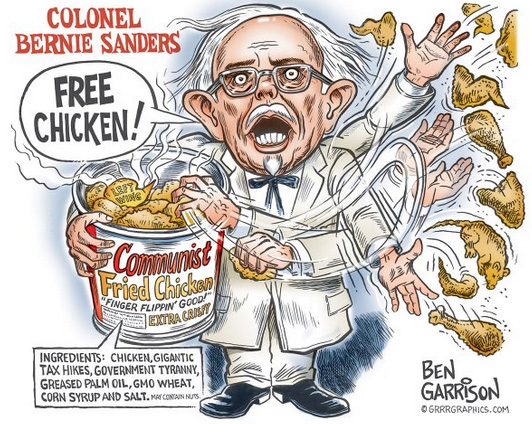
Bernie Sanders keeps probing for ways to create a backdoor minimum income, and he’s eager to loot successful job creators and their customers in the process. Last month I wrote about the folly of his proposed legislation that would offer federal job guarantees to all. A new Sanders bill, introduced jointly with Rep. Ro Khanna (D – CA), is an equally bad idea called the Stop BEZOS Act, or the “Stop Bad Employers by Zeroing Out Subsidies Act”. It’s pretty obvious that the selection of the acronym preceded the naming of the bill. Imagine the fun his Senate staffers had with that! The logical flaws embedded in the title of the act are bad enough. The effort to garner attention by using the title to smear the name of a famous technology entrepreneur is sickening.

Jeff Bezos, of course, is the founder and CEO of Amazon, the online retailer, as well as the owner of the Washington Post. Amazon has been rewarded by consumers for its excellent service and aggressive pricing, and it is now valued at about $1 trillion. That makes Bezos a very wealthy man, and it is no coincidence that Sanders has chosen to make an example of him in an effort to inflame envy and classist passions.

While some details of the bill remain sketchy, firms with more than 500 workers would face a 100% tax on every dollar of federal benefits received by those employees. But the tax would apply only to “low-wage” employees, however that is defined, and not simply any employee receiving federal benefits. If the bill became law (and it won’t any time soon), it would require a costly federal administrative apparatus to coordinate between several agencies, including the IRS. Beyond the tax itself, the compliance costs for firms won’t be cheap, and it will create terrible incentives: if you own a business, you would have a strong incentive to avoid hiring workers with little experience or weak skills, or anyone you might deem likely to be a recipient of federal aid. If you have 499 employees, you’ll probably think hard about how to execute future growth plans. Nothing could do more to improve the return to investment in automation.

Is Amazon really a “bad” employer? That’s what the title of the Sanders bill says. In fact, the company has been accused of harsh labor practices in its fulfillment centers. Life for corporate managers is said to be no picnic, and labor turnover at Amazon is high. Nonetheless, the wages it pays attract plenty of applicants. Unskilled labor does not command a high wage, and that is no fault of an employer willing to provide them with work and experience. Yet the bill would punish those employers, as well as employers having part-time workers drawing federal aid.

An absence of punishment can hardly be described as a “subsidy”, as the bill’s title suggests. But that is exactly how leftists think, at least when they do the punishing. In this respect, the bill’s title is an assault on logic and a misuse of language. It would also represent a violation of constitutional principles like property rights and freedom of contract.

The idea of taxing employers to recoup any public aid received by their workers is intended to affect a de facto “living wage”. However, one benefit of an independent social safety net, as opposed to a living wage tied to that net, is that the former largely preserves the operation of labor markets, despite creating some nasty labor-supply incentives. Wage rates that approximate the value of worker productivity allow efficient matching of jobs with workers having the requisite skills, even if the skills are relatively low-grade. Those wages also minimize distortions in the economics of production within firms and across different industries. Furthermore, prices faced by buyers should reflect the real resource costs associated with demands for various goods. They should not be inflated by political decisions about the level of federal welfare benefits. Quite simply, preserving labor market efficiency enhances the ability of the economy to allocate resources to the uses for which they are most highly-valued.

There are independent questions about whether the structure and level of benefits provided by the welfare state are appropriate. Those are matters of legitimate policy debate, and those benefits must be funded by taxpayers, but they should be funded in the least distortionary way possible. Bernie Sanders imagines that the burden of those taxes can simply be imposed on large employers with no further consequences, but he is badly mistaken. Consumers will shoulder a significant part of that burden under his latest scheme. And, of course, Sanders’ beef with Bezos is a cynical political ploy. It amounts to cheap scapegoating intended to promote another one of Sanders’ bad policy ideas.

Follow Sacred Cow Chips on WordPress.com

Recent Posts

  • Immigration and Merit As Fiscal Propositions
  • Tariff “Dividend” From An Indigent State
  • Almost Looks Like the Fed Has a 3% Inflation Target
  • Government Malpractice Breeds Health Care Havoc
  • A Tax On Imports Takes a Toll on Exports

Archives

  • December 2025
  • November 2025
  • October 2025
  • September 2025
  • August 2025
  • July 2025
  • June 2025
  • May 2025
  • April 2025
  • March 2025
  • February 2025
  • January 2025
  • December 2024
  • November 2024
  • October 2024
  • September 2024
  • August 2024
  • July 2024
  • June 2024
  • May 2024
  • April 2024
  • March 2024
  • February 2024
  • January 2024
  • December 2023
  • November 2023
  • August 2023
  • July 2023
  • June 2023
  • May 2023
  • April 2023
  • March 2023
  • February 2023
  • January 2023
  • December 2022
  • November 2022
  • October 2022
  • September 2022
  • August 2022
  • July 2022
  • June 2022
  • May 2022
  • April 2022
  • March 2022
  • February 2022
  • January 2022
  • December 2021
  • November 2021
  • October 2021
  • September 2021
  • August 2021
  • July 2021
  • June 2021
  • May 2021
  • April 2021
  • March 2021
  • February 2021
  • January 2021
  • December 2020
  • November 2020
  • October 2020
  • September 2020
  • August 2020
  • July 2020
  • June 2020
  • May 2020
  • April 2020
  • March 2020
  • February 2020
  • January 2020
  • December 2019
  • November 2019
  • October 2019
  • September 2019
  • August 2019
  • July 2019
  • June 2019
  • May 2019
  • April 2019
  • March 2019
  • February 2019
  • January 2019
  • December 2018
  • November 2018
  • October 2018
  • September 2018
  • August 2018
  • July 2018
  • June 2018
  • May 2018
  • April 2018
  • March 2018
  • February 2018
  • January 2018
  • December 2017
  • November 2017
  • October 2017
  • September 2017
  • August 2017
  • July 2017
  • June 2017
  • May 2017
  • April 2017
  • March 2017
  • February 2017
  • January 2017
  • December 2016
  • November 2016
  • October 2016
  • September 2016
  • August 2016
  • July 2016
  • June 2016
  • May 2016
  • April 2016
  • March 2016
  • February 2016
  • January 2016
  • December 2015
  • November 2015
  • October 2015
  • September 2015
  • August 2015
  • July 2015
  • June 2015
  • May 2015
  • April 2015
  • March 2015
  • February 2015
  • January 2015
  • December 2014
  • November 2014
  • October 2014
  • September 2014
  • August 2014
  • July 2014
  • June 2014
  • May 2014
  • April 2014
  • March 2014

Blogs I Follow

  • Passive Income Kickstart
  • OnlyFinance.net
  • TLC Cholesterol
  • Nintil
  • kendunning.net
  • DCWhispers.com
  • Hoong-Wai in the UK
  • Marginal REVOLUTION
  • Stlouis
  • Watts Up With That?
  • Aussie Nationalist Blog
  • American Elephants
  • The View from Alexandria
  • The Gymnasium
  • A Force for Good
  • Notes On Liberty
  • troymo
  • SUNDAY BLOG Stephanie Sievers
  • Miss Lou Acquiring Lore
  • Your Well Wisher Program
  • Objectivism In Depth
  • RobotEnomics
  • Orderstatistic
  • Paradigm Library
  • Scattered Showers and Quicksand

Blog at WordPress.com.

Passive Income Kickstart

OnlyFinance.net

TLC Cholesterol

Nintil

To estimate, compare, distinguish, discuss, and trace to its principal sources everything

kendunning.net

The Future is Ours to Create

DCWhispers.com

Hoong-Wai in the UK

A Commonwealth immigrant's perspective on the UK's public arena.

Marginal REVOLUTION

Small Steps Toward A Much Better World

Stlouis

Watts Up With That?

The world's most viewed site on global warming and climate change

Aussie Nationalist Blog

Commentary from a Paleoconservative and Nationalist perspective

American Elephants

Defending Life, Liberty and the Pursuit of Happiness

The View from Alexandria

In advanced civilizations the period loosely called Alexandrian is usually associated with flexible morals, perfunctory religion, populist standards and cosmopolitan tastes, feminism, exotic cults, and the rapid turnover of high and low fads---in short, a falling away (which is all that decadence means) from the strictness of traditional rules, embodied in character and inforced from within. -- Jacques Barzun

The Gymnasium

A place for reason, politics, economics, and faith steeped in the classical liberal tradition

A Force for Good

How economics, morality, and markets combine

Notes On Liberty

Spontaneous thoughts on a humble creed

troymo

SUNDAY BLOG Stephanie Sievers

Escaping the everyday life with photographs from my travels

Miss Lou Acquiring Lore

Gallery of Life...

Your Well Wisher Program

Attempt to solve commonly known problems…

Objectivism In Depth

Exploring Ayn Rand's revolutionary philosophy.

RobotEnomics

(A)n (I)ntelligent Future

Orderstatistic

Economics, chess and anything else on my mind.

Paradigm Library

OODA Looping

Scattered Showers and Quicksand

Musings on science, investing, finance, economics, politics, and probably fly fishing.

  • Subscribe Subscribed
    • Sacred Cow Chips
    • Join 128 other subscribers
    • Already have a WordPress.com account? Log in now.
    • Sacred Cow Chips
    • Subscribe Subscribed
    • Sign up
    • Log in
    • Report this content
    • View site in Reader
    • Manage subscriptions
    • Collapse this bar
 

Loading Comments...